논문 2016-53-4-14
이동표적을 위한 이동 창 함수 기반 추적 알고리즘
( Tracking Algorithm Based on Moving Slide Window for Manuevering Target )
배 진 호*, 이 종 현**, 전 형 구***
( Jinho Baeⓒ, Chong Hyun Lee, and Hyoung-Goo Jeon )
요 약
본 논문에서는 이동 창 함수 추적기라는 새로운 추적 알고리즘을 제안한다. 본 논문에서는 이동표적의 궤적을 효율적으로 추정하기 위해 과거 궤적의 정보를 포함하는 이동 구간이 선형이라는 가정을 한 선형 창 함수를 적용하여 구현한다. 제안된 알고리즘의 창 함수의 파라메터는 측정 잡음의 영향을 줄이기 위해 그리고 알파-베터 추적기와 비교하여 더 적은 계산량 증가 로 빠른 이동 표적 추적을 구현하기 위해 적절하게 선택할 수 있다. 본 논문에서 제안한 창 함수 추적기를 검증하기 위해 잡 음상황에서 선형과 비선형 궤적에 대한 컴퓨터 모의실험을 수행했다. 또한 제안된 창 함수 추적기는 초기값에 대한 둔감한 특 성과 예측할 수 없는 시변 측정 환경에서 창 함수 추적기를 사용할 경우 더 높은 자유도를 가짐을 보였다.
Abstract
In this paper, we propose a novel tracking algorithm called slide window tracker (SWT) suitable for maneuvering target. To efficiently estimate trajectory of moving target, we adopt a sliding piecewise linear window which includes past trace information. By adjusting the window parameters, the proposed algorithm is to reduce measurement noise and to track fast maneuvering target with little computational increment as compared to α-β tracker. Throughout the computer simulations, we verify outstanding tracking performance of the SWT algorithm in noisy linear and nonlinear trajectories.
Also, we show that the SWT algorithm is not sensitive to initial model parameter selection, which gives large degree of freedom in applying the SWT algorithm to unknown time-varying measurement environments.
Keywords: Schur algorithm, Slide window tracker, α-β tracker, Maneuvering target
*정회원, **평생회원, 제주대학교 해양시스템공학과 (Deptartment of Ocean System Engineering, Jeju National University)
***평생회원, 동의대학교 정보통신공학과 (Deptartment of Information and Communications Engineering, Dong- Eui University)
ⓒCorresponding Author(E-mail: [email protected])
※ 이 논문은 2015학년도 제주대학교 학술진흥연구비 지원사업에 의하여 연구되었음.
Received ; September 25, 2015 Revised ; March 15, 2016 Accepted ; March 25, 2016
Ⅰ. Introduction
In general, tracking filters work remove and estimate the states of system dynamics. The
well known α-β tracking filter[1~2] and Kalman filter[3] estimate position and velocity by using measurements of maneuvering targets.
The Kalman filter shows excellent tracking performance, when the target dynamics and statistical characteristics of measurement noise are available, which is difficult to obtain in advance[4]. The disadvantage of the Kalman filter is a large amount of computational cost.
The α-β tracker is more popular than the Kalman filter due to low computational cost and its simplicity. Because of simplicity, the tracking accuracy of the α-β tracker is not
그림 1. 창 함수 추적기를 위한 선형 창 함수 개념 Fig. 1. Linear sliding widow logic for the SWT.
guaranteed and sometimes target is lost when the target trajectory is nonlinear in noisy environment[4]. Also, the performance of the α- β tracker heavily depends on suitable choice of α and β, which make it difficult to be used for maneuvering target with AWGN (Additive White Gaussian Noise)[5].
To cope with these problems, we propose the SWT algorithm as an extension of the α-β tracker, which utilizes the Gaussian mean of past trace information by adopting sliding linear window. The Gaussian mean[6] is known to be a method to improve the SNR (Signal to Noise Ratio). The proposed algorithm does not require prior statistical characteristics of target and demands low computational cost. By changing parameters of noise, target trajectory, and variables, we demonstrate that the proposed method is less sensitive to algorithm parameters than the α-β tracker parameters. In the paper, Section 2 describes the SWT algorithm. Validity of the proposed method is demonstrated in Section 3. Conclusions are made in Section 4.
Ⅱ. SWT algorithm
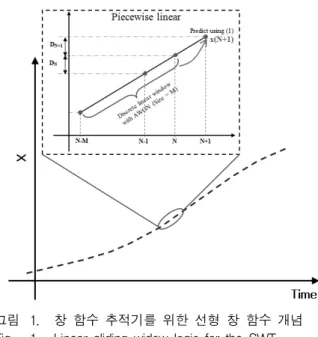
The SWT is designed by regarding the short time interval of target trajectory as piecewise linear as shown in Fig. 1, in which x(k) is a linearized trajectory in the linear window model of the moving target[7], M is a discrete linear window size, and Dk is the moving interval of a target in between k-1 and k.
To predict the target position at the time of N+1, we include past tract information in the model by setting the equal intervals, DN-M ≅
⋯ ≅ DN ≅ DN+1 and assuming Dk = D + ε, k
= N-M, ⋯, N-1, where ε is a small Gaussian random variable with zero mean. Then, if ε is zero such as perfect linear model, we can predict target position x(N+1) by using xp(N+1)
= x(N) + D as shown in Fig. 1. Here note that noise is always present in Dk. To reduce he Gaussian random error, we propose an equation to calculate the predicted interval D by linear combining the previous estimates[2,7] as follows:
≅
(1)
where μ is weight value.
Finally, using the predicted D in (1), the generalized equation of the predicted target position can be expressed as follows:
≅ (2)
where xp(k+1) is the predicted target position.
The μ in (1) can be found by minimizing the mean-square error (MSE) cost function as follows:
(3)
Assuming μ = 1 and M is a large, the left term of (2) approaches to a zero because ε has zero mean. To find filtered estimate, we use
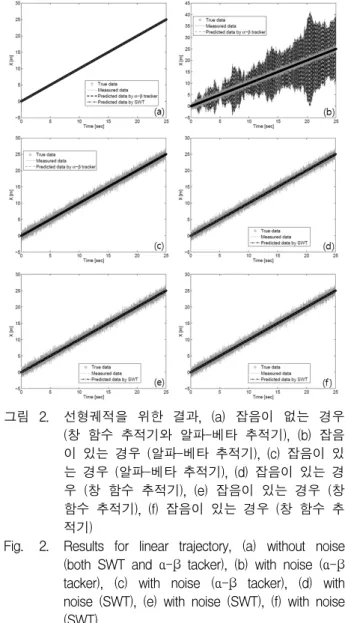
그림 2. 선형궤적을 위한 결과, (a) 잡음이 없는 경우 (창 함수 추적기와 알파-베타 추적기), (b) 잡음 이 있는 경우 (알파-베타 추적기), (c) 잡음이 있 는 경우 (알파-베타 추적기), (d) 잡음이 있는 경 우 (창 함수 추적기), (e) 잡음이 있는 경우 (창 함수 추적기), (f) 잡음이 있는 경우 (창 함수 추 적기)
Fig. 2. Results for linear trajectory, (a) without noise (both SWT and α-β tacker), (b) with noise (α-β tacker), (c) with noise (α-β tacker), (d) with noise (SWT), (e) with noise (SWT), (f) with noise (SWT).
measurement update[1~2] as follows:
(4)
where x(k) and xm(k) denote filtered target position and measured target position at k, respectively, and is a coefficient of the SWT. The can be calculated from a relation of with which we obtain the following:
(5)
where and
. As the tracking process converges, the becomes small because of
.
For N iterations, the computations of the proposed algorithm are as 2N additions, N(M + 1) subtractions, and 3N multiplications. On the other hand, the α-β tracker needs 3N additions, 2N subtractions, and 4N multiplications. This implies that the computational cost of the proposed algorithm is compatible to the α- β tracker.
Ⅲ. Verifications
To verify the performance of the SWT, we compare the SWT with the α-β tracker. The coefficient α for the α-β tracker is obtained by the criterion based on the best linear track fitted to radar data in a least squares sense[8]. The coefficient β for the α-β tracker is 0.05 and the obtained value by the criterion based on the best linear track fitted to radar data in a least squares sense[4]. To verify the proposed algorithm, we assume target moves every 0.001 [sec] and stops at 25 [sec] and generate a slow and a fast varying target following equations
of nonlinear trajectory cos
, where noise n(t) is the Gaussian random noise with N∼(0, 0.1) and linear trajectory , where noise n(t) is N∼(0, 0.5).
For initial parameters, we set arbitrary values of xp(1) and velocity V(1) for the α-β tracker and xp(1) and D for the SWT. In the paper, xp(1) = 1 [m] and V(1) = 0 [m/sec] are used. Note that the window size of the SWT is increased step by step from 1 to M. The error can be calculated as the square of the norm as ∥
∥, where
and
are true data vector without noise and the prediction data vector, respectively.
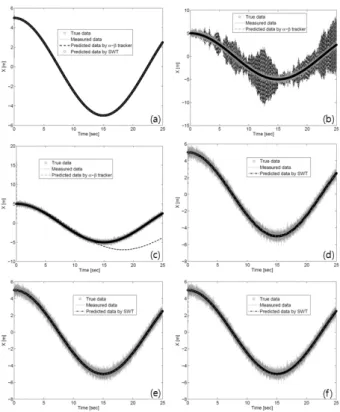
그림 3. 비선형궤적을 위한. 결과, (a) 잡음이 없는 경우 (창 함수 추적기와 알파-베타 추적기), (b) 잡음이 있는 경우 (알파-베타 추적기), (c) 잡음이 있는 경 우 (알파-베타 추적기), (d) 잡음이 있는 경우 (창 함수 추적기), (e) 잡음이 있는 경우 (창 함수 추적 기), (f) 잡음이 있는 경우 (창 함수 추적기) Fig. 3. Results for nonlinear trajectory, (a) without noise
(both SWT and α-β tracker), (b) with noise (α-β tracker), (c) with noise (α-β tracker), (d) with noise (SWT), (e) with noise (SWT), (f) with noise (SWT).
Fig. 2 shows tracking performance of the SWT with the α-β tracker in linear trajectory when we set all . In Fig. 2(a), when noise is not added, we can see that the errors of the two tracking algorithms are similar (errors are 1.99 for SWT (M = 5 and μ = 0.5) and 10.01 for α-β tracker (β = 0.05). Figs. 2(b) and 2(c) show the tracking of the trajectory with noise using the α-β tracker.
The error is propagated in Fig. 2(b) for β = 0.05 (error is 1.09×10⁶), and Fig. 2(c) for β = 6/k(k+1) shows a good result removing the error (error is 42.02), where k is a iteration number. Figs. 2(d), 2(e), and 2(f) show the tracking of the trajectory with noise using the SWT, and the algorithm is run changing M = 5, M = 25, and M = 100, respectively, we get better results than α-β tracker. The errors are 481. 81, 209.27, and 48.77, respectively, and we can see that a larger M is better for a linear trajectory.
Fig. 3 compares the SWT with the α-β tracker tracking a nonlinear trajectory, when we set all . In Fig.
3(a), we can see that the errors of the two tracking algorithm for the trajectory without noise are similar (errors are 32.05 for SWT (M
= 5 andμ = 0.5) and 16.98 for α-β tracker (β = 0.05). Figs. 3(b) and 3(c) show the tracking of the trajectory with noise using the α-β tracker.
Fig. 3(b) for β = 0.05 is propagated the error (error is 1.1×10⁵), and Fig. 3(c) for β = 6/k(k+1) is also propagated the estimation error of the nonlinear trajectory although noise are removed (error is 1.93×10⁵). The results show that the set of α and β is important. Figs.
3(d), 3(e), and 3(f) show the tracking of the trajectory with noise using the SWT by changing M = 5, M = 25, and M = 100, respectively, we got that the α-β tracker is more sensitive than the SWT. The errors are 2.71×10², 62.12, and 1.58×10², respectively, and we can see that a optimum M exists.
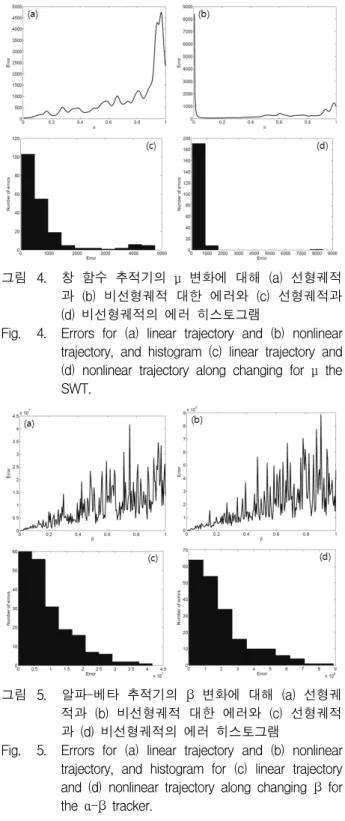
In Fig. 4 we present sensitivity and convergence behavior of the SWT by changing the parameter (μ) in estimating noisy linear
and nonlinear trajectories (the noise is the same that the cases of Figs. 2 and 3). Here, μ and β have changed as the every interval 0.005 in between 0 and 1, and we set as M=5, and
. Figs. 4(a) and 4(c) show the errors an histogram of linear moving target. The errors and histogram of nonlinear moving target are depicted in Figs. 4(b) and 4(d). On the estimation error of both algorithms, their probability are less than 250 is almost the same as 0.21.
Next, we use α-β tracker and do the same simulations by using the same conditions used in Fig. 4. Figs. 5(a) and 5(c) show the errors and histogram of the linear moving target and the errors and their histogram of the nonlinear moving target are depicted in Figs. 5(b) and
그림 4. 창 함수 추적기의 μ 변화에 대해 (a) 선형궤적 과 (b) 비선형궤적 대한 에러와 (c) 선형궤적과 (d) 비선형궤적의 에러 히스토그램
Fig. 4. Errors for (a) linear trajectory and (b) nonlinear trajectory, and histogram (c) linear trajectory and (d) nonlinear trajectory along changing for μ the SWT.
그림 5. 알파-베타 추적기의 β 변화에 대해 (a) 선형궤 적과 (b) 비선형궤적 대한 에러와 (c) 선형궤적 과 (d) 비선형궤적의 에러 히스토그램
Fig. 5. Errors for (a) linear trajectory and (b) nonlinear trajectory, and histogram for (c) linear trajectory and (d) nonlinear trajectory along changing β for the α-β tracker.
그림 6. 창 함수 추적기의 μ와 M 변화에 대해 (a) 선형 궤적과 (b) 비선형궤적 대한 에러와 (c) 선형궤 적과 (d) 비선형궤적의 에러 히스토그램 Fig. 6. Errors for (a) linear trajectory and (b) nonlinear
trajectory, and histogram for (c) linear trajectory and (d) nonlinear trajectory along changing μ and M by the SWT.
5(d). The probabilities of estimation errors are less than 250 are both 0.005. With these comparisons, we show that SWT is superior to α-β tracker.
In order to show the insensitivity to parameters of SWT, we have calculated the estimated errors by changing μ and M as shown in Fig.6. Here, μ have changed as the
every interval 0.05 from 0 to 1, M have changed as the every interval 10 in between 0 and 250, and α is set as .
Figs. 6(a) and 6(c) show the errors and histogram of the noisy linear moving target.
The results of the nonlinear target are depicted in Figs. 6(b) and 6(d). The estimation error probabilities of each trajectory is less than 250, are 0.822 and 0.511, respectively. With these results, we can conclude that the SWT is not sensitive to parameter selection for both linear and nonlinear trajectories. Comparing two trajectories, the SWT is more sensitive to nonlinear than the linear. The proposed SWT algorithm can apply in tracking software for various radar and sonar systems[9~10].
Ⅳ. Conclusions
In the paper, we have proposed a novel tracking algorithm called slide window tracker suitable for fast maneuvering target in noisy channel. To efficiently estimate trajectory from noisy moving target measurement, we have utilized a sliding piecewise linear window including past trace information. By
adjusting the window parameters, the proposed algorithm is to reduce measurement noise and to track fast maneuvering target. The computational increment of the proposed algorithm with comparison to α-β tracker is negligible. Throughout the computer simulations, we have demonstrated outstanding tracking performance of the SWT algorithm in severe noisy linear and nonlinear measurement. Also, we have presented that the SWT algorithm is not sensitive to initial model parameter selection. Thus, we can apply the SWT algorithm to tracking problem of unknown nonlinear time-varying measurements with large degree of freedom.
References
[1] J. Yoo, J. Bae, J. Kim, J. Chun, and J. Lew,
“PC-based implement of the maritime radar display unit,” Conference Record of the Thirtieth Asilomar Conference, Monterey, vol. 1, pp. 474–
480 1996.
[2] J. Han, M. S. Andrews, J. Bae, J. Lee, and H.
G. Jeon, “Maritime Radar Simulator based on DSP Board using Switched Slide Window Tracker,” Oceans’08 MTS/IEEE Quebec, vol. 1, pp. 1–4, 2008.
[3] R. E. Kalman and R. S. Bucy, “New results in linear filtering and prediction Theory,” J. Basic Eng., ASME Trans. ser. D, vol. 83, pp. 95–107, 1960.
[4] T. Kawase, H. Tsurunosono, N. Ehara, and I.
Sasase, “An adaptivegain alpha-beta tracker combined with circular prediction for maneuvering target tracking,” IEEE TENCON, Brisbane, vol. 1, pp. 795–798, 1997.
[5] K. C. Chan, V. Lee, and H. Leung, “Radar tracking for air surveillance in a stressful environment using a fuzzy-gain filter,” IEEE Trans. Fuzzy Syst, vol. 5, no. 1, pp. 80–89, 1997.
[6] A. Papoulis, Probability, random variables, and stochastic process, McGRAW-HILL, 1991.
[7] H. G. Jeon and E. Serpedin, “A novel simplified channel tracking method for MIMO-OFDM systems with null sub-carriers,” Signal Processing, vol. 88, pp. 80–89, 2008.
[8] F. R. Bach, G. R. G. Lanckriet, M. I. Jordan,
“Multiple kernel learning, conic duality, and the SMO algorithm,” Proc. of the 21th International
Conference on Machine Learning, 2004.
[9] Jaeil Lee, Ju-Hyung Lee, Jong-Wu Hyun, Chong Hyun Lee, Jinho Bae, Dong-Guk Paeng, Jungsam Cho, Taein Kang, and Nobok Lee,
“Surveillance-Alert System based on USN using PDR sensors,” Journal of The Institute of Electronics and Information Engineers, vol. 48, no. 12, pp. 54-61, 2011.
[10] Jeonghee Han, Chong Hyun Lee, Dong-Guk Paeng, Jinho Bae, and Won-Ho Kim,
“Parametric Array Sonar System Based on Maximum Likelihood Detection,” Journal of The Institute of Electronics and Information Engineers, vol. 48, no. 1, pp. 25-31, 2011.
저 자 소 개 배 진 호(정회원)
1993년 아주대학교 전자공학과 학 사 졸업.
1996년 KAIST 정보통신공학과 석 사 졸업.
2001년 KAIST 전자전산학과 박사 졸업.
1993년∼2002년 대양전기공업(주) 기술연구소 실장 2002년∼2002년 KAIST BK21 초빙 교수
2006년∼2007년 Texas A&M 방문 교수 2013년~2014년 UCSC 방문교수
2002년∼현재 제주대학교 해양시스템공학과 교수
<주관심분야 : 광신호처리 및 통신, 레이다 및 소 나 신호처리, 항해 시스템>
이 종 현(평생회원)
1985년 한양대학교 전자공학과 학사 졸업.
1987년 Michigan Technological University 석사 졸업.
2002년 KAIST 전기 및 전자공학과 박사 졸업.
1990년∼1995년 한국전자통신연구원 선임연구원 2000년∼2002년 (주) KM Telecom 연구소장 2003년∼2006년 서경대학교 전자공학과 전임강사 2006년∼현재 제주대학교 해양시스템공학과 교수
<주관심분야 : 통계학적 신호처리, 적응 배열 시스템, 수중 및 이동 통신, UWB 무선전송기술>
전 형 구(평생회원)
1987년 인하대학교 전자공학과 학 사 졸업.
1992년 연세대 대학원 전자공학과 석사 졸업.
2000년 연세대 대학원 전기 및 컴 퓨터공학 박사 졸업 1987년 2월∼2001년 2월 한국전자통신연구원 선
임연구원 기지국 모뎀연구팀장
2001년 3원∼현재 동의대학교 정보통신과 교수 2006년 1월∼2006년 12월 Texas A&M Post Doc.
2015년 1월∼2015년 12월 UCSD 방문교수
<주관심분야 : 이동통신 및 디지털 신호처리, MIMO - OFDM 채널추정>