Optimum Enzyme Mixture of Cellulase, Hemicellulase, and Xylanase for Production of Water-Soluble Carbohydrates from Rice Straw
Sang Buem Cho
1, Sang-Suk Lee
2, Chang-Hyun Kim
3, Kyeong Seon Ryu
1, Hee Jun Park
4, Hyun Myong
5and Nag-Jin Choi
1*
1
Department of Animal Science, Chonbuk National University, Jeonju 561-756, Korea
2
Department of Animal Science and Technology, Sunchon University, Sunchon 540-742, Korea
3
Department of Animal Life and Environment Science, Hankyong National University, Anseong 456-749, Korea
4
College of Human Ecology, Chonbuk National University, Jeonju 561-756, Korea
5
Department of Environmental Landscape Architecture Design, Chonbuk National University, Jeonju 561-756, Korea
Received November 4, 2011 /Revised December 5, 2011 /Accepted January 4, 2012This study was conducted to investigate the production of water-soluble carbohydrates (WSCs) by treatment of different amounts of rice straw with cellulase, hemicellulase, and xylanase. Treatment of high amounts of rice straw (100 g/l) with cellulase and hemicellulase resulted in similar production of WSCs. Reducing the amount of rice straw to 50 g/l decreased the production of WSCs by hemi- cellulase but had no effect on WSC production by cellulase. The interaction among rice straw amounts, and hemicellulase and xylanase activities was investigated using a Box Behnken design and a response surface model. An interaction was found only between hemicellulase and xylanase. An en- zyme mixture consisting of 0.55 mg/ml of hemicellulase and 0.65 mg/ml of xylanase generated the highest amounts of WSCs, regardless of the amount of rice straw provided. Therefore, the activity of cellulase was higher than that of either hemicellulose or xylanase for WSC production from rice straw.
The interaction observed for hemicellulase and xylanase indicates that a combined enzyme treatment could improve the production of WSCs from rice straw.
Key words : Cellulase, hemicellulase, xylanase, water soluble carbohydrates, rice straw
*Corresponding author
*Tel:+82-63-270-2579, Fax:+82-63-270-2612
*E-mail : [email protected]
서 론
식물 세포벽에 존재하는 섬유소를 단순당으로 전환시키는 과정에는 다양한 효소들이 관여하며, 농생명산업 등 다양한 산업분야에서 매우 중요한 의미를 가지고 있다[17]. 볏짚은 쌀 이 주식인 나라에서 생산되는 주요 농업부산물이며, 전세계적 으로 연간 731,000,000톤이 생산되며[16], 이 양은 205 GL의 바이오에탄올로 전환될 수 있다[7]. 섬유성 바이오메스를 구 성하는 식물고분자 탄수화물은 주로 cellulose와 hemi- cellulose 및 페놀계 중합체인 리그닌으로 구성되어 있다[11].
이러한 물질들의 분해를 통하여 생성된 수용성탄수화물들은 바이오에탄올 생산의 원료로서 사용되며[11,16], 반추동물의 탄소원으로도 이용될 수 있다. 특히 반추동물에 있어 수용성 탄수화물의 섭취량 증가는 소장 내 아미노산 흡수율 증가 및 산유량을 향상 시킬 수 있다고 보고되었다[10]. 섬유성 바이오 메스의 주요 성분인 cellulose는 glucose가 β-1,4 결합을 통하 여 결정형 연결구조를 이루며 섬유소를 형성하며, hemi- cellulose는 cellulose에 비하여 비교적 약한 결정형 구조이며
hetero-β-1,4-D-xylan이 주성분으로 이루어져 있다[13,14,18].
섬유성 바이오매스의 이용 방법은 크게 물리화학적 처리방법 과 효소처리(생물학적처리)로 나뉘어 지며, 효소적 처리는 친 환경처리 방법으로 알려져 있다[8,12]. 섬유성 바이오매스를 구성하는 성분들은 섬유소 분해 효율에 있어 상호간에 영향을 미치는 것으로 알려져 있다[1,9,15]. 따라서 기질의 종류에 따 라서 다양한 효소들의 상호관계의 이해는 섬유성 바이오매스 의 분해 효율성 향상에 중요한 역할을 할 수 있다. 여러 가지 요인들의 효과를 조사하는 방법으로 한번에 한가지 요인들을 검정해가는 OFAT (one factor at a time) 방법이 있다. 그러나 이 방법은 시간과 노력이 많이 드는 단점이 있다[4]. 이러한 단점을 보완하기 위하여 full factorial design 방법이 적용되었 으며, 이 방법은 요인들의 주효과와 상호작용을 알 수 있는 장점이 있는 반면, 요인분석을 위하여 수많은 실험이 요구되 는 단점이 있다[5]. 이러한 이유에서 fractional factorial design (FFD)이 고안되었고, 주효과 만을 탐색할 경우에는 Plackett- Burman design이 주로 사용되며, 요인들간의 상호작용까지 조사하여 최적화 모형을 도출할 경우에는 central composite design 혹은 Box Behnken design이 주로 사용된다[2,3,4,6].
따라서, 본 연구는 볏짚을 효소 처리하여 수용성 탄수화물
을 생산하는 과정에 있어, cellulase, hemicellulase 및 xylanase
의 주효과 및 상호작용을 알아보기 위하여 수행되었다.
재료 및 방법
시료의 전처리
실험에 사용된 볏짚은 전라북도 김제지역에서 재배 후에 수확된 볏짚을 사용하였으며, 80~120 mesh의 크기로 분쇄한 후 건조하여 실험에 이용하였다.
효소
볏짚으로부터 수용성 탄수화물을 생산하기 위하여 cellu- lase, hemicellulase 및 xylanase를 사용하였다. Cellulase (Sigma)는 1,000 U/g의 활성을 나타내는 것을 사용하였고, Hemicellulase (Sigma)는 3,000 U/g의 활성을 나타내는 것을 사용하였다. Xylanase (Sigma)는 2,500 U/g의 활성을 나타내 는 것을 사용하였다. 각 효소에서 1 U는 각각의 기질이 한 시간 동안 분해되어 생성된 glucose 1 µmol을 의미하며, 반응 조건은 cellulase의 경우 37°C와 pH 5.0, hemicellulase의 경우 40°C와 pH 5.0 그리고 xylanase의 경우 30°C와 pH 4.0이었다.
Hemicellulase와 xylanase는 37 mM acetic acid buffer (pH 4.8)에 10배 희석하여 사용하였다.
효소처리 조건
볏짚과 효소의 처리조건은 37 mM acetic acid buffer (pH 4.8)에 기질인 볏짚과 효소용액을 첨가한 후에 45°C water bath에서 150 rpm의 교반 속도로 12시간 동안 반응시켰다.
반응에 사용된 기질의 농도는 실험 설계에 따라서 10 g/l에서 100 g/l로 다양하게 하였다. 반응에 이용된 각 효소들의 첨가 농도 또한 실험 설계에 따라서 0.1 mg/ml에서 1 mg/ml로 다양하게 하였다.
수용성 탄수화물의 측정
반응이 완료된 기질·효소 혼합용액은 10,000 rpm에서 5분동 안 원심분리한 후에 얻은 상등액을 수용성 탄수화물 측정용 시 료로 사용하였다. 수용성 탄수화물은 DNS (3,5-Dinitrosalicylic acid)를 이용한 환원당 비색 정량법을 이용하여 측정하였으며, 이때 glucose를 표준용액으로 사용하였다. 효소반응에 의하여 생성된 수용성 탄수화물의 양을 측정할 때에 효소를 첨가하지 않고 반응 시킨 후에 얻어진, 즉 자연적으로 buffer내로 용출된 수용성탄수화물을 background 수치로 적용하여 계산하였다.
볏짚의 농도에 따른 각 효소들의 활성 평가
기질로 사용된 볏짚의 농도에 따른 각 효소들의 수용성 탄 수화물 생성량 평가는 OFAT 방법을 이용하여 평가하였다.
볏짚의 농도는 10 g/l에서 100 g/l까지 다양하게 하였으며, cellulase는 총 반응 부피에 대하여 1 mg/ml, hemicellulase와
xylanase는 원액을 10배 희석한 용액을 1 mg/ml의 농도로 사용하였다.
Box Behnken design (BBD) 실험설계 및 평가
총 3 가지의 변수에 대하여 각 변수들의 3 가지 수준을 사용 하였으며, 3개의 중앙점을 포함하는 총 15개의 실험(run)으로 구성된 BBD를 설계하였다. 각 실험들은 고정변수(fixed varia- ble)로 cellulase (1 mg/ml)를 포함하고 있으며, 변수들로는 볏짚, hemicellulase 및 xylanase의 수준들이 이용되었다. 각 실험들에 할당된 볏짚의 함량(수준)들은 20 g/l (-1), 50 g/l (0) 및 100 g/l (+1)이며, hemicellulase와 xylanase는 모두 0.1 mg/ml (-1), 0.5 mg/ml (0) 및 1.0 mg/ml (+1)으로 동일하게 사용하였다.
각 실험들로부터 얻어진 결과들은 반응표면모형(response surface model, RSM)을 이용하여 계산하였고, RSM에 사용된 모형은 다음과 같다.
위 식에서 Y는 예측반응값이며, β
0는 상수, β
i와 β
j는 회귀계 수를 의미한다. X
i와 X
j는 각각 독립변수(i≠j)를 의미한다.
통계적 방법
OFAT 실험결과의 통계분석은 SPSS (version 18.0.0)의 일 반선형모형(General linear model)의 다변량분석법을 사용하 였으며, 사후검정은 Duncan’s method를 사용하였다. 총 15 개의 실험으로 구성된 BBD의 설계 및 분석은 MINITAB (version 14)를 사용하였다.
결과 및 고찰
볏짚의 수준별 각 효소들의 수용성 탄수화물 생산량
기질로 사용된 볏짚의 수준을 10 g/l에서 100 g/l까지 변화
시킨 후에, 각각의 cellulase, hemicellulase 및 xylanase를 첨가
하여 반응시킨 후 얻어진 수용성 탄수화물의 양은 Table 1에서
보는 것과 같다. 반응액에 첨가된 볏짚의 수준이 100 g/l일
경우에는 cellulase와 hemicellulase가 서로 같은 수용성 탄수
화물 생성효율을 나타내었으며, xylanase 활성은 유의적으로
낮은 효율을 나타내었다(p<0.05). 그러나 첨가된 볏짚의 수준
이 50 g/l로 감소하였을 때에는 cellulase의 활성이 유의적으
로 높았으며(p<0.05), hemicellulase와 xylanase 간의 활성차이
는 나타나지 않았다. 이후 볏짚의 수준이 20 g/l와 10 g/l로
낮을 경우에는 cellulase가 유의적으로 가장 높은 수용성 탄수
화물 생성효율을 나타내었으며, 다음으로는 hemicellulase와
xylanase의 순서로 나타났다(p<0.05). 반응액에 첨가된 볏짚의
수준에 따른 각 효소들의 수용성 탄수화물 생성효율 변화에는
유의적 차이를 나타내었으며(p<0.05), 첨가된 볏짚의 수준과
Table 1. Effects of cellulase, hemicellulase and xylanase on water soluble carbohydrate production from different concentrations of rice straw
Rice straw content, g/l Significance2
100 50 20 10 SE E R I
C1 H X C H X C H X C H X
Water soluble carbohydrate, glucose mM equivalent
17.71b 14.59b 5.61a 11.66b 3.30a 2.81a 2.73c 1.70b 0.78a 2.06c 1.71b 0.50a 0.05 <0.01 <0.01 <0.01
1C, H and X mean cellulase (1 mg/ml), hemicellulase (1 mg/ml) and xylanase (1 mg/ml), respectively
2SE, E, R and I mean total standard error, effect of enzymes, effect of rice straw content and interaction of E and R, respectively Different superscripts in same rice straw content mean significantly different (
p
<0.05).Table 2. Box Behnken design configuration for the investigation of effects of rice straw content, hemicellulase and xylanse on the production of water soluble carbohydrate from rice straw
Runs Variables Water soluble carbohydrates,
glucose mM equivalent
Rice straw Hemicellulase Xylanase Observed Predicted
Coded Uncoded, g/l Coded Uncoded, mg/ml Coded Uncoded, mg/ml
1 -1 20 -1 0.1 0 0.5 6.22±0.29 5.92
2 1 100 -1 0.1 0 0.5 33.05±3.48 33.01
3 -1 20 1 1.0 0 0.5 6.10±0.68 6.49
4 1 100 1 1.0 0 0.5 31.81±4.17 32.20
5 -1 20 0 0.5 -1 0.1 5.47±0.50 4.83
6 1 100 0 0.5 -1 0.1 31.82±3.47 31.71
7 -1 20 0 0.5 1 1.0 6.32±0.46 6.90
8 1 100 0 0.5 1 1.0 32.25±3.86 32.86
9 0 50 -1 0.1 -1 0.1 14.57±0.23 15.47
10 0 50 1 1.0 -1 0.1 17.66±6.24 17.83
11 0 50 -1 0.1 1 1.0 19.74±7.87 19.50
12 0 50 1 1.0 1 1.0 17.31±6.48 16.68
13 0 50 0 0.5 0 0.5 19.98±8.76 19.59
14 0 50 0 0.5 0 0.5 19.36±8.25 19.59
15 0 50 0 0.5 0 0.5 19.27±7.96 19.59
1. Water soluble carbohydrate was calculated with the consideration of background WSC and the background of WSC from non-enzyme addition
2. Mean±standard deviation with triplicates.
All experimental runs contain 1 ul/ml cellulase.
는 관계없이 세가지 효소간의 활성차이도 유의적으로 나타났 다(p<0.05). 또한 볏짚의 첨가수준에 따른 효소들의 활성과 효 소의 종류별 활성간의 상호작용에도 유의적 차이가 있는 것으 로 나타났다(p<0.05).
볏짚의 수준, hemicellulase 및 xylanase 간의 상호작용 볏짚의 수준별 각 효소들의 수용성 탄수화물 생성 효율분석 에서 cellulase가 가장 우수한 효율을 나타내었다(p<0.05). 일 반적으로 cellulase는 섬유성 바이오매스로부터 수용성 탄수 화물을 생산하는 공정에서 가장 많이 사용되는 효소로 알려져 있다[11]. 이에 본 실험에서는 가장 효과가 큰 cellulase를 고정 변수(fixed variable)로 설정하여 모든 실험들에 대하여 동일한 수준(1 mg/ml)으로 첨가하였다. BBD 실험의 변수로는 볏짚, hemicellulase 및 xylanase를 사용하였고, 각 변수들은 세가지
수준으로 배열하여 총 15개의 실험(run)들을 설계하였다. 각 실험별로 나열된 변수들의 수준들(coded value)과 실제 반응 액에 첨가된 효소의 양 및 볏짚의 함량(uncoded value), 그리 고 실험별로 얻어진 반응(수용성 탄수화물 생산량)들과 반응 표면모형을 통하여 얻어진 예측값들의 결과는 Table 2에서 보 는 것과 같다. 각 실험별로 얻어진 수용성 탄수화물의 양은 최소 5.5 mM에서 최대 33.1 mM까지 매우 다양하게 나타났다.
BBD 설계를 이용한 실험의 분산분석결과는 Table 3에서
보는 것과 같다. 전체적인 회귀모형과 선형 및 2차 모형 모두
에서 95% 이상의 확률값을 얻을 수 있었으며, 변수들간의 상
호관계에서는 90% 이상의 확률값을 얻을 수 있었다. 분산분석
결과를 통하여 각 변수들의 효과에 대한 직선성과 곡선성이
확인되었고, 전체적인 모형의 적합성이 확인되었다. 변수들
간의 상호작용에 있어 확률값이 다른 분석성분에 비하여 다소
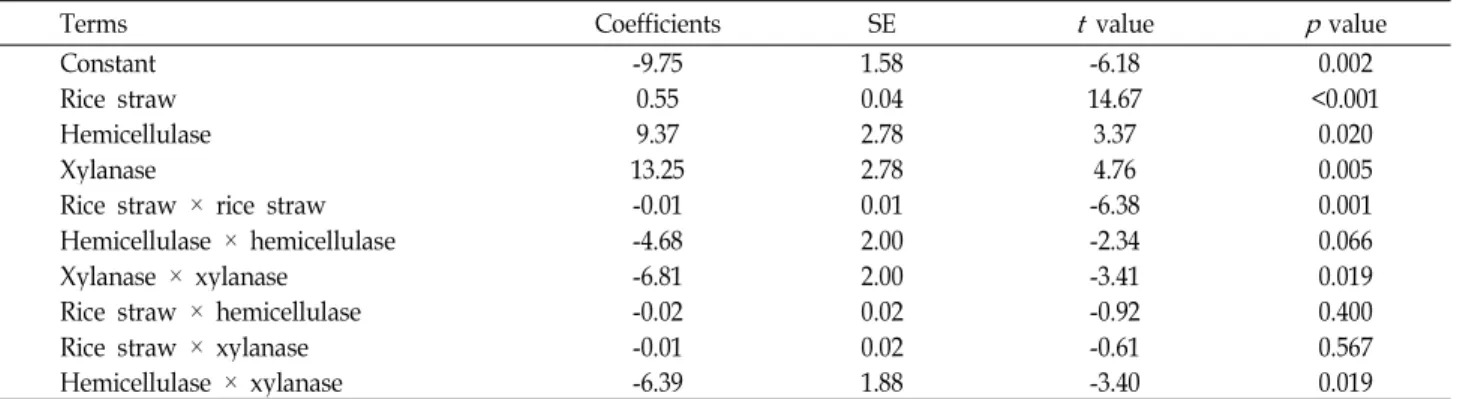
Table 4. Regression coefficients1and their probability
Terms Coefficients SE
t
valuep
valueConstant -9.75 1.58 -6.18 0.002
Rice straw 0.55 0.04 14.67 <0.001
Hemicellulase 9.37 2.78 3.37 0.020
Xylanase 13.25 2.78 4.76 0.005
Rice straw × rice straw -0.01 0.01 -6.38 0.001
Hemicellulase × hemicellulase -4.68 2.00 -2.34 0.066
Xylanase × xylanase -6.81 2.00 -3.41 0.019
Rice straw × hemicellulase -0.02 0.02 -0.92 0.400
Rice straw × xylanase -0.01 0.02 -0.61 0.567
Hemicellulase × xylanase -6.39 1.88 -3.40 0.019
1Regression coefficients were calculated with uncoded values of variables
Fig. 1. Three dimensional plots for the interaction between hemicellulase and xylanase on water soluble carbohydrate production from rice straw. A), B) and C) mean rice straw contents in reaction mixture as 100 g/l, 60 g/l and 20 g/l, respectively.
Table 3. Analysis of variance1 for the effects of rice straw content, hemicellulose and xylanase on the production of water soluble carbohydrates from rice straw
Items DF SS MS F P
Regression 9 1396.94 155.22 264.01 <0.001 Linear 3 1359.12 43.10 73.31 <0.001
Square 3 30.40 10.20 17.35 0.004
Interaction 3 7.42 2.47 4.21 0.078
Residual error 5 2.94 0.59
Lack of fit 3 2.64 0.88 5.89 0.149
Pure error 2 0.30 0.15
Total 14 1399.88
1DF, SS and MS mean degree of freedom, sum of square and mean of square, respectively.
낮은 결과를 나타낸 것은 상용된 변수들 중 볏짚의 첨가수준 이 매우 큰 효과를 나타내었기 때문인 것으로 판단된다.
반응표면모형에 대한 회귀계수들과 그 확률값들은 Table 4에서 보는 것과 같다. 1차 식의 회귀계수에서는 볏짚이 가장 높은 확률값을 나타내었으며, 다음으로는 xylanase 그리고 hemicellulase의 순서로 나타났다. 2차식에 대한 회귀계수에 서는 hemicellulase를 제외한 나머지 변수에서 모두 유의성이
발견되었다. 변수들간의 상호작용에 대한 회귀계수에서는 hemicellulase와 xylanase 간의 상호작용에서만 유의성이 발 견되었다. 반응표면모형의 수정된 R
2수치는 99.4%로 나타났 다. Hemicellulase는 섬유성 바이오매스에 포함된 hemi- cellulose를 제거하여 cellulase에 의하여 cellulose가 분해되는 작용을 향상시킨다고 보고된바 있다[1,9]. 또한 xylanase도 cellulase의 활성 저해요인으로 알려진 xylooligomer를 제거하 여 cellulase의 작용을 향상시킨다고 보고되었다[15].
회귀계수의 확률값 분석을 통하여 hemicellulase와 xyla-
nase 간의 상호작용이 확인되어서 두가지 변수들의 상호작용
형태를 반응표면모형을 통하여 얻어진 예측값을 이용하여 3
차원 그래프로 나타내었다(Fig. 1). 그 결과 첨가된 볏짚의 수
준에 관계없이 hemicellulase와 xylanase가 각각 0.55 mg/ml
와 0.65 mg/ml 수준으로 혼합될 경우에 가장 우수한 수용성
탄수화물 생성량을 나타내었다. 본 실험에서는 cellulase를 모
든 실험들(runs)에 동일하게 첨가한 상태에서 볏짚의 함량,
hemicellulase의 첨가수준 및 xylanase의 첨가수준을 달리하
였다. 그 결과, 볏짚의 수준이 증가됨에 따라서 생성되는 수용
성탄수화물은 증가하였다. 그러나 hemicellulase와 xylanase
의 경우에는 그 수준을 계속 증가시켜도 수용성 탄수화물이
직선적으로 증가하지 않았다. 또한 hemicellulase와 xylanase 의 경우 Fig. 4에서 보는 것과 같이 최고의 수용성 탄수화물을 나타내는 꼭지점을 나타내었고, 그 지점에서 상승효과를 나타 내는 상호작용을 보였다.
결과적으로 볏짚의 효소처리를 통한 수용성 탄수화물의 생 산에 있어 cellulase가 가장 큰 효과를 나타내며, hemicellulase 과 xylanase는 서로 상호작용을 통하여 수용성 탄수화물 생성 량을 향상시킨다는 알 수 있었다.
감사의 글
본 논문은 농촌진흥청 공동연구사업(과제번호: PJ007963) 의 지원에 의해 이루어진 것임.
References
1. Allen, S. G., D. Schulman, J. Lichwa, M. J. Antal Jr, E.
Jennings, and R. Elander. 2001. A comparison of aqueous and dilute-acid single-temperature pretreatment of yellow poplar sawdust.
Ind. Eng. Chem. Res.
40, 2352-2361.2. Bas, D. and I. Boyaci. 2007. Modeling and Optimization I:
Usability of response surface methodology.
J. Food Eng.
78, 836-845.3. Basri, M., R. Rahman, A. Ebrahimpour, A. Salleh, E.
Gunawan, and M. Rahman. 2007. Comparison of estimation capabilities of response surface methodology (RSM) with ar- tificial neural network (ANN) in lipase- catalyzed synthesis of palm-based wax ester.
BMC Biotechnol.
7, 53.4. Chauhan, K., U. Trivedi, and K. C. Patel. 2007. Statistical screening of medium components by Plackett-Burman de- sign for lactic acid production by
Lactobacillus
sp. KCP01 using date juice.Bioresour. Technol.
98, 98-103.5. Chen, C., K. Liu, Y. Lou, and C. Shieh. 2002. Optimisation of kojic acid monolaurate synthesis with lipase PS from
Pseudomonas cepacia
.J. Sci. Food Agric.
82, 601-605.6. Cho, S. B., W. K. Chang, Y. J. Kim, H. I. Moon, J. W. Joo, K. H. Seo, and S. K. Kim. 2010. Effect of plant oils and min- erals for the inhibition of lipase activity of
Staphylococcus aureus
isolated from fermented pork meat.Korean J. Food Sci. Ani. Resour.
30, 764-772.7. Hideno, A., H. Inoue, K. Tsukahara, S. Yano, X. Fang, T.
Endo, and S. Sawayama. 2011. Production and character-
ization of cellulases and hemicellulases by
Acremonium cellu- lolyticus
using rice straw subjected to various pretreatments as the carbon source.Enzyme Microb. Technol.
48, 162-168.8. Jeya, M., Y. W. Zhang, I. W. Kim, and J. K. Lee. 2009.
Enhanced saccharification of alkali-treated rice straw by cel- lulase from
Trametes hirsuta
and statistical optimization of hydrolysis conditions by RSM.Bioresour. Technol.
100, 5155-5161.9. Kabel, M. A., G. Bos, J. Zeevalking, A. G. J. Voragen, and H. A. Schols. 2007. Effect of pretreatment severity on xylan solubility and enzymatic breakdown of the remaining cellu- lose from wheat straw.
Bioresour. Technol.
98, 2034-2042.10. Lee, M. R. F., R. J. Merry, D. R. Davies, J. M. Moorby, M.
O. Humphreys, M. K. Theodorou, J. C. MacRae, and N. D.
Scollan. 2003. Effect of increasing availability of water-solu- ble carbohydrates on in vitro rumen fermentation.
Anim.
Feed Sci. Technol.
104, 59-70.11. Lee, S. B., S. K. Jung, and J. D. Lee. 2010. Production of rice straw based cellulosic ethanol using acidic saccharification.
Appl. Chem. Eng.
21, 349-352.12. Ma, H., W. W. Liu, X. Chen, Y. J. Wu, and Z. L. Yu. 2009.
Enhanced enzymatic saccharification of rice straw by micro- wave pretreatment.
Bioresour. Technol.
100, 1279-1284.13. Nishiyama, Y., J. Sugiyama, H. Chanzy, and P. Langan. 2003.
Crystal structure and hydrogen bonding system in cellulose Iα from synchrotron X-ray and neutron fiber diffraction.
J.
Am. Chem. Soc.
125, 14300-14306.14. Poutanen, K., J. Puls, and M. Linko. 1986. The hydrolysis of steamed birchwood hemicellulose by enzymes produced by
Trichoderma reesei
andAspergillus awamori
.Appl. Microbiol.
Biotechnol.
23, 487-490.15. Qing, Q., B. Yang, and C. E. Wyman. 2010. Xylooligomers are strong inhibitors of cellulose hydrolysis by enzymes.
Bioresour. Technol.
101, 9624-9630.16. Shinozaki, Y. and H. K. Kitamoto. 2011. Ethanol production from ensiled rice straw and whole-crop silage by the simul- taneous enzymatic saccharification and fermentation process.
J. Biosci. Bioeng.
111, 320-325.17. Singh, A., S. Tuteja, N. Singh, and N. R. Bishnoi. 2011.
Enhanced saccharification of rice straw and hull by micro- wave–alkali pretreatment and lignocellulolytic enzyme production.
Bioresour. Technol.
102, 1773-1782.18. Wada, M., Y. Nishiyama, H. Chanzy, T. Forsyth, and P.
Langan. 2008. The structure of celluloses.