For a reasonable design of equipment and an operation scheme in an electric distribution system, one important aspect is to quantitatively evaluate the reliability to be experienced in consumer's place and to reflect the results in the design. In general, the quantitative evaluating mean is divided into reliability indices based on the number of housed in consumers and load indices that are based on the energy.
It is used by selecting appropriate reliability indices according to the purpose of operators[1,2]. In particular, to estimate an electrostatic capacity generated in the outage of equipment in operation currently and to design the equipment more rationally, it is necessary to select the energy- centered reliability indices.
This method, however, fails to accurately estimate a decreasing phenomenon in the electrostatic capacity shortly after the restorative operation of equipments.
배전계통에서 GA를 이용한 접속변경 순서 결정 방법
오 선*, 서 정 갑** 정회원
Study of Connection Process in Distribution systems using Genetic Algorithm
Seon Oh*, Jeongkap Seo** Regular Members
요 약
본 논문에서는 전기 배전시스템에서 부하단의 실시간 변화에 따른 배전시스템의 안정적인 운용을 가능하게 하기 위해서 유전자 알고리즘 방법을 사용한 방법에 대해서 연구하였다 배전시스템의 안정적인 운용은 각각의 배전 구역에서의 안정성을 향상시킨다는 중요한 장점을 가지고 있다 본 논문에서는 배전계통에서 가장 어려운 것으로 평가되는 접속절차에 대한 접근을 기반의 신뢰성 모델에 기초하여 수행하였다 유전자 알고리즘은 일반적인 생물계에서의 생존을 위한 진화의 과정을 구현한 것으로서 본 논문에서 는 개의 노드와 개의 배전영역을 갖는 배전시스템을 대상으로 유전자 알고리즘을 적용한 배전시스템 최적화를 구현하였다
Key Words : Distribution System, genetic algorithm, combination, optimization
In this paper presents a new approach to evaluate reliability indices of electric distribution systems using genetic Algorithm (GA). The use of reliability evaluation is an important aspect of distribution system planning and operation to adjust the reliability level of each area. In this paper, the reliability model is based on the optimal load transferring problem to minimize load generated load point outage in each sub-section. This approach is one of the most difficult procedures and become combination problems. A new approach using GA was developed for this problem. GA is a general purpose optimization technique based on principles inspired from the biological evolution using metaphors of mechanisms such as natural selection, genetic recombination and survival of the fittest. Test results for the model system with 24 nodes 29 branches are reported in the paper.
서일대학교 자동차과
* ([email protected]), **서일대학교 전기과 본 논문은2009년도 서일대학 학술연구비에 의해 연구되었음.
※
접수일자: 2011년 1월 14일 수정완료일자, : 2011년 5월 27일 최종게재확정일자, : 2011년6월 1일
In this regard it is desired to introduce the optimal load transferring technique to minimize shortage capacity in supply by a restorative operation such as a load switching[3].
In general, since this method involves a combination problem having a number of local solutions such as load balancing, loss minimization, etc. reconstructing networks by operating switches based on the load conditions of system, it is difficult to find the optimal solution[4].
In order to overcome the above problems, the branch exchange has been proposed by mesut. E.
baran[4] in 1989. This method also, however, has a drawback limited to the local solution.
Thus, K. Kurihara[3] proposed the combined branch exchange and maximum flow method performed by 3 steps (local area, steady increase from the local area and the whole area) minimizing shortage capacity in electric power supply and introducing it into the reliability evaluating concept.
This method, however, covers only 80% to the solution of the whole area, thus it becomes a
complex problem that deals with the 3 steps to in order to find the optimal solution.
Further, more in the reliability evaluation, it considers only the outage except the restorative period.
Accordingly, as the optimal technique for solving such a local problem, Genetic Algorithm [GA] has been it covers the whole area and ensures the tenacity applied to loss reduction, by Koichi Nara[5]
in the year 1992. In recent years, GA has been widely used in various fields. Especially Tsutomu Oyama[6] proposed a " Restorative planning of power system using genetic algorithm with branch exchange method ", in 1996, in which a restorative scheme problem associated with BE in the operation procedure was used to enhance a convergence speed[7].
This method by Koichi describes up-down method to eliminate an inappropriate string generating problem which is the opposite problem to the tree construction restricting condition in system generated during GA operation. The method, however, fail to contrive a complete solution due to a directional problem of flow[8]-[10].
Accordingly, this paper proposes an algorithm to solve the tree restricting condition by introducing GA
in the optimal load switching. The algorithm is based on the reliability evaluation in described the document[3] through an analysis in the existing theory, so that the problem regarding the above condition can be solved only by GA.
In particular, The data in the system information can by easily processed by using a digitizer for constructing information in the system required for a case study. For performance enhancement of GA, this paper uses an elitist model which reflects the most superior genetic factor in the previous generation to the next generation the method for readjusting a mutation probability was used to search various solutions.
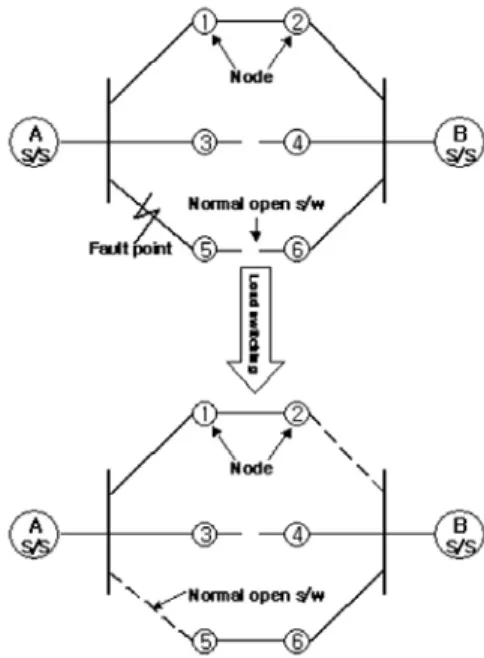
The optimal load switching determines an operating method in the switch so that load capacity or shortage capacity in supply can be minimized within a range meeting the construction limitation in a radial system and the capacity limitation in the distribution line. Figure 1 explains such a concept, in which load points are connected to respective nodes.
The outage between bank A and node 5, load in 5 in changed to bank B, resulting in the overload.
Figure 1. conceptual view for load switching
Therefore, by changing again load in node 2 to be supplied from the bank 5, load in bank 5 can be
reduced. As a result, overload in the whole system can be reduced.
One problem in such a load switching is that a magnitude of the shortage capacity in supply is irregularly changed during one operation. Figure 2 explains it illustrating a disadvantage due to peaks having a number of local solutions.
The evaluation function used in this paper is defined in Equation 1 based on the calculation expression in the load-centered reliability method. s equation also is defined as the minimization problem of energy need in supply (ENS) by the load switching, considering the shortage capacity in supply in the respective load points generated due to assuming troubles together with the restorative period concept. Here, restricting conditions include the limitation in the line capacity and the maintenance problem in the tree construction.
Figure 2. Optimal load switching having local solutions
λ
wherein,
(i) the number of outage of year on load points λ :
[number/km.year]
r(i) restorative period per outage on load points: [hour/number]
L(i) line distance between sections on load points: [km]
E(i) shortage capacity in supply[km]:
A parameter for determining minimization in the shortage capacity in supply based on the load switching is a position of normal-open section switch. In the number of the normal-open section switch, when the position of the switch is changed, the construction of the distribution system is always
kept radially. To store the radial construction, it is necessary to have the sufficient number in the switch position. In the open loop radial distribution system, sine a plurality of section switches are positioned at the branch between both nodes, the position of switch and the number of branch in which the open switch is disposed should be stored.
a. string structure
b. Two-Point Crossover Can Combine the Schemata Figure 3. The schemata can be combined with Two-point
crossover.
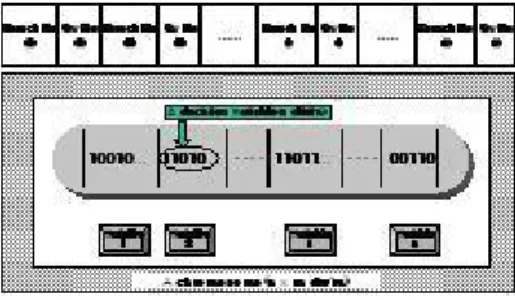
Therefore, the string structure is as shown in Figure 3.
In Figure, Branch No(i) means the number of branch in which the position of i-th open switch is in existence. Sw No(i) means normal open switch in branch (i). Branch No(i) and Sw No(i) are expressed in binary code as shown in Figure 3.
To prevent genetic factors in each generation to form structurally loop system and isolated nodes separated form the system to be generated, this paper proposes a string search algorithm which considers tree restricting conditions. Procedures for search steps are follows. Here, a base node menas a node disposed near power supply to receive electric power at all times. An extensible node is a terminal node in the final point in the starting path from the base node.
A connectable node is for searching the isolated node and means an adjacent node isolated from the extensible node due to switch opening.
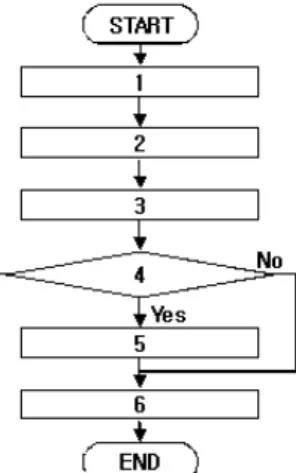
This flowchart comprises the following steps.
step 1 search the base node from each node:
step 2 perform steps 3 to 7 for every base nodes: step 3 if information regarding base nodes is in: existence, remove it
step 4 track all paths connected from one base: node to search terminal node and then establish it as extensible base node. It the demand is met demand in the branch, search the terminal node in all paths connected from the branch point
step 5 terminate the algorithm if extensible base: node or base node is connected to the path to be searched during search of terminal node, assuming as forming loop system. Search the terminal node in all paths while meeting the demand in the branch node
step 6 establish adjacent nodes not connected to: extensible base as connectable node be connected to another base node. If these connectable nodes is already establishing as the extensible node, removing these nodes from the connectable node
step 7 if the extensible base node remains in the: existing connectable node, remove these nodes from the connectable node
step 8 If information's regarding the connectable: node, assuming that the isolated node is generated, terminates algorithm
step 9 terminate: algorithm assuming that the construction in the system is suitable
A flow chart for the reliability evaluating algorithm based on the proposed GA is as show in Fig. 4, in which the system is constructed by using the digitizer to more easily process the system information data required to the reliability evaluation and a reliable model construction. In addition, the optimal load switching is performed by GA based on whether assumed troubles are in existence or not.
The system model with 24 nodes and 29 branches applied for a test study in this paper. Population size : 100[3].
The system load is assumed to be constant.
Convergence condition is satisfied when the number of identical individuals having the highest fitness exceeds 90%. In the case where even after 5000 generations convergence has not been achieved
Figure 4. Flow chart of GA algorithm
1. Construction of system information data using digitizer
2. Construction of reliable of object to be analyzed 3. Power flow calculation of base case
4. Assumed trouble?
5. Performs GA to minimize the shortage in supply 6. Reliability evaluation and results output
Figure 5. A graph displayed on the computer screen
Illustrating a system diagram input by using digitizer. As show in Figure 5 load points are connected to 20 nodes except 4 banks. They are assumed as an equalizing load for a big city-centered load. The distance over the whole line is 22.217[km] and the capacity to each of backs is 10[MVA].
In this paper the analysis was made comparing reliability indices at each point.
This comparative results can be adopted as an important material for searching vulnerable points so that the equipment can be reinforced. In this paper, the reliability evaluating results based on the optimal load switching by GA are analyzer and reported as Case Study 1.
Then, the result was compared with system utilizing the conventional branch exchange method for loss reduction as Case Study 2 and reconstructing system for load balance as Case Study 3, respectively, in support of validity of this research.
0 500 1000 1500 2000 2500
1 2 3 4 5 6 7 8 9 10 11 12 13 14 15 16 17 18 19 20 load point number
shortage capacity in supply
Case1 Case2 Case3
Figure 6. Graph for comparing the shortage capacity in supply in the respective load points
Table 1 reliability data in each load point.
Table 1 shows the reliability data in 20 load points that are required to the reliability evaluation.
As show in Table 1, the outage had highest rate in load point 1 and the restorative period had the
longest time in load point 7.
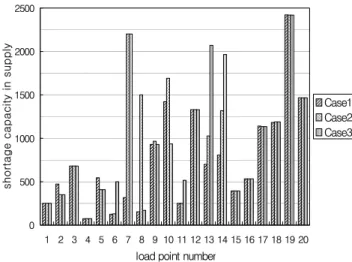
The optimization in this research is conducted based on the reliability data shown in Table 1 and then the shortage in supply in the respective load points is compared with each other as shown in Figure 6.
In Case Study 1, the most vulnerable point in view of the reliability indices is the load point 19. Since this problem is generated due to the limitation of the line capacity, the point 19 is required to increase its line capacity.
In Case Study 2, load points, 7,8 and 9 are shown as the most vulnerable points, while in Case Study 3, load points 7, 13, 14 and 19 have the lowest reliability incises.
As a result, the load point where a reinforcement is required can be easily recognized.
The reliability evaluation results in view of the energy need in supply to the whole system is shown in Figure 7. In the reconstruction of the model by the switch operation, the system construction in the cases 1 and 2 has shown to be inappropriate in view of the reliability.
1
2
3
S1 15000
16000 17000 18000 19000 20000
shortage capacity in supply
case study
Figure 7. Reliability evaluating results by the respective case studies
. Conclusion
Ⅲ
This paper proposed a reliability evaluating plan for the optimal scheme and operation of the electric distribution system by introducing the optimal load switching concept, the reliability indices can be calculated using the reliability data and the shortage capacity in supply at the respective load points.
In Particular, problems limited in the local solution
at the existing branch exchange (BE) and the maximum follower methods can be overcome by using GA associated with the optimization technique.
In addition, to overcome the tree restricting condition generated during the operation of gene, an algorithm for searching the tree is established.
This method is applied to the model system to prove of validity of the tenacity. In case of applied it to the actual system, it is possible to design the system with an enhanced reliability counterplan in detail by each customer other than evaluating relatively the predominance over the whole system.
Hereinafter, it is required to establish a composite distribution planning program including loss minimization and algorithm for load balancing.
The present research has been conducted by the Research Grant of Seoil University in 2009.
References
[1] D. Choi, J. Hasegawa "An Application of Genetic Algorithms to the Distribution System Loss Minimization Re-configuration Problem" IPEC'95 Vol. 2. pp. 436-441, 1995.
[2] D. Choi, J. Hasegawa "An Application of Genetic Algorithms to the Network Reconfiguration in Distribution Systems for Loss Minimization and Balancing Problem". IEEE SICICI '95 pp. 81-86.
2-8, July. 1995.
[3] R. Billinton, R. Goel. "An analytical approach to evaluate probability distribution associated with the reliability indices of electric distribution systems"
IEEE Trans. on Power elivery, Vol. PWRD-1, No.
3. pp. 245-252, July 1986.
[4] Mesut E. Baran, Felix F. Wu, "Network reconfiguration in distribution systems for loss reduction and load balancing", IEEE Transactions on Power Delivery, Vol. 4, No. 2, 1401-1407, April 1989.
[5] Koichi, Nara, Atusshi. Shiose, Minoru. Kitagawa, Toshihisa Ishihara, "Implimentation of genetic reduction and load balancing", IEEE Transactions on Power Delivery, Vol. 4, No. 2, 1401-1407, April 1989.
[6] Tsutomu Oyama, "Restorative planning of power system using genetic algorithm with branch exchange method", Proceedngs of ISAP96.
pp. 175-179, August. 1996.
[7] D. E. Goldberg, "Genetic algorithms in search,
optimization and machine learning", Addison- Wesley, 1989.
[8] Michalewicz, "Genetic Algorithms Data, structures", Evolution Programs second edition, Springer- Verlag, 1994.
[9] D. B. Fogel, "Introduction to simulated evolutionary optimization", IEEE Trans on Neural Networks, Vol.
5, No. 1, pp. 3-14, 1994.
[10] Branko Soucek, "Dynamic, Genetic and Chaotic programming", The Sixth- Generation, John Wiley
& Sona inc. 1992.
저 자
오 선(Seon Oh) 정회원
년 월 서울과학기술대학교 1988 2 :
공학사졸업
년 월 단국대학교 기계공학과 1991 9 :
공학석사졸업
년 월 단국대학교 기계공학과 1999 8 :
공학박사졸업
관심분야 위성통신 우주공학
< > ,
서 정 갑(Jeongkap Seo) 정회원
년 월 서울산업대학교 전기과 1990 2 :
졸업
년 월 연세대학교 산업대학원 1992 8 :
전기과 졸업
년 월 현재 서일대학교 전기
1995 9 ~ :
과 시간강사
관심분야 제어 및 임베디드 시스템
< >