반복적인 고온환경이 사전고온 적응한 육계의 생산성에 미치는 영향
황보 종4*․양영록1*․윤형숙1,2,3․김지민1,2,3․박병성5․최희철4․최양호1,2,†
1경상대학교 축산학과, 2경상대학교 농업생명과학연구원, 3경상대학교 대학원 응용생명과학부(BK21 Plus Program),
4농촌진흥청 국립축산과학원 가금과,5강원대학교 동물생명과학과
Effects of Repeated High Ambient Temperature on Performance in Broilers Heat-Conditioned at an Early Age
Jong Hwangbo4*, Young-Rok Yang1*, HyungSook Yoon1,2,3, Jimin Kim1,2,3, Byungsung Park5, Hee Chul Choi4 and Yang-Ho Choi1,2†
1Dept. of Animal Science, Gyeongsang National University, Jinju 660-701, Korea
2Institute of Agriculture and Life Sciences, Gyeongsang National University, Jinju 660-701, Korea
3Division of Applied Life Sciences (BK21 Plus Program), Gyeongsang National University, Jinju 660-701, Korea
4Division of Poultry Science, National Institute of Animal Science, RDA, Cheonan 301-801, Korea
5Dept. of Animal Biotechnology, Kangwon National University, Chooncheon 200-701, Korea
ABSTRACT Heat conditioning at an early age has been known to help chickens cope with heat stress later in life. The present study was conducted to determine the effects of heat conditioning at 5 days of age in broilers repeatedly exposed to high ambient temperature later in life. A total of 256 day-old Arbor Acre boiler chicks were housed in two identical rooms with a 23-h light/1-h dark cycle and provided with feed and water ad libitum. At 5 days of age, the birds in one room were exposed to 37 °C for 24 hours, while those in the other room served as controls. On day 21, half of the birds in each room were moved into the other room so that each room contained both control and heat-conditioned birds. After a 7-day adaptation period, the birds in one room were exposed to high ambient temperature (21°C → 31°C) for 3 days, whereas those in the other room were kept at normal temperature. The same 3-day exposure to high ambient temperature was repeated two weeks later. Hence, there were four treatment groups (CON+CON: control+control; CON+HS: control+high ambient temperature;
HC+CON: heat conditioning+control; and HC+HS: heat conditioning+high ambient temperature). Repeated heat stress resulted in decreased feed intake, water intake, body weight gain, and spleen weight (p<0.05) and increased rectal temperature (p<0.05), mortality, and plasma corticosterone concentrations. The relative weight of the spleen was increased in the heat-conditioned group (p<0.05). Plasma biochemicals were also influenced by high temperature. Thus, no beneficial effects of heat conditioning at an early age were detected in broilers repeatedly exposed to high ambient temperature later in life.
(Key words: broilers, early heat conditioning, repeated high ambient temperature, performance)
* Jong Hwangbo and Young-Rok Yang contributed equally to this work.
†To whom correspondence should be addressed : [email protected]
서 론
고온환경은 가금 산업에서 스트레스를 유발하는 중요한 요인 중 하나이다(Lin et al., 2006). 성숙한 닭의 체온은 42℃
정도로 포유동물보다 높으며(Kadono and Besch, 1978), 닭 의 피부에는 땀샘이 없으므로 피부 표면에서 증발을 통해 체 열을 발산시킬 수가 없다. 따라서 과다한 체열 발생의 대부
분을 호흡으로 배출해야 한다(Richards, 1970). 그러므로 고 온환경을 경험하는 닭에서는 행동뿐만 아니라, 생리적 변화 가 있게 되며, 그 결과 생산성이 저하되어 농가에 피해를 발 생시킨다(El-Moniary et al., 2010; Prieto and Campo, 2010).
예년에 비해 길렀지만 강수량이 적었던 2015년의 장마가 끝 난 후 시작된 폭염으로 폐사된 가축은 8월 중순까지 243만 마리 이상이며, 이 가운데 닭의 폐사율은 약 96%를 차지하
였다(Ministry of Public Safety and Security. 2015).
특히 육계의 경우, 산란계에 비해서 성장속도가 빠르고 조 단백질과 에너지 함량이 높은 사료를 섭취하기 때문에 대사 열이 높아 고온환경에 취약하다. 고온환경을 경험하는 육계 에서는 사료 섭취량, 음수량, 체중이 감소되며, 따라서 사료 효율이 감소되고, 체온, 지방 침착 및 폐사율은 증가하게 된 다(Geraert et al., 1996; Quinteiro-Filho et al., 2010; Yahav et al., 1995; Yahav and Hurwitz, 1996; Yoon et al., 2014). 뿐만 아니라 스트레스 지표로 사용되는 혈중 corticosterone의 농도 와 heterophil : lymphocyte 비가 고온환경에서 증가하게 되 며(Aksit et al., 2006; Altan et al., 2003; Yalcin et al., 2003;
Yoon et al., 2014), PSE육이 발생하여 계육 품질 저하의 주요 요인이 된다(Northcutt et al., 1994).
가금에서 고온환경에 대한 저항능력을 향상시키기 위한 방법의 하나로 사전 열적응이 보고되고 있다. 사전고온 적 응이란 부화과정에 있는 배아나 감온 과정에 있는 초생추를 36∼39℃ 정도의 온도에 일정시간 동안 노출시켜 성장 이후 에 이들이 고온에 다시 노출되었을 때 열 저항성을 갖게 하 도록 하는 온도 조작과정이다(Arjona et al., 1990; Collin et al., 2007; De Basilio et al., 2001; Yahav and Hurwitz, 1996).
예를 들면, Arjona et al.(1988)와 Yahav and Hurwitz(1996)의 보고에 의하면, 사전고온 적응을 경험한 병아리에서 사료효 율이 개선되었고, 직장 온도와 폐사율이 감소되었다. 그러나 사전고온 적응이 출하일령 전후의 육계에서 고온환경의 영 향을 감소시킬 것이라는 가설은, 반드시 유사한 목적을 가 지고 수행된 모든 유사한 연구에서 입증된 것이 아니며, 연 구자나 연구방법에 따라 전혀 다른 결과가 보고되기도 한 다. 심지어 고온환경의 저항능력을 향상시키려는 같은 연구 자의 다른 연구결과 사이에도 사전고온 적응에 대한 일관된 결과는 보이지 않는다(Collin et al., 2007; Yahav and Hurwitz, 1996). 뿐만 아니라 May(1995)는 사전고온 적응 처리된 육 계가 5주 또는 6주 후에 고온환경을 다시 경험했을 때 증체 량, 사료효율 및 폐사율에 차이를 보이지 않았으며, 이 결과 는 사전고온 적응의 유효성에 의문을 제기한다. 이러한 결 과와 일치하게 본 연구의 연저자(Yoon et al., 2014)와 다른 연구자들(May, 1995; Star et al., 2009)의 연구에서도 사전고 온 적응의 효과가 확인되지 않았다.
우리나라의 여름철에는 장마 이후에 고온 다습한 시기가 오랜 기간 지속되는 것이 특징이다. 따라서 우리나라에서 가 축은 여름철에 지속적 혹은 반복해서 고온에 노출될 수밖에 없다. 따라서 본 연구에서는 사전고온 적응이 반복적으로 고 온환경에 노출된 육계의 생산성에 미치는 영향이 조사되었다.
재료 및 방법
1. 동물 및 사육환경
1일령의 Arbor Acres 육계 256수(에이스인티그레이션, 경 북 경산)를 크기가 같은 두 개의 방에 사육실 당 8펜씩, 펜 당 16수씩 사육밀도를 동일하게 하여 수용하였다. 두 사육 실의 환경은 사전고온 적응 및 고온환경실험 기간 동안의 온도의 변화 이외는 동일하였다. 입추 당시 사육실의 온도 를 34℃에서 이틀에 1℃씩 감소시켜 21일령에 21℃, 상대습 도를 입추 초기 70%에서 21일령에 60%가 되도록 하였다.
사료와 물은 자유로이 섭취하게 하였고, 각 펜의 네 모서리 에, 니플을 장착한 2 L용 물병을 통해서 물이 공급되었다.
펜의 넓이는 사료통을 포함하여 1.1 m2였으며, 고온환경실험 의 시작 시점을 기준으로 25 kg/m2의 사육밀도가 유지되도 록 하였다. 사양기간 동안 사육실 내의 온도, 상대습도 및 폐사율이 매일, 체중, 사료 섭취량 및 음수량은 매주 측정되 었다. 사육실의 점등시간은 1시부터 24시까지이고, 소등시간 은 24시부터 1시까지 하였다. 본 연구는 경상대학교 동물실 험윤리위원회의 승인 하에 수행되었다.
2. 사전고온 적응 및 고온환경실험
사전고온 적응을 경험하는 육계가 수용된 사육실에서는 5 일령의 17시부터 20시까지 온도를 1시간에 2℃씩 올려 최종 온도 37℃로 24시간 동안 유지한 후, 6일령의 대조구 육계가 사육되고 있는 사육실의 온도로 내린 후에 원래의 감온과정 에 맞추어 온도를 낮추었다(사전고온 적응구: HC). 다른 사 육실에는 일반 육계의 온도관리와 같은 감온 일정에 맞추어 환경온도가 유지되었다(대조구: CON). 21일령에, 각각의 사 육실에서 육계의 반을 다른 사육실로 옮겨, 한 사육실 내 대 조구와 사전고온 적응구를 포함하도록 배치하였다. Yoon et al.(2014)에 의해 보고된 것처럼, 그 후 1주간의 환경적응기간 후 29일령에 1차 고온환경실험이 수행되었다. 하나의 사육실 에서 정상적인 사육조건(온도 22±1℃, 상대습도 60±15%)을 유지하였지만(대조구: CON), 다른 사육실의 온도를 한 시간 에 2℃씩 상승시켜 32±1℃에 도달하도록 하여 육계가 고온 환경(상대습도 60±15%)을 경험하게 하였다(고온환경처리구:
HS). 따라서 이러한 육계의 재배치 및 고온환경처리의 결과, 1) 사전고온 적응 및 고온환경 양자 모두를 경험하지 않은 육 계집단(CON+CON), 2) 사전고온 적응을 경험했지만 고온환 경을 경험하지 않은 육계집단(HC+CON), 3) 사전고온 적응 없이 고온환경만 경험한 육계집단(CON+HS), 4) 사전고온 적 응 및 고온환경 모두를 경험한 육계집단(HC+HS)을 가지는
이원배치법(HC vs. HS)으로 실험을 수행하였다. 본 연구에 서는 1차 고온환경실험에 이용된 육계(Yoon et al., 2014)를 43일령부터 3일 동안 2차로 고온환경에 노출시킨 후, 사료섭 취량, 체중, 폐사율 등을 조사하였다. 따라서 1차 및 2차 고 온환경실험에서 임의의 육계는 위에서 언급된 4처리구 중의 어느 하나만을 반복해서 경험하도록 하였다. 고온환경실험 동안에 사료 섭취량, 음수량, 체중, 폐사율, 사육실의 온도와 상대습도는 매일 측정되었다.
3. 직장 온도
육계가 고온환경을 경험하기 시작한 후 1일(43일령)과 3 일(45일령)에 삽입형 체온 측정계(#HI91610C, Hanna Instru- ments, Woonsocket, RI, USA)의 측정자를 육계의 직장에 삽 입하여 약 10초 동안에 직장온도가 안정된 값을 나타낼 때의 온도를 기록하였다.
4. F낭과 비장 무게
육계가 고온환경을 경험하기 시작한 후 1일(43일령)과 3 일(45일령)에 각 처리구 당 8수씩 선발하여 단두 후 닭의 경 동맥에서 혈액을 채혈하였고, 개복 후 비장과 F낭을 적출하 여 무게를 측정하고, 액체 질소에 —80℃에 냉동하였다. 이 들의 무게는 체중 100 g당의 무게로 환산 후 분석되었다. 적 출된 간 조직의 표면을 0.9% 식염수로 세척한 다음 수분과 혈액을 제거한 후, 색도계(#CR-400, Konica-Minolta, Tokyo, Japan)의 측정자를 모양이 손상하지 않을 정도로 간의 표면 에 가볍게 밀착시킨 후 색도를 측정하였다. 한 개체당 2번 측정하여 평균치를 이용하였다.
5. 혈액 분석
고온환경 개시 후 1일째(43일령)에 단두기를 사용하여 닭 을 희생시키고, 경동맥에서 채혈 후 원심분리(2,000× g, 4℃, 10분)하여 혈장을 채취해 —80℃에 보관하였다. 혈액분석기 (VetTest® 8008, IDEXX Laboratories, Westbrook, ME, USA) 를 이용하여 aspartate aminotransferase(AST), total protein (TP), glucose(GLU), inorganic phosphate(PHOS), triglycerides (TRIG), albumin(ALB), globulin(GLOB), creatinine(CREA), cholesterol(CHOL), amylase(AMYL) 및 ammonia(NH3)를 분 석하였다. 또한 상용 ELISA kit(#ADI-900-097, Enzo Life Sci- ences, Farmingdale, NY, USA)를 사용하여 혈장 corticosterone 농도를 분석하였고, 그 값을 ELISA 판독기(#51119000, Mul- tiskanTM FC Microplate Photometer, Waltham, MA, USA)를 이용하여 측정하였다.
6. 통계분석
본 실험에 얻어진 자료는 SAS v.9.3(SAS Institute, Carry, NC, USA)의 일반선형모형(Ggeneral Linear Model)을 이용 하여, 각각의 날짜에서 사전고온 적응(대조구 vs. 사전고온 적 응구)과 고온환경(대조구 vs. 고온환경처리구) 사이에 이원분 산분석으로, 그리고 각 처리구 내에서 경시적인 변화를 일원 분산분석으로 분석하였다. 유의성이 인정되는 경우(p≤0.05), 처리구들 사이에 평균은 LSmeans로, 각 처리구내에서 평균 치는 Duncan 다중검정으로 비교되었다.
결 과
본 연구에서 일부의 육계들은 생후 5일령에 사전고온 적응 과 29일령부터 3일 동안 1차 고온환경을, 그 후 43일령부터 3일간 2차 고온환경을 경험하였다. 고온환경실험 전날(42일 령: Day 0)에는 처리구들 사이에 사료섭취량에는 차이가 없 었다(Table 1). 고온환경실험이 시작된 후 3일 동안에 사전고 온 적응(HC)은 일일 사료섭취량에 전혀 영향을 미치지 않았 고(p<0.05), 고온환경(HS)만이 유의적으로 감소시켰으며, 주 요인들 사이의 교호작용(사전고온 적응×고온환경: HC×HS) 도 유의적이지 않았다(P>0.05). 각 처리구내 Day 0로부터 날 짜의 경과에 따른 변화를 별도로 분석한 결과, 사전고온 적 응과 고온환경을 전혀 경험하지 않은 처리구(CON+CON)에 서 Day 0의 섭취량과 비교했을 때 Day 2에 유의적으로 감소 하였으나(30.2%), Day 3에는 Day 0의 수준으로 회복되었다.
이러한 경향은 사전고온 적응을 경험한 이후 고온환경을 경 험하지 않았던 처리구(HC+CON)에서도 유사하였지만, Day 3의 사료섭취량은 Day 0의 수준보다 낮았다(14% 정도 감소).
그러나 고온환경(CON+HS: HC+HS)은 사전고온 적응의 유 무와 무관하게 3일 동안 일일 사료섭취량을 74∼88% 정도로 감소시켰다.
음수량을 분석했을 때, 사전고온 적응은 Day 3에만 그리 고 고온환경은 실험기간 4일 동안(Day 0∼Day 3) 유의적으 로 음수량에 영향을 미쳤으나(p<0.05), 주 요인들 사이의 교 호작용(사전고온 적응×고온환경: HC×HS)도 유의적이지 않 았다(P>0.05)(Table 1). 반면에 각 처리구 내에서 날짜에 따 른 반응은 사료섭취량과 다소 다른 양상을 보였다. 음수량은 사전고온 적응의 유무와 무관하게 대조구(CON+CON: HC+
CON)에서 Day 0에 비해 증가하였다. 그러나 사전고온 적응 을 경험한 동물에서 고온환경(HC+HS)은 음수량을 지속적으 로 감소시켰지만, 사전고온 적응 없이 고온환경을 경험한 육 계(CON +HS)에서는 음수량이 고온환경실험 개시 후 처음
Table 1. Effects of repeated high ambient temperature at 43 days of age for 3 days on feed and water intakes (g) in boilers heat-conditioned at 5 days of age, and exposed to high ambient temperature at 29 days of age for 3 days
Treatments
Feed intake (g) Water intake (g)
Day 0 Day 1 Day 2 Day 3 Day 0 Day 1 Day 2 Day 3
CON+CON 212.3±13.1 157.3±7.4a 148.3±28.3a* 221.5±21.2a 288.3±20.1 319.8±19.5a 442.5±105.4a 428.5±46.2a CON+HS 197.0± 1.7 47.3±7.7b* 24.0±10.1b* 29.8± 1.3b* 210.8±15.4 165.5±62.6b 158.8± 26.8b 352.5±25.5a*
HC+CON 200.3±11.1 153.3±19.2a 140.5±20.7a* 171.8±19.0a 283.5±22.3 284.5±31.4a 317.8± 42.5ab 320.0±62.1ab HC+HS 210.5±12.1 50.8±11.4b* 41.5±17.7b* 55.5±23.4b* 264.3±16.7 161.0±24.0b 192.3± 61.5b 173.3±59.3b
ANOVA
HC 0.945 0.984 0.814 0.536 0.220 0.613 0.503 0.015
HS 0.817 <.0001 <.0001 <.0001 0.025 0.004 0.009 0.047
HC*HS 0.251 0.767 0.546 0.068 0.148 0.695 0.254 0.496
At 5 days of age, a group broiler chicks in one room were exposed to 37℃ for 24 hours while those in the other were maintained under the routine management serving as control. The birds in each room were divided into two identical subgroups on 21 days.
One half the birds in one room were then moved into the other room, and vise versa, so that each room had both control and heat- conditioned birds in equal numbers. Starting from 29 days of age (Day 0) for 3 days after a 7-day adaptation, broilers in one room were exposed to the first round of high ambient temperature by increasing the room temperature in the room from 22℃ to 32℃
at a rate of 2℃/h, and again they began to experience the second round of high temperature for 3 days from 43 days (Day 0) to 45 days (Day 3) whereas those in the other room were kept at room temperature serving as control against high ambient tem- perature. These resulted in making 4 treatment groups (CON+CON: control+control; CON+HS: control+high ambient temperature;
HC+CON: heat conditioning+control; HC+HS: heat conditioning+high ambient temperature).
* Data (mean±SEM) within each treatment are significantly different from those of Day 0 at p<0.05. Means with a common super- script on each day are significantly different at p<0.05.
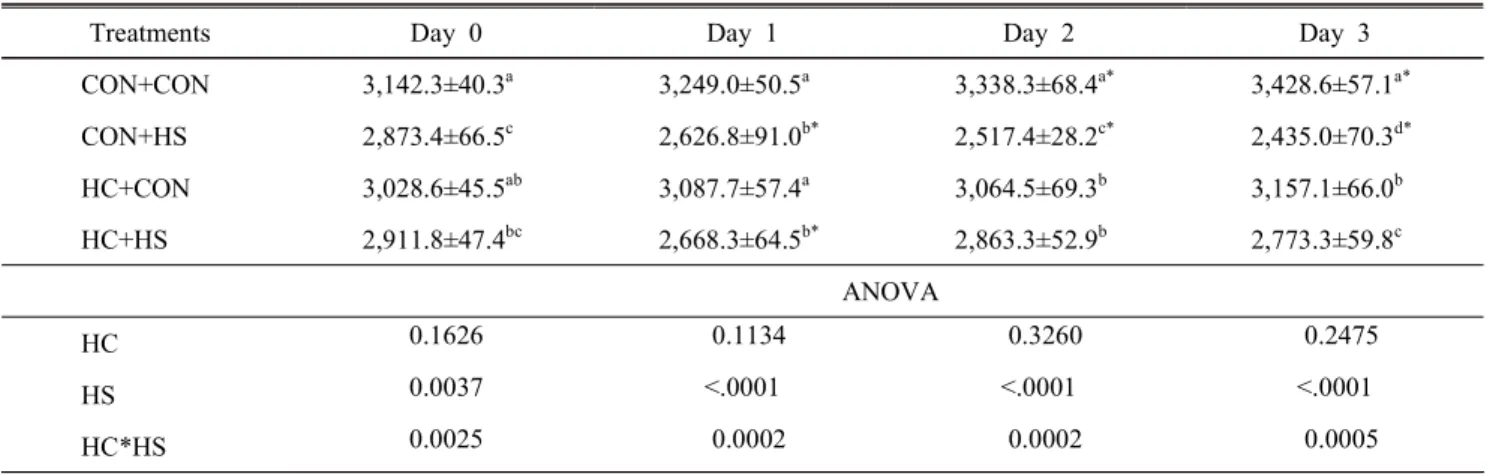
Table 2. Effects of repeated high ambient temperature at 43 days of age for 3 days on body weight (g) in boilers heat-conditioned at 5 days of age, and exposed to high ambient temperature at 29 days of age for 3 days
Treatments Day 0 Day 1 Day 2 Day 3
CON+CON 3,142.3±40.3a 3,249.0±50.5a 3,338.3±68.4a* 3,428.6±57.1a*
CON+HS 2,873.4±66.5c 2,626.8±91.0b* 2,517.4±28.2c* 2,435.0±70.3d*
HC+CON 3,028.6±45.5ab 3,087.7±57.4a 3,064.5±69.3b 3,157.1±66.0b
HC+HS 2,911.8±47.4bc 2,668.3±64.5b* 2,863.3±52.9b 2,773.3±59.8c
ANOVA
HC 0.1626 0.1134 0.3260 0.2475
HS 0.0037 <.0001 <.0001 <.0001
HC*HS 0.0025 0.0002 0.0002 0.0005
For detailed methods, see footnotes in Table 1 and Materials and Methods section in the text.
2일 동안만 25% 정도까지 감소된 후 3일째에는 거의 170%
가량 증가되었다.
체중의 변화를 분석한 결과, 3일간의 1차 고온환경실험으 로 2차 고온환경실험의 개시 직전(42 days: Day 0) 및 이후의 체중은 3일 동안(Day 1∼Day 3) 줄곧 유의적으로 영향을 받
았다(p<0.05). 반면에 사전고온 적응의 효과가 없었지만(P>
0.05) 이들 사이에는 유의적인 교호작용(사전고온 적응×고 온환경: HC×HS)이 있었다(p<0.05)(Table 2). 각 처리구 내에 서 날짜의 경과에 따른 분석에서 체중은 CON+CON구에서 꾸준하게 증가하여, Day 2 및 Day 3일령에는 유의적으로 증
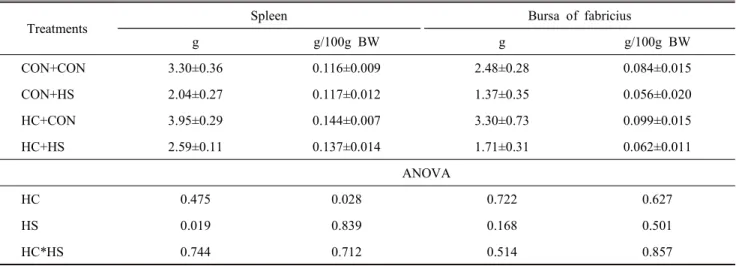
Table 4. Effects of repeated high ambient temperature at 43 days of age for 3 days on weights and relative weights (g/100 g body weight (BW)) of the spleen and bursa of fabricius in boilers heat-conditioned at 5 days of age, and exposed to high ambient tem- perature at 29 days of age for 3 days
Treatments
Spleen Bursa of fabricius
g g/100g BW g g/100g BW
CON+CON 3.30±0.36 0.116±0.009 2.48±0.28 0.084±0.015
CON+HS 2.04±0.27 0.117±0.012 1.37±0.35 0.056±0.020
HC+CON 3.95±0.29 0.144±0.007 3.30±0.73 0.099±0.015
HC+HS 2.59±0.11 0.137±0.014 1.71±0.31 0.062±0.011
ANOVA
HC 0.475 0.028 0.722 0.627
HS 0.019 0.839 0.168 0.501
HC*HS 0.744 0.712 0.514 0.857
The two organs were collected on Day 3.
For detailed methods, see footnotes in Table 1 and Materials and Methods section in the text.
가하였다(p<0.05). 증가폭은 작지만 HC+CON구에서도 유사 한 경향이 발견되었다. 한편, 고온환경을 경험한 CON+HS구 에서는 체중이 Day 0에 비해 Day 1에 8.6%, Day 3에 15.3%
감소하였고, HC+HS구에서는 Day 1에 8.7%에서 Day 3에 4.8
% 감소하였다. Day 0에서 Day 3까지 절대체중은, CON+HS 구에서 438 g이 감소하였지만, HC+HS구에서는 139 g 감소하 는데 그쳤다. 이것은 고온환경을 경험하기 직전인 Day 0에 두 처리구의 평균체중((CON+HS)—(HC+HS))이 38 g 밖에 차이 나지 않는다는 것을 고려할 때 주목할 만한 결과이다.
직장 온도는 사전고온 적응 없이 고온환경을 경험한 닭에 서 대조구에 비해(CON+CON vs. CON+HS) Day 1 및 Day 3에 각각 0.9℃씩 증가하였으며(P<0.011), 사전고온 적응 후 고온환경을 경험한 닭에서는 대조구에 비해(HC+CON vs.
HC+HS) Day 1에 0.6℃ 및 Day 3에 1.0℃ 증가하였다(P<
0.0001). 그러나 사전고온 적응의 효과나 이들의 교호작용은 확인되지 않았다(Table 3).
폐사율은 고온환경실험 개시 시점(Day 0)에서 육계의 수 를 기준으로 도출되었으며, 폐사율의 주된 요인은 고온환경 이었고, 사전고온 적응과 무관하였다. 즉, 폐사계는 고온환경 을 경험하지 않은 처리구에서 사전고온 적응과 관계없이 발 견되지 않았고, 고온환경을 경험한 처리구에서만 발생되어 3일 동안 총폐사율은 CON+HS구에서 47.8%였고, HC+HS구 에서 45.0%였다. 폐사계는 고온환경(HS)실험의 셋째 날(Day 3) 및 고온환경을 경험하지 않은 처리구들(CON+CON 및 HC +CON)에서는 전혀 발견되지 않았다.
Table 3. Effects of repeated high ambient temperature at 43 days of age for 3 days on rectal temperature (℃) in boilers heat-con- ditioned at 5 days of age, and exposed to high ambient temperature at 29 days of age for 3 days
Treatments Day 1 Day 3
CON+CON 42.3±0.1b 42.1±0.1b
CON+HS 43.2±0.2a 43.0±0.3a
HC+CON 42.6±0.3ab 42.2±0.1b
HC+HS 43.2±0.4a 43.2±0.1a
ANOVA
HC 0.5701 0.6125
HS 0.0113 <.0001
HC*HS 0.412 0.9784
For detailed methods, see footnotes in Table 1 and Materials and Methods section in the text.
육계가 2차 고온환경에 노출된 지 3일째(Day 3) 비장의 절 대무게는 유의적으로 고온의 영향을 받았지만(p<0.05), 사전 고온 적응의 영향 및 이들 사이의 교호작용은 유의적이지 않 았다(Table 5). 그러나 비장의 상대적인 무게는 사전고온 적 응에 의해 유의적으로 증가되었다(p<0.05). 반면에, 사전고온 적응과 고온환경 양자는 F낭의 절대 및 상대 무게에 영향을 미치지 않았으며, 이들 사이의 교호작용도 확인되지 않았다.
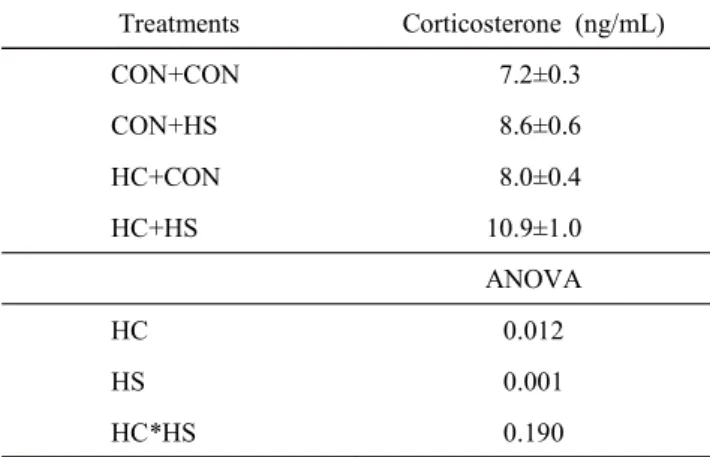
사전고온 적응(P<0.012)뿐만 아니라, 고온환경(P<0.001) 양
Table 6. Effects of repeated high ambient temperature at 43 days of age for 3 days on plasma biochemicals in boilers heat-conditioned at 5 days of age, and exposed to high ambient temperature at 29 days of age for 3 days
Treatments AST (U/L)
TP (g/dL)
GLU (mg/dL)
PHOS (mg/dL)
TRIG (mg/dL)
ALB (g/dL)
GLOB (g/dL)
CREA (mg/dL)
CHOL (mg/dL)
AMYL (U/L)
NH3
(μmol/L) CON+CON 464±56.9 2.6±0.2 238±4.9 6.2±0.2 28.0±3.3 0.7±0.1 1.9±0.1 0.1±0.00 102±6.7 221±28.5 259±28.9 CON+HS 419±40.3 2.8±0.1 263±5.0 6.2±0.2 26.4±4.1 0.8±0.1 2.0±0.1 0.1±0.00 109±5.9 239±41.9 301±42.2 HC+CON 504±26.7 2.8±0.1 257±4.0 6.8±0.1 43.0±3.3 0.8±0.1 2.1±0.1 0.1±0.02 110±7.3 248±36.1 294±24.6 HC+HS 508±34.4 3.3±0.1 270±11.8 6.2±0.2 27.0±3.9 1.0±0.1 2.3±0.1 0.1±0.04 131±4.8 334±57.6 195±23.6
ANOVA
HC 0.207 0.025 0.035 0.159 0.057 0.199 0.006 0.266 0.043 0.168 0.320
HS 0.677 0.048 0.003 0.103 0.033 0.159 0.028 0.266 0.054 0.240 0.413
HC*HS 0.626 0.375 0.349 0.195 0.078 0.602 0.511 0.266 0.324 0.436 0.056
Abbreviations: aspartate aminotransferase (AST), total protein (TP), glucose (GLU), inorganic phosphate (PHOS), triglycerides (TRIG), albumin (ALB), globulin (GLOB), creatinine (CREA), cholesterol (CHOL), amylase (AMYL) and ammonia (NH3).
For other detailed methods, see footnotes in Table 1 and Materials and Methods section in the text.
Blood were collected on Day 1.
자 모두 Day 1의 혈장 corticosterone 농도를 유의적으로 증가 시켰지만, 양자 사이의 교호작용은 인정되지 않았다(P>0.05) (Table 5). 고온환경뿐만 아니라, 사전고온 적응도 혈액성분 (TP, GLU, GLOB, TRIG, CHOL)에 영향을 미쳤으며, 이들 사 이의 교호작용 또한 영향을 받는 경향이(P<0.078 및 0.056) 이 있었다(Table 6).
고 찰
Table 5. Effects of repeated high ambient temperature at 43 days of age for 3 days on plasma corticosterone concentrations (ng/mL) in boilers heat-conditioned at 5 days of age, and ex- posed to high ambient temperature at 29 days of age for 3 days
Treatments Corticosterone (ng/mL)
CON+CON 7.2±0.3
CON+HS 8.6±0.6
HC+CON 8.0±0.4
HC+HS 10.9±1.0
ANOVA
HC 0.012
HS 0.001
HC*HS 0.190
For detailed methods, see footnotes in Table 1 and Materials and Methods section in the text.
본 연구에서는 육계가 사전고온 적응 후 반복적인 고온환 경을 경험하였을 때 사료섭취량, 음수량, 체중, 체온, 폐사율, 혈장 corticosterone 및 혈액 화학의 농도가 조사되었다. 사전 고온 적응과는 무관하게 고온환경실험 개시 후 사료섭취량 은 현저하게 감소되었다. 이러한 결과는 본 연구집단(Yoon et al., 2014)이나 다른 연구자들(Aksit et al., 2006)에 의해 수행된 1회성 고온환경실험 결과와 유사하다. 특히 주목할 만한 변화는 1차 고온환경실험에서 고온개시 직후 사료섭취 량이 감소되었다가 날짜가 경과함에 따라 3일 동안의 고온 이 끝나는 시점에서는 사료 섭취량이 회복되는 경향을 보였 지만(Yoon et al., 2014),반복해서 고온환경에 노출되었을 때는 실험종료시점(Day 3)에 사료섭취량이 전혀 회복되지 않 았다. 이러한 경향은 1차 고온환경실험의 음수량에서도 관찰 되었지만, 반복해서 고온환경에 노출되었을 때에는 음수량 은 일정하지 않았고, 특히 CON+HS구에서 Day 2의 음수량 이 159 g에서 Day 3에 353 g으로 증가된 원인은 불확실하지 만, 누수와 같이 음수공급시스템에서의 문제에 기인되었을 것 으로 추정된다. 이러한 추정은 음수량/사료섭취량의 비가 Day 0에 평균 1.27이었고, HC+HS에서조차 최고 4.7(Day 2)이었 지만, CON+HS에서 Day 3에 11.8로 증가되었다는 것으로 볼 때 타당하다고 할 수 있다.
1차 고온환경실험에서 체중은 Day 1에 감소된 후 점차 회 복되었고, Day 3에는 사전고온 적응과 관계없이 고온실험개시 시(Day 0)의 체중보다 약 100 g(혹은 약 6%)증가하였다(Yoon
et al., 2014). 그러나 앞선 연구결과와 달리 육계가 반복해서 고온환경을 경험했을 때, 사전고온 적응을 경험하지 않은 육 계집단(CON+HS)에서 Day 0 체중보다 시간이 경과함에 따 라 더욱 감소하여 Day 3에는 15.3%까지 감소하였다 (Day 1:
—8.6%; Day 2: —12.4%; Day 3: —15.3%). 반면에 사전고온 적응을 경험한 육계집단(HC+HS)에서 Day 1에 체중이 8.4%
까지 감소된 이후 반등하여 Day 3까지 감소폭이 5% 이하에 서 유지되었다(Day 1: —8.4%; Day 2: —1.7%; Day 3: —1.8%).
육계는 빠른 성장으로 인한 높은 대사율 때문에 고온에서 항 상성을 유지하는 것이 어렵고(Borges et al., 2004), 체중이 무 거운 육계일수록 고온에 더욱 민감하다(Reece et al., 1972).
따라서 실험개시시의 체중이 CON+HS구에 비해 HC+HS구 에서 38 g이나 더 무거움에도 불구하고, 고온환경하에서 체 중 감소폭이 더 작았다는 것은 주목할 만하다. 따라서 폐사 율이 두 집단 간에 유사한 것(47.8% vs. 45.0%)을 고려한다 면 반복적인 고온환경을 경험하는 육계에서는 사전고온 적응 이 반복된 고온환경에 따른 체중의 감소를 완화시키는데 기 여할지도 모른다.
사전고온 적응은 고온으로 인한 폐사율을 감소시키며(De Basilio et al., 2001), 체중감소 또한 완화시킨다(Deger Oral Toplu et al., 2014). 비록 1차 고온실험에서의 폐사율은 사전 고온 적응을 경험하지 않은 처리구(CON+HS)와 경험한 처 리구(HC+HS)에서 각각 20.7% 및 30.5%로 후자에서 약 10%
높았지만(Yoon et al., 2014), 육계를 반복해서 고온에 노출시 킨 본 연구에서는 오히려 사전고온 적응을 받지 않은 처리구 (CON+HS)에서 사전고온 적응을 경험한 처리구(HC+HS)에 서 보다 폐사율이 약간 높았다(47.8% vs. 45.0%). 이러한 결 과들은, 사전고온 적응이 고온환경을 경험하는 육계에서 생산 성의 개선을 보고한 연구 결과(Arjona et al., 1988; Yahav and Hurwitz, 1996; Yahav et al., 1997)와는 부분적으로 유사하다.
육계가 고온환경에 노출된 후 직장 온도는 상승하였고, 이 러한 온도 변화는 3일 동안의 고온환경실험 기간 내내 확인 되었으며, 사전고온 적응은 전혀 영향을 미치지 않았다. 1차 고온환경실험에서도 이와 유사한 결과가 관찰되었다(Yoon et al., 2014).
체중 100 g 당 상대적인 무게로 환산되었을 때, 사전열적 응을 경험한 동물에서 비장의 무게는 그렇지 않은 집단의 무 게보다 유의적으로 높았다. 이러한 결과는 육계가 사전열적 응 이후 반복적인 고온환경을 경험한 것과 무관하게 관찰되 었다. 또한, 이는 1차 고온환경을 경험한 육계에서 비장의 무게가 감소하였지만, 사전고온 적응의 효과는 관찰되지 않 았던 것과는 대조적이다(Yoon et al., 2014). 그러나 사전열적
응은 1차 고온환경을 경험한 육계에서 F낭의 무게를 감소시 켰지만(Yoon et al., 2014), 2차 고온환경을 경험한 육계에서 는 전혀 영향을 미치지 않았다. Quinteiro-Filho et al.(2010) 의 연구에서는 고온환경의 닭에서 비장과 F낭의 무게가 감 소하였다. 이러한 것은 고온환경으로 육계의 사료섭취량이 감소하여, 영양소공급이 적어지면서 면역기관 발육부진 때 문일 수 있다(Niu et al., 2009). 비장과 F낭은 닭의 면역기관 으로 무게가 감소하였다는 것은 면역력의 약화되었다는 것 을 의미한다.
고온환경뿐만 아니라, 사전고온 적응도 혈장 corticosterone 의 농도에 영향을 미쳤다. 이전의 연구에서 고온환경은 혈장 corticosterone의 농도를 증가시켰으며(Yoon et al., 2014), 이러 한 결과는 다른 연구자들에 의해서도 보고되었다(Giloh et al., 2012). 고온환경은 스트레스호르몬인 corticosterone의 농도를 증가시킬 뿐만 아니라, 육계의 혈액성분에 영향을 미친다.
사전고온 적응의 효과에는 복합적인 요인이 관여하는 것으 로 사료된다. 예를 들면, 5일령의 Cobb 육계(Yahav and Hur- witz, 1996) 또는 Ross 육계(May, 1995)를 이용하여 36℃에 서 24시간 동안 사전고온 적응시킨 연구에서 결과는 상반되 게 나타났다. 즉, 사전고온 적응에 사용된 온도와 병아리의 일령이 같다고 하더라도 계통에 따라 효과는 달라질 수 있음 을 나타낸다. 또한 종계의 나이는 병아리의 온도조절능력에 영향을 미친다고 보고되었다(Yahav and McMurtry, 2001;
Yalcm et al., 2005).
본 연구의 결과를 종합하면, 생후 초기에 사전고온 적응이 반복적인 고온환경을 경험하는 육계에게 고온저항성을 부 여하여 생산성에 긍정적인 결과를 가져온다는 기존의 연구 결과와는 일치하지 않는다. 단지, HC+HS구에서 Day 1에 관 찰된 체중감소 이후 감소율이 현저히 둔화된 것과 사전열적 응 이후 비장의 무게 변화에 대해서는 추가적인 연구가 필 요할 것으로 사료된다.
적 요
생후 초기에 고온을 경험하게 되면 이후 고온환경에 대하 여 저항성을 획득하는 것으로 알려져 있다. 본 연구에서는 5일령의 병아리에게 단시간 고온을 경험하게 한 다음, 29일 령에 1차 고온환경을 경험한 육계에서 반복된 고온환경이 생산성에 미치는 영향을 조사하였다. 아버에이커 초생추를 크기가 동일한 두 개의 사육실에 수용하였으며, 사료와 물 은 자유채식토록 하였다. 조명 환경 조건은 점등 23시간, 소 등 1시간이었다. 사전 고온 적응구는 5일령에 37℃의 고온
에 24시간 동안 노출시킨 후 정상 온도로 돌려졌고, 대조구 의 감온 일정은 정상적으로 진행되었다. 21일령에 육계를 기 존에 수용된 사육실에서 반을 다른 사육실로 옮겨, 한 사육 실 내 대조군와 열 적응구가 각각 4개의 Pen에 배치되게 하 였다. 1) 사전고온 적응 및 고온환경 양자 모두를 경험하지 않은 육계집단(CON+CON), 2) 사전고온 적응을 경험했지만 고온환경을 경험하지 않은 육계집단(HC+CON), 3) 사전고 온 적응 없이 고온환경만 경험한 육계집단(CON+HS), 4) 사 전고온 적응 및 고온환경 모두를 경험한 육계집단(HC+HS) 을 가지는 이원배치법(HC vs. HS) 으로 실험을 수행하였다.
29일령부터 3일 동안 고온환경에 노출된 육계들은 43일령부 터 재차 고온환경을 경험하였다. 고온환경 처리구에서 사육 실 온도를 32℃(2℃/1 h)까지 올려 3일 동안 유지하였으며, 대 조구는 22℃로 유지되었다. 고온환경은 사료 섭취량, 음수량 및 체중을 현저하게 감소시켰으며, 직장 온도와 폐사율 및 corticosterone의 농도를 증가시켰고, 혈액 생화학 성분을 변 화시켰다. 그러나 사전열적응한 육계에서는 비장의 상대무 게가 유의적으로 높았다. 따라서 연구결과를 종합적으로 고 려해볼 때, 사전고온 적응은 반복적으로 고온환경을 경험하 는 육계에게 고온에 대한 저항성을 부여하지 않았다는 것을 의미한다.
(색인어: 육계, 사전고온 적응, 반복적 고온, 생산성) 사 사
본 연구는 농촌진흥청 연구비 지원(PJ00824102)에 의해 수행되었다.
REFERENCES
Aksit M, Yalcin S, Ozkan S, Metin K, Ozdemir D 2006 Effects of temperature during rearing and crating on stress para- meters and meat quality of broilers. Poult Sci. 85:1867- 1874.
Altan O, Pabuccuoglu A, Altan A, Konyalioglu S, Bayraktar H 2003 Effect of heat stress on oxidative stress, lipid peroxi- dation and some stress parameters in broilers. Br Poult Sci.
44:545-550.
Arjona AA, Denbow DM, Weaver WD Jr 1988 Effect of heat stress early in life on mortality of broilers exposed to high environmental temperatures just prior to marketing. Poult
Sci. 67:226-231.
Arjona AA, Denbow DM, Weaver WD Jr 1990 Neonatally- induced thermotolerance: Physiological responses. Comp Biochem Physiol A Comp Physiol. 95:393-399.
Borges SA, Fischer da Silva AV, Majorka A, Hooge DM, Cummings KR 2004 Physiological responses of broiler chickens to heat stress and dietary electrolyte balance (so- dium plus potassium minus chloride, milliequivalents per kilogram). Poult Sci. 83:1551-1558.
Collin A, Berri C, Tesseraud S, Rodon FE, Skiba-Cassy S, Crochet S, Duclos MJ, Rideau N, Tona K, Buyse J, Bru- ggeman V, Decuypere E, Picard M, Yahav S 2007 Effects of thermal manipulation during early and late embryogenesis on thermotolerance and breast muscle characteristics in broiler chickens. Poult Sci. 86:795-800.
Deger Oral Toplu H, Tunca R, Unubol Aypak S, Coven F, Tugrul Epikmen E, Karaarslan S, Yagin O 2014 Effects of heat conditioning and dietary ascorbic acid supplementa- tion on heat shock protein 70 expression, blood parameters and fear-related behavior in broilers subjected to heat stress.
Acta Scientiae Veterinariae. 42(1):1-8.
De Basilio V, Vilarino M, Yahav S, Picard M 2001 Early age thermal conditioning and a dual feeding program for male broilers challenged by heat stress. Poult Sci. 80:29-36.
El-Moniary M, Hemid A, El-Wardany I, Gehad A, Gouda A 2010 The effect of early age heat conditioning and some feeding programs for heat-stressed broiler chicks on: 1-pro- ductive performance. World J Agr Sci. 6:689-695.
Geraert PA, Padilha JC, Guillaumin S 1996 Metabolic and endocrine changes induced by chronic heat exposure in bro- iler chickens: Growth performance, body composition and energy retention. Br J Nutr. 75:195-204.
Giloh M, Shinder D, Yahav S 2012 Skin surface temperature of broiler chickens is correlated to body core temperature and is indicative of their thermoregulatory status. Poult Sci.
91:175-188.
Kadono H, Besch EL 1978 Telemetry measured body tempe- rature of domestic fowl at various ambient temperatures.
Poult Sci. 57:1075-1080.
Lin H, Jiao HC, Buyse J, Decuypere E 2006 Strategies for preventing heat stress in poultry. World's Poultry Science Journal. 62:71-86.
May JD 1995 Ability of broilers to resist heat following neo- natal exposure to high environmental temperature. Poult Sci. 74:1905-1907.
Ministry of Public Safety and Security. Daily briefing on pu- blic safety management released on August 19, 2015. http://
www.safekorea.go.kr/dmtd/contents/room/stat/DaySityRept Detail.jsp?q_menuid=M_NST_SVC_01_02_01&rept_seq=
463749&q_string=&q_strdate=&q_enddate=&pageNo=3 (Accessed August 20, 2015).
Niu ZY, Liu FZ, Yan QL, Li WC 2009 Effects of different levels of vitamin E on growth performance and immune responses of broilers under heat stress. Poult Sci. 88:2101- 2107.
Northcutt JK, Foegeding EA, Edens FW 1994 Water-holding properties of thermally preconditioned chicken breast and leg meat. Poult Sci. 73:308-316.
Prieto MT, Campo JL 2010 Effect of heat and several additives related to stress levels on fluctuating asymmetry, heterophil:
Lymphocyte ratio, and tonic immobility duration in white leghorn chicks. Poult Sci. 89:2071-2077.
Quinteiro-Filho WM, Ribeiro A, Ferraz-de-Paula V, Pinheiro ML, Sakai M, Sa LR, Ferreira AJ, Palermo-Neto J 2010 Heat stress impairs performance parameters, induces intes- tinal injury, and decreases macrophage activity in broiler chickens. Poult Sci. 89:1905-1914.
Reece FN, Deaton JW, Kubena LF 1972 Effects of high tem- perature and humidity on heat prostration of broiler chi- ckens. Poult Sci. 51:2021-2025.
Richards SA 1970 The biology and comparative physiology of thermal panting. Biol Rev Camb Philos Soc. 45:223- 264.
Star L, Juul-Madsen HR, Decuypere E, Nieuwland MG, de Vries Reilingh G, van den Brand H, Kemp B, Parmentier
HK 2009 Effect of early life thermal conditioning and im- mune challenge on thermotolerance and humoral immune competence in adult laying hens. Poult Sci. 88:2253-2261.
Yahav S, Goldfeld S, Plavnik I, Hurwitz S 1995 Physiologi- cal responses of chickens and turkeys to relative humidity during exposure to high ambient temperature. Journal of Thermal Biology. 20:245-253.
Yahav S, Hurwitz S 1996 Induction of thermotolerance in male broiler chickens by temperature conditioning at an early age. Poult Sci. 75:402-406.
Yahav S, McMurtry JP 2001 Thermotolerance acquisition in broiler chickens by temperature conditioning early in life- the effect of timing and ambient temperature. Poult Sci.
80:1662-1666.
Yahav S, Shamai A, Haberfeld A, Horev G, Hurwitz S, Einat M 1997 Induction of thermotolerance in chickens by tem- perature conditioning: Heat shock protein expression. Ann N Y Acad Sci. 813:628-636.
Yalcin S, Ozkan S, Cabuk M, Siegel PB 2003 Criteria for evaluating husbandry practices to alleviate heat stress in broilers. J Appl Poult Res. 12:382-388.
Yalcm S, Ozkan S, Cabuk M, Buyse J, Decuypere E, Siegel PB 2005 Pre- and postnatal conditioning induced thermoto- lerance on body weight, physiological responses and relative asymmetry of broilers originating from young and old bree- der flocks. Poult Sci. 84:967-976.
Yoon HS, Hwangbo J, Yang Y-R, Kim J, Kim Y-H, Park B, Choi Y-H 2014 Effects of early heat conditioning on per- formance in broilers exposed to heat stress. Korean J Poult Sci. 41:297-303.
Received Sep. 4, 2015, Revised Sep. 14, 2015, Accepted Sep. 22, 2015