• 검색 결과가 없습니다.

Fabrication of Ultra Fine β-phase Ti-Nb-Sn-HA Composite by Pulse Current Activated Sintering

N/A
N/A
Protected

Academic year: 2021

Share "Fabrication of Ultra Fine β-phase Ti-Nb-Sn-HA Composite by Pulse Current Activated Sintering"

Copied!
6
0
0

로드 중.... (전체 텍스트 보기)

전체 글

(1)

DOI: 10.4150/KPMI.2010.17.6.443

Fabrication of Ultra Fine β -phase Ti-Nb-Sn-HA Composite by Pulse Current Activated Sintering

Kee-Do Woo * , Xiaopeng Wang

a

, Duck-Soo Kang, Sang-Hyuk Kim, Jeong-Nam Woo

b

, Sang-Hoon Park, and Zhiguang Liu

c

Division of Advanced Material Engineering and Research Center of Advanced Materials Technology(RCAMD), Chonbuk National University, Chonbuk 561-756, Korea

a

School of Material Science and Engineering, Harbin Institute of Technology, Harbin 150001, China

b

Biologics Research Divison, National Institute of Food and Drug Safety Evaluations, Seoul, 122-704, Korea

c
Department of Materials and Process Engineering, The University of Waikato, Private Bag 3105, New Zealand

(Received September 8, 2010; Revised September 30, 2010; Accepted October 12, 2010)

Abstract The β phase Ti-Nb-Sn-HA bio materials were successfully fabricated by high energy mechanical milling and pulse current activated sintering (PCAS). Ti-6Al-4V ELI alloy has been widely used as biomaterial. But the Al has been inducing Alzheimer disease and V is classified as toxic element. In this study, ultra fine sized Ti-Nb- Sn-HA powder was produced by high energy mechanical milling machine. The β phase Ti-Nb-Sn-HA powders were obtained after 12hr milling from α phase. And ultra fine grain sized Ti-Nb-Sn-HA composites could be fab- ricated using PCAS without grain growth. After sintering, the microstructures and phase-transformation of Ti-Nb- Sn-HA biomaterials were analyzed by scanning electron microscope (SEM) and X-ray diffraction (XRD). The rel- ative density was obtained by Archimedes principle and the hardness was measured by Vickers hardness tester.

The β -Ti phase was obtained after 12h milling. As result of hardness and relative density, 12h milled Ti-Nb-Sn- HA composite has the highest values.

Keywords : Ti-Nb-Sn-HA composite, High energy mechanical milling (HEMM), Pulse current activated sintering (PCAS)

1. Introduction

The demand of biomaterial has been increasing due to an aging society. From this reasons, the advanced biomaterials have to be developed. Ti and its alloys such as Ti-6Al-4V ELI (extra low interstitial) alloy have been widely applied as biomaterials due to their excellent biocompatibility, low density, excellent corro- sion resistance and good balance of mechanical prop- erties [1, 2]. Ti-6Al-4V ELI alloy and NiTi shape memory are used as replacement of damaged hard tissues, for example artificial hip joints [3, 4]. How- ever, some problems have been reported with Al and

V elements, which are contained in the most com- monly used Ti-6Al-4V ELI alloy [5, 6]. V element is classified in the sterile abscess (Toxic) group and Al has been linked with neurotoxicity. Al element also occurs Alzheimer’s disease [7]. Additionally, the Young’s modulus of Ti alloy having an α or α + β phase structure is too high compared to that of natu- ral bone [8]. The difference of elastic modulus between Ti-6Al-4V ELI alloy (about 110 MPa) and natural bone (20~30 MPa) may occurs stress shield- ing and implant failure. The β -phase Ti alloy which is bcc structure has lower Young’s modulus range from 60 to 80 MPa compare with α or α + β phase Ti

*Corresponding Author : [Tel : +82-63-270-2299; E-mail : [email protected]]

(2)

alloy [8]. The β -phase forming elements such as Nb, Ta, Mo and Zr, and β -phase improving elements such as Fe, Cr, V, Al and Sn are widely used in Ti based biomaterial. Due to the high plasticity of the

β -phase structure, the β -phase Ti alloys can be eas- ily shaped or deformed by thermomechanical pro- cessing or even at room temperature [2]. But, β - phase Ti alloy has a low strengthen as a disadvan- tage. Making alloy and reducing grain size are to improve strength of β -phase Ti alloy. HA element is one of the most promising materials for biomedical application. It is well known that hydroxyapatite (Ca

10

(PO

4

)

6

(OH)

2

) has biological and chemical simi- larity to the inorganic phases of bones and teeth.

Also, HA is biocompatible with hard tissues of human body and has osteoconductivity [9].

In general, pulse current activated sintering (PCAS) is one of the rapid sintering methods. Rapid sinter- ing can be achieved by PCAS which inhibits grain growth or contamination often caused due to the long sintering duration and high temperature of con- ventional sintering methods.

In this study, new type Ti-Nb-Sn-HA (hydroxyap- atite) composites were fabricated by pulse current activated sintering (PCAS) using various milled powder for 4h, 8h and 12h for improving mechani- cal property and Young’s modulus. Also, the phase transformation from α -phase to β -phase was observed after various milling times and sintering. The mechani- cal properties and microstructure of the ultra fine grained β -phase Ti-Nb-Sn-HA composite by HFIHS have been investigated.

2. Experimental Procedure

The samples were fabricated by adding different HA weight percentages and various milling time.

The compositions of the samples used in this experi-

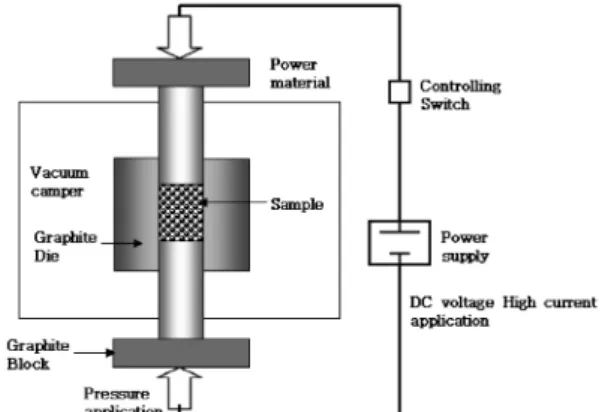
ment are shown in Table 1. The initial average pow- der sizes were 30 µ m, 43 µ m, 43 µ m and 35 nm for pure Ti, Nb, Sn and HA, respectively. The Ti, Nb, Sn and HA powders were placed with steel balls in a sealed cylindrical stainless steel vial under argon atmosphere and then mechanically milled for 4h, 8h and 12h using high energy mechanical milling equip- ment. Fig. 1 shows the schematic diagram of PCAS.

The milled powder was placed in a cylindrical graphite die (outside diameter: 35 mm, inside diame- ter: 10.5 mm, height: 40 mm) and the current of 2800A was applied. The four major stages of the PCAS process are shown in Fig. 2. The chamber was evacuated down to 10

−3

torr and a uniaxial pres- sure of 60 MPa was applied. The as-milled powder was sintered at 1100

o

C and cooled in air. Tempera- ture of the power compact was measured using a pyrometer focused on the surface of the graphite die.

Table 1. Sample compositions (wt.%)

Ti Nb Sn HA

Composition Bal. 35 2.5 15

Fig. 1. Schematic diagram of apparatus for PCAS.

Fig. 2. The four major stages of the PCAS process.

(3)

Shrinkage displacement of composites was obtained by measuring vertical displacement using a linear gage. The phases of the Ti-Nb-Sn-HA composites and powder were investigated before and after sin- tering using XRD with Cu K α radiation within the 2 range of 20-80°. The particle shape of the milled Ti- Nb-Sn-HA powders and morphologies of Ti-Nb-Sn- HA composites were observed by a scanning elec- tron microscope (JSM-6400: SEM). The density was measured by Archimedes’ principle. And the hard- ness was obtained using Vickers hardness tester with a loading of 1 kgf for 5seconds.

3. Results and Discussion

Fig. 3 shows typical SEM images of the variations in particle shape and size in Ti-Nb-Sn-HA powders with milling time. The as-mixed powder particles were found to be the irregular shape. The Ti-Nb-Sn-HA powder milled for 12h were found to be ellipsoids because of the strong plastic deformation that had occurred (Fig. 3-(d)). And, The Ti-Nb-Sn-HA pow- ders milled for 12h and 8h are agglomerated due to existing high surface energy. During HEMM, parti- cles were subsequently broken by a steel ball. This process was continued during HEMM. Also, numer- ous defects such as dislocations and voids are

included and the free surface areas of particles are increased due to HEMM.

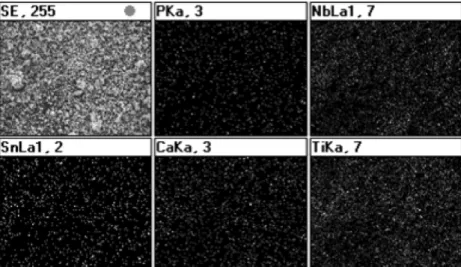
Fig. 4 shows the result of X-ray mapping after 12h milling. It was found that Ti, Nb, Sn and HA pow- ders are homogenously distributed. The Ca and P elements are displayed in Fig. 4 instead of HA.

Because HA is consist of Ca and P elements. It can confirm that the excellent distributed powders were obtained after milling for 12h. The XRD patterns obtained for the as-mixed and as-milled Ti-Nb-Sn- HA powders within 2 θ range of 20

o

to 80

o

are shown Fig. 3. SEM micrographs of as-mixed and as-milled Ti- 35Nb-2.5Sn-15HA powder with different milling times; (a) as-mixed for 24h, (b) as-milled for 4h, (c) as-milled for 8h and (d) as-milled for 12h.

Fig. 4.Result of X-ray mapping of 12h milled Ti-35Nb-2.5Sn-15HA powder.

(4)

Fig. 5. The XRD patterns of the as-mixed powders indicated that there were only α -phase Ti, Nb, Sn and HA, it means there is no reaction during the mixing process. With increasing milling time, the intensity of α -phase Ti decreased and was com- pletely transformed to β -phase Ti after 12hr milling.

The peaks of Sn vanished in XRD patterns of 8h and 12h milled powders. It means that Sn may form a solid solution of Ti during the milling. Nb was dis- solved into Ti to form solid solution as a stabilizing element of β -phase Ti.

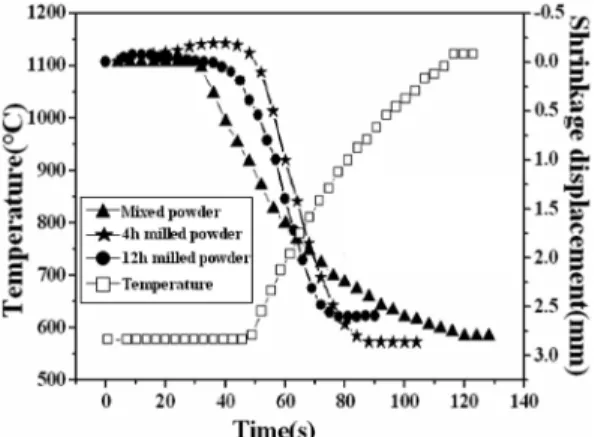
Temperature, time and shrinkage displacement curves of Ti-Nb-Sn-HA composites during the PCAS are shown in Fig. 6. With increasing temperature,

shrinkage displacement of the composites gradually increased. And the sintering time and temperature were reduced with increasing milling time. So, short sintering time and low temperature were very impor- tant to have HA biocompatibility. Because the decom- pose temperature of HA is 1000

o

C [10]. When the temperature reached about 900

o

C, shrinkage dis- placement of 12h milled powder was not changed. It means that 12h milled powder have been sintered completely at 900

o

C. On the other hand, mixed and 4h milled powder have been finished sintering about 1100

o

C and 970

o

C, respectively.

Fig. 7 shows the XRD patterns of sintered com- posites fabricated by PCAS and different milled powders. The XRD patterns show that α -phase Ti phase still remained in all sintered specimens. But α - phase Ti was reduced gradually with increasing mill- ing time and α -phase Ti in the specimen fabricated by 12h milled powder almost disappeared. At same time, β -phase Ti was formed from β -phase Ti.

Because, addition of Nb in Ti alloy promotes phase transformation to β -phase. Some new phases appeared in sintered composites, such as CaTiO

3

, Ti

2

O, CaO and Ti

x

P

y

. These phases indicate that HA would react with Ti during sintering process. And this reaction has been found in many Ti/HA bio-composites [10, 11], the reaction was suggested to be

Ti+Ca

10

(PO

4

)

6

(OH) Ti

2

O+CaTiO

3

+CaO+Ti

x

P

y

Fig. 5. XRD patterns of Ti-Nb-Sn-15HA powders pro- duced by mixing and milling: (a) as-mixed for 24h, (b) as- milled for 4h, (c) as-milled for 8h and (d) as-milled for 12h

Fig. 6. Variations of temperature and shrinkage displace- ment with heating time during PCAS of Ti-35Nb-2.5Sn- 15HA composites.

Fig. 7. XRD patterns of sintered Ti-35Nb-2.5Sn-15HA com-

posites fabricated by PCAS. (a) as-mixed composite, (b) 4h

milled composite and (c) 12h milled composite

(5)

C.Q. Ning reported that CaTiO

3

, CaO, Ti, Ca

4

P

2

O

9

and some Ti

x

P

y

were appeared in the Ti-50vol%HAp composites after sintering at 1000 or 1100

o

C for 30 min under a pressure of 20 MPa [9]. Also, he argued that formed Ti

2

O and CaO can induce the nucle- ation of apatite on the composite surface. It is impor- tant because formed bonelike apatite can lead to a chemical bone bonding between bio-composite and natural bone. In this experiment, Ti

2

O and CaO were also formed including other phases. The effect of CaTiO

3

on Ti-HA composite coating to Ti substrate have been studied by many researchers, however, its effect is still not clarified [12].

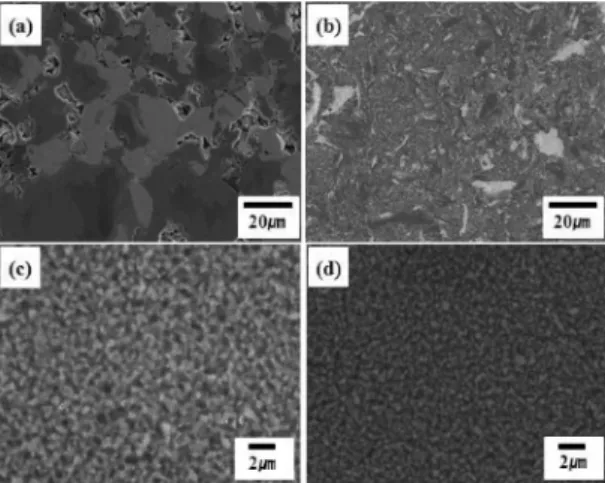
Fig. 8 shows the surface of the sintered specimens of the 24h-mixed powders and different milled pow- ders. Fig. 8-(a) reveals that there are some different phases, and Fig. 8-(b) is in the similar case. Also the two micrographs show different particle size and shape in the two specimens. Fig. 8-(c) and (d) reveal the micrographs of sintered specimen of 8h mill and 12h milled composite after HEMM and PCAS. Ultra fine particles (PFG) could be observed in Fig. 8-(c) and (d). The average particle size is about 200 nm.

This is because ultra fine powder was made by HEMM for 8h and 12h and composites were sintered

by PCAS without grain growth for very short time.

Fig. 9 shows the hardness and relative density of sintered composites by the mixed and milled pow- ders. The hardness of sintered composites (about 1200Hv) by milled powders was much higher than that of sintered composite (about 500Hv) by as-mixed powder. Especially, the sintered composite by 12h milled powder was more than two times that of com- posite using mixed powder. Some paper reported that hardness of the sintered specimen by milled powder depends on the milling time. Because the grain size of sintered specimens decreased with increasing milling time. And this is also because the content of solid solubility of Nb element in the Ti alloy is increased while the grain size of the sintered specimen decreased with milling time. It can also be attributed to the density difference between speci- mens fabricated using mixed and milled powder.

The relative density of sintered specimens also was increased with increasing milling time. The density of the composite using 12h milled powders is the highest than that of the composites using 4hr milled and 24h mixed powders. This is due to the introduc- tion of numerous defects such as dislocations and voids by HEMM. In addition, the free surface area is increased with increasing milling time [13].

4. Conclusions Fig. 8. FE-SEM micrographs of the Ti-35Nb-2.5Sn-15HA

composite after HEMM and PCAS: (a) mixed composite, (b) 4h milled composite, (c) 8h milled composite and (d) 12h milled composite

Fig. 9. The value of Vickers hardness and relative density

of sintered Ti-35Nb-2.5Sn-15HA composites by PCAS and

different milling time.

(6)

To fabricate of the ultra fine grain sized Ti-Nb-Sn- HA composite, HEMM and PCAS process are intro- duced. The results obtained from HEMM and PCAS are follows;

1. The ultra fine Ti-Nb-Sn-HA powders were obtained by high energy mechanical milling (HEMM).

2. The α -phase Ti transformed to β -phase Ti com- pletely after 12h milling because of the solid solu- tion of Nb into Ti.

3. The ultra fine grain sized Ti-Nb-Sn-HA compos- ites can be fabricated by pulse current activated sin- tering (PCAS) without grain growth due to short sintering time.

4. The sintered Ti-Nb-Sn-HA composites by 12h milled powder comprised many phases such as Ti, Ti

2

O, CaO, CaTiO

3

and Ti

x

P

y

.

5. The hardness and relative density increased with the milling time.

Acknowledgements

This study was supported by the National Research Foundation of Korea (NRF) grant funded by the Korea Government (No.310703002). The authors appreciate

Prof. In-Jin Shon of Chonbuk National University for use of PCAS equipment.

References

[1] A. Nouri, X. Chen, Y. Li, Y. Yamada, P. D. Hodgson and C. E. Wen: Mater. Sci. Eng., 485 (2008) 562.

[2] G. He, J. Eckert, Q. L. Dai, M. L. Sui, W. Löser, M.

Hagiwara and E. Ma: Biomater., 24 (2003) 5115.

[3] M. Niinomi, T. Kobayashi and N. Sasaki: Mater. Sci.

Eng., 100 (1988) 45.

[4] S. Tria, O. Elkedim, W. Y. Li and H. Liao: J. Alloys Compd., 483 (2009) 334.

[5] K. D. Woo, D. S. Kang, E. P. Kwon, M. S. Moon, I. J.

Shon and Z. Liu: Kor. J. Met. Mater., 47 (2009) 508.

[6] K. D. Woo, D. S. Kang, M. S. Moon, S. H. Kim, Z.

Liu and A. N. Omran: Kor. J. Met. Mater., 48 (2010) [7] Y. Okazaki, S. Rao, Y. Ito and T. Tateishi: Biomater., 369.

19 (1998) 1197.

[8] M. Long and H. J. Rack: Biomater., 19 (1998) 1621.

[9] Y.-L. Zhou and M. Niinomi: J. Alloys Compd., 466

(2008) 535.

[10] C. Q. Ning and Y. Zhou: Biomater., 23 (2002) 2909.

[11] C. Q. Ning and Y. Zhou: Biomater., 25 (2004) 3379.

[12] R. Sun, M. Li, Y. Lu and X. An: Mater. Sci. Eng., 26

(2006) 31.

[13] K. D.Woo, H. B. Lee, I. Y. Kim, I. J. Shon and D. L.

Zhang: Met. Mater. Int., 14 (2008) 327.

수치

Table 1. Sample compositions (wt.%)
Fig. 4 shows the result of X-ray mapping after 12h milling. It was found that Ti, Nb, Sn and HA  pow-ders are homogenously distributed
Fig. 5. XRD patterns of Ti-Nb-Sn-15HA powders pro- pro-duced by mixing and milling: (a) mixed for 24h, (b)  as-milled for 4h, (c) as-as-milled for 8h and (d) as-as-milled for 12h
Fig. 9 shows the hardness and relative density of sintered composites by the mixed and milled  pow-ders

참조

관련 문서