165
JOURNAL OF KOREAN FOREST SOCIETY ISSN 0445-4650(Print), ISSN 2289-0904(Online) http://e-journal.kfs21.or.kr
계방산의 고도와 사면방위별 하층식생구조 및 지표종 분석
천광일1·주성현2·성주한1·천정화1·이영근1*
1국립산림과학원 산림생태연구과, 2경북대학교 임학과
Understory Vegetation Structure by Altitude and Azimuth Slope and Indicator Species Analysis in Mt. Gyebang
Kwang Il Cheon
1, Sung Hyun Joo
2, Joo Han Sung
1, Jung Hwa Chun
1and Young Geun Lee
1*1Division of Forest Ecology, Korea Forest Research Institute, Seoul 130-712, Korea
2Division of Forestry, Kyungpook National University, Daegu 702-701, Korea
요 약: 본 연구는 유전자원보호구역 및 국립공원으로 지정된 계방산의 하층식생구조와 고도 및 사면별 지표종을 구 명하기 위해 실시하였다. 조사지 출현식물은 80과 203속 303종 38변종 5품종 4아종 총 350분류군으로 확인되었다.
중요치 분석결과, 관목층에서는 미역줄나무(9.143%), 당단풍나무(7.594%), 노린재나무(6.347%) 등이 우점 하였고, 초 본층에서는 조릿대(8.653%), 오리방풀(2.936%), 대사초(2.897%) 등이 우점 하는 것으로 나타났다. NMS 분석결과, 주 요종의 분포범위는 고도별 영향이 있는 것으로 밝혀졌다(관목층: R2>0.3, 초본층: R2>0.6). Plexus diagram 분석결과, 당단풍나무는 함박꽃나무, 청시닥나무, 참회나무 등과 연관성이 있으며, 초본층의 벌깨덩굴은 투구꽃, 박새, 귀룽나무 등과 연관성이 있는 것으로 분석되었다. 고도에 따른 유의성 있는 지표종은 60종, 사면방위별 유의성 있는 지표종은 30종이 분석되었다. MRPP-test 결과, 고도에 따른 집단 간 종조성은 이질적이며, 사면방위에 따른 종조성은 NE와 SW 간에 이질성이 큰 것으로 분석되었다.
Abstract: This study was conducted to investigate composition of understory vegetation and indicator species by altitude and slope azimuth in Mt. Gyebang designated as Protected Area for Forest Genetic Resource Conservation and National Park. Tracheophytes were 350 taxa; 80 families, 203 genera, 303 species, 38 varieties, 5 forma and 4 sub-species in research area. The species of greatest importance value were Tripterygium regelii (9.143%), Acer pseudosieboldianum (7.594%), Symplocos chinensis for. pilosa (6.347%) in the shrub layer and were Sasa borealis (8.653%), Isodon excisus (2.936%) and Carex siderosticta (2.897%). In the herb layer as a result of NMS analysis, the distribution range of the major species were found to be affected by the altitude (shrub layer: R2> 0.3, herb layer: R2> 0.6). The result of plexus diagram analysis showed that Acer pseudosieboldianum was associated with Magnolia sieboldii, Acer barbinerve, Euonymus oxyphyllus etc. in the shrub layer; Meehania urticifolia was associated with Aconitum jaluense, Veratrum oxysepalum, Prunus padus etc. in the herb layer.
The significant indicator species were analyzed for 60 species by the altitude and investigated for 30 species in accordance with the slope azimuth. As a consequence of MRPP, interspecies composition along the altitude group was heterogeneous and the species composition according to the azimuth slope was extremely different between the NE and SW.
Key words: MRPP, INSPAN, plexus diagram, species composition
서 론
최근 생태계에서 여러 가지 기능과 역할을 하는 종의 감 소와 단순화는 세계적으로 문제시 되고 있으며, 이에 생 물다양성의 증진과 보전은 생태계경영의 주요 목적 중 하
나다(Brunet et al., 2000; Odion and Sarr, 2007). 산림에 서 이루어지는 다양한 형태의 생태계경영에서 하층식생 의 기능을 유지하기 위해서는 식물종 다양성을 보존하는 것이 바람직하며, 이를 위해서는 서식지의 보호 및 관리 가 필요하다(Min and Osbert, 2013). 일반적으로 상층식생 의 다양성은 환경의 이질성을 높이게 되어 하층식생의 종 다양성을 향상시키는데(Beatty, 2003), 하층식생은 숲 전
*Corresponding author
E-mail: [email protected]
166 韓國林學會誌 제103권 제2호 (2014)
체에서 차지하는 생물량은 적은편이나 상층에 필요한 양 분공급, 종자의 발아 및 유목의 보호, 동물의 먹이원 및 은 신처 등 생태계에서 많은 역할을 하는 것으로 밝혀지고 있다(Yarie, 1980; Saunders and Puettmann, 1999; Gilliam, 2007; Royo and Carson, 2008; Mabry et al., 2008). 또 한 산림에서 하층식생은 상층의 수관의 발달함에 따라 크 게 결정되는데 일반적으로 광량, 양분유효도, 수관통과우, 토양수분함량 등에 영향을 받는다(Leith and Aston, 1969;
Kellomäki et al., 1977). 국내에서 하층식생에 관한 연구는 도시공원의 소나무림 내 하층식생 환경(Heo and Lee, 2002), 금대봉 산림유전자원보호림의 하층식생 분포양상 (Chun et al., 2009), 아까시나무 인공 숲 틈에서 졸참나무 식재후의 하층식생 반응(Cho et al., 2009), 섬잣나무와 솔 송나무림의 하층식생다양성(Cho et al., 2011a), 간벌효과 에 따른 하층식생의 초기 반응(Zhang et al., 2013) 등 하 층식생의 구조적 기능과 교란에 대한 반응에 관한 연구가 주로 이루어져 왔다. 국외의 경우 하층식생과 야생동물의 관리(Hanley, 2005), 생물다양성 지표의 개발을 위한 하층 식생의 관리(Barbier et al., 2009), 도시숲에서 하층식생의 보전정책과 공동경영(Kazuaki et al., 2013) 등 하층식생의 여러 가지 기능에 대한 중요성을 인식하고 다각적 산림경 영에서의 실질적인 정책과 시업으로 하층식생을 관리하 고 있다.
지표종은 다양한 유형의 서식처와 환경에 살아가는 종 의 개체생태학적 상세한 내용을 이해할 수 있으며, 우리 가 살아가는 생태계의 보전과 관리에 중요한 종으로 꾸준 한 관찰과 관심이 필요한 종이다(Rubio et al., 2011). 또한 지표종은 생태계에서 핵심종(keystone species)의 역할을 하는 종으로 그 지역 및 환경에 현존하는 종이다(Dufrene and Legendre, 1997). 생태계 보존과 관리를 위한 목표는 고유종의 유지, 고유한 생태계의 보호, 여러 가지 생태계 경영을 위한 규제 내에서 인간 활동의 수용 등이 있다 (Grumbine, 1994). 이러한 생태계경영에서 고유종에 속하 는 지표종은 선호하는 환경 및 서식처를 나타내는 지표이 며, 지역 사회의 유형 및 토지의 이용형태에 따라 변화하 며, 이에 따른 경영과 관리가 필요한 종으로 생태계의 보 전과 국토 관리 계획에서 중요한 자료가 된다(Dufrene and Legendre, 1997). 국내 지표종에 관한 연구는 TWINSPAN (Two Way INdicator Species ANalysis)을 이용한 산림군 락과 산림군집의 분류에 관한연구(Song and Kim, 1992;
Song et al., 1995; Jang et al., 1997; Lee et al., 1997;
Lee et al., 2001)가 활발히 이루어 졌으며, 그 외 강원도 남부 소나무림 벌채 후 초기 지표종변화(Cho et al., 2011b), 서부 지리산 일대 지표종을 활용한 산림군집분류 (Jung and Kim, 2013), 경북 동해안 곰솔림 군집에서 지표 종분석(Cheon et al., 2012) 등이 있으나 산림경영과 관리
를 위한 하층식생 및 지표종 연구에 대한 자료는 부족한 실정이다.
본 연구는 계방산 일대의 하층식생구조와 분포양상을 밝히고 고도와 사면별 현존하는 지표종을 분석하여 선호 하는 환경에 대한 자료를 제공하고자 한다. 이러한 하층 식생의 분포양상 및 지표종 자료는 보호구역 및 국립공원 으로 지정된 이곳의 희귀·특산식물, 생태계 교란종, 귀 화식물 등 여러 가지 유형의 식물종의 관리와 보전에 활 용 될 수 있을 것이다.
연구내용 및 방법
1. 연구대상지
계방산(1,577 m)은 강원도 홍천군과 평창군의 경계를 이 루는 산으로 북동쪽에는 오대산(1,563 m), 서쪽은 운두령 (1,089 m)이 위치하고 있으며, 그 주변으로는 황병산(1,407 m), 방태산(1,444 m)이 태백산맥을 형성하고 있다. 홍천지역 의 30년간 연평균기온은 10.3oC, 연평균 최고기온과 최저기 온의 평균값은 각각 17.5oC와 4.7oC이며, 연평균강수량은 1,405.4 mm이다(Korea Meteorological Administration, 2013). 계방산 일대는 온대북부 낙엽활엽수림으로 한반도 생물기후구계에서 태백산맥 고원지역인 대관령형에 속하 며, 산림식생형은 신갈나무-철쭉군목에 속하는 신갈나무- 잣나무군단과 신갈나무-생강나무군단의 특징을 갖는다 (Kim and Lee, 2006).
2. 조사구설치 및 조사방법
계방산 일대 127개(20 × 20 m)의 정방형 조사구를 설치 하고 조사구 내 5 × 5 m 크기의 하층식생조사구 3개를 설 치하였다(Figure 1). 그리고 조사구 내에 출현하는 흉고직 경 1 cm 이상의 종을 식별하고 흉고직경을 측정하였다.
하층식생조사구는 출현하는 관목층과 초본층 식물을 대 상으로 Braun-Blanquet(1965)의 방법을 사용하여 피도와 군도를 기록하였다. 사면방위는 방위계(Sunnto, PM-5)를 이용하였으며, 고도는 GPS수신기(Garmin Oregon 300)를 이용하였다. 조사기간은 2011년 5월부터 2013년 10월까 지이며, 식물의 동정은 원색식물도감(Lee, 2003a; 2003b) 와 한국의 나무(Kim and Kim, 2012)를 참고하였다. 식물 종의 학명과 국명은 Korea National Arboretum and The Plant Taxonomic Society of Korea(2007)에 따랐다.
3. 통계분석방법
종-면적곡선의 누적종수의 추정치는 Jackknife(Jack1) 분 석방법(Palmer, 1991)을 따랐으며, 관목층과 초본층으로 나누어 분석하였다. 중요치는 종간 상대적 우세를 비교하기 위하여 Curtis and McIntosh(1951)의 중요치(I.V.: Importance
Value)를 백분율로 나타낸 상대중요치(Brower and Zar, 1977)를 관목층과 초본층으로 구분하여 분석하였으며 상 대우점치는(상대피도+상대빈도)/2로 계산하였다.
하층식생 조사구와 종의 관계를 파악하기 위해 비정규 적 또는 불연속적이며 생태학적인 데이터에서 사용하기 적합한 NMS(다차원척도법: Non-metric Multidimensional Scaling)분석을 사용하여 2차원 상에 배열하였다(McCune and Mefford. 2006). 초본층과 관목층의 공통적인 환경요 인으로는 흉고직경을 사용한 기저면적(m2/ha), 고도, 경사, 방위값을 사용하였다. NMS배열에서 Plexus diagram (Mueller-Dombois and Ellenberg, 2003)을 사용하여 상대 적으로 연관성 있는 종의 관계를 2차원상에 표시(overlay) 하였다. Plexus diagram은 각 종의 빈도값을 바탕으로 카 이제곱의 거리 값을 사용하였으며, 1에 가까울수록 높은 수준의 연관성을 갖는다(McCune and Mefford, 2006). 하 층의 종조성 분포특성과 각 서식처별 경향을 분석하기 위 해 MRPP (Multi-Response Permutation Procedures)-test 및 지표종 분석을 하였다. 고도는 300 m단위, 세 그룹으 로 나누었는데 이는 MRPP-test에 필요한 집단기준 중 명 확하고 간결하게 나타낼 수 있는 다변량분석의 최저집단 수(Mielke, 1984)에 기준하였다. 이에 고도는 Low (<1,000 m, 관목층 조사구 n=34, 초본층 조사구 n=35), Mid (1,001-1,300 m, 관목층 및 초본층 조사구 n=44), High
(1,301 m>, 관목층 조사구 n=46, 초본층 조사구 n=48)의 3개의 그룹으로 나누었다. 사면방위는 Yang and Kim(2002) 의 방법에 의한 4개 사면방위의 구배로 나누었으며, NE (0-90°, 관목층 조사구 n=20, 초본층 조사구 n=21), SE (91-180°, 관목층 조사구 n=24, 초본층 조사구 n=25), SW (181-270°, 관목층 및초본층 조사구 n=51), NW (271- 359°, 관목층 조사구 n=29, 초본층 조사구 n=30)의 4개의 그룹으로 나누어 분석을 하였다. MRPP-test의 거리 척도 는 Sørensen의 방법을 사용하였으며(McCune and Grace, 2002; McCune and Mefford, 2006), 지표종 분석은 Dufrene and Legendre(1997)의 방법을 따랐다.
결과 및 고찰
1. 조사지 출현식물 및 종-면적 곡선
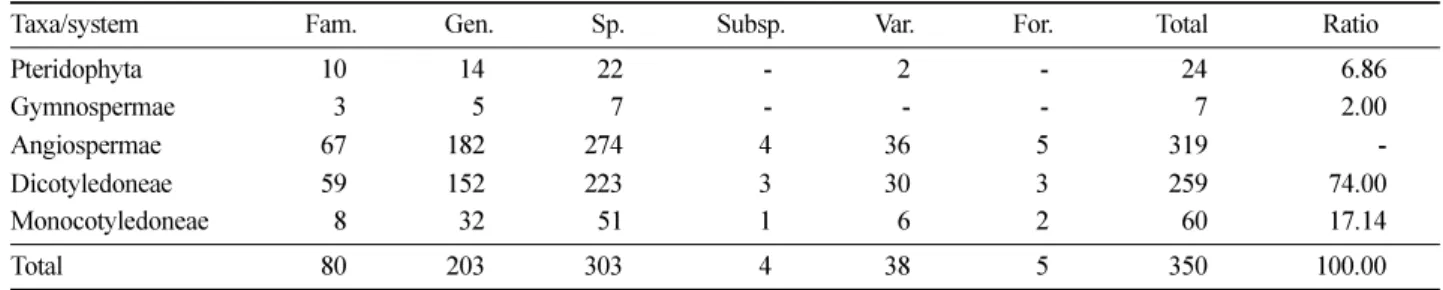
전체 조사지에서 출현한 관속식물은 80과 203속 303종 38변종 5품종 4아종 총 350분류군으로 확인되었다(Table 1). 이 중 양치식물은 10과 14속 22종(6.86%), 나자식물은 3과 5속 7종(2.00%), 피자식물의 쌍자엽식물은 59과 152 속 223종 30변종 3품종 3아종(74.00%), 단자엽식물은 8과 32속 51종 38변종 5품종 4아종(17.14%)이 조사되었다. 이 는 한반도 전체 식물 4,881종류(Korea National Arboretum and The Plant Taxonomic Society of Korea, 2007)의 Figure 1. The location map of the surveyed plots in study site.
168 韓國林學會誌 제103권 제2호 (2014)
7.2%에 해당된다. 종-면적 곡선은 적정 조사구 수 및 종수 를 추정하는 방법 중 하나로 야외조사 결과를 평가할 수 있는 중요한 분석방법이다(Park and Seo, 2002). 또한 이 에 사용된 Jckknife 분석은 비모수적 표본수가 크지 않을 때 사용되는 방법으로 통상적인 추정량에 비해 모수에 빨 리 수렴하는 특징을 가진다(Kang, 2002). 이에 본 연구에 서 조사구 수가 늘어날수록 기울기는 0에 가까워져 이 지 역을 대표할 수 있는 종들을 파악하는데 적절한 조사구가 설치되었다고 판단된다(Figure 2).
2. 중요치 및 NMS 분석
중요치 분석결과, 관목층에서 미역줄나무(9.143%), 당 Table 1. The number of plants distributed in study plots.
Taxa/system Fam. Gen. Sp. Subsp. Var. For. Total Ratio
Pteridophyta 10 14 22 - 2 - 24 6.86
Gymnospermae 3 5 7 - - - 7 2.00
Angiospermae 67 182 274 4 36 5 319 -
Dicotyledoneae 59 152 223 3 30 3 259 74.00
Monocotyledoneae 8 32 51 1 6 2 60 17.14
Total 80 203 303 4 38 5 350 100.00
Figure 2. Species-area curve of shrub layer and herb layer species.
Table 2. Importance value of shrub layer and herb layer species.
Shrub layer Herb layer
Scientific name I.V. Scientific name I.V.
Tripterygium regelii 9.143 Sasa borealis 8.653
Acer pseudosieboldianum 7.594 Isodon excisus 2.936
Symplocos chinensis for. pilosa 6.347 Carex siderosticta 2.897
Rhododendron schlippenbachii 5.844 Filipendula glaberrima 2.828
Prunus padus 3.831 Schisandra chinensis 2.393
Stephanandraincisa 3.707 Astilbe rubra 2.392
Quercus mongolica 3.639 Tripterygium regelii 2.304
Deutzia glabrata 3.270 Meehania urticifolia 2.116
Acer pictum subsp. mono 2.573 Pseudostellaria heterophylla 2.018
Magnolia sieboldii 2.446 Pseudostellaria palibiniana 1.648
Acer komarovii 2.320 Calamagrostis arundinacea 1.603
Syringa wolfii 2.121 Polystichum braunii 1.575
Lindera obtusiloba 2.035 Veratrum oxysepalum 1.403
Tilia amurensis 1.915 Artemisia stolonifera 1.259
Sambucus sieboldiana var. miquelii 1.784 Dryopteris expansa 1.242
Weigela praecox 1.696 Ainsliaea acerifolia 1.093
Acer ukurunduense 1.688 Rubus crataegifolius 1.083
Fraxinus rhynchophylla 1.521 Polystichum tripteron 1.057
Acer barbinerve 1.498 Acer pseudosieboldianum 0.922
Euonymus oxyphyllus 1.488 Melica nutans 0.917
Euonymus macropterus 1.334 Carex lanceolata 0.916
Rosa suavis 1.231 Viola diamantiaca 0.902
Viburnum opulus var. calvescens 1.223 Quercus mongolica 0.896
Acer mandshuricum 1.215 Dryopteris crassirhizoma 0.893
Lespedeza maximowiczii 1.183 Cardamine leucantha 0.880
Other 68 species 27.351 Other 319 species 53.175
단풍나무(7.594%), 노린재나무(6.347%), 철쭉(5.844%) 등 이 우점하고 있는 것으로 분석되었으며, 초본층에서는 조 릿대(8.653%), 오리방풀(2.936%), 대사초(2.897%), 터리 풀(2.828%), 오미자(2.393%) 등이 우점하고 있는 것으로 분석되었다(Table 2). 관목층의 미역줄나무는 대부분의 조사지에 출현하였으며, 특히 해발 1,000 m 이상의 상대 적으로 높은 해발고에서 우점하는 것으로 나타났다. 미 역줄나무는 일반적으로 덩굴성 목본이지만 흔히 덤불형 태로 자라며, 전국적으로 분포한다(Kim and Kim, 2012).
이렇듯 미역줄나무는 지위(niche)가 넓은 수종으로 선행 연구인 아고산 주목군락(Cho et al., 2012) 및 천왕봉 가 문비나무림(An et al., 2010)에서도 관목층 우점수종으로 밝혀졌다. 미역줄나무는 아고산 및 고산지대 숲 틈과 나 출지에 출현하는 선구수종으로 초본층에서부터 관목층 까지 분포하며, 수간을 타고 아교목층 이상까지 빠르게 피복하는 종으로 향후 천이의 과정 및 산림생태계에서 기 능적 역할을 밝히는 것이 필요할 것으로 사료된다. 관목 층의 NMS 분석결과, 1축과 2축의 종합설명력은 30.5%
로 나타났으며, 주요종의 분포범위는 고도별 영향이 있 는 것으로 분석되었다(Figure 3, cut off environmental
factors R2=0.3). 관목층에서 상대적으로 높은 고도에 서 식하는 종은 눈측백, 만병초, 가문비나무 등으로 나타났 으며, 상대적으로 낮은 고도에 서식하는 종은 당단풍나 무, 까치박달, 다릅나무 등이 나타났다. 관목층의 Plexus diagram(strong association line value>0.3)에서 당단풍나 무는 함박꽃나무, 청시닥나무, 참회나무 등 6종과의 높은 연관성이 있는 것으로 분석되었다. 또한 관목층에서 가 장 높은 우점치를 가지는 미역줄나무는 국수나무, 생강 나무와 높은 연관성이 있는 것으로 나타났다. 초본층의 NMS 분석결과, 1축과 2축의 종합성명력은 37.6%로 나 타났으며, 관목층과 마찬가지로 고도에 영향을 받는 것 으로 분석되었다(Figure 4, cut off environmental factors R2=0.6). 초본층의 Plexus diagram(strong association line value>0.3)에서 터리풀은 개별꽃, 참취, 풀솜대, 박새, 실 새풀과 연관성이 있는 것으로 분석되었으며, 벌깨덩굴은 투구꽃, 박새, 귀룽나무, 미나리냉이 등과 연관성이 있는 것으로 분석되었다.
3. 고도 및 방위별 지표종 분석 및 종조성의 차이 고도별 지표종 분석결과, 유의한 지표종의 종은 High에 Figure 3. NMS distribution of study site and shrub layer species (sp.1-Thuja koraiensis, sp.2-Rhododendron brachycarpum, sp.3- Vaccinium hirtum var. koreanum, sp.4-Oplopanax elatus, sp.5-Abies nephrolepis, sp.6-Picea jezoensis, sp.7-Ribes komarovi, sp.8- Acer tegmentosum, sp.9-Sorbus commixta, sp.10-Syringa wolfii, sp.11-Acer ukurunduense, sp.12-Taxus cuspidata, sp.13-Weigela praecox, sp.14-Sambucus sieboldiana var. miquelii, sp.15-Acer komarovii, sp.16-Rhamnus davurica, sp.17-Tripterygium regelii, sp.18-Spiraea chamaedryfolia, sp.19-Philadelphus schrenkii, sp.20-Spiraea fritschiana, sp.21-Weigela subsessilis, sp.22-Rhododendron mucronulatum, sp.23-Tilia amurensis, sp.24-Pinus koraiensis, sp.25-Euonymus macropterus, sp.26-Ribes mandshuricum, sp.27- Spiraea chamaedryfolia, sp.28-Sambucus williamsii var. coreana, sp.29-Prunus padus, sp.30-Magnolia sieboldii, sp.31-Ulmus davidiana var. japonica, sp.32-Acer mandshuricum, sp.33-Weigela florida, sp.34-Pyrus ussuriensis, sp.35-Syringa reticulata var.
mandshurica, sp.36-Acer pictum subsp. mono, sp.37-Deutzia glabrata, sp.38-Acer barbinerve, sp.39-Ulmus laciniata, sp.40-Cornus controversa, sp.41-Euonymus alatus for. ciliatodentatus, sp.42-Fraxinus mandshurica, sp.43-Deutzia parviflora Bunge, sp.44- Stephanandra incisa, sp.45-Symplocos chinensis for. pilosa, sp.46-Lindera obtusiloba, sp.47-Lonicera subsessilis, sp.48-Fraxinus rhynchophylla, sp.49-Rhododendron schlippenbachii, sp.50-Malus baccata, sp.51-Ribes maximowiczianum, sp.52-Quercus mongolica, sp.53-Populus davidiana, sp.54-Acer pseudosieboldianum, sp.55-Lespedeza bicolor, sp.56-Rhamnus ussuriensis, sp.57- Euonymus oxyphyllus, sp.58-Abies holophylla, sp.59-Carpinus cordata, sp.60-Fraxinus mandshurica, sp.61-Betula schmidtii, sp.62-Staphylea bumalda).
170 韓國林學會誌 제103권 제2호 (2014)
22종, Mid에 나타나는 유의한 지표종은 10종, Low에 나 타나는 유의한 지표종은 28종으로 나타났다(Table 3). 지 표값은 터리풀(52.6, High)이 상대적으로 높은 것으로 나 타났으며, 그 다음으로는 넓은잎외잎쑥(40.0, Low), 조릿 대(38.6, Mid), 개머루(36.8, Mid), 오리방풀(36.4, Mid), 박새(35.6, Low) 등의 순으로 나타났다. 이러한 지표종의 서식처정보와 지표값은 희귀·특산식물의 보전 및 복원 등에 이용될 수 있는데, 희귀식물(Korea Forest Service, 2008) 중 금강제비꽃은 Mid, 꽃개회나무는 Low에 현존하 는 종이며, 특산식물(Oh et al., 2005) 중 지리강활은 Mid, 할미밀망은 Low에 현존하는 종으로 분석되었다. 고도별 종조성 비교결과, 초본층과 목본층에서 고도별 종조성의 차가 있는 것으로 나타났으며(Table. 4), 관목층 및 초본층 에서 Low와 High 그룹 간 A값이 상대적으로 높게 나타 났다. 이 결과는 두 그룹 간 종조성 차이는 이질적이며, 각 각의 그룹이 포함하는 종들 간에 유사성이 높다고 할 수 있다. 또한 관목층에서 Mid와 High의 A값은 다른 그룹에 비해 상대적으로 값이 낮아 두 그룹 간 종조성 차이는 있 으나 각각의 그룹이 포함하는 종들 간에 상대적으로 이질 적인 것으로 분석되었다. 일반적으로 산림에서는 고도에 따라 식물종조성과 풍부도는 변화하는데 이러한 종조성 의 변화는 환경요인(기압, 온도, 풍향 등)과 복잡한 상호 관계에 놓여 있다(Thorsten et al., 2013). 한국산림과 같이 복잡한 지형에서 미세기후의 영향 및 다양한 수준의 교란 (Cho et al., 2011b)은 식생 종조성간 이질도를 높혀 해석 에 어려움을 높이는 것이 사실이다. 이에 한국산림생태계
가 가지고 있는 공간 및 환경의 특수성과 보편적 생태학 이론 및 법칙의 관계를 조화하는 것은 한국산림생태계를 이해하는 핵심이라고 사료된다.
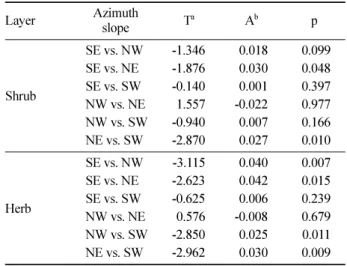
사면방위별 유의한 지표종은 SE 6종, NE 12종, NW 8 종, SW 4종으로 분석되었다(Table 5). 관목층에 출현하는 물참대(28.9), 신갈나무(27.1), 당단풍나무(25.1) 등은 SE의 서식처에서 유의성 있게 출현할 수 있는 종으로 분석되었 으며, NE에서는 흰진범(21.7), 박새(21.7), 퍼진고사리(19.1) 등이 분석되었다. NW에서는 홀아비꽃대(16.7), 노랑갈퀴 (16.7), 얼레지(14.3) 등이 분석되었으며, SW에서는 파리 풀(13.7), 속새(11.8), 고추나무(11.8) 등이 사면방위별 유 의성 있게 출현 하는 종으로 분석되었다. 희귀식물 꽃개 회나무는 NE의 방위와 초본층에서 현존하는 종이며, 희 귀·특산식물인 홀아비바람꽃은 NW의 사면방위와 초본 층에서 현존하는 종으로 분석되었다. 산림에서는 일반적 으로 고도 뿐 아니라 사면방위와 지형요소(산복, 능선, 계 곡 등)는 식생 종조성의 뚜렷한 변이를 파악할 수 있는 주 요 요인(Yang and Kim, 2002)으로 작용하는데 사면방위 별 종조성은 관목층에서 SE-NE, NE-SW에서 종조성의 차 이가 있는 것으로 나타났으며, 초본층 종조성은 SE-SW, NW-NE를 제외한 사면 간에 종조성의 차이가 있는 것으 로 나타났다(Table 6). 특히 NE-SW의 종조성의 차이는 관 목층과 초본층 모두에서 나타나 두 개의 사면방위 간의 종조성은 이질적인 것으로 분석되었다. 이러한 사면방위 별 하층식생의 종조성의 변화는 방위에 따라 사면이 가지 고 있는 경사, 광량, 상층식생의 구조 등 여러 가지의 원 Figure 4. NMS distribution of study site and herb layer species (sp.1-Meehania urticifolia, sp.2-Cardamine leucantha, sp.3- Aconitum jaluense, sp.4-Veratrum oxysepalum, sp.5-Prunus padus,sp.6-Filipendula glaberrima, sp.7-Acer ukurunduense, sp.8- Angelica purpuraefolia, sp.9-Calamagrostis arundinacea, sp.10-Aster scaber, sp.11-Ainsliaea acerifolia, sp.12-Smilacina japonica, sp.13-Pseudostellaria heterophylla, sp.14-Acer pseudosieboldianum, sp.15-Artemisia stolonifera, sp.16-Rubus crataegifolius, sp.17- Quercus mongolica, sp.18-Ampelopsis brevipedunculata, sp.19-Sasa borealis).
Table 3. Indicator value of shrub and herb layer species by altitude. Scientific nameAltitudeIndicator valuep LayerScientific nameAltitudeIndicator valuep Layer Filipendula glaberrimaHigh52.60.0002HerbUlmus laciniata Low18.20.0012Shrub ArtemisiastoloniferaMid40.00.0002HerbPrunus padus High18.20.0316Shrub Sasa borealisMid38.60.0002HerbPedicularis resupinata High18.10.0026Herb Ampelopsis brevipedunculataMid36.80.0002HerbCarpinus cordata Low17.60.0006Shrub Isodon excisus Mid36.40.0008HerbStaphylea bumalda Low17.60.0004Shrub Veratrum oxysepalum High35.60.0002HerbAcer ukurunduense.High17.20.0012Shrub Lindera obtusiloba Low35.30.0002ShrubEquisetum hyemale Low17.10.0004Herb Lindera obtusiloba Low31.40.0002HerbActinidiaargutaLow17.10.0006Herb Vicia venosa var. cuspidata High31.10.0002HerbViburnum opulus var. calvescens High17.00.0008Shrub Acer pictum subsp. mono Low30.20.0006HerbAbies holophylla Low16.90.0006Herb Quercus mongolica Low29.60.0020HerbAndrosace umbellataHigh16.70.0016Herb Acer pseudosieboldianumLow29.40.0018HerbAruncus dioicus var. kamtschaticus High16.60.0022Herb Euonymus alatus for. ciliatodentatusLow28.40.0002HerbDioscorea quinqueloba Low16.40.0036Herb Dryopteris expansa High28.30.0004HerbSyringa wolfiiHigh16.10.0050Shrub Quercus mongolicaLow27.00.0012ShrubCimicifuga dahurica Low16.00.0016Herb StephanandraincisaMid26.70.0004ShrubLysimachia clethroides Mid15.50.0046Herb Calamagrostis arundinaceaHigh26.70.0030HerbTilia amurensis Mid15.30.0212Shrub Smilacina japonicaHigh25.50.0030HerbDeutzia glabrata Low15.20.0530Shrub Polystichum tripteron Low24.10.0008HerbMorus bombycisLow14.70.0020Shrub Euonymus oxyphyllus Low23.70.0002HerbRosa suavisHigh14.60.0010Herb Pseudostellaria setulosaLow22.80.0002HerbSyringa reticulata var. mandshurica Low14.30.0012Herb Acer pictum subsp. monoMid22.70.0020ShrubClematis trichotoma Low14.20.0012Herb Aconitum longecassidatumHigh22.40.0008HerbWeigela praecox High13.60.0168Shrub Vicia unijuga Mid21.80.0032HerbArtemisia keiskeana Low13.50.0030Herb Viola diamantiacaMid21.80.0036HerbSyringa reticulata var. mandshurica Low11.90.0170Shrub Angelica purpuraefoliaHigh20.60.0018HerbUlmus davidiana var. japonicaLow11.80.0042Shrub Abies holophylla Low20.40.0002ShrubScutellaria pekinensis var. ussuriensisLow11.40.0042Herb Rosa suavisHigh19.10.0006ShrubUlmus laciniata Low11.40.0050Herb Aconitum pseudolaeve High18.80.0036HerbRhamnus davurica High 9.50.0486Shrub Ligularia fischeriHigh18.60.0018HerbMalus baccataHigh 8.50.0400Shrub
172 韓國林學會誌 제103권 제2호 (2014)
인들이 복합적으로 작용한다고 할 수 있다. 이와 같이 지 표값과 여러 가지 속성들을 토대로 희귀·특산식물 뿐 아 니라 고유종에 해를 끼치는 생태계 교란종 및 주의를 기 울여야하는 귀화식물의 서식처 및 환경을 파악할 수 있으 며, 그들의 관리에 한층 더 도움을 줄 수 있을 것이라 판 단된다.
결 론
본 연구는 국립공원 및 유전자원보호구역으로 지정된 계방산일대의 하층식생 구조와 분포특성을 파악하여 향 후 여러 가지 유형의 산림 생태계경영 중 하층식생의 관 리에 필요한 자료를 제공하기 위해 실시하였다. 127개 조 사지에서 출현한 식물은 총 350분류군이 확인되었으며, 중요치 분석결과, 관목층에서는 미역줄나무, 당단풍나무, 노린재나무, 철쭉 등이 우점하며, 초본층에서는 조릿대, 오리방풀, 대사초, 터리풀 등이 우점하는 것으로 분석되었 다. 이 중 미역줄나무의 중요도가 높게 분석되어 지속적 으로 모니터링 해야 할 주요수종으로 판단된다. 관목층의 NMS 분석결과, 주요종의 분포범위는 고도별 영향이 있는 것으로 밝혀졌으며(R2>0.3), 높은 고도에 서식하는 종은 눈측백, 만병초, 가문비나무 등이다. 관목층의 Plexus diagram에서 당단풍나무는 함박꽃나무, 청시닥나무, 참회 나무 등 6종과의 연관성이 높은 것으로 확인되었으며, 초 본층의 NMS 분석결과, 관목층에 비해 상대적으로 고도 의 영향을 더 받는 것으로 분석되었다(R2>0.6). 초본층의 Plexus diagram 분석결과, 터리풀은 개별꽃, 참취, 풀솜대, 박새, 실새풀과 연관성이 있는 것으로 분석되었으며, 벌깨 덩굴은 투구꽃, 박새, 귀룽나무, 미나리냉이 등과 연관성 이 있는 것으로 분석되었다. 고도별 지표종 분석결과, 유 의한 지표종은 전체 60종으로 나타났으며, 고도별 종조성 비교결과, 초본층과 목본층에서 고도별 종조성의 차가 있 는 것으로 나타나 일정한 고도 차이가 하층종조성에 영향 을 미치는 것으로 판단된다. 사면방위별 지표종 분석결과 전체 30종으로 나타났으며, NE와 SW 간의 종조성의 차 이는 관목층과 초본층 모두에서 나타나 두 개의 사면방위 간 종조성은 이질적인 것으로 나타났다. 이는 두 사면방 Table 4. MRPP-test of shrub layer and herb layer by altitude
(Ta is the MRPP test statistic and Ab is the chance corrected within-group agreement).
Layer Altitude Ta Ab p
Shrub
Mid vs. High -6.806 0.051
p<0.001 Mid vs. Low -7.124 0.064
High vs. Low -13.378 0.111
Herb
Mid vs. High -17.240 0.136 Mid vs. Low -10.792 0.098 High vs. Low -18.963 0.162
Table 5. Indicator value of shrub and herb layer species by azimuth slope
Scientific name Azimuth slope
Indicator
value p Layer Deutzia glabrata SE 28.9 0.0008 Shrub Quercus mongolica SE 27.1 0.0058 Herb Acer pseudosieboldianum SE 25.1 0.0122 Herb Aconitum longecassidatum NE 21.7 0.0060 Herb Veratrum oxysepalum NE 21.7 0.0108 Herb
Viola selkirkii SE 21.7 0.0032 Herb
Dryopteris expansa NE 19.1 0.0240 Herb Chloranthus japonicus NW 16.7 0.0018 Herb Vicia chosenensis NW 16.7 0.0020 Herb Pseudostellaria setulosa SW 15.6 0.0206 Herb
Prunus padus NE 15.5 0.0302 Herb
Diarrhena fauriei SE 14.6 0.0358 Herb Erythronium japonicum NW 14.3 0.0208 Herb Weigela florida SE 14.0 0.0188 Shrub Lespedeza bicolor NW 13.8 0.0048 Shrub Phryma leptostachya var.
asiatica SW 13.7 0.0266 Herb
Valeriana fauriei NE 13.6 0.0174 Herb Androsace umbellata NE 13.1 0.0468 Herb Acer ukurunduense NE 13.0 0.0346 Shrub
Weigela praecox NE 12.7 0.0430 Shrub
Syringa wolfii NE 12.4 0.0168 Herb
Euonymus macropterus NE 12.2 0.0408 Shrub Equisetum hyemale SW 11.8 0.0202 Herb Staphylea bumalda SW 11.8 0.0328 Shrub Anemone koraiensis NW 10.0 0.0228 Herb
Viola rossii NW 10.0 0.0230 Herb
Weigela praecox NW 10.0 0.0236 Herb
Carex quadriflora NW 10.0 0.0272 Herb Impatiens furcillata NE 9.5 0.0268 Herb Carpesium triste NE 9.4 0.0488 Herb
Table 6. MRPP-test of shrub layer and herb by slope azimuth (Ta is the MRPP test statistic and Ab is the chance corrected within-group agreement).
Layer Azimuth
slope Ta Ab p
Shrub
SE vs. NW -1.346 0.018 0.099 SE vs. NE -1.876 0.030 0.048 SE vs. SW -0.140 0.001 0.397 NW vs. NE 1.557 -0.022 0.977 NW vs. SW -0.940 0.007 0.166 NE vs. SW -2.870 0.027 0.010
Herb
SE vs. NW -3.115 0.040 0.007 SE vs. NE -2.623 0.042 0.015 SE vs. SW -0.625 0.006 0.239 NW vs. NE 0.576 -0.008 0.679 NW vs. SW -2.850 0.025 0.011 NE vs. SW -2.962 0.030 0.009
위 간의 여러 가지 이질적 환경요인에 기인한 것이라 사 료되며, 이와 같은 결과는 사면방위가 식생종조성의 뚜렷 한 변이를 파악할 수 있는 주요요인 중 하나라고 판단된다.
References
An, H.C., Kim, G.T., Choo, G.C., Um, T.W., Park, S.B., and Park, E.H. 2010. A Study on the Structure of Forest Community of Picea jezoensis Stands at Cheonwang- bong Area, Jirisan (Mt.). Journal of Korean Forest Soci- ety 99(4): 590-596.
Barbier, S., Chevalier, R., Loussot, P., Bergès, L., and Gosse- lin, F. 2009. Improving biodiversity indicators of sustain- able forest management: Tree genus abundance rather than tree genus richness and dominance for understory vegetation in French lowland oak hornbeam forests. For- est Ecology and Management 258: 176-186.
Beatty, S.W. 2003. Habitat heterogeneity and maintenance of species in understory communities. In: Gilliam, F.S., Rob- erts, M.R. (Eds.), The Herbaceous Layer in Forests of East- ern North America. Oxford University Press, New York, pp. 177-197.
Braun-Banquet, J. 1965. Plant sociology. The Study of the Plant Communities. (Transl. by G.D. Fuller and H.S. Conard).
New York, U.S.A. pp. 439.
Brower, J.E. and J.H. Zar. 1977. Field and Laboratory Meth- ods for General Ecology. Wm. Brown Company. p. 194.
Brunet, J., von Oheimb, G., and Diekmann, M. 2000. Fac- tors influencing vegetation gradients across ancient-recent woodland borderlines in southern Sweden. Journal of Vegeta- tion Science 11: 515-524.
Cheon, K.I., Jung, S.C., Youn, H.J., Byun, J.K., and Joo, S.H.
2012. Community Structure of Pinus thunbergii Stand in the Eastern Coast of Gyeongsangbuk-do. Institute of Agriculture and Life Sciences, Gyeongsang National Uni- versity 46(4) :57-68.
Cho, M.G., Jung, J.M., Jung, H.L., Kang, M.Y., and Moon, H.S. 2012. Vegetation Structure of Taxus cuspidata Com- munities in Subalpine Zone. Institute of Agriculture and Life Sciences, Gyeongsang National University 46(5): 1-10.
Cho, Y.C., Hong, J.G., Cho, H,J., Bae, K.H., and Kim, J.S.
2011a. Structure and Understory Species Diversity of Pinus parviflora-Tsuga sieboldii Forest in Ulleung Island. Jour- nal of Korean Forest Society 100(1): 34-41.
Cho, Y.C., Kim, J.S., Lee, C.S., Cho, H.J., Lee, H.Y., and Bae, K.H. 2011b. Early Successional Change of Vegeta- tion Composition After Clear Cutting in Pinus densiflora Stands in Southern Gangwon Province. Journal of Korean Forest Society 102(2): 240-245.
Cho, Y.C., Kim, J.S., Lee, J.H., Lee, H.H., Ma, H.S., Lee, C.S., Cho, H. J., and Bae, K.H. 2009. Early Responses of Planted Quercus serrata Seedlings and Understory Vege-
tation to Artificial Gap Treatments in Black Locust Plan- tation. Journal of Korean Forest Society 98(1): 94-105.
Chun, S.H., Lee, H.S., and Lim, J.H. 2009. Distributional Patterns of Understory Vegetation at Mt. Geumdae Pro- tected Area for Forest Genetic Resources. Journal of Korean Forest Society 98(3): 339-350.
Curtis and McIntosh. 1951. An Upland Forest Continuum in the Prairie-forest Vorder Region of Winsconsin. Ecology 32: 476-496.
Dufrene, M. and Legendre, P. 1997. Species assemblages and indicator species : the need for a flexible asymmetrical approach. Ecological Monographs 67: 345-366.
Gilliam, F.S. 2007. The ecological significance of the herba- ceous layer in temperate forest ecosystems. Bioscience 57: 845-858.
Grumbine, R.E. 1994. What is ecosystem management? Con- servation Biology 8: 27-38.
Hanley, T.A. 2005, Potential management of young-growth stands for understory vegetation and wildlife habitat in southeastern Alaska. Landscape and urban planning 72(1):
95-112.
Heo, J.A. and Lee, J.S. 2002. Analysis of Pine Tree’s Sub- vegetation Environment in the Urban Parks. Korean jour- nal of horticultural science and technology 10(1): 47-53.
Jang, G.K., Song, H.K., and Kim, S.D. 1997. Study on Clas- sification of Quercus mongolica Forests in Kangwon - do by Phytosociological Method and TWINSPAN. Journal of Korean Forest Society 86(2): 214-222.
Jung, S.H. and Kim, J. H. 2013. The Classification of Forest Cover Types by Consecutive Application of Multivariate Statistical Analysis in the Natural Forest of Western Mt.
Jiri. Journal of Korean Forest Society 102(3): 407-414.
Kang, C. 2002. A Study of the Jackknife Estimate. Journal of Industrial Science and Technology. 34: 325-331.
Kazuaki, T., Toshiya, O., and Kazuhiko, T. 2013. The com- bined effects of conservation policy and co-management alter the understory vegetation of urban woodlands: A case study in the Tama Hills area, Japan. Landscape and Urban Planning 110: 87-98.
Kellomäki S., Hari, P., Vuokko, R., Väisänen, E., and Kanninen, M. 1977. The aboveground growth rate of a dwarf shrub community. Oikos 29: 143-149.
Kim, J.S. and Kim, T.Y. 2012. Woody plants of Korean pen- insula, Dolbaegae, Paju. pp. 688.
Kim, J.W. and Lee, Y.K. 2006. Classification and Assess- ment of Plant Communities. World science. Seoul. pp.
240.
Korea Forest Service. 2008. Rare Plants Data Book in Korea.
Korea National Arboretum. Geobook. Pocheon. pp. 332.
Korea Meteorological Administration. 2013. Climatological data.
http://www.kma.go.kr (2013. 12).
Korea National Arboretum and The Plant Taxonomic Society of Korea. 2007, A synonymic list of vascular plants in
174 韓國林學會誌 제103권 제2호 (2014)
Korea. Korean National Arboretum, Pocheon, pp. 560.
Lee, M.J., Song, H.K. and Lee, S. 2001. Study on Classifica- tion of Forest Vegetation of Songinbong and Taeharyong in Ullungdo - With a Special Reference to TWINSPAN and Phytosociological Method-. Korean Journal of Envi- ronment and Ecology 14(1): 57-66.
Lee, K.Y., Lee, S.W., and Song, H.K. 1997. The Analysis of Vegetation - Environment Relationships of the Coniferous For- ests in Subalpine Districts of Mt. Chiri by TWINSPAN and CCA. Journal of Korean Forest Society 86(3): 279- 278.
Lee, T.B. 2003a. Coloured flora of Korea 1 volumes. Hyang- munsa, Seoul. pp. 914.
Lee, T.B. 2003b. Coloured flora of Korea 2 volumes. Hyang- munsa, Seoul. pp. 910.
Leith, H. and Aston, D.H. 1961. The light compensation point of some herbaceous plants inside and outside deciduous woods in Germany. Canadian Journal of Botany 39: 1255-1259.
Mabry, C.M., Gerken, M.E., and Thompson, J.R. 2008. Sea- sonal storage of nutrients by perennial herbaceous spe- cies in undisturbed and disturbed deciduous hardwood forests.
Applied Vegetation Science 11: 37-44.
McCune, B. and Grace, J.B. 2002. Analysis of Ecological Communities. MjM Software Design. Gleneden Beach. Ore- gon, U.S.A. p. 300.
McCune, B. and Mefford, M.J. 2006. PC-ORD Multivariate Analysis of Ecological Data, Version 5.17. MJM Soft- ware Design, Gleneden Beach. Oregon, U.S.A.
Mielke Jr, P.W. 1984. Meteorological applications of permuta- tion techniques based on distance functions. Handbook of statistics 4: 813-830.
Min, Y. and Osbert, J.S. 2013. Effects of forest patch type and site on herb-layer vegetation in a temperate forest ecosys- tem. Forest Ecology and Management 300: 14-20.
Mueller-Dombois, D. and Ellenberg, H. 2003. Aims and Meth- ods of Vegetation Ecology. The Blackburn Press. New York, U.S.A. pp. 547.
Odion, D.C., Sarr, D.A. 2007. Managing disturbance regimes to maintain diversity in forested ecosystems of the Pacific Northwest. Forest Ecology and Management 246: 57-65.
Oh, B.U., Cho, D.G., Kim, K.S., and Jang, C.G. 2005. Endemic Vascular Plants in the Korean Peninsula. Korea National Arboretum, Daesin, Seoul. pp. 205.
Palmer, M.W. 1991. Estimating species richness: the second- order jackknife reconsidered. Ecology 72: 1512-1513.
Park, I.H. and Seo, Y.K. 2002. Plot Size for Investigating Forest Community Structure(5) - Adequate Number of Plots for Tree and Shrub Strata in a Mixed Forest Community of Broad-Leaved Trees at Guryongsan Area-. Korean Journal of Environment and Ecology 15(4): 394-400.
Royo, A. and Carson, W.P. 2008. Direct and indirect effects of a dense understory on tree seedling recruitment in tem- perate forests: habitat-mediated predation versus competi- tion. Canadian Journal of Forest Research 38: 1634-1645.
Rubio, A., Gavilan, R.G., Montes, F., Gutierrez-Giron, A., Diaz- Pines, E., and Mezquida, E.T. 2011. Biodiversity measures applied to stand-level management: can they really be use- ful? Ecological Indicators 11: 545-556.
Saunders, M.R. and Puettmann, K.J. 1999. Use of vegeta- tional characteristics and browsing patterns to predict deer damage in Eastern White pine (Pinus strobus) plantations.
Northern Journal of Applied Forestry 16: 96-102.
Song, H.K., Jang, G.K., and Kwon, K.W. 1995. An Analysis of the Vegetation-Environment Relationships in Major Hard- wood Communities by TWINSPAN and CANOCO. Jour- nal of Ecology and Field Biology 18(1): 99-108.
Song, H.K. and Kim, S.D. 1992. The Analysis on the Forest Community in Mt. Paekdu by Two - Way Indicator Spe- cies Analysis and Detrended Canonical Correspondence Analysis Ordination. Journal of Korean Forest Society 81(4):
310-319.
Thorsten K., Amparo A., Jürgen K., and Michael, K. 2013. Effects of altitude and climate in determining elevational plant spe- cies richness patterns: A case study from Los Tuxtlas, Mexico. Flora 208: 197-210.
Yang, H.M. and Kim, J.H. 2002. Analysis and Comparison of Community Structural Attributes by Topographic Posi- tions and Aspects in the Natural Deciduous Forest. Jour- nal of Forest Science 18: 73-86.
Yarie, J., 1980. The role of understory vegetation in the nutri- ent cycle of forested ecosystems in the mountain hem- lock biogeoclimatic zone. Ecology 61: 1498-1514.
Zhang, M., Kim, J.S., Cho, Y.C., Bae, S.W., Youn, C.W., Byun, B.G., and Bae, K.H. 2013. Initial Responses of Understory Vegetation to 15% Aggregated Retention Harvest in Mature Oak (Quercus mongolica) Forest in Gyungsangbukdo. Jour- nal of Korean Forest Society 102(2): 239-246.
(2014년 1월 24일 접수; 2014년 2월 26일 채택)