Ti/IrO
2/Ta
2O
5Fabrication of Ti/IrO
2/Ta
2O
5Electrode with High Electrochemical Activity and Long Lifetime
Da-eun Kim Jaemin Yoo Yongho Lee Daewon Pak
Graduate School of Energy and Environment, Seoul National University of Technology & Science (Received 10 October 2016, Revised 23 December 2016, Accepted 29 December 2016)
Abstract
Under a corrosive environment, electrodes that are applied in the water-treatment system need not only very high electro- chemical activity for fast reactions, but also high durability for cost saving. Therefore, the fabrication condition of iridium electrodes was examined to produce a more durable iridium electrode in this study. Tantalum was selected as a binder to enhance the durability of the iridium electrode. Investigation of the weight ratio between the catalyst and the binder to improve electrochemical activity was performed. Also, to compare the effect of the different coating amounts of the catalyst, the results of CV (Cyclic Voltammetry) and EIS (Electrochemical Impedance Spectroscopy) were discussed. Furthermore, an ALT (Accelerated Lifetime Test) was designed and applied to the electrodes to determine the conditions for highly durable electrode fabrication.
Key words : Accelerated lifetime test, Catalytic electrode, Cyclic Voltammetry, Electrochemical characterization, Electro- chemical Impedance Spectroscopy
Dimensionally Stabel Anode(DSA)
Mixed Metal Oxide(MMO)
. DSA Table 1
, MMO 0.01~
0.05 A/cm2 .
Table 1 MMO Iridium(Ir, )
Ruthenium(Ru, )
MMO .
. MMO TiO2/RuO2
To whom correspondence should be addressed.
This is an Open-Access article distributed under the terms of the Creative Commons Attribution Non-Commercial License (http://creativecommons.org/
licenses/by-nc/3.0) which permits unrestricted non-commercial use, distribution, and reproduction in any medium, provided the original work is properly cited.
(Cl2, HOCl, OCl) (Lee et al., 2011).
.
Ru Ir
. Ir
(overvoltage)
. Ir SnO2, Ta2O5, Nb2O5 MMO
(Xu and Scantlebury, 2003).
Ta2O5
Ti(Titanium)
(Lee et al., 2011). Ir Ta2O5 Ir
DSA . Ti/IrO2/Ta2O5
.
Ti/IrO2/Ta2O5
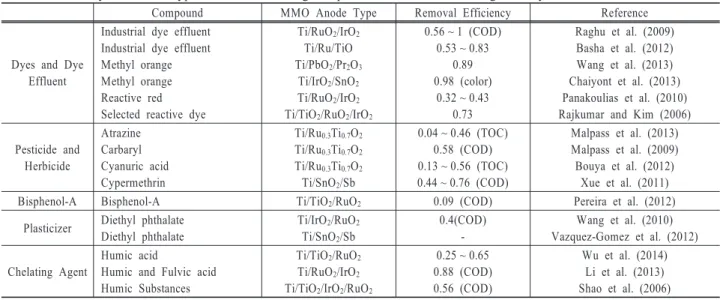
Table 1. Summary of various types of recalcitrant organic pollutants which can be degraded by an MMO anode
Compound MMO Anode Type Removal Efficiency Reference
Dyes and Dye Effluent
Industrial dye effluent Industrial dye effluent Methyl orange Methyl orange Reactive red Selected reactive dye
Ti/RuO2/IrO2
Ti/Ru/TiO Ti/PbO2/Pr2O3
Ti/IrO2/SnO2
Ti/RuO2/IrO2
Ti/TiO2/RuO2/IrO2
0.56 ~ 1 (COD) 0.53 ~ 0.83
0.89 0.98 (color)
0.32 ~ 0.43 0.73
Raghu et al. (2009) Basha et al. (2012) Wang et al. (2013) Chaiyont et al. (2013) Panakoulias et al. (2010) Rajkumar and Kim (2006)
Pesticide and Herbicide
Atrazine Carbaryl Cyanuric acid Cypermethrin
Ti/Ru0.3Ti0.7O2
Ti/Ru0.3Ti0.7O2
Ti/Ru0.3Ti0.7O2
Ti/SnO2/Sb
0.04 ~ 0.46 (TOC) 0.58 (COD) 0.13 ~ 0.56 (TOC) 0.44 ~ 0.76 (COD)
Malpass et al. (2013) Malpass et al. (2009) Bouya et al. (2012)
Xue et al. (2011)
Bisphenol-A Bisphenol-A Ti/TiO2/RuO2 0.09 (COD) Pereira et al. (2012)
Plasticizer Diethyl phthalate Diethyl phthalate
Ti/IrO2/RuO2
Ti/SnO2/Sb
0.4(COD) -
Wang et al. (2010) Vazquez-Gomez et al. (2012)
Chelating Agent
Humic acid
Humic and Fulvic acid Humic Substances
Ti/TiO2/RuO2
Ti/RuO2/IrO2
Ti/TiO2/IrO2/RuO2
0.25 ~ 0.65 0.88 (COD) 0.56 (COD)
Wu et al. (2014) Li et al. (2013) Shao et al. (2006)
Fig. 1. DSA fabrication process.
. . , MMO
. MMO
(Cyclic voltammetry,
CV) (Electrochemical impe-
dance spectroscopy, EIS) .
.
Ti/IrO2/Ta2O5 (1×4 cm2)
(Sand blaster) ,
. Ti/IrO2/Ta2O5 (IrCl3)
(TaCl5) 50:50, 70:30, 90:10 (n-Butanol) brushing (cm2) 2 mg, 4 mg, 6 mg, 8 mg
.
350°C 20
350°C 1 . Fig. 1
.
Ti/IrO2/Ta2O5
.
, MMO
,
(Kim et al., 2002). Ti/IrO2/Ta2O5
Fig. 2 Potentiostat/galva-
nostat (AMETEK PAR, 2273) .
, (Ag/AgCl,
KCl), .
0.1N H2SO4 , 25°C .
25 mV/sec .
100 kHz 10 mHz , 10 mV
Fig. 2. Electrochemical cell apparatus.
, Zsimpwin(Princeton Applied Research,
England) . (Accelerated
life test, ALT) (Wonatech, WBCS3000S)
Ti/IrO2 Pt
1N HCl 0.3 A/cm2
.
Ti/IrO2/Ta2O5
DSA
Fig. 3 .
-
- . -0.4 V 1.4 V
1.3 V(vs. Ag/AgCl)
90% IrO2+ 10% TaO5/Ti
. 50% IrO2+ 50%TaO5/Ti
IrO2 50% 70%
.
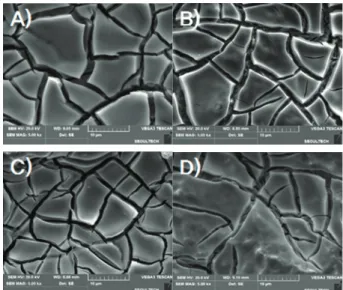
Fig. 4 DSA , Ir
IrO2/Ti 50% IrO2+ 50% TaO5/Ti , 70% IrO2+ 30% TaO5/Ti , 90% IrO2+ 10% TaO5/Ti
SEM .
Fig. 4. SEM photograph of Ti/IrO2/Ta2O5 electrodes with a variation of IrO2 and TaO5: A) 100% IrO2/Ti, B) 90%
IrO2+ 10% TaO5/Ti, C) 70% IrO2+ 30% TaO5/Ti, D) 50% IrO2+ 50% TaO5/Ti.
(mud crack)
. 50% IrO2+ 50% TaO5/Ti 1.240 ~ 1.575 Ɇm, 70% IrO2+ 30% TaO5/Ti 1.372 ~ 1.719 Ɇm, 90% IrO2+ 10% TaO5/Ti 1.558 ~ 1.948 Ɇm, IrO2/Ti 1.934 ~ 2.236 Ɇm
. Ir
. Wang et al. (2010) 25 °C, 1 bar
1 Ɇm . 1 Ɇm
O2
. Ir
IrO2 50%
1 Ɇm , 50%
1 Ɇm .
Ti/IrO2/Ta2O5
,
IrO2 50%
.
Ti/IrO2/Ta2O5
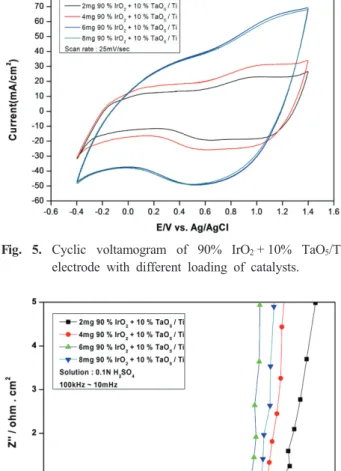
0.1N H2SO4 -0.4 V 1.4
V Fig. 5
. 90% IrO2+ 10% TaO5
2 mg/cm2 6 mg/cm2
. 6 8 mg/cm2
. 6 8 mg/cm2
Ti/IrO2/Ta2O5
. Ti/IrO2/Ta2O5
Fig. 5. Cyclic voltamogram of 90% IrO2+ 10% TaO5/Ti electrode with different loading of catalysts.
Fig. 6. Nyquist plots of Ti/IrO2/Ta2O5 electrode with diffe- rent loading of mixed metal oxide.
Fig. 7. Resistance of Ti/IrO2/Ta2O5 electrode with different loading of mixed metal oxide.
Fig. 6
.
Ti/IrO2/Ta2O5 (cm2) 2
mg, 4 mg, 6 mg, 8 mg
2.113 ȳ, 1.796 ȳ, 1.760 ȳ, 1.831 ȳ (Fig. 7).
.
.
4 mg 6 mg
.
. 8 mg
.
,
.
Ti/IrO2/ Ta2O5
. ·
Ti/IrO2/Ta2O5
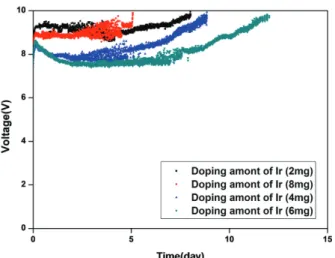
2 V . Fig. 8 1N HCl 0.3 A/cm2 Ti/IrO2/Ta2O5
. 2 mg, 4 mg, 6 mg
. 2 mg
.
, 4 mg 6 mg
Fig. 8. Accelerated lifetime of Ti/IrO2/Ta2O5 electrode with different loading of mixed metal oxide in 1N HCl at 0.3 A/cm2.
,
. ,
.
, 8 mg
.
(Xu and Scantlebury, 2003), 8 mg
.
Ir
.
1) Ir (Ta)
, (Ir) (Ta)
50:50 90:10
. 90:10
. 2)
90:10
(cm2) 2 mg, 4 mg, 6 mg, 8 mg
. ,
6 mg
.
3) 1N HCl
0.3 A/cm2 Ti/IrO2/Ta2O5 6mg
.
MMO DSA
.
. (2015-1263)
Basha, C. A., Sendhilb, J., Selvakumarc, K. V., Muniswaranb, P.
K. A., and Lee, C. W. (2012). Electrochemical Degradation of Textile Dyeing Industry Effluent in Batch and Flow Reactor Systems, Desalination, 285, 188-197.
Bouya, H., Errami, M., Salghi, R., Bazzi, L., Zarrouk, A., Al-Deyab, S. S., Hammouti, B., Bazzi, L., and Chakir, A.
(2012). Electrochemical Degradation of Cypermethrin Pesti- cide on a SnO2 Anode, International Journal of Electroche- mical Science, 7(4), 7453.
Chaiyont, R., Badoe, C., Ponce de León, C., Nava, J. L., Recio, F. J., Sirés, I., Herrasti, P., and Walsh, F. C. (2013).
Decolorization of Methyl Orange Dye at IrO2-SnO2-Sb2O5
Coated Titanium Anodes, Chemical Engineering & Techno- logy, 36(1), 123-129.
Kim, K. W., Lee, E. H., Kim, J. S., Shin, K. H., and Jung, B.
I. (2002). Material and Organic Destruction Characteristics of High Temperature-Sintered RuO2 and IrO2 Electrodes, Journal of The Electrochemical Society, 149, 187-192.
Lee, J. Y., Kang, D. K., Lee, K. H., and Chang, D. Y. (2011).
An Investigation on the Electrochemical Characteristics of Ta2O5-IrO2 Anodes for the Application of Electrolysis Pro- cess, Materials Sciences and Applications, 2, 237-243.
Li, X., Wang, C., Qian, Y., Wang, Y., and Zhang, L. (2013).
Simultaneous Removal of Chemical Oxygen Demand, Turbidity and Hardness from Biologically Treated Citric Acid Wastewater by Electrochemical Oxidation for Reuse, Sepa- ration and Purification Technology, 107, 281-288.
Malpass, G. R. P., Miwa, D. W., Miwa, A. C. P., Machado, S.
A. S., and Motheo, A. J. (2009). Study of Photo-assisted Electrochemical Degradation of Carbaryl at Dimensionally Stable Anodes(DSA®), Journal of Hazardous Materials, 167(1), 224-229.
Malpass, G. R., Salazar-Bandaa, G. R., Miwa, D. W., Machadoa, S. A., and Motheoa, A. J. (2013). Comparing Atrazine and Cyanuric Acid Electro-Oxidation on Mixed Oxide and Boron- Doped Diamond Electrodes, Environmental Technology, 34(8), 1043-1051.
Panakoulias, T., Kalatzis, P., Kalderis, D., and Katsaounis, A.
(2010). Electrochemical Degradation of Reactive Red 120 using DSA and BDD anodes, Journal of Applied Electro- chemistry, 40(10), 1759-1765.
Pereira, G. F., Rocha-Filho, R. C., Bocchi, N., and Biaggio, S.
R. (2012). Electrochemical Degradation of Bisphenol A using a Flow Reactor with a Boron-Doped Diamond Anode, Che-
Ti/IrO2/Ta2O5
mical Engineering Journal, 198, 282-288.
Raghu, S., Lee, C. W., Chellammal, S., Palanichamy, S., and Basha, C. A. (2009). Evaluation of Electrochemical Oxida- tion Techniques for Degradation of Dye Effluents-A Compa- rative Approach, Journal of Hazardous Materials, 171, 748- 754.
Rajkumar, D. and Kim, J. G. (2006). Oxidation of Various Reactive Dyes with In Situ Electro-generated Active Chlorine for Textile Dyeing Industry Wastewater Treatment, Journal of Hazardous Materials, 136(2), 203-212.
Shao, L., He, P., Xue, J., and Li, G. (2006). Electrolytic Degradation of Biorefractory Organics and Ammonia in Leachate from Bioreactor Landfill, Water Science and Tech- nology, 53(11), 143-150.
Vazquez Gomez, L., de Battisti, A., Ferro, S., Cerro, M., Reyna, S., Martínez Huitle, C. A., and Quiroz, M. A.
(2012). Anodic Oxidation as Green Alternative for Removing Diethyl Phthalate from Wastewater using Pb/PbO2 and Ti/SnO2 Anodes, CLEAN-Soil, Air, Water, 40(4), 408-415.
Wang, F., Li, S., Xua, M., Wan, Y., Fanga, W., and Yan, X.
(2013). Effect of Electrochemical Modification Method on Structures and Properties of Praseodymium Doped Lead Dioxide Anodes, Journal of the Electrochemical Society, 160(2), 53-59.
Wang, H., Sun, D. Z., and Bian, Z. Y. (2010). Degradation Mechanism of Diethyl Phthalate with Electrogenerated Hydroxyl Radical on a Pd/C Gas-diffusion Electrode, Journal of Hazardous Materials, 180(1), 710-715.
Wu, W., Huang, Z. H., and Lim, T. T. (2014). Recent Deve- lopment of Mixed Metal Oxide Anodes for Electrochemical Oxidation of Organic Pollutants in Water, Applied Catalysis A: General, 480, 58-78.
Xu, L. K. and Scantlebury, J. D. (2003). A Study on the Deac- tivation of an IrO2-Ta2O5 Coated Titanium Anode, Corrosion Science, 45, 2729-2740.
Xue, B., Zhang, Y., and Wang, J. Y. (2011). Electrochemical Oxidation of Bisphenol A on Ti/SnO2-Sb2O5/PbO2 Anode for Wastewater Treatment, Procedia Environmental Sciences, 10, 647-652.