ISSN 2288-1069 (Online)
http://dx.doi.org/10.12925/jkocs.2015.32.4.639
첨가제에 따른 바이오디젤 산화안정 특성 연구
강형규
*ㆍ송호영
*ㆍ도진우
*ㆍ박수열
**ㆍ나병기
***†*한국석유관리원 석유기술연구소, **한국화학연구원, ***충북대학교 화학공학과 (2015년 10월 6일 접수; 2015년 11월 23일 수정; 2015년 12월 21일 채택)
A study on the Property of Oxidation Stability in Biodiesel by the Additives
Hyung-Kyu Kang*ㆍHo-Yong Song*ㆍJin-Woo Doe*ㆍSoo-Youl Park**ㆍByung-Ki Na†
*
Research Institute of Petroleum Technology, Korea Petroleum Quality & Distribution Authority
**
Korea Research Institute of Chemical Technology
***†
Department of Chemical Engineering, Chungbuk National University (Received October 6, 2015; Revised November 23, 2015; Accepted December 21, 2015)
요 약 : 바이오디젤은 지방산 중의 일부물질이 대기중의 산소와 결합하여 유기지방산 등을 형성하며 밀도, 동점도, 전산가, 산화안정도 등의 물성 특성에 영향을 준다. 바이오디젤의 산화안정성 문제를 해결 하기 위해 바이오디젤에 다양한 산화방지제를 첨가하여 물성 변화의 특성을 분석하였다. 첨가제의 함량 이 증가함에 따라 산화안정도는 증가하는 경향을 나타내고 대부분 첨가량에 비례적으로 증가하였다. 7 종의 첨가제 중 TBHQ가 가장 우수한 성능을 보이며 propyl gallate, butyl-amine, aniline, pyrogallol 등 4종의 첨가제도 목표치인 500 ppm 첨가 시 10시간 이상의 성능을 보였다. pyrogallol이 전산가에서 품질기준에 부적합하여 첨가제로서 적절하지 않은 것으로 나타났으며, hydroquinone계열의 TBHA, DTBHQ는 산화안정도에서 품질기준은 만족하나 연구과제의 목표치인 10 시간 이상에 미치지 못하는 결과를 보여 개발 첨가제로서는 결함이 있는 것으로 판단하였다. 또한 propyl gallate도 전산가에서 품질 기준에 적합하나 500 ppm 첨가 시 수치가 높고 첨가제 증가에 따른 전산가 증가 경향이 커서 첨가제 로서 부적합한 것으로 판단하였다.
주요어 : 산화안정제, 바이오디젤, 산화안정도, TBHQ, TBHA, propyl gallate, butyl-amine, aniline, pyrogallol
Abstract : Some materials of fatty acids in the biodiesel affect the physical/chemical properties like density, kinematic viscosity, total acid number and oxidation stability by forming an organic fatty acid in combination with oxygen in the air. To solve the problem of the oxidative stability of biodiesel, various kinds of antioxidant has added and analyze the characteristics of the physical/chemical property changes by the addition of antioxidant. Oxidation stability increased by
✝
Corresponding author
(E-mail: [email protected])
2 강형규ㆍ송호영ㆍ도진우ㆍ박수열ㆍ나병기 韓國油化學會誌
the increase of additives content. The TBHQ among the seven kinds of the additives showed the best performance. Also, 4 kinds of additives like propyl gallate, butyl-amine and pyrogallo has showed above 10 hr of oxidation stability at the addition of 500 ppm. In case of pyrogallo, this is not appropriate as an additive to suitable quality standards of total acid number. TBHA, DTBHQ of hydroquinone was satisfied with the quality standard of oxidation stability but the target of this research(above 10 hr) did not satisfied with oxidation stability. Propyl gallate is also a suitable at the quality standards of total acid number but it was shown not to be an appropriate to the additives due to increasing the total acid number by increasing of the content of additives at the addition of 500 ppm.
Keywords : Antioxidant, Biodiesel, TBHQ(tertiary butyl hydroquinone), Oxidative stability, Total acid number, propyl gallate, butyl-amine, aniline, pyrogallol
1. 서 론
석유자원의 고갈에 대응하고 지구 온난화의 주 요 원인인 온실가스와 대기오염물질인 자동차 배 출가스를 감소시키기 위하여 기존의 화석연료를 대체할 수 있는 새로운 연료인 신재생에너지에 대한 관심이 집중되고 있다.[1] 자연에 존재하면 서 에너지 자원의 고갈문제가 없는 재생 가능한 바이오메스인 대두유, 유채유, 팜유 등의 식물성 기름 및 돈지, 우지 등의 동물성 지방과 폐식용 유 등의 유지로부터 대량 생산이 가능한 바이오 디젤은[2] 경유와 점도, 밀도 등의 물성이 유사하 고[3-4] 세탄가가 높아 디젤엔진에서 압축착화연 소가 가능하므로 연료공급시스템과 엔진의 특별 한 구조 변경 없이 경유에 대체 또는 혼합하여 사용할 수 있고[5-11] 기존의 석유 유통 인프라 를 그대로 활용할 수 있어 새로운 석유 대체연료 로서 주목받고 있다. 이러한 바이오디젤의 제조기 술에는 알카리촉매법[12], 산촉매법[13], 리파아 제효소반응법[14], 초임계메탄올법[15] 등이 제안 되고 있고 자동차용 연료로 사용 시에 연료 품질 면에서 산화안정성과 겨울철 저온유동성 향상 등 기술적으로 해결하여야 할 문제들이 A. Monyem [16-18] 등의 연구에서 제시되고 있다. 탄화수소 만으로 구성되어 있는 석유계 경유와는 달리 바 이오디젤은 지방산메틸에스터(fatty acid methyl ester, FAME)로 구성(96.5 % 이상)되어 있어, 온·습도 등의 저장조건과 자동차 연료분사 환경 등에 따라 경유에 비해 산화되기 쉽고 이러한 산 화반응에 의해 유기산과 중합물이 생성될 수 있 는 것으로 추정되기 때문이다.[19-20] 유기산은
금속재료 부식과 고무·수지 등의 열화를 초래하고 중합물은 연료필터 등 자동차 연료공급 시스템에 축적되어 연료필터 막힘 또는 연료 분사량에 변 화를 일으키거나 연료분사펌프와 인젝터 불량의 원인이 될 수 있을 것으로 판단하고 있다.
[16-17] 바이오디젤의 산화는 바이오디젤 내에 포함된 메틸에스터 중에서 이중결합이 있는 메틸 에스터 즉, 불포화 메틸에스터 때문이다. 불포화 메틸에스터의 산화는 이중결합의 수와 위치에 따 라 달라진다. 긴사슬 지방산 메틸에스터의 경우 이중결합이 2개 이상인 에스터가 이중결합이 1개 인 에스터에 비해 산화에 대한 반응성이 약 2배 가 되는 것으로 알려져 있으며 원료의 정제정도 에 따른 산화안정도는 크루드 대두유, 탈검대두 유, 정제대두유의 순서이다.[21] 산화방지를 위한 효과적인 방법은 산화방지제를 투입하는 것이다.
바이오디젤용 산화방지제는 이미 식품산업에서도 사용되던 것들이다. 바이오디젤 산화방지제는 천 연 산화방지제와 합성 산화방지제로 구분할 수 있다. 천연 산화방지제에는 Tocopherol, Ascorbic acid, β-carotene 등이 있고, 합성 산화방지제는 페놀 화합물이 대표적이며 BHA(butylated hydroxyanisole), BHT (butylatedhydroxytoluene), PG(propyl gallate), TBHQ(tert-butylhydro quinone)가 있다. BHT의 경우 가격이 저렴하다 는 장점이 있다. 이중 대표적인 바이오디젤 산화 방지제는 TBHQ가 가장 효과적인 것으로 알려져 있다.[22-23] 대표적인 산화방지제의 구조는 Fig.
2와 같다.
Fig. 1. A schematic chemical structure of Antioxidant
이러한 바이오디젤의 산화안정성 문제를 해결하 기 위해 바이오디젤에 다양한 산화방지제를 첨가 하여 석유 및 석유대체연료 사업법과 대기환경보 전법에 근거한 자동차연료의 물성 변화에 따른 특성을 연구하였다.[24-25]
2. 실 험
2.1. 산화방지제를 첨가한 바이오디젤의 산화안 정성 시험
본 연구에서 사용한 산화방지제는 propyl gallate, TBHA, TBHQ, DTBHQ, buty-amine, aniline, pyrogallol 등 총 7종이다. 순수한 폐식용 유 바이오디젤에 첨가제를 250 ppm, 500 ppm, 750 ppm을 첨가하고 산화안정도를 각각 시험하 였다. 바이오디젤 산화안정성 시험은 Fig. 3과 같 이 바이오디젤을 110 ℃ 공기 흐름 조건에서 산 화시켜 산화물인 유기산이 증류수에 녹아 전도도 가 급격히 증가하는 시간을 측정하는 시험으로 본 연구에서는 EN 14112(가속산화안정성) 시험 방법을 적용하였다.[26]
Fig. 2. Principle of oxidation stability instrument[27]
4 강형규ㆍ송호영ㆍ도진우ㆍ박수열ㆍ나병기 韓國油化學會誌
Kinds of Compound*
Oxidation Stability (hr)
BD100 250 ppm 500 ppm 750 ppm
TBHA 3.8 6.7 8.9 9.6
DTBHQ 3.8 6.5 9.0 9.0
TBHQ 3.8 16.9 22.8 17.4
Propyl gallate 3.8 8.2 10.4 12.1
Pyrogallol 2.7 12.1 15.0 15.9
DMSF1X 2.6 3.0 3.9 3.9
DMSF2X 2.6 2.8 3.8 4.0
* TBHA : t-Butylhydroxyanisole, DTBHQ : Di-t-butylhydroquinone, TBHQ : t-Butylhydro quinone, DMSF1X : Di-t-butylmethoxybenzene, DMSF2X : Di-t-butyldimethoxybenzene Table 2. The oxidation stability of hydroquinone-based and gallate-based antioxidant
Items Unit Analysis Method Test Instrument
Oxidation Stability hour EN14112 Rancimat 743
Density kg/m3 KS M 2002 DA-3000
Kinematic Viscosity mm2/s KS M 2012 CAV-2100 Total Acid Number mgKOH/g KS M ISO 6619 Titrino plus Table 1. Test method and equipment criteria
2.2. 산화방지제의 적합성 시험
바이오디젤에 t-부틸하이드로퀴논(TBHQ), t- 부틸하이드로아니솔(TBHA), 디-t-부틸하이드로 퀴논(DTHQ), 프로필갈레이트(Propyl gallate), 피로갈롤(Pyrogallol), 디부틸-p-페닐아민 (DMSF1X), 디페닐-p-페닐렌디아민(DMSF2X) 의 산화방지제를 각각 100 ppm, 200 ppm, 300 ppm, 400 ppm, 500 ppm 첨가하여 110 ℃에서 10 일 동안 강제 산화를 시키고 산화안정성, 밀 도, 동점도 및 전산가 등의 물성시험을 진행하였 다. 적합성 시험에 사용된 시험법은 Table 1에 나타내었다.
3. 결과 및 고찰
3.1. 산화방지제의 산화안정성 시험3.1.1. 하이드로퀴논계 및 갈레이트계 산화방지 제의 산화안정성 시험
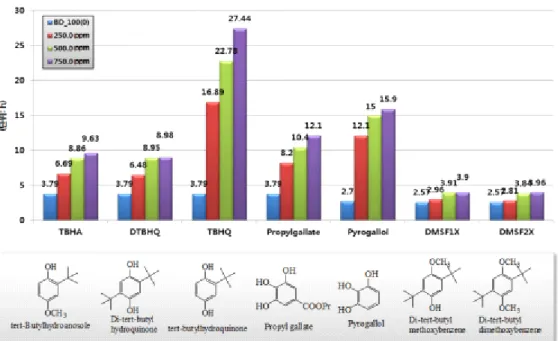
하이드로퀴논계 산화방지제의 산화안정성 측 정 결과 500 ppm이하에서 t-부틸하이드로퀴논 화합물이 산화안정성이 높았으며(22.8 시간), Di-t-부틸하이드로퀴논(9.0 시간)과 t-부틸하이 드로아니솔(8.9 시간) 화합물은 유사한 산화시간 을 가졌다.
갈레이트계 산화방지제 화합물의 산화안정성 은 500 ppm이하에서 피로갈롤이 프로필갈레이트 화합물과 비교하여 우수함을 보였으며, Di-t-부 틸메톡시벤젠과 Di-t-부틸디메톡시벤젠 화합물은 바이오디젤의 산화안정성을 향상시키지않았다.
그밖에 250 ppm과 750 ppm에서의 측정결과 를 통하여 산화방지제의 첨가량을 증가함에 따라 비례적으로 그들의 산화안정성이 증가하지는 않 았다.
하이드로퀴논계 및 갈레이트계 산화방지제의 시험결과를 Table 2와 Fig. 4에 나타내었다.
Kinds of
Compound* Oxidation Stability (hr)
BD100 250 ppm 500 ppm 750 ppm
Et-NH2 3.8 11.4 13.4 14.9
Bu-NH2 3.8 9.1 12.5 13.0
He-NH2 3.8 6.3 8.7 11.6
Oc-NH2 3.8 5.1 6.8 8.1
Aniline 3.8 15.3 20.2 23.4
Benzyl-NH2 3.8 5.3 5.6 7.1
PEA-NH2 3.8 8.3 10.1 10.5
* Et-NH2 : N,N’-Diethyl-p-phenylenediamine, BU-NH2 : N,N’-Dibutyl-p-phenylenediamine, He-NH2 : N,N’-Dihexyl-p-phenylenediamine, Oc-NH2 : N,N’-Dioctyl-p- phenylenediamine, Aniline : N,N’-Diphenyl-p-phenylenediamine, Benzyl-NH2 : N,N’-Dibenzyl-p-phenylene diamine, PEA-NH2 : N,N’-Diphenethyl-p-phenylenediamine Table 3. The oxidation stability according to the added amount of the diamine-based antioxidant
Fig. 3. Results of oxidation stability according to the added amount of hydroquinone-based and gallate-based antioxidant
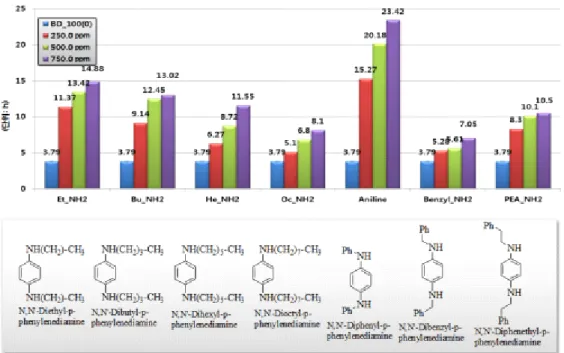
3.1.2. 디아민계 산화방지제의 산화안정성 시험 아민계 산화방지제의 산화안정성 측정 결과 500 ppm이하에서 페닐-p-페닐렌디아민 화합물 이 가장 좋았으며(20.2 시간), 그 다음으로 디에 틸-p-페닐렌디아민(13.4 시간), 디부틸-p-페닐 렌디아민(12.5 시간), 디페닐에틸-p-페닐렌디아
민(10.1 시간), 디헥실-p-페닐렌디아민(8.7 시 간), 디옥틸-p-페닐렌디아민(6.8 시간), 디벤질 -p-페닐렌디아민(5.6 시간) 화합물의 순서로 산 화안정성을 가졌다. 그밖에 250 ppm과 750 ppm에서의 측정결과를 통하여 산화방지제의 첨 가량을 증가함에 따라 비례적으로 그들의 산화안
6 강형규ㆍ송호영ㆍ도진우ㆍ박수열ㆍ나병기 韓國油化學會誌
Kinds of Compound*
Oxidation Stability (hr)
BD100 250 ppm 500 ppm 750 ppm
3MPPA 2.7 3.3 3.6 4.0
PPDTA 2.7 4.2 4.7 5.4
4MDPA 2.7 3.6 4.1 4.4
* 3MPPA : 3-Methyldiphenylamine, PPDTA : p,p'-Ditoylamine4, MDPA : 4-Methyldiphenyl amine
Table 4. The oxidation stability according to the added amount of the amine-based antioxidant Fig. 4. Results of oxidation stability according to the added amount of the diamine-based
antioxidant
정성이 증가하지는 않았다.
디아민계 산화방지제의 시험결과를 Table 3.
과 Fig. 5.에 나타내었다.
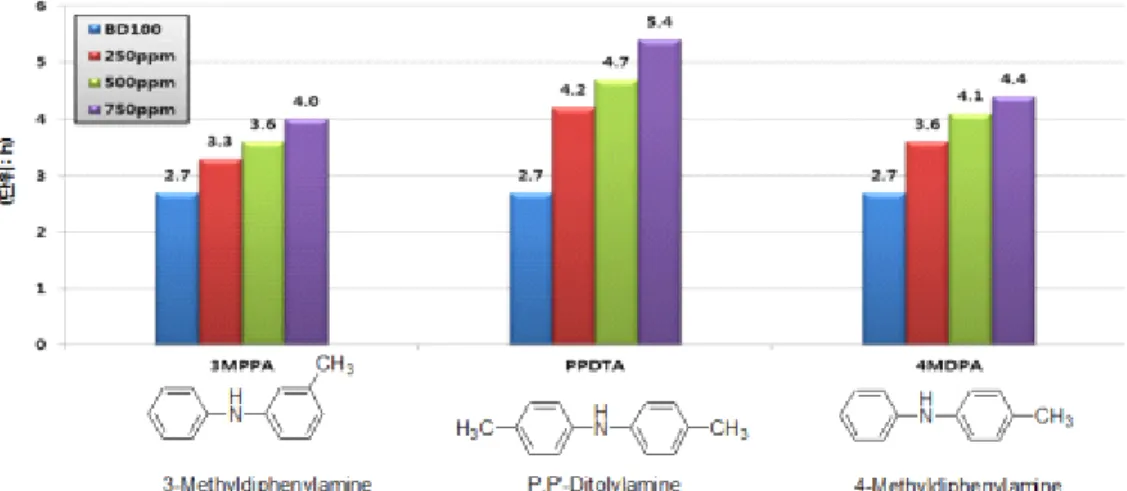
3.1.3. 아민계 산화방지제의 산화안정성 시험 아민계 산화방지제의 산화안정성 측정 결과 첨 가량에 따른 산화안정도가 증가하였으나, 250 ppm, 500 ppm, 750 ppm 모두에서 좋지 않은 결과가 나타났다.
아민계 산화방지제의 시험결과를 Table 4.와 Fig. 6.에 나타내었다.
3.1.4. 산화방지제 500 ppm에서의 산화안정성 시험
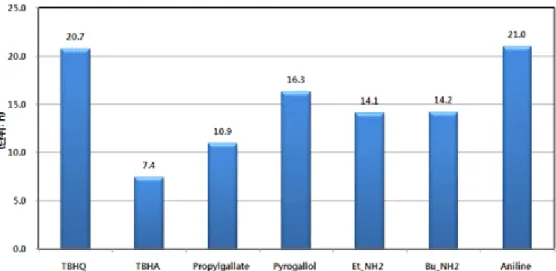
하이드로퀴논계 산화방지제의 산화안정성 측정 결과 500 ppm이하에서 t-부틸하이드로퀴논 화합 물이 산화안정성이 높았으며(22.8 시간), Di-t- 부틸하이드로퀴논(9.0 시간)과 t-부틸하이드로아 니솔(8.9 시간) 화합물은 유사한 산화시간을 가진 결과를 얻을 수 있었다. 이 중 비교적 산화안정 성이 좋은 t-부틸하이드로퀴논과 t-부틸하이드로 아니솔 화합물을 선별하여 산화안정성을 평가하 였다. 하이드로퀴논계 산화방지제의 500 ppm이
Kinds of Compound* Oxidation Stability (hr)
BD100 500 ppm
TBHQ 2.6 20.7
TBHA 2.6 7.4
Propylgallate 2.6 10.9
Pyrogallol 2.6 16.3
Et-NH2 2.6 14.1
Bu-NH2 2.6 14.2
Aniline 2.6 21.0
* TBHQ : t-Butylhydroquinone, TBHA : t-Butylhydroxyanisole, Et-NH2 : N,N’-Diethyl-p- phenylenediamine, Bu-NH2 : N,N’-Dibutyl-p-phenylenediamine, Aniline : N,N’-Diphenyl- p-phenylenediamine
Table 5. The oxidation stability according to the added amount of hydroquinone-based, gallate-based and amine-based antioxidant
Fig. 5. Results of oxidation stability according to the added amount of the amine-based antioxidant.
하에서 산화안정성 측정 결과 t-부틸하이드로퀴 논 화합물은 20.7 시간이며 t-부틸하이드로아니 솔은 7.4 시간의 산화안정성을 가졌다.
갈레이트계 산화방지제 화합물의 경우 피로게 롤과 프로필겔레이트 화합물 2종을 선별하고, 이 들을 합성하여 500 ppm이하에서 산화안정성을 측정한 결과 피로게롤 화합물은 16.3 시간, 프로 필겔레이트 화합물은 10.9 시간의 산화시간을 보 였다. 아민계 산화방지제 산화안정성 측정 결과 500 ppm이하에서 페닐-p-페닐렌디아민 화합물 이 가장 좋았으며(20.2 시간), 디에틸-p-페닐렌 디아민(13.4 시간), 디부틸-p-페닐렌디아민(12.5 시간), 디페닐에틸-p-페닐렌디아민(10.1 시간),
디헥실-p-페닐렌디아민(8.7 시간), 디옥틸-p-페 닐렌디아민(6.8 시간), 디벤질-p-페닐렌디아민 (5.6 시간) 화합물 순으로 산화안정성을 가졌으 며, 산화안정성이 우수한 디에틸-p-페닐렌디아 민, 디부틸-p-페닐렌디아민 및 페닐-p-페닐렌디 아민 3종을 선별하여 500 ppm이하에서 산화안 정성을 평가하였다. 아민계 산화방지제를 각각 500 ppm이하에서 측정한 결과 디에틸-p-페닐렌 디아민 화합물은 14.1 시간, 디부틸-p-페닐렌디 아민 화합물은 14.1 시간, 페닐-p-페닐렌디아민 화합물은 21 시간의 산화시간을 보였다.
이들의 시험결과를 Table 5.와 Fig. 7.에 나타 내었다.
8 강형규ㆍ송호영ㆍ도진우ㆍ박수열ㆍ나병기 韓國油化學會誌
Kinds of Antioxidant
Assessment of Quality Standard(at 500 ppm) Density
(860 ∼ 900)
Kinematic Viscosity (1.9 ∼ 5.0)
Total Acid Number (under 0.5)
Oxidation Stability (6hr, Target : 10hr)
TBHQ O O O O
TBHA O O O O
(under 10 hr)
DTBHQ O O O O
(under 10 hr)
PPG O O O O
PG O O X O
Butyl amine O O O O
Aniline O O O O
* O : Conformity, X : Unconformity
Table 6. Results of quality standards test and physical properties in antioxidant for biodiesel Fig. 6. Results of the oxidation stability according to the added amount of hydroquinone-
based, gallate-based and amine-based antioxidant.
3.2. 산화방지제의 적합성 시험
Table 6은 7종의 첨가제에 대한 밀도, 동점 도, 전산가 및 산화안정도 등을 품질기준과 비교 하여 첨가제로서 적합한지 여부를 나타낸 것이다.
Pyrogallol이 전산가에서 품질기준에 부적합하 여 첨가제로서 적절하지 않은 것으로 나타났으며, hydroquinone계열의 TBHA, DTBHQ는 산화안
정도에서 품질기준은 만족하나 연구과제의 목표 치인 10 시간 이상에 미치지 못하는 결과를 보여 개발 첨가제로서는 결함이 있는 것으로 판단하였 다. 또한 Propyl gallate도 전산가에서 품질기준에 적합하나 500 ppm 첨가 시 수치가 높고 첨가제 증가에 따른 전산가 증가 경향이 커서 첨가제로 서 부적합한 것으로 판단하였다.
5. 결 론
첨가제 함량이 증가함에 따라 산화안정도는 증 가하는 경향을 보이고 있으며 대부분 첨가량에 비례적으로 증가한다. 7종의 첨가제 중 TBHQ가 가장 우수한 성능을 보이며 propyl gallate, butyl-amine, aniline, pyrogallol 등 4종의 첨가 제도 목표치인 500 ppm 첨가 시 10 시간 이상 의 성능을 보였다.
첨가제에 대한 밀도, 동점도, 전산가, 산화안정 도 등을 품질기준과 비교하여 첨가제로서 적합한 지 여부를 확인하였고, 그 결과 pyrogallol이 전 산가에서 부적합하여 첨가제로서 적절하지 않은 것으로 나타났으며, hydroquinone계열의 TBHA, DTBHQ는 산화안정도에서 품질기준은 만족하나 연구과제의 목표치인 10 시간 이상에 미치지 못 하는 결과를 보여 개발 첨가제로서는 결함이 있 는 것으로 판정하였다. 또한 propyl gallate는 전 산가에서 품질기준에 적합하나 500 ppm 첨가 시 수치가 높고 첨가제 함량 증가에 따른 전산가 증 가 경향이 커서 첨가제로서 부적합한 것으로 판 단된다.
첨가제의 함량에 따른 산화안정도 실험, 물리 적/화학적 특성분석 등의 시험결과로 부터 TBHQ, butyl-amine, aniline 등이 바이오디젤 산화방지제로서 적합한 것으로 판단된다. 또한, 첨가제의 사용은 경제적 비용의 문제도 함께 고 려하여야 하는 사항으로 바이오디젤의 품질 향상 과의 적절한 검토가 요구된다.
References
1. N. Schlager, J. Weisblatt, Alternative Energy, Tomson Gale,
Farmington Hills
, 75 (2006).2. A.K. Agarwal. Biofuels(alcohols and biodiesel) application as fuels for internal combustion engines,
Progress in Energy and Comebustion Science
, 33, 223 (2007).3. S.L Dmytryshyn, A.K. Dalai, S.T.
Chaudhari, H.K. Mishra and M.J. Reaney Synthesis and characterization of vegetable oil derived esters : evaluation for their diesel additive properties,
Bioresource Technology
, 92, 55 (2007).4. C.E. Ejim, B.A. Fleck and A. Amirfazli, Analytical study for atomization of biodiesels and their blends in a typical injector : Surface tension and viscosity effects,
Fuel
, 86, 1534 (2007).5. G. Knothe, R.O. Dunn, M.O. Bagby, in:
B.C. Saha, J. Woodward (Eds.), ACS Symp. Ser. 666: “Fuels and Chemicals for Biomass, American Chemical Society”, Washington, DC, 172, (1997).
6. M. S. Graboski and R. L. McCormick, Combustion of Fat and Vegetable Oil Derived Fuels in Diesel Engines,
Prog.
Energy Combust. Sci.
, 24, 125 (1998).7. Krahl, J., Bünger, J., Jeberien, H. E., Prieger, K., Schütt, C., Münack, A., &
Bahadir, M. Analysis of biodiesel exhaust emissions and determination of environmental and health effects.
In Proceedings, Third Liquid Fuel Conference:
Liquid Fuel and Industrial Products from Renewable Resources
149, (1996)..8. Krahl, J., A. Münack, M. Bahadir, L.
Schumacher and N. Elser, Survey About Biodiesel Exhaust Emissions and Their Environmental Benefits,
Institute of Biosystems Engineering, Federal Agricultural Research Centre, Braunschweig, Germany,
(1995).9. A. W. Schwab, M. O. Bagby and B.
Freedman, Preparation and Properties of Diesel Fuels from Vegetable Oils,
Fuel
, 66, 1372 (1987).10. G. Knothe, A.C. Matheaus and T.W.
Ryan, Cetane number of branched and straight-chan fatty esters determined in an ignition quality tester,
Fuel
, 82, 971 (2003).11. K.H. Ryu, Y.T. Oh, Durability Test of a Direct Injection Diesel Engine Using Biodiesel Fuel,
Korean Society of Automotive Engineers
, 12, 32 (2004) 12. L. Hui, H. Kai and Z. Xiaoming, Methodfor manufacturing biodiesel using solid base catalyst, Faming Zhuanli Shenging Gongkai Shuomingshu, ACS on SciFinder,
10 강형규ㆍ송호영ㆍ도진우ㆍ박수열ㆍ나병기 韓國油化學會誌
pp.5, (2007).
13. Z. Haijun, Method for preparing biodiesel oil by using solid acid base as catalysts, Faming Zhuanli Shenging Gongkai Shuomingshu, ACS on SciFinder, pp.13, (2007).
14. N.W. Li, H. Wu, W.Y Lou and M.H.
Zong, Immobilization of Lipase and its application in biodiesel production, ACS National Meeting,
American Chemical Society
, 233 (2007).15. S. Saka, Biodiesel fuel from fats and oils using a supercitical method process, Kemikaru Enjiiniyaringu, 52(2), Kagaku Kogyosha, 132 (2007).
16. A. Monyem, J.H. Van Gerpen, The effect of biodiesel oxidation on engine performance and emissions,
Biomass and Bioenergy
, 20, 317 (2001).17. A.S ramadhas, S. Jayaraj and C.
Muraleedharan, Charcaterization and effect of using rubber seed oil as fuel in the compression ignition engines,
Renewable Energy
, 30, 795 (2005)18. J.Y Park, D.K Kim, J.P. Lee, S.C. Park, Y.J. Kim and J.S. Lee, Blending effects of biodiesels on oxidation stability and low temperature flow properties,
Bioresource Technology
, 99(5), 1196 (2007).19. K. Miyashita, K, Fujimoto and T. Kaneda, Formation of dimers during the initial stage of autoxidation in methyl linoleate,
Agric. Biol. Chem.,
46, 751 (1981).20. E.N. Frankel, C.D. Evans and J.C. Cowan, Thermal Dimerization of Fatty Ester Hydroperoxides,
The Journal of the American Oil Chemists Society
, 37, 424 (1960).21. 김래현, 2005, “바이오매스의 에너지 변환과 산업화”, 아진, 서울, p.81.
22. T. Lee., M. Kim., D. B., and Y. H., The effect of Bio-diesel and Cooled-EGR System in a Heavy-duty Diesel Engine,
The Korean Society of Automotive Engineers
, 160 (2005).23. J. Kim, S. Choi, Y. Oh and G. Kim, A Study on the Characteristics for Durability of the Commercial CRDI Diesel Engine with Biodiesel Fuel,
The Korean Society of Automotive Engineers
, 705 (2005).24. Petroleum and Petroleum Substitute Fuel Business Act, Ministry of Trade, Industry and Energy, (2014).
25. Clean Air Conservation Act, Ministry of Environment, (2014).
26. EN 14112, Fat and oil derivatives-Fatty Acid Methyl Esters (FAME) - Determination of oxidation stability (accelerated oxidation test), (2003)
27. 743 Rancimat user guide, Metrohm
![Fig. 1. A schematic chemical structure of Antioxidant 이러한 바이오디젤의 산화안정성 문제를 해결하 기 위해 바이오디젤에 다양한 산화방지제를 첨가 하여 석유 및 석유대체연료 사업법과 대기환경보 전법에 근거한 자동차연료의 물성 변화에 따른 특성을 연구하였다.[24-25] 2](https://thumb-ap.123doks.com/thumbv2/123dokinfo/4923949.537884/3.892.215.641.175.563/바이오디젤의-산화안정성-바이오디젤에-산화방지제를-석유대체연료-대기환경보-자동차연료의-연구하였다.webp)