Journal of the Korean Chemical Society 2021, Vol. 65, No. 5
Printed in the Republic of Korea https://doi.org/10.5012/jkcs.2021.65.5.309
-309-
Solvolysis of (1S)-(+)-Menthyl Chloroformate in Various Mixed Solvents
Han Joong Koh* and Suk Jin Kang
Department of Science Education, Jeonju National University of Education, Jeonju 55101, Korea.
*E-mail: [email protected]
(Received June 28, 2021; Accepted July 21, 2021)
The solvolysis of (1s)-(+)-menthyl chloroformate (1) were studied kinetically in 28 pure and various mixed solvents. The analysis using the extended Grunwald-Winstein equation in the solvolysis of 1 obtained the l value of 2.46 ± 0.18, the m value of 0.91 ± 0.07, and the correlation coefficient of 0.950. The solvolysis of 1 might proceed via an associative S N 2 mechanism enhanc- ing bond making than bond breaking in the transition state (TS). The value of l/m is 2.7 within the ranges of value found in associative S N 2 reaction. This interpretation is further supported by a relatively large solvent kinetic isotope effect (SKIE, 2.16).
Key words: (1s)-(+)-Menthyl chloroformate, Extended Grunwald-Winstein equation, Associative S N 2 mechanism, Solvent kinetic isotope effect
INTRODUCTION
The first study of solvolysis was done by Berthelot and St.
Gille. 1 Hughes and Ingold 2 studied the solvolysis to estab- lish the theoretical concept of the nucleophilic single-molecule substitution reaction and the nucleophilic bimolecular substi- tution reaction.
Kevill and co-works 3 applied the extended Grunwald- Winstein equation (eq. 1) to study the reaction pathways of the solvolysis by calculating the l and m values. In equation 1, k and k o represent the rate constants of solvolyses of a sub- strate RX in a given solvent and in the standard solvent (80% ethanol), respectively; l is the sensitivity of the sol- volysis to changes in solvent nucleophilicity (N T ); m is the sensitivities of the solvolysis to changes in solvent ion- izing power (Y Cl ), for leaving group X); c is a constant term.
This study uses the solvent nucleophilicity (N T ) scale based on the solvolyses of S-methyldibenzothiophenium ion and the solvent ionizing power (Y Cl ) scale based on the solvolyses of 1-adamantyl chloride.
log (k/k o ) = lN T + mY Cl + c (1) In previous papers in this series, we have reported that solvent effects on the TS variation in the reaction of car- bonyl derivatives (RCOCl or ROCOCl) in various mixed solvents. 4 These solvolysis can be shown as Scheme 1. It is known that the solvolysis of carbonyl compounds pro- ceeds as an S N 1 (ion pair intermediate) reaction, an S N 2 reaction, or an addition-elimination (A-E) reaction depending on the reaction conditions.
In the present study we measure rate constants of sol-
volysis 1 as eq. 2. The reaction mechanism was investi- gated by applying the rate constants of the solvolysis of 1 to the extended Grunwald-Winstein equation (eq. 1). 3 In addition, the solvent kinetic isotope effect and activation parameters were discussed in order to obtain more infor- mation for the reaction mechanism.
(2)
RESULTS AND DISCUSSION
The rate constants of solvolysis 1 were determined in 28
solvents at 55.0 o C. The solvents consisted of ethanol and
methanol, binary mixtures of water with ethanol, methanol,
2,2,2-trifluoroethanol (TFE), acetone, and four binary mixtures
of TFE and ethanol. The rate constants of solvolysis are
Scheme 1. Reaction pathways for the solvolysis of carbonyl
derivatives.
Journal of the Korean Chemical Society
310 Han Joong Koh and Suk Jin Kang
reported in Table 1.
The rates of reactions were relatively fast in strongly nuc- leophilic solvent (e.g., H 2 O) and were relatively slow in strongly electrophilic solvent in Table 1. The reaction rate constants (k) are 3.24×10 −6 s −1 at 90% acetone-H 2 O (Y=−2.39), 2.63×10 −4 s −1 at 90% EtOH-H 2 O (Y=−0.94), and 1.91×10 −3 s −1 at 90% MeOH-H 2 O (Y=−0.18). The rate constants were more dependent on the solvent nucleophilicity than on the solvent ionization power. 4a
Bimolecular reactions have been reported to have larger rate constants in nucleophilic solvent (H 2 O) systems and smaller rate constants in electrophilic solvent systems, it can be suggested that the solvolysis of 1 is a bimolecular reaction mechanism. 3
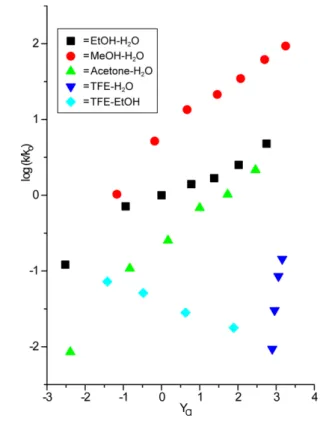
An analysis in terms of the simple Grunwald-Winstein equation (log (k/k o ) = mY Cl + c) 5 leads to an extermely poor
correlation (Fig. 1). This means that the solvolysis of 1 should consider not only the interaction between the leav- ing group on the substrate and the solvent (electrophilic assistance) but also the interaction between the solvent and the reaction center on the substrate (nucleophilic assistance).
The correlation is greatly improved by the use of the extended Grunwald-Winstein equation, 3 with an l value of 2.46±0.18, m value of 0.91±0.07, c value of 0.37±0.20, and a correlation coefficient (R) of 0.950 (Fig. 2). The very large l value to changes in solvent nucleophilicity sug- gests a very pronounced involvement of the solvent as a nucleophile in the rate-determining step. 4a
When the nucleophilic substitution reaction proceeds via the S N 1 reaction, the l value is ≈ 0 and the m value is
≈ 1, whereas the l value is ≈ 1.0 and the m value is ≈ 0.50 in the S N 2 reaction, and the l value is ≈ 1.9 and the m value is
≈ 0.60 in the associative S N 2 (or addition-elimination) reaction. 6
The results showed that the solvolysis of 1 proceeds via the associative S N 2 reaction. The value of l (=2.46) is greater than the value of m (=0.91), it can be expected that the bond formation is more advanced than the bond breaking in the TS.
The l value of 2.46 is similar to those previously reported Table 1. Rate constants (k) for solvolysis of 1 at 55.0
oC
Solvent-mixture
ak (s
-1)
100%EtOH 4.47×10
-590%EtOH-H
2O 2.63×10
-480%EtOH-H
2O 3.69×10
-470%EtOH-H
2O 5.16×10
-460%EtOH-H
2O 6.20×10
-450%EtOH-H
2O 9.29×10
-440%EtOH-H
2O 17.7×10
-4100%MeOH
b3.80×10
-490%MeOH-H
2O 1.91×10
-380%MeOH-H
2O 4.96×10
-370%MeOH-H
2O 7.94×10
-360%MeOH-H
2O 1.27×10
-250%MeOH-H
2O 2.29×10
-240%MeOH-H
2O 3.43×10
-290%Me
2CO-H
2O 3.24×10
-680%Me
2CO-H
2O 3.98×10
-570%Me
2CO-H
2O 9.31×10
-560%Me
2CO-H
2O 2.51×10
-450%Me
2CO-H
2O 3.77×10
-440%Me
2CO-H
2O 7.92×10
-480%TFE-H
2O
c3.46×10
-670%TFE-H
2O 1.11×10
-560%TFE-H
2O 3.11×10
-550%TFE-H
2O 5.31×10
-580%TFE-EtOH 6.61×10
-660%TFE-EtOH 1.04×10
-540%TFE-EtOH 1.91×10
-520%TFE-EtOH 2.66×10
-5a
Prepared on a volume/volume basis with other component water.
b
Value of k (= 1.76×10
-4s
-1) in methanol-d (MeOD), corresponding to a k
MeOH/ k
MeODvalue of 2.16.
c
Prepared on a weight/weight basis with other component water.
Figure 1. Plot of log (k/k
o) for (1s)-(+)-Menthyl Chloroformate
solvolysis at 55.0
oC against Y
Cl.
Solvolysis of (1S)-(+)-Menthyl Chloroformate in Various Mixed Solvents 311
2021, Vol. 65, No. 5
for associative S N 2 reactions. Solvolysis of the benzyl chlo- roformate 7 (C 6 H 5 CH 2 OCOCl, l = 1.95), phenyl chlorofor- mate 4a,8 (C 6 H 5 OCOCl, l = 1.68), and methyl chloroformate 9 (CH 3 OCOCl, l = 1.59) in which a chloride ion is displaced from carbonyl carbon.
According to previous reports, 9,10 when the value of l/m in the extended Grunwald-Wintein equation is 1, it is known as a typical bimolecular reaction (synchronus S N 2) in which bond formation and bond breakage occur simultaneously.
If the value of l/m is greater than about 2, it is known as an associative S N 2 reaction (addition-elimination reaction).
On the other hand, if the value of l/m is less than 1, it is known that the reaction proceeds as a single-molecule reaction.
The value of l/m is 2.7 within the ranges of value found in associative S N 2 reaction in the solvolysis of 1.
In previous studies, the rate constant ratio (k 80%EtOH / k 100%EtOH = 320) of the solvolysis of 1-adamantyl chloride, 11 which represents a single-molecular reaction, is very sen- sitive to the ionizing power of the solvent. However, the rate constant ratios (k 80%EtOH /k 100%EtOH ) of benzyl chloro- formate 7 and p-methylbenzoyl chloride, 12 known as bimolec- ular reactions, were 3.4 and 5.3, respectively, indicating that they were not sensitive to the ionizing power of the
solvent. Therefore, it can be seen that the solvolysis of 1 is not sensitive to the ionizing power of the solvent and is similar to the bimolecular reaction.
The solvolysis of carbonyl derivative compounds pro- ceeding with bimolecular reaction may undergo the tran- sition state (TS1) as the general base catalysis reaction.
The contribution of the second methanol solvent may be closely related to the reaction rate in TS1 because the first molecule of methanol (a) affects the ability attacks the car- bonyl carbon of the substrate in TS1. In the case of bimo- lecular (S N 2) reactions, the force constant of the H-O (a) vibration modes will decrease and this will lead to a pri- mary solvent kinetic isotope effect in TS1. 13 The SKIE (k MeOH /k MeOD ) is 2.16 in the solvolysis of 1, which showed a rel- atively large primary solvent kinetic isotope effect. From these results, it can be expected that the solvolysis of 1 proceeds an S N 2 reaction pathway. 13
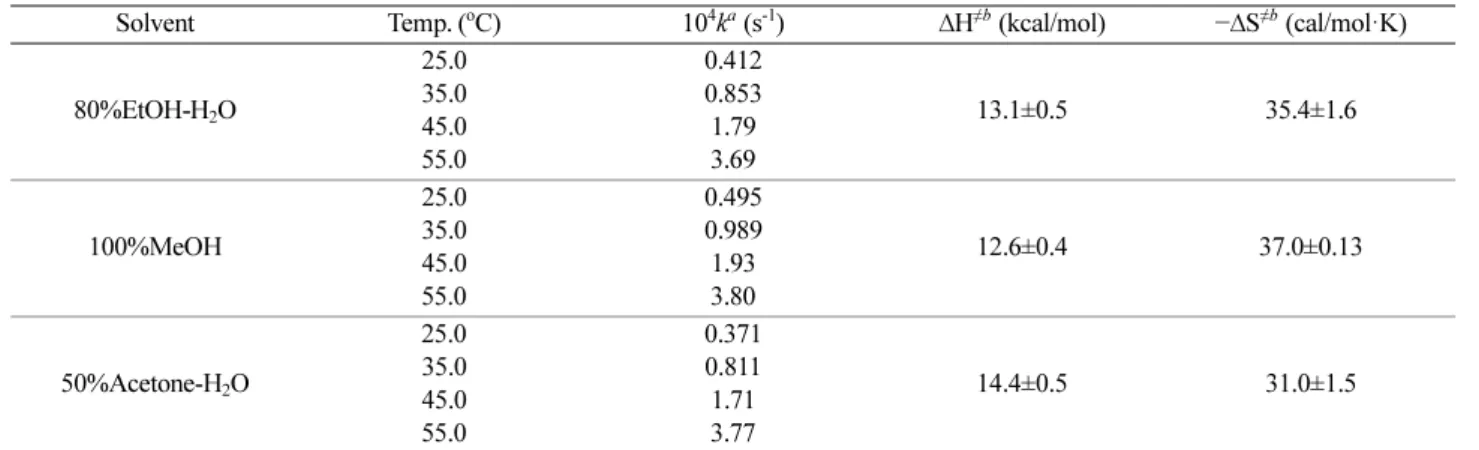
Rate constants (k) and the activation parameters for (1s)-(+)-menthyl chloroformate in pure and aqueous sol- vents at various temperatures in Table 2. The activation parameters (∆H ≠ and ∆S ≠ ) were calculated by Eyring equation. 14
Relatively low ∆H ≠ (12.6~14.4 kcal/mol) and large neg- ative ∆S ≠ values (−31.0~−37.0 cal/mol·K) in Table 2 are characteristic of a reaction involving partial development of change with a low degree of bond cleavage in the TS. It can be expected to proceed an associative S N 2 mechanism. 8,10
CONCLUSIONS
The analysis using the extended Grunwald-Winstein equation in the solvolysis of 1 obtained the l value of 2.46
± 0.18, the m value of 0.91 ± 0.07, and the correlation coefficient of 0.950. The solvolysis of 1 might proceed via an associative S N 2 mechanism enhancing bond making than bond breaking in the TS. This interpretation is fur- ther supported by a relatively large solvent kinetic isotope effect (2.16) and activation parameters.
EXPERIMENTAL
The (1s)-(+)-menthyl chloroformate ( 1) was purchased.
Two-component mixed solvents such as an aqueous meth- Figure 2. Plot of log (k/k
o) for (1s)-(+)-Menthyl Chloroformate
solvolysis at 55.0
oC against (2.46N
T+ 0.91Y
Cl).
Journal of the Korean Chemical Society
312 Han Joong Koh and Suk Jin Kang
anol solution, an aqueous ethanol solution, an aqueous acetone solution, and an ethanol-TFE solution were pre- pared in a volume ratio, and an aqueous TFE solution was prepared in a weight ratio. The kinetic experiments were carried out by allowing a conductivity cell containing 12.5 mL of solvent to equilibrate, with stirring, in a constant- temperature water bath. A 12 µL portion of a 1.0 mol dm -3 stock solution of 1 in acetonitrile was then added. The monitoring of increases in conductivity with time and the calculation of the rate constants were conducted by the Guggenheim method. 15 The multiple regression analyses were performed using commercially available packages.
The rate constants in Table 1, 2 are the averages of more than three runs and the uncertainty value is within ±3%.
REFERENCES
1. (a) Berthelot, M.; Pean de Saint-Gilles, L. Ann. Chem. Et Phys., 3. Ser. 1862, 65, 385. (b) Berthelot, M.; Pean de Saint-Gilles, L. Ann. Chem. Et Phys., 3. Ser. 1863, 68, 255.
2. (a) Hughes, E. D.; Ingold, C. K. J. Chem. Soc. 1935, 244.
(b) Ingold, C. K. Structure and Mechanism in Organic Chemistry; Cornell Univ. Press Ithaca: New York. 1953.
3. (a) Kevill, D. N. In Advances in Quantitative Structure- Property Relationships; Charton, M., Ed.; Jai Press: Green- wich, CT, 1996; 1, 81. (b) Kevill, D. N. In the Chemistry of the Functional Groups: The Halides; Patais., Ed.; Wiley:
New York, 1972; Chapter 12. (c) D’Souza, M. J.; Stant- Boggs, M.; White, R.; Kevill, D. N. J. Chem. Res. (S)
2003, 775. (d) Koh, H. J.; Kevill, D. N. Phosphorus, Sul- fur, and Silicon 2010, 185, 865.
4. (a) Kevill, D. N.; D’Souza, M. J. J. Chem. Soc., Perkin Trans. 2 1997, 1721. (b) Koh, H. J.; Kang, S. J.; Kevill, D. N. Bull. Korean Chem. Soc. 2010, 31, 835.
5. (a) Grunwald, E.; Winstein, S. J. Am. Chem. Soc. 1948, 70, 846. (b) Winstein, S.; Grunwald, E.; Jones, H. W. J.
Am. Chem. Soc. 1951, 73, 2700.
6. (a) Kevill, D. N.; Miller, B. J. Org. Chem. 2002, 67, 7399. (b) Kevill, D. N.; Carver, J. S. Org. Biomol. Chem. 2004, 2, 2040. (c) Kevill, D. N.; Park, K. H.; D’Souza, M. J.;
Yaakoubd, L.; Mlynarski, S. L.; Kyong, J. B. Org. Biomo- lecular Chem. 2006, 4, 1580.
7. Kyong, J. B.; Park, B. C.; Kim, C. B.; Kevill, D. N. J.
Org. Chem. 2000, 65, 8051.
8. Yew, K. H.; Koh, H. J.; Lee, H. W.; Lee, I. J. Chem. Soc., Perkin Trans. 2. 1995, 2263.
9. Kyong, J. B.; Kim, Y. G.; Kim, D. K.; Kevill, D. N. Bull.
Korean Chem. Soc. 2000, 21, 662.
10. Koh, H. J.; Kang, S. J. Bull. Korean Chem. Soc. 2009, 30, 2437.
11. Bentley, T. W.; Carter, G. E. J. Am. Chem. Soc. 1982, 104, 5741.
12. Bentley, T. W.; Koo, I. S. J. Chem. Soc., Perkin Trans. 2 1989, 1385.
13. (a) Bentley, T. W.; Ryu, Z. H. J. Chem. Soc. Perkin Trans.
2 1994, 761. (b) Bentley, T. W.; Schleyer, P. v. R. J. Am.
Chem. Soc. 1976, 98, 7658.
14. Eyring, H.; Lin, S. H.; Lin, S. M. Basic Chemical Kinet- ics; Wiley-Interscience: New York, 1980.
15. Guggenheim, E. A. Philos. Mag. 1926, 2, 538.
Table 2. Rate constants and activation parameters for the solvolyses of (1s)-(+)-menthyl chloroformate
Solvent Temp. (
oC) 10
4k
a(s
-1) ∆H
≠b(kcal/mol) −∆S
≠b(cal/mol·K) 80%EtOH-H
2O
25.0 35.0 45.0 55.0
0.412 0.853 1.79 3.69
13.1±0.5 35.4±1.6
100%MeOH
25.0 35.0 45.0 55.0
0.495 0.989 1.93 3.80
12.6±0.4 37.0±0.13
50%Acetone-H
2O
25.0 35.0 45.0 55.0
0.371 0.811 1.71 3.77
14.4±0.5 31.0±1.5
a