논문접수: 2009. 04. 02 수정보완: 2009. 05. 15 게재확정: 2009. 05. 30
* A Study on the Risk Management of Korean Firms in Chinese Market*
**
Kim, Pan-Jin**
< Contents >
. Introduction
Ⅰ
. Literature Review
Ⅱ
. Method
Ⅲ
. Analysis of Survey
Ⅳ
. Conclusion
Ⅴ
【 Abstract 】
As a result of this study only a few Korean firms have a certain management methods designed to predict the possibility of risk occurrence and establishment of systematic countermeasure. Besides, the Korean firms do not have enough data on the risk of Chinese Market. The risk management department inside the firm does not function efficiently, and when it comes to investigation of risk, it heavily depends on that of local branches. Accordingly, in order to accurately recognize and manage, the firms need to not only specialize risk management department but also outsource by using a consulting firm.
Key Words : political risk, investment environment, foreign direct investment
* 본 논문은 한국유통과학회 학술대회에서 발표되었던 내용을 수정 정리하였음 ‧
** Professor, Dept. of Business Management, Chodang University ([email protected])
. Introduction
Ⅰ
As the business world becomes ever more global, international corporations are investing heavily in the world markets. In 1999, nearly $ 800 billion was invested around the world, almost four times the 1988-95 average. Of this, over $ 40 billion was invested in the People's Republic of China(World Investment Report 2000). It is not difficult to see why China attracts so much foreign direct investment (FDI). The Economist estimated that based on the PRC's current growth rates. China is projected to become one of the world's top markets by 2020, replacing many of the top industrial nations. From an international commerce perspective, the State Strategy Institute of Great Britain forecasted that the Chinese economy would be account for 20 percent of world trade by 2030.
However, despite the obvious success in attracting foreign companies, there are still many question marks concerning the Chinese Market. One, concerning China's entry into the World Trade Organization, is under negotiation. Another, concerning the Asia Pacific Economic Cooperation (APEC) group, is a work in progress as the 21-country group works to harmonize trade and investment conditions across the diverse APEC group.
While China has attracted much investment from North America and Western Europe, Japanese and other Asian investors have also invested in the PRC's.
But there are many problems associated with operating in the PRC. The Chinese Market has had many risk factors. For example, China's capital markets are inadequate, its social infrastructure facilities are insufficient and there are internal problems, especially in the human rights field.
It is more dangerous than ever before to invest in China, therefore, the Korean firms need careful analysis about Chinese Market. Thus, this study is written about investment risk in the Chinese Market. And this study is analyzed countermeasure and management ways about the risk positively when it occurs.
The purpose of this study is to examine managerial perceptions of the risk involved in investing in the Mainland Chinese Market.
How Korean firms perceive the various risks as they execute investment strategies in China.
Second, how Korean firms manage risk in the Chinese Market.
Third, whether risk perceptions vary by site of firm, industry type, and investment
level.
. Literature Review
Ⅱ
1. Korea – China Relation
As Korea and China enter the new millennium, much of the discord that characterized Korea- PRC relations over past decades has disappeared. Despite recent trade frictions concerning Chinese garlic exports to Korea, business and diplomatic relations have improved considerably. The 2000 meeting of the ASEAN trade bloc countries was successful in establishing a platform for Asian economic cooperation outside of the more formal APEC structure that includes Western Hemisphere members such as the US, Canada and Chile. In particular, powers on currency swaps and E-commerce initiatives were laid out and trilateral talks between Korea, China and Japan focused on building a strong Asian economy with those three economies as their centerpieces.
2. Status of Korean Firms into Chinese Market
In 1988, the Korean firms have begun FDI for Chinese Market. But Korean firms real started to invest in China in the early 1999s, after Western economic sanctions against the PRC were rescinded and diplomatic relations between the two countries were restored. At present, Korean firms have invested over $ 4.6 billion in the PRC and account for about 11/2 percent of foreign direct investments in China.
Of this investment by Korean firms in China, over 85percent has been in manufacturing, significantly is higher than U.S (45percent) and Japan (63.5percent) of there manufacturing investments, 24.1 percent were in clothing, 18.2percent in light industries, 26.4percent in restaurants, and 6.6percent in electronics industries. Of there investments, over 70percent were located in coastal and economic special zones. In contrast, most Western firms have their investments inland. The most important reason is that it is near Korea and many oversea in it live there, which allows the firms to use low priced labors. Also, ratio firms which invested autonomous investment entered firms have occupied 57percent. But Western countries do no more than 20 percent.
3. Risk of Political and Environment in Chinese Market
When making investments in foreign markets, firms are aware that political,
economic and social risks are high. As such, they make every effort to evaluate
country conditions and risks prior to entry. To gain overviews of country markets
many companies purchase environmental and political risk information from commercial vendors like Business Risk Services (BRS) and Political Risk Services (PRS).
Their assessments evaluate operating conditions, political and financial risks and produce nation-by-nation comparisons as well as in-depth country reports.
Since the mid 1980's, the emphasis on political risk analysis has been shifted from conceptually oriented studies to more quantitative orientations. Political risk encompasses a broad range of risks that arise from the economic, financial, legal, and social conditions of a foreign country. Root (1968) defined political risk as threats to foreign investments that can arise from the attitudes and behavior of host governments and significant political and social groups.
According to Simson (1982), political risk can be viewed as governmental or societal actions and policies originating either within or outside the host country and negatively affecting either selected groups of, or the majority of foreign business operations and investments.
For the more, in assessing political risk the analysts need to consider ethnic and religious composition of the nation in question. For example, in Malaysia it is essential to recognize the specific economic relationships between Chinese and Malay. In the Philippines, it is essential to recognize the significant and sometimes leading financial role played by Philippine- Chinese. These inimitable relationships are important sources of political risk that could have an adverse impact on foreign direct investment.
And, also when firms mark Foreign Direct Investment (FDI), they should choose every different strategies. Industrialized and developing countries will differ in their overall orientation towards foreign business. A suspicion of foreign investment as a potentially exploitative entity is not as prevalent in industrialized societies as in developing countries. In the developing countries, the need to promote indigenous business elements as part of the development process will be reflected in rules such as technology transfer requirements, joint venture pressure, and local content rules, among others. While these rules are less likely in industrialized countries, moderate rules, such as environmental standards, licensing requirements, and price controls can be expected.
Kobrin(1980) notes that various risks have different degrees of importance
depending on whether the firm is operating in a developing or an industrialized
country. In a survey of senior international managers of U.S. based on multinational
firms respondents were asked to rank the relative importance of various kinds of
political risk. Civil disorder and expropriation were seen as the most important in less
developed countries, whereas in industrialized countries, price controls and labor disruptions were seen as the most important.
As noted by Schmidt (1986), the Less Development Country? (LDC) perhaps the single most important attribute of any foreign investment operation as it relates to political risk is sector of economic activity. The host government's policies aimed at controlling or influencing the activities of foreign investors are most frequently applied to primary and service sector operations. Extractive industries face a significantly higher degree of political risk. LDC host nations are of the opinion that foreign investment engaged in the removal of natural resources is associated with the loss of national wealth.
The degree of openness in the society is an important dimension of political risk.
In an open society, expression of discontent can be channeled into elections, protests, boycotts, and other forms of non-violent activity. In closed societies these avenues of expression are not available, and the repression of the populace can often erupt into violent activities.
Degree of Technological Complexity-For industrial manufacturing operations, the likelihood of governmental restriction is contingent upon technological sophistication and pattern of ownerships. The higher the level of technology, the less likely the operation is to be a target of governmental constraints. On the other hand where an investment is marked by a standardized, simple production process, a country will not require the expertise of the foreign enterprise.
Bradley's (1977) study on country versus firm specific political risk analysis shows that firms with dynamic high technology of a proprietary nature, such as IBM, have little chance of being expropriated, because the hostcountry cannot duplicate the product or service. On the other hand, he also finds that firms with a very low level of technology, such as textiles or food processing, are not likely to be expropriated because they lack the glamour or aura of technological development sought by host governments for political reasons. Firms with a middle level of technology are most exposed to political risk.
By the way, the types of political risks are as follow.
Economic Risk is the significant change in the economic structure or growth rate
that produces a major change in the expected return of an investment. Risk arises
from the potential for detrimental changes in fundamental economic policy goal or
significant changes in a country's comparative advantage. Economic risk often overlaps
with political risk in some measurement systems since both deals with policy.
Transfer Risk is the risk arising from a decision by a foreign government to restrict capital movements. Restrictions could make it difficult to repatriate profits, dividends, or capital. Because a government can change capital-movement rules at any time, transfer risk applies to all types of investments. It usually is analyzed as a function of a country's ability to earn foreign currency, with the implication that difficultly earning foreign currency the probability that some form of capital controls can emerge.
Exchange Risk is an unexpected adverse movement in the exchange rate. Exchange risk includes an unexpected change in currency regime such as a change from a fixed to a floating exchange rate. Economic theory guides exchange rate risk analysis over longer periods of time. Short-term pressures, while influenced by economic fundamentals, tend to be driven by currency trading momentum best assessed by currency traders.
Sovereign Risk concerns whether a government will be unwilling or unable to meet its loan obligations, or is likely to renege on loans it guarantees. Sovereign risk can relate to transfer risk in that a government may run out of foreign exchange due to unfavorable developments for its balance of payments. It also relates to political risk in that a government may decide not to honor its commitments for political reasons.
4. Review on Firm Characteristics
Wherever international firms enter new market, they are aware that customer needs, competitive and environment conditions are likely to vary. Also as the size of the foreign investment increases, so does the risk of doing business there. However, the larger the firm, the more resources that can be brought to bear on the market screening process (James, 1990). As firm globalizes, they accumulate experience in serving various markets and in operating in different environments. Those experiences add to companies' knowledge base and enable them to recognize risk in new markets.
Also, in globalization experience a more abundant firm is superior to the less abundant firm due to the more experiences of international investment and trade respectively. Thus, the risk the abundant firm encounters is lower than that fewer firms do and also, globalization affects the risk.
While, the bigger the size of firm is, the lower the risk is. Because the local
subsidiary firm would occupy competitive predominance, so the firm is at advantage
more than invested - firm. Also the big firm can absorb needed cost, whish is in
order to magnify international market. Thus, the risk to the big firm is lower than that
small firm does(Kumar, 1984).
On the other hand, in the uncertain environment, if the care of investment is big, the risk is high. Because, the ways to avoid risk are limited so that the degree of risk would be high. Besides, labor-oriented industry has lower risk than capital-oriented industry relative because the investment of equipment does not cost lots(Hawkin, 1976).
With regard to market entry method, the literature suggests that ownership levels affect risk. Specifically, 100 percent ownership (whether through acquisition or Greenfield operation) carries more than joint ventures (Shapiro, 1981)
Thus, hypothesis I was established based on the theory of James, Hawkin, and Shapiro.
Hypothesis-I The degree of risk would vary according to firm characteristics in Chinese Market.
H I-1 The bigger the size of firms is, the higher the risk would be resulting from uncertain environment.
H I-2 The bigger the scale of investment is, the higher the risk stemming from uncertain environment would be.
H I-3 The item of investment would affect the risk that can be caused by uncertain environment of local country.
H I-4 The style of investment would affect the risk can be gendered by uncertain environment of a local country.
H I-5 The fewer the experience of globalization is, the higher would be the risk, which can be used by uncertain environment of a local country.
5. Reviews on Industry Characteristics
Porter (1980) writes that if a firm maintaining competitive predominance have a lower degrees of risk when investing abroad. Because, as the firm assure competitive predominance, the risk factors by discrimination with other firms would be reduced.
Firms have options in where they produce products and components. They can build scale in one country and single source items for markets worldwide or they can produce the same product or component in multiple countries, hereby reducing risk of distribution if manufacturing is concentrated in a single location (Haendel, 1979). Also, if firm low intervention of resources, the firm would decrease the risk from the investee-country. Because, if intervention of resources from investee-country decrease, the firm would be overcome the risk according to environment change (Kobrin, 1983).
Thus, hypothesis II was established according to the theory of Poter, Haendel, and
Kobrin.
Hypothesis II The degree of risk would vary according to industrial characteristics of Chinese Market.
H II-1 The higher the competition degree of industry is, the higher would be the risk that appears from uncertain environment.
H II-2 The higher the rate of resource used is, the higher would be the risk, which can be caused by uncertain environment of local country.
H II-3 The lower the level of diversification of business is, the higher the risk would be that could be caused by uncertain environment.
6. Reviews on Investment Environment
Country risk is one of the most important factors affecting investments in emerging markets because of the many political, economic andsocial changes occurring in the industrialization process (Hill, 2000). For example, in China's case, the transition firm a communistic to a market focus based economy has unproved many shown existing economical, political, and social structures.
Low wages attract international corporations to developing markets, but as with other risk factors, the tradition to market focus based economics improper practices on labor to orient its activities to the needs of profit-driven companies. The rural to urban immigration that is a primary characteristic of industrializing nations. And, low wages of undeveloped countries always is considered factor of comparison predominance in international trade, but if labor market were unstable the risk instability of labor market would offer risk to investment firms. Thus the more unstable the labor market is, the higher the risk is(Geringer, 1988).
Thus, hypothesis III was established based on the theory of Hill, Root, Truitt, and Geringer.
Hypothesis III The uncertainty and a degree of risk would vary according to the investment environment in the Chinese Market.
H III-1 The higher the country risk (economic, social, and political instability) is, the higher the risk would be can be caused by uncertain environment of a local country.
H III-2 The more unstable the labor environment is, the higher the risk would be that can be caused by uncertain environment.
H III-3 The more uncertain the market is, the higher the risk would be that can show up
from uncertain environment.
. Method
Ⅲ
1. Data Collection and Measures
For data collecting this study is surveyed by visit, telephone, and mail to Korean Manufacturing Industry Companies, which are presently operating in China.
This study is analyzed the risk management and recognition to apply to the Chinese Market. In order to analyze the risk factors this study is used the variables suggested as the risk factors in the existing theories.
Those variables affecting the risk Korean Firms has are suggested as follows.
Firm Characteristics; size of firm, scale, item, and style of investment, and globalization experience
Industry Characteristics; degree of competition of industry, ratio of resource used, and degree of diversification of business
Investment Environments; country risk, labor and market environment
2. Independent Variable
1) Firm Characteristics
This study is analyzed the risk management and recognition to apply to the Chinese Market. In order to analyze the risk factors this study is used the variables suggested as the risk factors in the existing theories.
Those variables affecting the risk Korean Firms has are suggested as follows.
Firm Characteristics; size of firm, scale, item, and style of investment, and globalization experience
Industry Characteristics; degree of competition of industry, ratio of resource used, and degree of diversification of business
Investment Environments; country risk, labor and market environment
2) Industry Characteristics
5-Point-Likert Scale was used to measure the degree of competition of industry;
companyerial, and the rate of capitals contributed from Chinese Markets.
This measurement used the ratio scale. Diversification of business; the degree of
distribution of production facilities, the diversity of distributing and producing goods.
3) Investment Environment
The country risk of China was measured by using 5-Point Likert Scale. Four variables; political risk, economical, social stability, and continuity of policy are used for 5-Point Likert Scale. The labor and market environment such as; unsuitability of the labor market, unpredictability of demand of employees, of policy and system. And, also number of competition firms was measured by using 5-Point Likert Scale.
4) Dependent Variable
In this study, dependent variable is risk recognition. I would like to know which risk factors cause real problems for Korean Firms to do business in China. To find these factors, this study used 5-Point Likert Scale and ratio scale to measure the level of risk and evaluate management strategy with subjective method.
. Analysis of Survey
Ⅳ
1. Reliability Analysis
As a result of reliability analysis per competition and diversification of business in China questionnaires Cronbach's Alpha coefficient is measured 0. 7829, which is considered high because more than 0.60 is considered high-leveled reliability in social science study. Per investment environment and recognition of risk of China questionnaires Cronbach's Alpha coefficient is measured 0.6022, which also is more than 0.6 so that it is considered reliable items.
For this analysis, SPSS WIN is used as an analysis tool and regression analysis is used with the effect that independent variables affect dependent.
2. Survey Analysis
In this survey, capital stock of survey firm was that 17.3 percent of surveyed companies have less than U.S. $100,000 capital. 19.0 percent have U.S. $ 100,000 to 1,000,000. 30.3 percent have capital from U.S $ 1,000,000 to 5,000,000. 12.8 percent have U.S. $ 5,000,000 to 10,000,000 .20.9 percent more than U.S $10,000,000.
Annual amount of sales is 7.3 percent of companies recorded less than U.S. $
1,000,000. 21.8 percent have U.S. $ 1,000,000 to 10,000,000. 30.0 percent have U.S. $
10,000,000 to 50,000,000. 40.9 percent did more than U.S $ 50,000,000.
Also, 14.5 percent of surveyed companies have less than 200 employees working in the foreign subsidiary branches. 29.0 percent have 200 to 500 employees. 10.9 percent have 500 to 1000 employees. 43.6 percent of companies have more than 1000 employees. 72.7 percent of surveyed companies favored coast area and economic special zone as an investment area.
Globalization of survey is that 47.3 percent experienced globalization less than 10 years and 52.7 percent did more than 10 years.
In this survey, concerned with investment environment and risk recognition is shown that environment of investment in Chinese Market ranked middle (52 percent responded) in the questionnaires. The survey revealed that it is very difficult for firms to predict the change of related regulation or system (84 percent responded), the degree of corruption of government officers in general survey is very high (80.7 percent responded). Also, the result of responding in instability of society is middle(51.3 percent responded), in the stability of politics low (49 percent responded), in the condition of limit in profit's remittances middle (55 percent responded), in the potentiality of growth very high (86 percent responded), in the demand of employees middle(45 percent responded).
By examining the labor management, the foremost difficulty in the human resource management is sabotage of employees showing 70.8 percent. The next difficulty is language barrier corresponding 15.5 percent and remaining 3.6 percent have management interference of a government.
Survey on ways of risk management in Chinese Market shows that 70.7 percent of surveyed companies responded that they investigated the risk of Chinese Market, while 29.3 percent did not according to the questionnaires of whether or not the firms investigated the Chinese Market.
As a result of investigation of the Chinese market the survey shows that 98.6 percent of firms did investigate by themselves, while only 1.4 percent of companies used a consulting companies to do so.
The following is the result of how Korean Firms manage the risk of Chinese Market. The Most companies, 43.4 percent, choose the localization strategy. 20.7 percent of companies.
Choose diversification strategy of business. 16.0 percent of companies purchased
insurance according to the corresponding firms. 5.7 percent of companies choose
extension strategy of joint investment.
3. Result
1) Hypothesis Establishment and Verification Result
The degree of risk would be different resulting from characteristics of firm, industry, and investment. But until such assertions are not proved. That the risk of investment would vary can be presumed according to the size of firms, scale, item, and style of investment, degree of competitiveness of industry, rate of resource used, diversification of business, country risk, labor environment, and uncertainty of market, etc.
In this study the following hypotheses are established on the basis of logic appeared in literature review.
In this study, regression analysis method is conducted in order to test hypothesis verification.
2) Hypothesis Verification on Firm Characteristics
Hypothesis-I The degree of risk would vary according to firm characteristics in Chinese Market.
HI-1 The bigger the size of firms is, the higher the risk would be resulting from uncertain environment.
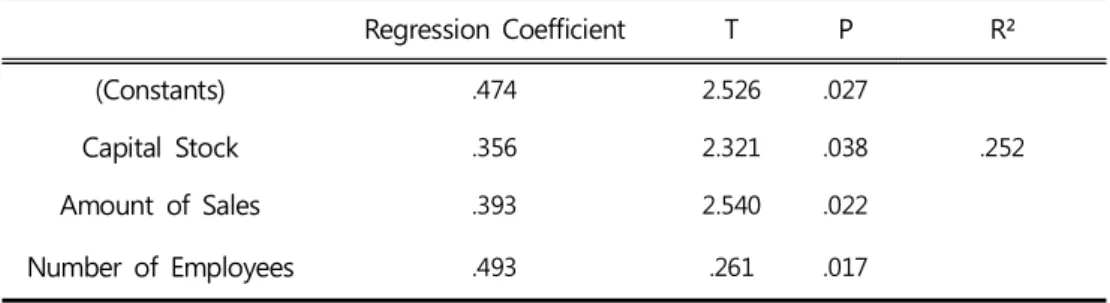
Assuming that in FDI, the size of firm will affect investment risk, this study is established the hypothesis as above and tried to verify it. In this study, capitalstock, amount of sales and number of employees of Mother Company are used as a measure of the size of firms. And they constituted independent variables. The regression coefficient t values and probabilities appear in table. Table1 shows that p values of capital stock, amount of sales, and number of employees are .038, .022, and .017, which are statistically significant at .05 level (P<. 05). As a result, the previous hypothesis that the bigger the risk would be, that HI-1 is adopted.
H I-2 The bigger the scale of investment is, the higher the risk stemming from uncertain environment would be.
The above H1-2 is established on the basis of the assumption that in FDI, if a
certain firm invested a lot of practical capital in a local country, the firm would have
relatively level of risk. And, this study is used regression analysis method in order to
verify H1-2. Also, in this study scale as a unit of scale of investment. However, in this
result of analysis, p value of practical investment amount is .276, which means it is not statistically significant at .05 level (P<. 05) (see table 2). Thus, table -2 shows Ⅶ that H1-2 which proposes the bigger the scale of investment is, the higher the risk would be, is rejected.
Regression Coefficient T P R²
(Constants)
.474 2.526 .027Capital Stock
.356 2.321 .038 .252Amount of Sales
.393 2.540 .022Number of Employees
.493 .261 .017<Table 1> Analysis of Risk Attributed by Size of Firm
<Table 2> Analysis of Risk Attributed by Scale of Investment
Regression Coefficient T P R²
( Constants )
.210 1.432 .292 .016Practical Investment
Capital
-.211 1.321 .276H I-3 The item of investment would affect the risk that can be caused by uncertain environment of local country.
H I-4 The style of investment would affect the risk can be gendered by uncertain environment of a local country.
Table 3 shows that the regression analysis was used to verify HI-3, HI-4 and p values are .021, .025. Which are statistically significant at .05 level (P<. 05).
Accordingly, this study indicates that H1-3, H1-4 are all adopted; the item and style of
investment can affect the risk from uncertain environment.
<Table 3> Analysis of Risk Attributed by Item and Style of Investment
Regression Coefficient T P R²
(Constants)
.401 2.816 .042 .491Investment Item
.223 2.345 .021Investment Style
-.236 -2.374 .025H I-5 The fewer the experience of globalization is, the higher would be the risk, which can be caused by uncertain environment of a local country.
This hypothesis is established in order to verify the suggestion that the risk can be caused differently according to the presence or absence of the experience of globalization. A level of globalization depends on the experience of oversea production, the number of oversea branches, the amounts of expect, and experience of foreign investment. So, in this study, those are used as independent variables of experience of globalization. Table 4 shows that p value of export amount is .031 and of experience of oversea investment is .028, so those numbers are statistically significant at .05 level (P<. 05). Thus HI-5 is adopted partially (Except p=. 072 number of oversea branches). As a result, it can be seen that if a certain firm has experience of globalization, the firm is lower than nothing firm.
Regression Coefficient T P R²
(Constants)
-.329 -1.581 .109 .491Number of Overseas Branches
-.314 -1.823 .072Amount of Export
-.451 -2.316 .031Experience of Oversea Investment
-.316 -2.361 .028<Table 4> Analysis of Risk by Experience Globalization
3) Hypothesis Verification on Industry Characteristics
Hypothesis II the degree of risk would vary according to industrial characteristics of Chinese Market.
H II-1 In the local country, the higher the competition degree of industry is, the
higher would be the risk that appears from uncertain environment.
The above hypothesis suggests that when a firm has highly competitive industry in the local country, the firm will have high risk from uncertain environments. In this study, competition degree of local country is measured by industry competition analysis Poter's by 5- Point Likert Scale, which is competition of industry inside, potential competition, demander, supplier, and competitionof alternate products. Table 5 shows that p value of the degree of competitive industry is .035, it is statistically significant at .05 level (P<. 05). Accordingly, the result of analysis indicates that H II-1 is adopted; if competition degree of industry is high, risk will be high.
H II-2 The higher the rate of resource used is, the higher would be the risk, which can be caused by uncertain environment of local country.
The above hypothesis is established, by assuming that if the rate of resource used is high, a firm will have high risk. In order to verify this study surveyed each ratio of resources used and finished parts in local country. Table 5 shows that p value rate of resource used is .031, so it is statistically significant at .05 level (P<. 05). The result of analysis proved H -2 that the rate of resource and parts product in a local country Ⅱ affects risk in FDI. Thus, H II-2 is adopted.
<Table 5> Analysis of Risk by Degree of Competition of Industry and Rate of Resource used
Regression Coefficient T P R²
(Constants)
.381 2.816 .028 .542Degree of Competition of
Industry
.372 2.741 .035Rate of Resource used
.412 -2.421 .031H II-3 The lower the level of diversification of business is, the higher the risk would be that can be caused by uncertain environment.
The above hypothesis is established in order to verify that diversification of
business affects the risk from uncertain environment of a local country. In this study,
dispersion of production equipment, diversification of supply of raw material constituted two independent variables of business diversification. Also, diversification of business can be used as a way to reduce the level of loss from the risks of a local country. Table 6 diversification of business is statistically significant at .05 level (P<.
05). Thus, the assumption that in FDI, diversification of business affects the risk of firms is the and H II-3 is adopted(see table 6).
<Table 6> Analysis of Risk Attributed by Diversification of Business
Regression Coefficient T P R²
(Constants)
2.13 2.490 .002 .011Diversification of Business
-.206 2.706 .0474) Hypothesis Verification on Investment Environment
Hypothesis III the uncertainty and a degree of risk would vary according to the investment environment in the Chinese Market.
H III-1 The higher the country risk (economic, social, and political instability) is, the higher the risk would be can be caused by uncertain environment of a local country.
H III-2 The more unstable the labor environment is, the higher the risk would be that can be caused by uncertain environment.
H III-3 The more uncertain the market is, the higher the risk would be that can show up from uncertain environment.
Generally, when multinational enterprises make inroads into foreign market, they should act into diverse environment. At this time, obstacle factors of business activity appear on the stage as political and environmental background of a local country.
Table 7 shows that the p values of country risk, instability of labor market, and
uncertain market are zero, so it is very statistically significant. Thus, the result of
analysis of above hypothesis should that, when firms invest foreign direct investment,
three factors of country risk, labor environment, and uncertain environment of local
country, affected risk from uncertain environment H III-1, H III-2, and H III-3 are all
adopted.
<Table 7> Analysis of Risk by Country Risk, Instability of Labor Market and Uncertain Market
Regression Coefficient T P R²
(Constants)
.493 8.610 .000 .745Country Risk
.384 7.329 .000Instability of Labor Market
.442 8.403 .000Uncertain Market
.574 -11.586 .0004. Discussion
This study examined substance of risk Korean firms might experience in Chinese Market and constructed theoretical model about factors substantially affecting risk, and examined how the variables such as the characteristics of firm, industry, and investment environment operates in the formation of the risk of Chinese Market.
The results derived from this study are summarized as follows.
First, recognition and management of risk of Korean firms doing business in China are appeared considerably low in this study. Those firms recognized substantially the uncertainty of Chinese Market, change of system and related regulation, the corruption of government officers, and difficulty in adoption to the local cultural difference. But, they hardly recognized the possibility such as confiscation of company properties, controlling over managers, and nationalization of firms. The reasons might be that most Korean firms have small size of investment and occupy a low portion of general economy of China, compared with those of multinational companies. In this light, Chinese government does not take the trouble to nationalize industry at the rise of international criticism and most firms involved in business in China are located in free export zone, which allows them to enjoy direct and indirect benefits from Chinese government.
Second, as examined in the verification of H I-1, H I-3, H I-4, and H I-5 using the variables. It is proved that the size of the firm, item and style of investment, and experience of globalization affect the risk. The result of this analysis is the same as James, Hawkins, and Shaprio's opinions appeared in literature review. Accordingly, in order for firm to invest with a large size of firms in China, it must recognize and manage the risk, which must be followed.
While, the H I-2 that the degree of risk is not adopted because the p value is
0.276 so that not considered statistically significant. Accordingly, the opposite result of assertion suggested in Kumar(1984); If the bigger the scale of investment is lower the risk is appeared in this analysis I guess that his study analyzed developed country firms, so his assertion is different from this study. Scale of investment can be high risk in Developed Country Market, but in Chinese Market, Under Developed Country Market will not affect it. Therefore, as a result of this analysis the scale of investment does not have any affects on the risk.
Third, the firm can differentiate the degree of risks by possessing industrial characteristics. If the firm has high competitiveness in its industrial field, it would have high risk(H -1). Thus, the firms that conduct business in China, can reduce risks coming from uncertain Chinese market by obtaining differentiated superiority of competitiveness. Besides, in case of a firm with high dependence on local resource, the risk can be increased. On the other hand, since diversification has a significant affect in terms of preventing risks and reducing the size of loss, it was adopted as variable H II-2, H II-3.It was verified that the diversification is the factors to reduce the risk from uncertain environment (H-2,H -3). This result is as same as Kobrin and Haendel's opinion.
Fourth, forecasting and analysis of Chinese market are difficult since it has high level of national risk, unstable labor market, and unpredictable market environment.
Specifically, it is considerably difficult to predict the possibility of risk. Therefore it is natural that those adoptions of H III-1, H III-2, and H III-3 investment environment have affected on the risk of investment. This result is as same as Geringer and Hill's opinion.
5. Risk Management Strategies in Chinese Market
Strategies of risk management of foreign firms should be used as follows in Chinese Market.
First, management strategy of risk is joint venture.
Foreign firms which advanced in China need to make an effort to improve the relationship with Chinese government and people of the actual place for adapting to the market environment of China. Since Chinese government generally confines business participation of foreign corporation with a rule, joint venture can both reduce levels of risk and disperse risk.
Second, insurance is another strategy of risk management.
This strategy is used to transfer or disperse risk to other person and employed by
firms with large amount of investment. Presently, many Korean firms do not use this way. But, since Chinese Market has a lot of risk factors, this strategy is very important in order to prevent suddenly occurring risk. Luckily, current large companies tend to use this way.
Third, an influx of local capital is used as a strategy of risk. This management strategy of risk is used to reduce the danger of company's confiscation and also, to activate the movement of capital when foreign exchange is controlled by government of host.
Next, localization strategy is used as a risk management.
Foreign firms advancing in the Chinese Market must localize business, management, employment, harmonize labor force and management staff, and maintain reliable relationship with people of the actual place, and local agency in order to manage risk.
In addition, diversification strategy is used as a way of risk management in Chinese market. Placement of factory in different countries or diversity of production and supply can help decrease risk and maintain continuation of business. For example, if one company has high dependency of produce on a certain country, the level of risk the company might face is too high. Therefore, the company must try to reduce risk, by dispersing the product to several other countries. Especially, if the degree of diversification of product is higher, the firms would get the higher negotiation power with the local country because they gain the upper hand in the changing market.
Finally, diversity strategy of raw material is used as a way of management of risk.
The higher the used rate of resource supply from host country is, the higher the risk would be because higher degree of dependence is easier way for firms to be exposed to the danger which changing environment of host country can create.
. Conclusion
Ⅴ
In order to decrease the possibility of investment risk in Chinese market, firms
should conduct continuous self-verification about the risk analysis and management
methods. In addition, firms must have accurate guidelines about goals of risk
management, appropriate methods, clearly mentioned location of responsibility on
tasks, and continuous efforts of improvement. For the purpose of this, in order to do
so, independent risk management department is necessary and responsibility must be
defined among divers tasks. Despite the recognition of uncertainty, the complexity of
political, economical and society cultural environment is hard to control and the cost of research blocks its professional and scientific exploration. Firms depend on only economic resources of China at present. The management of environment and risk in a local country is a must in foreign direct investment. Thus, a pile of accurate data on the predictable risks should be gathered to analyze, predict and manage them along with the development of Information system, which allows the firms to refer to business-related information.
As a result of this study only a few Korean firms have a certain management methods designed to predict the possibility of risk occurrence and establishment of systematic countermeasure. Besides, the Korean firms do not have enough data on the risk of Chinese Market. The risk management department inside the firm does not function efficiently, and when it comes to investigation of risk, it heavily depends on that of local branches. Accordingly, in order to accurately recognize and manage, the firms need to not only specialize risk management department but also outsource by using a consulting firm.
Limitations and Further Research
This study presents limitations, which future study subjects need to consider as follows.
First, this study does not present an analysis of the outcome after risk management has performed and how the risk in Chinese Market affected the management of Korean firms. This study analyzed risk factors and presented management countermeasures for them, but did not approach systematically and depended only on questionnaires, which limited the accuracy of the this study.
Accordingly, future studies should present synthetically risk management countermeasures by interview of the firms, which have entered a local country with systematic and comprehensive exploration and analysis.
Second, this study did not detail how the risk coming from uncertain environment of Chinese market affected the strategies of management of Korean firms and the subsequent analysis of the result was not presented. Thus, future studies need practical analysis of the influences of the risk of Chinese Market on management strategy and also need analysis of the earned benefit of risk management.
Accordingly, analyses of those problems are needed in the following, study to
overcome such a limitation. However, this study performed analysis about risk
management and risk recognition of Korean firms about which not many previous
studies attempted to clarify. It examined how Korean firms managed risk and
recognized risk factors. The study contributed Korean firms by providing analysis of
effective recognition and management of risk, and subsequent strategy for risk
management, which could be said the first attempt as a thesis.
References
Bradly, D .G.(1977), Managing against Expropriation, Harvard Business Review, July- August.
Chatterjee, A. K.(1982), Foreign Direct Investment and Political Risk: A weak Signal Perspective, New York, New York University, Ph.D Dissertation.
Coplin, W. D., and O'Leary, M. K.(1994), The Handbook of Country and Political Risk Analysis, East Syracuse, New York, Political Risk Services, International Business, Communications.
Duncan, H.M.(2000), Country Risk and Foreign Direct Investment, Business Economic;
Washington, Jan.
Geringer,J.M.(1988), Joint Venture Partner Selection; Strategic for Developed Countries, Westport, Conn: Quorum Books.
Haendel, Dan.(1979), Foreign Investments and the management of Political Risk, Boulder, Colorado: West View Press, p. 136.
Hawkins, R. G., Norman, M.and Michael Provissiero(1976), Government take over of U.S. foreign Affairs , Journal of International Business Studies, Spring, pp. 4-5.
James, B.(1990), Reducing the Risks of Globalization, Long Range Planning VOL.23.
NO.1, pp. 80-88.
Kobrin, S. J.(1980), Foreign Enterprises and Forced Divestment in Less Developed Countries (LDCs) , International Organization, Winter.
Kobrin, S. J.(1983), Selective Vulnerability and Corporate Management, in Moran T. H.
ed., International Political Risk Assessment: The Status of the Art, Georgetown University Press, Washington DC.
Kumar, M. S.(1984), Growth, Acquisition and Investment: An Analysis of the Growth of Industrial Firms and their Overseas, Cambridge University Press.
Porter, M. E.(1980), Competitive Strategy, the Free Press.
Stevens, F.Y.(1997), Quantitative Perspective on Political Risk Analysis for Direct
Foreign Investment, Multinational Business Review; Detroit, Spring.
국문초록
< >
중국시장에서 한국기업의 리스크 관리에 관한 연구
*
김 판 진*
현재 중국은 전 세계적인 경기침체 하에서도 어느 정도의 성장을 거듭하고 있지만
이러한 중국시장도 많은 위험이 존재하고 있는 사실이다 이러한 현실 하에서 본 연구에서 .
는 한국기업이 중국시장에서 겪게 되는 위험의 실체를 규명하고 실질적으로 위험에 영향 을 미치는 요인에 의한 이론적인 모델을 구축한 후 실증분석을 통해 한국기업의 중국시장
위험에 대하여 기업특성 산업특성 투자환경특성 변수들이 각각 어떻게 작용하는지를 살 , ,
펴보았다.
본 연구에서 얻은 결과를 살펴보면 다음과 같다.
첫째 중국에 진출해 있는 우리나라 기업들이 중국시장의 환경 불확실성에서 오는 ,
위험의 인식과 관리가 상당히 낮게 나타났다.
둘째 가업특성변수로서 사용된 기업의 규모 투자규모 국제화경험 투자업종 및 형 , , , ,
태 등을 이용한 가설검증 결과 기업의 국제화경험 투자업종 및 형태가 위험에 미친다는 ,
사실을 알 수 있었다.
셋째 기업이 지니는 산업특성에 따라 위험의 정도로 달라질 수 있다는 사실이다 기 , .
업이 지니는 경쟁강도가 높은 경우에는 어떻게든 위험도 높게 나타날 것이다 따라서 중국 .
에 진출해 있는 기업은 차별화된 경쟁우위를 보유함으로써 중국시장의 환경 불확실성에서 오는 위험을 감소시킬 수 있을 것이다.
넷째 중국의 국가위험 지수가 높고 노동시장이 불안정하고 시장 환경에 불확실해 , , ,
미래에 대한 예측과 분석이 힘들 때 위험의 발생가능성을 추정하는 것은 상당히 어려운
일이다 따라서 이러한 중국의 투자환경이 한국기업의 투자위험에 미친다는 가설의 채택은 .
당연한 결과라고 볼 수 있다.
이러한 연구를 통해서 얻어진 분석결과를 중심으로 종합적으로 정리한다면 우리나라 기업이 중국의 이질적인 환경 하에서 경영활동을 수행함에 있어 중국시장 환경 불확실성 에서 오는 위험은 기업의 영업활동이나 이익에 직접 영향을 주게 되는 것으로 경영활동을
수행하는 기업은 항상 중국의 불확실한 환경에 능동적으로 대처하여야 한다 그러기 위해 .
서는 중국의 환경 불확실성에서 오는 위험을 객관적으로 분석할 방법을 강구하고 전략적
으로 위험을 극소화할 수 있는 방안을 모색하여야 한다 즉 특정기업이 해외시장에 진출 . ,
하여 성공하기 위해서는 현지국의 투자환경과 위험관리를 최소화하여야 한다는 것이다.
*