1. Introduction
Some leading airports have recently tried to increase smart service, information and communication technology (ICT), and airport soft power during the process of passengers' entry with the objective of realizing Smart Airport combined with up-to-date SSTs. The Society of International Telecommunication of Airline (SITA) envisaged providing passengers with a smooth travel based on six
* First Author, PhD student, School of Business, Korea Aerospace University, South Korea.
Tel: +82-32-741-5259, E-mail: [email protected]
** Corresponding Author, Professor, School of Business, Korea Aerospace University, South Korea.
Tel: +82-2-300-0354, E-mail: [email protected]
© Copyright: Korean Distribution Science Association (KODISA)
This is an Open Access article distributed under the terms of the Creative Commons Attribution Non-Commercial License (https://creativecommons.org/licenses/by-nc/4.0/) which permits unrestricted non-commercial use, distribution, and reproduction in any medium, provided the original work is properly cited.
principal steps: check-in, luggage check, automatic immigration control, self-boarding, booking change, and checked luggage management on self-service while approximately 80% of the global passenger airlines were running a relevant program with the aim of realizing a trip based on self-service by 2020 (SITA, 2016).
A smart airport means an airport possibly operated more safely and efficiently by applying new ICTs, including artificial intelligence, robot technology, the internet of things, the mobile internet, and big data (Korea Transport Institute, 2017). Biometric systems, big data and smart phones are bound to radically change facilities and operations in future passenger buildings and improve passenger experience (Sofia Kalakou et al., 2015).
As the airport of each country intends to realize a smart airport by increasing SSTs, it is more necessary than ever for major international airports in South Korea to introduce and apply SSTs with the aim of becoming more globally competitive and to present a direction of policies for Print ISSN: 1738-3110 / Online ISSN 2093-7717
http://dx.doi.org/10.15722/jds.17.05.201905.29
The Effect of Airport Self-Service Characteristics on Passengers’
Technology Acceptance and Behavioral Intention
Jong-Hyeon KIM * , Jin-Woo PARK **
Received: March 27, 2019. Revised: March 28, 2019. Accepted: May 05, 2019.
Abstract
Purpose - This paper analyzes the effects of the SST characteristics at airports on behavioral intention through technology acceptance and customer satisfaction, and presents a strategic plan for introducing SSTs to airports providing differentiated services.
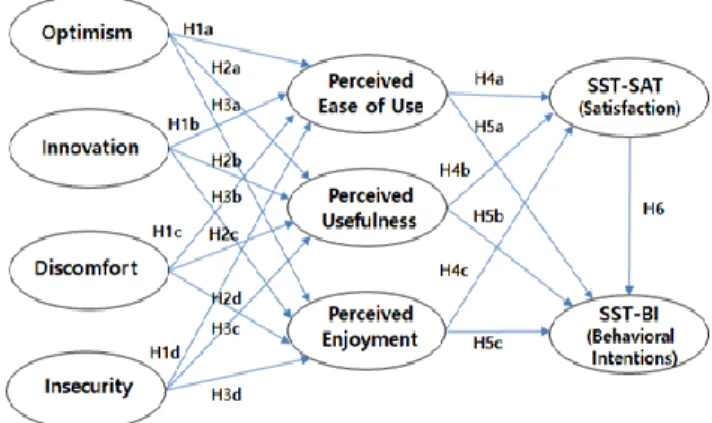
Research design, data, and methodology - We examine the role of airport self-service characteristics and access the influence of the Technology Acceptance Model (TAM) on both customer satisfaction and behavioral intentions towards SSTs.
To do this, a survey is conducted with passengers having used self-service technologies(SSTs) at Incheon International Airport. A total of 400 questionnaires are then analyzed using structural equation modeling.
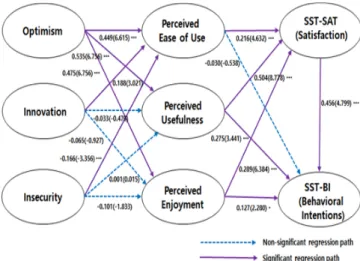
Results - According to the results, of the self-service characteristics, customer satisfaction and behavioral intention were affected by optimism through perceived ease of use, perceived usefulness, and perceived enjoyment and by innovativeness and insecurity through perceived ease of use.
Conclusions - According to the results of the study, the purpose of using TBSS in the airport is to save time and convenience. Therefore, it is necessary to closely analyze the differences in technology acceptance by age and generation, increase user self-efficacy, increasing satisfaction through effective management of cognitive and emotional waiting time will have a positive impact on behavioral intentions.
Keywords: Self-service Technologies (SSTs), Technology Readiness (TR), Technology Acceptance Model (TAM), Customer Satisfaction, Behavioral Intention.
JEL Classification: L93, N7, O31, O33, R4.