1. Introduction
e-Commerce is now one of the alternative consumers
* First Author, Student at Doctoral Program in Management Science, Universitas Padjajaran, Indonesia
** Faculty of Economics and Business, Universitas Padjajaran, Indonesia.
*** Faculty of Economics and Business, Universitas Padjajaran, Indonesia.
**** Faculty of Economics and Business, Universitas Padjajaran, Indonesia.
***** Corresponding Author, Faculty of Economics and Business, Universitas Muslim Indonesia, Indonesia,
* Faculty of Social Science and Politics, Universitas Muhammadiyah Cirebon, Indonesia
© Copyright: Korean Distribution Science Association (KODISA)
This is an Open Access article distributed under the terms of the Creative Commons Attribution
Non-Commercial License (https://creativecommons.org/licenses/by-nc/4.0/) which permits unrestricted
non-commercial use, distribution, and reproduction in any medium, provided the original work is
properly cited.
today in shopping; the ease and convenience factor is the main reason why e-commerce is increasing throughout the world. Various studies today have examined a lot of e-commerce phenomena, e.g., (Ragunathan, Battula, Jorika, Mounika, Sruthi, & Vani, 2015), (Masouras & Papademetriou, 2018), (Wagner, Schramm-klein, & Steinmann, 2018), and (Haming, Syaiful, Putra, & Murdifin, 2019). In Indonesia, the development of e-commerce also feels increasingly rapid.
(Triandini, Djunaidy, & Siahaan, 2017). As a G-20 country, Indonesia is one of the developing countries that has been affected by the impact of globalization and technological advances, especially e-commerce (Triandini et al., 2017) and (Haming et al., 2019). The development of information technology is so rapid and so is the technology of access the internet. According to Redwing Asia data, Indonesia is using the smartphone fourth largest in the world. Whereas according to data from Roy Morgan Research ownership smartphone increased from 12% to 24%. The useof mobile phones by 10% to 84% of the population. A fantastic Print ISSN: 1738-3110 / Online ISSN 2093-7717
http://dx.doi.org/10.15722/jds.17.07.201907.15
Moderating of the Role of Technology Theory to the Existence of Consumer Behavior on e-commerce
Daduk Merdika MANSUR * , Erni Tisnawati SULE ** , Dwi KARTINI *** , Yevis Marty OESMAN **** , Aditya Halim Perdana Kusuma PUTRA ***** , Nurul CHAMIDAH *
Received: June 14, 2019. Revised: June 19, 2019. Accepted: July 05, 2019.
Abstract
Purpose – e-Commerce is now one of the alternatives in shopping. Ease of Use and convenience aspects are the main supporting reasons that e-commerce is a trend for most people today. This study examines the relationship between the theory of technology to consumer behavior in using e-commerce applications.
Research design, data, and methodology – The number of samples in this study was 600 samples from four major e-commerce made in Indonesia. The research method of this study Structural Equation Model (SEM) with AMOS and SPSS applications as analysis tools.
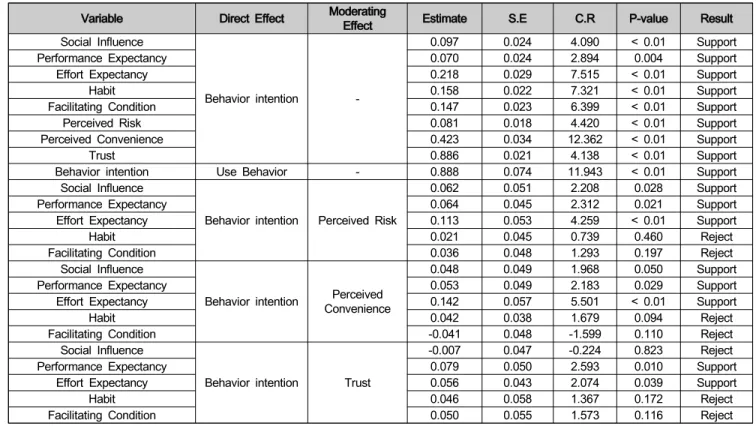
Results – The results of this study state that most hypotheses support prior research and grand theory. On the other hand, the components of technology acceptance theory are mostly able to moderate variable consumer behavior in the digital era.
Conclusions – The combination of essential elements of technology theory are oriented to the fundamental aspects of human beings as social beings. The most important thing for the development of the e-commerce industry to develop and be sustainable is the obligation to increase consumer confidence. The combination of components of technology theory and CCT can be a comprehensive marketing strategy and innovation to competitive advantage in the future.
Keywords: Theory Reasoned Action (TRA), Technology Acceptance Model (TAM), UTAUT, Consumer Culture Theory (CCT), Distribution Information Technology (DIT).
JEL Classifications: M0, M210, O31, O35.