서 론
최근 남조류
(Microcystis aeruginosa)
제어를 위한 다양한 종류의 화학제나 생물제재의 개발이 활발하지만
(Reyssac and Pletikisic, 1990; Yamamoto et al., 1998;
Sigee et al., 1999; Choi et al., 2005; Kim et al., 2008; Park et al., 2009; Kim et al., 2011),
이들은 공통적으로 반복된─
─ 347 ─ ─
식물 - 광물 혼합제가 부영양 수체의 수질 , 플랑크톤 및 microcystin-LR 에 미치는 영향
김백호∙이주환∙박채홍∙권대률∙박혜진∙문병천1∙문병진1 최인철2∙김난영∙민한나∙박명환∙황순진*
건국대학교 환경과학과, 1(주)엠씨이코리아, 2서울시 상수도연구소
Effects of Plant-mineral Composites (PMC) on the Water Quality, Plankton Community and Microcystin-LR in Eutrophic Waters. Kim, Baik-Ho, Ju-Hwan Lee, Chae-Hong Park, Dae-Yul Kwon, Hye-Jin Park, Byeong-Cheon Mun
1, Byeong-Jin Mun
1, In-Chel Choi
2, Nan-Young Kim, Han-Na Min, Myung-Hwan Park and Soon-Jin Hwang* (Department of Environmental Science, Konkuk University, Seoul 143-701, Korea;
1MCE Korea Co., Seongnam-si, Gyeonggi 463-712, Korea;
2Waterworks Research Institute, Seoul Metropolitan Government, Seoul 143-820, Korea)
We examined two reservoirs (Inkyung res. and Joongang res.) and two streams (Kyungan str. and Jecheon str.), all of which were eutrophic, during the 2010 warm season, to evaluate the water quality improvement activity (WQIA) of plant-mineral composite (PMC), which was previously developed to control suspended solids, includ- ing cyanobacterial bloom (Kim et al., 2010). We simultaneously measured both solid (S-MCLR) and dissolved microcystin-LR (D-MCLR), before and after PMC treatment, in the Joongang reservoir. Taking water body size and volume into account, we con- ducted the whole-scale experiment in the Inkyung reservoir, and mesocosm-scale experiments in the other three systems. The WQIAs of PMC were found to be compar- atively high in SS (70~ ~81%), TP (75~ ~91%), BOD (65~ ~91%), Chl-a (88~ ~98%), phyto- plankton (84~ ~92%) and zooplankton (68~ ~88%), except for the Kyungan stream, which was below 45% in all parameters. After PMC treatment, the concentrations of both S- MCLR (47%) and D-MCLR (96%) decreased within two days, suggesting a mitigation possibility of hazardous chemicals such as agrochemicals and endocrine disrupters in the aquatic ecosystem. Our results collectively indicate that PMC is a useful agent to control suspended solids, including nuisance cyanobacterial bloom and their exu- dates, in an undisturbed water system with a long residence time.
Key words : plant-mineral composite, water quality improvement, phytoplankton, zooplankton, microcystin LR
* Corresponding author: Tel: 02) 452-3749, Fax: 02) 452-3749, E-mail: [email protected]
처리 및 적용 후 관리 부재 등의 단점을 가지고 있다
. Kim et al. (2005)
은 살조세균 처리시 남조류 밀도는 감소 하지만 수중내 용존성 독소량은 증가한다고 보고하였다.
지금까지microcystin
은70
여종의 유도체가 알려져 있으 며 가장 강한 독성을 가지고 있는microcystin-LR (Choi et al., 1997; Chorus and Bartram, 1999; Brittain et al., 2000)
은pH,
온도,
효소 등에 분해되기 어려워6NHCl, TFA
등 강산으로 제어가 가능하다(Harada et al., 1991, 1996).
육상 또는 수중에 서식하는 고등식물이 가지고 있는 다양한
allelochemical (Rice, 1984; Einhellig, 1995)
과 응 집력과 살균력이 뛰어난 광물들의 남조류(
유기물)
제어 능에 대해서는 이미 잘 알려져 왔다(Na et al., 1998; Kim and Kang, 2000; Gam et al., 2003; Yun et al., 2003).
최 근 저자들은 부영양 저수지의 조류제어를 위하여 국내산 식물(Camellia sinensis, Quercus acutissima, and Cast- anea crenata)
및 광물(minerals loess, quartz porphyry, zeolite)
또는 이들을 혼합한 식물-
광물 복합체(plant- mineral composite; PMC)
의 조류성장 억제능을 비교한 바 있으며(Kim et al., 2010),
부영양 저수지 표층수를 대 상으로PMC
처리농도,
빛,
수온, pH,
수심,
조류종 등에 대 한 최적화 실험을 시도한 바 있다(Lee et al., 2011).
결과 에 의하면, PMC
는 첫째,
별도의 장치나 처리시설 없이 수중에 살포함으로써0.05 mL L
-1의 낮은 농도에서도 남 조를 포함한 부유물질을 효과적으로 응집-
부상시키고,
특 히,
수온20~30
�C, pH 7~9,
광도16~1,400 μmol m
-2s
-1,
수심1 m
이하,
남조류가 우점하는 수체에 적합한 것으로 밝혀졌다.
그러나PMC
를 현장조건에 적용한 사례는 많 지 않으며 특히 남조류(
독소를 발생하는)
밀도가 높은 수 체에 적용할 경우 조류독소의 변화 등에 대한 연구사례 는 매우 빈약하다.
본 연구는 계속된 실험의 하나로 기 개발된 천연물질 혼합제의 현장 적용성을 평가하기 위하여 실험대상 수계 로서 남조류와 규조류 발생이 심한 하천
(
경안천,
제천천)
과 저수지(
인경저수지,
중앙저수지)
등을 선정하였다.
현 재 경안천과 제천천은 주변 도시의 음용수원으로 이용되 고 있으며,
인경저수지와 중앙저수지는 농업용수와 레크 레이션 등으로 이용되고 있다.
오늘날 많은 연구자들과 세계보건기구(WHO)
에서 제안하고 있는 음용수에 대한 조류독소(microcystin)
의 기준농도는 공통적으로1
μg L
-1 이지만(WHO, 1998; Figueiredo et al., 2004; Hoeger et al., 2004; Chorus, 2005; Vardaka et al., 2005),
호주1.3
μg L
-1in Australia (NHMRC, 2004),
캐나다1.5
μg L
-1(HC, 2002)
은 약간 높으며,
물놀이나 여가활동에 대한 기준은WHO,
독일,
호주 등에서 각각20~100, ¤100, ¤10
μg L
-1등으로 차이가 심하다(WHO, 2003; Wood et al., 2006).
본 연구에서는 수체의 크기와 수질을 고려하여
3
개 장 소는 소형 메조코즘을 설치하고,
나머지 인경저수지는 저 수지 전체를 대상으로 동일한 농도(PMC, 0.5 mL L
-1)
를 처리한 다음, 1~2
일 동안 수질개선 효과를 각각 조사하 였다.
한편 유독성 남조Microcystis aeruginosa
밀도가 높았던 중앙저수지에서는PMC
처리 전후의 용존성 및 조체성 조류독소의 변화를 동시에 조사하였다.
재료 및 방법
1.
실험장소실험은 수체가 작은 인경저수지는 저수지 전체를 실험 대상으로 하였으며 경안천
,
중앙저수지 및 제천천과 같이 대형 수체에서는 연안 부근에 메조코즘을 설치하여 실시 하였다(Table 1).
인경저수지는 주변이 도로와 관상수로 둘러 싸인 공원연못으로 뚜렷한 오염원은 없지만 체류시 간이 길고 관상용 잉어,
향어 등 어류가 서식하고 있으 며,
항상 조류밀도가 높다.
경안천은 하류(
광주시 퇴촌면)
로서 주변에 소도시와 농경지가 분포하며,
강우시 많은 유기물이 유입되고 있다.
수심이 낮아 수생식물(
마름,
연)
이 풍부하며 잉어,
베스 등이 서식하고 있다.
중앙저수지 는 농업용 저수지로서 수생식물(
마름)
이 저수지 전체에 번성하고,
잉어,
붕어,
백년어 등이 서식하고 있으며,
매년 남조류 발생이 일어나고 있다.
제천천은 남한강(
충주호)
의 유입하천으로 주변은 산으로 둘러 싸여 있으나 유역 에 크고 작은 체육 및 위락 시설(
유원지)
가 설치되어 있 으며 붕어,
잉어,
베스 등이 서식하고 매년 남조류 발생이 일어나고 있다(YTN, 2009).
2.
실험디자인인경저수지를 제외한 나머지 장소에서는 수심이 얕고 빛이 제한되지 않은 지점을 선정하여 메조코즘을 설치하 고
,
물막이용 펜스(
테프론)
의 아래 부분에 추를 매달아 바닥에 충분하게 밀착시켰다. PMC
처리는Lee et al.
(2010)
의 방법에 따라 모든 장소에서 동일하게0.5 mg L
-1 로 처리하였다.
먼저PMC
원액(10 g L
-1)
을 수돗물과 혼 합하여 최종농도를0.5 mg L
-1 되도록 분무용 분사기를 이용하여 선박 또는 메조코즘 가장자리에서 살포하였다.
PMC
처리 후 응집부상된 부유물질은 송풍기나 수거용그물을 이용하여 한쪽 방향으로 모은 다음 흡입기를 이 용하여 수집포에 넣고 여과된 물은 다시 환원하였다
. PMC
처리 전후의 수질변화를 비교하기 위하여 각 수체 별2
개 장소에서 처리1
일전과 처리 후2
일간 환경요인(
수온, pH,
용존산소,
전기전도도,
투명도,
질소,
인, Chl-a, SS, BOD)
과 생물요인(
동물,
식물플랑크톤)
을 각각 분석 하였다.
환경요인 중 현장에서 야외용 측정기로 측정하기 어려운 항목들은Van-dorn
채수기로 채수한 다음 아이스 박스에 넣고 곧바로 실험실로 운반하였다.
한편, PMC
처 리에 따른 조류독소의 변화를 파악하기 위하여,
중앙저수 지에 메조코즘을 설치하고PMC
를 처리한 다음, 2
개 지 점에서 조체성(S-MCLR)
과 용존성 독소(D-MCLR)
째 처 리 전(-1
일),
처리 후1
일(
++1
일),
처리 후2
일(
++2
일)
각 각 조사하였다.
3.
환경 및 생물요인 분석환경요인은 수온
,
용존산소, pH,
전기전도도,
탁도Por- table multi-parameter (YSI 600QS-O-M, YSI Inc., USA)
로 직접 측정하였고 나머지 항목은 채수후 실험실로 운 반하여 분석하였다.
환경요인 분석은 전체적으로Stan- dard method (APHA, 2001)
에 따랐으며Chl-a
는 채취한 시료를GF/F filter (Whatman Inc., England)
로 여과하여90%
아세톤을 넣어24
시간 동안 냉암소에서 추출한 후20
분간 원심분리기로 분리한 다음 상층액의 흡광도를 측 정하여 계산하였다. SS
는 미리100
�C dry oven (OF-11, JEIO Tech Inc.)
에서 건조하여 무게를 잰GF/C filter
를 이용하여 일정량의 시료를 여과하고 다시100
�C dry oven
에서24
시간 건조시킨 후 측정한 무게의 차이를 계산하 였다.
한편BOD
는Winkler
법에 따라 채수한 시료를BOD
병에 넣고20
�C incubator
에서5
일 동안 암조건에서 배양하여 채수 당일 고정한 시료와의
O
2농도의 차이를 이 용하여 계산하였다.
질소-
인 계열의 영양물질은NO
2-N
은phenate
법, NH
4-N
은colorimetric
법, NO
3-N
과TN
은cad- mium reduction
법, PO
4-P
는ascorbic acid
법, TP
는per- sulfate
분해 후 용존무기인 측정법으로 각각 측정하였다(APHA, 2001).
생물요인은 동물 및 식물플랑크톤 현장에서 채집한 시 료를 고정하여 실험실로 운반하여 분석하였다
.
식물플랑 크톤은Van-Dorn
채수기로 채수한 다음Lugol
액으로 고정한 다음 실험실로 옮겨12
시간 이상 침전시킨 다음 정량분석을 위해 고정된 시료 중1 mL
를Sedgwick- Rafter Chamber
에 넣고3
분 이상 안정시킨 후 도립현미 경을 이용하여 계수하였다.
식물플랑크톤의 동정은 광학 현미경을 이용하여 종 수준까지 하였고,
미동정종에 대해 서는sp.
로 처리하였다.
동물플랑크톤은 망목64 μm
네트 를 이용하여Van-Dorn
채수기로5 L
현장수를 여과시킨 다음,
포르말린을 넣어 최종농도가5%
가 되도록 고정하 였다.
고정한 시료를Sedgwick-Rafter
계수판에 넣고 광 학현미경(Zeiss, Axiostar plus,
×100~200)
하에서 윤충 류,
요각류,
지각류로 구분하여 동정 및 계수하였다(Stem- berger, 1979; Balcer et al., 1984; Cho, 1993).
PMC
의 적용에 따른 수질개선능(WQIA; water quality improvement activity, %)
은 다음과 같은 단순식으로 계 산하였다. WQIA (%)= =(1-T/C)
×100.
위 식에서C
는PMC
처리 전, T
는PMC
처리 후 측정값을 각각 의미한다.
4.
조류독소분석남조
Microcystis-Anabaena
가 우점하였던 중앙저수지 실험에서PMC
처리 전후의 조체성(solid-microcystin- LR; S-MCLR)
과 용존성 독소microcystin-LR (dissolved- Table 1. Experimental conditions and designs for four reservoirs. All PMC-treatment experiments were conducted in 2010.
Characters IKR* KAS** JAR** JCS**
Location 37�26′ 57′′N 37�29′ 18′′N 37�24′ 09′′N 37�04′ 14′′N
126�39 ′ 20′′E 127�18 ′ 23′′E 127�13 ′ 04′′E 128�01 ′ 48′′E
Water type whole reservoir mesocosm mesocosm mesocosm
Surface area (m
2) 3,600 (ca. 60×60 m) 600 (20×30 m) 200 (10×20 m) 300 (15×20 m)
Mean depth (m) 0.70 1.00 2.00 1.30
Volume (m
3) ca. 2,520 600 400 420
Temperature (� C) 12.5 25.1 22.6 19.7
Experiment periods (d) 6 April 3 June 7 September 12 October
IKR: Inkyung reservoir, KAS: Kyungan stream, JAR: Joongang reservoir, JCS: Jecheon stream.
PMC: plant-mineral composite (concentration, 0.5 mg L-1), which was first developed by Kim et al. (2010).
*: the experiment was conducted in whole reservoir. **: the experiment was conducted in mesocosm constructed at littoral zone of reservoir.
microcystin-LR; D-MCLR)
의 변화를 동시에 분석하였다.
먼저PMC
처리 전후의 현장수를Van-Dorn
채수기로 각 각 채수하여 실험실로 운반한 다음, S-MCLR
은 원수50 mL
를GF/C
여과지로 여과한 후 메탄올10 mL
를 넣어 추출한 액을 이용하였고, D-MCLR
은GF/C
여과지로 여 과한 여과액을 이용하였다.
독소분석을 위하여 세액(wash solution; WS) 50 mL,
증류수200 mL,
시료50 μL
등을 넣어 혼합하였다.
다시 항체(antibody solution) 50 μL
를 넣고parafilm
으로 감싼 후bench top
으로30
초 혼합하 여 실온에서90
분간 배양하였다.
배양한 물을 제거하고 다시WS
로3
회 세척한 다음 건조시켰다. Anti-Sheep- HRP conjugate 100 μL
를 넣고parafilm
으로 감싼 후bench top
으로30
초 혼합 후 실온에서30
분간 배양하였 다.
배양액을 제거하고WS
로250 μL
씩3
회 세척하고 건 조시켰다.
측정은Color Solution (TMB) 100 μL
를 첨가하 고20
분간 실온에서 배양한 후 정지액(Stop Solution) 50 μL
를 넣고 효소면역분석기(ELISA reader TEMS-MF, Labsystem Y)
로 측정하였으며 분석키트는Microcystins (ADDA) ELISA Kit
를 이용하였다.
표준독소는Microcy- stin-LR (C
49H
74N
10O
12, Wako, Japan)
으로methanol 1 mL
에 용해시켰으며 검량선은 증류수를 이용하여 단계별로(0, 0.15, 0.4, 1.0, 2.0, 5.0 μg L
-1)
희석하여 사용하였다.
결 과
1.
환경요인PMC
처리 후 환경요인은 실험장소와 요인에 따라 증가 및 감소 현상을 나타냈다
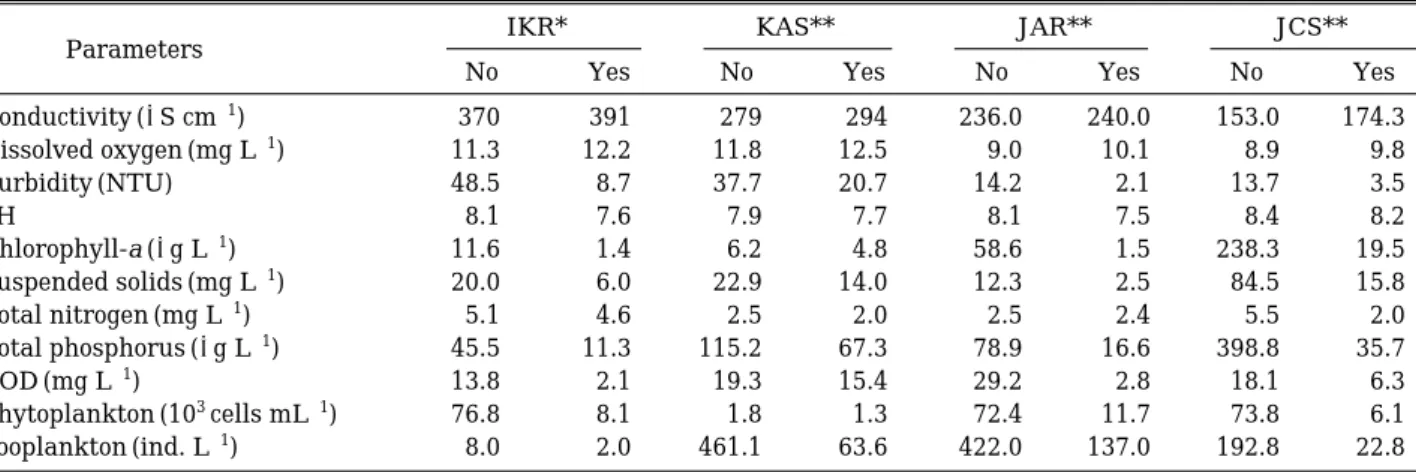
(Table 2, Fig. 1). PMC
의 수 질개선능은 인경저수지에서는 전기전도도(WQIA 5.7%), DO (7.8%), pH (7%), TN (10%), SS (70%), TP (75%),
탁도(82%), BOD (84%), Chl-a (88%)
등으로 나타났다.
경안천 은 전기전도도(5.5%), DO (5.3%), pH (4%), TN (19%), BOD (20%), Chl-a (23%), SS (39%), TP (42%),
탁도(45%)
등 모든 항목에서50%
미만의 낮은 수질개선효과를 보 였다.
중앙저수지는 전기전도도(2%), DO (12%), TN (5%), pH (12%), TP (79%), SS (80%),
탁도(85%), BOD (90%), Chl-a (98%)
등으로 각각 나타났으며,
제천천은 전기전도 도14%, DO 10%, pH (3%), TN (64%), BOD (65%),
탁도(75%), SS (81%), TP (91%), Chl-a (92%)
등으로 나타났다.
2.
플랑크톤 군집 변화PMC
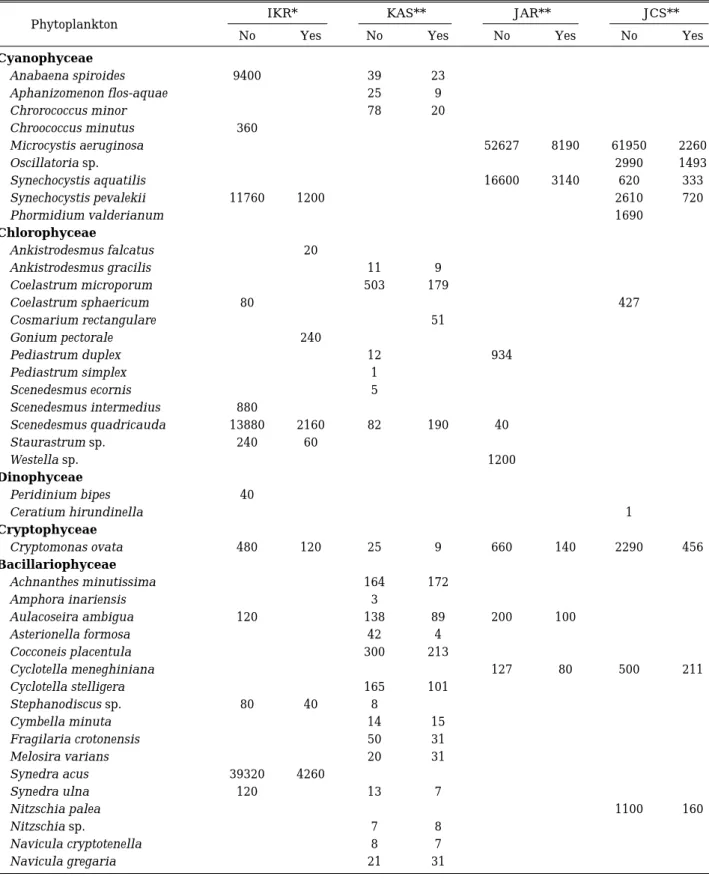
처리 후 식물 및 동물플랑크톤 현존량의 변화를 살펴보면,
남조류 밀도가 높았던 인경저수지,
중앙저수지,
제천천에서는 식물플랑크톤 감소가 뚜렷한 반면,
수질개 선효과가 낮았던 경안천에서는 동물플랑크톤 현존량이 뚜렷하게 감소하였다(Table 2, Fig. 1).
인경저수지에서PMC
처리 후 식물플랑크톤은 약90%,
동물플랑크톤은75%
등으로 뚜렷한 현존량 감소를 나타냈다.
또한PMC
처리 전에는Synedra acus, Synechocystis pevalekii,
처리 후에는Synedra acus, Scenedesmus quadricauda
등이 각각 우점하였다.
동물플랑크톤은PMC
처리 전후 요각 류Naupliu, Brachionus angularis, Keratella valga
등이 우점하였으나 현존량은 다른 장소에 비해 상대적으로 낮 았다.
경안천에서는PMC
처리 후 식물플랑크톤27%,
동 물플랑크톤86%
등으로 특히 동물플랑크톤에 대하여 강Table 2. Comparisons of environmental parameters with and without PMC treatment for each study.
Parameters IKR* KAS** JAR** JCS**
No Yes No Yes No Yes No Yes
Conductivity ( μS cm
-1) 370 391 279 294 236.0 240.0 153.0 174.3
Dissolved oxygen (mg L
-1) 11.3 12.2 11.8 12.5 9.0 10.1 8.9 9.8
Turbidity (NTU) 48.5 8.7 37.7 20.7 14.2 2.1 13.7 3.5
pH 8.1 7.6 7.9 7.7 8.1 7.5 8.4 8.2
Chlorophyll-a ( μg L
-1) 11.6 1.4 6.2 4.8 58.6 1.5 238.3 19.5
Suspended solids (mg L
-1) 20.0 6.0 22.9 14.0 12.3 2.5 84.5 15.8
Total nitrogen (mg L
-1) 5.1 4.6 2.5 2.0 2.5 2.4 5.5 2.0
Total phosphorus ( μg L
-1) 45.5 11.3 115.2 67.3 78.9 16.6 398.8 35.7
BOD (mg L
-1) 13.8 2.1 19.3 15.4 29.2 2.8 18.1 6.3
Phytoplankton (10
3cells mL
-1) 76.8 8.1 1.8 1.3 72.4 11.7 73.8 6.1
Zooplankton (ind. L
-1) 8.0 2.0 461.1 63.6 422.0 137.0 192.8 22.8
IKR: Inkyung reservoir, KAS: Kyungan stream, JAR: Joongang reservoir, JCS: Jecheon stream
*: the experiment was conducted in whole reservoir to compare the differences before and after treatment of PMC (0.5 mg L-1). **: the experiment was conducted in mesocosm constructed at littoral zone of reservoir, to compare the differences between no PMC (no) and PMC treatments (yes).
한 현존량 감소를 유도하였다
.
또한PMC
처리 전후 모두 동일한 식물플랑크톤Coelastrum microporum, Cocconeis placentula
와 동물플랑크톤Bosmina longirostris,
요각류Naupli
등이 우점하였다.
중앙저수지에서는PMC
처리 후 식물플랑크톤84%,
동물플랑크톤68%
등으로 식물플랑크 톤 현존량 감소가 뚜렷하였다. PMC
처리 전후 모두Mi- crocystis aeruginosa, Synechocystis pevalekii, Bosmina longirostris
와 요각류Naupli
가 우점하였다.
제천천에서 는PMC
처리 후 식물플랑크톤92%,
동물플랑크톤88%
등으로 실험기간 동안 가장 높은 플랑크톤 제어효과를 나 타냈다
.
식물플랑크톤은PMC
처리 전후 모두Microcystis
aeruginosa, Oscillatoria sp.
등이 우점하였고,
동물플랑크 톤은PMC
처리 전에는Calanoida, Eudiaptomus formo- sus
가, PMC
처리 후에는 요각류Naupli
가 각각 우점하였 다.
한편
,
플랑크톤 군집(class)
의 변화를 살펴보면, PMC
처 리 후 식물플랑크톤 군집은 인경저수지에서는 녹조류와 크립토조(12%),
경안천은 규조류(4%)
가 각각 증가한 반 면,
제천천에서는 남조류(9%)
의 구성비가 감소하였다.
중 앙저수지는PMC
처리 전후 뚜렷한 변화를 보이지 않았 다(Fig. 3).
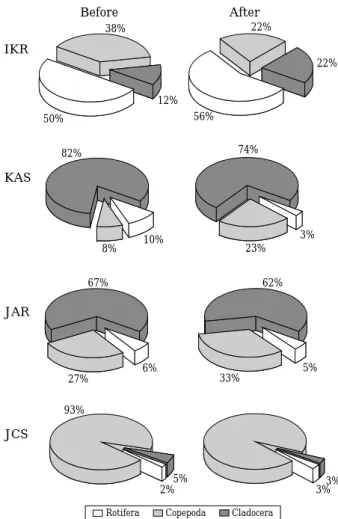
동물플랑크톤의 경우,
인경저수지에서는PMC
처리 후rotifer (16%), cladocera (10%)
가 각각 증가하였 다.
경안천에서는rotifer (15%)
가 증가한 반면cladocera (-8%), copepoda (-7%)
는 약간씩 감소하였다.
중앙저수 지는 경안천과 유사하게rotifer (6%)
증가 및cladocera (-5%)
감소를 나타냈다.
한편 제천천에서는PMC
처리Chlorophyll-a TP Turbidity SS BOD NH4 PO4
TN NO2
NO3 pH WT Conductivity DO
-50 0 50 100 150 200 250 300 350 400 IKR KAS JAR JCS
WQIA (%)
Fig. 1. Water quality improvement activity (WQIA, %) of PMC in environmental parameters. Minus values represent an increase following PMC treatment.
IKR: Inkyung reservoir, KAS: Kyungan stream, JAR: Joongang reservoir, JCS: Jecheon stream.
Cyanobacteria Rotifera T-zooplankton Chlorophyceae Cladocera Cryptophyceae Copepoda T-phytoplankton Bacillariophyceae
-50 0 50 100 150 200 250 300 350 400 WQIA (%)
IKR KAS JAR JCS
Fig. 2. Water quality improvement activity (WQIA, %) of PMC in biological parameters (phytoplankton and zooplankton). IKR: Inkyung reservoir, KAS: Kyung- an stream, JAR: Joongang reservoir, JCS: Jecheon stream.
Before After
Cyanobacteria
Chlorophyceae+Cryptophyceae Bacillariophyceae
Fig. 3. Relative composition of phytoplankton communities
before and after PMC treatment. IKR: Inkyung re- servoir, KAS: Kyungan stream, JAR: Joongang re- servoir, JCS: Jecheon stream.
IKR
KAS
JAR
JCS
52% 52%
32%
15%
55% 59%
96%
1%
3%
97%
94% 85%
2%
2%
4%
1%
8%
7%
8% 4%
37% 37%
28%
20%
전후 뚜렷한 종 구성비의 변화를 보이지 않았다
(Fig. 4).
3.
조류독소PMC
처리 후 독소의 종류에 상관없이 뚜렷하게 감소하 였다(Fig. 5). S-MCLR
의 경우, PMC
처리 전에는4.850
±
0.750 μg L
-1,
처리1
일 뒤에는3.945
±1.223 μg L
-1(19%),
처리2
일 뒤에는2.555
±0.516 μg L
-1(47%)
등으 로 점차적으로 감소율이 증가하였다.
이에 비해D-MCLR
의 경우, PMC
처리 전에는4.935
±1.124 μg L
-1,
처리1
일 뒤에는0.315
±0.049 μg L
-1(94%),
처리2
일 뒤에는0.205
±0.064 μg L
-1(96%)
등으로 급격하게 감소하였다.
결국 남조Microcystis aeruginosa
가 우점한 수계에PMC
를 처리할 경우,
조체성 독소는 물론 특히 용존성 독소 제어에 탁월한 효과를 나타냈다.
고 찰
국내에 널리 분포하고 있는 천연재료
(
상수리나무,
밤나 무,
녹차,
황토,
맥반석,
제올라이트)
를 단순 추출하여 혼합 한 식물-
광물 혼합제(plant-mineral composite; PMC)
는 부영양 수체의 조류(
유기물)
제어를 목적으로 개발되었 다(Kim et al., 2010). PMC
의 주된 기능은 높은 살조능,
응집능,
부상능 등을 동시에 가지고 있으며(Kim et al., 2010),
현장수를 이용한 실내실험에서 저농도(⁄0.5 mg L
-1),
상온(20~30
�C),
약알카리성pH (7~9),
낮은 수심(~10 cm),
고농도 남조류 조건에서 최대 효과를 나타냈 다(Lee et al., 2011).
본 연구는 크기와 수질이 서로 다른 수체에 동일한 농도의PMC
를 처리하고 처리 전후의 환 경요인,
플랑크톤 현존량 및 종조성의 변화를 비교 조사 하였다.
그 결과,
유속이 있고,
규조류 밀도가 높으며,
어 류(
주로 붕어,
잉어)
에 의한 교란이 심했던 경안천에서는 모든 항목에서45%
미만의 낮은 수질개선효과를 보인 반 면,
나머지 수체에서는 입자성 물질(
탁도, SS, TP, Chl-a)
에 대하여70%
이상의 높은 수질개선효과를 나타냈다.
특히chlorophyll-a
에 대해서는 경안천(23%)
에 비하여 인 경호(88%),
중앙저수지(98%),
제천천(92%)
등 매우 높은 수질개선능을 보여 수체의 흐름이 적은 현장에 효과적임 이 밝혀졌다.
뿐만 아니라 조류의 성장에 절대적인 영향 을 미치는 인(Schindler et al., 1971, 1974; Edmondson and Lehman, 1981)
저감이나 남조류 발생 또는 발생예 상 수역의 수질개선에 적절한 차단제(breaker)
역할을 할 것으로 판단되었다.
수질개선효과가 상대적으로 낮았던 경안천은 남
,
북한Before After
Rotifera Copepoda Cladocera
Fig. 4. Relative composition of zooplankton communities before and after PMC treatment. IKR: Inkyung re- servoir, KAS: Kyungan stream, JAR: Joongang re- servoir, JCS: Jecheon stream.
1-d before PMC
1-d after PMC
2-d after PMC 0.0
1.0 2.0 3.0 4.0 5.0 6.0 7.0
Microcystin-LR (μg L-1 )
D-MCLR S-MCLR
Fig. 5. Changes in dissolved (D-MCLR) and solid microcy- stin-LR (S-MCLR), before and after PMC treatment.
IKR
KAS
JAR
JCS
38%
12%
50% 56%
22%
22%
82% 74%
8% 10%
23%
3%
67% 62%
33%
6% 5%
27%
93%
2%
5%
3%3%
Table 3. Changes in phytoplankton density (10
3cells mL
-1) after PMC treatment for each study.
Phytoplankton IKR* KAS** JAR** JCS**
No Yes No Yes No Yes No Yes
Cyanophyceae
Anabaena spiroides 9400 39 23
Aphanizomenon flos-aquae 25 9
Chrorococcus minor 78 20
Chroococcus minutus 360
Microcystis aeruginosa 52627 8190 61950 2260
Oscillatoria sp. 2990 1493
Synechocystis aquatilis 16600 3140 620 333
Synechocystis pevalekii 11760 1200 2610 720
Phormidium valderianum 1690
Chlorophyceae
Ankistrodesmus falcatus 20
Ankistrodesmus gracilis 11 9
Coelastrum microporum 503 179
Coelastrum sphaericum 80 427
Cosmarium rectangulare 51
Gonium pectorale 240
Pediastrum duplex 12 934
Pediastrum simplex 1
Scenedesmus ecornis 5
Scenedesmus intermedius 880
Scenedesmus quadricauda 13880 2160 82 190 40
Staurastrum sp. 240 60
Westella sp. 1200
Dinophyceae
Peridinium bipes 40
Ceratium hirundinella 1
Cryptophyceae
Cryptomonas ovata 480 120 25 9 660 140 2290 456
Bacillariophyceae
Achnanthes minutissima 164 172
Amphora inariensis 3
Aulacoseira ambigua 120 138 89 200 100
Asterionella formosa 42 4
Cocconeis placentula 300 213
Cyclotella meneghiniana 127 80 500 211
Cyclotella stelligera 165 101
Stephanodiscus sp. 80 40 8
Cymbella minuta 14 15
Fragilaria crotonensis 50 31
Melosira varians 20 31
Synedra acus 39320 4260
Synedra ulna 120 13 7
Nitzschia palea 1100 160
Nitzschia sp. 7 8
Navicula cryptotenella 8 7
Navicula gregaria 21 31
IKR: Inkyung reservoir, KAS: Kyungan stream, JAR: Joongang reservoir, JCS: Jecheon stream
*: the experiment was conducted in whole reservoir to compare the differences before and after treatment of PMC (0.5 mg L-1). **: the experiment was conducted in mesocosm constructed at littoral zone of reservoir, to compare the differences between no PMC (no) and PMC treatments (yes).
강과 함께 팔당호의 주요 유입원이며 유량과 수질변화가 매우 심하다
.
특히 경안천은 홍수기에는 체류시간이 매우 짧아지고(
약4.5
일),
이로 인한 극심한 유역환경 변동과 상류지역 산업형 도시와 주변 유역의 농경지로부터 많은 하,
폐수 및 유기물이 유입되고 있어3
개 지류중 가장 오 염도가 높다(Lim et al., 1999; Cheon et al., 2006; Kim et al., 2007).
본 연구가 진행되고 있었던 시기에도 강우로 인하여 팔당댐 방류에 따라 수위변동의 일교차가 매우 심 하고,
실험장소 주변의 농경지로부터 많은 유기물이 유입 되었으며,
어류에 의한 바닥층 교란으로 탁도가 매우 높은 상태였다.
그러나 비록 현존량은 상대적으로 낮았으나 다 른 실험장소보다 다양한 식물플랑크톤(25
종)
이 출현하였 고,
특히 군체를 형성하는Anabaena
와Chroococcus
등 남조류가 출현하였다.
또한 동물플랑크톤의 경우(86%), PMC
처리 후 다른 수체-
인경호(75%),
중앙저수지(68%),
제천천(88%)
보다 오히려 높거나 유사하였다.
이러한 결 과는 결국 현장 수계의 수체이동,
탁수성격 및 동,
식물플 랑크톤의 현존량 등에 의해PMC
의 수질개선능이 결정 될 수 있다는 것을 의미한다.
따라서PMC
작용에 미치는 환경요인에 대한 세부적인 연구가 요구되었다.
PMC
의 조류(
유기물)
제어능은 다른 조류에 비하여 남 조류에 탁월하다고 알려졌으나(Kim et al., 2010),
수중 탁수의 성질이나 양에 대해서는 아직 정확하게 알려져 있지 않다.
다만 조류에 의해 유발되는 탁도와 토양(
외부 로부터 유입되거나 저수지 바닥)
에서 유발되는 탁도가PMC
의 기능에 미치는 영향은 차이를 보일 것으로 예상 되었다.
경안천의 경우 토양에서 발생하는 탁류성 물질이 높은 반면 나머지 저수지에서는 주로 식물플랑크톤 현존 량에 의하여 탁도가 증가하였는데,
전자보다 후자에서 상 대적으로PMC
의 높은 수질개선능을 나타냈다.
각 조사 지점의 탁류물질의 특성에 대한 분석을 시도하지 않아 단순하게 비교하기는 어렵지만 남조류 같은 식물플랑크 톤 밀도가 높은 수체보다 탁류성 물질이 높은 수체에서 수질개선능은 상대적으로 낮게 나타난 점은 분명하였다.
게다가PMC
처리에 따른 경안천의BOD, TP,
동물플랑 크톤 등은 인경저수지보다 상대적으로 크게 감소하였고,
동물플랑크톤과TP
는 제천천과 유사한 수준이었으나 식 물플랑크톤에 대해서만 낮은 제어능을 보여,
탁도의 성질(
토양유래 탁도와 조류유래 탁도)
이PMC
의 기능에 중요 한 역할을 하는 것으로 판단되었다.
결국 수체의 바닥이Table 4. Changes in zooplankton density (indiv. L
-1) after PMC treatment for each study.
Zooplankton IKR* KAS** JAR** JCS**
No Yes No Yes No Yes No Yes
Rotifera
Asplanchna sieboldi
13.6 0.1
Asplanchna sp.
29.8 1.6
Brachionus angularis
2.0 0.4 0.8
Brachionus calyciflorus
0.6 0.1 25.0 6.5
Keratella valga
2.0 0.4 2.3
Philodium roseola
0.2
Polyathra euryptera
1.2 0.2
Trichocerca cylindrica
1.0 0.7
Copepoda
Eudiaptomus formosus
53.3 2.5
Neutrodiaptomus okadai
21.8 1.7
Macrocyclops fuscus
8.3 1.0
Nauplius 3.0 0.4 37.1 14.8 111.0 38.5 13.5 12.3
Calanoida 3.5 6.5 82.5 4.0
Cladocera
Alona guttata
1.5
Bosmina longirostris
1.0 0.4 372.1 43.9 282.5 85.5 7.5 0.7
Diaphanosoma brachyurum
4.1 0.8
Daphnia galeata
1.9 2.1 1.0
IKR: Inkyung reservoir, KAS: Kyungan stream, JAR: Joongang reservoir, JCS: Jecheon stream
*: the experiment was conducted in whole reservoir to compare the differences before and after treatment of PMC (0.5 mg L-1). **: the experiment was conducted in mesocosm constructed at littoral zone of reservoir, to compare the differences between no PMC (no) and PMC treatments (yes).
나 외부로부터 유입되는 토양유래 탁류물질이 많은 수계 에는
PMC
사용이 적합하지 않을 것으로 사료되었다.
한편
,
남조Microcystis aeruginosa
가 우점하였던 중앙 저수지를 대상으로PMC
를 처리한 후 수중내 조체성(S- MCLR)
및 용존성 독소(D-MCLR)
의 변화를 분석한 결 과,
조체성(47%)
보다 용존성 독소가 현저하게 저감되었 다.
특히 용존성 독소는PMC
처리2
일째96%
가 감소되 어 또 다른 용존성 유해물질의 제어가능성을 시사해 주 었다.
지금까지 흡착능을 가진 화학제들이 수중내 조류독 소에 대한 효과는 잘 알려지지 않았으나PMC
에 포함된 광물중 황토(Moon et al., 2006; Seok and Jun, 2009),
제 올라이트(Kim et al., 1991),
맥반석(Hwang et al., 1996)
등은 다양한 용존성 물질-
중금속, PCB, MBTE,
인산염,
암모니아 등에 대하여 높은 흡착능을 가지고 있다. PMC
처리 전MCLR
의 농도는 용존성과 조체성 모두 비슷한 수준이었으나 처리 후M. aeruginosa
는 처리2
일째 약84%
까지 감소한 반면, S-MCLR (47%)
보다D-MCLR (96%)
이 높게 감소하는 이유는 분명하지 않다.
본 연구에서
D-MCLR
은 광물들의 흡착반응의 결과로 예상되지만S-MCLR
의 낮은 감소는 연구결과만으로는 설명하기 어렵다
.
뿐만 아니라 총MCLR
이 반드시 남조M. aerugi- nosa
에 의해서만 생성된 것으로 단정하기는 어렵다.
동 시에 출현하였던 남조Synechocystis (PMC
처리 후 현존 량81%
감소)
의 독소생성에 대해서는 알려진 바가 없기 때문에 추가적인 연구가 요구된다.
적 요
2010
년 고온기(
여름~
가을)
동안 수체 크기와 수질이 서로 다른 부영양 하천(
경안천,
제천천)
및 저수지(
인경 저수지,
중앙저수지)
의 유기물 제어를 목적으로 기 개발 된 식물-
광물 혼합제(PMC)
를 동일한 농도(0.05 mg L
-1)
로 각각 처리하고 수질,
플랑크톤 변화를 조사하였다.
또 한 남조Microcystis aeruginosa
밀도가 높았던 중앙저수 지에서는 동시에 조류 독소microcystin-LR
변화를 각각 조사하였다.
실험은 수체의 크기를 고려하여 인경저수지 를 제외한 나머지 장소에서는 실험용 메조코즘을 설치하 였다.
실험결과,
강우와 어류에 의한 교란이 심했던 경안 천에서는 모든 항목에 대하여45%
이하의 낮은 수질개 선능을 보인 반면,
수체가 안정되고 남조류 밀도가 높았 던 수체에서는SS (70~81%), TP (75~91%), BOD (65~
91%), Chl-a (88~98%),
식물플랑크톤(84~92%),
동물플 랑크톤(68~88%)
등에 높은 수질개선효과를 보였다.
한편
PMC
처리 후 조체성에 비해 용존성 독소(96%)
가 현 저하게 감소하여 유해물질 제어 가능성을 나타냈다.
따라 서 기 개발된PMC
는 수체 교란이 적고 남조류가 우점 하는 수체내 유기물 제어에 적합한 것으로 판단되었다.
사 사
본 연구는
2010
년도 한강수계 기초조사사업“
상수원 수질개선 기술의 실효성 검증 및 적용연구”
의 일환으로 수행되었음.
인 용 문 헌