Print ISSN: 1738-3110 / Online ISSN 2093-7717 http://dx.doi.org/10.15722/jds.18.6.202006.15
A Study on the Impact of Cultural Contact Service on Brand Equity
Ok-Chul SHIN
1, Jin-Woo PARK
2Received: January 15, 2020. Revised: May 29, 2020. Accepted: June 05, 2020.
Abstract
Purpose: The ultimate purpose of this research is to analyze the influence of direct service experience on brand equity components and continuance intention by focusing on cultural marketing at airport, as a huge market place. Design/methodology: This study examines how the cultural contact experience of an airport's cultural marketing activities affect the brand equity components, as well as how these factors affect the continuance intention. A questionnaire survey is conducted for airport users and a total of 313 copies of the questionnaire are analyzed using a structural equation. Results: The results demonstrate that cultural contact service has a positive effect on brand awareness, brand meaning, and perceived value, and all factors of brand equity components have a positive effect on continuance intention. In addition, MTE also has a significant effect on continuance intention. Conclusions/implications: The purpose of this study was to investigate the relationship between the cultural contact and brand attachment of tourists experiencing airport cultural marketing services on the composition factors of airport brand equity. The results of this study can be used not only as basic data to help establish a cultural marketing strategy at an airport, but also as to aid establishing and implementing a long-term marketing strategy for the sustainable growth of an airport.
Keywords: Cultural Marketing, Market Place, Cultural Contact, Brand Attachment, Brand Equity JEL classification: L81, L84, M16, Z13, Z31
1. Introduction
34Because international airports serve as gateways into their respective countries, it is important that cultural contact experiences within these airports maintain an international quality that can be enjoyed and communicated universally by people around the world. Because users of various nationalities grow up in different cultural environments and think differently, it is necessary to provide cultural environments that allow them to enjoy and communicate comfortably in one space, the airport.
Because Incheon International Airport is South Korea‘s gateway airport, it endeavors to develop and deliver various messages and contents to provide a universal and
1 First Author, PhD student, School of Business Korea Aerospace University, Korea, Email:[email protected]
2 Corresponding Author, Professor, School of Business Korea Aerospace University, Korea, Email: [email protected]
ⓒ Copyright: The Author(s)
This is an Open Access article distributed under the terms of the Creative Commons Attribution Non-Commercial License (http://Creativecommons.org/licenses/by-nc/4.0/) which permits unrestricted noncommercial use, distribution, and reproduction in any medium, provided the original work is properly cited.
differentiated culture that appeals to airport users of various
nationalities. In particular, since opening, Incheon
International Airport has aimed to ensure that passengers
can fully enjoy elements of cultural travel by providing
various cultural and artistic experiences incorporating
traditional and modern culture. Cultural marketing is
basically intended to promote sales of duty-free shops,
specialty stores and F & B restaurants in the airport, which
is essentially a large-scale market place. Cultural marketing
activities at Incheon International Airport include cultural
performances, cultural events, art exhibitions and artistic
designs. The airport actively utilizes modern cultural
elements as well as traditional factors to satisfy the cultural
needs of visitors who have various nationalities and cultural
backgrounds. Airport users will be normally satisfied with
new and exciting experiences when they face traditional
and modern cultural activities, for instance, popera(Pop and
Opera), fusion performance(Jazz, Rock, traditional and
Classic music), K-pop, Robot Dancing, etc. These activities
are understood as a strategic marketing to increase brand
value. Incheon is not alone in this regard. Nearby airports in
China, Singapore, and Japan, as well as most gateway
airports in Europe and the Americas, are actively pursuing
differentiation strategies that appeal to users with unique content incorporating their own cultures. Diverse cultural activities attract a lot of cultural interests and curiosities from nationals to foreigners. When Incheon International Airport opened in 2001, a culture-port strategy was initiated, and this emphasis has more recently been re-invigorated according to the airport‘s ‗Vision 2030‘ strategy which outlines the need for the implementation of a ‗Heart-port‘.
Gimpo International Airport in the metropolitan area and other regional airports in southern area can be considered to be in competition with Incheon International Airport in the overlapping air-routes. Although the importance of direct service experience and cultural marketing at airports continues to increase, studies on the effects of these activities have been overlooked compared to other industries. It is difficult to find systematic studies on the effects of cultural marketing, as part of the direct service experience at airports, on airport brand equity and the continuance intention perceived. The present study conducts research on the direct service experience at Incheon International Airport from the perspective of cultural contact and from the perspective of brand equity, memorable tourism experience, and continuance intention because the airport is an independent service brand.
Therefore, this study empirically analyzes the effects of cultural contact and brand attachment on memorable tourism experiences and continuance intention through brand equity. In particular, this study empirically analyzes the relationship between airport users‘ cultural contact and brand attachment on brand equity and the impact of brand assets on memorable tourism experiences and continuance intention. It thereby provides research implications to explore ways to further enhance brand competitiveness and encourage airport selection from users. In the end, this study can provide the academic basis that the airport can achieve sustainable growth as the customer relationship becomes more solid in the long term if the value of the brand equity is increased through differentiated customer experiences based on cultural factors .
2. Theoretical Background 2.1. Literature Review
Cultural marketing is a marketing activity that allows companies to increase their value by using culture as a marketing tool and create added value through smooth communication with consumers. Culture and tourism have always been inextricably linked. Cultural sights, attractions and events provide an important motivation for travel, and travel in itself generates culture (Richards, 2018). Today,
companies recognize that marketing strategies built around culture can help them fulfil their social responsibilities and enhance corporate image or brand appeal. Research on cultural marketing for corporate products and services and research from a multicultural perspective have been conducted by various scholars.
The term cultural contact refers to situations in which people or regions with different cultural backgrounds meet with different nationalities, lifestyles, and places of residence. International airports can be considered as the most frequent place that we can naturally experience cultural contact. Cultural contact is a newly emerging concept that measures the purpose and depth of the experience that tourists or travelers seek when traveling to experience a different culture. Here, the subject of cultural contact refers to a group of tourists who return after sightseeing at a specific cultural tourist destination for a few days (Gnoth & Zins, 2013). Gnoth (2013) stated that cultural contact dealt with both the "what" and "how" of culture because it relates to the way tourists use cultural tourism resources and specific behaviors related to cultural tourism destinations. He also developed a measure of cultural contact for tourists who participated in Maori culture in New Zealand. According to the service brand asset evaluation model by Sarker (2019), direct service experience was considered a leading variable of brand consistency and brand assets. Chen (2018) stated that cultural contact positively and significantly influences memorable tourism experience (MTE). Contucci (2007) demonstrated his model of cultural contact between two cultures (e.g., immigration), showed that it was possible to make predictions about how contact changes the two cultures. It was judged that the cultural contact would be more appropriate because it combines the elements of culture and experience together.
In the dictionary sense, the word attachment in the term brand attachment suggests a state that does not fall with a person or object because they are loved or attracted deeply.
In addition, the object of attachment can be a brand,
destination, place, relationship, product, and so on. A
consumer's attachment to tourism destination products has
been shown as brand loyalty, store loyalty, and service
loyalty in the marketing field, and has been treated as one
of the most important factors in developing marketing
strategy (Dennis, 2016). In the field of tourism, the concept
of place attachment is defined as a person's attachment to a
certain place as a continuous psychological attitude or
behavioral tendency to show the relationship with the
human geographic environment (Li, 2019). Research on the
influence of brand attachment has been conducted by
various scholars. Dolbec (2013) studied the relationship
between brand attachment, store image, and brand
experience. Pedeliento (2013) found that brand-self
congruity and brand reliability affected brand attachment, and thereafter brand attachment affected brand loyalty. Son (2014) asserted that place attachment had a positive (+) effect on brand attitude and strengthened the intention to visit through this process. As such, the higher the brand or place attachment, the more it affected brand attitude and loyalty. Therefore, in the airport industry, brand attachment would also have a mutual influence on brand equity. Sarker (2019) claimed that there was no empirical evidence available on brand consistency. They described brand consistency as a similar customer perception to that of brand messages in their service brand equity evaluation model. Considering the characteristics of publicity in airport services, it is appropriate to use brand attachment rather than brand consistency. Dennis (2016) asserted that attachment strength had a positive effect on satisfaction, trust, commitment and brand equity. Li (2019) asserted that brand attachment had positive effects on satisfaction and continuance intention. Japutra (2019) asserted that brand attachment positively affected impulsive buying and obsessive-compulsive buying. Kim (2014) stated that place attachment was one of the potential constructs of the destination attributes that affect MTEs.
Brand equity is the added value that a brand gives to a specific product and service through a consumer. Keller (1993) defined brand equity as how customers react and differentiate their response to the different marketing mix elements of the named and unnamed versions of products or services. The constituent factors of brand equity have been studied by various scholars. First, Aaker (1994) presented brand loyalty, brand association, brand awareness, and perceived product quality. Keller (1993) subsequently presented two types–brand awareness and brand image.
Berry (2000) presented brand awareness, brand meaning, consumer experience, uncontrolled communication by publicity, and word-of-mouth communication (WOM) in the service brand model. Berry (2000) explained that brand awareness and brand meaning disproportionately influenced brand equity despite the variation between product and service brands. Ç ifci (2015) presented eight variable factors, including brand awareness, physical quality, brand consistency, and brand loyalty. Ç ifci (2015) stated that some of the dimensions (e.g., brand awareness, ideal self- congruence, life style congruence) were the cognitive/affective components of brand equity which evolve when consumers come in contact with brand touch points. Sarker (2019) presented the service experience, brand consistency, brand equity components and service brand equity directly from the Consumer-Based Service Brand Asset Evaluation Model (CBSBE) and presented the constituent factors of brand equity as brand awareness, brand meaning, and perceived value. Berry (2000) defined brand awareness as the ability for consumers to recognize
and recall a brand, he defined brand meaning as the customer's predominant perception of a brand, and he defined brand equity as a brand variable component, namely a resulting response variable. Berry (2000)‘s service brand equity components (brand awareness and brand meaning) and brand equity are similar to the Keller's model. Sarker (2019) applied the concepts of brand awareness and brand meaning to Berry's service brand model, and they defined perceived value as a customer's cognitive evaluation formed by the recognition of service utility and expenditure of monetary and non-monetary cost (Parashuraman, 1988). Brand loyalty seems to have similar aspects to brand attachment, but the characteristics are different when comparing variable concepts and questionnaire items. The use of Brand attachment as a leading variable or a dependent variable of constituent elements of brand equity has been diverse in previous research literatures on the papers of Li (2019) and Hwang (2019). While Brand loyalty is mainly used as a dependent variable, Sarker (2019) stated that brand equity has a similar meaning to brand loyalty based on the papers of Berry (2000) and Keller (1993). Ç ifci (2015) describes question items for brand loyalty as recommend and repurchase. In addition, according to recent studies between brand assets and other variables, Tran (2020) indicated that brand authenticity positively relates to brand equity and customer satisfaction and Zahari (2019) suggested that all CSR practices, namely environmental, community, workplace and marketplace, have a significant and positive correlation with financial based brand equity.
It can be said that brand loyalty has a different meaning from brand attachment. Brand attachment was used as a leading variable on the satisfaction and continuance intention in Li (2019) and loyalty intention in Hwang (2019). In addition, brand attachment was also used as determinant variable on brand loyalty and brand attitude (Hwang, 2007). The specific case study in which brand attachment was used as a leading variable of brand components (brand awareness, brand meaning, perceived value) has not yet been found, so it is not judged that brand attachment should be necessarily used as a dependent variable only. Accordingly, there is no clear prior study on the sequential relationship between brand attachment and brand equity components. Therefore, this paper tries to set the assumption that brand attachment based on past experience has influence on brand equity components and destination loyalty (continuance intention, MTE) considering the characteristics of the airport industry.
Experience types can vary, and they include product and
service experiences, brand experiences, and tourism
experiences. This study focuses on the latter. It is difficult
to define a tourism experience due to the various
characteristics, but Stamboulis (2003) observed that a
tourism experience was generated through the act of visiting destinations away from the traveler's home, learning the properties of destinations, and enjoying activities. Tung (2011) described tourism experiences as personal subjective assessments (eg: emotional, cognitive, and behavioral) on the traveler‘s activities and related events before trip (planning and preparation), during trip (destinations) and after trip. A MTE is defined as "a tourism experience that is remembered after the event has occurred"
(Kim, 2010). The importance of this MTE theory is that consumer decision-making comes from the influence of past memories, and in fact, past memories are considered to be the most important source of information when tourists decide to revisit a particular destination (Chandralal, 2013).
Chen (2018) stated that cultural contact had a mediating effect between visitor engagement and MTE, and that MTE affected destination loyalty (revisit intention and intention to recommend). Nguyen (2020) proposed that the quality of services (including empathy, assurance, reliability, and tangibility) impacted tourists‘ intention to revisit, through satisfaction mediating construct. According to Chandralal (2013), consumer decision-making comes from the influence of past memories, and in fact, these past memories (MTE) are considered the most important source of information when tourists decide to visit a particular destination again. Hwang (2019) noted that the perceived novelty of a tourist destination had a positive effect on revisit intention.
Kalwani (1995) asserted that continuance intention determines the behavioral intention of customers from now to the future and maintaining long-term relationships with customers is a strong method of securing a competitive advantage for the company. Moorman (1992) defined continuance intention as the desire to continue to maintain a valuable relationship. Recently, competition among large airports to attract destination visitors or transit passengers has become fierce. It is thought that the experiences of differentiated services at each airport or contact with high- quality culture will have a direct impact on brand equity and memorable tourism experiences.
2.2. Research Model
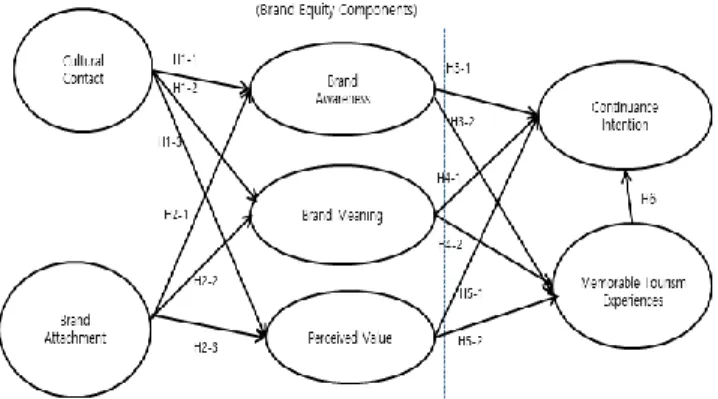
The airport can be regarded as a place that consumes a complex experience in the form of travel and services, and the relationship between the airport and the passenger is determined by brand value perceived from the experience of airport. This study examines how the cultural contact experience and brand attachment of an airport‘s cultural marketing activities affect the composition factors of brand equity, as well as how these factors affect the MTE and continuance intention. We used cultural contact and brand attachment as independent variables, brand equity
components as parameter, MTE and continuance intention as dependent variables.
The research model shown in Figure 1 is based on previous studies on cultural contact, brand attachment, brand equity composition factors, MTE, and continuance intention. Specifically, the research model of this study examines the effects of cultural contact and brand attachment, which are affected by cultural marketing activities, on the composition factors of brand equity (i.e.
brand awareness, brand meaning, and perceived value).
Furthermore, the study also continues to examine the relationship between the composition factors of brand equity, MTE, and continuance intention. The hypotheses used in this study are indicated by arrows, and all hypotheses are set to have a positive effect.
Figure 1: Proposed Conceptual Model
3. Methodology
A questionnaire was prepared based on the existing literature research, and it was then modified after a preliminary survey. The final questionnaire contained five questions measuring cultural contact, four questions measuring brand attachment, three questions measuring brand awareness, three questions measuring brand meaning, three questions measuring perceived value, five questions measuring MTE, and three questions measuring continuance intention. Each item was marked as [Very Much (5)-Absolutely Not (1)] using the Likert 5-point scale.
The composition of the questionnaire is shown in Table 1.
The survey sample for the empirical study was conducted for airport users with experiences related to Incheon International Airport‘s cultural marketing, and the survey took place from November 20, 2019 to February 14, 2020 both landside and airside at Incheon International Airport.
In order to grasp the impact on all airport users, this paper,
in principle, the survey should be conducted not only by
Koreans but also by foreigners. However, the first survey
was conducted only by Koreans in this paper. To increase
the response rate of the questionnaire, it was distributed directly to the survey participants, and it was collected after the respondents completed all questions.
Table 1: Measurement items
Construct Items Related
Studies
Cultural Contact
1. I got to learn about different customs and ways of life with cultural contact at Incheon International Airport(IIA).
2. I actually experienced this culture.
3. I got to know the diversity and difference in terms of culture.
4. The more I contact this culture, the more I want to experience it.
5. I got to understand the world better after I contacted this culture.
Chen (2018) Hongxia.(2019)
Sheu (2009)
Brand Attachment
1. I have much affection for IIA.
2. I am very connected to IIA.
3. IIA gives me much joy and pleasure
4. I find a certain comfort at IIA.
Sheu (2009) Dolbec (2013)
Kim (2018)
Brand Awareness
1. IIA has a good reputation.
2. IIA is very popular.
3. IIA is quickly recalled.
Yang (2019) Kim (2018)
Brand Meaning
1. IIA is the first airport that I can recall among airports.
2. Whenever I travel, IIA will come to my mind first.
3. IIA will remain in my memory for a longtime.
Berry (2000) Sarker (2019)
Perceived Value
1. I am satisfied with the services at IIA.
2. It is worthwhile to spend time at IIA.
3. It is worthwhile to spend money at IIA.
Sarker (2019)
MTE
1. I enjoyed the cultural experience at IIA very much.
2. I was absorbed in the cultural activities.
3. They were once-in-a lifetime experiences.
4. It was unique and different from previous experiences.
5, I experienced something new.
Chen (2018)
Continuance Intention
1. If possible, I intend to continuously use IIA..
2. I’ll use IIA in the long term.
3. I’ll recommend IIA to others.
Chuah (2019) Hongxia.(2019)
Donald(2017)
The study used a random sampling method to ensure internal consistency to solve sample selection bias problems.
In order to obtain a sincere answer, the researcher collected a sample of data through a face-to-face survey. A total of 350 questionnaires were distributed, and among them, a
total of 313 questionnaires were used for the analysis, excluding questionnaires with poor accuracy or unsuccessful responses.
4. Empirical analysis
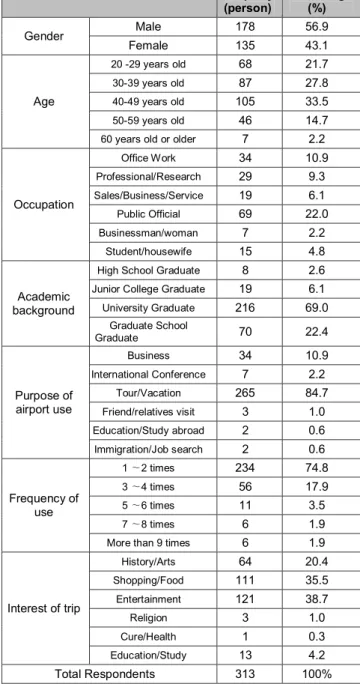
We conducted a frequency analysis to determine the demographic characteristics of the survey respondents, and the results are shown in Table 2 below.
Table 2: Sample Profile
Freqency (person)
Percentage (%)
Gender Male 178 56.9
Female 135 43.1
Age
20 -29 years old 68 21.7
30-39 years old 87 27.8
40-49 years old 105 33.5
50-59 years old 46 14.7
60 years old or older 7 2.2
Occupation
Office Work 34 10.9
Professional/Research 29 9.3 Sales/Business/Service 19 6.1
Public Official 69 22.0
Businessman/woman 7 2.2
Student/housewife 15 4.8
Academic background
High School Graduate 8 2.6
Junior College Graduate 19 6.1 University Graduate 216 69.0
Graduate School
Graduate 70 22.4
Purpose of airport use
Business 34 10.9
International Conference 7 2.2
Tour/Vacation 265 84.7
Friend/relatives visit 3 1.0 Education/Study abroad 2 0.6 Immigration/Job search 2 0.6
Frequency of use
1 ∼2 times 234 74.8
3 ∼4 times 56 17.9
5 ∼6 times 11 3.5
7 ∼8 times 6 1.9
More than 9 times 6 1.9
Interest of trip
History/Arts 64 20.4
Shopping/Food 111 35.5
Entertainment 121 38.7
Religion 3 1.0
Cure/Health 1 0.3
Education/Study 13 4.2
Total Respondents 313 100%
The gender distribution of the airport users revealed 178 males (56.9%) and 135 females (43.1%). The age distribution showed 68 respondents in their 20‘s (21.7%), 87 in their 30‘s (27.8%), 105 in their 40‘s (33.5%), 46 in their 50‘s (14.7%), and seven in their 60‘s (2.2%). In total, respondents in their30‘s and 50‘s accounted for76% of the total samples. The occupation distribution revealed 163 persons (53.7%) in office work, 69(22.0%) in public official, 29(9.3%) in profession/research, 19(6.1%) in sales/business/service. The distribution of academic background showed 216 persons (69%) in college graduate, 70 (22.4%) in graduate school graduate, 19(6.1%) in junior college graduate.
Tour/vacation was answered by 265 people (84.7%), the highest rate in terms of purpose of airport use.
Subsequently,34 respondents indicated business (10.9%), seven indicated international conference (2.2%), two indicate education/study, and two reported immigration/employment.234 respondents(74.8%) used the airport once or twice per year, 56 respondents (17.9%) used it three to four times, 11 respondents (3.5%) used it five to six times, six respondents(1.9%) used it seven to eight times, and six respondents (1.9%) used it nine or more times. Leisure/entertainment was the most common reason for overseas travel, with 121 respondents (38.7%), followed by 111 respondents (35.5%) reporting shopping/food, 64 respondents (20.4%) indicating history/art, and 13 respondents (4.2%) reporting education/learning.
<Table 3> shows the results of the confirmatory factor analysis to verify the dimensionality, conceptual validity, and reliability of the measurement items. As a result of the analysis, all metrics showed that the standardized estimates were less than 0.5 and the squared multiple correlations (SMC) were also greater than 0.4. Thus, there is validity and reliability of the measurement concept. The suitability of this study model is X2 (CMIN) / p value = 732.157 / .000, df
= 278, p = 0.000, CMIN / df = 2.634, RMR = 0.054, GFI = 0.849, AGFI = 0.809, PGFI = 0.672, NFI = 0.892, RFI = 0.873, IFI = 0.930, TLI = 0.918, CFI = 0.929, PNFI = 0.763, PCFI = 0.795, RMSEA = 0.072. Since the CMIN / df value is 3 or less, it is within the suitability range, and all other indices also satisfy the reference value, so the measurement model of this study is judged to be suitable.
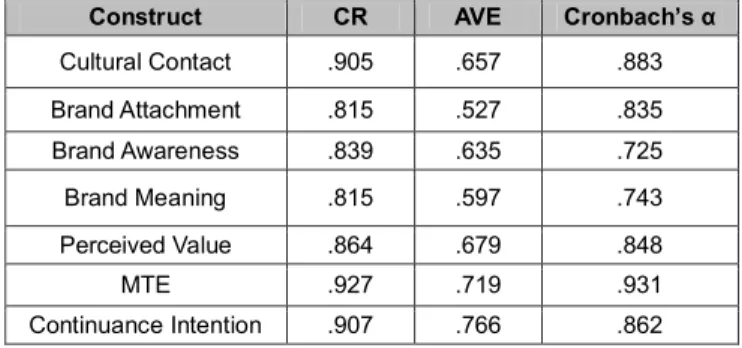
As a result of analyzing the validity of convergence (convergence) on each potential variable in this study model, as shown in <Table 4>, the conceptual reliability (CR) of all constituent concepts was above 0.7. In addition, the average variance extraction index (AVE) value was also above 0.5, which ensured sufficient convergent validity among the measurement variables in this study. Moreover, an analysis of Cronbach`s α values for the evaluation of the accurate measurement model revealed that all values were higher than 0.6, thereby securing internal validity. Therefore, the
measurement tools used in this research model secured reliability and validity suitable for the research model.
Table 3: Statistics of Construct Items
Construc
t Measurement Item
Regression Weight
(t value) S.E. C.R.*** SMC
Construct
Contact1 1.000(fix) - - .580
Contact2 1.158 ..083 13.907*** .601 Contact3 1.296 ..085 15.324*** .718 Contact4 1.296 ..095 13.533*** .573 Contact5 1.243 ..091 13.685*** .584
Construct
Attachment1 1.000(fix) - - .502
Attachment2 1.242 ..114 10.857*** .443 Attachment3 1.197 ..089 13.443*** .711 Attachment4 1.175 ..089 13.171*** .674 Construct
Awareness1 1.000(fix) - - .421
Awareness2 .980 ..088 11.183*** .561 Awareness3 .992 ..100 9.939*** .483 Construct
Meaning1 1.000(fix) - - .407
Meaning2 1.282 …126 10.199*** .547 Meaning3 1.474 ..144 10.226*** .552 Construct
Value1 1.000(fix) - - .649
Value2 1.058 ..063 16.724*** .729 Value3 1.010 ..069 14.565*** .584
Construct
Experience1 1.000(fix) - - .645
Experience2 1.098 ..064 17.088*** .693 Experience3 1.298 ..076 16.991*** .688 Experience4 1.539 ..078 19.755*** .846 Experience5 1.581 ..082 19.393*** .825 Construct
Continuance1 1.000(fix) - - .665
Continuance2 1.019 ..067 15.260*** .638 Continuance3 1.049 ..064 16.373*** .725
Note: *P<.05, **P<.01, ***P<.001
Table 4: Results of Reliability and Validity Analysis
Construct CR AVE Cronbach’s α
Cultural Contact .905 .657 .883
Brand Attachment .815 .527 .835
Brand Awareness .839 .635 .725
Brand Meaning .815 .597 .743
Perceived Value .864 .679 .848
MTE .927 .719 .931
Continuance Intention .907 .766 .862
As for the discriminant validity, an analysis of the
correlation revealed that all correlation values were smaller
than 0.85, the average variance extraction index (AVE) of
all constituent concepts was less than 0.90 and also greater
than the square of the maximum value of the correlation
coefficient in Table 5. Therefore, it can be said that the
discriminant validity was secured.
Table 5: Results of Discriminant Validity CCnstruct
Square of Coefficient of Correlation
AAVE Cultural
Contact
Brand Attachment
Brand Awareness
Brand Meaning
Perceived
Value MTE
Cultural Contact 1 0.657
Brand Attachment 0.051*** 1 0.527
Brand Awareness 0.024*** 0.049*** 1 0.635
Brand Meaning 0.021*** 0.038*** 0.042*** 1 0.597
Perceived Value 0.075*** 0.159*** 0.079*** 0.064*** 1 0.679
MTE 0.059*** 0.067*** 0.022*** 0.023*** 0.126*** 1 0.719
Continuance Intention 0.038*** 0.060*** 0.049*** 0.041*** 0.123*** 0.070*** 0.766 Note: *P<.05, **P<.01, ***P<.001
A structural equation model analysis was conducted to test the hypothesis of this study. The analysis of the structural model indicated that the model fit index wasX2 (CMIN) = 687.968, df = 285, p <0.001, CMIN / df = 2.414, RMR = 0.056, GFI = 0.850, AGFI = 0.815, PGFI = 0.690, NFI = 0.874, RFI = 0.856, IFI = 0.922, TLI = 0.911, CFI = 0.922, PNFI = 0.767. PCFI = 0.808 and RMSEA = 0.067, all of which satisfied the acceptance level of fitness.
Accordingly, the structural model suggested in this study is judged to be suitable. The results of hypothesis verification are shown in <Figure 2>.
Figure 2: Test Results of the Proposed Model
It was found that hypotheses (H1-1 / 2/3) between cultural contact and brand equity composition factors (i.e.
brand awareness, brand meaning, and perceived value) all had significant effects. Between cultural contact and perceived value (H1-3), the result was β = 0.328 and CR = 5.456 (P <0.001), indicating that it had a greater effect than other brand equity composition factors (i.e. brand awareness and brand meaning). In other words, it can be seen that when the respondents had a more positive
experience due to cultural contact, they not only positively evaluated the brand awareness and meaning of the airport, they also gave higher meaning to the service value of the airport. The relationship between brand attachment and the brand equity composition factor (H2-1 / 2/3) also showed a significant effect.
The relationship between brand attachment and perceived value was β = 0.658 and CR = 8.708 (P <0.001), indicating that it had a greater effect than other brand equity composition factors (i.e. brand awareness and brand meaning). In particular, as brand attachment showed a higher regression coefficient than cultural contact, brand attachment to airports had a greater influence on passengers' brand recognition, which means that systematic and continuous efforts of brand management are needed at the same time as cultural marketing activities.
Brand equity composition factors and dependent variables (i.e. impressive travel experience and relationship persistence) were found to be significant, but the relationship between brand awareness and MTE (H3-2), and the relationship between brand meaning and MTE (H4- 2) did not have a significant influence. In particular, the relationship between brand awareness and continuance intention (H3-1) was β = 0.274, CR = 2.921 (P <0.001), and the relationship between perceived value and MTE (H5-2) was β = 0.694, CR = 7.830 (P <0.001), which indicated very high impact. Lastly, it was found that the relationship between MTE and continuance intention (H6) also had a significant effect.
5. Conclusion
The purpose of this study was to investigate the
relationship between the cultural contact and brand
attachment of tourists experiencing airport cultural
marketing services on the composition factors of airport
brand equity, as well as the influence of these brand equities
on MTE and continuance intention. The results of this study are summarized as follows. First, it was found that cultural contact with airport marketing had a positive effect on airport brand equities and continuance intention. In other words, it can be seen that cultural marketing activities are effective in improving the brand value of airports and at the same time encouraging airport users to revisit.
Second, it was found that cultural contact had a positive effect on brand attachment, brand equity, and continuance intention. In other words, it can be seen that brand attachment, as promoted through airport brand improvement activities, is effective in improving the brand value of the airport and at the same time promoting the revisit of airport users. Third, it appears that cultural contact triggered a positive effect between MTE and continuance intention, and it appears possible to increase the number of revisits when providing experiences beyond expectations that were not experienced at other airports.
Based on the results of this study, three academic suggestions can be made, as follows. Initially, for the first time, this study demonstrates how cultural contact, as a cultural experience, and the brand attachment of airport users, affect the brand equity components (i.e. brand awareness, brand meaning, and perceived value) and subsequently affect MTE and continuance intention. There has been no similar precedent research conducted in Korea or abroad.
It is significant that this study established the first brand asset evaluation model that could be applied to the airport culture marketing field. It conducted an empirical study by utilizing the service brand asset evaluation model suggested recently by Sarker (2019) and applied it to the airline industry. Third, this study examined the relationship between cultural contact, a type of service experience, and brand equity. It also looked at the relationship between brand attachment and brand equity. Moreover, it‘s meaningful at the same time to expand the research into the impact on MTE, which is an element of cultural tourism.
In addition, based on the results of this study, the following practical implications can be suggested. First, the airport is not just a space for the efficient management of passengers. It can also enhance brand value through differentiated cultural and art services that make use of airport characteristics. Second, airports, like other service industries, will be able to solidify their long-term relationship with customers if they manage systematic brand management. Therefore, the fact that the increase in positive cultural contact by airports affects the continuance intention with specific airports which indicates that cultural factors are essential to the sustainable development of airports.
Third, the cultural marketing activities of airports require a high-class approach beyond airport brand recognition and brand meaning to offer a memorable tourism experience.
The fact is that if an airport does not meet these expectations, it can create negative experiences for its customers. It is necessary to find out cultural factors suitable for the characteristics of airports by conducting surveys on the cultural requirements of airport users because cultural consumption patterns may differ depending on nationality, the purpose of airport use or others. Therefore, airport managers should conduct sufficient analysis of airport users in advance, and consider the results when designing various cultural marketing activities or airport operation services.
For example, in the case of a major visit season from mainland china, the airport operator can consider conducting specialized cultural programs or a special promotion for preferred products to satisfy Chinese visitors.
In addition to the above implications, this study has the following limitations of research, and based on this, the direction of future research can be suggested. Although Incheon International Airport competes with local airports, it is considered to be a semi-exclusive position on international flights because it is the main gateway airport of Korea. Accordingly, there may be limitations in this study because Koreans have no choice but to use Incheon International Airport if they use the exclusive routes.
Considering that the airport industry has complex characteristics that integrate aspects of the service industry, sales industry, and travel industry, this study is significant in that it is the first research to link cultural experiences, brand equity, and continuance intention. However, there is a lack of wide participation opportunities in airport cultural marketing because the majority of airport passengers still do not have a high frequency of airport use, so there is no general awareness of airport culture marketing. Considering the tendency that Incheon International Airport as well as nearby airports are actively promoting cultural marketing activities to differentiate themselves, it is expected that the airport experience of users will gradually increase and the cultural awareness of cultural contacts will also significantly increase. Because this study was conducted with Koreans, it would be meaningful to study the differences with non- Korean visitors with different cultural backgrounds. The majority of Incheon International Airport users are non- Koreans, so it is necessary to actively utilize cultural factors related to differences in recognition between Koreans and non-Koreans in order to differentiate airport operations. In addition, this study mainly examined the effects of the perception of cultural contact among users on the relationship between brand assets and relationship intention.
We believe it is also necessary to conduct follow-up research
based on comprehensive experiential marketing or
relationship marketing because Incheon International
Airport's cultural marketing activities will become more
diversified and airport users will experience more frequent
experiences in the near future.
References
Aaker, D.A. (1994). Managing Brand Equity: Capitalizing on the value of a brand name. Journal of Business Research, 29(3), 247-248.
Berry, L.L. (2000). Cultivating Service Brand Equity. Journal of the Academy of Marketing Science, 28(1), 128-137.
Bricker, K. S., & Kerstetter, D. L. (2000). Level of specialization and place attachiment; An exploratory study of white water recreationists. Journal of Leisure Sciences, 22(4), 233-257.
Chandralal, L., & Valenzuela, F. (2013). Exploring memorable tourism experiences: antecedents and behavioural outcomes.
Journal of Economics, Business and Management, 1(2), 177- 181.
Chen, H., & Rahman, I. (2018). Cultural tourism: An Analysis of engagement, cultural contact, memorable tourism experience and destination loyalty. Tourism Management Perspectives, 26(18), 153-163.
Chuah, S.H.W. (2019).You inspire me and make my life better:
Investigating a multiple sequential mediation model of smart watch continuance intention. Telematics and Informatics, 43(1), 101245.
Ç ifci, S., Ekinci, Y., Whyatt, G., Japutra, A., Molinillo, S., & Siala, H. A (2016). Cross validation of Consumer-Based Brand Equity models: Driving customer equity in retail brands.
Journal of Business Research, 69(9), 3740–3747.
Contucci, P., & Ghirlanda, S. (2007). Modeling society with statistical mechanics: an application to cultural contact and immigration.International Journal of Methodology (Quality &
Quantity), 41(4), 569–578.
Dennis C., Papagiannidis S., Alamanos E., & Bourlakis M. (2016).
The role of brand attachment strength in higher education.
Journal of Business Research, 69(8), 3049-3057.
Dolbec, P. Y., & Cheabat, J. C. (2013). The Impact of a Flagship vs. a Brand Store on Brand Attitude, Brand Attachment and Brand Equity. Journal of Retailing, 89(4), 460-466.
Donald, A., & Lim, R. (2017).The mediating effects of habit on continuance Intention. International Journal of Information Management, 37(6), 693-702.
Gnoth, J., & Zins, A. H. (2013). Developing a tourism cultural contact scale, Journal of Business Research, 66(6), 738-744.
Hwang, E., Baloglu, S., & Tanford, S. (2019). Building loyalty through reward programs: The influence of perceptions of fairness and brand attachment. International Journal of Hospitality Management, 76(Part A),19-28.
Hwang, I. C., Hwang, Y. Y., Jeong, H. S., & Choi S. A (2007). The Effect of Travel Motivation and Image on Destination Love in China. Industrial Economics Research, 20(5), 2095-2118.
Hongxia, L., GurSoy, D., & Zhang, M. (2019). Impact of customer to customer interactions on overall service experience.
International Journal of Hospitality Management, 87(33), 102376.
Japutra, A., Ekinci, Y., & Simkin L. (2019). Self-congruence, brand attachment and compulsive buying. Journal of Business Research, 99(13), 456-463.
Kalwani, M. U., & Narayandas, N. (1995). Long Term Manufacturer Supplier Relationships: Do They Pay Off for Supplier Firms. Journal of Marketing, 59(1), 1-16.
Keller, K. L. (1993). Conceptualizing, measuring and managing
customer-based brand equity. The Journal of Marketing, 57(1), 1-22.
Kim, J. H. (2010). Determining the factors affecting the memorable nature of travel experiences. Journal of Travel and Tourism Marketing, 27(8), 780-796.
Kim, J. H. (2014). The antecedents of memorable tourism experiences: the development of a scale to measure the destination attributes associated with memorable experiences.
Tourism Management, 44(3), 34-45.
Kim, S. S., Choe, J. Y., Choe, & James F. P. (2018). The effect of celebrity on brand awareness, perceived quality, brand image, brand loyalty, and destination attachment to a literary festival.
Journal of Destination Marketing Management, 9(30),320- 329.
Li, C. Y., & Fang, Y. H. (2019). Predicting continuance intention toward mobile branded apps through satisfaction and attachment. Telematics and Informations, 43(8), 101248.
Moorman, C., Zaltman, G., & Deshpande, R. (1992), Relationships between Providers and User of Marketing Research: The Dynamics of Trust within and between Organizations. Journal of Marketing Research, 29(3), 314-328.
Nguyen, X. T. (2020). Factors That Influence the Intentions to Revisit Korea of Vietnamese Tourists. Journal of Asian Finance, Economics and Business, 7(4), 247 - 258
Parashuraman, A., & Zeithaml, V. A. (1988). SERVQUAL: A Multiple-item Scale for Measuring Consumer Perceptions of Service Quality. Journal of Retailing, 64(1), 12-37.
Pedeliento, G., Andreini D., Bergamaschi M., & Salo J. (2016).
Brand and product attachment in an industrial context: The effects on brand loyalty. Industrial Marketing Management, 53(16), 194-206.
Richards, G. (2018). Cultural tourism: A review of recent research and trends. Journal of Hospitality and Tourism Management, 36(2), 12-21.
Sarker, M. M., Mohd-Any, A. A., & Kamarulzaman, Y. (2019).
Conceptualising consumer-based service brand equity (CBSBE) and direct service experience in the airline sector.
Journal of Hospitality and Tourism Management, 38(10), 39- 48.
Sheu, J. J., Su, Y. H., & Chu, K. T. (2009). Segmenting online game customers- the perspective experiential marketing.
Expert Systems with Applications, 36(4), 8487-8495.
Son, E. J., & Jeon, J. G. (2014). The Effect of Place Attachment on Intention to Visit through the Place Brand Attitude: Focusing on Busan Yeong-do Bridge. Tourism and Leisure Research, 26(9), 415-431.
Stamboulis, Y., & Skayannis, P. (2003). Innovation strategies and technology for experience-based tourism. Tourism Management, 24(1), 35-43.
Tran, V. D., Linh, V. O. T. N., & Dinh, T. Q. (2020). The Relationship between Brand Authenticity, Brand Equity and Customer Satisfaction. Journal of Asian Finance, Economics and Business, 7(4), 213- 221.
Tung, V. W. S., & Ritchie, J. R. B. (2011). Investigating the memorable experiences of the senior travel marker: An examination of the reminiscence bump. Journal of Travel &
Tourism Marketing, 28(3), 331-343.
Yang, F. X., & Lau, V. M. C. (2019). Experiential learning for
children at World Heritage Sites: The joint moderating effect of brand awareness and generation of Chinese family travelers.
Tourism Management, 72(1), 1-11.
Zahari, A. R., Esa, E., Rajadurai, J., Azizan, N. A., & Tamyez, P. F.
M. (2020). The Effect of Corporate Social Responsibility Practices on Brand Equity: An Examination of Malaysia‘s Top 100 Brands. Journal of Asian Finance, Economics and Business, 7(2), 271-280.