Print ISSN: 1738-3110 / Online ISSN 2093-7717 JDS website: http://kodisa.jams.or.kr/
http://dx.doi.org/10.15722/jds.18.10.202010.39
The Impact of Face-to-Face Sales in the Air Service Market
Yu-Lim SUNG1, Hye-Yoon PARK2
Received: August 12, 2020. Revised: September 03, 2020. Accepted: October 05, 2020.
Abstract
Purpose: This study aims to find out the relationship between the impact of Korean crew on airline service quality in the global aviation market, which is the representative of the face-to-face sales and can help in the face-to-face market of aviation services. Research design, data: The survey was conducted for about a month from March 1 to April 6, 2020, and a total of 300 copies were used in the analysis of the results. To verify the hypothesis, data was analyzed using the statistical package program SPSS 18.0, and frequency analysis, exploratory factor analysis, correlation analysis, and multiple regression analysis were performed. Results: It is a study on the sales of face-to-face service of crews of global airlines. Non-verbal elements in airline service face-to-face sales have been shown to have a significant impact on service quality. Conclusions: In the face-to-face service sales of global airlines, communication has been shown to affect service quality. A face-to-face sale using mother tongue means important. The better the flight attendant's linguistic face- to-face selling ability, the more positive on the airline's quality of service. It suggests that the communication skills of managers in the aviation service market are important for repurchase.
Keywords: Face-to-Face Sales, Air Service Market, Service Quality Management, Repurchase.
JEL Classification Code: L15, L84, M12, M31.
1. Introduction*†
The number of foreign airlines operating on Korean routes continues to rise, and the number of passengers using foreign airlines is also increasing every year. South Korea's aviation market is becoming an attractive market for airlines around the world due to the steady increase in demand and the impact of global cultural exchanges.
1 First Author, Cabin Crew, Vietnam Air,
Email: [email protected]
2 Corresponding Author. Senior Professor, Aviation Tourism Dept., Hanseo University, Korea [46. Hanseo 1-ro, Hasemi-Myun, Seosan-Si, Chungcheongnam-do, Republic of Korea].
Email: [email protected]
ⓒ Copyright: The Author(s)
This is an Open Access article distributed under the terms of the Creative Commons Attribution Non-Commercial License (http://Creativecommons.org/licenses/by-nc/4.0/) which permits unrestricted noncommercial use, distribution, and reproduction in any medium, provided the original work is properly cited.
According to statistics from the Ministry of Land, Infrastructure and Transport and Incheon International Airport Corp., the number of foreign airlines operating in Korea has been on a steady rise over the past few years, with a high number of 84 in 2019. As foreign airlines of all sizes and regions are entering Korea's aviation market, foreign airlines are also keen to secure excellent human resources.
Besides, as many domestic low-cost airlines participate in the aviation business along with the ever-increasing number of foreign flag carriers operating in Korea, the competition to secure market competitiveness between national and foreign airlines to secure a share of air users is fierce. This fierce competition among airlines has given airline users more opportunities to compare and evaluate air fares and services between airlines within a wider and more diverse range of choices.
Various studies have not been conducted on improving the quality of service for foreign nationals to satisfy Korean
passengers. In particular, the quality of human service is the most important of the quality of service perceived by the customer, especially for airline services that have a longer service interface with the customer compared to other industries.
Therefore, not only domestic airlines but also foreign airlines operating at Incheon International Airport are hiring foreign flight attendants. The selection and recruitment of foreign flight attendants of various nationalities are being carried out, but above all, the hiring and selection of the Korean crew has been on a steady rise.
China is seeking to hire Korean-flagged crew members as part of its marketing efforts to attract more South Korean passengers and transfer passengers to Incheon International Airport, which serves as the hub airport in Northeast Asia.
To improve the quality of cabin service and to enhance customer satisfaction, it will not only solve the problem of language communication with crew members of foreign nationality, but also provide higher quality service to passengers of their nationality.
In this study, we would like to examine the impact of the communication of cabin crew on airline service quality, customer satisfaction, and re-use intentions. In addition, we would like to find ways to increase passengers' intention to use the airline again to maximize airline profits by identifying factors that act as a medium between communication and re-use of cabin crew members. Based on the results of the empirical analysis, we would also like to present not only academic implications but also managerial implications that help airline practice.
2. Literature Reviews
2.1. Communication in Face-To-Face Sales
From a relational perspective, the degree to which the objectives of communication-related to practical action are fulfilled through appropriate interactions (Spitzberg &
Cupach, 1987).Many scholars define communication skills in terms of cognitive, state, linguistic interpersonal and relational aspects described in this regard.
Communication refers to the face-to-face interaction between two or more individuals and conveys information, emotions, etc. in verbal and nonverbal ways (Morman et al., 1993). Current communication does not extend its meaning and end with information or emotional exchanges among members of society, but has an important impact on customer satisfaction assessment that is directly related to the interests and management performance of service companies.
Studies have also shown that verbal and non-verbal communication of service providers in service interfaces
affects customer responses and eventually nourishes corporate performance (Lee, 2017).
Because most services have uncertain service delivery processes due to their nature, and the quality of service is evaluated according to the customer's experience and subjectivity, it is difficult to measure service quality. Thus, unlike other industries, service providers play an important role as a service delivery medium and are a tooling factor that can affect the customer's experience, so it is necessary to form a positive communication relationship with the customer.
Besides, the service provider's activities will be strongly influenced by the customer's behavioral characteristics, and the customer's behavior will also depend on the service provider. Thus, smooth interaction between the customer and the service provider would enable the customer to provide a satisfactory service. This means that in the course of delivering services, the service provider and the customer are in a partnership, so interaction between the customer and the service provider is essential and more necessary through communication.
When placed in a variety of communication situations, the ability to communicate is defined as the ability to efficiently and accurately judge and use the message in the appropriate situation when the individual's will and the other's needs are well harmonized (Hardius, 2015).
Therefore, this study divided communication into verbal and non-verbal communication and organized it into the concept of the ability to effectively present their opinions and maintain good relationships with customers as circumstances change.
2.1.1. The Verbal Communication in Face-to-Face Sales Linguistic communication is the most important medium of information delivery, which is to use words to select and communicate meanings with the correct intent. It can be said that the transmission and expression of meaning are the essences of language and that words are the center of human communication to communicate in human relationships. Therefore, verbal communication is important for the formation and maintenance of interpersonal relationships, and through language, one communicates one's thoughts clearly and receives others' thoughts. For a language to be persuasive, it requires organized and intuitive thinking, and by using clear, easy-to-express vocabulary, it is possible to recognize the message in the recipient's mind and to expect work efficiency (Westbrook
& Oliver, 1981).
The essence of language is transmission and expression of meaning, and in human relationships, speech refers to the social experience of delivering verbal messages, and the receiver and the sender are equally involved in delivering the intended message (Gronroos, 1984).
To use verbal communication effectively, it is necessary to consider the situation of the group and to respond differently. The larger the group, the more difficult it is to communicate information; therefore, an appropriate level of service should be provided to facilitate the exchange of information (Oliver, 1981). It can be said to be the center of communications (Ritchie, 1991).
Depending on the customer's level of acceptance of the message, the employee should communicate verbally in consideration of the customer's attitude. The customer's level of acceptance of messages depends on the customer's psychological state, where the customer's psychological state is examined and the communication with the customer will be satisfactory and the level of acceptance of the message will also be increased.
In corporate marketing activities, verbal communication plays an important role in boosting customer loyalty and retention. In the airline industry, language exchange between the flight attendant and the customer is very important when sharing and providing various information.
Besides, verbal communication is an important tool because the act of employees at the store drawing customers' attention and driving responses is a process that drives customers' consumption.
To sum this up, language communication is a means to elicit customer responses in the course of sales or corporate marketing. In other words, if a service provider effectively uses language communication to accurately elicit the customer's needs, it can attract more attention from customers. For this reason, a service provider's language communication ability is considered one of the key qualities of a service provider that forms a customer's response.
The message symbols used in the communication process to communicate one's thoughts or feelings to others were linguistic and nonverbal, and among them, language, a socially established symbol system, was the most basic means of communication. In the case of cabin crew, the customer will continue to communicate during the flight.
For example, starting with welcoming customers on board, they will have language communication with customers, such as explaining safety and services clearly and sympathizing with their feelings. These effective communications of cabin crew members can induce positive customer behavior and have a positive effect on the enterprise by forming a positive image of the company as well as the cabin crew.
The communication types are classified as controlled, cooperative, reliable, and professional, and in the study of communication types and nonverbal communication, communication and nonverbal communication have affected the assessment of customer eligibility, customer orientation, and mutual empathy (Chamidah et al.2020).
In a study by Spreng et al. (1996), acts of expression in symbolic language was called verbal communication.
Therefore, verbal communication is important in that salesmen and customers meet face-to-face at the store. In other words, verbal communication between the salesperson and the customer in the process of making the sale can affect the customer's psychology and behavior.
According to this prior study, verbal communication plays an important role in maintaining the relationship between flight attendants and customers. This study also defined verbal communication as "using the linguistic symbol of words to convey some meaning to others."
2.1.2. The Non-Verbal Communication in Face-to- Face Sales
Babin and Griffin (1998), who studied the concept of nonverbal communication, said that nonverbal elements account for as much as 93 percent of the total for emotional or semantic communication. What you want to express among communication elements, in other words, language elements account for only 7%. Voice, tone, tone, accent, etc.
38% of voice, 55% of facial expressions, attitudes, gestures, and gestures were visually expressed (Leigh & Summers, 2002). Another scholar, R. Babin, and Griffin (1998), who studied nonverbal communication, said that when communicating, the number of information delivered by the language that uses motion was about 65 percent, and 35 percent of the languages that use speech.
More important than the linguistic elements of communication is nonverbal communication, which can be effectively used to convey emotions and express character and expression (Anderson et al., 1994). Therefore, it is important to focus on nonverbal communication when evaluating speakers' speech (Bitner, 1990). Nonverbal communication has a wide range of research and different definitions by researchers, so there is a difference in type classification.
Facial expression is an important factor in the passenger's ability to grasp the level of immersion, interest, goodwill, and sincerity of the passenger when handling passengers with the facial expressions of the crew, to judge whether the crew using communication is favorable or unfriendly to the passenger, and to provide important clues to determine the crew to the other party through interest, indifference, and immersion (Leigh and Summers, 2002). Eye contact can be used as a means of expressing attraction or attraction to the other party, and it can also be used as a signal to express no interest to the other party through avoidance or interruption of contact.
For airlines, the interaction between passengers and cabin crew is inevitable as the consumption and production of services will occur together. In particular, nonverbal communication is indeed important in the process of
interacting with passengers or colleagues on board. In particular, the airline cabin crew's emotional state through facial expressions, smiles, and gestures of nonverbal communication is perceived to be more sincere to customers than verbal communication, which is also important to build customer confidence and friendly relationships (Moorman et al., 1993). Service companies have shown a significant impact on customer response (Ostrowski et al., 1993) in the service interface between customers and service personnel and also on corporate performance (Jung et al., 2015). Therefore, it is necessary to be aware that because of its heavy reliance on human services, nonverbal communication can not only have a greater effect on persuading customers than verbal communication, but can also improve the reliability and quality of service to the enterprise from the customer, which can lead to high customer satisfaction, new customer acquisition, and retention of existing customers.
Anderson et al. (1994) studied and analyzed human physical behavior in a total of seven categories, divided into body language, physical appearance, physical contact, doctor's language, spatial language, temporal language, artifacts, and environment. Spreng et al. (1996) defined nonverbal communication by analyzing fewer body movements, contact behaviors, staring behavior, spatial language, and temporal language.
Body language has been systematically defined by Ostrowski et al. (1993) as a body movement for expression of speech and is a nonverbal communication factor associated with facial expressions, gaze, gestures, smiles, postures, nods, handshakes, etc. in interpersonal interactions (Sundaram & Webster, 2000).
Body language is one of the most important factors in nonverbal communication quality (Leigh & Summers, 2002) as it is one of the factors that greatly affect human interaction with nonverbal signals such as facial expressions, gestures, eye contact, nodding, handshakes, and smiles (Leigh & Summers, 2002). Among them, facial expressions are one of the important factors that determine a person's image because they reveal individual emotions honestly. Also, facial expressions are the primary source of information because they unconsciously express emotions.
Message delivery by facial expression occurs most often in nonverbal communication because they communicate with each other face-to-face.
A gesture is a means of expressing emotions and serves to make communication more effective by supplementing the inability to express through other nonverbal communication. Also, if you make the same gestures in the communication process, you will feel similar and connected and have a good feeling toward the other person. Therefore, gestures give a boost to expressing emotions and emphasize specific words or sentences to increase concentration and
make the meaning clearer (Park et al., 2019). For example, a straight-headed, slightly reclining head is regarded as both aggressive and arrogant regardless of the person's intentions.
On the other hand, the posture of a bowing person is considered a passive person.
Posture plays an important role in determining a person's impression. Therefore, it is necessary to ensure that the other party forms a positive image by taking an appropriate posture in the situation.
Therefore, if a service provider properly directs nonverbal communication, i.e., body posture and direction, towards the customer, it can create positive and favorable feelings for the customer and create a polite image of the employee to achieve a positive effect.
Synonyms are among the quasi-linguistics that study human sounds, not words or actions that we know. Thus, depending on the views and views of scholars, it is sometimes referred to as a quasi-lingual or quasi-lingual language or a secondary language, and when communicating, it means pronunciation expressed through voice, size of voice, speed of speech, tone, sound, etc., so it is included in nonverbal communication quality factors, not verbal communication (Hand & Kim, 2015).
Choi and Li (2016) also show the same results as Bayes (1972), and various elements of similar languages affect the determination of age, gender, occupation, social class, attractiveness, and education.
In other words, the use of appropriate synonyms is an effective means of nonverbal communication because it can convey clear and accurate meanings.
Sundaram & Webster (2000) defines spatial language as the spatial distance from the other party when communicating and refers to the relationship between the human distance of surrounding objects and spaces. In other words, spatial language belongs to nonverbal elements such as smiles and gestures, in that it can communicate with the other person with the intention and emotion.
Space language refers to the space required for smooth communication or access to the other party for effective communication (Sundaram & Webster, 2000). That is, it means distance or relative location from the other party, and if adequate space is secured in the communication process, smooth communication will take place. These spatial languages can also be used as a measure of interest, intimacy, and interest in the other person (Leigh &
Summers, 2002).
The first impression of the physical appearance language is that the physically attractive service provider feels more persuasive and friendly than the case. In other words, physical attraction makes people think that they have enough socially required abilities and qualities and feels more friendly (Park et al., 2019).
A study by Sundaram & Webster (2000) found that the appearance or attractiveness of a service provider can be further enhanced by wearing a suit suitable for the job. In other words, many service companies use uniforms as a means of physical language, as a way to not only give employees a sense of belonging but also to show their expertise externally to customers. As such, clothing is often used as a means of expressing social status or cultural tastes, and the service industry recognizes that wearing uniforms is effective in giving professional and positive impressions to customers who receive services.
Based on the various studies presented earlier, this study defined nonverbal communication elements as body movements, gestures, physical appearance, attire, facial expressions, and gaze, and distinguished nonverbal communication by body language, physical appearance, similar language, and spatial language.
2.2. The Airline Service Quality
Quality of service is used to mean 'the overall judgment or attitude of an individual concerning the excellence of a particular service' (Parasuraman et al., 1990), measured in comparison to the service expected by the customer and the results of the assessment with the service perceived (Gronos, 1984). Quality of service is defined as a measure of how much the customer has an overall impression of the service and how the service level matches the customer's expectations (Bitner, 1992).
Cronin & Taylor (1994) claims that airline services are a leading factor in customer satisfaction. The concept of service quality, which is perceived by the customer as having an overall assessment of a particular service, has been defined.
Airlines provide services that take into account safety, operational timeliness and comfort based on high speed, internationality, public nature, capital-intensive and facility dependence (Chun & Park, 2018).
Airline services are also tangible and intangible total services provided by airlines and are said to exist as processes of interaction, programs in operation, human services, and physical facilities (Kim, 2012). Therefore, passengers using the aircraft are not only buying seats on the aircraft, but also buying a variety of services and support systems provided by the airline at the same time. In other words, from the moment a passenger purchases a ticket, the buyer is allowed to use various services. In other words, the goods in airline services can be said to be a combination of space and human services, and they have two sides: liquid goods and fixed goods. Fixed products include routes, aircraft types, aircraft seats, etc. provided by airlines, and services as flexible goods are all services related to transportation, including booking, selecting,
releasing, boarding procedures, in-flight services, baggage management and provision of travel information from the origin to the destination (Chang & Yeh, 2002).
Airline services are also said to be intangible products sold in the market, starting with customer and service provider interrelationships and solving customer problems.
Among the various service offerings, Airline services include all on-the-ground services, including ticket reservations, ticketing and baggage transportation, and all on-board services, including all human and material services, as well as post-sales services provided at the destination.
Airline services are generally defined as providing intangible air transport services to customers by operating type aircraft. The main attributes are the polite and friendly services provided by the crew to the customer and the convenience and comfort that the customer experiences with the flight, which includes the type of aircraft, flight time, and intermediate stop (Nam, 2015).
Airline services can be largely divided into human and physical services. Human service refers to the provision of services on board, such as seat guidance, serving of beverages and in-flight meals by the cabin crew, or equipment equipped with such services as the provision of in-flight meals for passengers to travel comfortably and safely to their destinations. Since human services are often carried out on-board and face-to-face, the quality of the service depends on the personal competence of the cabin crew, which in turn leads to the airline's image and satisfaction. Thus, the human service portion of an airline's service quality is made by the interrelationship between the staff and the passenger, and the role and competence of the crew, the main agent of the service, are of paramount importance (Kim, 2017).
Gronroos (1984) explained that the quality of service was divided into technical quality and process quality, and explained that the process quality was more important in service braking activities, where technical quality refers to the understanding of which service consumers themselves want, and the assessment of the quality can be made based on whether or not the service is available. It is defined that the quality of the process is not about the activities of the consumer itself, but about the activities of identifying how the consumer will obtain the service on its own.
Ritchie (1991) classified the quality of service for airlines as a total of eight factors, including aircraft type and characteristics, flight services, safety points, airfares, flight schedules, booking conditions, absence of constraints, and additional services.
Developed by Parasuraman et al. (1988), the SERVQUAL model is defined based on the conceptual basis of Oliver's (1980) expectation-performance mismatch model, and the service quality is measured with five-level
items based on customer perception by reconstructing the 10 types of service quality previously presented. At the composition level, the conceptual structure was completed as a function of the performance-expected value for 22 questions with five things related to reliability, tangibility, responsiveness, empathy, and certainty.
Reliability is a measure of reliability to ensure accurate mission performance, tangible refers to the physical appearance of the material element, and responsiveness can be described as a dimension of whether it helps with quick and immediate responses, empathy can be described as a measure of good understanding and easy access to customer needs, and certainty can be defined as a measure of service provider's trustworthiness, politeness, safety, ability, etc.
3. Data and Research Methodology
3.1. Research Model
The research model in this paper focused on defining the relevance of the communication between the communication and re-use intentions of the Korean crew of a foreign airline and the communication of the Korean crew of a foreign airline. The independent variables of the final research model are the communication of the Korean crew of an overseas airline, and the lower variables are verbal and non-verbal communication. Besides, the dependent variables are airline service quality, customer satisfaction and re-use intention. The study models established accordingly are shown in Figure 1.
Figure1: Research Model
3.2. Research Hypothesis
Airline's quality of service is a relative relationship that is evaluated based on the expectations of the service that passengers feel before the flight and after the flight. Based on the actual assessment of passenger's perception after the flight, customer satisfaction will affect whether the passenger intends to re-use the vehicle. It can be interpreted that the quality of service must be improved to increase customer satisfaction (Bitner, 1990).
As the number of foreign airlines operating in Korea increases, the interest and boarding rate of Korean passengers in overseas airlines is increasing rapidly. At this point, we studied the re-use intentions of foreign airlines by investigating the existence of Korean crew members and how they perceive communication of Korean crew members and by examining the impact of any factors on airline service quality and customer satisfaction. Besides, we hope that the quality of airline service and communication skills of Korean crew members working at overseas airlines will be used as basic data for the verification of competitiveness, forecasting demand, and improving and improving customer satisfaction in Korea, and drew up the following exploratory research hypothesis.
3.2.1. The Relationship between the Verbal Communication and Airline Quality of Service of the Korean Crew
.
H1: Verbal communication of the Korean crew will have a positive impact on airline service quality.
H1-1: The verbal communication of the Korean Crew will have a positive effect on the human service of airline services.
H1-2: The verbal communication of the Korean Crew will have a positive effect on the systemic service of airline services.
H1-3: The verbal communication of the Korean Crew will have a positive effect on the material service of airline services.
3.2.2. The Relationship between the Non-Verbal Communication and Airline Quality of Service of the Korean Crew
Chun and Park (2018) studied the impact of non-verbal communication on service quality perception and satisfaction of airline service providers and said that when non-verbal communication is used appropriately, customers who are aware of the service are aware of the quality of service and have a significant impact on customer satisfaction.
Therefore, the following hypotheses were established in this study to establish the relationship between non-verbal communication and the quality of airline service based on prior research.
H2: Non-verbal communication by the Korean crew will have a positive impact on airline service quality.
H2-1: The body language of the Korean crew will have a positive effect on airline service quality.
H2-1-1: The body language of the Korean crew will have a positive impact on the human service of airline services.
H2-1-2: The body language of the Korean crew will have a positive effect on the system services of airline services.
H2-1-3: The body language of the Korean crew will have a positive effect on the physical service of the airline service.
H2-2: A similar language of the Korean Crew will have a positive effect on airline service quality.
H2-2-1: A similar language of the Korean crew will have a positive effect on the human service of airline services.
H2-2-2: Similar languages of the Korean Crew will have a positive effect on the system services of airline services.
H2-2-3: Similar languages of the Korean Crew will have a positive effect on the physical service of airline services.
H2-3: The spatial language of the Korean crew will have a positive effect on airline service quality.
H2-3-1: The spatial language of the Korean crew will have a positive impact on the human service of airline services.
H2-3-2: The spatial language of the Korean crew will have a positive effect on the system services of airline services.
H2-3-3: The spatial language of the Korean crew will have a positive effect on the physical service of airline services.
H2-4: The external body language of the Korean crew will have a positive effect on airline service quality.
H2-4-1: The external body language of the Korean crew will have a positive impact on the human service of airline services.
H2-4-2: The external body language of the Korean crew will have a positive effect on the system services of airline services.
H2-4-3: The external body language of the Korean crew will have a positive effect on the physical service of the airline service.
4. Results
4.1. The Demographic Characteristics of Sample The survey period of this survey took about a month
from 1 March to 6 April 2020 and a total of 331 copies were distributed using the self-addressed questionnaire method. However, 300 copies were used for demonstration analysis of this paper, since 31 questionnaires surveyed had no experience using an overseas airline.
The results of an analysis of airline usage are shown in Table 1. First, the frequency of using foreign airlines was 127 (42.3%) two to three times a year, 118 (39.3 %), 44 (14.7 %) four to five times a year, and 11 (3.7 %) more than six times a year.
In addition, the purpose of foreign routes was tourism and vacation (61.3%), 52 commercial/business trips (17.3%), 45 friends visits (15%), 11 education/training purposes (3.7%), and 8 others (2.7%), 69 Vietnamese airlines (23%), 43 non-etjet airlines (14.4%), 46 Southern Airlines (44.3%), and Singapore Airlines (42.1%), and 351 UAE airlines.
4.2. Reliability and Feasibility of the Sample Feasibility is an indicator of how accurately the concepts and attributes that are intended to be measured can be measured using tools developed for measurement, and in quantitative studies it is generally divided into content validity and concept validity. Content relevance refers to the extent to which the items that make up the measurement tool represent the concept to be measured. In other words, content feasibility refers to the selection of the most representative of all items for measuring the concept as a measurement tool.
This means that the most representative of all the items that can measure the concept are selected as measurement tools. As with this study, operational definitions and references of proven variables in previous prior studies are used to correct and supplement the corresponding questionnaire, which can be judged to be sufficient in this case.
Besides, the concept of construct concept validity is a method of indicating how properly measured a property or concept, such as an abstract concept or an emotion, that is difficult to demonstrate validity on a basis of content validity or on any basis, using measurement tools. In other words, by verifying the accuracy logically and conceptually through comparison with various measurement methods, it is used as a way to identify whether the theoretical relationships with the concepts to be measured are established according to the theoretical framework of the existing prior research and to assess the validity of the conjecture of the concept. The methods of assessment of construct validity can be divided into concentrated feasibility, discriminative validity, and law validity, and
evaluated through various methods such as search factor analysis, correlation analysis, and confirmation factor analysis. In this study, feasibility verification was conducted based on confirmatory factor analysis (CFA).
Reliability measurement is an indicator of how consistently the measurement has been made for the object being measured and is also described as consistency, stability, accuracy, and predictability. In addition, reliability can be verified and determined by the variance of the measured result values obtained through repeated measurements, by means of how many identical result values can be obtained when repeatedly measuring the object to be measured. In this study, the value of the Cronbach' alpha coefficient, which represents internal consistency for each concept of composition, was used to verify the reliability of the measurement tool, and the results of the reliability verification can be judged to be significant.
4.3. Analyzing the Confirming Factors for the Concept of Composition
In this study, CFA was conducted to verify the validity of the SEM maximum Likelihood was used to estimate the model, and the research model was evaluated through the model fit.
Besides, verification, the most representative absolute qualifying index, was conducted to assess model fit, but was not dependent on -validation due to the sample size and complexity of the model, and was not dependent on - validation, but also on other absolute compliance indices (normalized- , RMEA, RMR, GFI, AGFI, etc.) and incremental compliance indices (TLI, CFI, NFI, NFI, NFI, etc.) as Table 1.
/df is a number divided by the degree of freedom (df), which is acceptable if the sample size is less than 3 and is less than 2 except when the sample size is extremely complex.
Besides, NFI examining the simplicity and complexity of the model, GFI indirectly affected by the size of the sample, and AGFI modified GFI values through the degree of freedom of the model, are usually considered suitable models if they are 0.85 or higher, and CFI values are 0.9 or higher.
Besides, RMRs below 0.05 can be considered good, and RMSEA, which is least affected by the size of the sample, can be judged to be appropriate below 0.08, and normal below 0.1. Therefore, the model fit was analyzed and evaluated based on the major goodness-of-fit indices.
Among the suitability of the structural equation model (SEM) set up for hypothesis testing in this study, value
is χ =977.454(df=420, p=.000). It was shown to be statistically significant. This fails to reject the null hypothesis that the input covariance matrix is the same as the estimated covariance matrix, and the alternative hypothesis that the input covariance matrix is different from the estimated covariance matrix can be adopted to determine that the research model is not suitable. However, as noted in the positive factor analysis, the value could increase together as the number of samples increases, reducing the model's suitability, so an additional index of conformity that is relatively free from the number of samples rather than making a definitive conclusion was determined to determine the model's suitability.
The other fit for the SEM in this study, excluding the value, is /df=2.327, RMR=.055, GFI=.886, AGFI=.844, NFI=.906, TLI=.911, CFI=.925, RMSEA=.063. The measurement model of this study can be judged to be appropriate as the conformity indices of RMR, NFI, TLI, CFI, and RMSEA, which are relatively free in the number of samples, were found to be capable of meeting the criteria, although the GFI and AGFI values that were shown and affected by the size of the samples were somewhat lower.
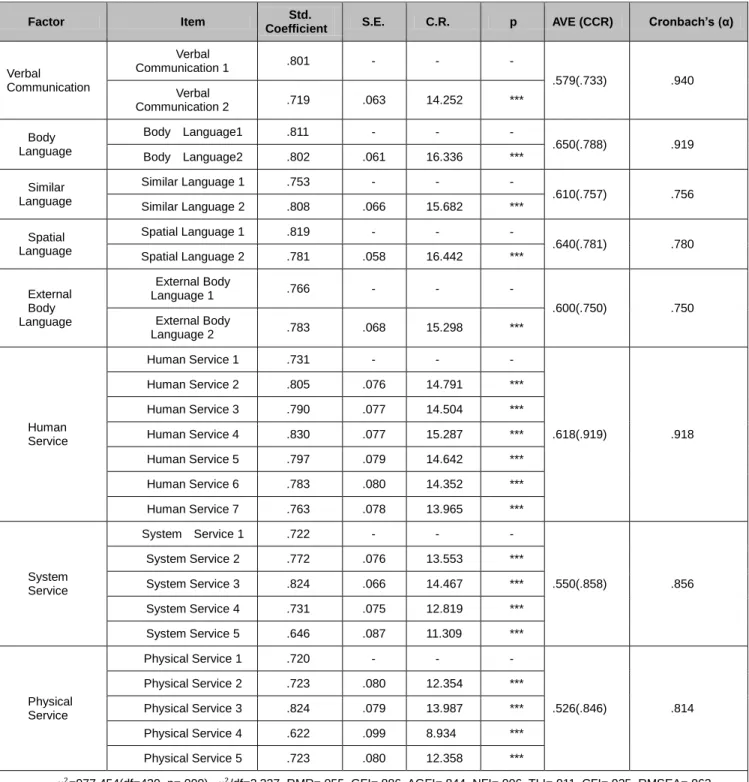
In this study, the following criteria were applied to evaluate the central feasibility of measurement tools. First, it was judged that intensive feasibility is good if the standardized factor loadings loaded on each concept are 0.5 or higher and 0.95 and that there is concentrated feasibility if statistically significant. Second, for more accurate verification, the average variance extract (AVE) and the construction composite reliability (CCR) were calculated and the value of AVE (or higher than 0.5) and CCR (or higher than 0.7) was determined to have concentrated feasibility.
Meanwhile, the analysis of AVE and CCR for each potential variable showed verbal communication AVE=.579, CCR=.733, body Language AVE=.650, CCR=.788, similar language AVE=.610, CCR=.757, spatial language AVE=.640, CCR=.781, exterior body language AVE=.600, CCR=.750, human Services AVE=.618, CCR=.919, systematic Service AVE=.550, CCR=.858, physical service AVE=.526, CCR=.846, concentrated feasibility was found to be satisfied. Also, the reliability factor (Cronbach's α) of the items that make up the factor is verbal communication =.940, body language =.919, similar language =.756, spatial language=.780, external body language=.750, human services =.918, systematic Service
=.856, physical service =.814. Therefore, the measurement items in this study were also assessed to be reliable. On the other hand, the AVE, CCR, and Cronbach's α values were not calculated because they were a single observation.
Table 1: Results of Intensive Feasibility and Reliability Verification of the Factor
Factor Item Std.
Coefficient S.E. C.R. p AVE (CCR) Cronbach’s (α)
Verbal Communication
Verbal
Communication 1 .801 - - -
.579(.733) .940 Verbal
Communication 2 .719 .063 14.252 ***
Body Language
Body Language1 .811 - - -
.650(.788) .919
Body Language2 .802 .061 16.336 ***
Similar Language
Similar Language 1 .753 - - -
.610(.757) .756
Similar Language 2 .808 .066 15.682 ***
Spatial Language
Spatial Language 1 .819 - - -
.640(.781) .780
Spatial Language 2 .781 .058 16.442 ***
External Body Language
External Body
Language 1 .766 - - -
.600(.750) .750 External Body
Language 2 .783 .068 15.298 ***
Human Service
Human Service 1 .731 - - -
.618(.919) .918
Human Service 2 .805 .076 14.791 ***
Human Service 3 .790 .077 14.504 ***
Human Service 4 .830 .077 15.287 ***
Human Service 5 .797 .079 14.642 ***
Human Service 6 .783 .080 14.352 ***
Human Service 7 .763 .078 13.965 ***
System Service
System Service 1 .722 - - -
.550(.858) .856
System Service 2 .772 .076 13.553 ***
System Service 3 .824 .066 14.467 ***
System Service 4 .731 .075 12.819 ***
System Service 5 .646 .087 11.309 ***
Physical Service
Physical Service 1 .720 - - -
.526(.846) .814
Physical Service 2 .723 .080 12.354 ***
Physical Service 3 .824 .079 13.987 ***
Physical Service 4 .622 .099 8.934 ***
Physical Service 5 .723 .080 12.358 ***
=977.454(df=420, p=.000), /df=2.327, RMR=.055, GFI=.886, AGFI=.844, NFI=.906, TLI=.911, CFI=.925, RMSEA=.063
***: p<.001
4.4. Correlation Analysis of Measurement
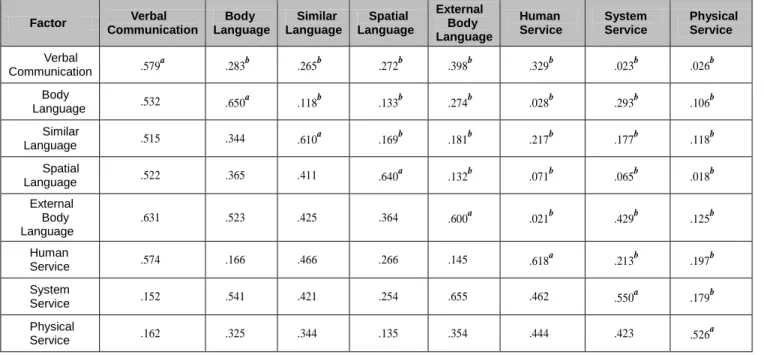
In this study, the multi-collinearity of the measurement model was verified through the analysis results and the
determination feasibility was evaluated. To assess the model's discriminant validity, a method was used to examine whether the variance index value was above the
square value of the correlation coefficient ( ) between concepts, and if the variance index was greater than the square value of the correlation coefficient ( ), it was determined that there was a discriminant equivalence.
The relationship between all potential variables was assessed to be more of AVE values for all potential variables than the correlation squared values between potential variables, with absolute values of 0.7 or less, resulting in significant results of multi-collinearity, which
makes it possible to establish a distinction between constructions. It was also determined that the direction of the relationship between the constructions was calculated as a positive (+) relationship consistent with the direction of the hypothesis, resulting in a legal validity. Therefore, the conceptual validity of the measurement tools in this study can be assessed to be sufficient. The results of the correlation analysis between each potential variable were shown in Table 2.
Table 2: Feasibility and Correlation Analysis Factor Verbal
Communication
Body Language
Similar Language
Spatial Language
External Body Language
Human Service
System Service
Physical Service Verbal
Communication .579a .283b .265b .272b .398b .329b .023b .026b Body
Language .532 .650a .118b .133b .274b .028b .293b .106b
Similar
Language .515 .344 .610a .169b .181b .217b .177b .118b Spatial
Language .522 .365 .411 .640a .132b .071b .065b .018b
External Body Language
.631 .523 .425 .364 .600a .021b .429b .125b
Human
Service .574 .166 .466 .266 .145 .618a .213b .197b
System
Service .152 .541 .421 .254 .655 .462 .550a .179b
Physical
Service .162 .325 .344 .135 .354 .444 .423 .526a
a: AVE Value, b: Squared Multiple Correlations ( ).
4.5. Structural Equation Model (SEM) Analysis
In this study, the hypothesis was verified by analyzing the proposed model and the path coefficient estimation was verified to substantiate the theory of study. The hypothesis was verified based on the final model and the results of the suitability of the study model were as follows.
The value among the fit of the SEM is 1090.294 (df=442, p=.000). It was shown to be statistically significant. This fails to reject the null hypothesis that the input covariance matrix is the same as the estimated covariance matrix and the alternative hypothesis that the input covariance matrix is different from the estimated covariance matrix and can be used to determine if the research model is suitable or not. However, as noted in the conduct of the positive factor analysis, the value was determined by an additional check of the goodness-of-fit index, which is relatively free to the number of samples
rather than finalizing the conclusions, because the higher the number of samples, the lower the adequacy of the model, as well as the higher the number of samples, could be. The other fitted values for the structural equation model in this study, excluding values, are /df=2.524, RMR=.030, GFI=.884, AGFI=.773, NFI=.907, TLI=.914, CFI=.947, RMSEA=.The goodness-of-fit indices for GFI and AGFI values, which were shown as 066 and affected by sample size, were somewhat lower, but were found to be capable of meeting the criteria for RMR, NFI, TLI, CFI and RMSEA, which are relatively free in the number of samples, and were considered suitable as a measurement model for this study.
4.6. Hypothesis Test
4.6.1. The Relationship between Verbal Communication and Airline Service Quality of the Korean Crew
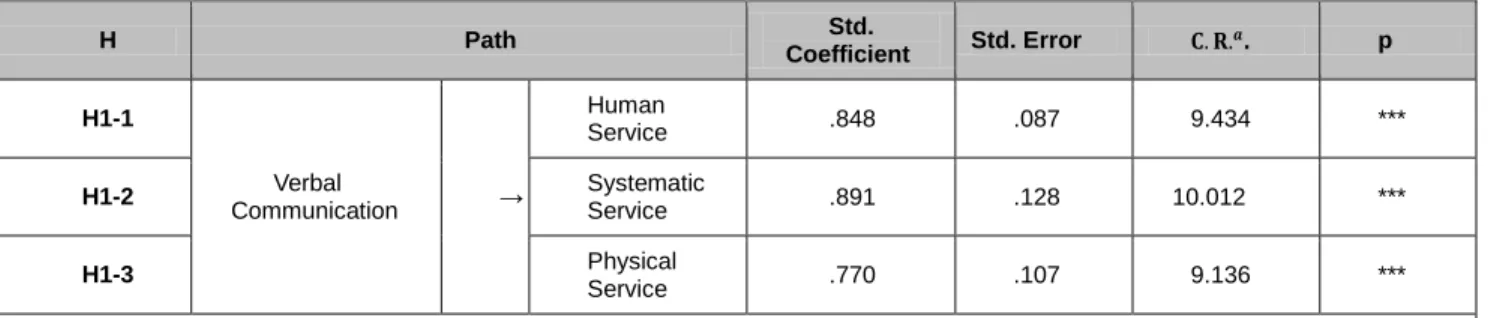
The results of the verification of the effect of verbal
communication on airline service quality by the H1 Korean crew are as shown in Table 3.
The effect of verbal communication, H1-1, on human services among the sub-factors of airline service quality was shown at .848 and C.R.=9.434(p=.000), indicating a significant effect. Therefore, H1-1 'Language Communication of the Korean Crew will have a positive effect on the human services of airline services.'
The effect of verbal communication, H1-2, on systemic services among the sub-factors of airline service quality was shown to be .891, and C.R.=10.012(p=.000) was
shown to have a significant effect. Therefore, H1-2 'Language Communication of the Korean Crew will have a positive effect on the systemic service of airline services' was adopted. The effect of verbal communication of H1-3 on physical services among the sub-factors of airline service quality was shown to be .770 and C.R.=9.136(p=.000), indicating a significant effect.
Therefore, H1-3 'Language Communication of the Korean crew will have a positive effect on the physical service of airline services' was adopted.
Table 3: The Relationship between Verbal Communication and Airline Service Quality of the Korean Cabin Crew
H Path Std.
Coefficient Std. Error . p H1-1
Verbal
Communication →
Human
Service .848 .087 9.434 ***
H1-2 Systematic
Service .891 .128 10.012 ***
H1-3 Physical
Service .770 .107 9.136 ***
=1090.294(df=441, p=.000), /df=2.530, RMR=.030, GFI=.884, AGFI=.773, NFI=.907, TLI=.914, CFI=.947, RMSEA=.066
***: p<.001, a. C.R.(Critical Ratio)
4.6.2. The Relationship between Non-Verbal Communication and Airline Service Quality of the Korean Crew
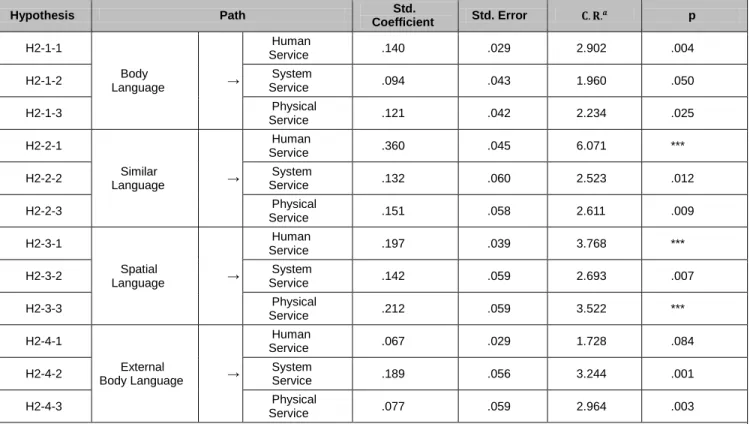
The results of the verification of the effect of nonverbal communication on airline service quality by the H2 Korean crew are as shown in Table 4.
H2-1-1, the body language's impact on human services among the sub-factors of service quality was .140 and C.R.=2.902(p=.004) was shown to have a significant effect.
Therefore, H2-1-1's body language will have a positive impact on the human service of airline services.'
H2-1-2, the body language's effect on system services among the sub-factors of service quality was shown to be .094 and C.R.=1.960(p=.050), indicating a significant effect. Therefore, H2-1-2 the body language of the Korean crew will have a positive effect on the systemic service of airline services.
H2-1-3, the body language's effect on physical service among the sub-factors of service quality was shown to be .121 and C.R.=2.234(p=.025), indicating a significant effect. Therefore, H2-1-3, the body language of the Korean crew will have a positive effect on the physical service of airline services.
H2-2-1, the effect of similar language on human services among the sub-factors of service quality was shown to be .360 and C.R.=6.071(p=.000), indicating significant effect. Therefore, H2-2-1 the similar language of the Korean crew will have a positive impact on the human
service of airline services.
H2-2-2, the effect of similar language on system services among the sub-factors of service quality was shown to be .132 and C.R.=2.523(p=.012), indicating a significant effect. Therefore, H2-2-2 the similar language of the Korean crew will have a positive effect on the systemic service of airline services.
H2-2-3, the effect of similar language on physical services among the sub-factors of service quality was .151 and C.R.=2.611(p=.009), indicating a significant effect.
Therefore, H2-2-3, the 'similar language of the Korean crew will have a positive effect on the physical service of airline services.
H2-3-1, the impact of spatial language on human services among the sub-factors of service quality was shown to be .197, and C.R.=3.768(p=.000), indicating a significant effect. Therefore, H2-3-1, the spatial language of the Korean crew will have a positive effect on the human service of airline services.
H2-3-2, the effect of spatial language on system services among the sub-factors of service quality was .142 and C.R.=2.69(p=.000), indicating a significant effect.
Therefore, H2-3-2, the spatial language of the Korean crew will have a positive effect on the systemic service of airline services.
H2-3-3, the effect of spatial language on physical services among the sub-factors of service quality was shown to be 2.212, and C.R.=3.522(p=.000), indicating a