동결건조 보호제와 기질이 동결건조된 Bacillus sp. SH1RP8의 생존율에 미치는 영향
홍선화, 심준규, 이은영*
수원대학교환경에너지공학과
Received: July 29, 2015 / Revised: October 15, 2015 / Accepted: October 15, 2015
환경보존을위한친환경농법에대한연구가큰관심을받 고있다. 화학비료의사용을대체할수있으며, 토양에다양 한유용물질을제공할수있는토양미생물의탐색과생물비 료의개발은시급히해결해야할문제이다. 친환경농법중 에는각종질병으로부터식물을보호할수있는미생물을활 용한생물농약과식물의성장을향상시킬수있는근권미 생물을활용한생물비료의개발이있다[19, 21]. 이중식물성 장을촉진시킬수있는기능을가지고있는다양한근권미 생물의개발에대한많은연구가진행되고있다[4, 10, 12, 13,
23, 24]. 근권미생물은항생물질을생산하여토양내의병
원균으로부터발생하는식물의질병으로부터식물을보호하 거나[3, 15], indole acetic acid(IAA)와같은식물성호르몬 을합성하며, 인과같은미네랄을가용화시켜식물이보다 쉽게영양물질을흡수하여이용할수있게도와준다[11]. 이
밖에도식물성호르몬이지만과다하게분비될경우식물뿌리 의성장을저해시키는물질인에틸렌의농도를조절하는 (1- aminocyclopropane-1-carboxylic acid(ACC) deaminase
activity)를활성하거나식물성장의필수요소이지만난용성
물질이어서식물이이용하기어려운철을식물의체내에흡 수할수있게도와주는역할(siderophore synthesis) 등을한
다[7]. 그러나이러한미생물들은계속적인계대배양으로인
해항생물질을포함한다양한유용물질의생산력이크게감 소되고, 장기간안정적인생존상태를유지하는것이어렵다
[1, 4, 8]. 이러한문제를해결하기위해서는미생물에적합한
제형으로제제화하는기술개발이필수적이다. 미생물의안 정적제제화기술로는크게기능성고분자및다당류로캡 슐화시키는방법과세포보호제를첨가하여동결건조하는 방법이주로이용되고있다[2, 24, 27]. 동결건조시에는온 도와수분의손실을최소화하기위해 skim milk, starch와 같은고분자물질과 glucose, lactose와같은저분자물질등
이이용된다[27]. 보호제의 역할은미생물의종류, 동결조
건, 건조시간등에따라다르며, 미생물의종류에따라서는
보호제가생존율에많은영향을미칠수있다[6, 25].
Effect of Substrates and Lyoprotectant on the Survival Ratio of Lyophilized Bacillus sp. SH1RP8 Sunhwa Hong, Jun Gyu Sim, and Eun Young Lee*
Department of Environmental and Energy Engineering, The University of Suwon, Gyeonggi 445-743, Republic of Korea In order to develop an eco-friendly biofertilizer, a plant growth promoting rhizobacterium (PGPR), Bacillus sp., SH1RP8 was investigated. SH1RP8 was lyophilized via freeze-drying along with other protective agents that protect cells from lysis. The freezedried powder of Bacillus sp. SH1RP8, containing 5% skim milk (w/v), exhibited the highest survival rate of 30.6%
among all the protective agents (skim milk, glucose, and peptone). The lyoprotective effect of the skim milk, mixture including 5% skim milk, and substrates on the survival of the test strain was examined. Control group was added only skim milk and test groups were added skim milk and other substrates. As a result, the group supplemented with both glycerol and 5% skim milk showed the protective effect much higher by 214.29% than the control group. Freeze-dried Bacillus sp. SH1RP8 could be a good candidate as a potential biofertilizer due to its effective PGPR activity.
Keywords: Lyoprotectant, freeze drying, GP plate, substrates
*Corresponding author
Tel: +82-31-220-2614, Fax: +82-31-220-2533 E-mail: [email protected]
© 2015, The Korean Society for Microbiology and Biotechnology
본연구에서는동결건조보호제이외에분리균주 Bacillus
sp. SH1RP8이빠른속도로이용하는탄소원을첨가하여동
결건조한후보호제와각각의기질이미생물의생존율에미 치는영향을평가하였다.
Bacillus sp. SH1RP8는식물성장촉진능이매우우수하 며염에강한내성을가진미생물로서이전연구에서미생 물제제로서의가능성을평가하여그기능을확인하였다[7].
본균주의동결건조시첨가할기질을알아보기위하여 Gram
positive 균주용 GP2 MicroPlate(Biolog Inc., USA)를이용 하여기질 이용성을확인하였다. LB broth에 Bacillus sp.
SH1RP8를접종하여증식기에서정체기로접어들도록 3일
간 30oC incubator에서배양한후원심분리하여균체를회 수하고멸균수를첨가하여배지성분을제거하였다. 배지제 거과정을 2−3회반복한후에초기배양액과같은양의멸 균수를첨가하여혼합하였다. 혼합액을 200 rpm으로 10분 간 교반한 후 GP2 plate(Biolog, USA)의 각각의 well에 150μl씩접종하였다. 이를실온(약 25oC)에서배양하면서, 4시간간격으로각 well의색변화를 595 nm 파장에서측정 하였다. 평균발색양을기준으로 OD가 1.00 이상인기질을 선택하여그중구입가능하였던 9종을동결건조용기질로 사용하였다. 서로다른기질이코팅되어있는 GP2 plate를
활용하여 SH1RP8의기질이용도를 OD 값을측정하여평
가하였다.
그결과 SH1RP8은 plate에있는전체기질을이용했다. 그 중에서 amine 계열의 L-Alaninamide(1.06±0.06)과 Putrescine(1.07±0.03), Carbohydrate 계열의 Maltose (1.01±0.05), Maltotriose(1.09±0.17), D-Mannitol(1.51± 0.28), D-Ribose(1.00±0.06) 그리고 Turanose(1.02±0.02), Carboxylic acid 계열은 α-Hydroxy butyric Acid(1.19± 0.05), L-Lactic Acid(1.27±0.12) 그리고 L-Malic Acid (1.10±0.77), Miscellaneous 계열은 Salicin(1.09±0.02)과 Pyruvic Acid Methyl Ester(1.26±0.09), Miscellaneous 중 Phosphorylated chemical 계열은 D-L-α-Glycerol Phosphate (1.56±0.04)과 Glycerol(1.22±0.01), 그리고 Polymer 계열 은 Dextrin(1.10±0.11), Tween 40(2.19±0.07) 그리고 Tween 80(2.02±0.06)의기질이용성이높았다. 특히, Polymer 계열의 Tween 40과 Tween 80의기질이용도가가장우수 하였다. 반면에 Amino acid 계열의기질은매우적게이용하 였다.
Othman 등[17]은토양에서분리된 Bacillus sp. strain A.
rzi가 GP2 plate에포함되어있는기질을 98% 이용하였다 고보고하였으며, Nowlan 등[16]은인도의염전에서분리한 Bacillus okhensis Kh10-101와 Bacillus krulwichiae AM31D의경우 GP2 plate에포함되어있는기질의이용도 가서로매우다르다는보고를하였다. 이러한결과들은비
슷한환경에서분리한균주라도순수균의기질이용도에있 어서매우다양함을보여주는결과이다. 특히, B. okhensis Kh10-101는 Tween 40과 Tween 80을이용하지않는반면 에 B. krulwichiae AM31D는 Tween 40과 Tween 80을이 용하였다. 본연구에서사용한 SH1RP8 역시 Tween 40과 Tween 80의기질이용도가높게나왔다. Perkins과 Nicholson [20]의연구에의하면 rpoB mutant Bacillus subtilis를이용 해기질이용도를측정한결과, amino acid 계열의기질을이 용하지않거나이용도가낮았다. 본연구에서도 SH1RP8 역 시 amino acid 계열의기질이용도가낮았다.
Average well color development(AWCD)는미생물의기 질이용도를평균값으로나타낸것으로그값이높을수록미 생물의기질이용도가높음을의미하고, 기질이용속도를유
추할수있다. SH1RP8에의한기질이용도를알아보기위
하여 AWCD 분석은다음의식으로계산하였다[5].
AWCD = Σ(C − R)/n C: 각 well의 OD595nm 값 R: Control well의 OD595nm 값 n: 기질의수(31)
그결과본연구에서사용된 SH1RP8의경우는반응시작
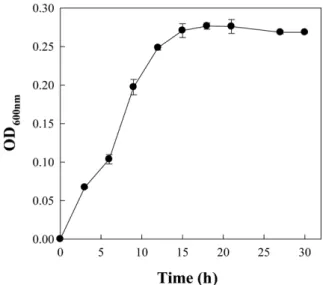
1시간에최대기질이용도를나타냈으며, 18시간이후부터평 균발색 OD 값이 0.28로가장높았고그후에유사값을유 지하였다(Fig. 1).
앞서언급한미생물제제화를위한최적조건을알아보기 위하여동결건조시첨가하는보호제를선별하였다. 보호제 로는 skim milk, peptone, glucose를사용하였다. 각각의보
호제는 LB에서배양된본배양액을 1/10로농축한현탁액에
Fig. 1. Time course of average well color development of Bacillus sp. SH1RP8 (n = 3).
각각 5와 10%의비율로첨가되었다. 또한, 선별된보호제를 대상으로보호제의농도가미생물생존에미치는영향을알 아보기위해보호제의농도를미생물현탁액의 2, 4, 5, 6, 8 그리고 10%로첨가하여미생물의생존율을평가하였다. 이
밖에도, 앞선결과에서 SH1RP8의이용성이높았던기질이
균주의생존율에미치는영향을알아보고자선정된각각의 기질을 1%씩첨가하였다. 동결건조전의생균수와동결건조
후의생균수와비교하여 SH1RP8의생존율을평가하였다.
생존율은아래식을이용하였다
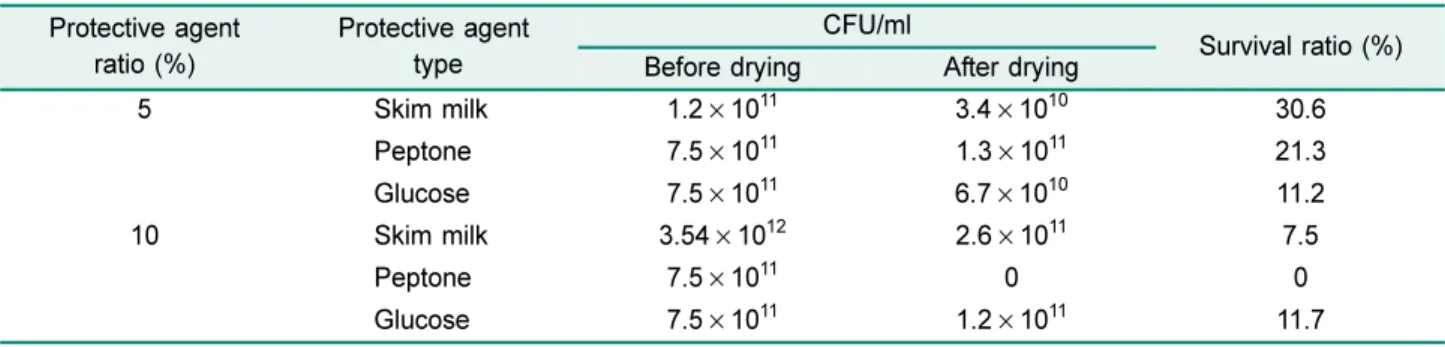
그결과, 각각의보호제가 5%씩첨가됐을때가 10%씩첨 가됐을때보다생존율이우수하였다. Skim milk는농축액 의 5%가첨가됐을때는 30.6%의생존율을나타냈고, 10%일 때는 7.5%의생존율을나타냈다. 또한, peptone의경우는각 각 21.3%와 0%였고, glucose는 11.2%와 11.7%로나타났다 (Table 1).
동결건조보호제의최종선정을위해선별된 skim milk를
대상으로보호제의각기다른농도가미생물생존에미치는 영향을알아본 결과, skim milk의 농도가 2, 4, 5, 6, 8 및 10%로첨가되었을때, 생존률이 26.73, 28.72, 30.60, 21.01, 20.35, 및 7.50%로보호제의농도가증가할수록생존율이증 가하다가 5% 첨가시최대값을보이고그이후의농도에서 다시감소하였다. 이에보호제의최적농도는 5%로결정하 였다.
Park 등[18]은 Photorhabdus temperate M1021을대상으 로동결건조보호제에따른생존율을평가하였다. 그들의연 구에서 skim milk를 1−10% 첨가하여생존율을평가하였는 데고농도로갈수록미생물의생존율이향상하다가 10%에 서는감소하였다는연구결과를발표하였다. 이러한결과는 본연구의결과와유사하며 skim milk를배양액에 10%가되 도록첨가하였을때는오히려 SH1RP8의생존율이감소하 였다. Skim milk는단백질, 탄수화물, 및지방을포함하고 있으며단백질및당류가원심분리시균체와함께침적되
어균체를포집및포괄하는작용을하며동결건조후에는 건조균체의세포벽과결합하여미생물을코팅하여균체를
보호한다[9]. 그러나일정농도이상이되면미생물보호제
로서의성능은증가하지않고점성이증가하여분리되는현 상이나타난다(Kolon, Korea Patent No: 10-1996-0078399).
본연구에서 skim milk가 5%일때보다 10% 첨가했을때 생존율이낮아졌던이유도점성의증가로인해균농축액과 skim milk가분리되어동결건조시 skim milk가보호제로 서의성능이감소했기때문이라사료된다.
동결건조시미생물의생존효율을증대시키고자 Bacillus
sp. SH1RP8가선호하는기질을첨가하여건조후의생존율
평가하였다. 선정된 기질은 총 9개로 A4; Dextrin, A8, Tween 40, A9; Tween 80, C3; Maltose, C5; D-Mannitol, D7; D-Ribose, G1; L-Alaninamide, G12; Glycerol, H12;
D-L-α-Glycerol Phosphate였다. 그 결과, Miscellaneous (Alcohol) 계열의 Glycerol이 214.29%로생존율이가장우수 했고, 나머지모든기질들은생존율이크게감소하였다(Table 2).
생존율(%) = 동결건조된시료의 cfu 값 ×100 동결건조전시료의 cfu 값
Table 1. Assessment of Bacillus sp. SH1RP8 survival ratio according to the cryoprotectant agents.
Protective agent ratio (%)
Protective agent type
CFU/ml
Survival ratio (%) Before drying After drying
5 Skim milk 1.2× 10¹¹ 3.4× 10¹⁰ 30.6
Peptone 7.5× 10¹¹ 1.3× 10¹¹ 21.3
Glucose 7.5× 10¹¹ 6.7× 10¹⁰ 11.2
10 Skim milk 3.54× 10¹² 2.6× 10¹¹ 7.5
Peptone 7.5× 10¹¹ 0 0
Glucose 7.5× 10¹¹ 1.2× 10¹¹ 11.7
Table 2. Assessment of Bacillus sp. SH1RP8 survival ratio according to the substrates with 5% skim milk (each substrate concentration: 1% of the microbial suspension).
Guild Carbon source Survival
ratio (%) w/o 100
Amines/amides L-Alaninamide (G1) 8.09
Carbohydrate D-Mannitol (C5) 4.56
D-Ribose (D7) 4.26
Maltose (C3) 11.48
Miscellaneous
(Phosphorylated chemical)
D-L-α-Glycerol Phosphate (H12)
82.65
Miscellaneous (Alcohol) Glycerol (G12) 214.29
Polymer Dextrin (A4) 4.78
Tween 40 (A8) 10.12 Tween 80 (A9) 16.51
동결건조보호제는미생물의생존율에영향을미치는가 장중요한인자이지만미생물의종류에따라악영향을미칠 수도있다[14]. 본연구에서는 Bacillus sp. SH1RP8가선호
하는기질을동결건조보호제인 skim milk와함께적절히
혼합하게되면동결시상해방지에함께미생물의기질이 혼합되어생존율이크게향상될것으로기대하였다. 그러나 대부분의기질은생존율을향상시키지못했다. 하지만또다 른동결상해방지효과를가진 glycerol의경우는 Bacillus sp.
SH1RP8가선호하는기질의한종류로써 skim milk와함께 혼합하였을때동결건조후의생존율이크게향상됨을확인 하였다. Glycerol은 ethylene glycol과 propylene glycol과 마찬가지로, 비이온성이다. 물-물의수소결합과경쟁하여물 과강력한수소결합을형성한다[24]. 이는온도가급강하지 않을경우얼음의결정격자를깨뜨린다. 물에 70% glycerol 이포함되면빙점이 -37.8oC까지저하된다. 또한, 생물독성 이없으며빙점을낮추기때문에동결건조시얼음의결정 격자(ice crystal)에의한세포파괴를막을수있어동결건조 보호제로이용된다[9].
동결건조후에도 Bacillus sp. SH1RP8의식물성장촉진 능력의상실여부를평가하기위해 Hong과 Lee[7]의논문을 참고하여 ACC deaminase 활성을평가하였다. Deaminase 활
성확인을위하여사용한배지는 DF medium으로배지의조
성은 증류수 1 L에 3 mM의 ACC, 4 g의 KH2PO4, 15 g의 Na2HPO4·12H20, 0.2 g의 MgSO4·7H2O, 1.0 mg의 FeSO4· 7H2O, 10 μg의 B(as H3BO3), 11 μg의 Mn(as MnSO4·H2O), 125 μg의 Zn(as ZnSO4·7H2O), 78 μg의 Cu(as CuSO4· 5H2O), 17 μg의 Mo(as Na2MoO4·2H2O)을첨가하여제조하 였다. 각각의보호제및기질을첨가하여동결건조된균주를 배지에 5% (w/v)가되도록접종하여 30oC에서 180 rpm으로 48시간동안배양하였다. 식물성장촉진근권미생물이 ACC deaminase 활성을갖고있는경우 ACC를질소원으로이용
하여뿌리주변의 ACC 농도를조절한다. 에틸렌의전구체
인 ACC가 ACC deaminase에의해분해되어에틸렌생성으 로인한식물의스트레스를감소시킨다. 이러한원리를착안 하여미생물성장값인흡광도(optical density, OD) 값을측 정하여미생물이 ACC를질소원으로사용하는지를측정한다 [22]. 이에배양기간동안 4시간마다 600 nm에서 OD를측 정하였다. Bacillus sp. SH1RP8를 동결 건조 보호제(5%
skim milk)만을첨가하여동결건조한대조군과보호제와선
호기질을 함께 첨가한 실험군으로 나누어 재배양(LB medium에 3일배양)하여식물성장촉진능력을평가하였 다. 그결과, ACC deaminase 활성은배양 48시간째에대조 군(C)의 OD 값은 0.05±0.01이였다. 보호제와기질을첨가 한실험군은기질의첨가로인해대조군과비교하면효소활 성이크게향상되었으며동결건조전의효소활성(0.25±0.02)
과비교하면증가하거나유사한값을나타내었다(0.20±0.4− 0.34±0.02) (Fig. 2). 실험군의효소활성은대조군과비교하 였을때크게향상되는것을유의적으로확인하였다(SPSS 18(PASW statistic 18)). 또한, Glycerol(G12)을기준으로다 른기질의효소활성도에대한유의차를분석한결과 p value 값은 D-mannitol(C5)가 0.052의최저값을가지며, 0.052− 0.652의범위를보인다. 즉, 기질간의효소활성도의차이는 통계적으로큰의미가없는것으로나타났다.
즉, 기질로도이용되고보호제로도이용된 glycerol은동 결건조후해동과정에서보호제의역할로생존율에기여하 였으며, 기타기질이용도가높은기질의경우동결건조시 첨가할경우해동후미생물의초기생육을촉진시켜이차 대사과정인 ACC deaminase 활성을향상시켜주는것으로 사료된다.
앞에서도언급했듯이동결건조보호제는미생물의생존율 에영향을미치는가장중요한인자이지만미생물의종류에 따라악영향을미칠수도있다. 이러한문제를보안하고자 본연구에서는특정미생물이선호하는기질을추가로첨가 하여동결건조후미생물의생존률과활성을보호하고자하 였다. 5% skim milk를첨가한 Bacillus sp. SH1RP8의동 결건조시 maltose, D-mannitol 등다양한기질을첨가하였 을때생존율에미치는영향을알아보았다(Table 2). 그중 glycerol 첨가시생존률이크게향상되었다. 이에본연구에
서는미생물의생존률을향상시킨 5% skim milk와생존률
과효소활성을함께향상시킨 1% glycerol를첨가하면우수 한미생물제제를생산할수있을것이라고사료된다. Fig. 2. ACC deaminase activity of lyophilized Bacillus sp.
SH1RP8 with skim milk and various substrates (n = 3). (C, control (without substrates); A4, Dextrin; A8, Tween 40; A9, Tween 80; C3, Maltose; C5, D-Mannitol; D7, D-Ribose; G1, L-Alanin- amide; G12, Glycerol; H12, D-L-α-Glycerol Phosphate). (*, 0.01<
p ≤ 0.05; **, 0.001 < p ≤ 0.01; ***, p ≤ 0.001).
요 약
본연구는식물성장촉진근권세균인 Bacillus sp. SH1RP8 를친환경생물비료로이용하기위하여수행되었다. SH1RP8 균주를동결건조시세포의용혈을방지하도록여러가지동 결건조보호제를첨가하여균주의성장과활성에미치는영 향을알아보았다. SH1RP8 균주의동결건조시동결건조보 호제로 skim milk, glucose, peptone 등을이용하였을때, 그 중 5%의 skim milk를첨가하였을때가장높은 (30.6%)의 생존율을보였다. 또한, 균주의성장을촉진하는기질그룹 을첨가하여 5%의 skim milk 단독으로첨가한경우와기질 그룹을각각첨가한경우의동결건조보호효과를비교하여 보았다. 그결과 5% skim milk에 glycerol을동시에첨가할
경우균주의생존율이 skim milk 단독첨가효과와비교시
214.29%의향상율을보여주었다. 또한동결건조된 Bacillus sp. SH1RP8 은매우효과적인 PGPR로활성을보여주어생 물비료로서의훌륭한기능이기대된다.
Acknowledgments
This research was supported by Korea Ministry of Environment as “EI Project” (Project No. E315-00013-0301-1), for which the authors are grateful.
References
1. Agasimani CA, Mudagiryappa M, Sreenivas MN. 1994.
Response of ground nut to phosphate solubilizing microor- ganisms. Groundnut News 6: 5−7.
2. Bozolu TF, Özilgen M, Bakir U. 1987. Survival kinetics of lactic acid starter cultures during and after freeze drying. Enzym Microbiol. Tech. 9: 531–537.
3. Chin-A-Woeng TFC, Bloemberg GV, van der Bij AJ, van der Drift KMGM, Schripsema J, Kroon B, et al. 1998. Biocontrol by phenazine-1-carboxamideproducing Pseudomonas chlororaphis PCL1391 of tomato root rot caused by Fusarium oxysporum f.
sp. Radicis lycopersici. Mol. Plant–Microbe Interact. 11: 1069–
1077.
4. Dubey SK, Billore SD. 1992. Phosphate solubilising microor- ganisms (PSM) as inoculant and their role in augmenting crop productivity in India: A review. Crop. Res. 5: 11−24.
5. Garland JL, Mills AL. 1991. Classification and characterization of heterotrophic microbial communities on the basis of pat- terns of community level sole carbon source utilization. Appl.
Environ. Microbiol. 57: 2351−2359.
6. Heckly RJ. 1961. Preservation of bacteria by lyophilization.
Adv. Appl. Microbiol. 2: 1−28.
7. Hong SH, Lee EY. 2014. Vegetation restoration and preven- tion of coastal sand dunes erosion using ion exchange resins
and the plant growth-promoting rhizobacteria Bacillus sp.
SH1RP8 isolated from indigenous plants. Int. Biodeterior. Bio- degradation 95: 262−269.
8. Illmer P, Schinner E. 1992. Solubilization of inorganic phos- phates by microorganisms isolated from forest soils. Soil Biol.
Bioehem. 24: 389−395.
9. Jeong EJ, Moon DW, Oh JS, Moon JS, Eom HJ, Choi HS, et al. 2012. Composition optimization of cabbage extract medium for cell growth of Lactobacillus plantarum. Korean Soc. Biotechnol. Bioeng. J. 27: 347−351.
10. Johnson DL, Anderson DR, McGrath SP. 2005. Soil microbial response during the phytoremediation of a PAH contaminated soil. Soil Biol. Biochem. 37: 2334−2336.
11. Lebeau T, Braud A, Jézéquel K. 2008. Performance of bioau- gmentation-assisted phytoextraction applied to metal contami- nated soils: A review. Environ. Pollut. 153: 497−522.
12. Lee EY, Hong SH. 2013. Plant growth-promoting ability by the newly isolated bacterium Bacillus aerius MH1RS1 from indig- enous plant in sand dune. J. Korean Soc. Environ. Eng. 35:
687−693.
13. Leveau JH, Lindow SE. 2005. Utilization of the plant hormone indole-3-acetic acid for growth by Pseudomonas putida strain 1290. Appl. Environ. Microbiol. 71: 2365−2371.
14. Lim YB, Park NS, Kim YM. 2001. Screening of lactic acid bac- teria for the development of probiotics and the effect of cryo- protectant agents. Korean J. Food Nutr. 14: 441−445.
15. Lucy M, Reed E, Glick BR. 2004. Application of free living plant growth promoting rhizobacteria. Antonie Van Leeuwen- hoek 86: 1−25.
16. Nowlan B, Dodia MS, Singh SP, Patel BKC. 2006. Bacillus okhensis sp. nov., a halotolerant and alkalitolerant bacterium from an Indian saltpan. Int. J. Syst. Evol. Microbiol. 56: 1073−
1077.
17. Othman AR, Bakar NA, Halmi MIE, Johari WLW, Ahmad A, Jirangon H. et al. 2013. Kinetics of molybdenum reduction to molybdenum blue by Bacillus sp. strain A.rzi. BioMed Res. Int.
2013: 1−9.
18. Park GS, Jang EK, Kim MS, Shin JH. 2012. Insecticidal activ- ity and stability by freeze-drying of entomopathogenic bacte- ria, Photorhabdus temperata M1021. J. Appl. Biol. Chem. 55:
123−127.
19. Park KS. 2011. Development of biopesticide and role of Bacillus spp. KIC News. 14: 1−12.
20. Perkins AE, Nicholson WL. 2008. Uncovering new metabolic capabilities of Bacillus subtilis using phenotype profiling of rifampin-resistant rpoB mutants. J. Bacteriol. 190: 807−814.
21. Seo SY, Kim YG. 2011. Development of “Bt-Plus” biopesticide using entomopathogenic bacterial (Xenorhabdus nematophila, Photorhabdus temperata ssp. temperata) metabolites. Korean J. Appl. Entomol. 50: 171−178.
22. Safronova VI, Stepanok VV, Engqvist GL, Alekseyev YV, Belimov AA. 2006. Root associated bacteria containing 1- aminocyclopropane-1-carboxylic acid deaminase improve
growth and nutrient uptake by pea genotypes cultivated in cadmium supplemented soil. Biol. Fertil. Soils 42: 267−272.
23. Stamford NP, Santos CERS, Dias SHL. 2007. Phosphate rock biofertilizer with Acidithiobacillus and rhizobia improves nodu- lation and yield of cowpea (Vigna unguiculata) in greenhouse and field conditions. Trop. Grassl. 41: 222−230.
24. Tao XQ, Lu GN, Liu JP, Li T, Yang LN. 2009. Rapid degrada- tion of phenanthrene by using Sphingomonas sp. GY2B immobilized in calcium alginate gel beads. Int. J. Environ.
Res. Public. Health 6: 2470−2480.
25. Yoon SS, Lee HO, Yu JH. 1986. Effect of the amino acid mix- ture on freeze-drying and preseravation of Lactobacillus casei YIT 9018. Korean J. Appl. Microbial. Bioeng. 14: 421−426.
26. Wolfe J, Bryant G. 1999. Freezing, drying, and/or vitrification of membrane-solute-water systems. Cryobiology 39: 103−129.
27. Zhao G, Zhang G. 2005. Effect of protective agents, freezing temperature, rehydration media on viability of malolactic bacteria subjected to freeze-drying. J. Appl. Microbiol. 99: 333−338.