1) North London Collegiate School Jeju
A Simple Method for Preserving Underground Water Resources in Volcanic Island (Jeju)
Junhyuk Hwang
1)・ Hoki Ban
†Received: June 10
th, 2016; Revised: July 5
th, 2016; Accepted: August 19
th, 2016
ABSTRACT : Being mostly made up of highly permeable basalt and volcanic ash soil, Jeju Island’s lithosphere characterizes its streams to be dry, flowing only when precipitation is happening. Under this condition, this research was motivated to identify the need of conservation of underground water, which is taking up most of (84% of) Jeju’s water usage, and made an attempt to reduce the permeability of stream beds so that it can replace underground water and be used instead. To this end, this study suggested a simple method to make dry streams to carry water all-year-round by reducing permeability of stream floor. The experiment of permeability was performed on the porous basalt and compared it with that of same basalt with volcanic ash soil and Jumunjin sand layer added on top. The results showed a dramatic decrease in permeability of water when both volcanic ash soil and Jumunjin sand is were layered on top of porous basalt. Despite being gained in a controlled environment with a simple test, this result may provide a realistic and effective method of preserving Jeju Island’s underground water which ultimately is a method of resolving water related issues.
Keywords : Basalt, Volcanic ash, Water resources, Permeability
Journal of the Korean Geo-Environmental Society17(9): 29~35. (September, 2016) http://www.kges.or.kr
ISSN 1598-0820 DOI http://dx.doi.org/10.14481/jkges.2016.17.9.29
1. Introduction
Water is a necessary element for not only humans but also for all living things. Humans can survive three weeks without eating food, but even three days without water is lethal. Unfortunately, the only existing consumable water is fresh water, which takes up only 2.5% of all existing water.
Additionally, even most of the fresh water mentioned exists in the form of glaciers, causing the actual reachable amount of fresh water to be only about 0.01%.
Although modern societies do not recognize the importance and scarcity of water, one must recognize that water was the number one clash point between societies for many centuries.
Even now days, in places where different countries rely on single water way, it is at the verge of triggering a dispute.
This is the current situation of China, European and American countries. This conflict was serious enough to create a new word: “water security” (Maude, 2009).
South Korea is not in a good position, experiencing water shortages. Especially, Jeju Island has been leading South Korea in underground water development, contributing not only to beverage industries (water, beer and etc.), but also
in golf clubs and large hotels. Like this, Jeju is hitting its peak with both the variety and amount of water usage according to the report from WAMIS (Water Resources Management Information System, 2013). The report said that Jeju Island showed its weak point in water supply in 2013 draught. Showing a dramatic increase in underground water usage during this season, it is debatable whether such usage is sustainable to this society.
Despite relatively high precipitation (700 mm higher than mainland), the main reason why Jeju’s underground water usage is because most of Jeju’s streams are dry streams.
Having a highly permeable lithosphere due to being a volcanic island, water is quickly absorbed to underground, causing the streams to be dry at most times. Thus, Jeju is in situation where they have to rely only on underground water.
Thus, a simple experimental idea came out how to preserve water and stay longer in streams by reducing the absorption into the underground, leading to saving the water. To this end, a volcanic ash soil which is most commonly available in Jeju and Jumunjin sand were adopted as suppressing agents for reducing permeability of porous basalt.
This idea comes together with Maude Barlow’s three
Fig. 1. Moon-Soo stream in Jeju taken 2014
Fig. 2. Map of Jeju’s underground water tubes distribution suggestions on behalf of better future for water. To list them:
‘water preservation’ ‘water justice’ and ‘water democracy’
(Maude, 2009). Our theory fits well with his first suggestion on ‘water preservation’ where increase in water supply (such as rain water) should be regarded as a method along with pure preservation of water. The resulting of this simple experiments would be able to step further from simple preservation in to a fully engaged preparation for our future.
2. Volcanic Island Arcs’ Underground Water Status
2.1 Jeju’s Underground Water Status
The total length of Jeju’s stream is 1,907 km, 4.5% of them being small streams (width between 3 and 10 meters)
and 32.9% of them being streamlets (width under 3 meters), with 62.6% of them being dry streams. Small streams are mostly distributed in the coastal areas (75.8%), and streamlets are mostly distributed in middle mountainous areas (59.6%).
Also, dry streams show even distribution along different altitudes (Jung, 2003).
Fig. 1 is one of the obvious examples showing the stream turns into dry quickly. Actually, Fig. 1 (left) was taken on 2014 August when Typhoon Nakri struck with heavy rain.
Fig. 1 (right) is taken at same place just five days after.
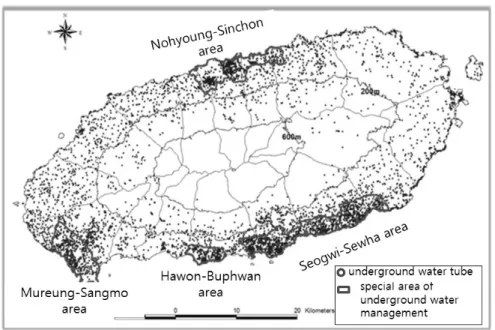
In Jeju, underground water demands showed a dramatic increase as population has grown and new businesses are taking place. As presented in Fig. 2, by 2011 December, there were about 4,581 underground water tubes, most of them being small ones, being used for agricultural purposes.
However, this increase in number of underground tubes
caused the lithosphere to be destabilized. In some coastal regions, sea water flow caused salinization of underground water. Additionally, because these tubes are directly connected by aquifer, the possibility of pollution is very high.
In terms of intensive usage of water in Jeju, golf clubs use more than 4 million tons of underground water annually.
Moreover, the fertilizers and pesticides used by golf clubs may contaminate underground water, adding on top of the problem of water shortage.
On the other hand, Jeju’s underground water has gained great amount of profit through the development of drinkable water. However, this water has been produced 600,000 tons every year, increasing the rate of underground water exhaustion.
In the status quo where JPDC (Jeju Province Development Corporation) is promoting exportation of drinking water, the increasing usage of underground water is inevitable. Due to lack of awareness, waste of underground water is frequent, and most of the time considered as an economic factor rather than environmental factor, resulting in more development than conservation.
2.2 Hawaii’s Underground Water Status and Preservation Method
Hawaii is a volcanic island arc located at the Pacific Ocean. Hawaii began development of underground water since 1800, few decades faster than Jeju. After development, population growth caused underground water usage to increase, resulting in quickly increasing number of underground water tubes. Mostly being used for industrial and agricultural purposes, its overuse and mistreatment resulted in decreasing water levels and pesticides being found in them. The problem became severe.
The Hawaiian government went for improving the situation right away, enacting related bills and forming Commission on Water Resource Management (CWRM). The commission takes care of Hawaii’s underground water by shutting down tubes, constructing water treatment facility, regularly testing water quality and monitoring water height along with monitoring sodium ion. Also, CWRM is independently managed, controlling the water usage limit by itself. Furthermore, the government, academia and citizens cooperate to construct a systematic underground water management system. Like this, Hawaii have produced a logical measure, taking care of underground
water. Unlike Jeju, on top or everything, underground water has not been developed to drinking water in Hawaii (Hawaii Water Authority, 1959).
2.3 Solution Concept through Comparing Jeju, Hawaii and Fiji
Both Jeju and Hawaii is similar in that it has been formed as island arc, created by collision of two oceanic crusts.
Historically, water was rare in Jeju up to a degree where people had to bring water found natural fountain on a daily bases. This is due to the characteristics of being a volcanic island. To solve this magnificent problem of water shortage, it was inevitable for Jeju to start developing underground water.
On the other hand, unlike Jeju, Hawaii’s lakes and rivers were naturally developed leaving a great amount of overground water to use. Even so, Hawaii developed underground water for more stable supply of water. However, looking at Hawaii’s case, development of underground water is directly linked with underground water pollution, salinization and other major problems.
Through Hawaii, it is visible that preservation of under- ground water is done through the combination of policy recheck, orderly management and improvement in realization of the importance of underground water, along with the importance of efficient water uses such as reuse of precipi- tation. Also, to prevent contamination of water through tubes, tube shutdown and usage of grouting method is needed. On top of everything, the fundamental solution would be preserving forest to increase water catchment, rather than making new tube wells.
Currently, Jeju’s representing drinkable water company is looking forward for exportation. That company aims at high profit through relatively high mineral content despite low prices. However, rather than aiming just at high profit, it is necessary that specific solution is provided so that underground water preservation and development can be balanced in a nature–friendly way.
Fiji Island is another example other than Hawaii. Fiji is
a volcanic island located at the South Pacific Ocean. Like
Jeju, Fiji has developed its underground water (bedrock water)
as drinkable water and is currently selling it all around the
world. It is being sold at high prices after American develop-
(a) (b)
(c) (d)
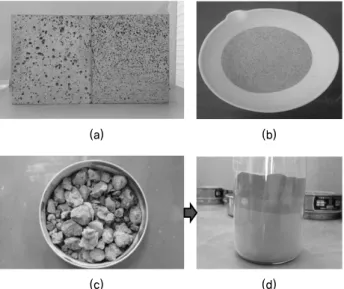
Fig. 3. Sample preparation: (a) basalt; (b) Jumunjin sand; (3) volcanic rock; and (d) volcanic ash gained from volcanic
rock presented in (c) Fig. 4. Grain size distributions of suppressing agents
ment. Despite the price, the sale is continuously increasing.
In the case of Fiji, it can be seen as a successful example of gentrification of its product, which is currently what the company in Jeju aims for.
Based on the aforementioned cases, it can be known to how the volcanic islands make an effort to preserve under- ground water as the usage of water increases due to population growth and industrial development as well. Hence, this study also suggested a simple method to preserve underground water making the stream stay longer before draining out. To assure the suggested method, a simple laboratory tests were performed as stated in next section.
3. Laboratory Test
A laboratory test was performed to measure the permeability of pure Jeju’s basalt called ‘untreated sample’ and of ‘treated sample’ to which two suppressing agents are added. The suppressing agents are volcanic ash which is most commonly found in Jeju and Jumunjin sand which is chosen to compare decrease in permeability of soils other than volcanic ash soil.
3.1 Preparing Samples and Test Procedures As shown in Fig. 3, a clean edged basalt plate (a), two suppressing agents such as a volcanic ash and Jumunjin sand ((b) and (d)) were prepared for the test.
Prior to the permeability test, the sieve analysis was
conducted to identify the grain size characteristics of the suppressing agents in accordance with KS F 2502 (2005) and the results were presented in Fig. 4.
As seen in the figure, Jumunjin sand has more uniform grain size distribution compared to the volcanic ash, whereas the volcanic ash is more well-graded than Jumunjin sand.
Although Takeuchi et al. (2008) measured the permeability of volcanic materials with simple permeameter, in this study, as mentioned earlier, the purpose of this study was to provide a simple method to preserve underground water by adding suppressing agents which could retard the water to be drained out.
Therefore, the test was simply performed to measure how fast the water drained out for both cases of with and without suppressing agents.
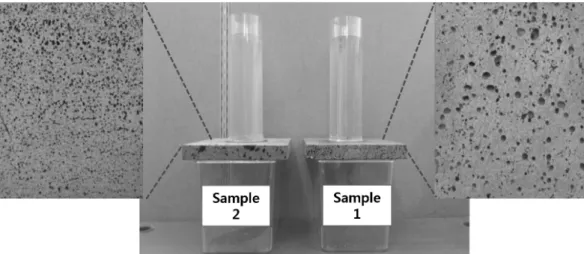
To this end, a simple apparatus was created by attaching an acrylic cylinder with diameter of 10 cm and height of 30 cm on the center of basalt slate as presented in Fig. 5.
The permeability can be computed by measuring the amount of water passed through the basalt slate with respect to time.
Additionally, the test was repeated using Jumunjin sand.
In second experiment, the same basaltic rock slate has been used. In order to use the unused spaces from previous experi- ment, acrylic cylinder with diameter of 6.5 cm and height of 30 cm has been used.
The specific test procedures are as follows. For the testing
permeability of basalt, pour water until it reaches the height
of 25 cm shown in Fig. 5 and measure the change in height
every 15 minutes. this procedure repeats three time to minimize
the experimental errors. For the testing of suppressing agents,
put grounded volcanic ash and Jumunin sand with small
amount of water at first, and then pour water until the levels
Fig. 5. Experimental apparatus used in this study and filled with water up to 25 cm
Fig. 6. Test procedures of permeability of basalt with suppressing agents
Fig. 7. Permeability test results of basalt
Fig. 8. Permeability test results of basalt with suppressing agents reach 25 cm as shown in Fig. 6. In the same way, measure
the change in height every 15 minutes and repeat three times.
3.2 Test Results
Fig. 7 presents the experimental results on two slabs of basalt. As seen, the test was repeated three times to minimize experimental errors. As seen, the water height of sample 1 decreased dramatically with time whereas there was no visible change of water height for sample 2. It is also observed that as the test repeated, the speed of water levels dropping decreased for both samples. This is because empty spaces in basalt being may be covered with basalt fragments as water repeatedly permeated through the samples.
Permeability after volcanic ash soil insertion was measured in the same way with measuring that of testing basalt’s permeability. As seen in the Fig. 6, the permeability of sample 2 was too small to investigate the effect of suppressing
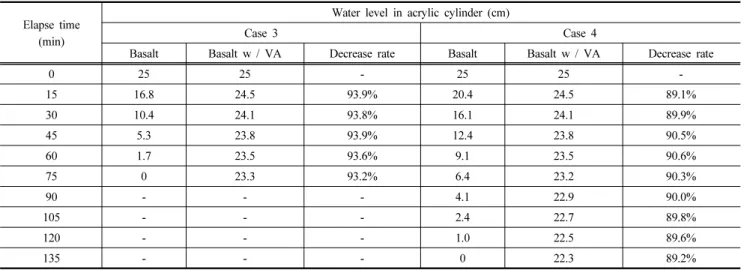
agent. Therefore, the tests for adding suppressing agents were performed only on the sample 1. In addition, the amount of suppressing agent (volcanic ash) was used 100 and 200 g to examine the effect in quantity. The water level was measured every 15 minutes until there was no change in water level which is about 300 minutes.
Fig. 8 presents the results of permeability of basalt after
volcanic ash inserted. As seen in the figure, case 1 having
Fig. 9. Comparison of permeability of basalt after volcanic ash and Jumunjin sand inserted
Table 1. Result of permeability decrease rate
Elapse time (min)
Water level in acrylic cylinder (cm)
Case 3 Case 4
Basalt Basalt w / VA Decrease rate Basalt Basalt w / VA Decrease rate
0 25 25 - 25 25 -
15 16.8 24.5 93.9% 20.4 24.5 89.1%
30 10.4 24.1 93.8% 16.1 24.1 89.9%
45 5.3 23.8 93.9% 12.4 23.8 90.5%
60 1.7 23.5 93.6% 9.1 23.5 90.6%
75 0 23.3 93.2% 6.4 23.2 90.3%
90 - - - 4.1 22.9 90.0%
105 - - - 2.4 22.7 89.8%
120 - - - 1.0 22.5 89.6%
135 - - - 0 22.3 89.2%