Print ISSN: 2288-4637 / Online ISSN 2288-4645 doi:10.13106/jafeb.2021.vol8.no4.0827
Antecedents and Consequences of Intention to Become a Customer:
A Case Study of Islamic Banks in Indonesia
Miko Andi WARDANA
1, I Ketut RAHYUDA
2, I Putu Gde SUKAATMADJA
3, I Gusti Ayu Ketut GIANTARI
4Received: December 20, 2020 Revised: March 07, 2021 Accepted: March 15, 2021
Abstract
The aim of the study was to examine the effect of trust, awareness, attitude, subjective norms, and behavioural control on intention and examine the mediating role of trust in the relationship between awareness and attitude. The population was Muslims in Bali Province, with a sample of 150 respondents. Quantitative analysis is used based on multivariate analysis using the SEM model with a variance-based PLS.
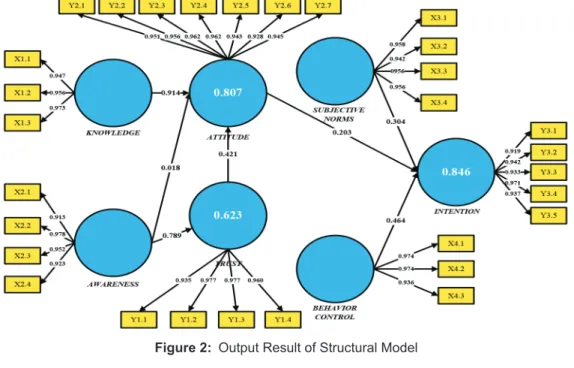
The results are as follows: (1) knowledge has a significant positive effect on attitude. (2) Awareness has no significant effect on attitude.
(3) Awareness has a significant positive effect on trust. (4) Trust has a significant positive effect on attitude. (5) Attitude has no significant effect on intention. (6) Subjective norm has a significant positive effect on intention. (7) Behaviour control has a significant positive effect on intention. (8) The role of trust is a conscious mediation that impacts attitude. The study provides insight into Islamic bank managers to meet prospective customers’ expectations and identify their intention to become customers through managing trust, awareness, attitude, subjective norms, behavioural control, and intention in one unified whole as internal resource. This study enriches empirical evidence on the Theory of Planned Behaviour, which examines knowledge, awareness, and belief.
Keywords: Attitude, Behaviour Control, Knowledge, Subjective Norms, Trust JEL Classification Code: E310, E370, E710
to shariah (Islamic law). Although Islamic commercial banks have many products similar to those offered by conventional banks, the two entities differ conceptually. One key difference is that conventional banks earn their money by charging interest and fees for services, whereas Islamic banks earn their money by profit and loss sharing, trading, leasing, charging fees for services rendered, and using other sharia contracts of exchange (Islam & Bhuiyan, 2021).
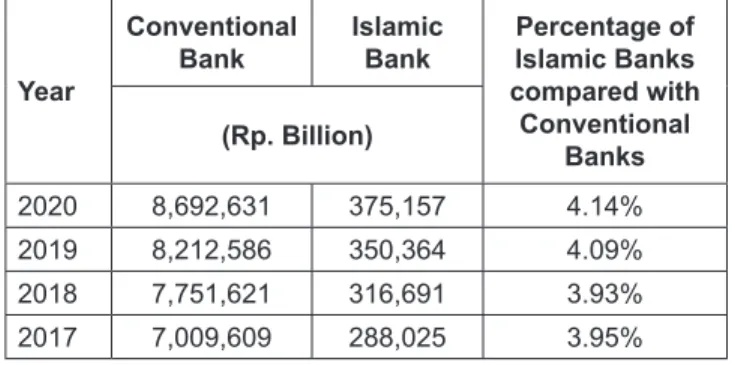
As of October 2020, Islamic banking’s total assets were recorded at Rp. 375,157 billion, and Islamic banking assets were only 4.14% of the total banking assets, while conventional banking assets reached Rp. 8,692,631 billion (Indonesia Financial Service Authority, 2020).
The comparison of Islamic banks’ assets with national conventional banks is shown in Table 1.
Table 2 shows the Indonesian population according to religion embraced.
From the Islamic banking business gap, insight into intention is sought from previous empirical studies that offer factors of knowledge, awareness, trust, attitude, subjective norms, and behavioral control as intention constructs. Furthermore, the result of awareness and attitude
1
First Author and Corresponding Author. [1] Ph.D. Student, Faculty of Economics and Business, Universitas Udayana, Denpasar, Indonesia [2] Lecturer, Department of Enterpreneurship, Institut Pariwisata dan Bisnis Internasional, Indonesia [Postal Address: Jl.
Kecak No.12, Tonja, Denpasar Utara, Kota Denpasar, Bali, 80233, Indonesia] Email: [email protected]
2
Lecturer, Faculty of Economics and Business, Universitas Udayana, Indonesia. Email: [email protected]
3
Lecturer, Faculty of Economics and Business, Universitas Udayana, Indonesia. Email: [email protected]
4
Lecturer, Faculty of Economics and Business, Universitas Udayana, Indonesia. Email: [email protected]
© Copyright: The Author(s)
This is an Open Access article distributed under the terms of the Creative Commons Attribution Non-Commercial License (https://creativecommons.org/licenses/by-nc/4.0/) which permits unrestricted non-commercial use, distribution, and reproduction in any medium, provided the original work is properly cited.