* 본 연구는 환경부 과제 “환경영향평가 협의기준 설정 및 생물 서식․이동성 제고를 위한 가이드라인 마련”의 지원에 의해 수행되었음.
First author : Shim, Yun-Jin, Group Han Associates,
Tel:+82-2-521-1122, E-mail:[email protected] Corresponding author : Park, Yong-Su, National Institute of Ecology,
Tel:+82-41-950-5142, E-mail:[email protected] Received:26 January, 2018. Revised:19 March, 2018. Accepted:12 March, 2018.
- 77 -
대체서식지 조성 현황 및 개선방안 연구*
- 환경영향평가 대상 사업을 중심으로 -
심윤진1)․정규종2)․어양준3)․유윤진4)․박현경5)
김동환6)․조영호6)․윤주덕6)․우승현6)․박수곤6)․장은혜6)․추연수6)․박용수6)
1)(주)그룹한 어소시에이트․2)(주)장안․3)(주)다인산업개발
4)넥서스환경디자인연구원(주)․5)일송지오텍(주)․6)국립생태원
A Study on the Status and Improvement Plan of Alternative Habitats
- Based on the Projects Subject to Environmental Impact Assessment -
Shim, Yun-Jin1)․Jung, Gyu-Jong2)․Eo, Yang-Joon3)․Ryu, Yoon-Jin4)․Park Hyun-Kyung5) Kim, Dong-Hwan6)․Cho, Young-Ho6)․Yoon, Ju-Duk6)․Woo, Seung-Hyun6)
Park, Su-Gon6)․Jang, Eun-Hye6)․Chu, Yun-Soo6) and Park, Yong-Su6)
1)Group Han Associates, 2)Jangan, 3)Dain Development Company,
4)NEXUS Environmental Design Centre, 5)Ilsong Geotech inc., 6)National Institute of Ecology.
ABSTRACT
The intensive habitats loss of natural organisms as a consequence of anthropogenic activities has lead to the use of alternative habitats for species conservation. We reviewed the current status of alter- native habitats and suggest the improvement of alternative habitats. Most of alternative habitats regarded in this study are not following the pre-arranged consultation at environmental impact assessment. These alternative habitats are rendered useless due to the insufficient consideration of ecological characteristics of species and lack of detailed plans. A number of alternative habitats are influenced by disturbance such as environmental pollution and construction. Post-monitoring of alternative habitats are needed to estimate immigration rate of species. Post management is also needed to assess the status of population
stability. Overall, low effectiveness of alternative habitats is presented in this study. According to the status survey, methods for improvement of alternative habitats are required such as detailed guidelines, establishment of post-monitoring system, improvement of habitat restoration techniques, and guidelines for management and operation of alternative habitats.
Key Words : Biodiversity offset, Disturbance, Ecological compensatory mitigation, Ecological restora- tion, Immigration rate of species, Post-monitoring system
I. 서 론
개발 사업을 추진함에 있어 멸종위기종 등 주 요 생물서식지의 원형 보전을 기본전제로 설정하 고, 만약 불가피하게 생물서식지를 훼손할 경우 이에 대한 보상대책의 일환으로 대체서식지 조성 을 고려하여야 한다(MOE, 2011). 대체서식지는 개발 사업으로 인해 훼손되거나 영향을 받을 것 으로 예상되는 생물의 서식지를 보상하기 위하여 사업대상지역 또는 주변지역에 원래의 서식지와 동일하거나 유사한 수준으로 창출(Creation), 향 상(Enhancement) 또는 복원(Restoration)한 서식지 를 의미한다(MOE, 2013). 현재 법령, 행정규칙, 자치법규에서 대체서식지를 언급한 사례는 없다.
대체서식지는 개발로 훼손되는 목표 생물종이나 서식지 보상을 위한 대응방안으로 주로 환경영향 평가에서 협의의견으로 제시되고 있다(NIER, 2008).
환경영향평가제도는 개발로 인한 서식지 훼손 을 방지하기 위한 제도로 정착하고 있으나, 생물종 에 대한 자료부족과 개발사업에 따른 서식지 영향 분석 미흡으로 생태계 보전에 한계가 있다(MOE, 2011). 개발사업에 따른 환경영향평가 시 대체서식 지의 설치 의견이 제시되고 있으나 설치 규격, 관 리 방법 등의 세부기준이 부재하여 대체서식지 조 성 및 관리가 부실하다는 의견이 제기되고 있다.
대체서식지는 개발 사업으로부터 훼손되는 서 식지의 총량(양적, 질적)을 최대한 보전하고 궁극 적으로 생물다양성 증진에 기여한다. 따라서 대체 서식지의 실질적인 효과를 거두기 위해서는 조성
현황 및 개선방안 검토가 선행되어야 한다. 본 연 구는 대체서식지 조성 현황 및 문제점을 파악하고 개선방안을 제시하는데 목적을 두고 있다.
II. 연구방법
1. 연구범위
2016년 국립생태원, 한국환경정책평가연구 원, 한국환경공단에 접수된 약 2,300건의 사후 환경영향조사서 중 대체서식지 조성을 언급한 138개 사업을 연구 대상지로 선정하였다. 그리 고 138개의 사업 중 멸종위기 야생생물Ⅰ급과
Ⅱ급을 대상으로 대체서식지를 조성하고 현장 조사가 가능한 33개소1)를 현장조사 대상지로 선정하였다(Table 1, 4). 그리고 2016년 6월부터 8월까지(3개월) 각 지방․유역환경청별로 선정 된 대체서식지에 대한 현황 조사를 실시하였다.
2. 연구방법
먼저, 138개 연구 대상지에 대하여 사후환경 영향조사서 내용을 기반으로 대체서식지 조성 기본 현황을 파악하였다. 그리고 33개 현장조사 대상지에 대하여 대체서식지의 현황 조사 항목 및 조사 내용을 도출하기 위해 관련 선행 연구 로 MOE(2011, 2013, 2016), Park et al.(2015), Shim et al.(2014, 2015) 등을 검토하였다 그 후 대체서식지의 입지 선정, 계획 및 시공, 모니터 1) 현장조사는 사업자, 지방유역환경청 담당자와 같이 실시함. 필요시 인터뷰를 실시하였으며 조사 일정 및 여건을 고려하여 최종적으로 33개소를 선정함
Total Ministry of environment(MOE) in local office
Hangang Nakdong Geumgang Yeongsan Wonju Daegu Saemangeum
33 13 6 4 0 6 1 3
Table 2. Field survey items and contents of alternative habitats in this study
Survey items Contents
Site selection Habitat requirement for target species, threat factor etc.
Plan and construction Planning establishment for construction, size and shape, structure, ecological consideration, carrying capacity, threat factor etc.
Monitoring and maintenance Planning establishment for maintenance, monitoring status, removal of threat, installation of board, main agent of maintenance etc.
Table 3. Status of alternative habitats creation by taxonomic group (Unit: %) Division Amphibians
and reptiles Mammals Birds Fish Benthic
Invertebrates Plants Sum
ratio 43 27 13 7 7 3 100
Table 1. Field survey sites of alternative habitats by ministry of environment(MOE) in local office
링 및 유지관리 측면으로 구분하여 Table 2과 같이 조사 항목 및 내용을 선정하였다. 마지막 으로 현황 조사 결과 내용을 바탕으로 개선방안 을 제시하였다.
III. 연구 결과 및 고찰
1. 대체서식지 조성 기본 현황
사후환경영향조사서 분석 결과 양서․파충류 (43%), 포유류(27%), 조류(13%) 등의 순으로 대 체서식지 조성이 많이 이루어진 것으로 확인되 었다(Table 3). 양서․파충류의 대체서식지가 가장 많이 조성된 이유는 조류나 포유류에 비해 행동권이 작아 현실적으로 대체서식지 조성이 용이하기 때문이라고 판단된다.
그러나 사후환경영향조사서에서 대체서식지 에 대한 내용을 구체적으로 확인한 결과 48%의 대상지가 대체서식지 조성이 아닌 멸종위기종 이주로 확인되었다. 그리고 대체서식지에 대한 다른 구체적인 내용 확인이 불가능하였다.
2. 대체서식지 현황 조사 결과
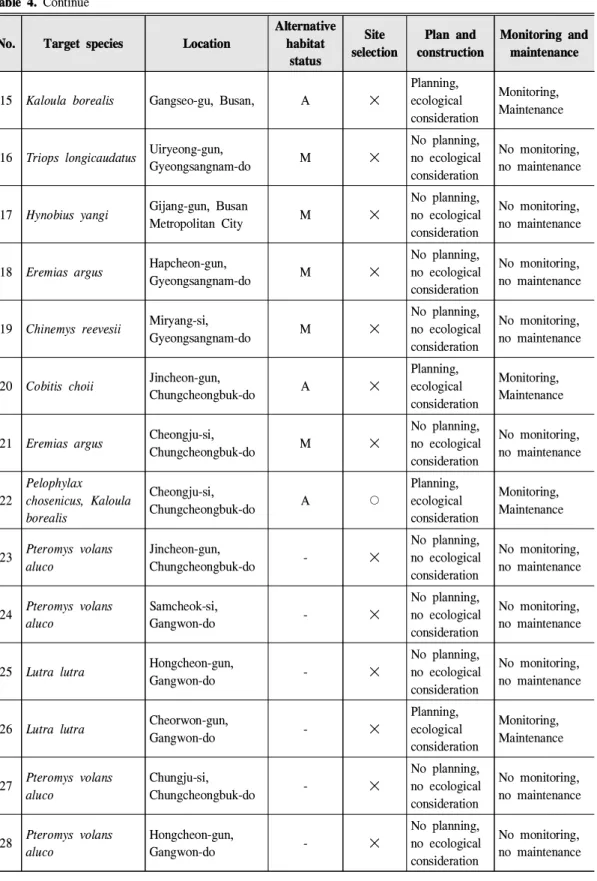
대체서식지 현황 조사 결과를 입지 선정 현 황, 계획 및 시공 현황, 모니터링 및 유지관리 현황 등으로 구분하여 정리하면 Table 4와 같다.
1) 입지 선정 현황
사후환경영향조사서에서 대체서식지로 언급 된 33개소 현장 대상지 중 약 30%(10개소)만이 대체서식지로 조성되고 약 33%(11개소)는 멸종 위기종 이주지로 확인되었다. 나머지 약 37%
(12개소)는 대체서식지도 멸종위기종 이주지도 아닌 것으로 확인되었다. 대체서식지도 멸종위 기종 이주지도 아닌 12개소를 포함하여 약 82%(27개소)가 입지 선정 단계에서 목표종의 생태적 특성에 대한 충분한 고민 없이 입지가 선정된 것으로 확인되었다(Table 4, Figure 1).
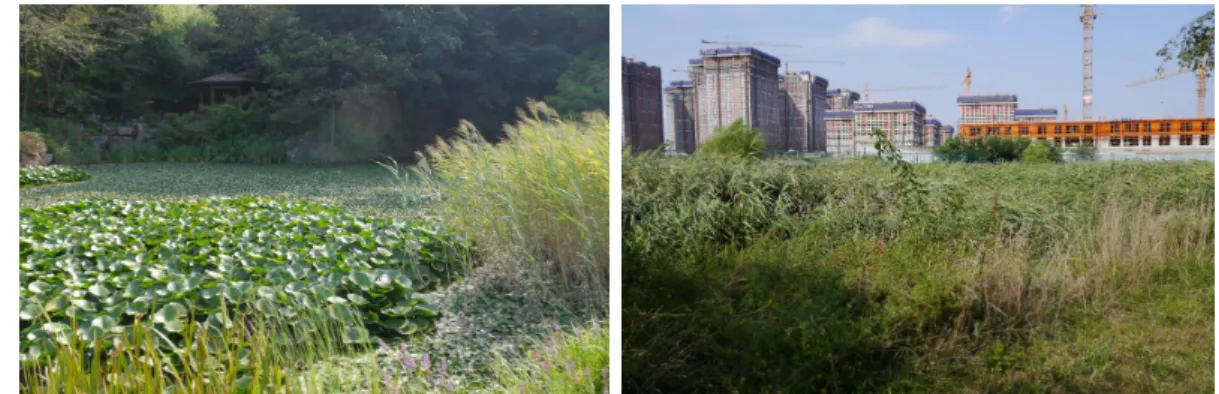
이주지의 대부분이 위협요소(교란, 환경오염, 개발압력 등)에 노출되어 있는 경우가 많은 부 적합한 대상지로 대부분의 이주지 주변에 개발 압력이 존재하고 있어 결과적으로 이주지 내 고 립 및 이로 인한 이주종의 절멸 가능성이 높을
No. Target species Location
Alternative habitat
status
Site selection
Plan and construction
Monitoring and maintenance
1
Migratory birds (statutory protected species)
Ansan-si,
Gyeonggi-do - ✕
No planning, no ecological consideration
No monitoring, no maintenance
2 Platalea minor Yeonsu-gu, Incheon - ✕
No planning, no ecological consideration
No monitoring, no maintenance
3 Platalea minor Yeonsu-gu, Incheon - ✕
No planning, no ecological consideration
No monitoring, no maintenance
4 Platalea minor Yeonsu-gu, Incheon - ✕
No planning, no ecological consideration
No monitoring, no maintenance
5 Polygonatum
stenophyllum Paju-si, Gyeonggi-do A ✕
Planning, ecological consideration
Monitoring, Maintenance
6 Ninox scutulata Pyeongtaek-si,
Gyeonggi-do A ✕
No planning, no ecological consideration
No monitoring, no maintenance
7 Grus japonensis Yeoncheon-gun,
Gyeonggi-do M ○
No planning, no ecological consideration
No monitoring, no maintenance
8 Hyla suweonensis Pyeongtaek-si,
Gyeonggi-do A ○
No planning, no ecological consideration
No monitoring, no maintenance
9
Pelophylax chosenicus, Kaloula borealis
Siheung-si,
Gyeonggi-do M ✕
No planning, no ecological consideration
No monitoring, no maintenance
10
Pelophylax chosenicus, Kaloula borealis
Bucheon-si,
Gyeonggi-do A ✕
No planning, no ecological consideration
No monitoring, no maintenance
11
Pelophylax chosenicus, Kaloula borealis
Siheung-si,
Gyeonggi-do M ○
Planning, ecological consideration
No monitoring, no maintenance
12
Pelophylax chosenicus, Kaloula borealis
Seo-gu, Incheon M ✕
Planning, ecological consideration
Monitoring, Maintenance
13
Pelophylax chosenicus, Kaloula borealis
Pyeongtaek-si,
Gyeonggi-do A ○
Planning, ecological consideration
Monitoring, Maintenance
14 Lutra lutra Geoje-si,
Gyeongsangnam-do - ✕
No planning, no ecological consideration
No monitoring, no maintenance Table 4. The field survey results of alternative habitats
Table 4. Continue
No. Target species Location
Alternative habitat
status
Site selection
Plan and construction
Monitoring and maintenance
15 Kaloula borealis Gangseo-gu, Busan, A ✕
Planning, ecological consideration
Monitoring, Maintenance
16 Triops longicaudatus Uiryeong-gun,
Gyeongsangnam-do M ✕
No planning, no ecological consideration
No monitoring, no maintenance
17 Hynobius yangi Gijang-gun, Busan
Metropolitan City M ✕
No planning, no ecological consideration
No monitoring, no maintenance
18 Eremias argus Hapcheon-gun,
Gyeongsangnam-do M ✕
No planning, no ecological consideration
No monitoring, no maintenance
19 Chinemys reevesii Miryang-si,
Gyeongsangnam-do M ✕
No planning, no ecological consideration
No monitoring, no maintenance
20 Cobitis choii Jincheon-gun,
Chungcheongbuk-do A ✕
Planning, ecological consideration
Monitoring, Maintenance
21 Eremias argus Cheongju-si,
Chungcheongbuk-do M ✕
No planning, no ecological consideration
No monitoring, no maintenance
22
Pelophylax chosenicus, Kaloula borealis
Cheongju-si,
Chungcheongbuk-do A ○
Planning, ecological consideration
Monitoring, Maintenance
23 Pteromys volans aluco
Jincheon-gun,
Chungcheongbuk-do - ✕
No planning, no ecological consideration
No monitoring, no maintenance
24 Pteromys volans aluco
Samcheok-si,
Gangwon-do - ✕
No planning, no ecological consideration
No monitoring, no maintenance
25 Lutra lutra Hongcheon-gun,
Gangwon-do - ✕
No planning, no ecological consideration
No monitoring, no maintenance
26 Lutra lutra Cheorwon-gun,
Gangwon-do - ✕
Planning, ecological consideration
Monitoring, Maintenance
27 Pteromys volans aluco
Chungju-si,
Chungcheongbuk-do - ✕
No planning, no ecological consideration
No monitoring, no maintenance
28 Pteromys volans aluco
Hongcheon-gun,
Gangwon-do - ✕
No planning, no ecological consideration
No monitoring, no maintenance
Table 4. Continue
No. Target species Location
Alternative habitat
status
Site selection
Plan and construction
Monitoring and maintenance
29 Pteromys volans aluco
Chuncheon-si,
Gangwon-do - ✕
No planning, no ecological consideration
No monitoring, no maintenance
30 Gobiobotia nakdongensis
Yeongju-si,
Gyeongsangbuk-do M ✕
No planning, no ecological consideration
No monitoring, no maintenance
31 Cristaria plicata Buan-gun,
Jeollabuk-do M ✕
No planning, no ecological consideration
No monitoring, no maintenance
32 Ranunculus kazusensis
Buan-gun,
Jeollabuk-do A ✕
Planning, ecological consideration
Monitoring, Maintenance
33
Pelophylax chosenicus, Kaloula borealis
Gimje-si,
Jeollabuk-do A ✕
No planning, no ecological consideration
No monitoring, no maintenance
* A : Alternative habitat, M : Migration site, - : Neither alternative habitat nor immigration site
○ : appropriate, ✕ : not appropriate
Figure 1. Migration without any ecological consideration for Kaloula borealis
Figure 2. Migration site of Pelophylax chosenicus influenced by disturbance such as construction
것으로 확인되었다(Figure 2).
2) 계획 및 시공 현황
약 73%(24개소)가 목표종에 대한 대체서식지 조성 절차별(계획․설계․시공) 구체적인 계획 수립이 없고 생태적 고려 없이 조성되어 서식지 로서 가치가 낮은 것으로 나타났다(Table 4, Figure 3).
또한 이주지의 적절성, 이주 대상지의 수용 력, 이주 개체의 안정화를 돕는 추가 시설 설치 등에 대한 정밀 검토가 미흡한 것으로 확인되었 다. 이주 개체의 안정화를 돕기 위해 설치된 보 호펜스 등이 실제 기능을 하지 못할 정도로 기 능이 저하되는 등 시공 현황이 미흡한 것으로 확인되었다(Figure 4).
Figure 3. A habitat without any ecological consideration for Ranunculus kazusensis
Figure 4. Fence installed poorly in migration site of Kaloula borealis
Figure 5. Alternative habitats with no post-monitoring and maintenance at all 3) 모니터링 및 유지관리 현황
대체서식지 조성 후 또는 이주지역에 목표종 을 옮긴 후 대상종이 그 지역(새로운 서식지)에 안정적으로 적응하여 살아가는지에 대한 모니 터링은 매우 중요한 사항이나, 현재는 대체서식 지 조성 및 이주에만 초점이 맞춰져 있었다. 약 76%(25개소)의 사업장에서 목표종에 대한 별도 의 모니터링 없이 사후환경영향조사와 병행하 여 수행하거나 그대로 방치하고 있었다(Table 4).
주기적인 모니터링을 통해 고사체 관리, 퇴적 물 제거, 외래종 퇴치 등 필요한 조치를 취할 수 있는 유지관리 계획이 수립되지 않았다. 그 결 과 사후환경영향조사 완료 후 오랫동안 유지관 리가 이루어지지 않아 대체서식지의 기능을 완 전히 상실하였고(Figure 5), 당초 조성 목적과 위치, 규모 등에 대한 정보(안내판)를 찾을 수
없었다. 사후환경영향조사 완료 후 대체서식지 에 대한 유지관리 이관 주체가 명확하지 않은 것이 주요 원인 중 하나로 판단된다.
2. 대체서식지 조성 개선 방안
첫째, 환경영향평가 협의 단계별 대체서식지 조성 검토에 대한 세부 기준(지침) 마련이 필요 하다. 환경영향평가 협의단계는 크게 초안 작성 및 의견수렴-평가서(본안)작성 및 협의-사후조 사(공사 시)-사후조사(운영 시)의 4단계로 구분 할 수 있다. 현재 대체서식지의 계획 및 설계는 환경영향평가 협의단계 중 평가서(본안) 작성 및 협의 단계가 아닌 사후조사(공사 시)에 이루 어지고 있어 대체서식지 조성 실행율이 매우 떨 어지고 있는 실정이다. 특히 협의 단계별 세부 기준(지침)이 없어 사업자들이 대체서식지 조성
시 개발편의성을 고려하여 조성하는 문제점이 발생되고 있다. 따라서 대체서식지의 조성 목표 와 방법, 사업유형별 적용범위 등을 명확히 하 여 실효성 있는 대체서식지 조성을 위한 기준 (지침)이 필요하다. 또한 각 분류군별 대체서식 지 조성 효과를 검증할 수 있는 점검표 및 사후 관리 기법 등을 개발하여 대체서식지 조성에 대 한 실효성 및 적절성을 파악할 필요가 있다.
둘째, 유지관리 주체 확립이 필요하다. 대체 서식지 조성 시 생물에 대한 배려가 이루어졌어 도 조성 완료 후 유지관리를 실시하지 않으면 조성 효과가 반감될 수 있다. 현재 사후환경영 향조사 시 원칙 없이 형식적으로 관리를 시행하 거나 사후환경영향조사 완료 후 유지관리에 대 한 이관 주체가 명확하지 않아 조성된 대체서식 지가 방치되어 원기능을 완전히 상실하는 문제 가 발생하고 있다. 따라서 사후환경영향조사 이 후 다음 관리주체로의 이관이 명확하지 않아 대 체서식지 조성의 효과가 저감되지 않도록 관계 기관 및 지자체와 긴밀하게 연계할 수 있는 제 도적 보완 방안 마련이 필요하다.
셋째, 멸종위기종을 비롯한 주요 생물종에 대 한 서식지 복원 기법에 대한 연구가 지속적으로 수행되어야 한다. 일부 멸종위기종의 경우 서식 지 적합성 지수(HSI, Habitat Suitability Index)를 활용하여 구체적인 대체서식지 조성 모델을 제 시하고 있으나(Kim et al., 2013; Park et al., 2015; Shim et al., 2014; Shim et al., 2015) 대부 분의 멸종위기종의 경우 연구가 미비한 실정이 다. 따라서 멸종위기종을 중심으로 다양한 서식 지 조성 기술이 지속적으로 확보될 수 있어야 한다.
마지막으로, 환경영향평가 및 사후관리 사업 장 중, 일정 규모 이상으로 조성된 대체서식지 에 대해서는 운영․관리 실태 및 이행조치 점검 에 대한 사후관리 매뉴얼 마련이 필요하다. 현 재 환경영향평가 시 조성되는 대체서식지의 경 우 사후관리의 부재로 인해 대체서식지 조성 후
성공․실패에 대한 파악이 어려운 현실이다. 또 한 일부 대체서식지의 경우 조성 후 일정기간 안정화될 수 있도록 지속적인 유지관리가 필요 하나, 관리가 이루어지지 않아 생태계교란 생물 의 침입으로 주변 생태계의 교란을 야기하기도 한다. 사후관리 매뉴얼을 통한 지속적인 점검을 통해 대체서식지 조성의 실효성을 제고할 수 있 도록 할 필요가 있다.
IV. 결 론
본 연구는 대체서식지의 실질적인 효과를 거 두기 위한 선행연구로 대체서식지 조성 현황 및 문제점을 파악하고 개선방안을 제시하고자 수 행하였다.
대체서식지 현황 조사 결과, 당초 환경영향평 가 협의 조건으로 제시된 대체서식지 조성과 다 르게 이주가 수행되거나 대체서식지도 이주지도 아닌 사례가 많았다. 결과적으로 환경영향평가 협의 이후 사후관리가 미흡하여 협의 조건과 다 르게 조성된 것으로 판단된다. 목표종에 대한 생태적 고려 및 구체적인 계획 수립 없이 대체 서식지 조성 및 이주가 결정되어 효과가 매우 미흡한 것으로 나타났다. 또한 대체서식지 조성 및 이주 후 목표종에 적합한 모니터링이 미흡하 여 대체서식지 조성 및 이주에 성공 여부를 판 단하기 어려웠다. 이주지 주변에 위협요소(교란, 환경오염, 개발압력 등)에 노출되어 있는 경우 가 많고 이주 개체의 안정화를 위한 조치 및 유 지관리가 미흡한 것으로 확인되었다. 결과적으 로 대체서식지 조성 및 이주의 실효성이 매우 떨어지는 것으로 판단된다.
현황 조사 결과를 바탕으로 대체서식지 조성의 실효성 있는 환경영향평가 협의 단계별 세부 지침 마련, 유지관리 주체 확립, 생물종 서식지 복원 기 법의 지속적인 연구 수행, 운영·관리 실태 및 이행 조치 점검에 대한 사후관리 매뉴얼 마련 등의 개선 방안을 제시하였다.
본 연구는 대체서식지 조성 현황 및 문제점 을 파악하고 이에 대한 개선방안을 제시하여 대 체서식지 조성 및 관리 시 주요 기초자료로 활 용할 수 있다. 그러나 33개의 대체서식지이란 한정한 대상으로 연구를 진행한 점에서 한계를 지니고 있다. 향후 연구로서 충분한 사례지의 확보와 본 연구에서 제시한 개선방안을 바탕으 로 대체서식지 조성의 세부 기법 및 지침, 모니 터링 및 유지관리 기법 등 다양한 연구를 진행 하여야 할 것이다.
References
Kim SR․Lee JH․Song JY․Chang MH․Sung HC and Cho DG. 2013. A Study on the Habitat Restoration Model for Chinemys reevesii. J. Korean Env. Res. Tech. 16(2):
115-125. (in Korean with English summary) Ministry of Environment(MOE). 2011. A Study on the Guideline for Creating Alternative Habitats of Major Species in Environmental Impact Assessment. (in Korean)
Ministry of Environment(MOE). 2013. Guidelines for the Environmental Impact Assessment on the Creation and Management of Alternative Habitats. (in Korean)
Ministry of Environment(MOE). 2016. Guidelines
for Monitoring of Ecological Restoration Projects. (in Korean)
NATIONAL INSTITUTE OF ENVIRONMENTAL RESEARCH(NIER). 2008. A study on the efficient management of artificially created ecosystem (I) : Evaluation study of artificial habitat's ecological effectiveness. (in Korean with English summary)
Park YS․Chang MH․Cha JY․Cho DG․Kim SH and Lee SW. 2015. A Study on Site Selection for Reeve’s turtle(Maunemys reeve- sii) Habitats Using Habitat Suitability Index.
J. Korean Env. Res. Tech. 18(3): 109-118. (in Korean with English summary)
Shim YJ․Cho DG․Park SH․Lee DJ․Seo Y H․Kim SH․Kim DH․Ko SB․Cha JY and Sung HC. 2014. Development of Habitat Suitability Index for Habitat Restoration of Narrow-mouth Frog(Kaloula borealis). J.
Korean Env. Res. Tech. 17(2): 109-123. (in Korean with English summary)
Shim YJ․Cho DG․Hong JP․Kim DHo․Park YS and Sung HC. 2015. Site Selection of Narrow-mouth Frog(Kaloula borealis) Habitat Restoration Using Habitat Suitability Index. J.
Korean Env. Res. Tech. 18(2): 33-44. (in Korean with English summary)