563
http://www.koseb.org
cies in the western Pacific(Fisher 1911; Djakonov 1940;
Hayashi 1940) was a major contribution to the classifica- tion of this group of species. In the classification of Henri- cia species, individual species cannot be correctly separat- ed based on only one characteristic. Moreover, only a set of individual characteristics that can reliably separate species has been used for Henricia identification(Bratova and Paskerova 2017). Currently, 11 Henricia species have been recorded in Korea(Ubagan and Shin 2019a, b, c, 2020): H.
anomala Hayashi, 1973; H. elachys Clark & Jewett, 2010; H.
leviuscula Stimpson, 1857; H. nipponica Uchida, 1928; H.
ohshimai Hayashi, 1935; H. pachyderma Hayashi, 1940; H.
pacifica Hayashi, 1940; H. perforata(O.F. Müller, 1776); H.
regularis Hayashi, 1940; H. reniossa Hayashi, 1940; and H.
sanguinolenta(O.F. Müller, 1776). Most Henricia species are distributed in the East Sea of Korea.
https://doi.org/10.11626/KJEB.2020.38.4.563
INTRODUCTION
The family Echinasteridae is currently populated by eight genera, of which two genera, Aleutihenricia and Henricia, are present in the Korean fauna. Henricia is the most diverse of the echinasterid genera and includes 94 described species. Although Henricia species are well dis- tributed worldwide, the complexity of the morphological characteristics in several of the recognized species has been poorly described. Historically, the taxonomy of Henricia has been based on traditional morphology, using the main diagnostic characteristics from the abactinal and actinal morphological characteristics(i.e., the shape and number of abactinal and actinal spines, the shape of abactinal and actinal skeletons, and the number of adambulacral spines).
Previous taxonomic research performed on Henricia spe-
Note
Newly recorded sea star Henricia oculata(Asteroidea: Spinulosida:
Echinasteridae) in the East Sea, Korea
Michael Dadole Ubagan and Sook Shin*
Department of Animal Biotechnology & Resource and Marine Biological Resource Institute, Sahmyook University, Seoul 01795, Republic of Korea
Korean J. Environ. Biol.
38(4) : 563-566(2020) ISSN 1226-9999(print) ISSN 2287-7851(online)
Korean Journal of Environmental Biology
* Corresponding author Sook Shin
Tel. 02-3399-1717 E-mail. [email protected]
Received: 3 November 2020 Revised: 8 November 2020
Revision accepted: 9 November 2020
Abstract: Henricia specimens were collected using fishing nets from the East Sea of Korea. The specimens were identified as Henricia oculata Pennant, 1777, belonging to the family Echinasteridae of the order Spinulosida. This species can be distinguished from other Henricia species by broad arms(R/r=4-4.1), rough skin, a thick arm base, three to nine minute delicate abactinal spines, and inferomarginal plates reniform in shape.
This species superficially resembles H. pachyderma in its body size and wide papular areas but differs mainly in the number of papulae and abactinal spines, and the shape and arrangement of the inferomarginal plates. To date, two genera of Echinasteridae, Aleutihenricia and Henricia, with a total of 13 species, have been reported in Korea.
The morphological characteristics of H. oculata are described, and photographs are provided.
Keywords: distribution, Echinasteridae, Henricia oculata, East Sea, Korea
Korean J. Environ. Biol. 38(4) : 563-566(2020)
564 ⓒ2020. Korean Society of Environmental Biology.
MATERIALS AND METHODS
The Henricia specimens were collected from waters near Namae and Shinnam, Korea, using fishing nets on March 3, 2014, and September 12, 2014, respectively. The collected specimens were preserved in 95% ethanol, and the follow- ing morphological characteristics were examined: the size of the disk, upper and proximal portions of the arms, num- ber of abactinal spines, shape of the abactinal and actinal skeleton, and number of adambulacral spines. The mor- phological features of the specimens were photographed using a scanning electron microscope(JSM-6510; JEOL Ltd., Tokyo, Japan), a stereomicroscope(Nikon SMZ1000;
Nikon Co., Tokyo, Japan), and a digital camera(Nikon D7000). The abbreviations for the measurements were those used by Ubagan and Shin(2019a).
SYSTEMATIC ACCOUNT Class Asteroidea de Blainville, 1830 Order Spinulosida Perrier, 1884 Family Echinasteridae Verrill, 1870 Genus Henricia Gray, 1840 Henricia oculata Pennant, 1777 거친애기불가사리(신칭)(Fig. 1A-K)
Henricia oculata Pennant, 1777: Madsen, 1987: pp. 254- 257, figs. 44-45; Clark and Downey, 1992: p. 393, pls.
93e, 95f-g, figs. 60q-r; Jewett et al., 2012: p. 160, fig. 9d;
Mah, 2020: 123970.
Material examined. One specimen: Namae, 3 March 2014, MERBK-A-1257; one specimen: Shinnam, 12 Sep- tember 2014, MERBK-A-1258, fishing net, Shin, S. and Lee, T.
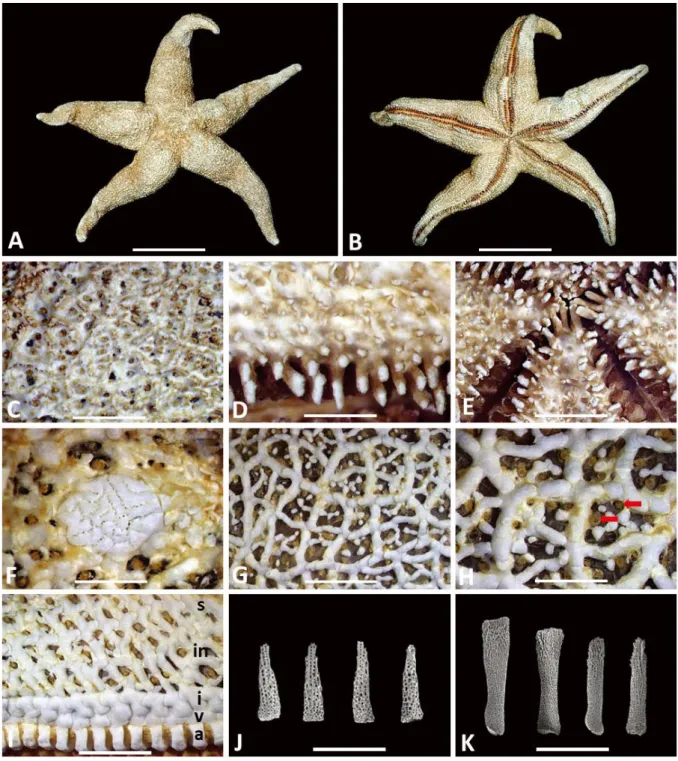
Description. Arms five, slightly broad arm base, gradually tapering to tips(Fig. 1A, B). Abactinal paxillae clustered, containing three to nine minute spinelets, more or less in a curved series around the papular area, and covered with rough skin(Fig. 1C). Papular areas wide, containing two to six papulae in an area(Fig. 1H). Abactinal skeleton open-meshed, reticulated, comprising rod-like, small os- sicles present inside papular areas(Fig. 1G). Madreporite situated near center of disk, circular in form, not elevated, and bearing spines larger than abactinal spines(Fig. 1F).
Actinal plates close-meshed, with narrow spaces of papular
areas with one or two papulae larger than abactinal plates.
Superomarginal, intermarginal, inferomarginal, and ventro- lateral plates distinguishable. Superomarginal plates bear- ing five to nine spines, reaching tip of arm. Intermarginal plates formed longitudinally between inferomarginal and superomarginal plates, containing a wide area on actinal side, reaching three-quarters length of the arm. Inferomar- ginal plates reniform in shape, compact, bearing three to six spines, and larger than surrounding plates. Ventrolateral plates rounded cross shape, compact, bearing four to six spines, reaching one-half length of arm(Fig. 1I). Adambu- lacral armature comprising three to eight bluntly pointed spinelets; inner spine being longer and more spatulate than outer spines, and arranged in two transverse or zigzag rows (Fig. 1D, K). Oral plate bearing two slender, flat tip spines (Fig. 1E). Furrow spine single.
Size. R=76-92mm, r=19-22mm, R/r=4-4.1.
Habitat. Hard substrates(rocks).
Color. Body color was light brown in alcohol.
Korea. East Sea(Namae, Shinnam).
Distribution. Korea(East Sea), Alaska(Akun Island, Kodiak Island), France, Ireland, Portugal, and the United Kingdom(British Isles, England, Scotland, Wales).
Deposition. The collected specimens were deposited in the Marine Echinoderm Resource Bank of Korea, Sah- myook University, Seoul, Korea.
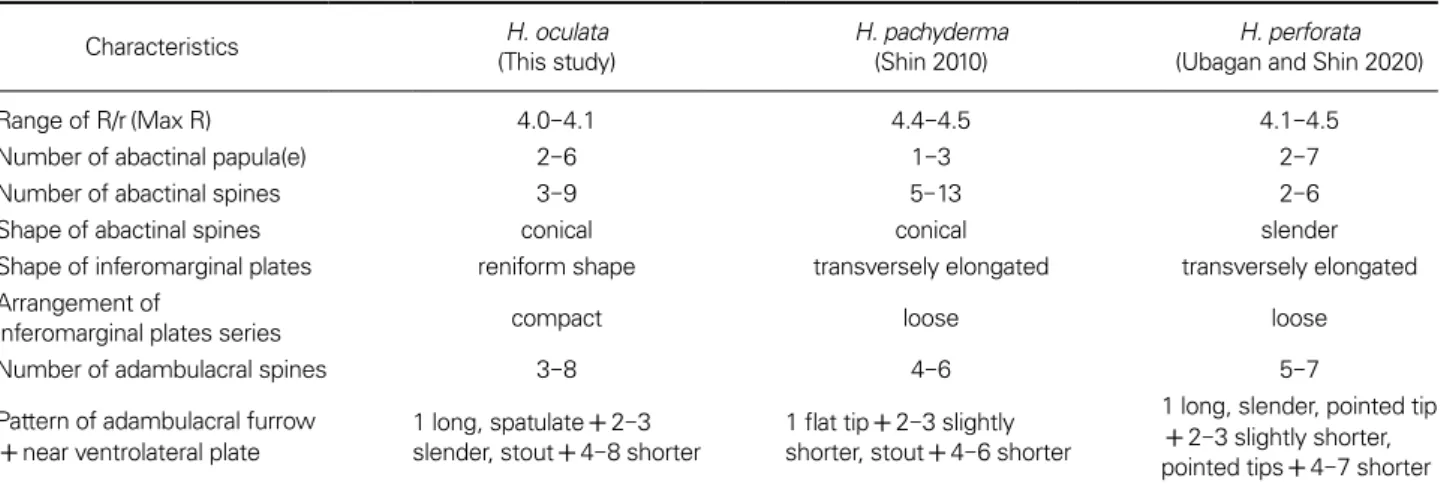
Remarks. Henricia oculata was first described as Asterias oculata by the British zoologist Thomas Pennant, 1777, and was later transferred under Henricia. Our specimen su- perficially resembled that of H. pachyderma in its size, wide papular areas, the conical shape of the abactinal spines, and flat-tipped adambulacral spines. It differs mainly from the similar H. pachyderma in the number of papulae(H.
oculata: 2-6; H. pachyderma: 1-3), the number of abacti- nal spines(H. oculata: 3-9; H. pachyderma: 5-13), the shape of inferomarginal plates(H. oculata: reniform; H.
pachyderma: transversely elongated), and the arrangement of inferomarginal plates series(H. oculata: compact; H.
pachyderma: loose). In comparison with other Henricia species bearing broad arms, our morphological analysis showed that it differed from H. perforata in the shape of abactinal spines(H. oculata: conical; H. perforata: slender), the shape of inferomarginal plates(H. oculata: reniform;
H. perforata: transversely elongated), and the arrangement of the series of inferomarginal plates(H. oculata: compact;
H. perforata: loose)(Table 1). Our specimens H. oculata have slight morphological differences compared to the At- lantic H. oculata. Previously, H. oculata abactinal plates had
565
http://www.koseb.org
Newly recorded sea star Henricia oculata
been crowded with abactinal spines(up to 25 in numbers) in multiple rows(Madsen 1987), but our specimens pos- sessed lesser number of abactinal spines(three to nine).
However, differences in the number of abactinal spines alone cannot be regarded as a stable character for Henri- cia species identification(Bratova and Paskerova 2017).
Fig. 1. Henricia oculata. A. abactinal side; B. actinal side; C. abactinal paxillae; D, K. adambulacral spines; E. oral part; F. madreporite; G.
abactinal skeleton; H. papulae(arrows); I. actinal skeleton: superomarginal plates(s), intermarginal plates(in), inferomarginal plates(i), ven- trolateral plates(v), adambulacral plates(a); and J. abactinal spines. Scale bars: A, B=1cm, C-I=1mm, J=100μm, K=500μm(J, K, SEM images).
Korean J. Environ. Biol. 38(4) : 563-566(2020)
566 ⓒ2020. Korean Society of Environmental Biology.
Therefore, we consider that Korean H. oculata is the same species as the Atlantic H. oculata. H. oculata is reported for the first time in the Korean fauna.
ACKNOWLEDGEMENTS
This study was supported by a grant from the National Institute of Biological Resources(NIBR), which was fund- ed by the Ministry of Environment of the Republic of Ko- rea(NIBR 202002204), and the project titled “Improve- ment of management strategies on marine disturbing and harmful organisms” funded by the Ministry of Oceans and Fisheries, Korea(No. 20190518) and the Marine Biotech- nology Program of the Korea Institute of Marine Science and Technology Promotion(KIMST) funded by the Min- istry of Oceans and Fisheries(MOF)(No. 20170431).
REFERENCES
Bratova O and GG Paskerova. 2017. Henricia spp.(Echinodermata:
Asteroidea: Echinasteridae) of the White Sea: morphology, morphometry, and synonymy. Can. J. Zool. 96:341-355.
Clark AM and ME Downey. 1992. Starfishes of the Atlantic.
Chapman & Hall Identification Guides 3. Chapman & Hall.
London. pp. 1-794.
Djakonov AM. 1950. Keys to the fauna of the USSR. Sea Stars (Asteroids) of the USSR Seas. Zoological Institute of the Academy of Sciences of the USSR(translated 1968 by Israel Program for Scientific Translations, Jerusalem). 34:1-183.
Fisher WK. 1911. Asteroidea of the North Pacific and adjacent
waters. Part. 1. Phanerozonia and Spinulosa. Bull. U.S. Nat.
Mus. 76:1-420.
Hayashi R. 1940. Contributions to the classification of the Sea- stars of Japan I. Spinulosa. J. Fac. Imp. Sci. Kokkaido Univ.
Ser. 7:107-204.
Jewett SC, RN Clark and H Chenelot. 2012. Seastars of the near- shore Aleutian Archipelago. pp. 144-172. In: Proceedings of the 31st American Academy of Underwater Sciences Sym- posium. Dauphin Island, AL.
Madsen FJ. 1987. The Henricia sanguinolenta complex(Echino- dermata, Asteroidea) of the Norwegian Sea and adjacent waters. A re -evaluation, with notes on related species.
Steenstrupia 13:201-268.
Mah C. 2020. Henricia oculata Pennant, 1777. World Asteroidea database. World Register of Marine Species at http://www.
marinespecies.org/aphia.php?p=taxdetails&id=123970 ac- cessed 06 June 2020.
Shin S. 2010. Sea Stars: Invertebrate Fauna of Korea. National Institute of Biological Resources. Incheon, Korea. pp. 1-150.
Ubagan MD and S Shin. 2019a. A newly recorded sea star of ge- nus Henricia(Asteroidea: Spinulosida: Echinasteridae) from the East Sea of Korea. J. Species Res. 8:109-112.
Ubagan MD and S Shin. 2019b. New record of a sea star of ge- nus Henricia(Asteroidea: Spinulosida: Echinasteridae) from Jeju Island, Korea. Korean J. Environ. Biol. 37:68-71.
Ubagan MD and S Shin. 2019c. A newly recorded sea star of ge- nus Aleutihenricia(Asteroidea: Spinulosida: Echinasteridae) from East Sea, Korea. Anim. Syst. Evol. Divers. 35:91-94.
Ubagan MD and S Shin. 2020. New record of a sea star, Henricia perforata(Asteroidea: Spinulosida: Echinasteridae), in the East Sea, Korea. Korean J. Environ. Biol. 38:388-391.
Table 1. Comparison of morphological characteristics between H. oculata and related Henricia species reported in Korea
Characteristics H. oculata
(This study) H. pachyderma
(Shin 2010) H. perforata
(Ubagan and Shin 2020)
Range of R/r(Max R) 4.0-4.1 4.4-4.5 4.1-4.5
Number of abactinal papula(e) 2-6 1-3 2-7
Number of abactinal spines 3-9 5-13 2-6
Shape of abactinal spines conical conical slender
Shape of inferomarginal plates reniform shape transversely elongated transversely elongated Arrangement of
inferomarginal plates series compact loose loose
Number of adambulacral spines 3-8 4-6 5-7
Pattern of adambulacral furrow
+near ventrolateral plate 1 long, spatulate+2-3
slender, stout+4-8 shorter 1 flat tip+2-3 slightly shorter, stout+4-6 shorter
1 long, slender, pointed tip +2-3 slightly shorter, pointed tips+4-7 shorter Morphological data derived from the present study, Shin(2010), and Ubagan and Shin(2020).