이 논문은 2012년 1월 30일 접수하여 2012년 3월 8일 채택되었음.
책임저자:송용민, 삼성서울병원 방사선종양학과 Tel: 02)3410-2600, Fax: 02)3410-2619 E-mail: [email protected]
Total Scalp의 방사선 치료 시 Helmet Bolus 제작방법에 관한 연구
삼성서울병원 방사선종양학과
송용민ㆍ김종식ㆍ홍채선ㆍ주상규ㆍ박주영ㆍ박수연
목 적: Total Scalp의 방사선 치료 시 표면선량(surface dose)을 증가시키기 위해 조직보상체(bolus)를 사용한다. 이에 본 저자 는 두피(scalp) 전체를 덮는 조직보상체로서 Bolx-II, paraffin wax, solid thermoplastic물질을 각각 적용한 Helmet bolus를 제작하 여 유용성을 비교 평가해보고자 한다.
대상 및 방법: Rando 팬톰을 이용하여 두피 고정용구(mask)를 만든 후 전체 두피에 Bolx-II (Action Products, USA), paraffin wax (Densply, USA), solid thermoplastic 물질(Med-Tec, USA)을 0.5 cm 두께로 동일하게 적용한 Helmet bolus를 각각 제작 하 였다. 각 Helmet bolus에 대한 물리적 특성을 평가하기 위해 전산화 단층촬영(computed tomography) (GE, Ultra Light Speed16) 을 시행 후 방사선치료계획시스템(radiation therapy planning system) (Philips, Pinnacle)을 이용하여 최적의 치료 계획(radiation therapy plan)을 세웠으며, 각 조직 보상체(bolus)에 대한 밀도 변화(density variation)화를 분석하였다. 선량 분포(dose distribution) 평가(evaluation)를 위해 선량체적히스토그램(Dose-Volume Histogram) (DVH)을 이용해 임상표적체적(Clinical Target Volume) (CTV)에 대한 Dose-homogeneity index (DHI, D90/D10), Conformity index (CI, V95/TV)를, 정상 뇌 조직(Normal brain tissue)에 있어 V20, V30을 각각 구하여 비교 하였다. 또한 총 제작시간을 측정하여 제작과정에서의 효율성을 평가하였고, 열형광선량계 (Thermoluminescent Dosimeter)를 사용하여 실제 치료 시 각 두피의 표면선량을 확인 하였다.
결 과: Bolx-II, paraffin wax, solid thermoplastic 물질에 대한 밀도측정(density measurement) 결과 0.952±0.13 g/cm3, 0.842±0.17 g/cm3, 0.908±0.24 g/cm3로 Bolx-II의 밀도변화(density variation)가 가장 작았다. Bolx-II, paraffin wax, solid thermoplastic 물질을 적용한 각 Helmet bolus DHI는 0.89, 0.85, 0.77, CI는 0.86, 0.78, 0.74로 Bolx-II가 가장 우수 하였으며, 정상조직에 있어 뇌(brain tissue)의 V20은 11.50%, 10.80%, 10.07%, V30은 7.62%, 7.40%, 7.31%로 나타났다. 제작 시 총 소요 시간은 30분, 120분, 90분 이였으며, Bolx-II를 적용한 Helmet bolus 제작과정이 가장 간단하였다. 열형광선량계(Thermoluminescent Dosimeter) 측정 결과 세 Helmet bolus 모두 ±7% 이내의 선량오차를 보였다.
결 론: Total Scalp의 방사선치료 시 Bolx-II를 사용한 Helmet bolus의 적용은 CTV (Clinical Target Volume)에 대한 Homogeneity 와 Conformity를 높여 줄 뿐만 아니라 제작시간 및 제작방법이 간단하여 임상 적용 시 유용하리라 생각된다.
핵심용어: 전체 두피, 조직 보상체
서 론
두피 전체에 퍼져 나타나는 임파종(lymphoma), 악성 흑색 종(melanoma), 혈관육종(angiosarcoma) 등의 방사선 치료는 두피의 범위가 광범위하고, 불규칙한 형태, 정상 뇌(brain)조 직과 맞닿아 있어 치료가 쉽지 않다. 이를 극복하기 위해 과 거부터 선형가속기(linear accelerator)를 이용한 다양한 방사 선 치료방법이 소개되어 왔다. Total Scalp의 방사선치료는 전통적으로 표면의 선량을 증가시킬 목적으로 고에너지 전 자선을 사용해 왔다. 선량분포의 homogeneity를 높이기 위해
많은 조사야를 사용하거나, 중복된 조사야를 이용한 치료방 법들이 소개되어졌지만, 많은 조사야 생성 및 계면조사야로 인해 전체 두피의 선량이 균등하지 못했다.1-4)
반면 엑스선이 적용 되면서 이러한 문제들이 다소 해결 되 었다. 가장 널리 알려진 치료 방법으로서 lateral photon-elec- tron 치료방법(Akazawa)은 양측에서 엑스선과 전자선을 결 합하여 치료하는 방식으로 기존의 전자선만을 이용한 치료 보다 정상 뇌조직의 선량을 줄이고, 전체 두피선량에 대한 homogeneity를 높여 주었다.5,6) 최근에는 IMRT (Intesity Modulated Radiaiton Thearpy)와 TOMOTHERAPY 등 최신 치료방법이 소개되고 있으며, 이는 기존 치료방법 보다 두피 선량에 대한 homogeneity는 향상 시키지만 치료시간이 오래 걸리고, 주변 정상조직에 높은 선량을 초래 하는 단점들이 보고되고 있다.7,8)
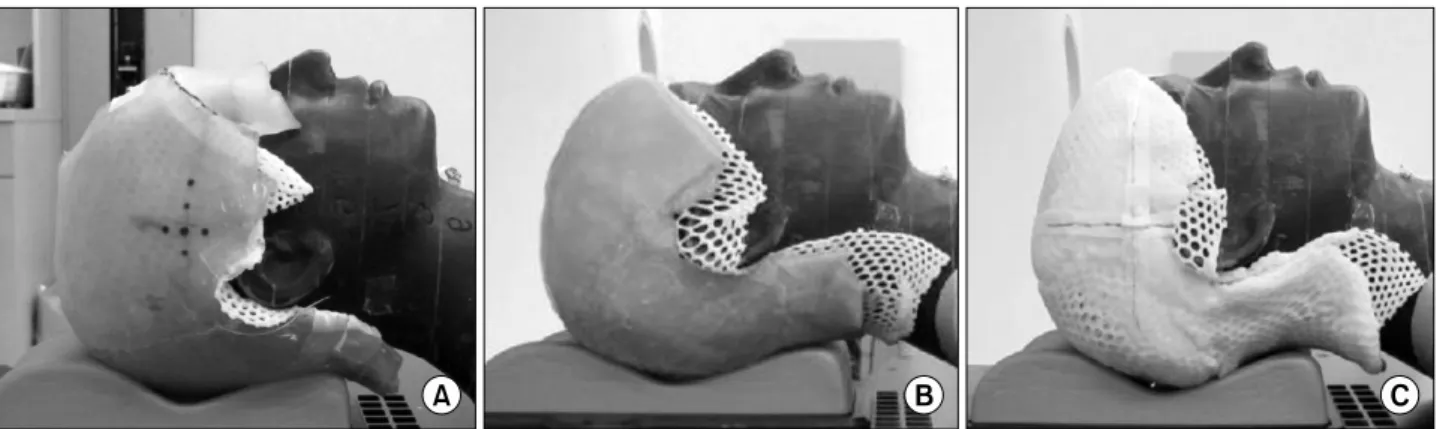
Fig. 2. Tissue equivalent material was applied the helmet applicator respectively. Bolx-II (A), paraffin wax (B), thermoplastic materials (C).
Fig. 1. CT-scan image to the 3 kinds of tissue equivalent. Bolx-II (A), paraffin wax (B), thermoplastic materials (C).
Total scalp의 방사선 치료 시 정상 뇌 조직의 방사선량을 최소화 하고, 표면선량을 증가시키기 위해 적절한 조직 보상 체와 고정용구의 사용이 필요하며, 총 치료 시간 동안 환자 에게 편안함을 유지 시켜 주는 것 또한 중요하다.9) 보통 방 사선 치료 시 조직 보상체로 사용되는 물질로는 상품화된 bolus, paraffin wax, solid thermoplastic 물질, 물(water), 아크 릴(acrylic) 등이 주로 사용되고 있지만, 두피의 경우 범위가 광범위 하고, 모양이 불규칙해 적절한 조직 보상체를 적용하 기란 쉽지 않다. 두피 전체를 덮는 조직 보상체로서 paraffin wax, thermoplastic 물질등이 선행 연구에서 사용 되어 졌으 며, 상품화된 bolus는 bolus와 환자 두피표면과의 공기층(air gap)의 형성을 단점으로 사용되지 않고 있다.10)
이에 본 연구에서는 두피 전체를 덮는 조직 보상체로서 상 품화된 Bolx-II (Action Products, USA), paraffin wax (Densply USA), solid thermoplastic 물질(Med-Tec, USA)을 각각 적용 한 Helmet bolus를 제작하여 그 유용성을 비교 평가해 보고 자 한다.
대상 및 방법 1. 조직 보상체의 밀도변화 측정
조직 보상체로서 Bolx-II, paraffin wax, solid thermoplastic 물질을 각각 10×10×0.5 cm 크기로 동일하게 제작한 후 전
산화 단층촬영(GE, Ultra Light Speed16)을 시행 하였고, 방 사선치료계획시스템(Philips, Pinnacle)을 사용하여 관심영역 (region of interest)을 5 cm3으로 동일하게 설정한 후 각각의 밀도변화를 측정하여 분석하였다(Fig. 1).
2. Helmet bolus의 제작
Rando 팬톰(The Phantom Laboratory, Salem, NY)을 이용 하여 팬톰의 두피(scalp) 전체를 덮는 고정용구(thermoplastic mask)를 각각 제작하였다. 첫 번째로 Bolx-II를 사용한 Helmet bolus의 제작에서 Bolx-II와 표면과의 공기층을 최소화하기 위해 고정용구에 먼저 paraffin wax를 최대한 얇게 도포 한 후 0.5 cm 두께의 Bolx-II를 덮어 밀착시킨 후 고정시켜 제작 하였다. 두 번째로 paraffin wax를 사용한 Helmet bolus의 제 작 또한 paraffin wax를 고정용구(thermoplastic mask) 위에 먼저 최대한 얇게 도포 한 후 paraffin wax를 불에 녹여 0.5 cm 두께로 한 면씩 덧붙여 전체를 고정시켜 제작 하였다. 마 지막으로 solid thermoplastic 물질을 사용한 Helmet bolus는 고온의 물에 녹여 만든 solid thermoplastic 물질을 고정용구 위에 0.5 cm의 동일한 두께로 한 면씩 덧붙여 전체를 고정시 켜 제작 하였다(Fig. 2).
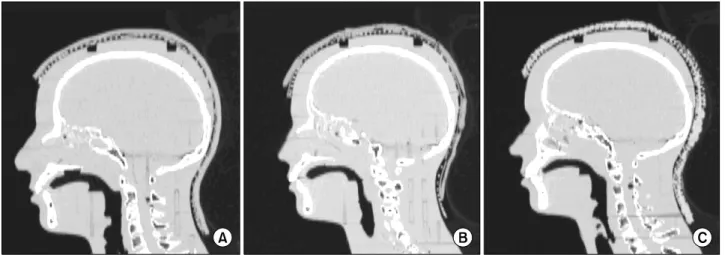
Fig. 3. CT-scan image to the 3 kinds of helmet applicator respectively. Bolx-II (A), paraffin wax (B), thermoplastic materials (C).
Fig. 4. Dose distribution of sagittal image. Bolx-II (A), paraffin wax (B), thermoplastic materials (C).
3. Helmet bolus의 치료 계획 및 분석 1) 전산화 단층촬영 및 치료 계획
각각 제작된 세 가지 Helmet bolus를 Rando 팬톰(The Phan- tom Laboratory, Salem, NY)에 적용 하였고, Mev-Geen을 이 용해 자세 고정 보조기구를 제작한 후 전산화 단층촬영(GE, Ultra Light Speed16)을 시행 하였다. 단층촬영슬라이스(slice) 는 2.5 mm였고, 두 경부 전체가 포함되도록 촬영한 후 획득 한 단층 촬영 영상은 방사선치료계획시스템(Philips, Pinnacle) 으로 전송되어졌다(Fig. 3). 방사선치료계획시스템(Philips, Pinnacle)을 사용하여 본원에서 치료 받은 환자와 동일하게 임 상표적체적과 정상 뇌 조직의 contour를 각각 그리고, photon- electron치료방식(Akazawa)으로 최적의 치료 계획을 세웠으 며, 총 22회에 걸쳐 55 Gy를 처방하였다.
2) 분석 및 평가
세 가지 치료 계획에 대한 결과를 토대로 임상표적체적과 정상 뇌조직에 대한 선량 체적 히스토그램을 이용해 선량학 적으로 분석하였다. 임상표적체적 내에서 선량분포를 평가하 기 위해 표적용적의 90%, 10%가 받는 최소 선량에 대한 Dose Homogeneity index (DHI, D90/D10)와 처방선량의 95%가 받는 용적을 계산하여 Conformity index (CI, C95/TV)를 구하 여 비교하였다. 정상 뇌조직의 경우 전체선량의 20% 및 30%
이상을 받는 뇌조직의 용적의 백분율(Percentage of volume:
V20, V30)을 구하여 분석하였다. 정상 뇌조직의 경우 처방선 량의 20% 및 30% 이상을 받는 뇌조직의 용적의 백분율 (Percentage of volume: V20, V30)을 구하여 분석하였다(Fig.
4).
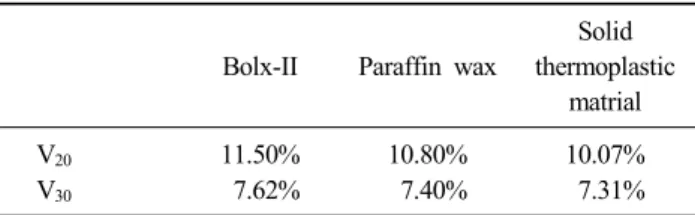
Table 3. Dosimetric result for brain Bolx-II Paraffin wax
Solid thermoplastic
matrial
V20 11.50% 10.80% 10.07%
V30 7.62% 7.40% 7.31%
V20 and V30: % volume of brain receiving minimum of 20% and 30% prescription dose, respectively.
Table 1. Variation of density for tissue equivalent material Bolx-II Paraffin wax
Solid thermoplastic
matrial Density (g/cm3) 0.952±0.13 0.842±0.17 0.908±0.24
Table 2. Dose homogeneity index and conformity index for CTV
Bolx-II Paraffin wax
Solid thermoplastic
material
DHI (D90/D10) 0.89 0.85 0.77
CI (V95/TV) 0.86 0.78 0.74
DHI: dose homogeneity index, CI: conformity index, D90, D10: minimal dose covering 90%, 10% of target volume, V95: volume of target receiving minimum of 95% of prescription dose, TV:
target volume.
4. 실제치료시 표면 선량확인
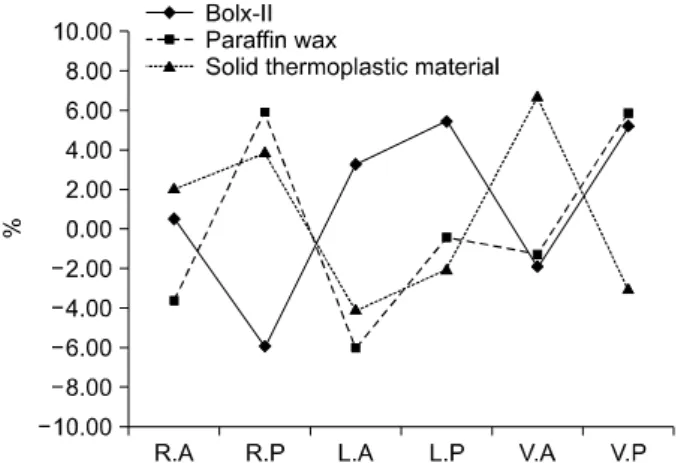
실제 치료 시 두피의 표면선량을 확인하기 위해 열형광선 량계(TLD 100chip, Harshow, Germany)를 사용 하였다. 측정 점은 각 두피의 귀 상방 2 cm에서 우측 전(Right Anterior, RA) 후방(Right Posterior, RP)으로 좌측 전(Left Anterior, LA) 후방(Left Posterior, LP) 3 cm 지점과 정수리(vertex)에 서 전(Vertex Anterior, VA) 후방(Vertex Posterior, VP) 6 cm 지점, 각 Helmet bolus에 각 6곳을 측정하여 방사선치료계획 시스템(Philips, Pinnacle)에서 얻은 계산 값과 비교하였다.
5. 제작소요 시간 비교
각 Hemet bolus를 제작하는 데 걸리는 소요시간을 비교했 다. Rando 팬톰을 이용하여 팬톰의 두피 전체를 덮는 고정용 구(thermoplastic mask)를 제작하는 시간은 제외 하였고, 각 각의 조직 보상체를 고정용구(thermoplastic mask)에 적용하 여 제작하는데 걸리는 시간을 측정했다.
결 과
1. 조직 보상체의 밀도 변화 분석비교
방사선치료계획시스템(Philips, Pinnacle)을 사용하여 각 조 직 보상체의 밀도측정 결과 Bolx-II의 경우 0.952±0.13 g/cm3, paraffin wax의 경우 0.842±0.17 g/cm3, solid thermoplastic 물질의 경우는 0.908±0.24 g/cm3으로 Bolx-II의 밀도 변화가 가장 작게 측정되었다(Table 1).
2. Helmet bolus의 선량학적 분석
임상표적체적과 정상 뇌조직에 대한 선량 체적 히스토그 램(DVH)을 선량학적으로 분석한 결과 임상표적체적(CTV) 의 90%, 10%가 받는 최소 선량에 대한 Dose Homogeneity in- dex (DHI, D90/D10)는 Bolx-II 0.89, paraffin wax 0.85, solid thermoplastic물질 0.77로 나타났으며, 처방선량의 95%가 받 는 용적을 계산하여 Conformity Index (CI, C95/TV)를 구한 결과 Bolx-II 0.86, paraffin wax 0.78, solid thermoplastic 물질 0.74로 Bolx-II의 경우가 가장 우수했다(Table 2). 정상 뇌조
직의 경우 전체선량의 20% 및 30% 이상을 받는 뇌조직의 용 적의 백분율은 Bolx-II, paraffin wax, solid thermoplastic 물질 순서로 V20은 11.50%, 10.80%, 10.07%, V30은 7.62%, 7.40%, 7.31%로 나타났다(Table 3).
3. 실제 치료(radiation therapy) 시 표면 선량(surface dose) 확인
실제 치료 시 두피의 표면선량을 확인하기 위해 열형광선량 계(TLD 100chip, Harshow, Germany)를 사용하여 각 Helmet bolus에 6곳을 측정한 값과 방사선치료계획시스템(Philips, Pinnacle)에서 얻은 계산 값과 비교한 결과 모두 ±7% 이내 의 오차범위를 보였다(Fig. 5).
4. 제작과정에서의 효율성 및 총 제작시간 비교 Helmet bolus 제작 과정에서 Bolx-II의 사용은 Bolx-II와 환 자 두피표면과의 공기층의 형성을 최소화 하기 위해 고정용 구(thermoplastic mask)위에 먼저 paraffin wax를 얇게 도포 한 후 두피 전체에 덮어 고정 시켜 0.5 cm의 동일한 두께로 제작이 가능하였고, 총 제작시간은 30분으로 가장 적은 시간 이 소요 되었으며, 제작과정이 간단하였다.
Paraffin wax를 적용한 Helmet bolus의 경우 paraffin wax 를 불에 녹여 고정해야 하기 때문에 제작과정이 복잡하고,
Fig. 5. Distribution of difference between TLD* measurement and calculation abbreviation. R.A: right anterior, R.P: right posterior, L.A: left anterior, L.P: left posterior, V.A: vertex anterior, V.P: vertex posterior. *Thermoluminescent dosimeter.
제작시간은 120분으로 가장 오랜 시간이 소요되었다.
마지막으로, solid thermoplastic 물질의 경우 특성상 높은 온도의 물에 녹여 덧붙이는 식으로 제작해야 하기 때문에 먼 저 제작 해 놓은 고정용구(thermoplastic mask)가 변형 되는 위험이 있을 수 있었다. 또한 제작 시 전체에 동일한 두께의 적용이 불가능 했으며, 제작 시간은 90분이 소요되었다.
고안 및 결론
Total scalp의 방사선 치료는 표면선량을 증가시키기 위한 목적으로 조직 보상체를 사용한다. 일반적으로 조직 보상체 는 일반적으로 편평한 부위에 쉽게 적용이 가능하지만, 두피 의 경우 범위가 광범위 하고, 모양이 불규칙하기 때문에 조 직 보상체를 적용한 Helmet bolus 제작 시 밀도의 균일성, 공 기층, 제작과정의 효율성 및 소요시간 등이 고려되어야 한다.
먼저 각 조직 보상체의 밀도측정결과 Bolx-II, paraffin wax, solid thermoplastic 물질순서로 0.952±0.12 g/cm3, 0.842±
0.17 g/cm3, 0.908±0.24 g/cm3으로 단위 면적당 Bolx-II의 평 균밀도의 변화가 가장 작게 측정 되어 다른 조직 보상체에 비해 밀도가 균일함을 보여 주었다. Solid thermoplastic 물질 의 경우 밀도변화가 높게 나타난 이유는 제작과정에서 각 물 질 사이에 공기층이 형성 되었거나, 두께가 0.5 cm으로 동일 하지 못함을 암시한다.
각 Helmet bolus에 대한 선량학적인 분석비교결과 다른 조 직 보상체에 비해 Bolx-II의 적용이 임상표적체적(CTV)에 대 한 Homogeneity와 conformity를 높일 수 있었다. Bolx-II에서 Dose Homogeneity Index (DHI, D90/D10)는 0.89로 paraffin wax 0.85, solid thermoplastic 물질 0.77에 비해 우수 하였으
며, Conformity index (CI, C95/TV) 또한 0.86으로 paraffin wax 0.78, solid thermoplastic 물질 0.74에 비해 가장 우수한 결과를 보였다. 이는 각 조직 보상체의 밀도측정 결과와 hel- met bolus 제작 시 동일한 두께의 적용 반영됨을 알 수 있었 다. 정상 뇌조직에 있어 Bolx-II, paraffin wax, solid thermo- plastic 물질 순서로 V20은 11.50%, 10.80%, 10.07%, V30은 7.62%, 7.40%, 7.31%로 정상 뇌조직의 큰 선량차이를 보이지 않았다.11)
각 조직 보상체(bolus)에 의한 표면 선량을 검증 하고자 열 형광선량계(TLD 100chip, Harshow, Germany)를 이용했으며,
±7% 이내의 선량오차를 확인하였다. 이는 처방선량과 실제 치료 시 방사선량과 비슷한 값으로 각각의 Helmet bolus 모 두 만족할 만한 결과를 보였다.12)
Helmet bolus 제작 과정에서 Bolx-II의 적용은 제작이 간단 하고, 두피 전체에 동일한 두께의 적용이 가능하였다. 하지만 Bolx-II와 환자 두피표면에서 공기층의 형성이 단점으로 지 적되었으나, 고정용구위에 먼저 paraffin wax를 얇게 도포한 후 Bolx-II를 덮어 제작하여 그러한 단점을 최소화 시킬 수 있었다. Paraffin wax를 적용한 Helmet bolus는 제작 후 팬톰 (The Phantom Laboratory, Salem, NY)의 두 경부에 적용 시 일정 힘을 가하면 갈라지고, 틈이 생겨 치료 기간 동안 일정 한 형태를 유지하는 것이 어려웠고, 0.5 cm의 두께로 제작 된 solid thermoplastic 물질은 제작 후 신축성이 사라져 환자 의 두 경부에 적용하기 불편할 것이라 사료된다. 또한, paraf- fin wax와 solid thermoplastic 물질의 적용은 특성상 높은 온 도의 발열 물질을 이용해 덧붙이는 식으로 제작해야 하기 때 문에 두피 전체에 동일한 두께의 적용이 불가능 하며, 먼저 제작한 고정용구가 열에 의해 변형될 수 있는 단점이 있었 고, 제작과정이 복잡하여 오랜 시간이 소요되었다.13)
결론적으로 Total scalp의 방사선 치료 시 표면선량을 증가 시키기 위한 목적으로서 Bolx-II를 사용한 Helmet bolus의 적 용은 다른 조직 보상체를 적용한 Helmet bolus와 비교하여 밀도가 균일하고, 동일한 두께로 제작이 가능해 선량분포에 서 임상표적 체적(CTV)에 대한 Homogeneity와 conformity를 높일 수 있었으며, 특히 제작방법이 간단하고 제작소요 시간 이 짧아 임상 적용 시 매우 유용하리라 생각된다.
참고문헌
1. Able CM, Mills MD, McNeese MD, et al.: Evaluation of a total scalp electron irradiation technique. Int J Radiation Oncology Biol Phys 1991;21:1063-1072
2. Mellenberg D, Schoeppel S: Total scalp irradiation of my- cosis fungoides: the 4×4 technique. Int J Radiat Oncol Biol
Phys 1993;27:953-958
3. Sagar S, Pujara C: Radical Treatment of angiosarcoma of the scalp using megavoltage electron beam therapy. Br J Radiol 1992;65:421-424
4. Walker C, Wadd N, Lucraft H: Novel solutions to the prob- lems encountered in electron radiation to the surface of the head. Br J Radiol 1999;2:787-791
5. Akazawa C: Treatment of the scalp using photon and elec- tron beams. Med Dosim 1989;214:129-131
6. Tung SS, Shiu AS, Starkschall G, et al.: Dosimetric evalua- tion of a total scalp irradiation using a lateral electron-pho- ton technique. Int J Radiat Oncol Biol Phys 1993;27:153- 160
7. Locke J, Low DA, Grigireit T, et al.: Potential of tomother- apy for total scalp treatment. Int J Radiat Oncol Biol Phys 2002;52:553-559
8. Wojcicka JB, Lasher DE, McAfee SS, Fortier GA: Dosime- tric comparison of three different treatment techniques in ex-
tensive scalp lesion irradiation. Radiother Oncol 2009;91:
255-260
9. Lin SH, Latronico D, Teslow T, et al.: A highly reprodu- cible bolus immobilization technique for the treatment of scalp malignancies. Med Dosim 2008;331:30-35
10. Bedford JL, Childs PJ, Hansen VN, et al.: Treatment of ex- tensive scalp lesions with segmental intensity-modulated photon therapy. Int J Radiat Oncol Biol Phys 2005;62:1549- 1558
11. Orton N, Jaradat H, Welsh J, et al.: Total scalp irradiation using helical tomotherapy. Med Dosim 2005;30:162-168 12. Kim JY, Choi JH: Angiosarcoma of the scalp: a case report
and the radiotherapy technique. J Korean Soc Ther Radiol Oncol 1998;3:16
13. Driscoll CF, Taylor MA, Ostrowski JS: Fabrication of bolus compensators used in the treatment of irregular tissue surfa- ces in radiation therapy. I Prosfhrf Dent 1992;67:370-374
Abstract
Comparison of Three Different Helmet Bolus Device for Total Scalp Irradiation
Yong Min Song, Jong Sik Kim, Chae Seon Hong, Sang Gyu Ju, Ju Young Park, Su Yeon Park Department of Radiation Oncology, Samsung Medical Center, Seoul, Korea
Purpose: This study evaluated the usefulness of Helmet bolus device using Bolx-II, paraffin wax, solid thermoplastic material in total scalp irradiation.
Materials and Methods: Using Rando phantom, we applied Bolx-II (Action Products, USA), paraffin wax (Densply, USA), solid thermoplastic material (Med-Tec, USA) on the whole scalp to make helmet bolus device. Computed tomography (GE, Ultra Light Speed16) images were acquired at 5 mm thickness. Then, we set up the optimum treatment plan and analyzed the variation in density of each bolus (Philips, Pinnacle). To evaluate the dose distribution, Dose-homogeneity index (DHI, D90/D10) and Conformity index (CI, V95/TV) of Clinical Target Volume (CTV) using Dose-Volume Histogram (DVH) and V20, V30 of normal brain tissues. we assessed the efficiency of production process by measuring total time taken to produce. Thermoluminescent dosimeters (TLD) were used to verify the accuracy.
Results: Density variation value of Bolx-II, paraffin wax, solid thermoplastic material turned out to be 0.952±0.13 g/cm3, 0.842±0.17 g/cm3, 0.908±0.24 g/cm3, respectively. The DHI and CI of each helmet bolus device which used Bolx-II, paraffin wax, solid thermoplastic material were 0.89, 0.85, 0.77 and 0.86, 0.78, 0.74, respectively.
The result of Bolx-II was the best. V20 and V30 of brain tissues were 11.50%, 10.80%, 10.07% and 7.62%, 7.40%, 7.31%, respectively. It took 30, 120, 90 minutes to produce. The measured TLD results were within ±7% of the planned values.
Conclusion: The application of helmet bolus which used Bolx-II during total scalp irradiation not only improves homogeneity and conformity of Clinical Target Volume but also takes short time and the production method is simple. Thus, the helmet bolus which used Bolx-II is considered to be useful for the clinical trials.
Key words: total scalp, bolus