한방병원에 내원한 산후병 환자의 특성 및 증상에 대한 분석
1 경희대학교 대학원 임상한의학과, 2 경희대학교 한의과대학 부인과교실 황영식 1 , 박남춘 1 , 이진욱 1 , 양혜린 1 , 박승혁 2 , 황덕상 2 , 이진무 2 , 이창훈 2 , 장준복 2
ABSTRACT
Analysis on Outpatients with Postpartum Disease at the Korean Gynecology Clinic of Traditional Korean Medicine Hospital
Young-Sik Hwang 1 , Nam-Chun Park 1 , Jin-Wook Lee 1 , He-Rynn Yang 1 , Seung-Hyeok Park 2 Deok-Sang Hwang 2 , Jin-Moo Lee 2 , Chang-Hoon Lee 2 , Jun-Bock Jang 2
1 Dept. of Clinical Korean Medicine, Graduate School, Kyung Hee University
2 Dept. of Gynecology, College of Korean Medicine, Kyung Hee University Objectives: The purpose of this study was to analyze the current characteristics of outpatients with postpartum disease and provide a treatment instruction in the clinical field.
Methods: To analyze characteristics of outpatients with postpartum disease, We searched medical records from January 1, 2015 to December 31, 2017 using Z34 (Supervision of normal pregnancy), O94 (Sequelae of complication of pregnancy), U327 (産後風) and 388 postpartum patients were analyzed.
Results:
1. The general characteristics of the subjects are as follows. The average age was 33.73±3.62 years old, 356 (91.75%) patients are full term pregnancy, 201 (51.81%) patients are first delivery, 79 (20.36%) patients had past history of abortion and 63 (16.24%) patients had past history of gynecologic disease.
2. The most subjects visited in April (10.31%). The mean duration from delivery date to visiting date was 131.5±214.6 days. The mean number of visits after the initial visit was 1.91±1.7.
3. The characteristics related with pregnancy and delivery are as follows. The number of subjects taken assisted reproductive technology was 19 (4.9%) and suffering from gestational disease was 28 (7.22%). The mean body weight difference between full term pregnancy and visiting date was -8.24±3.57 kg. The number of subjects discharging lochia on visiting date was 167 (43.04%) and breastfeeding was 262 (67.53%).
4. The most chief complaint was arthralgia in 217 (55.93%) followed by general weakness, cold sensation, edema, sweating disorder, dizziness, lower abdominal pain, digestion disorder, heat sensation, defecation disorder and urination disorder.
5. The most accompanied symptom was arthralgia in 322 (82.99%), followed by sleep disorder, cold sensation, general weakness, sweating disorder, defecation disorder, edema, dizziness, digestion disorder, urination disorder, lower abdominal pain and heat sensation.
6. A total of 356 subjects were taken herbal medicine. The most prescribed herbal medicine to subjects was Gungguijohyeol-eum-gamibang (29.59%).
Conclusions: These results could be helpful to diagnose and treat postpartum patients in Korean gynecologic clinical fields.
Key Words: Korean Gynecology, Outpatient, Postpartum Patients, Korean Medical Treatment
5)
Corresponding author(Jun-Bock Jang) : Kyung Hee University Korean Medicine Hospital, 23 Kyungheedae-ro, Dongdaemun-gu, Seoul, Republic of Korea
Tel : 02-958-9159 E-mail : [email protected]
Ⅰ. 서 론
출산 후나 산욕기에 산모에게 발생하 는 분만이나 산욕과 관련된 질병을 총칭 하여 산후병이라 한다 1) . 산후병의 치료 여부에 따라 임신 전 건강상태로의 회복 에 단기적, 장기적으로 영향을 주게 되므 로 많은 연구들에서 산후병 치료의 중요 성을 강조하고 있다 2) .
30세 이상 고령 출산의 증가, 고위험 임산부의 증가, 불임시술로 인한 다태 임신 증가 등으로 산후의 의료적 개입 및 관리의 전문적 변화에 대한 필요성이 대두되었다 3) . 실제로 과거에 비해 여성 들의 산후 건강 회복에 대한 관심도가 상승하고 있으며 이는 출산 여성의 산후 조리원 이용률이 증가하고 산후조리원의 상업화, 고급화 추세가 가속화되고 있음 을 통해 확인할 수 있다 4) . 산후 조리원 뿐만 아니라 우 등 5) 의 연구에서 한방부 인과 외래 환자 4,677명을 연령대별로 분 석하였을 때 출산 연령의 대부분을 차지 하는 20대, 30대가 전체 환자의 58%를 차지하고 20대, 30대 질환 분포에서 산후 병이 각각 2위, 1위인 것으로 보아 출산 후 여성들의 한방 치료에 대한 수요가 적 지 않음을 추정할 수 있다.
산후병에 대한 최근 연구들은 주로 증 상에 초점을 맞추어 활발하게 이루어졌 으며, 대표적으로 산후질환에 관한 임상 보고 6) , 한의치료를 받은 산모의 산후 6주 간 증상에 대한 전향적 관찰 연구 7) 와 관
내원한 환자 104례를 분석한 연구 11) 가 있 었으나 표본의 수가 크지 않다는 점에서 새로운 분석이 필요하였다. 가장 최근에 이루어진 한방 부인과 임상 현황 보고 연 구로는 2017년 서울시 강동구 소재 한방병 원 한방부인과 외래 환자의 주소증을 분 석한 연구 5) 가 있으나, 산후병 환자의 세 부적 특성에 대한 분석 없이 외래 환자 군을 총괄적으로 분석하였다는 점에서 산후병으로 내원한 환자에 특정된 연구 가 필요하다 사료되었다.
본 연구에서는 ⃝⃝대학교 한방병원에 산후병으로 처음 내원한 산모 388명을 대상으로 산모의 특성과 산후병 증상을 분석하여 유의한 결과를 얻은 바 이에 대하여 보고하는 바이다.
Ⅱ. 연구대상 및 방법
1. 연구대상
2015년 1월 1일부터 2017년 12월 31일 까지 산후병 치료를 목적으로 ⃝⃝대학교 한방병원 여성의학센터에 처음 내원한 산 모를 상병 코드 Z34(Supervision of normal pregnancy), O94(Sequelae of complication of pregnancy), U327(産後風)으로 검색 하였다. 검색 결과 441명이 산후병으로 내원하였으며, 이 중 산과적 기록이 분명 한 388명을 연구 대상으로 확정하였다.
치료의 방향성이 다른 질환에 영향을 받
을 가능성을 배제하기 위하여 임신 또는
출산과 무관한 질환으로 내원 후 산후병
래 초진 기록을 바탕으로 하여 내원한 산모의 특성을 일반적 특성, 내원 시기 의 특성, 임신 및 분만과 관련된 특성, 산후병 특성의 네 항목으로 분석하였다.
일반적 특성은 산모의 연령, 재태 기 간, 초산 여부, 유산의 과거력, 부인과 질 환의 과거력을 분석하였으며, 내원 시기 는 내원일, 출산일로부터 내원까지의 기 간, 초진 이후 평균 내원 횟수를, 임신 및 분만과 관련된 특성은 보조 생식술
시행여부, 임신성 질환의 이환 유무, 산 모의 체중 변화, 분만 형태, 내원 당시의 오로 배출 유무 및 모유수유 여부를 분 석하였다. 마지막으로 산후병 관련 특성 은 구 등 6) 의 산후 질환에 관한 임상보고 를 참고하여 환자가 실제로 호소하는 산 후 제반 증상을 토대로 주소 뿐 아니라 복수 응답의 형태로 동반증상을 분석하 였으며 추가로 한방 치료와 다빈도 한약 처방을 분석하였다(Table 1).
Classification Subjective complaints
Arthralgia ∙Pain of all sites including shoulder, lumbar region, sacral region, knee, wrist and fingers
Lower abdominal pain ∙Pain of lower abdominal sites
General weakness ∙Fatigue, lethargy, lack of motivation, tiredness Edema ∙Swelling or stiffness in any sites of body region Sweating disorder ∙Sweating a lot in any sites of body region
Dizziness ∙Feeling dizziness
Cold sensation ∙Feeling coldness in any sites of body region Heat sensation ∙Feeling heat in any sites of body region Digestion disorder ∙Bloating, nausea, vomiting, heartburn
∙Upper abdominal pain
Sleep disorder ∙Failure to fall a sleep, light sleep
∙Difficulty in maintaining sleep, dreaming a lot Defecation disorder ∙Constipation, diarrhea ∙Fecal incontinence, hematochezia
Urination disorder ∙Feeling of residual urine, urinary incontinence ∙Dysuria, urinary frequency Table 1. Classification of Subjective Complaints in Postpartum Patients
Ⅲ. 결 과
1. 일반적 특성 1) 연 령
연구 대상자의 평균 연령은 만 33.73
±3.62세였으며 최소 연령은 만 22세, 최고 연령은 만 47세였다. 연령 별로 분류하였 을 때 20~24세는 4명(1.03%), 25~29세
는 41명(10.57%), 30~34세는 193명(49.74%), 35~39세는 123명(31.70%), 40~44세는 26명 (6.70%), 45세 이상은 1명(0.26%)이었다 (Table 2).
2) 재태 기간
연구 대상자 중 재태 기간이 37주 이
상이었던 산모는 356명(91.75%), 재태 기
간이 20주~37주였던 산모는 32명(8.25%)
이었다(Table 2).
3) 초산여부
연구 대상자 중 초산으로 내원한 산모 는 201명(51.81%), 두 번째 출산으로 내 원한 산모는 171명(44.07%), 3회 이상의 출산으로 내원한 산모는 16명(4.12%)이 었다(Table 2).
4) 유산의 과거력
연구 대상자 중 유산의 과거력이 없는 산모는 309명(79.64%), 1회 유산의 과거 력이 있는 산모는 55명(14.18%), 2회 유 산의 과거력이 있는 산모는 17명(4.38%), 3회 이상의 유산의 과거력이 있는 산모 는 7명(1.80%)이었다(Table 2).
5) 부인과 질환의 과거력
연구 대상자 중 부인과 질환의 과거력 이 있는 산모는 총 63명(16.24%)이었으 며, 5명의 산모에서는 두 가지 부인과 질 환의 과거력이 있었다. 자궁근종이 18명 (4.68%)으로 가장 많았으며 그 뒤로 자 궁내막증 11명(2.86%), 다낭성 난소 증 후군 8명(2.08%), 자궁 경부 이형성증, 난소낭종이 각각 5명(1.30%), 자궁 선근 증, 자궁경부무력증, 유방의 양성종양이 각각 4명(1.04%), 자궁 내 폴립, 자궁경 부염이 각각 2명(0.52%)이었으며 자궁 내 유착, 난관 협착, 유방의 악성종양이 각각 1명(0.26%) 순이었다(Table 3).
Item 2015 2016 2017 Total Percentage
Age (year)
20-24 0 3 1 4 1.03
25-29 16 14 11 41 10.57
30-34 76 62 55 193 49.74 35-39 37 56 30 123 31.70
40-44 10 7 9 26 6.70
45- 0 0 1 1 0.26
Gestational age (GA) GA (wk)≥37 wk 127 130 99 356 91.75 20≤GA (wk)≺37 12 12 8 32 8.25 History of delivery First 74 66 61 201 51.81
Second 60 71 40 171 44.07
Over third 5 5 6 16 4.12
History of abortion
No history 103 115 91 309 79.63
1 times 28 18 9 55 14.17
2 times 7 5 5 17 4.38
Over 3 times 1 4 2 7 1.80
Total 139 142 107 388 100
Table 2. The Number of Postpartum Patients Classified by General Items for 3
Years
Gynecologic disease Number Percentage
Uterus
Uterine myoma 18 4.68
Adenomyosis 4 1.04
Endometriosis 11 2.86
Uterine polyp 2 0.52
Uterine synechia 1 0.26
Cervicitis 2 0.52
Cervical intraepithelial neoplasia 5 1.30
Cervical cancer 2 0.52
Cervical incompetence 4 1.04 Appendix Polycystic ovarian syndrome 8 2.08
Ovarian cyst 5 1.30
Tubal stenosis 1 0.26
Breast Benign tumor 4 1.04
Malignant tumor 1 0.26
Table 3. Past History of Postpartum Patients Related with Gynecologic Disease
2. 내원시기의 특성 1) 내원일
내원일을 월별 분석 하였을 때, 4월이 40명(10.31%)으로 가장 많았고 그 뒤로 8월 39명(10.05%), 7월 38명(9.79%), 5월 37명(9.54%), 2월 및 6월 34명(8.76%), 3월 및 9월 33명(8.51%), 10월 31명(7.99%), 12월 26명(6.70%), 1월 22명(5.67%) 순 이었으며 11월이 21명(5.41%)으로 가장 적었다(Table 4).
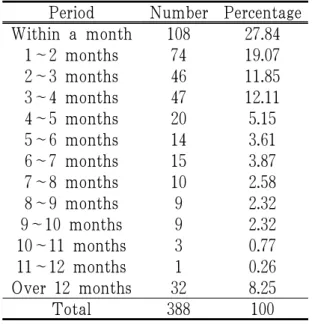
2) 출산일로부터 내원일까지의 기간 출산일로부터 내원일까지 평균 기간은 131.5±214.6일 이었으며, 1개월 이내 108명 (27.84%), 1개월~2개월 74명(19.07%), 2개월~3개월 46명(11.85%), 3개월~4개월 47명(12.11%), 4개월~5개월 20명(5.15%), 5개월~6개월 14명(3.61%), 6개월~7개월 15명(3.87%), 7개월~8개월 10명(2.58%),
8개월~9개월 9명(2.32%), 9개월~10개월 9명(2.32%), 10개월~11개월 3명(0.77%), 11개월~12개월 1명(0.26%), 12개월 이상 이 32명(8.25%)으로 나타났다(Table 5).
Month Number Percentage January 22 5.67 February 34 8.76
March 33 8.51
April 40 10.31
May 37 9.54
June 34 8.76
July 38 9.79
August 39 10.05 September 33 8.51
October 31 7.99 November 21 5.41 December 26 6.70
Total 388 100
Table 4. The Number of Postpartum
Patients according to Visiting Month
Period Number Percentage Within a month 108 27.84
1~2 months 74 19.07 2~3 months 46 11.85 3~4 months 47 12.11 4~5 months 20 5.15 5~6 months 14 3.61 6~7 months 15 3.87 7~8 months 10 2.58 8~9 months 9 2.32 9~10 months 9 2.32 10~11 months 3 0.77 11~12 months 1 0.26 Over 12 months 32 8.25
Total 388 100
Table 5. The Number of Postpartum Patients according to Duration from Delivery Date to Visiting Date
3) 초진 이후 내원 횟수
초진을 포함하여 같은 주소로 평균 1.91±1.7회 내원하였으며, 1회 내원 209명
(53.87%), 2회 내원 106명(27.32%), 3회 내원 39명(10.05%), 4회 내원 15명(3.86%), 5회 이상 내원은 19명(4.90%)이었다(Table 6).
Visit count Number Percentage 1 time 209 53.87 2 times 106 27.32 3 times 39 10.05 4 times 15 3.86 Over 5 times 19 4.90
Total 388 100
Table 6. The Number of Postpartum Patients according to Visit Count under Same Chief Complaints
3. 임신 및 분만과 관련된 특성 1) 보조생식술 시행 여부
연구 대상자 중 자연임신을 한 산모는 369명(95.10%), 보조생식술을 시행하여 임신을 한 산모는 19명(4.90%)으로 나타 났다(Table 7).
2015 (%) 2016 (%) 2017 (%) Total (%) Natural Pregnancy 133 (95.68) 140 (98.59) 96 (89.72) 369 (95.10) ART Intrauterine insemination 4 (2.88) 0 (0) 1 (0.93) 5 (1.29)
In vitro fertilization 2 (1.44) 2 (1.41) 10 (9.35) 14 (3.61) Table 7. The Number of Postpartum Patients according to Natural Pregnancy and Assisted Reproductive Technology (ART)
2) 임신성 질환의 이환 여부
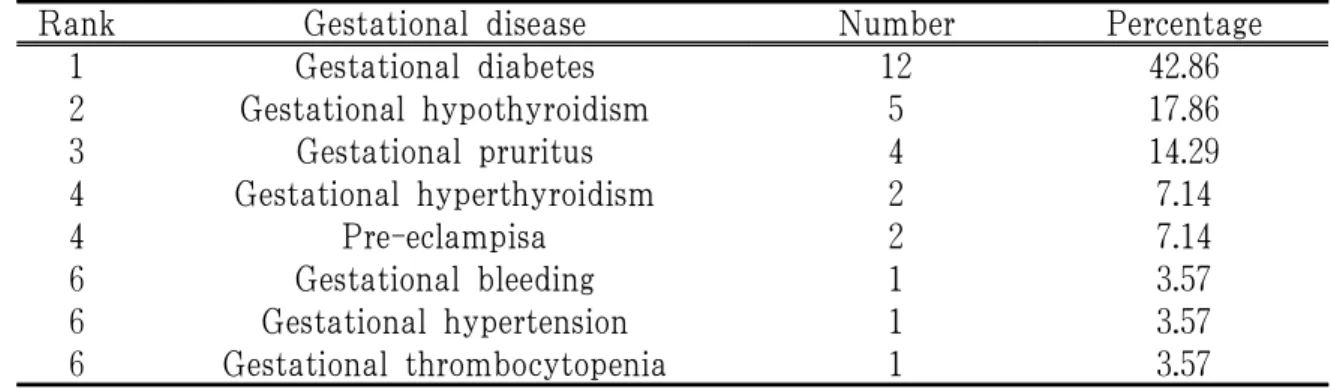
연구 대상자 중 임신성 질환에 이환된 산모는 총 28명(7.22%)이었다. 그 중 임 신성 당뇨가 12명(42.86%)으로 가장 많 았고, 갑상선 기능 저하증 5명(17.86%),
임신성 소양증 4명(14.29%), 임신 중독증
과 갑상선 기능 항진증 각각 2명(7.14%)
순이었으며 임신성 고혈압, 임신 중 출
혈, 임신성 혈소판 감소증은 각각 1명
(3.57%)으로 가장 적었다(Table 8).
Rank Gestational disease Number Percentage
1 Gestational diabetes 12 42.86
2 Gestational hypothyroidism 5 17.86
3 Gestational pruritus 4 14.29
4 Gestational hyperthyroidism 2 7.14
4 Pre-eclampisa 2 7.14
6 Gestational bleeding 1 3.57
6 Gestational hypertension 1 3.57
6 Gestational thrombocytopenia 1 3.57 Table 8. The Number of Postpartum Patients Diagnosed with Gestational Disease
3) 산모의 체중 변화
연구 대상자 중 임신 전 체중, 만삭 체 중, 내원 당시의 체중이 모두 기록되어 있는 229명 산모의 임신 전 평균 체중은 54.21±7.32 kg, 만삭 평균 체중은 67.2±8.42
kg, 내원 당시의 평균 체중은 58.95±8.15 kg였다(Table 9).
출산일로부터 내원일까지의 기간에 따 른 만삭 평균 체중과 내원 당시의 평균 체중 차는 다음과 같다(Table 10).
A* B † C ‡ B-A C-A C-B
Average BW (kg) 54.21±7.32 67.2±8.42 58.95±8.15 12.99±4.99 4.74±4.69 -8.24±3.57
* A : before pregnancy, †B : full-term pregnancy, ‡C : visiting date
Table 9. The Comparison of Average Body Weight (BW)
Period Number The difference of average BW Within a month 68 -7.97
1~2 months 44 -7.95 2~3 months 29 -8.83 3~4 months 23 -8.43 4~5 months 10 -8 5~6 months 8 -9.5 6~7 months 9 -8.45 7~8 months 6 -8.67 8~9 months 4 -6 9~10 months 4 -8.25 10~11 months 5 -7.6 Over 12 months 19 -8.79
Table 10. The Difference of Average BW between Full-term Pregnancy and Visiting Date according to Duration from Delivery Date to Visiting Date
5) 분만 형태
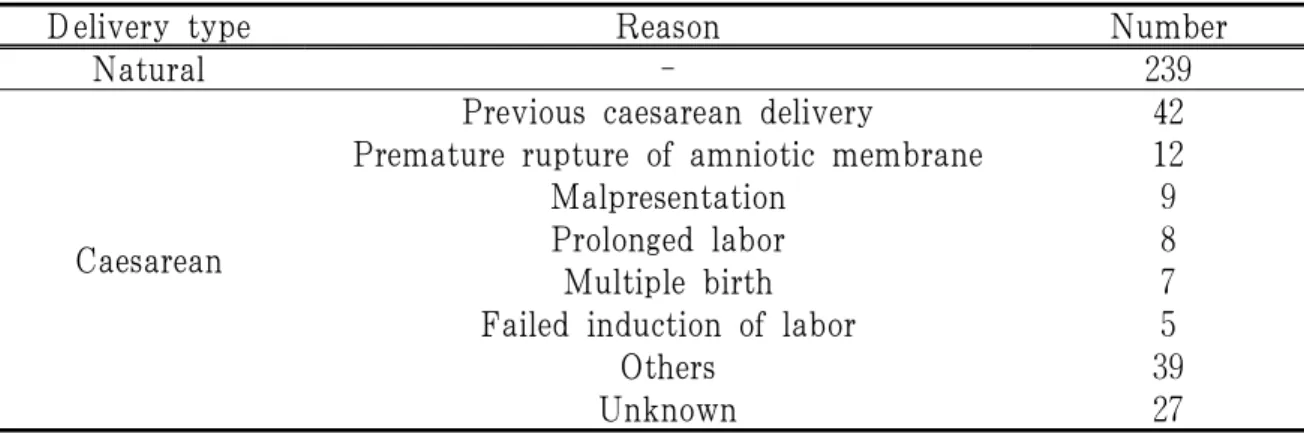
연구 대상자 중 자연분만을 한 산모는
239명(61.6%), 제왕절개를 통해 분만한 산모는 149명(38.4%)이었다.
제왕절개로 분만한 산모에서 시행 원
인으로 제왕절개의 과거력 42명(28.2%)
으로 가장 많았으며 조기 양막 파수 12
명(8%), 태위 이상 9명(6%), 분만 지연
8명(5.4%), 다태아 분만 7명(4.7%), 유
도분만 실패 5명(3.4%), 협골반, 조기진
통, 전치태반, 양수과소증, 경관개대지연,
거대아, 거대한 자궁근종이 각각 3명(2%),
과도한 진통, 임신 중독증, 노산, 분만 중
출혈과다, 산모의 선택이 각각 2명(1.34%),
태아의 태변 흡입, 태아 호흡부전, 태반
조기 박리, 유착태반, 과도한 자궁수축,
자궁 파열, 융모양막염, 양수과다증이 각각
1명(0.7%)으로 가장 적었다(Table 11).
Delivery type Reason Number
Natural - 239
Caesarean
Previous caesarean delivery 42 Premature rupture of amniotic membrane 12
Malpresentation 9
Prolonged labor 8
Multiple birth 7
Failed induction of labor 5
Others 39
Unknown 27
Table 11. Classification of Postpartum Patients by Delivery Type
6) 내원 당시 오로 배출 및 모유수유 여부
연구 대상자 중 내원 당시 오로 배출
이 진행 중인 산모는 167명(43.04%)이었 으며, 모유수유를 하고 있는 산모는 262 명(67.53%)이었다(Table 12).
Item State Number Percentage
Discharging lochia Ongoing 167 43.04 Already terminated 221 56.96
Feeding Formula feeding 126 32.47
Exclusive breast feeding 139 35.82 Partial breast feeding 123 31.71 Table 12. The Number of Postpartum Patients Discharging Lochia and Breast Feeding at First Visiting Date
4. 산후병의 특성 1) 주 소
주소가 되는 산후병의 증상은 관절통 217명(55.93%), 기력저하 58명(14.95%), 냉감 53명(13.66%), 부종 18명(4.64%), 발한과다 13명(3.35%), 현훈 9명(2.32%), 하복통 7명(1.80%), 소화장애 3명(0.76%), 열감, 대변이상, 소변이상은 각각 2명(0.52%) 순으로 나타났으며 기타가 4명(1.03%)이 있었다. 기타에는 체중감량, 오로배출지연,
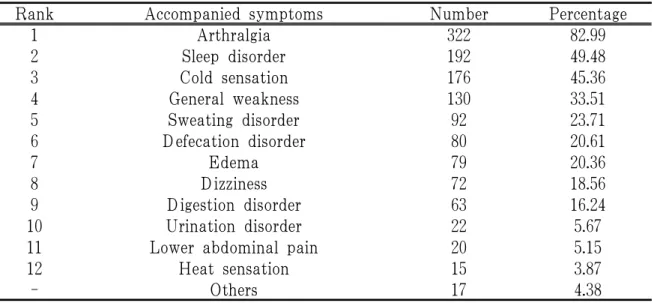
주소를 포함하여 현재 호소하고 있는
동반증상에 따라 분류하였을 때, 관절통
322명(82.99%), 수면장애 192명(49.48%),
냉감 176명(45.36%), 기력저하 130명(33.51%),
발한과다 92명(23.71%), 대변이상 80명
(20.61%), 부종 79명(20.36%), 현훈 72명
(18.56%), 소화 장애 63명(16.24%), 소변
이상 22명(5.67%), 하복통 20명(5.15%),
열감 15명(3.87%) 순으로 나타났으며 기
타 17명(4.38%)이 있었다. 기타에는 한
Rank Chief complaints Number Percentage
1 Arthralgia 217 55.93
2 General weakness 58 14.95
3 Cold sensation 53 13.66
4 Edema 18 4.64
5 Sweating disorder 13 3.35
6 Dizziness 9 2.32
7 Lower abdominal pain 7 1.80
8 Digestion disorder 3 0.76
9 Heat Sensation 2 0.52
9 Defecation disorder 2 0.52
9 Urination disorder 2 0.52
- Others 4 1.03
Total 388 100
Table 13. Chief Complaints of Postpartum Patients
Rank Accompanied symptoms Number Percentage
1 Arthralgia 322 82.99
2 Sleep disorder 192 49.48
3 Cold sensation 176 45.36
4 General weakness 130 33.51
5 Sweating disorder 92 23.71
6 Defecation disorder 80 20.61
7 Edema 79 20.36
8 Dizziness 72 18.56
9 Digestion disorder 63 16.24
10 Urination disorder 22 5.67
11 Lower abdominal pain 20 5.15
12 Heat sensation 15 3.87
- Others 17 4.38
Table 14. Other Accompanied Symptoms of Postpartum Patients including Chief Complaints (Multiple Responses)
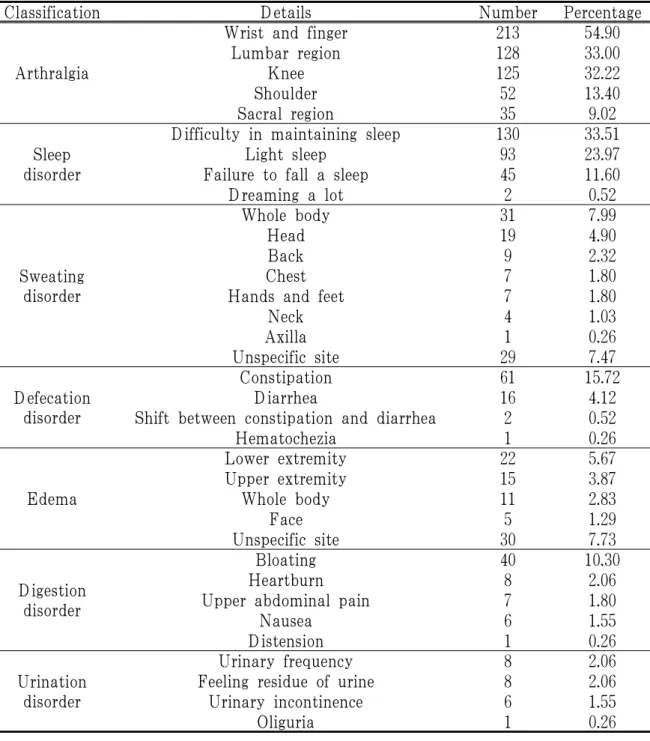
관절통의 부위에 따라서는 손목과 손 가락이 213명(54.90%)으로 가장 많았으며 요부 128명(33%), 슬부 125명(32.22%), 견 부 52명(13.40%), 천추부 35명(9.02%) 순 으로 나타났다.
수면장애의 양상에 따라서는 빈각이 130명(33.51%)으로 가장 많았으며 천면 93명(23.97%), 난입면 45명(11.60%), 다 몽 2명(0.52%) 순으로 나타났다.
발한과다의 부위에 따라서는 전신이 31명
(7.99%)으로 가장 많았으며 두부 19명 (4.90%), 배부 9명(2.32%), 흉부 및 수 족부 각각 7명(1.80%), 경항부 4명(1.03%), 액와부 1명(0.26%) 순으로 나타났으며 불특정 부위에는 29명(7.47%)이 있었다.
대변이상의 양상으로는 변비가 61명 (15.72%)으로 가장 많았으며 설사 16명 (4.12%), 변비⋅설사 교대 2명(0.52%), 혈 변 1명(0.26%) 순으로 나타났다.
부종의 부위에 따라서는 하지가 22명
(5.67%)으로 가장 많았으며 상지 15명 (3.87%), 전신 11명(2.83%), 안면 5명(1.29%) 순으로 나타났으며 불특정 부위에는 30 명(7.73%)이 있었다.
소화장애의 양상으로는 더부룩함이 40명 (10.30%)으로 가장 많았으며, 속 쓰림 8명 (2.06%), 상복부 통증 7명(1.80%), 오심
6명(1.55%), 상복부 팽만(0.26%) 1명 순 으로 나타났다.
소변이상의 양상으로는 빈뇨 및 잔뇨 감 각각 8명(2.06%)으로 가장 많았으며 실금 6명(1.55%), 핍뇨 1명(0.26%) 순으 로 나타났다(Table 15).
Classification Details Number Percentage
Arthralgia
Wrist and finger 213 54.90
Lumbar region 128 33.00
Knee 125 32.22
Shoulder 52 13.40
Sacral region 35 9.02
Sleep disorder
Difficulty in maintaining sleep 130 33.51
Light sleep 93 23.97
Failure to fall a sleep 45 11.60
Dreaming a lot 2 0.52
Sweating disorder
Whole body 31 7.99
Head 19 4.90
Back 9 2.32
Chest 7 1.80
Hands and feet 7 1.80
Neck 4 1.03
Axilla 1 0.26
Unspecific site 29 7.47
Defecation disorder
Constipation 61 15.72
Diarrhea 16 4.12
Shift between constipation and diarrhea 2 0.52
Hematochezia 1 0.26
Edema
Lower extremity 22 5.67
Upper extremity 15 3.87
Whole body 11 2.83
Face 5 1.29
Unspecific site 30 7.73
Digestion disorder
Bloating 40 10.30
Heartburn 8 2.06
Upper abdominal pain 7 1.80
Nausea 6 1.55
Table 15. Accompanied Symptoms in Detail (Multiple Responses)
3) 치 료
증상에 대한 한방 처치로 한약 치료는 356명(91.75%), 침 치료는 150명(38.66%), 구 치료는 122명(31.44%)의 산모에게 시 행되었다(Table 16). 세부적으로는 한약 단독 치료가 215명(55.41%)으로 가장 많 았으며 그 뒤로 한약치료+침구치료 114명 (29.38%), 한약치료+침 치료 27명(6.96%), 무 처치 23명(5.93%), 침구치료 8명(2.06%) 순으로 나타났으며 침 단독 치료는 1명 (0.26%)으로 가장 적었다(Table 17).
Types of treatment Number Percentage Herbal medicine 356 91.75%
Acupuncture 150 38.66%
Moxibustion 122 31.44%
Table 16. The Number of Postpartum Patients according to Treatment
Types of treatment Number Percentage
HM* 215 55.41
HM+ACUP † +MOXA ‡ 114 29.38 HM+ACUP 27 6.96 ACUP+MOXA 8 2.06
ACUP 1 0.26
No treatment 23 5.93 Total 388 100
* HM : herbal medicine, †ACUP : acupuncture,
‡MOXA : moxibustion