대한치위생과학회지
Vol. 3, No. 1, 2020
Doi : 10.22753/JKDHS/2020.3.1.15
Awareness and Necessity of Registered Dentist Program for Children and Adolescents
최용금
1·김미선
2·정수라
3·류다영
4·김은정
5†1
선문대학교 건강보건대학 치위생학과 및 유전체 기반 바이오IT 융합연구소,
2경동대학교 치위생학과,
3
이화여자대학교 신산업융합대학 융합보건학과,
4혜전대학교 치위생과,
5서울대학교 치학연구소
1. Introduction
According to ‘student health analysis data’, the most frequent problem in Korean students is oral disease along with abnormal visual acuity1). The DMFT index for 12-year-old children in Korea is generally declining compared to the past. However, the prevalence of dental caries was still very high(30%), and about 60% of students suffered from oral disease due to periodontal disease and malocclusion. Moreover, oral health levels during the childhood and adolescence period were clearly worse than those of the socially underprivileged2,3). To address this problem, social policies are needed for vulnerable people with low oral health levels4). In the case of developed countries, oral health care systems in adult targets vary widely from country to country in the scope of oral health care coverage; however, it provides free oral health care
for both children and adolescents5). In addition, in the U.K. and other major advanced countries, dental care systems are common in all children and adolescents, providing preventive and oral health-enhancing services instead of treatment-oriented ones6,7).
The dentists’ society for health society argued that the overall introduction of a system of children and adolescent dentists, whose main contents is to provide preventive and education-oriented services to the national health insurance system from 2007, is a realistic measure suitable for Korea8). The ministry of health and welfare is also expressing its commitment to introduction the system by including a projects to develop a system for children and adolescent dentist in the third comprehensive plan for national health promotion announced in 20119). For this reason, the Korean government also started to implement the registered dentist program for children and adolescents(RDPCA)10).
RDPCA is a system for enrolling one dental practitioner each year for ages 0~18, to receive oral health care with sustainability, and to give participants the choice and prior autonomy of dental practitioners, while enhancing the benefits of sustainability11). 접수일: 2020년 4월 30일 최종수정일: 2020년 6월 11일
게재 확정일: 2020년 6월 11일
교신저자: 김은정, (03080) 서울특별시 종로구 대학로 101 서울대학교 치과대학 치학연구소
Tel: 02-740-8782, Fax: 02-766-8781 E-mail: [email protected]
Services provided by the RDPCA system include oral examination(check-up, oral examination, radiography), oral health promotion(oral hygiene, eating habits control, fluoride use, smoking, etc.), preventive care(professional oral hygiene management, fluoride application, sealant, removing calculus). In Incheon, the program began as a registered dentist program for children and adolescents for low-income children and expanded to the whole country. In 2012, after undergoing a pilot project in Seoul, RDPCA were implemented in Ulsan, Incheon Namdong-gu, Gwangju, Jeonnam Mokpo, Gyeonggi Seongnam, Bucheon, Hwaseong, and Busan. In Gangneung, where the RDPCA project were implemented, the results of the implementation of a dental health care system centered on prevention and oral health promotion services showed that improvement in oral health level, number of cases and the cost of medical care were reduced12). As such, the RDPCA is similar to the primary medical service’s goal of promoting preventive-oriented oral health, and one can expect even greater results as preventive care focuses on children and adolescents which the most effective effect. However, currently, no RDPCA has been implemented nationwide in Korea, and research on it is very insufficient. In addition, there is no study conducted on participants and non-participants implementing RDPCA.
Therefore, based on the findings for previous studies, this study aims to provide the right direction for the expansion of RDPCA system. The purpose of this study is to prepare the basic data for the improve RDPCA system by analyzing the necessity, satisfaction differences and awareness according to the implementation.
2. Materials and methods
2.1. Study participants
It targeted adult residents in their 20s or older who live in Seoul, an area that has been implementing the RDPCA system since March 2019, and in the cities of Cheonan and Asan. The survey was conducted by randomly extracting a total of 310 people from 236 non-RDPCA system area people, 74 from RDPCA system area people.
2.2. Study design
The survey was conducted by the individual self- writing survey on the necessity and recognition of the RDPCA system. The questionnaire to be used for the study was carried out by the researchers revising and supplementing the questionnaire of the preceding study, which has been verified for reliability and validity13-15). The questionnaire consisted of 27 questions, and detailed items included general characteristics(5 questions), oral management behavior and attitude questions(3 questions), awareness survey(7 questions), participation survey(4 questions), and effectiveness survey(4 questions), and the investigator who participated in the RDPCA system surveyed the satisfaction questions by adding 4 questions. Participate survey included expectation effect, reason for participate, and so on. The survey was conducted online and SNS with Naver form. The Institutional Review Board of the 00 University approved the survey(00-201903-009-1). All participants signed an informed consent form before participating in the study.
2.3. Statistical analysis
The data used were IBM SPSS statistics 20.0(IBM SPSS Statistics 20.0, IBM, Inc, Chicago, IL, USA). For general characteristics, frequency analysis was
conducted to find out whether the RDPCA system was implemented and the satisfaction of system participants.
Cross-analysis was conducted to examine general characteristics, oral care behaviors and attitudes, awareness and participation. The awareness and need of participants and non-participants in the RDPCA were analyzed using t-test. Statistically, the significance level was 0.05.
3. Results
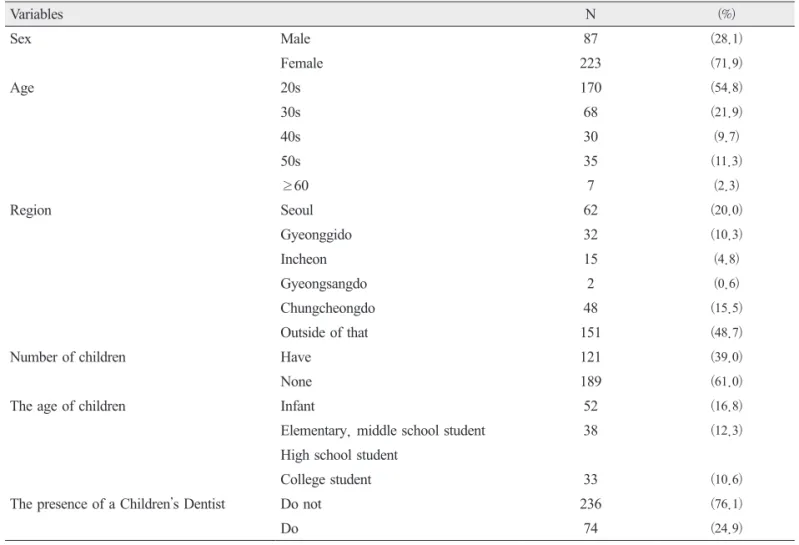
Among the study subjects, 236 people(76.1%) did not implement the RDPCA, and 74 people(24.9%) did
it(Table 1). When surveying the people who know about the RDPCA, the non-participants were 215 who did not know the most(91.1%), and 21 who knew(8.9%). When we looked at the participants, 59(79.7%) were the most unaware, and 15(20.3%) were the “knowing”.
RDPCA participants were significantly more aware than non-participants. Regarding how they knew about RDPCA, non-participants were found to be the highest in 6(25.0%), who were known as ‘doctor/
urse of the hospital’ or ‘introduction of relatives or neighbors’. In the RDPCA participants group, ‘after seeing advertisements/promotions directly’ was the most(10 (50.0%))(Table 2).
Table 1. General Subjects Information
Variables N (%)
Sex Male 87 (28.1)
Female 223 (71.9)
Age 20s 170 (54.8)
30s 68 (21.9)
40s 30 (9.7)
50s 35 (11.3)
≥60 7 (2.3)
Region Seoul 62 (20.0)
Gyeonggido 32 (10.3)
Incheon 15 (4.8)
Gyeongsangdo 2 (0.6)
Chungcheongdo 48 (15.5)
Outside of that 151 (48.7)
Number of children Have 121 (39.0)
None 189 (61.0)
The age of children Infant 52 (16.8)
Elementary, middle school student 38 (12.3)
High school student
College student 33 (10.6)
The presence of a Childrenʼs Dentist Do not 236 (76.1)
Do 74 (24.9)
Values are presented as a number (%).
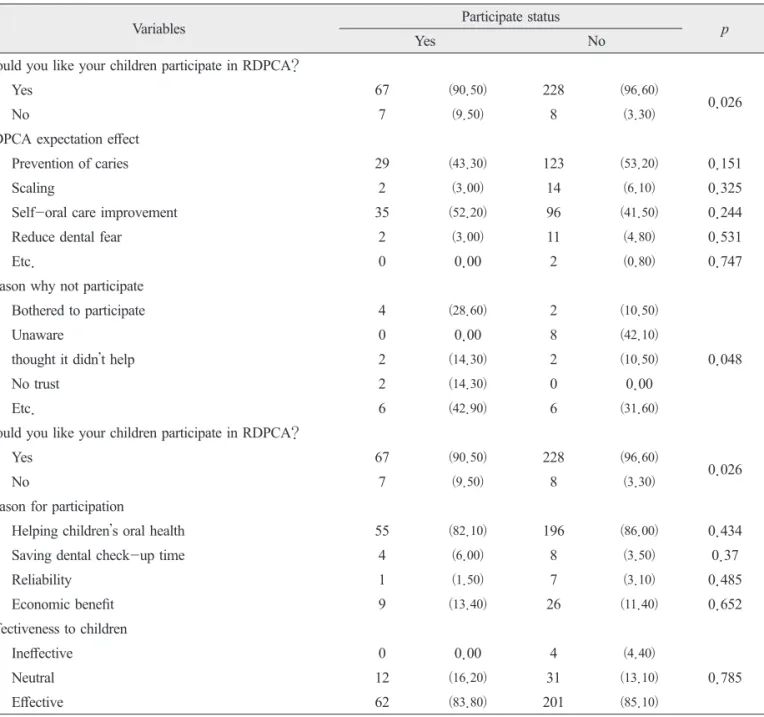
When surveying the desire to participate in RDPCA, 96.6% of the respondents said they would ‘participate’
in non-RDPCA participate group. In addition, non- RDPCA participants were more likely to participate in RDPCA than those who participated in RDPCA(P
<0.026). Among the expected effects of RDPCA, caries prevention was the highest with 53.2% and self- oral care improvement was high with 41.5%. The reason for not participating in RDPCA was 41.1%, because they did not know how to apply(Table 3). Table 2. Analysis of the Awareness of RDPCA Participants and Non-Participates
Variables Participate status
Yes No p
Do you know RDPCA?
0.008
No 59 (79.7) 215 (91.1)
Yes 15 (20.3) 21 (8.9)
Do you think RDPCA is necessary?
0.321
No 2 (3.0) 13 (5.7)
Yes 63 (97.0) 215 (94.3)
Path to knowing RDPCA
Magazine 10 (50.0) 4 (16.7) 0.018
Hospital 3 (14.3) 6 (25.0) 0.399
Broadcast 4 (19.0) 4 (16.7) 0.835
Relatives 1 (4.8) 6 (25.0) 0.062
Etc. 3 (14.3) 4 (16.7) 0.826
Do you think RDPCA is important?
0.313
No 0 (0.0) 4 (1.7)
Yes 74 (100.0) 232 (98.3)
Do you think RDPCA costs are reasonable?
0.092
Low 48 (64.8) 123 (52.3)
Moderate 24 (32.4) 102 (43.4)
High 25 (33.8) 112 (47.7)
How much do you think it is appropriate to pay for the RDPCA (Won)
0.573
Less than forty thousand 3 (5.5) 11 (8.0)
40,000 to 50,000 4 (7.3) 6 (4.4)
50,000 to 60,000 8 (14.5) 30 (21.9)
60,000 to 70,000 16 (29.1) 30 (21.9)
Over 70,000 24 (43.6) 60 (43.8)
Values are presented as a number (%).
Table 3. Participation and Benefit of RDPCA
Variables Participate status
Yes No p
Would you like your children participate in RDPCA?
Yes 67 (90.50) 228 (96.60)
0.026
No 7 (9.50) 8 (3.30)
RDPCA expectation effect
Prevention of caries 29 (43.30) 123 (53.20) 0.151
Scaling 2 (3.00) 14 (6.10) 0.325
Self-oral care improvement 35 (52.20) 96 (41.50) 0.244
Reduce dental fear 2 (3.00) 11 (4.80) 0.531
Etc. 0 0.00 2 (0.80) 0.747
Reason why not participate
Bothered to participate 4 (28.60) 2 (10.50)
0.048
Unaware 0 0.00 8 (42.10)
thought it didn’t help 2 (14.30) 2 (10.50)
No trust 2 (14.30) 0 0.00
Etc. 6 (42.90) 6 (31.60)
Would you like your children participate in RDPCA?
Yes 67 (90.50) 228 (96.60)
0.026
No 7 (9.50) 8 (3.30)
Reason for participation
Helping children’s oral health 55 (82.10) 196 (86.00) 0.434
Saving dental check-up time 4 (6.00) 8 (3.50) 0.37
Reliability 1 (1.50) 7 (3.10) 0.485
Economic benefit 9 (13.40) 26 (11.40) 0.652
Effectiveness to children
Ineffective 0 0.00 4 (4.40)
0.785
Neutral 12 (16.20) 31 (13.10)
Effective 62 (83.80) 201 (85.10)
Values are presented as a number (%).
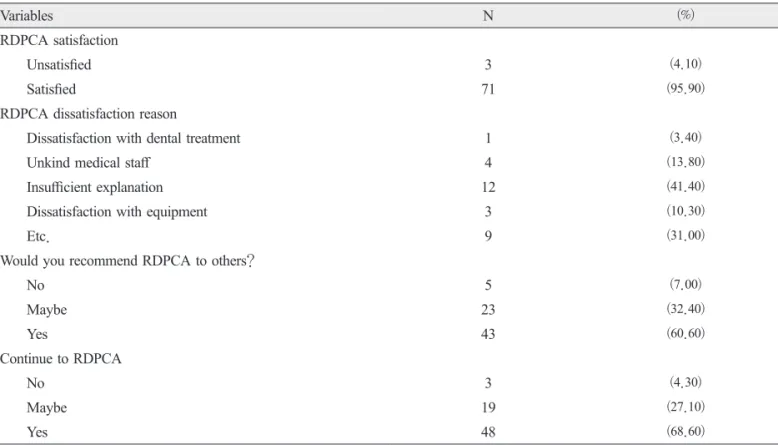
According to the analysis of the satisfaction level of the RDPCA received by their children, 48.6% said they were satisfied, and 47.3% said they were normal.
The reason why they were not satisfied with the RDPCA services they received was because they were not explained in detail, followed by unfriendliness from
the medical staff in charge. In addition, the highest percentage of people who said they would recommend RDPCA to others was the highest, and the highest percentage of those who said they would continue to use RDPCA(Table 4).
Table 4. RDPCA Satisfaction Survey of RDPCA Participants
Variables N (%)
RDPCA satisfaction
Unsatisfied 3 (4.10)
Satisfied 71 (95.90)
RDPCA dissatisfaction reason
Dissatisfaction with dental treatment 1 (3.40)
Unkind medical staff 4 (13.80)
Insufficient explanation 12 (41.40)
Dissatisfaction with equipment 3 (10.30)
Etc. 9 (31.00)
Would you recommend RDPCA to others?
No 5 (7.00)
Maybe 23 (32.40)
Yes 43 (60.60)
Continue to RDPCA
No 3 (4.30)
Maybe 19 (27.10)
Yes 48 (68.60)
Values are presented as a number (%).
4. Discussion
Oral health behaviors that are correctly formed in children and adolescents are an important factor in determining oral health throughout whole life. Dental caries and periodontal disease, the most common oral disease, are chronic diseases that are frequent from the time of children and adolescents, and affect them throughout their entire lives. Therefore, children and adolescents should make efforts to prevent oral disease at home12). Based on the results of implementing a dental care system focused on preventive and oral health promotion services through the implementation of projects by children and adolescent dentists, the results of improving oral health levels, reducing the number of treatments and the cost of care were found12). Based on these achievements, there is a need to expand the RDPCA. Therefore, this study assessed the need and awareness of areas where and where the
RDPCA is not implemented, and examined to help develop the business continuously, knowing the need for areas where the business is not implemented, as well as for areas where it is not implemented.
In this study, oral care behaviors and attitudes of those who participate in the RDPCA show greater interest in those who participate in the RDPCA and those who do not participate. Oral management methods have also shown that subjects performing scaling and tooth brushing are managed at a higher rate in those who participate in the RDPCA. Since research on the RDPCA is insufficient in Korea, it is somewhat difficult to compare it with other preceding studies. Nevertheless, these results are thought to be more interested in oral hygiene than those who do not participate in the RDPCA.
When asked whether they knew the RDPCA, the subjects responded that participants knew the RDPCA rather than non-participants. However,
despite participating in the RDPCA, 80 percent of the respondents said they did not know the RDPCA well, indicating that they participated in the RDPCA but did not know about the RDPCA. The route of knowing the RDPCA was the highest when they saw advertisements or promotional materials. Another prior study, “Satisfaction of Family Medicine Registrar of a tertiary care institution that is implementing the system of the physician,” also showed high results of reporting advertisements or promotional materials directly to the RDPCA16). Previous research has similar results to our research, with similar results suggesting the direction of RDPCA perception and therefore the advertising/
promotion should be conducted nationwide as a route to raising awareness of the RDPCA system. Both non-participants and participants in the RDPCA need and, to the extent of importance, have responded that it is necessary and important, I think it is necessary for all, and I think most of the respondents have positive thoughts about the projects related to oral health.
The appropriateness of the amount of RDPCA has been shown to be high on ‘very low’ for both participants and non-participants. In addition, the appropriate amount was the highest response rate of
‘over 70,000 won’. As the cost of preventive care can be lower than the cost of high treatment, it is believed that government support for prevention rather than treatment is needed. Participants in the RDPCA and those who did not participate showed higher results than those who participated in the RDPCA.
In the “Seoul Dental Clinicʼs Policy Assessment and Improvement Plan,” a survey on whether to continue to use dental services or recommend other parents to participate in the RDPCA showed a tendency to repeat the increase and decrease over the past three years17). The reason why the non-participants were higher than the participants is that the expected effects
of helping children’s teeth and preventing cavities are consistent with the curiosity to participate in the RDPCA. Therefore, we should provide opportunities to know and actively participate in RDPCA. Among those who were not allowed to participate in the RDPCA, however, the most respondents said they did not know how to apply for the RDPCA. This seems to be a lack of awareness of the RDPCA, which requires not only the promotion of the RDPCA, but also the improvement and efforts to prevent oral health. The degree of oral health, effectiveness, oral care, and oral hygiene care improvement among children showed no significant difference between the participating and the nonparticipating subjects with the highest 'improvement' results. This is expected to expand the RDPCA as both subjects are aware of the positive effects on the RDPCA, and the government is expected to need further amplified support for the preventive-focused dental projects.
In a survey on the satisfaction of project participants in RDPCA, 48 percent said yes to the satisfaction of service use and continued use of the RDPCA afterwards. In response, it is believed that continuous dental work should be further developed. However, 41.4 percent said they were not satisfied with the service because they did not elaborate. This is judged to be a lack of information and understanding of RDPCA, so it should present the proper direction of the RDPCA with more diverse knowledge and information about the RDPCA.
There are several limitations of this study. The research results cannot be generalized because the survey was conducted in the Seoul metropolitan area and Asan city area, and the ratio of areas where RDPCA have been conducted is relatively small compared to those in the non-experienced areas, depending on the characteristics of the study
participants. In addition, since RDPCA is still being implemented in a few areas throughout the country, it has received low-recognition survey results, including answers that it is not aware of the project. And also, there was some difficulty in comparing with our research because there was no prior study researched on the work of RDPCA. Based on these findings, the research should be carried out in the future at an even rate nationwide as well as in the Seoul Metropolitan Government and Asan City areas to ensure that the survey is not biased.
It is necessary to actively promote the background and needs of the system itself, such as the need for more attention in the enforcement area for the proper direction of the dental system, and the development of a lifelong oral health care program through the dental system. In addition, for the development of oral health care programs for all children and adolescents in Korea, and for the improvement of the satisfaction level of the dental care system, high quality programs are actively considered and continuous monitoring is needed. And also, it is believed that such RDPCA could be expanded nationwide and lead to a sweeping change in the dental care system for oral care of the entire nation, from children and adolescents to adults, pregnant women, infants, senior citizens and disabled people based on their performance in the future.
ORCID ID
Yong-Keum Choi: 0000-0002-5537-4208 Mi-Sun Kim: 0000-0002-3191-9541 Su-Ra Jeong: 0000-0002-7853-8893 Da-Young Ryu: 0000-0003-4356-6621 Eun-Jeong Kim: 0000-0002-6316-7807
References
1. Ministry of Education Science and Technology.
The results of sample survey on school health examination 2011. Seoul:Ministry of Education Science and Technology;2012:1-52.
2. Jung MH, et al. Relationship of socioeconomic status to self-related oral health. J Dent Hyg Sci 2014;14:207-213.
3. Shin BM, et al. Oral health and occupational status among Korean adults. J Dent Hyg Sci 2016;16:225- 234. https://doi.org/10.17135/jdhs.2016.16.3.225 4. Kim CS, Jeon JE. Trends in oral health inequality
in 12-year-old Korean children: A study using the Gini coefficient. J Kor Acade Oral Health 2013;37:154-160. https://doi.org/10.11149/
jkaoh.2013.37.3.154
5. Kim MJ, et al. Oral health status of the old, over 65 who Dwell in Seongnam city. J Dent Hyg Sci 2005;5:19-24.
6. Ministry of Health and Welfare. A handbook of oral health program: VI. Installation and operation of dental clinic in public sector. Gwacheon:Ministry of Health and Welfare;2000:77.
7. Ministry of Health and Welfare, Korea Institute for Health and Social Affairs. The National Health Plan 2020: 11. Oral health. Seoul:Ministry of Health and Welfare, Korea Institute for Health and Social Affairs;2011:301-331.
8. Jung SH, et al. Basic research for introducing the dental family doctor system for children and adolescents(1). Seoul:Gunchi;2010:1-71.
9. Ministry of Health and Welfare, Korea Institute for Health and Social Affairs. The National Health Plan 2020: 11. Oral health. Seoul:Ministry of Health and Welfare, Korea Institute for Health and Social Affairs;2011:301-331.
10. Government SM: Seoul Metropolitan Masterplan Seoul Metropolitan Government, pp.53-56, 2012.
11. Jung SH, et al. A study for registered dentist of Child and Adolescent (I). Seoul: Association of Dentists for Healthy Society 2010.
12. Jung SH, et al. One-year outcomes and reasons for dropout in participants of the continuous dental care program of the Community Child Center in Gangnueng city. JKAOH 2013;37:110-116.
https://doi.org/10.11149/jkaoh.2013.37.2.110 13. Yoo JH, et al. The Degree of Satisfaction on
Constitutional Health Care Program for an Extended Family. JSCM 2009;20:.87-95.
14. Seo HK, et al. A Telephone Survey on the Opinions about Family Doctor 1998;31:310-322.
15. Park JM, et al. Development and Evaluation of Comprehensive Health Care Program for Infectious Disease Management in Child Care Centers by Doctor of Korean Medicine 2013;30:65-81.
16. Jung JH, et al. Oral health promotion program application and effect for underprivileged lower grade students. The journal of korean society for school &
community health education 2015;16:41-50.
17. Lee YS. Satisfaction of the registrar of the third- degree medical institution in which the doctor’s system is implemented: Phd Thesis. Graduate School of Health at Yonsei University: 2000
ABSTRACT
Awareness and Necessity of Registered Dentist Program for Children and Adolescents
Yong-Keum Choi
1· Mi-Sun Kim
2· Su-Ra Jeong
3· Da-Young Ryu
4· Eun-Jeong Kim
5†1
Department of Dental Hygiene, College of Health Science and Genome-based BioIT Convergence Institute, Sun Moon University, Chungcheong, Korea
2
Department of Dental hygiene, Kyungdong university, Korea
3
Department of Health Convergence, The Graduate School Ewha Womans University, Korea
4
Department of Dental Hygiene, Hyejeon College, Korea
5