• 검색 결과가 없습니다.

Comparison Survey Examining Korean and Japanese University Students' Understanding of Foreign Words

N/A
N/A
Protected

Academic year: 2021

Share "Comparison Survey Examining Korean and Japanese University Students' Understanding of Foreign Words"

Copied!
4
0
0

로드 중.... (전체 텍스트 보기)

전체 글

(1)

54

Journal of Engineering Education Research Vol. 17, No. 4, pp. 54~57, July 2014

Comparison Survey Examining Korean and Japanese University Students' Understanding of Foreign Words

Jae Hoon Lee

*,†

․ Yutaka Arimitsu

*

․ Zhiqiang Wu

*

․ Hidetsugu Yagi

*

*

Ehime University

ABSTRACT

This paper investigated the influence of foreign words, otherwise known as loan words, on global communication abilities of university students from two non English-speaking countries: Korea and Japan. To survey the understanding and usage of foreign words which are from English language and used frequently in daily conversation, questionnaires were administered to Korean and Japanese university students majoring in engineering who shared similar linguistic backgrounds. The results were analyzed from global communication viewpoint. Based on the results, methods for improving global communication skills in engineering education were proposed.

Keywords: Engineering Education

I. Introduction 1)

Recent advances in globalization have increasingly required collaborations between engineers at multinational and foreign companies. Consequently, foreign language education in Korean and Japanese universities has expanded. Many programs have been established to teach foreign languages, specifically English, concurrently with professional knowledge, and engineering education is not an exception to this trend [1-4]. Furthermore, many critical disciplines are now taught solely in English, and numerous classes also rely upon English-language textbooks.

From the standpoint of language education, the frequent and continuously evolving use of loanwords in mass media and on social networking sites aids foreign language learning.

While countless foreign words encompass the lexicon of global communication, those most familiar to students are often used erroneously. For example, the original pronunciation and meaning of loanwords can become distorted, forming completely new words through truncation or fusion with a speaker's native vocabulary. As a result, communication is impeded between native and non-native speakers, thus hindering effective global communication.

Received 30 June, 2014; Revised 30 June, 2014 Accepted 30 July, 2014

† Corresponding Author: [email protected]

In a scenario where a beginning language learner attempts to converse with foreigners, regardless of whether the other interlocutor is a native or non-native speaker of the target language, the learner may struggle to communicate since he or she misunderstands or mispronounces certain words. While the learner may like to use familiar words that they believe are English, miscommunication occurs if the learner's usage of a word differs from its commonly understood meaning. This is particularly true for native speakers of Japanese or Korean at the university level, who struggle with English's very different pronunciation and grammar. When a foreign word is a key term in an individual's field, the aforementioned issues are detrimental to the learner's successful communication with colleagues worldwide. Therefore, this paper examines Korean and Japanese engineering students' understanding of foreign words, and the influence of distorted loanwords is analyzed within the scope of beginning level global communications.

II. Korean and Japanese Linguistic Environments 1. General features

Although Korean and Japanese are different languages,

there are some commonalities between them, specifically

in their grammars. Most notably, predicates and verbs

(2)

Comparison Survey Examining Korean and Japanese University Students' Understanding of Foreign Words

Journal of Engineering Education Research, 17(4), 2014 55

are generally positioned at the end of sentences in both languages. However, in English, predicates that follow a subject are not usually positioned at the end. Thus, the framework of Korean and Japanese are fundamentally different, and English learners from both countries experience common difficulties.

Furthermore, many words in Japanese and Korean are derived from Chinese characters. For example, the word equivalent to “preparation” in English is 준비 in Hangul and “じゅんび” in Hiragana, which are Korean and Japanese scripts, respectively. However, in either language the term is pronounced [zu:nbi], since both words are derived from the Chinese character 準備. Therefore, a Korean familiar with Chinese characters can extract some meaning from Japanese sentences since they are not only written in Hiragana and Katakana, but also Chinese. It is worth mentioning that while many Korean words are derived from Chinese characters, general sentences in modern Korean are written solely in Hangul; in contrast, general sentences in Japanese continue to be written in both Chinese characters and Hiragana.

2. Use of loanwords

In transliterating foreign words into Korean it is customary to use the Hangul script, although it is preferable to use Latin characters. In Japanese, however, most foreign words are written in Katakana, which is a specialized Japanese script designed for emphasis or foreign words. The actual pronunciation of foreign words differs between speakers of Korean and Japanese due to the existence of distinct sounds in each respective language. For instance, while Koreans prefer to pronounce English words in a manner akin to a native speaker, the use of Katakana by speakers of Japanese requires adherence to certain phonetic constraints.

III. Questionnaire examining Korean and Japanese university students' understanding of foreign words

1. Questionnaire content

In investigating participants' understanding of loanwords,

especially those of an English derivation, a survey was administered. Several frequently used loanwords in both Japanese and Korean were compiled along with questions related to them(see Table 1). Basic words that all students would likely be familiar with, regardless of their academic proficiency, were selected to reduce bias. Vocabulary was provided solely in the participants' native scripts to more accurately gauge their understanding of each word. Thus, Japanese and Korean students were supplied with loanwords in Katakana and Hangul respectively. Table 1 provides both the native English, Japanese, and Korean transliterations of each word, accompanied by a transcription of each language's pronunciation using the International Phonetic Alphabet. It is observed that there are some differences between the pronunciations of each language for the words.

Table 1. List of questionnaire vocabulary.

English Japanese (Katakana) Korean (Hangul) 1 Presentation

[pri:zenteɪʃn]

プレゼン [prezen]

프리젠테이션 [pri:zenteɪʃn]

2 Seminar

[semɪnɑ:(r)]

ゼミ [zemɪ]

세미나 [semɪnɑ:]

3 Gear

[gɪə(r)]

ギア [gia]

기어 [gɪə]

4 Bolt / Voltage [boʊlt/voʊltɪdƷ]

ボルト [boruto]

볼트 [bolt]

5 Touring

[túəriŋ-]

ツーリング [tsu:rɪŋgu]

투어링 [túəriŋ]

6 Thank you

[θӕŋkju:]

サンキュー [saŋkju:]

땡큐 [ttӕŋkju:]

7 Trouble

[trʌbl]

トラブル [toraburu]

트러블 [trəbl]

8 Global

[gloʊbl]

グローバル [guro:baru]

글로벌 [globəl]

9 Hamburger

[hӕmb3:rgə(r)]

ハンバーガー [hanba:ga:]

햄버거 [hӕmbəgə]

10 Energy

[enərdƷ]

エネルギー [enerugi]

에너지 [enədƷ]

The following four questions were asked in relation to each word above:

Q1. Concerning the student's interpretation of a word How do you understand its meaning? Please describe

its simplest meaning in your native language.

Q2. Concerning the original English word

Do you know the original English word? Can you

(3)

Jae Hoon Lee․Yutaka Arimitsu․Zhiqiang Wu․Hidetsugu Yagi

공학교육연구 제17권 제4호, 2014

56

recollect and rewrite it?

Q3. Assessing the participant's understanding of a word's general meaning in English-speaking countries.

Do you believe that the general meaning of this word in English-speaking countries corresponds to your own understanding of it? Please answer with

‘O(same) / X(not same)’.

Q4. Regarding the ability of native English speakers to understand the student's pronunciation of a word If you use this word with a native speaker of

English will they understand? Please answer with

‘O(may understand) / X(may not understand)’.

Q5. Additionally, participants were asked to assess their overall ability to communicate with native English speakers in the following question:

Of the one hundred English words you know related to daily life, estimate how many could be understood by the general public of an English-speaking country Please write down the number of your expectation.

2. Questionnaire results

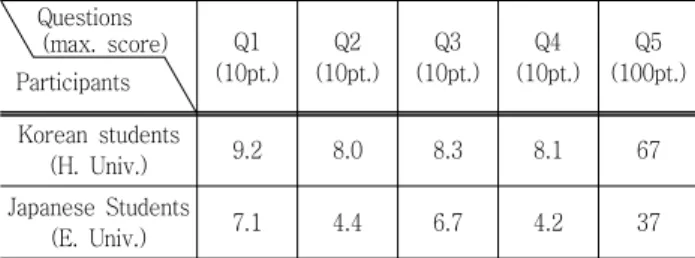
Thirty-nine Korean and 73 Japanese engineering students attending H and E universities respectively participated in the survey. The results are shown in Table 2; numbers denote the average score for each question. Fore questions 1-4, ten points signifies a perfect score, while one hundred points is the maximum achievable score for the fifth question. Overall, Korean students scored higher than their Japanese counterparts; this is particularly evident for the second and fourth questions.

Table 2. Questionnaire results (average points).

Questions (max. score) Participants

Q1 (10pt.)

Q2 (10pt.)

Q3 (10pt.)

Q4 (10pt.)

Q5 (100pt.)

Korean students

(H. Univ.) 9.2 8.0 8.3 8.1 67

Japanese Students

(E. Univ.) 7.1 4.4 6.7 4.2 37

3. Analysis of results

Although these results provide a partial understanding

of students' abilities from both countries, the results cannot be considered conclusive. Overall, the results suggest that Korean students grasp the original meanings of English loanwords more accurately than their Japanese peers.

This could be attributable to Japanese students' use of Katakana to represent loanwords, whose unique phonetic constraints result in degraded understanding and, particularly, distorted pronunciation. This phenomenon is evident in Table 1, which illustrates the sharply different pronunciation of English loanwords in Japanese when compared to Korean.

A commonality between both groups of students, however, is their ability to understand the meanings of frequently used loanwords, specifically, simple ones that are less likely to deviate in meaning or pronunciation from their original forms. Regarding the poor performance of Japanese students for questions two and four, this highlights a need for educational activities targeting their unique needs, focusing on the correct pronunciation and meaning of loanwords. This, in turn, will aid Japanese students as effective participants in global communication. As for question 5, these results are indicative of a lack of self-confidence pertaining to communicative ability, in which students fear real life contact with foreigners.

IV. Suggestions for enhancing the global com- munication ability

It is believed that loanwords are misunderstood due to inadequate explanation, or because of contextualization unique to the learner‘s culture or field; in both cases, the individual’s familiarity with the word differs from conventional, native usages. Therefore, engineering educators must provide students with adequate opportunities to obtain the correct knowledge concerning the general use of both foreign and native terms in the field. To accomplish this, the following changes should be considered:

• Syllabi should provide keywords for lectures not only in students' native language, but also in English

• Introductory lectures should familiarize students with foreign keywords and their native pronunciations, accompanied by a post-lecture review

• Examinations should quiz students concerning foreign

(4)

Comparison Survey Examining Korean and Japanese University Students' Understanding of Foreign Words

Journal of Engineering Education Research, 17(4), 2014 57

keywords

• Textbooks should provide keywords both in the students' native language and English

V. Conclusions

It has been generally accepted that the inclusion of English loanwords in the lexicons of other languages aids global communication. However, changes in the pronunciation and meaning of loanwords can inhibit global communication in specializations such as engineering, where the exchange of information using common terminology is vital. In the author's survey of Korean and Japanese students' understanding of loanwords, distortions in meaning, pronunciation, and the original form were apparent. Therefore, educators must provide students with increased exposure to loanwords in their original forms, with specific emphasis placed on key terms. This can be accomplished through modifications to syllabi, lectures, examinations, and textbooks.

This work was partially supported by JSPS Grants- in-Aid for Scientific Research (C) 22500813.

References

1. K. Morimura, Y.A. Ono, “Assessment of ‘Special English Lessons’ for engineering students”, IEEE Int. Conf. on Professional Communication Conference(IPCC), pp. 1-4, (2009)

2. Y. Arimitsu, H. Yagi, J.H. Lee, Z. Wu, and H. Kanesaka,

“An Experiment of Reading Aloud Meeting in English,”

The 2nd Asian Conference on Engineering Education (ACEE), (2011)

3. K. Norimura, and S. Suzuki, “Global Leader Education in Project Based Style – Live Experience of Global Activity”, Journal of JSEE, Vol.60, No.1, pp.112-118, (2012).

4. H. Nishizawa, T. Yoshioka, and K. Ito, “Improving Engineering Students' English Proficiency with International Exchange Activities and Extensive Reading”, Journal of JSEE, Vol.61, No.1, pp.147-152, (2013).

Jae Hoon Lee

Associate professor, Department of Mechanical Engineering, Graduate School of Science and Engineering, Ehime University Received BS(1996) in Mechanical and Automatic Control Engineering from Korea University of Technology and Education, and MS(1998) and Ph.D.(2003) in Electric, Electrical, Control and Instrumentation Engineering from Hanyang University, Korea. His work experiences are JSPS fellow(2007-2008) with the Ubiquitous Functions Research Group, Intelligent Systems Research Institute, AIST, Postdoctoral fellow(2004-2006) with Intelligent Robot Laboratory, University of Tsukuba, Japan. His current research focuses on the collaborative navigation of mobile robot in daily environment, and the design and control of bio-inspired robotic systems.

Phone / Fax: +81-89-927-9709 E-mail: [email protected]

Yutaka Arimitsu

Associate Professor, Faculty of Engineering, Ehime University Received BE(1978), ME(1980) and Ph.D.(1990) in Engineering from Osaka University. His work experiences are Associate Professor(1993-), Assistant Professor(1991-1993), Faculty of Engineering, Ehime University, Kochi National College of Technology(1982-1991) and KYOCERA Corporation(1980-1982). He was a visiting fellow, CCM, University of Delaware, USA(1996-1997). His current research focuses on topology optimization of micro polar solids.

Phone: +81-89-927-9710 Fax: +81-89-927-9744

E-mail: [email protected]

Zhiqiang Wu

Senior Assistant Professor, Faculty of Engineering, Ehime University Received BS(1987) from Northeastern University (China), MS(1992) and Ph.D.(1995) from Toyohashi University of Technology(Japan). His work experiences are Senior Assistant Professor(2004-2014), Assistant Professor(1995-2004), Faculty of Engineering, Ehime University. His current research focuses on the shape and topology optimization in dynamic problems.

Phone: +81-89-927-9714 Fax: +81-89-927-9714

E-mail: [email protected]

Hidetsugu Yagi

Professor, Faculty of Engineering, Ehime University Received BS(1972), MS(1974) and Ph.D.(1983) in Mechanical Engineering from Osaka University. His work experiences are Professor (2011-), Associate Professor(1987-2011), Assistant Professor (1974-1987), Faculty of Engineering, Ehime University. His current research focuses on the plasma process.

Phone: +81-89-9279729

Fax: +81-89-9279744

E-mail: [email protected]

수치

Table  1.  List  of  questionnaire  vocabulary.
Table  2.  Questionnaire  results  (average  points).

참조

관련 문서