감자(Solanum tuberosum L.)는 인류의 식량으로 중요한 작물중의 하나로 7,000년 전에 이미 재배되었다고 알려져 있으나, 이보다 더 이른 시기부터 재배되었을 것으로 추정 된다(Kim, 2005). 재배되는 감자는 괴경을 이용하여 증식 하는 영양번식작물로 감자 식물체로부터 절단된 부정아를
땅속에 묻으면 괴경이 형성된다는 것이 알려진 후, 경삽은 씨감자 대량증식방법으로 이용되었으며(Bryan et al., 1981;
Buck & Akeley, 1966; Cole & Wright, 1967; International Potato Center, 1975, 1976), Hamann (1974)은 경삽묘가 1 년에 260~7,600배까지 증식이 가능하여 효율적인 묘 생산
폐쇄형식물생산시스템을 이용한 감자 경삽묘 육묘시 묘소질과 괴경 생산에 대한 LED 광도의 영향
조만현
1,†
・ 함인기2
・ 박권서1
・ 조지홍3
Effect of LED Light Intensity on Seedling Quality and Tuber Production of Potato Stem Cuttings Grown in a Closed-Type Plant Production System
Man Hyun Jo
1,†
, In Ki Ham2
, Kwon Seo Park1
, and Ji Hong Cho3
ABSTRACT This study was performed to establish light intensity conditions for producing stem cuttings for aeroponic systems suitable for seed potato production using a closed-type plant production system. Shoot tip cultured plantlets of ‘Sumi’ and
‘Chubaek’ potato (Solanum tuberosum L.) were acclimatized, cuttings were collected, and stem cuttings were planted. The seedlings were raised for 40 days at different LED light intensities (60, 120, 180, and 240 μmol·m-2·s-1), and were cultivated in an aeroponic system for 80 days. When stem cuttings were raised at 60 μmol·m-2·s-1 LED light intensity, the plant height was the longest, at 17.3 cm for ‘Sumi’ and 16.1 cm for ‘Chubaek’, and the number of nodes was the highest in both cultivars. The higher light intensities, produced smaller plants with fewer nodes. The leaf areas, SPAD values, and Fv/Fm values differed slightly between cultivars. The fresh weight of stem cuttings, and the production rate of healthy stem cuttings were the highest at 60 µmol·m-2·s-1. In the aeroponic system, seedlings raised at 60 μmol·m-2·s-1 with LED light intensity showed a difference between the cultivars, but the fresh weight of stems and leaves above the planting plate was the heaviest. In addition, below the planting plate the stem cuttings were longest and the root weight was heaviest at 60 μmol·m-2·s-1 LED light intensity. The number of stolons also differed between cultivars, but was greatest for seedlings raised at 60 μmol·m-2·s-1 LED light intensity, at 4.2/plant for ‘Sumi’
and 7.7/plant for ‘Chubaek’. At 60 μmol·m-2·s-1 LED light intensity, the tuber number and total tuber weight were the best, but the higher the light intensity, the smaller the total tuber number and total tuber weight for both cultivars. In conclusion, when producing potato stem cuttings for aeroponic systems using a closed-type plant production system, the most suitable LED light intensity for raising seedlings was found to be 60 μmol·m-2·s-1.
Keywords : aeroponic system, closed-type plant production system, photosynthetic photon flux density, Solanum tuberosum L., stem cuttings, tuber, yield
Original Research Article
ⓒ 본 학회지의 저작권은 한국작물학회지에 있으며, 이의 무단전재나 복제를 금합니다.
This is an Open-Access article distributed under the terms of the Creative Commons Attribution Non-Commercial License (http://creativecommons.org/licenses/by-nc/3.0) which permits unrestricted non-commercial use, distribution, and reproduction in any medium, provided the original work is properly cited.
1)충청남도농업기술원 종자관리소 농업연구사 (Junior Research Scientist, Seed Management Office, Chungcheongnam-do Agricultural Research and Extension Services, Yesan 32425, Korea)
2)충청남도농업기술원 원예연구과 농업연구관 (Senior Research Scientist, Horticulture Research Division, Chungcheongnam-do Agricultural Research and Extension Services, Yesan 32418, Korea)
3)농촌진흥청 국립식량과학원 고령지농업연구소 농업연구관 (Senior Research Scientist, Highland Agriculture Research Institute, National Institute of Crop Science, Rural Development Administration, Pyeongchang 25342, Korea)
†
Corresponding author: Man Hyun Jo; (Phone) +82-41-635-6292; (E-mail) [email protected]
<Received 4 June, 2020; Revised 28 August, 2020; Accepted 21 September, 2020>
기술이라고도 하였다. 유전자원의 보존방법(Goodwin et al., 1980)으로 이용하던 기내소괴경도 씨감자 생산에 이용하기 도 하였으나(Hussey & Stacey, 1984; Joung, 1989; Wang
& Hu, 1982; Yiem et al., 1990), 크기가 작아 발아가 불균 일하고 초기생육이 늦고 수량이 적은 등의 문제점이 있었 다(Choi et al., 1994; Kim et al., 1993).
양액재배는 일반적으로 배지의 종류나 배양액과 산소의 공급방법에 따라 수경, 분무경, 역경, 사경, rock wool경 등 으로 분류되는데(Fong et al., 1969; Ulrich et al., 1972;
Wheeler et al., 1990), 감자에서도 양액재배를 이용한 씨감 자 생산 가능성이 보고된 바 있으며(Kim et al., 1993), 씨 감자 생산을 위한 양액재배방식은 담액경(DFT)이나 박막 순환식(NFT) 양액재배 방식보다 분무경재배가 적합하다고 알려졌다(Kang et al., 1996). 분무경재배를 통한 씨감자 생 산에는 대량의 경삽묘 생산기술을 이용하고 있으며(Kang et al., 2006), 경정배양으로 생산된 조직배양묘를 증식(Jo et al., 2001)하고 경삽한 경삽묘를 이용하여 안정적인 씨감자 생산체계를 구축하고 있다(Jo et al., 2017, 2018a, 2018b, 2018c, 2019, 2020; Kang et al., 1996; Kim et al., 1997;
Kang et al., 2005, 2006, 2017). 충청남도농업기술원에서 는 2013년부터 씨감자생산기반구축사업에 참여하여 경삽 묘를 이용한 분무경재배로 최상위단계의 바이러스 무병 씨 감자를 생산하고 농업인에게 보급하고 있다.
작물을 시설 내에서 광, 온도, 습도 및 배양액 등의 환경 조건을 인공적으로 제어하여 계절이나 장소 등의 외부환경 에 관계없이 연속적으로 생산하는 시스템을 좁은 의미로는 밀폐형 인공제어 식물생산시스템(Masamoto, 2007)으로 정 의 할 수 있는데, 본 연구는 안정적인 씨감자 생산을 위하 여 폐쇄형 생산시스템에서 경삽묘의 생산에 적합한 LED 광도를 구명하고자 수행하였다.
재료 및 방법 공시품종 및 조직배양묘 증식
대한민국에서 봄에 가장 많이 재배하고 있는 일기작 감 자인 ‘수미’와 숙기가 빠르면서 휴면기간이 짧고 봄·가을에 모두 재배할 수 있는 이기작 감자인 ‘추백’을 공시품종으 로 이용하였다. 실험재료는 농촌진흥청 국립식량과학원 고 령지농업연구소에서 경정배양한 배양묘를 분양 받아 PVY ImmunoStrip Kit (ISK 20001/0025, Agdia, Inc., USA)를 이용하여 PVY 감염여부를 확인한 다음 온도 21°C, 상대습 도 50%, 광도 60 μmol·m-2·s-1 (LED 하방광), 그리고 광주 기(명기/암기) 16/8시간으로 조정된 배양실에서 hormone-
free MS배지(Murashige & Skoog, 1962)를 이용하여 조직 배양묘를 증식하였다.
조직배양묘 순화 및 삽수채취
배양실에서 20일간 계대배양한 조직배양묘(초장: ‘수미’
8.3 cm, ‘추백’ 7.5 cm)를 가로 550 × 세로 366 × 높이 120 mm 크기의 순화상자(NAP 5312, 엔피씨주식회사, 대한민 국)에 흰 부직포(40 g·m-2)를 깔고 펄라이트(입자크기 2~5 mm) 10 L를 채운 다음 상자당 225주를 3 cm 깊이로 정식 (2018년 1월 7일)하여 순화하였다. 순화는 온도 21°C, 상대 습도 80%, 광도 60 μmol·m-2·s-1 (LED 하방광), 그리고 광 주기(명기/암기)를 16/8시간으로 하여 폐쇄형식물생산시스 템인 경삽실에서 제4종 복합비료를 이용한 배양액(pH 6.6, EC 1.0 dS·m-1)을 충전식분무기(HP-2010, 한일에스피주식회 사, 대한민국)로 매일 상자당 200 ml씩 두상관비하였다.
조직배양묘 순화 24일 후 삽수를 채취하였는데, 본엽 2 매를 남기고 나머지 잎을 제거하고 삽수장을 5 cm로 다듬 어서 경삽용 삽수(경경: ‘수미’ 1.8 mm, ‘추백’ 1.7 mm)로 이용하였다.
경삽묘 육묘 및 광도
경삽묘는 온도 21°C, 상대습도 80%로 조정된 경삽실에 서 수조형배양대(W 1350 × D 800 × H 2200 mm, 4단)에 서 제4종 복합비료를 이용한 배양액(pH 6.6, EC 1.0 dS·m-1) 을 분무기로 매일 상자당 200 ml씩 두상관비하면서 Jo et al. (2018a, 2018b, 2018c, 2019)의 보고를 참고하여 40일 간 육묘하였다.
육묘중의 광도는 수조형배양대 각 단마다 평판 LED (1170
× 466 × 18 mm, 120W, SMPS, Dimming type, 3개 PCB, PCB: 396 × 298 × 1.0 t, loz)를 1개씩 설치하여 60, 120, 180, 그리고 240 μmol·m-2·s-1 하방광으로 광도를 조절하였 으며, 광주기(명기/암기)는 16/8시간 이었다(Fig. 1). LED (Light emitting diode, Mid-Power LED-3030, 서울반도체주식회 사, 대한민국)의 광도 측정은 PHOTO/RADIOMETER (HD 2102.2, Delta OHM, Italy)를 이용하여 광원(LED)으로부 터 38 cm 떨어져 있는 배지표면 중앙에 38 mm 높이의 센 서(LP 471 PAR Probe, Italy)를 놓고 광합성유효광양자속 밀도(PPFD, Photosynthetic Photon Flux Density)를 측정 하였다. 시험구는 반복당 삽수 225개씩 3반복으로 총 675 개를 경삽하여 1개 배양대에 4개 처리구를 완전임의배치 하였다.
분무경재배
분무경재배는 농촌진흥청 표준설계 08-자동화-I형 온실 (4,160 m2)에서 스티로폼 성형베드(가로 520 × 세로 1,000
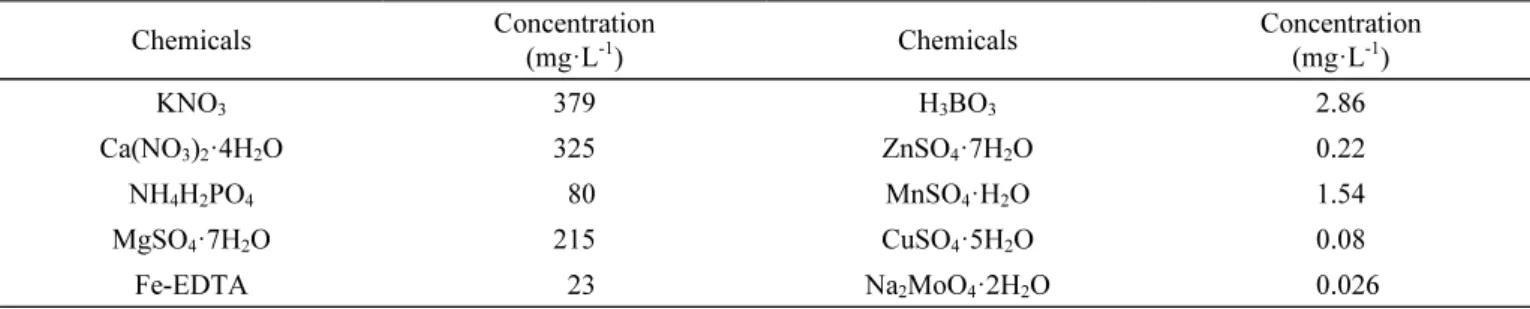
× 높이 310 mm)에 50 cm 간격으로 노즐(1.32 ± 0.02 mm) 을 설치하고, 분무경 2호 정식판(두께 35 mm)에 재식거리 25 × 25 cm 간격으로 정식하였으며, 배양액은 감자전용액 (Table 1, Chang et al., 2000)을 이용하여 주간 300초 공급 후 300초 휴지, 야간에는 300초 공급 후 600초 휴지로 조 절하다가, 4월 6일 이후부터는 주간 120초 공급 후 600초 휴지, 야간에는 120초 공급 후 1,200초 휴지로 공급하였다.
배양액의 온도는 18°C로 조절하다가 4월 3일 이후에는 16°C 로 낮추어 관리하면서, 10일마다 새로운 배양액(EC 0.8~1.3 dS·m-1, pH 6.5)으로 교체하였다. 시험구는 반복당 4주씩 5 반복으로 총 20주를 2018년 3월 16일 정식하였으며, 1개 베드에 4개 처리구를 완전임의배치하였다.
생육 및 수량조사
광도별 경삽묘의 생육조사는 반복당 10주씩 경삽 후 40 일째에 초장, 마디수, 경경(줄기굵기), 엽수, 엽면적, SPAD, Fv/Fm, 생체중, 건물중, 경삽묘 생산율을 조사하였다. 초장 은 배지표면에서 식물체 정부까지의 길이를, 마디수는 배지 표면에서 정부 아래 마디가 명확히 구분되는 부분까지, 경 경은 정부 아래 세 번째 마디의 중간 부위를 측정하였다. 엽 수는 1 cm 이상의 본엽을, 엽면적은 엽면적측정기(LI-3100C AREA-METER, LI-COR, USA)를 이용하여 개체 전체의 잎 을 채취하여 측정하였다. SPAD 값은 엽록소측정기(SPAD 502, Minolta, Japan)를 이용하여 정부 아래 세 번째 본엽을, 엽록소형광값(Fv/Fm)은 측정하기 전에 암적응 클립으로 30 분간 적응시킨 후 엽록소형광측정기(Multi-Mode Chlorophyll Fluorometer OS5p, Opti-SCIENCES, USA)를 이용하여 정 부 아래 세 번째 본엽을 측정하였다. 경삽묘 생산율은 정상 적으로 생장을 하면서 분무경재배에 이용할 수 있는 건전 한 경삽묘 비율을 조사하였다.
분무경재배의 생육조사는 정식 후 80일 되는 날에 지상 부의 경엽 생체중, 경삽묘 생체중, 뿌리 생체중, 복지 생체 중을 조사하였으며, 첫 번째, 두 번째, 세 번째 각각의 복지 수와 복지길이를 측정하였다.
분무경재배의 수량조사는 수확하기 전 1일간 감자표피 큐 어링을 위하여 배양액 공급을 중단하고 정식판을 들어 올 려 자연녹화를 시킨 다음, 2018년 6월 4일 수확하였는데, 괴 경중이 0.5 g 이상인 것을 6계급(0.5~3, 3~5, 5~10, 10~30, 30~50, 50 g 이상)으로 나누어 주당 괴경수와 총괴경중을 조사하였다.
Fig. 1. Closed-type plant production system using perlite hydro- ponic system (Left, ‘Sumi’; Right, ‘Chubaek’).
Table 1. Chemical composition of nutrient solution used for the aeroponic cultivation of potatoes.
Chemicals Concentration
(mg·L
-1) Chemicals Concentration
(mg·L
-1)
KNO
3379 H
3BO
32.86
Ca(NO
3)
2·4H
2O 325 ZnSO
4·7H
2O 0.22
NH
4H
2PO
480 MnSO
4·H
2O 1.54
MgSO
4·7H
2O 215 CuSO
4·5H
2O 0.08
Fe-EDTA 23 Na
2MoO
4·2H
2O 0.026
통계분석
모든 통계처리는 Costat프로그램(CoStat Version 2.11, Monterey, USA)을 이용하여 ANOVA 및 Duncan의 다중 검정을 p ≤ 0.05수준에서 유의성을 분석하였다.
결과 및 고찰 광도별 경삽묘 생육
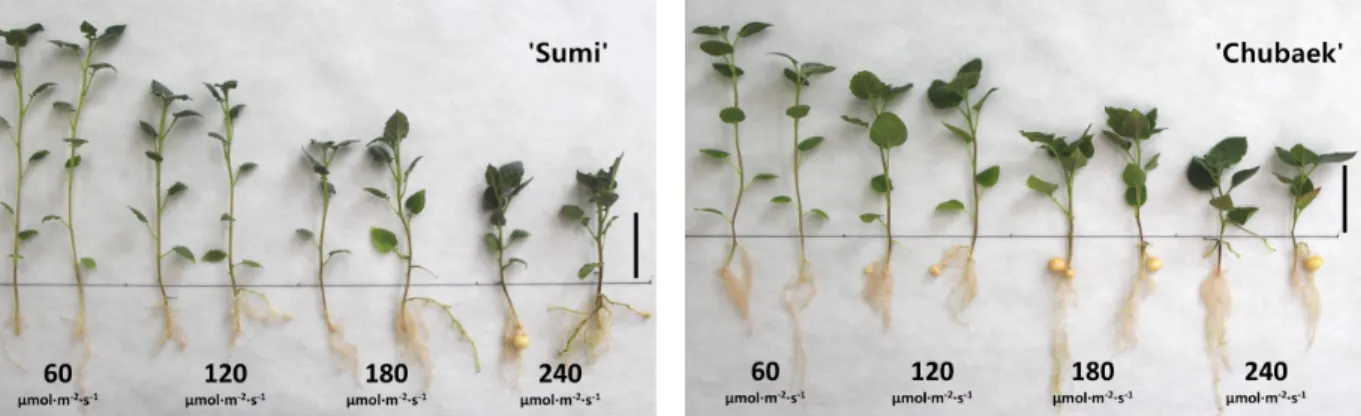
육묘 40일 후의 품종별 광도에 따른 경삽묘의 생육은 Table 2 및 Fig. 2와 같다.
초장은 60 μmol·m-2·s-1 광도에서 ‘수미’ 17.3 cm, ‘추백’
16.1 cm로 가장 컸으며, 광도가 높아질수록 작았다. 경경은
‘수미’에서는 광도가 높을수록 굵었지만 ‘추백’에서는 광도 별 유의적 차이가 없었다. 마디는 60 μmol·m-2·s-1 광도에서
‘수미’ 10.4개, ‘추백’ 7.9개로 가장 많았으며, 광도가 높을
수록 마디수는 적었다.
엽수에서는 품종별 반응이 달랐는데 ‘수미’의 경우에는 광도에 따른 일정한 경향을 보이지는 않았으나 ‘추백’에서 는 광도가 낮을수록 많아 60 μmol·m-2·s-1 광도에서 주당 7.3개로 많았다. 엽면적 또한 ‘수미’의 경우 광도별 유의차 가 없었으며, ‘추백’에서는 광도가 낮을수록 주당 엽면적이 컸는데, 60 μmol·m-2·s-1 광도에서 ‘수미’ 19.0 cm2, ‘추백’
25.7 cm2로두 품종 모두 낮은 광도에서 주당 엽면적이 큰 경향이었다. SPAD 값도 ‘수미’에서는 광도에 따른 차이는 없었으나, ‘추백’에서는 240 μmol·m-2·s-1 광도에서 51.6으로 가장 높게 나타났다. Fv/Fm 값 또한 ‘수미’에서는 광도에 따른 유의적 차이는 없었으나 ‘추백’에서는 240 μmol·m-2·s-1 광도에서 0.8186으로 가장 낮았다.
광도별 경삽묘의 주당 생체중은 60 μmol·m-2·s-1 광도에 서‘수미’ 1.229 g, ‘추백’ 1.249 g으로 가장 높았으나 나머
Fig. 2. Growth of stem cuttings as affected by LED light intensity in a closed-type hydroponic system using perlite (Left, ‘Sumi’;
Right, ‘Chubaek’). The black scale bar represents 50 mm.
Table 2. Effect of LED light intensity on the growth of stem cuttings of 2 potato cultivars grown for 40 days in a closed-type plant production system.
Cultivar LED light intensity (μmol·m
-2·s
-1)
Plant height
(cm)
Stem diameter
(mm)
No. of nodes /plant
No. of leaves /plant
Leaf area
(cm
2/plant) SPAD
value Fv/Fm value
Fresh weight (g/plant)
weight Dry (g/plant)
Production rate
z(%) Sumi 60 17.3 a
y1.7 b 10.4 a 8.7 ab 19.0 a 50.0 a 0.8671 a 1.229 a 0.0885 c 100.0 a
120 10.2 b 1.8 b 8.9 b 7.6 c 15.2 a 48.8 a 0.8310 a 0.927 b 0.1269 b 89.4 b 180 10.4 b 2.2 a 10.7 a 9.2 a 17.5 a 50.9 a 0.8299 a 1.069 ab 0.1565 ab 83.1 b 240 7.3 c 2.1 a 8.9 b 8.3 b 15.1 a 49.8 a 0.8243 a 0.967 b 0.1765 a 58.6 c Chubaek 60 16.1 a 1.7 a 7.9 a 7.3 a 25.7 a 48.1 ab 0.8272 a 1.249 a 0.1034 a 99.1 a 120 9.5 b 1.7 a 6.9 ab 6.5 ab 22.1 ab 47.7 b 0.8297 a 0.994 b 0.1069 a 85.9 a 180 8.2 b 1.7 a 7.2 ab 6.7 ab 22.8 ab 48.8 ab 0.8254 a 1.038 b 0.1445 a 65.6 b 240 5.9 c 1.6 a 6.7 b 6.2 b 21.0 b 51.6 a 0.8186 b 0.993 b 0.1391 a 25.6 c
z
Rate of healthy stem cuttings production.
y
Mean differences within columns by Duncan’s multiple range test at p ≤ 0.05.
지 광도에서는 통계적 유의성이 없었으며, 건물중의 경우
‘수미’는 광도가 높을수록 높았으나 ‘추백’은 광도에 따른 유의성이 없었다. 건전한 경삽묘 생산율은 두 품종 모두 60 μmol·m-2·s-1 광도에서 가장 높았으며, 광도가 높을수록 매 우 감소하였다. 광도가 높을수록 경삽묘에서 복지나 마이 크로튜버가 많이 생성되었는데(Fig. 2), 특히 ‘수미’의 경우 60 μmol·m-2·s-1 광도에서는 마이크로튜버가 형성되지 않았다.
유식물체의 생장 및 형태에 영향을 주는 환경요인은 온 도, 상대습도, 수분포테셜, 광, CO2 농도, 배지의 무기영양 분 등 여러 요인이나, 그 중에서 광은 식물의 생장과 분화 에 큰 영향을 미친다(Jeong et al., 1995). 감자 배양시 광조 사 방향에 관계없이 광도가 증가하면 초장은 짧아진다는 Kitaya et al. (1995)의 보고와 폐쇄형 묘생산 시스템에서 감자 플러그묘는 광도가 증가함에 따라 초장은 감소했다는 Kim et al. (2008)의 보고는 본 연구 결과와 유사한 결과를 나타내었다. 그러나 식물공장에서 광도는 엽채류의 엽수 전 개에는 영향을 미치지 않는다는 보고(Choi et al., 2014)와 높 은 광도에서 배양한 감자가 생체중이나 건물중 모두 증가 했다는 보고(Hayashi et al., 1992), 기내배양 Spathiphyllum 의 순화에서 광도가 100 μmol·m-2·s-1까지 높아질 경우 생 체중, 건물중, 엽면적은 증가하였으나 엽수는 차이가 없었 다는 보고(Dewir et al., 2005) 등은 본 연구 결과와 다른 양상을 보였는데, 이는 작물별 광요구도나 광 조사 방법, 배양액 및 재배방법 등의 차이에서 기인된 것으로 보인다.
SPAD 값은 강광도 조건에서 증가(Lee et al., 2001)하지 만 오히려 낮은 광도에서 엽록소 함량이 높은 경우도 있는
데(Choi et al., 1999), 본 연구의 SPAD 값에서는 품종간 차이를 보여 ‘수미’에서는 광도별 차이가 없고 ‘추백’은 광 도가 높을수록 높았다.
광이용 효율이나 식물체의 스트레스 지표로 사용되는 Fv/Fm 값은 정상적인 환경에서는 0.80~0.84 범위이고(Baker &
Rosenqvist, 2004), 대부분의 식물에서 건강한 잎의 경우 보 통 0.83 정도인데(Choi et al., 2004), 본 연구 결과 ‘수미’는 60 및 120 μmol·m-2·s-1 광도에서 0.83 이상이었으며, 통계 적 유의성은 없었으나 두 품종 모두 광도가 증가하면 Fv/Fm 값은 감소하였다. 이는 광도가 증가함에 따라 Fv/Fm 값은 감소하였다는 보고(Piao et al., 2001; Dewir et al., 2005)와 같은 경향으로, 품종별로는 ‘수미’가 Fv/Fm 값이 높아 광 스트레스를 적게 받으며 광을 효율적으로 이용하고 있다고 볼 수 있어서 품종에 따라 광 이용 효율이 다르다는 것을 확인할 수 있었다.
본 연구에서 60 μmol·m-2·s-1 광도 처리구에서 ‘수미’와
‘추백’ 모두 정상적인 생장이 이루어져 건전묘 생산비율이 월등히 높았지만, 광도가 높아질수록 건전묘 생산비율이 낮 고 생육이 둔화되는 경향이 있었는데, 이는 광도 등 경삽에 이용된 모주가 적응했던 생육환경의 변화에 따른 스트레스, 광질, 광 이용 효율과 같은 품종특성 등에 기인하는 것으로 추정되므로 더 많은 다양한 연구가 필요할 것이다.
분무경재배 생육 및 괴경 수량
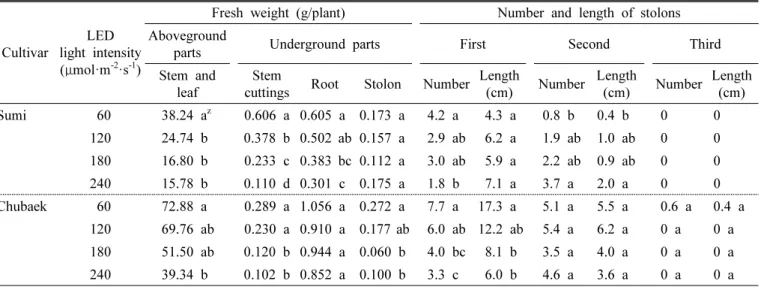
각기 다른 광도에서 육묘한 경삽묘를 이용하여 80일간 분무경재배한 감자의 생육은 Table 3 및 Fig. 3과 같다.
Table 3. Effect of LED light intensity on the fresh weight and stolon development of 2 potato cultivars grown for 80 days after planting of stem cuttings in an aeroponic system.
Cultivar LED
light intensity (μmol·m
-2·s
-1)
Fresh weight (g/plant) Number and length of stolons Aboveground
parts Underground parts First Second Third
Stem and
leaf Stem
cuttings Root Stolon Number Length (cm) Number Length (cm) Number Length (cm)
Sumi 60 38.24 a
z0.606 a 0.605 a 0.173 a 4.2 a 4.3 a 0.8 b 0.4 b 0 0
120 24.74 b 0.378 b 0.502 ab 0.157 a 2.9 ab 6.2 a 1.9 ab 1.0 ab 0 0 180 16.80 b 0.233 c 0.383 bc 0.112 a 3.0 ab 5.9 a 2.2 ab 0.9 ab 0 0
240 15.78 b 0.110 d 0.301 c 0.175 a 1.8 b 7.1 a 3.7 a 2.0 a 0 0
Chubaek 60 72.88 a 0.289 a 1.056 a 0.272 a 7.7 a 17.3 a 5.1 a 5.5 a 0.6 a 0.4 a 120 69.76 ab 0.230 a 0.910 a 0.177 ab 6.0 ab 12.2 ab 5.4 a 6.2 a 0 a 0 a 180 51.50 ab 0.120 b 0.944 a 0.060 b 4.0 bc 8.1 b 3.5 a 4.0 a 0 a 0 a 240 39.34 b 0.102 b 0.852 a 0.100 b 3.3 c 6.0 b 4.6 a 3.6 a 0 a 0 a
z
Mean differences within columns by Duncan’s multiple range test at p ≤ 0.05.
지상부 경엽의 생체중은 품종간 차이는 있으나 두 품종 모두 60 μmol·m-2·s-1 광도에서 육묘한 경삽묘를 이용한 경 우가 무거웠으며, 광도가 높아질수록 가벼웠고, ‘추백’이
‘수미’ 보다 높았다.
정식판 아래 뿌리의 생체중은 ‘수미’의 경우 60 μmol·m-2·s-1 광도에서 육묘한 경삽묘를 이용했을 때 0.605 g/주로 통계 적으로 유의성이 있게 가장 무거웠고, 광도가 높아질수록 가벼웠다. ‘추백’의 경우 약간의 차이는 있었으나 유의성은 없었는데, 감자 양액재배시 광도가 증가할수록 초장이나 건 물중이 증가한다는 보고(Piao et al., 2004)와는 다른 경향이 었다. 반면, 복지의 생체중은 ‘수미’의 경우 광도별로 육묘한 경삽묘간 유의차가 없었으며, ‘추백’의 경우 60 μmol·m-2·s-1 광도에서 육묘한 경삽묘를 이용했을 때 0.272 g/주로 가장 무거웠다.
분무경재배시 복지 발생정도를 살펴보면, 괴경형성에 가 장 영향이 큰 1차 복지 발생 수는 품종간 차이는 있으나 두 품종 모두 60 μmol·m-2·s-1 광도에서 육묘한 경삽묘를 분무경 재배했을 때 ‘수미’ 4.2개/주, ‘추백’ 7.7개/주로 가장 많았고, 복지길이는 ‘추백’에서만 유의성을 보여 60 μmol·m-2·s-1 광도 에서 육묘한 경삽묘에서 17.3 cm로 가장 길었다. 2차 복지 발생 수는 ‘수미’의 경우 1차 복지와는 달리 250 μmol·m-2·s-1 광도까지높은 광도에서 육묘한 경삽묘가 복지수 및 복지길 이 모두 높았으며, ‘추백’은 유의성이 없었다. 3차 복지는
‘수미’에서는 발생하지 않았고 ‘추백’에서도 60 μmol·m-2·s-1 광도에서 육묘한 경삽묘에서만 약간 발생하였다.
이와 같이 육묘시 광도를 달리한 경삽묘를 분무경재배했을 때 품종특성에 따라 품종간에 차이는 있으나, 60 μmol·m-2·s-1 광도에서 육묘한 경삽묘가 육묘시의 광도가 높은 다른 처 리보다 경엽 및 뿌리 생체중이 높고 복지수가 많았는데, 이 는 상대적으로 경삽묘의 묘소질에 따른 초기 생육이 좋은 데서 기인한 것으로 보인다.
분무경에서는 뿌리의 전부 혹은 일부가 공기 중에 노출 된 상태로 양액을 분무하거나 안개와 같이 포화시켜 재배 하므로 용존산소를 충분히 공급할 수 있고(Massantini, 1985;
Maxwell, 1986), 분무경에서 자란 식물은 수경재배와 달리 근권의 산소가 풍부하고 근모의 발달이 좋아서 생육이 왕 성하다(Zobel et al., 1976). 그러나 본 연구에서는 전체적 으로 생육이 왕성하지 않았는데, 이는 분무경재배 초기 온 실의 저온과 생육 전기간에 동일한 배양액을 사용하여 생 육단계에 따른 적절한 배양액 관리가 이루어지지 않아서 발생한 것으로 보이고 또한 생육과 괴경형성에도 영향을 미쳤을 것으로 생각되므로 생육단계별 배양액 조성이나 배 양액 온도 등의 체계적인 연구가 필요하다.
육묘 광도를 달리한 경삽묘를 이용하여 80일간 분무경재 배한 감자의 괴경수량 특성은 Fig. 4와 같다. 주당 총괴경 수는 ‘수미’의 경우 60 및 120 μmol·m-2·s-1 광도에서 육묘 한 경삽묘에서 6.3개, ‘추백’에서는 60 μmol·m-2·s-1 광도에 서 육묘한 경삽묘에서 14개이었으며, 두 품종 모두 광도가 높을수록 괴경수는 적어지는 경향이었다. 두 품종 모두 60 μmol·m-2·s-1 광도에서 육묘한 경삽묘의 분무경재배가 주당 총괴경중도 역시 가장 높았으며, 괴경수와 마찬가지로 광도 가 높아질수록 적어졌다. 이는 60 μmol·m-2·s-1 광도에서 육 묘한 경삽묘의 묘소질에 따른 초기 생육이 좋아 뿌리 발달 이 좋고 복지수가 많은 것 때문으로 판단되는데, 뿌리무게 와 괴경수량간에는 정의 상관관계가 있다는 보고(Chloupek, 1970; Iwama et al., 1979)와 분무경재배시 경삽묘의 초장 이 긴 것을 정식하는 것이 괴경수량이 높다는 보고(Jo et al., 2018b)와 같은 경향이었다.
계급별 괴경수량을 보면 육묘할 때 광도를 달리한 모든 경삽묘를 분무경재배하여 수확한 10~50 g의 괴경비율이 대 부분이었는데, 60 μmol·m-2·s-1 광도에서 육묘한 경삽묘로 분 무경재배하여 수확한 씨감자를 노지재배나 망실에서 이용할 수 있는 크기인 3 g 이상의 괴경비율이 ‘수미’는 90%이었으 며, ‘추백’도 60 μmol·m-2·s-1 광도에서 육묘한 경삽묘에서 주당 12개로 가장 많았다. 주당 총괴경중은 60 μmol·m-2·s-1 광도에서 ‘수미’가 153 g, ‘추백’은 298 g으로 같은 광도에
Fig. 3. Growth and yield per plant using stem cuttings as
affected by LED light intensity in an aeroponic system
(Upper, ‘Sumi’; Lower, ‘Chubaek’). The white scale
bar represents 100 mm.
서 육묘한 경삽묘를 이용하였어도 ‘수미’보다는 ‘추백’의 수량이 높았는데, 이는 복지수나 복지길이 차이 등의 품종 특성에 따른 것으로, 많은 복지수(유효복지수)와 유전적으 로 긴 복지가 수량을 증대시킨다(Kim et al., 1997)는 보고 와 같았다.
이상의 연구결과로 보면 폐쇄형식물생산시스템을 이용 하여 분무경재배용 경삽묘를 생산할 경우, 육묘에 적합한 LED 광도는 60 μmol·m-2·s-1라고 판단되었으며, 폐쇄형식 물생산시스템은 외부 환경에 관계없이 안정적으로 생산이 가능하므로 광조사 방법 및 LED 광질 등에 관한 면밀한 추 가 연구가 필요할 것으로 생각된다.
적 요
본 연구는 씨감자 생산에 적합한 분무경재배용 경삽묘를 폐쇄형식물생산시스템을 이용하여 생산하기 위한 광도조건 을 설정하기 위하여 수행하였다. 감자(Solanum tuberosum L.) ‘수미’와 ‘추백’의 경정배양묘를 순화한 다음 삽수를 채
취하여 경삽하였다. 서로 다른 LED 광도(60, 120, 180, 그 리고 240 μmol·m-2·s-1)에서 40일간 육묘하고, 80일간 분무 경재배하였다.
1. LED 광도 60 μmol·m-2·s-1에서 경삽묘를 육묘하였을 경 우 ‘수미’ 17.3 cm, ‘추백’ 16.1 cm로 두 품종 모두 초장 이 가장 길었고, 마디수도 많았다. 광도가 높을수록 초장 은 작고 마디수도 적었다.
2. 품종에 따라 엽면적이나 SPAD 값, Fv/Fm 값은 육묘기 의 광도에 따라 약간의 차이를 보였다. 경삽묘의 생체중 은 60 μmol·m-2·s-1 광도에서 가장 무거웠으며, 건전묘 생산율도 두 품종 모두 60 μmol·m-2·s-1 광도에서 가장 높았다.
3. 분무경재배에서 LED 광도 60 μmol·m-2·s-1에서 육묘한 경삽묘가 품종간 차이를 보이기는 하지만 지상부 경엽중 이 가장 무거웠고, 정식판 아래 경삽묘장이 가장 길고 뿌 리 무게도 가장 무거웠으며, 광도가 높을수록 가벼웠다.
4. 복지수에 있어서도 품종간 차이는 있으나 60 μmol·m-2·s-1 광도에서 육묘한 경우 ‘수미’ 4.2개/주, ‘추백’ 7.7개/주 로 가장 많았다. 또한 60 μmol·m-2·s-1 광도에서 괴경수 및 총괴경중이 가장 좋았는데 광도가 높을수록 두 품종 의 총괴경수와 총괴경중이 적어지는 경향이었다.
이상의 연구결과를 종합해 보면 폐쇄형식물생산시스템 을 이용하여 분무경재배용 경삽묘를 생산할 경우, 육묘에 적합한 LED 광도는 60 μmol·m-2·s-1라고 판단되었다.
인용문헌(REFERENCES)