199
Review Article
Korean College of Clinical PharmacypISSN 1226-6051 eISSN 2508-786X https://doi.org/10.24304/kjcp.2017.27.4.199 Korean journal of clinical pharmacy (Online) URL: http://www.ekjcp.org
폐경기 증상을 완화시키기 위한 개별화 호르몬 요법에 대한 고찰: 다른 위험요소가 없는 폐경기 여성을 중심으로
이영미
1 ·윤휘열1 *
1
충남대학교 약학대학
(2017 년 10 월 11 일 접수 · 2017 년 11 월 22 일 수정 · 2017 년 11 월 22 일 승인 )
Hormone Therapy Review for Perimenopausal Symptoms: Focused on Perimenopausal Women without Other Risk Factors
Young Mee Lee 1 and Hwi-yeol Yun 1 *
1
College of Pharmacy, Chungnam National University, Daejeon, 34134, Republic of Korea (Received October 11, 2017 · Revised November 22, 2017 · Accepted November 22, 2017)
여성 호르몬 estrogen은 크게 estriol, estradiol, estrone 3종류 가 있다. 생식이 가능한 건강한 여성의 경우 estradiol이 가장 많은 형태의 호르몬으로 콜레스테롤에서 androgen을 거쳐 난 소에서 생성된다. Estriol 은 임신부에서 높게 나타나는 호르 몬이며 부신에서 dehydroepiandrosterone sulfate (DHEA-S) 가 태반효소와 결합한 후 전환된다. Estrone은 부신에서 생성 되며 폐경기 여성에서 주로 분비되는 호르몬이다. 정상적인 폐경 전 여성에서 estradiol과 estrone의 비율은 2:1 인 반면, 폐 경기에 접어드는 여성들은 이 비율이 변화되면서 여러 임상증 상들을 경험하게 된다.1)주로 호소하게 되는 증상으로는 혈관
운동 증상(안면홍조, 두통, 발한), 질건조감, 질소양감, 불안, 불 면, 우울증 등이다. 폐경기 여성들은 이러한 임상증상으로 인 한 직접적인 불편감(근육통, 관절통증 등)을 호소할 수 있으며, 증상 지속으로 인한 삶의 질 저하 등의 문제가 발생할 수 있다.
또한 이러한 호르몬의 불균형은 장기적으로 지속되는 경우 주 요 노인성 질환(골다공증, 심혈관질환, 치매 등)의 위험요인으 로 작용하기도 한다.2)
폐경으로 인한 호르몬 불균형으로 인해 발생하는 다양한 질 환들 중 골다공증은 유병률이 빠르게 증가하고 있으며, 치료 를 위해 긴 시간이 소요되는 특성이 있으므로, 다른 질환에 비
ABSTRACT
As the population ages, the life of women after menopause becomes much longer than the past, and the quality of life of old age becomes increasingly principal issue. There is a period that women experience the physical symptoms of menopause, although there are differences in degree, and the management of this period is a suitable time for women to improve their quality of life.
According to the menopausal hormone therapy (MHT) and Timing Hypothesis, which has been proven in the Kronos Early Estrogen Prevention Study (KEEPS) and the Early vs Late Intervention Trial with Estradiol (ELITE) study, a relatively young woman before and after menopause can benefit from long-term beneficial effects such as prevention of osteoporosis and cardiovascular disease by early initiation of hormone therapy to alleviate menopausal symptoms. MHT should be considered for all women in healthy (without other important diseases) menopausal years, expecting to improve their quality of life through symptom relief in menopausal women and, in the long term, to prevent cardiovascular disease and osteoporosis. When applying hormone therapy to individuals, it is necessary to establish various treatment strategies according to the menopausal symptoms of individual patients (individualization of treatment) and judge the suitability of clinical application.
KEY WORDS: Estrogen, progestogen, MHT, perimenopause, menopause
*Correspondence to: Hwi-yeol Yun, College of Pharmacy, Chungnam National University, Daehak-ro 99, Yuseonggu, Daejeon 34134, Repub- lic of Korea
Tel: +82-42-821-5941, Fax: +82-42-823-6781
E-mail: [email protected]
하여 폐경 초기에 골다공증이 발생하지 않도록 미리 예방하는 것이 매우 중요하다. 또한 이미 발생한 골다공증은 골절에 이 르지 않도록 주의 깊은 관리와 치료가 필수적이다.
MHT는 폐경기 증상완화에 효과적인 약물로 알려져 있고 장기적인 사용으로 골밀도를 높여 골다공증의 발생을 줄이는 효과를 가지고 있다. 그러나 부작용으로 나타날 수 있는 혈전 생성, 심혈관질환 유발, 유방암 발생 증가 등에 대한 우려들도 있는 것이 사실이다. 부작용에 대한 우려들을 불식시키고 안 전성을 확립하기에는 최근의 임상연구들이 아직까지는 미흡 하다. 하지만 현시점의 연구문헌들에 대한 분석과 해석이 다 각도에 걸쳐 자주 이루어 진다면 MHT 의 유효성과 안전성을 정립하는데 도움이 될 것이다.
따라서 이 연구는 갱년기의 MHT 를 개인의 조건과 상황에 따라 시작하는데 근거중심의 치료방법을 제시하고자 한다. 특 히 최근의 ELITE연구에서 입증된 시기가설을 바탕으로 치료 시작시점에 중점을 두고 호르몬의 종류와 용량, 치료지속기간, 선택해야할 약물제형에 대하여 고찰하여 가장 적절한 개인맞 춤요법을 시행할 수 있도록 하는데 목적이 있다.
국내 MHT 사용현황
우리나라에서 폐경기 증상에 따른 병원 내원이나 치료비용 에 관하여 건강보험심사평가원의 통계를 살펴보면 최근 3년 간 1년에 대략 70만명의 여성이 폐경기증상과 관련하여 병원 을 찾았고 50대 여성의 비율이 가장 높았다.3)
건강보험심사평가원의 데이터(N95 질병코드에 의한 MHT 사용현황(심평원 통계자료 2017년 8월 현재))에 의하면 폐경 및 폐경 전후장애로 2012년부터 2016년 사이에 요양기관을 내원한 환자는 2012년 739,410명에서 매해 약간씩 하향되다 가 2015년 671,483명을 최저로 한 후 2016년에는 677,800명으 로 다시 증가되었다. 요양기관 그룹으로는 의원급이 2016년 내원일수 1,390,356일로 가장 높은 방문일을 나타내고 있고 그 다음은 병원급이 297,630일로 두번째 높은 방문일을 보였 다. 요양급여비용총액에서는 의원급이 59.0%로 가장 높은 비 율을 차지하였고, 차순위로는 종합병원이 17.6%를 차지하여 내원일수의 순위와는 다르게 병원급의 14.1%를 넘어서는 현 상을 보였다. 이는 종합병원이 청구하는 약물의 비용이 병원 급에서 청구하는 약물의 가격보다 더 높거나 또는 처방되는 약물의 종류가 더 많다고 볼 수 있다.
2016년 폐경 및 폐경 전후장애로 MHT를 사용한 요양급여비 용총액을 연령에 따른 비율로 보면 50-59세의 여성이 58.0%를 차지하였고 60-69세가 20.9%, 40-49세가 15.3%를 차지하였다.
건강보험심사평가원의 통계자료에 의한 2016년 MHT요양급여 비용 총액은 2016년 약 338억원 이었다(50-59세의 MHT 요양급 여비용총액은 약196억원).
국내 2010년 폐경 호르몬 약제 사용에 관한 조사연구4)에 의 하면 우리나라에서 50세 이후 여성의 4.5%가 폐경 후 호르몬 제를 복용하는 것으로 나타났다. 그중 60%는 estrogen 또는 estrogen+progestogen 병용요법을 사용하였고 40%는 tibolone 을 사용하였다. 사용된 금액으로는 38,100,000,000원으로 전해 (2009년 35,600,000,000원)에 비해서 7% 증가한 금액이었다.
이 연구에 따르면 폐경 후 호르몬요법 사용은 2002년에서 2007년 사이에 최저(30,100,000,000원 )로 떨어졌고 Women's Health Initiative (WHI) 연구결과의 재평가로 2007년 이후 꾸 준히 증가해 왔다.
MHT와 심혈관계 질환의 예방 효과
MHT는 1970년대 estrogen 단독요법이 사용되기 시작하고 MHT 절정기를 보이다가 자궁내막암 위험증가 보고로 하향 세로 돌아섰으며 estrogen과 progestogen 병용투여로 자궁내 막암 위험성은 감소되어 1990년대를 최고 전성기로 한 후 2002년 WHI의 중간 발표로 인하여 사용 타당성이 정립되지 못하면서 최저치로 떨어졌다. WHI의 중간발표가 있기 전까지 는 MHT는 폐경 후 증상의 완화, 골다공증의 예방은 물론, 치 매, 대장암, 그리고 심장질환의 예방에도 효과가 있다고 알려 져 있었다. 따라서 약 20여년 전에는 관련 위험요인을 가지고 있지 않은 모든 폐경 여성은 필수적으로 처방 받아야 할 약제 로 권고 되어 왔다.5)
그러나 폐경기 증상완화를 위한 MHT는 2002년의 WHI 연구 결과 발표 이후 급격히 사용이 감소되었고 지금까지도 MHT의 심혈관계질환 예방효과에 대해서는 사용타당성이 정립되지 못 하고 있다.6)
하지만 WHI에 참여한 여성은 심혈관계 질환을 가지고 있고 폐경기가 훨씬 지난 비교적 고령의 여성이 다수 포함되었기 때문에 심혈관계질환의 위험도 상승에 대한 해석이 적절치 않 다고 보고 MHT의 시작 시점과 심혈관계 질환의 유무가 MHT 의 유효성에 중요한 요소라고 결론 낸 KEEPS7)와 ELITE 연 구8)로 MHT의 사용에 대한 타당성이 재 확립되었다. 이 두 연 구에서는 다른 중요질환이 없는 건강한 비교적 젊은 폐경기 여성이 MHT를 시행하였을 때 심혈관계 질환의 신규발생이 나 이로 인한 사망률 증가등은 없었다는 것을 입증하였다.
MHT 투여 시작 시기
WHI 이후에 MHT 는 심혈관질환의 감소는 투여 시점과 연 관 있다는 가설(Window of therapeutic opportunity)을 세우게 되었고 KEEPS 연구는 40-55세 폐경 후 3년이 지나지 않은 727명의 여성을 대상으로 2006년부터 5년간 연구하여 폐경 초 기 MHT가 심혈관질환의 위험성을 높이지 않는다는 것을 입 증하였다. 2016년 the New England Journal of Medicine (NEJM)에 발표된 ELITE연구는 ‘호르몬과 시기가설’(HRT &
timing hypothesis)을 증명하였다. ‘호르몬과 시기가설’을 입증 한 이후의 MHT 의 방향은 건강한 여성이 나이가 들어 감에 따라 발생하는 갱년기 증상을 완화하고 삶의 질을 높이기 위 한 목적으로 호르몬 투여를 시작하는 것이 바람직하다고 보여 진다. Gallagher 연구9)에 의하면 폐경 후 첫 5년동안 총 칼슘량 이 가장 크게 감소하게 되고, 폐경 전 여성에 비해 연간 척추 골 밀도 및 뼈의 칼슘 감소량이 10배에 달하는 것으로 추정하 였다. 폐경 후 3-4년이 골 밀도 감소가 가장 큰 시기로 이 시기 의 호르몬 치료는 골밀도감소를 예방할 수 있는 가장 효과적 인 방법이다.
갱년기에 접어들면서 폐경에 따른 증상완화와 장기적인 건 강상 이익을 위하여 MHT을 가능한 빨리 시작하는 것이 유익 하다는 연구는 KEEPS7, 10-13)를 통하여 증명되었다. 이 연구 에서는 평균나이 52세의 폐경에 이르거나 폐경 후 3년이 지나 지 않은 심장질환이 없는 건강한 727명의 여성에게 경구형과 패치형태의 estrogen을 progesterone과 병용하여 4년간 투여 하였다. 이 연구는 estrogen의 공급형태에 따른 영향과, 알려진 통상의 estrogen 0.625 mg 용량보다 낮은 농도의 conjugated estrogen 0.45 mg/day 을 사용하고 transdermal estradiol patch 는 50 μg/d, cyclic micronized progesterone (Prometrium®)은 한달 중 12일만 병용하였을 때의 영향을 보고자 하였다. MHT 가 심혈관계 질환의 진행에 미치는 영향을 평가하기 위해 설계 된 KEEPS는 그 척도로carotid artery intima-medial thickness (CIMT)의 변화와 전임상 동맥경화(subclinical atherosclerosis) 를 측정하기 위해 coronary artery calcification (CAC)를 평가 하였다.7) 2016년 KEEPS는estrogen의 약물유전체학이 CIMT 와 CAC의 변화에 미치는 영향을 살펴본 것인데 결론적으로 호르몬의 상태와 유전적 변이가 심혈관계의 표현형태에 영향 을 줄 수 있는데 특히 CIMT에서는 타고난 면역경로내에서 약 물유전체학적인 영향이 있었다. 안면홍조나 야간 발한 등의 갱년기증상은 위약군에 비해 두 제형 모두에서 더욱 향상되었 다.13)골밀도(Bone Mineral Density, BMD) 또한 위약군에 비 해 향상되었고, 성적 건강면에서도 성교통, 질건조감 등이 호 르몬 치료군에서 유익한 효과를 보였다. 패치형태의 호르몬제 투여시에는 성욕(libido)이 상승되는 효과를 보였고, 또한 glucose 와 insulin level에 미치는 영향에서 인슐린저항성에 유익한 효 과를 보였다. MHT는 다른 연구에서도 밝혀진 바 대로 혈압을 높이지는 않지만 지질에 미치는 영향은 약간 다르다. 경구 estrogen 투약의 경우 HDL은 높이고 LDL은 낮추는 반면 TG 와 염증의 지표인 C-reactive protein은 증가시키는 효과를 보 였다. estradiol 패치의 지질에 대한 효과는 중성적이었다. 인 지능력개선에 관한 호르몬 치료 효과는 없었고 유방조직 밀도 에 대한 영향은 패치의 영향이 더 있는 것 같았다. 이 영향에 대한 추가 평가가 필요한 것으로 보인다. 이 연구에서는 정신 적 기능에 대한 평가를 하였는데 경구로 투여된 estrogen 환자
군에서 우울증이 현저히 개선되었다. 불안감과 긴장도도 경구 estrogen 투약으로 좋아졌다. 이와는 반대로 호르몬 투여가 기 억력 감퇴에 주는 영향은 없었는데 이는 WHI의 연구에서 MHT를 받은 경우 치매의 위험성이 높아진다고 한 결과와는 상충되는 것이다.14) 지금까지는 MHT의 위험성을 부각하는 분위기가 더 지배적이었지만 이 연구의 결과는 risk benefit ratio가 유익한 쪽으로 기울게 하는데 기여하였다.
가장 최근에 발표된 2016년 ELITE8)연구는 심혈관질환이 나 당뇨병이 없는 건강한 폐경 여성 643명을 대상으로 투여시 작시점에 따라 심혈관계에 미치는 영향에 차이가 있는지를 보 기 위하여 호르몬요법을 시행하였다. 이 연구에서는 폐경 후 6 년 이내 그룹과 10년이상된 그룹으로 나누었고 호르몬은 17β- estradiol 1 mg과 progesterone gel 4%(45 mg)은 1개월에 10일 간 시행하였다. 주요 판단지표로는 CIMT를 6개월마다 시행하 였고 5년쯤 후의 결과는 progestogen 투여 여부는 상관없이 조 기 호르몬투여군에서 훨씬 유익한 결과를 보였다. 폐경 후 10 년이상 지난 후 호르몬을 시작한 그룹은 위약군과 큰 차이가 없었다. 이차적 결과판단은 cardiac computed tomography (CT)으로 coronary atherosclerosis를 평가하였는데 영향에 그 룹간 큰 차이가 없었다. 이 연구 결과로 폐경기여성이 조기에 호르몬요법을 시작하면 폐경기 증상완화와 함께 심혈관계에 유익한 영향을 줄 수 있다는 것이 증명되어 이를 근거로 MHT 를 좀더 적극적으로 시행하면 여성의 갱년기 이후의 삶의 질 도 높이고 장기적인 건강상의 긍정적 효과도 기대할 수 있을 것으로 전망된다. Table 1에서는 MHT를 시작하는 시점에 심 혈관질환을 가지고 있지 않다면 심혈관계질환예방에 효과가 있는 연구들에 대해 정리하였다.
MHT를 위한 estrogen 용량
지금까지 폐경기 여성에서 보편적으로 상용되어온 estrogen의 일일 표준 용량은 conjugated equine estrogen (CEE) 0.625 mg와 이와 동등한 역가를 보이는 estrogen 제제 즉, piperazine estrone sulfate 0.625 mg, estradiol valerate 2 mg, micronized estradiol 2 mg, transdermal estrogen 50μg, ethinyl estradiol 5 μg, estradiol implant 50 mg(6개월 동안)이었다. 그러나 WHI 연구 결과15)가 발표된 후 MHT에 대한 유효성과 안정성에 대해 새로운 해석 과 지침이 발표되고 있으며, 현 시점의 호르몬 요법에서 대두 되고 있는 중요한 경향은 용량의 감소와 치료 목적에 부합하 는 범위 내에서 단기간의 사용이다. estradiol의 혈중 농도와 임 상효과 (골밀도나 안면홍조 증상)사이에는 밀접한 상관관계가 있긴 하지만 개별적인 폐경기 여성의 혈중농도로 치료효과를 예측할 수는 없는 것으로 알려져 있다. 그 이유는 estrogen의 호르몬 강도는 각각의 조직에 대해서 특이적이기 때문에 한가 지 기준으로 강도를 일반화하기는 어렵기 때문이다. 예를 들 어, estradiol은 임신 같은 생식기능에 가장 중요한 역할을 하지
만 인체의 대사적 과정에 관여하면서 인체 전체에 영향을 준 다. 배란기중에는 estradiol의 혈중 농도가 30 pg/ml 에서 배란 전에는 150-350 pg/ml까지 올라갔다가 황체기에는 100-210 pg/
ml가 된다. 임신중에는 100배 정도 높게 상승하여 임신 후반기 에는 20,000 pg/ml에 이른다. 폐경 여성의 estradiol 혈중 농도는 대개 20 pg/ml 이하인 것으로 알려져 있다.1) MHT요법으로 경 구 투여한 estradiol제제(2 mg estradiol valerate or micronized estradiol)의 혈중농도는 투여 첫날 평균 40 pg/ml이었다가 21일 째에는 평균 최대 80 pg/ml 정도되는 것으로 보고 되었다.1)
최근 보다 적은 estrogen의 용량에서도 폐경기 후 여러 증상 및 징후에 효과가 있으며 부작용이 보다 적다는 HOPE(2005 년) 등의 연구 결과가 발표되어 “저용량 estrogen 요법”이 제시되 기에 이르렀다.16)또한 저용량보다 적은 초 저용량을 사용한 두 연구, ULTRA(2008년; 1 mg estradiol(E2)+0.5 mg norethindrone acetate(NETA) or 0.5 mg 17β E2+0.25 mg NETA)와 CHOICE 연 구(2008년; 0.5 mg 17β E2+0.1 mg or 0.25 mg NETA)결과가 발표 됨에 따라, 호르몬의 용량은 보다 적은 양의 사용이 주류를 이루 게 될 것으로 예상하고 있다. ULTRA 연구17)는 2년동안 저농 도(low-dose continuous combined HRT, LD-HRT) 의 1 mg E2 와 0.5 mg NETA를 28 일동안 투여하거나, 0.5 mg E2와 0.25 mg NETA(Ultra low dose, Ultra-LD-HRT)를 칼슘1 g과
투여하여 폐경기증상과 출혈경향, 골밀도를 평가한 연구인데 LD-HRT 와 Ultra-LD-HRT 모두 폐경기증상완화에 효과적이 었고 골밀도감소에 대한 보호효과가 있었다.
CHOICE 연구18)는 0.5 mg의 E2와 NETA 0.1 mg 또는 0.25 mg을 폐경기여성에게 투여하였을 때 무출혈의 빈도가 높고 6개월동안의 치료기간동안 자궁내막두께도 위약군이나 두가지NETA농도군 모두에서 특별히 증식되지 않아 MHT요 법시행에서 초저농도의 E/P복합제가 폐경증상 치료에도 효과 적이면서 자궁내막증식억제 작용이 있음을 증명한 연구이다.
Table 2에 보다 낮은 용량의 호르몬을 사용하여도 골밀도 감 소에 효과적이고 자궁내막 증식에도 안전하게 사용할 수 있음 을 입증한 연구들에 대한 비교가 되어있다.
MHT를 위한 progestogen 용법
자궁이 있는 여성에서는 estrogen을 단독으로 사용하면 자 궁내막암 발생 위험이 증가하므로 progestogen을 병합하여 사 용해야 한다. Progestogen을 사용하는 방법에 따라 주기적 또는 지속적 요법으로 구분되는데, 주기적 요법 시행 시 80~90%에서 소퇴성 출혈이 나타난다. 지속적 병합 요법으로 매일 progestogen 을 복용하면 1년 후에는 대부분의 여성에서 출혈이 없어진다. 투 여되는 progestogen의 종류와 용량, 그리고 날짜는 다양하게
Table 1. Hormone therapy trial for coronary heart disease and fractures
Clinical trials Intervention drug(mg/day) Duration
(years) Results Age at enrollment
(years)
Total number of enrollment
HERS CEE 0.625 + MPA 2.5 4
NOT protective of the heart but significantly raises the risk of breast cancer, heart attack, stroke and thrombosis
55-75 2763
WHI CEE 0.625 + MPA 2.5 5.2 E/P HRT increased BC, stroke 50-79 16608
KEEPS
CEE 0.45, or TD E2 50 mcg/wk (both with cyclic oral, micronized progesterone, 200 mg for 12 days/month
4
neither significantly reduced nor accelerated progression of atherosclerosis
42-58 727
ELITE
17β-E2 1+ micronized progesterone 45 as a 4%
vaginal gel for 10 days/cycle
5
the effects of estradiol (with or without progesterone) on the progression of atherosclerosis differed according to the time of initiation of therapy, with benefit noted when it was initiated in women who were less than 6 years past menopause
52-68 643
HERS stands for the Heart and Estrogen/Progestin Replacement Study WHI: Women's Health Initiative
KEEPS: The Kronos Early Estrogen Prevention Study ELITE: Early Versus Late Intervention Trial with Estradiol CEE: conjugated equine estrogen
MPA: medroxyprogesterone
E/P: estrogen/progestogen
BC: breast cancer
TD: transdermal
17β-E2: 17 beta-estradiol
조절될 수 있으나, 원칙적으로 주기적 병합 요법의 경우 자궁 내막 보호 효과를 감안하여 최소 12~14일의 사용이 권장된다.
MHT에서 estrogen의 자궁내막 과다증식효과를 막기위해 사 용되는 주기적 요법의 progestogen 하루 최소 필요용량을 Table 3에 나타냈다.
폐경기 상태의 여성에서 저농도의 호르몬치료 효과를 보는 연구19)에서는 불규칙한 생리와 안면홍조를 호소하는 120명의 여성에게 micronized 17β-estradiol 1 mg과 dydrogesterone 10 mg 지속요법 혹은 13일만 투여하는 주기요법을 시도하였 다. 안면홍조 개선은 지속요법에서 현저히 좋아졌고 주기적 생리는 두 그룹 모두 86%, 76%로 각각 좋아졌고 생리기간은 지속요법이 더 짧게 나타났다. 일반적으로 주기요법 MHT는 perimenopause 기간이나 조기 폐경(early postmenopause)인 경우에 추천된다.20-21)
현재 개발된 estrogen 중에서 EE(ethinyl estradiol)가 가장 강 력한 estrogen agonist로 모든 E/P(estrogen/progestogen)결합 경 구피임제에 사용되고 있고, MHT에서는 안면홍조(hot flushes) 와 urogenital atrophy의 치료에 E2(estradiol)와 CEE(conjugated equine estrogen)가 동등하게 효과적이고 다른 치료법보다 우수 하다.22)
CEE 0.625 mg과 progesterone 200 mg 또는 MPA 5mg 투여 로 감정변화에 미치는 영향을 살펴본 이른(조기)폐경 여성 대상 연구에서는 MPA보다 progesterone 투여군에서 vaginal bleeding, breast tenderness를 덜 겪었다.23) Progestogen이 우울증을 유발할 것이라는 일반적인 개념과는 다르게 감정적인 부분에 미치는 progestogen의 영향은 없었다. 전반적으로 MPA보다는 micronized
progesterone함유 병용요법제가 부작용이 적게 나타났다.
MHT의 장기사용 위험성
MHT의 장기 사용 위험성에 있어서 estrogen 외에 중요한 결 정인자는 progestogen 타입이 어떤 종류 인지에 달려있다. 특히 breast cancer risk 관점에서 부작용에 좀 더 안전한 progestogen 종 류는 micronized progesterone, 혹은 dydrogesterone이다.24) Thrombotic risk에 관한 MHT에서의 중요한 결정 인자는 estrogen 의 제형과 경구투여 용량인데 패치 형태가 혈전발생 위험측면에 서 위험도가 낮았고, 경구투여시에는 estrogen 저용량을 사용하 여야 위험도를 낮출 수 있었다.25) Estrogen and Thromboembolism Risk (ESTHER) Study26) 에서는 경구투여 estrogen이 패치형태보 다 정맥혈전색전증(venous thromboembolism; VTE)을 야기할 위 험성이 더 높았고 micronized progesterone과 pregnane 유도체 (dydrogesterone포함)가 norpregnane유도체보다 VTE 위험성을 덜 가지고 있는 것으로 보고 하였다. 덴마크의 골다공증 예방연구
27)와 또 다른 연구 28)에서는 MHT 를 조기에 적절히 시작하면 심 혈관계 위험과 심혈관계로 인한 사망률을 줄일 수 있다고 결론 지었다.
MHT를 위한 투여기간 고찰
MHT의 투여기간에 대해서는 정해지지 않아서 장기간의 호 르몬 치료를 위해서는 치료에 따른 이익과 위험에 대하여 환 자와 상담하여 결정한다. 2015년 발표된 미국 내분비학회의 지침에서는 MHT의 기간에 대해 ‘치료목적에 합당한 상태에 서 최단기간’으로 명시하였다. 폐경 후 혈관운동증상은 장기 간 지속될 수 있으며, 호르몬치료를 하다가 중단하면 증상이 재발하는 경우도 있을 수 있다. WHI 연구의 경우 연구종료 후 호르몬 치료를 중단하였을 때 20% 정도의 여성이 혈관운동성 증상의 재발을 경험하였다. 그러나 치료 중단 후 증상 재발여 부를 미리 알 수는 없고, 다만 증상이 재발한 경우에는 환자의 상황 및 증상 정도에 따라 재 치료 여부를 결정한다.
경구용 피임제 복용력이 있는 여성의 폐경 증상 완화를 위 한 MHT로의 전환 방법과 시점
폐경 전 여성이 피임목적이나 부정기적 출혈을 조절하기 위
Table 3. Minimum daily dose of sequential oral progestogen for
the protection of endometrium
Progestogen type Minimum daily dose Micronized progesterone 200 mg Medroxyprogesterone acetate 10 mg
Dydrogesterone 10-20 mg
Norethindrone 1 mg
Norgestrel 150 mcg
Levonorgestrel 75 mcg
Table 2. Clinical studies to find the lowest effective dose of hormone
Clinical trials Intervention drug(mg/day) Duration Results
HOPE CE 0.625, 0.45, 0.3 ± MPA 2.5. 1.5 2yrs BMD loss 4.5% with CE 0.45/MPA 1.5 & 15.6% with CE 0.3/MPA 1.5 ULTRA E2 1+NETA 0.5(LD-HRT) or E2 0.5+NETA
0.25(ultra LD-HRT) + 1000 mg Ca. 2yrs BMD increased in spine & femoral neck in LD
& Ultra-LD-HRT.
CHOICE E2 0.5 +NETA 0.1 or 0.25 6months no significant change in mean endometrial thickness HOPE: The Women’s Health, Osteoporosis, Progestin, Estrogen trial
ULTRA: Ultra low-dose hormone replacement therapy and bone protection in postmenopausal women
CHOICE: Ultra-low-dose continuous combined estradiol and norethisterone acetate: improved bleeding profile in postmenopausal women
하여 경구 피임제를 복용하고 있는 경우에는 폐경의 정확한 시점을 알 수 없다. 이런 경우에는 50세를 전후하여 일정 시점 에 (예를 들면 1-2년정도를 경구용 피임제를 복용하다가 1년마 다 2-3개월 휴지기를 가지면서 폐경의 증상, 징후가 있는지 관 찰) plasma follicle-stimulating hormone; FSH(난포자극호르 몬) 농도를 검사하여 35IU/L이상이면 폐경으로 진단하고23) MHT 요법으로 전환하여 복용한다. 폐경기 증상을 완화시키 기 위하여 MHT요법으로 전환하는 경우에는 몸의 적응력, 부 작용 발현을 막기 위하여 같은 계열의 progestogen이 함유된 복합제를 선택하는 것이 적절하다고 보고, estrogen 농도는 폐 경증상이 치료되는 가능한 낮은 농도(CEE 0.625 mg기준)가 함유된 것이 바람 직 하다고 보고있다.20-21, 29-30)
MHT를 위한 제제 선택
Cochrane Database Systematic Review31) 연구에서는 estrogen 단독 호르몬요법은 VTE의 위험성을 더 높일 수 있다 고 하였고 American Association of Clinical Endocrinologists (AACE)/American College of Endocrinology (ACE)의 2017 년 폐경에 관한 지침에서는 경구보다는 패치형태의 estrogen이 VTE의 위험성을 덜 높이는 것으로 결론지었다.32) WHI연구에서 는 Breast Cancer나 Cardiovascular risk측면에서는 CEE(conjugated equine estrogen)단독요법보다 MPA(Medroxyprogesterone acetate) 와의 병용요법이 훨씬 VTE위험도를 증가시켰다.
estrogen은 투여방법에 경구제, 피부에 부착하거나 바르는 경 피제(패취 또는 젤), 질 안에 투여하는 질 국소제제 등이 있다.
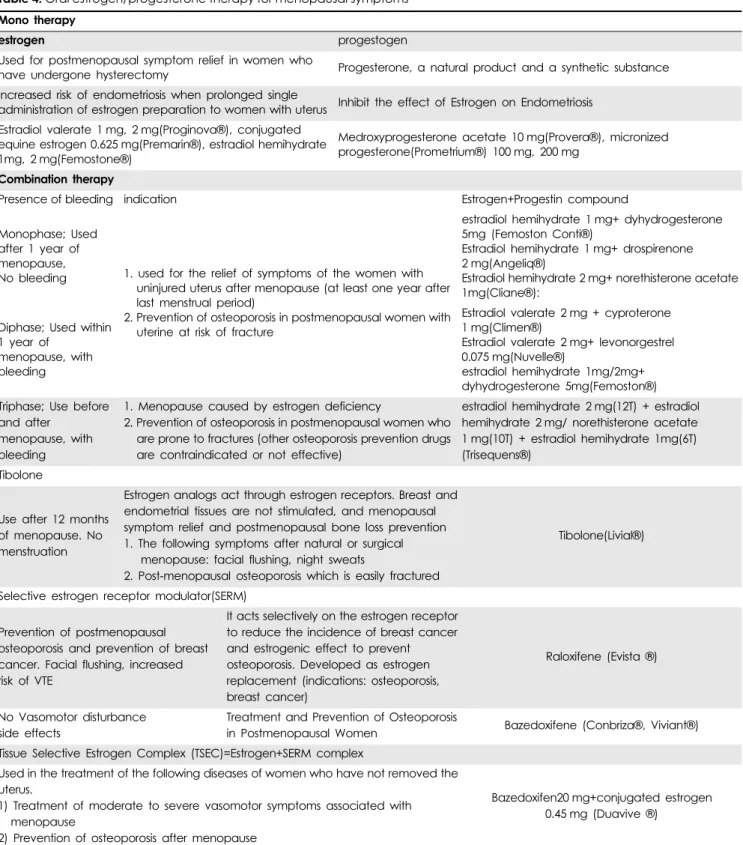
경구제의 장점으로는 복용하기 쉽고 또한 쉽게 중단할 수 있다. 반감기가 짧으므로 중단하면 곧 효과가 없어진다. 단점 으로는 잊지않고 복용해야 하고 구역질, 위불편함 등이 있을 수 있다. 경구용 약제는 프레마린 정, 스로겐 정, 오젠 정, 에스 젠 정, 에스페민 정, 에스트로펨 정, 트라디올 정, 프레디올 정, 프로기노바 정, 비스테론 정이 있다. Table 4에 호르몬요법에 사용되는 estrogen과 progestogen의 종류와 임상적용에 대하 여 요약하였다.
경피제 장점은 투여와 중단이 쉽고 반감기가 짧으므로 중단 하면 곧 효과가 없어진다. 경구제보다 간에 부담이 덜하다. 단 점은 피부자극이나 가려움증이 있을 수 있고 패취가 잘 떨어 지기도 한다. 경피용 약제로는 에스트레바 젤, 에스트라덤- TTS/MX, 클리마라 패취, 삼양 에스트란 패취, 베타디올 패취, 더메스트릴 등이 있다.
질 국소제제의 장점은 국소적으로 주로 비뇨생식기에 좋은 영향을 주며 단점이라면 전신적 갱년기 증상이나 골보존효과 및 심혈관 질환 보호작용이 미흡하다. 질 국소제제로는 프레 마린 질크림, 오베스틴 질좌제/질크림, 콜맥스 질좌제/질크림, 콜셉틴 질좌제 등이 있다.
Estrogen 과 progestogen 이외 폐경기 치료에 사용되는 약물
골다공증의 위험이 높은 폐경기 여성에게 폐경증상 완화와 골 다공증 예방목적으로 단기사용이 허가된 약물로는 tibolone 이 있다. 2007년 세계 폐경학회(International Menopause Society)는 tibolone 도 호르몬 요법에 추가 하였고 이에 따라 estrogen과 progestogen을 사용한 호르몬 요법은 전통적 호르몬 요법 (conventional hormone therapy)이라고 불리기도 한다.Tibolone은 합성된 조직-특이적(tissue-specific) 스테로이드로 구조가 norethisterone 같은 19-nortestosterone 유도체와 비슷 하다. Tibolone 은 심혈관 질환 위험도 줄이고 지질도 낮추는 효과를 가지고 있지만 당뇨병을 가지고 있는 경우에는 추천하 지 않는다.33) Tibolone은 또한 우울증이나 다른 정신적인 증상 완화효과에 있어서 CEE+MPA 주기요법과 비교했을 때 동등 한 효과를 보였다.34) Tibolone은 폐경기 혈관운동 증상완화에 호르몬제보다는 덜 효과적이지만 부정기 출혈은 호르몬치료 보다 적게 나타난다.35) 이외에 골다공증에 사용되는 약물로 selective estrogen receptor modulators (선택적 estrogen 조절 제, SERMs) 2세대로 분류되는 raloxifene 은 유방조직과 자궁 에서는 antiestrogenic 작용을 하고 뼈에 대해서는 estrogen 작 용을 한다. 안면홍조 같은 혈관운동장애를 유발하기도 하는 raloxifene 은 골다공증의 예방과 치료제로 사용되지만 유방 암의 예방목적으로도 사용된다. 3세대 SERM인 bazedoxifene 20 mg은 0.45 mg Premarin (conjugated estrogens)과 결합하 여 폐경기 골다공증의 치료와 중등-중증도의 열감(hot flush)의 치료에 사용되는데 이 약물은 최초의 SERM (bazedoxifene) 과 estrogen이 결합된 MHT 제제이다.
고찰 및 결론
여성의 일생 중 3분의 1 정도를 폐경기 이후의 삶이라고 보 았을 때 그 삶의 질이 과거와 비교해서 가능한 더 건강하고 즐 거워야 한다는 것이 당연한 기대감이다. 폐경기에 접어들면서 느끼게 되는 불편함과 고통들을 치료할 수 있고 나아가 미래 의 건강을 보전해 준다면 폐경기 호르몬요법을 주저할 이유가 없을 것이다. 다만 MHT를 시행하였을 때 생길 수 있는 부작용 의 측면을 고려하여 개인의 조건이나 증상에 따라 가장 타당 한 선택을 하여야 할 것이다. 다른 기저질환이 없고 자궁이 있 는 건강한 폐경 여성이 혈관운동 이상증상 치료를 목적으로 MHT를 시행하려고 하면서 유방암의 발생위험성에 무게를 둔 다면 치료목적에 부합하는 가능한 저용량 estrogen과 함께 자궁 내막 보호작용을 위해 주기적 또는 지속적 요법의 progestogen (MPA 제외)을 병용하는 경구요법을 선택하는 것이 좋고, 성적 인 증상이나 질건조감 등의 부분적 증상을 치료하고자 한다면 estrogen 질정이나 겔제제가 적절한 것으로 생각된다. 혈전 발 생 위험을 좀 더 피하고 싶다면 estrogen 패치 형태가 유리하
다. 경구 estrogen을 복용해야 하는데 자궁이 있다면 pregnane계 progestogen (dydrogesterone 등)을 병용하는 것이 혈전 발생위 험이 더 적다. 골다공증 예방을 위하여 골밀도 감소를 막기 위한 목적으로 MHT를 택한다면 SERM제제 중에서 bazedoxifene이
부작용측면에서 더 우호적이다. 안면홍조, 발한 등의 혈관운동 이상증상도 치료하고 골다공증도 예방하고자 한다면 estrogen 과 bazedoxifene 복합제를 선택할 수 있을 것이다.
Table 4. Oral estrogen/progesterone therapy for menopausal symptoms Mono therapy
estrogen progestogen
Used for postmenopausal symptom relief in women who
have undergone hysterectomy Progesterone, a natural product and a synthetic substance Increased risk of endometriosis when prolonged single
administration of estrogen preparation to women with uterus Inhibit the effect of Estrogen on Endometriosis Estradiol valerate 1 mg, 2 mg(Proginova®), conjugated
equine estrogen 0.625 mg(Premarin®), estradiol hemihydrate 1mg, 2 mg(Femostone®)
Medroxyprogesterone acetate 10 mg(Provera®), micronized progesterone(Prometrium®) 100 mg, 200 mg
Combination therapy
Presence of bleeding indication Estrogen+Progestin compound
Monophase; Used after 1 year of menopause,
No bleeding 1. used for the relief of symptoms of the women with uninjured uterus after menopause (at least one year after last menstrual period)
2. Prevention of osteoporosis in postmenopausal women with uterine at risk of fracture
estradiol hemihydrate 1 mg+ dyhydrogesterone 5mg (Femoston Conti®)
Estradiol hemihydrate 1 mg+ drospirenone 2 mg(Angeliq®)
Estradiol hemihydrate 2 mg+ norethisterone acetate 1mg(Cliane®):
Diphase; Used within 1 year of
menopause, with bleeding
Estradiol valerate 2 mg + cyproterone 1 mg(Climen®)
Estradiol valerate 2 mg+ levonorgestrel 0.075 mg(Nuvelle®)
estradiol hemihydrate 1mg/2mg+
dyhydrogesterone 5mg(Femoston®) Triphase; Use before
and after menopause, with bleeding
1. Menopause caused by estrogen deficiency
2. Prevention of osteoporosis in postmenopausal women who are prone to fractures (other osteoporosis prevention drugs are contraindicated or not effective)
estradiol hemihydrate 2 mg(12T) + estradiol hemihydrate 2 mg/ norethisterone acetate 1 mg(10T) + estradiol hemihydrate 1mg(6T) (Trisequens®)
Tibolone
Use after 12 months of menopause. No menstruation
Estrogen analogs act through estrogen receptors. Breast and endometrial tissues are not stimulated, and menopausal symptom relief and postmenopausal bone loss prevention 1. The following symptoms after natural or surgical
menopause: facial flushing, night sweats
2. Post-menopausal osteoporosis which is easily fractured
Tibolone(Livial®)
Selective estrogen receptor modulator(SERM)
Prevention of postmenopausal osteoporosis and prevention of breast cancer. Facial flushing, increased risk of VTE
It acts selectively on the estrogen receptor to reduce the incidence of breast cancer and estrogenic effect to prevent osteoporosis. Developed as estrogen replacement (indications: osteoporosis, breast cancer)
Raloxifene (Evista ®)
No Vasomotor disturbance side effects
Treatment and Prevention of Osteoporosis
in Postmenopausal Women Bazedoxifene (Conbriza®, Viviant®) Tissue Selective Estrogen Complex (TSEC)=Estrogen+SERM complex
Used in the treatment of the following diseases of women who have not removed the uterus.
1) Treatment of moderate to severe vasomotor symptoms associated with menopause
2) Prevention of osteoporosis after menopause
Bazedoxifen20 mg+conjugated estrogen
0.45 mg (Duavive ®)
감사의 말씀
이 연구는 충남대학교 학술연구비에 의해 지원되었으며, 이 에 감사드립니다.
참고문헌