Res. Plant Dis. 18(1) : 57−61 (2012) © The Korean Society of Plant Pathology
Fusarium solani f. sp cucurbitae에 의한 오이 근경썩음병
한경숙*·이성찬·한유경·김동휘1·김 수2
국립원예특작과학원 원예특작환경과, 1국립원예특작과학원 인삼과, 2국립원예특작과학원 채소과
Crown and Foot Rot of Grafted Cucumber Caused by Fusarium solani f. sp. cucurbitae
Kyung-Sook Han*, Seong-Chan Lee, You-Kyoung Han, Dong-Hwi Kim1 and Sui Kim2 Horticultural & Herbal Environment Division, National Institute of Horticultural and Herbal Science,
RDA, Suwon 441-440, Korea
1Ginseng Research Division, National institute of Horticultural and Herbal Science, RDA, Eumseong 369-873, Korea
2Vegetable Research Division, National institute of Horticultural and Herbal Science, RDA, Suwon 440-706, Korea (Received on December 7, 2011; Revised on February 5, 2012; Accepted on March 8, 2012)
In March 2010, grafted cucumber cultivated in the greenhouse showed a severe rot on crown resulting yellowing and wilting of the leaves. The symptoms of naturally infected plants showed dark brown, water- soaked lesions at the base of the stem. The fungus produced mass of white mycelium and yellow to orange spores in necrotic lesions on dead and dying plants. Fungus was isolated from rotted tissues of the crown and root. On the basis of morphological characteristics, ITS sequence and pathogenicity tests, the isolate was identified as Fusarium solani f. sp. cucurbitae. This is the first report of the crown and foot rot of grafted cucumber caused by F. solani f. sp. cucurbitae in Korea.
Keywords : Crown and Foot Rot, Cucumber, Fusarium solani f. sp. cucurbitae, ITS sequence
오이(Cucumis sativus)는 대표적인 박과작물로서 국민소 득 향상과 식생활 패턴의 변화로 재배면적과 생산량이 증 가추세에 있다. 오이에 발생하는 주요 토양전염성병으로 는 Erwinia tracheiphila에 의한 세균시들음병, Didymella bryoniae에 의한 덩굴마름병, Fusarium oxysporum f. sp.
cucumerinum에 의한 덩굴쪼김병, Monosporascus cannoballus 에 의한 검은점뿌리썩음병, Phytophthora에 의한 역병 등 이 보고되어 있다(The Korean Society of Plant Pathology, 2009). 특히 오이를 비롯한 대부분의 박과작물은 덩굴쪼 김병과 역병을 예방하기 위해 저항성 대목을 사용하여 접 목재배하고 있으며, 접목된 대목 뿌리는 저온 신장성, 환 경 적응성 및 흡비력 등이 강하고 이들 병에 저항성을 나 타내는 것으로 알려져 있다(Lee, 1989). 오이에 사용하는 대목으로는 호박(Cucurbita moschata), 흑종호박(Cucurbita
ficifolia), 신토좌호박(C. maxima x C. moschata)이 이용 되고 있으며, 오이에 있어 접목재배는 일반화 되어 있고 실생묘 재배는 전무한 실정이다.
2010년 3월 경기도 평택시 오이 시설재배농가에서 정 식 50일된 오이의 지제부 줄기가 썩으면서 시들어 죽는 증상이 발생하였다. 대목은 흑종호박을 사용하였으며, 대 목줄기가 수침상으로 썩고 표면에 흰색 내지 분홍색의 곰 팡이가 형성된 것을 확인할 수 있었으며, 병든 식물체 줄 기에서 병원균을 분리하여 균학적 특징을 파악하고 배양 적 특성을 검토한 결과 Fusarium solani f. sp. cucurbitae 로 동정되었다. 우리나라에서는 오이에 발생하는 Fusarium 속에 의한 병으로는 덩굴쪼김병이 보고되어 있는데 토양 전염성 병원균(F. oxysporum f. sp. cucumerinum)이 뿌리 를 통해 침입한 후, 줄기의 도관을 폐쇄하여 식물체를 시 들게 하고 도관부위가 파열하여 줄기가 세로로 쪼개지는 병징을 나타낸다. 그러나 F. solani f. sp. cucurbita에 의 해서는 도관부 감염을 일으키지 않고 지제부 줄기와 뿌 리가 썩는 증상을 나타내었다. 따라서 본 연구에서는 우
*Corresponding author
Phone) +82-31-290-6233, Fax) +82-31-290-6259 Email) [email protected]
http://dx.doi.org/10.5423/RPD.2012.18.1.057 Note Open Access
리나라의 접목된 오이에서 처음 발생이 확인된 근경 썩 음병의 병징, 병원균의 균학적 특징 및 박과작물 및 호박 대목에 대한 병원성 검정 결과를 보고한다.
병징. 2010년 3월 경기도 평택시의 오이 시설재배농가 에서 정식한지 50일된 오이의 지제부 줄기가 수침상으로 썩으며 식물체 전체가 시들어 죽는 증상이 발생하였다 (Fig. 1A). 병든 식물체는 흑종호박을 대목으로 사용하여 접목한 오이였으며, 대목줄기가 옅은 갈색을 띠고 약간 물러 썩었으며, 초기 병징을 보이는 뿌리를 물에 씻어 관 찰한 결과 세근과 주근에는 큰 피해를 나타내지는 않았 으나 지제부 아래 줄기까지 갈색으로 변색된 것을 확인 할 수 있었다(Fig. 1B). 병이 더 진행되면 감염된 식물체 는 말라죽었으며 오래된 병반에서는 지제부와 뿌리까지
갈색으로 변색된 것을 확인할 수 있었다. 오래된 병반에 서는 줄기 표면 뿐 아니라 줄기 속까지도 흰색 곰팡이 균 사와 함께 주황색의 분생포자 덩어리가 형성된 것이 관 찰되었다(Fig. 1C).
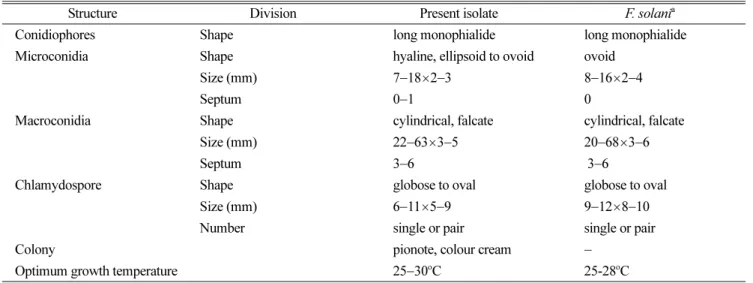
병원균 분리 및 특성. 병든 식물체로부터 병원균을 분 리하기 위하여 줄기에 형성된 병든 조직을 잘라 1% 차 아염소산나트륨(NaOCl) 용액에 표면 살균하고 살균수로 3회 세척한 후 멸균된 여과지에서 물기를 말린 다음 물 한천배지(WA) 위에 치상하였다. 병원균은 26oC 항온기에 서 3일간 배양 후 균사 선단부를 떼어내 감자한천배지 (PDA, Difco)와 CLA(Carnation leaf agar) 배지에서 배양 하면서 배양적, 형태적 특징을 조사하였다(Table 1). 분리 한 병원균의 생육적온은 25−30oC에서 PDA에 배양할 경 Fig. 1. Crown and foot rot of grafted cucumber caused by Fusarium solani f. sp. cucurbitae. (A) Natural symptoms on cucumber showing wilt in field, (B) Crown rot on rootstock plants, (C) Internal symptoms of the rotten stem, (D) Colony of the isolate on PDA, (E) Microconidia and septate, falcate macroconidia formed on aerial mycelium (Bar = 20 µm), (F) Macroconidia (Bar = 20 µm), (G) Chlamydospores (Bar = 10 µm), (H) Monophialides, (I) Symptom on cucumbers by artificial inoculation.
우 균사 생장이 가장 왕성하였으며, 기중균사를 형성하고 배지에서의 색깔은 갈색 내지 크림색을 나타내었다(Fig.
1D). 소형분생포자는 난형으로 0−1개의 격벽을 보였고, 크기는 7−18×2−3 µm였다(Fig. 1E). 대형분생포자는 통통 한 초승달 모양으로 뚜렷한 3−6개의 격벽을 보였고 기부 세포는 foot-shape으로 크기는 22−63×3−5 µm였다(Fig. 1F).
후막포자는 PDA에서 비교적 드물게 형성하였으며, 둥근 형태로 크기는 6−11×5−9 µm였다(Fig. 1G). 분생자경은 monophialide를 나타내었으며(Fig. 1H), 배양 중에 유성세 대는 관찰되지 않았다.
ITS 염기서열 분석. 병원균의 유전학적 동정을 위해 ITS(internal transcribed spacer) rDNA 부분을 2개의 프라
이머 ITS1(5'-TCCGTAGGTGAACCTGCGG-3')과 ITS4(5'- TCCTCCGCTTATTGATATGC-3') 영역을 PCR(polymerase chain reaction)로 증폭시켰다. 전기영동을 통하여 PCR 산 물을 확인한 후에 pGEMT Easy vector에 클로닝한 후 염 기서열(총 564 bp)을 결정하여(White 등, 1990) GenBank 에 등록하였다(Accession No. JN017202). 계통수는 MEGA4 프로그램을 사용하여 Li 등(2010)이 보고한 Fusarium solani (Accession No. HM015882) 등 ITS rDNA 염기서열을 그 룹 외 표본으로 하여 계통발생을 비교 분석하였다(Fig. 2).
따라서 ITS rDNA 염기서열 비교분석한 결과 F. solani로 확인하였다.
병원성 검정. 접목한 오이의 줄기에서 분리한 F. solani Table 1. Comparison of morphological characteristics of Fusarium solani f. sp. cucurbitae isolated from crown and foot rot of grafted cucumber and described
Structure Division Present isolate F. solania
Conidiophores Shape long monophialide long monophialide
Microconidia Shape hyaline, ellipsoid to ovoid ovoid
Size (mm) 7−18×2−3 8−16×2−4
Septum 0−1 0
Macroconidia Shape cylindrical, falcate cylindrical, falcate
Size (mm) 22−63×3−5 20−68×3−6
Septum 3−6 3−6
Chlamydospore Shape globose to oval globose to oval
Size (mm) 6−11×5−9 9−12×8−10
Number single or pair single or pair
Colony pionote, colour cream −
Optimum growth temperature 25−30oC 25-28oC
aBooth (1971)
Fig. 2. Phylogenetic relationship between Fusarium solani isolate and some reference isolates retrieved from GenBank, inferred by neighbor-joining method using the ITS rDNA region. Bootstrap values based on 1000 replications are indicated above the branches and the scale bar represents 0.5 nucleotide substitutions per site.
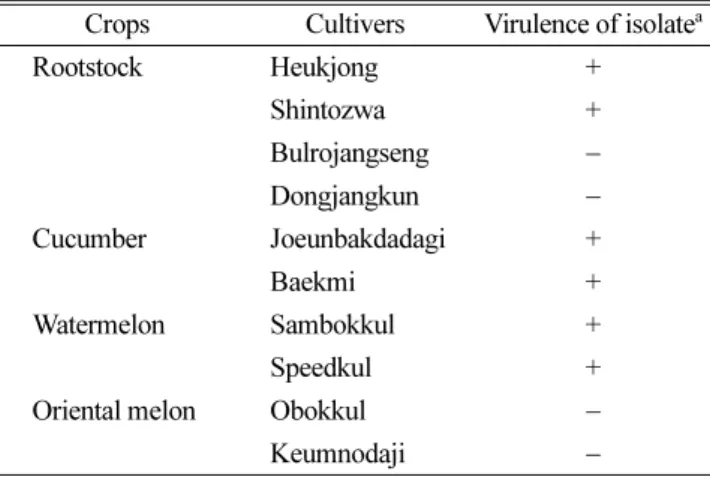
f. sp. cucurbitae의 병원성 검정을 위해 접종원은 CLA 배 지에 균사 조각을 접종한 후 포자형성을 유도하였다. 26oC 에서 10일 동안 배양한 배지에 멸균된 0.5% Tween 20 용액을 넣어 멸균 면봉으로 긁어낸 뒤, 멸균된 가제를 이 용하여 소형 분생포자와 대형 분생포자의 포자현탁액 (4×10⁹ spores/ml)을 제조하였다. 접종을 위한 식물체 준 비는 오이, 수박, 참외 각각 2품종과 호박대목 2품종, 참 박대목 2품종을 직경 8 cm 검정색 비닐포트에 파종한 후 30일 동안 온실에서 키운 후 각 포트 당 지제부에 5 ml 씩 포자현탁액을 접종하였다. 접종 후 25−30oC로 유지되 는 유리온실에서 재배하면서 발병 여부를 조사하였다. 접 종 15일 후 지제부 줄기와 뿌리가 갈변되면서 말라죽는 증상을 조사한 결과, Table 2와 같이 대목의 종류에 따른 병원성 검정결과 호박대목에 속하는 ‘흑종호박’과 ‘신토 좌’는 감수성을, 참박대목에 속하는 ‘동장군’과 ‘불로장생’
은 F. solani f. sp. cucurbitae에 대해 뚜렷한 저항성을 보 였다. 박과작물에 대한 병원성 검정결과에서도 오이와 수 박은 뚜렷한 감수성을 나타내었으나 참외 2품종에서는 병 징을 보이지 않았다(Fig. 1I).
이상과 같이 병원균의 균학적 특성을 조사한 결과 Booth(1971)과 Nelson 등(1983)에 의해 보고된 F. solani 와 형태적, 배양적 특성과 ITS 염기서열 유사도가 일치 하였다. 세계적으로는 F. solani f. sp. cucurbitae에 의한 박과작물에 대한 병 발생은 미국에서는 호박에 발생하는 것으로 보고하였으며(Castroagudin 등, 2009) 스페인에서 는 쥬키니호박(Gómez 등, 2008)과 접목된 수박에 발생하 는 것으로 보고되었으며(Armengol 등, 2000), 오이에 발 생하는 것은 중국에 보고된 바 있다(Li 등, 2010). 또한 3
종의 수박과 9종의 대목에 대한 저항성 검정에서도 서로 다른 저항성을 나타내는 것을 보고한 결과도 있다(Boughalleb 등, 2007). 따라서 본 연구에서 얻어진 결과를 가지고 이 병을 F. solani f. sp. cucurbitae에 의한 오이 근경썩음병 (Crown and Foot Rot)으로 제안하고자 한다.
요 약
2010년 3월 경기도 평택시 오이 시설재배농가에서 오 이의 지제부 줄기가 썩으면서 시들어 죽는 증상이 발생 하였다. 대목은 흑종호박을 사용하였으며, 대목줄기가 수 침상으로 썩고 표면에 흰색 내지 분홍색의 곰팡이가 형 성된 것을 확인할 수 있었으며, 병든 식물체 줄기에서 병 원균을 분리하여 균학적 특징을 파악하고 배양적 특성을 검토한 결과 Fusarium solani f. sp. cucurbitae로 동정되 었다. 따라서 본 연구에서 얻어진 결과를 가지고 이 병을 F. solani f. sp. cucurbitae에 의한 오이 근경썩음병(Crown and Foot Rot)으로 제안하고자 한다.
References
Armengol, J., José, C. M., Moya, M. J., Sales, R., Vicent, A. and García-Jiménez. J. 2000. Fusarium solani f. sp. cucurbitae race 1, a potential pathogen of grafted watermelon production in Spain. Bulletin OEPP 30: 179−183.
Booth, C. 1971. The genus Fusarium. Commonwealth Mycological Institute. Kew, Surrey, England. No. 237.
Boughalleb, N., Tarchoun, N., Mbarki, A. E. and Mahjoub, M. E.
2007. Resistance evaluation of nine cucurbit rootstocks and grafted watermelon (Citrullus lanatus L.) varieties against Fusarium wilt and Fusarium crown and root rot. J. Plant Sci.
2: 102−107.
Castroagudin, V. L., Correll, J. C. and Cartwright, R. D. 2009.
First report of fruit rot of pumpkin caused by Fusarium solani f. sp. cucurbitae in Arkansas. Plant Dis. 93: 669.
Gómez, J., Guerra-Sanz, J. M., S·nchez-Guerrero, M. C. and Serrano, Y. 2008. Crown rot of Zucchini squash caused by Fusarium solani f. sp. cucurbitae in AlmerÌa Province, Spain.
Plant Dis. 92: 1137.
Lee, J. M. 1989. On the cultivation of grafted plants of Cucurbitaceous vegetables. Hort. Envir. Bio. 30: 169−179. (In Korean)
Li, B. J., Liu, Y., Sh, Y. X. and Xie, X. W. 2010. First report of crown rot of grafted cucumber caused by Fusarum solani in China. Plant Dis. 94: 377.
Nelson, P. E., Toussoun, T. A. and Marasas, W. F. O. 1983.
Fusarium Species, an Illustrated Manual for Identification.
pp. 146−150. The Pennsylvania State University, USA.
Table 2. Pathogenicity of Fusarium solani f. sp. cucurbitae isolated from crown and foot rot of grafted cucumber on rootstocks and different Cucurbitaceous vegetables plants
Crops Cultivers Virulence of isolatea
Rootstock Heukjong +
Shintozwa +
Bulrojangseng −
Dongjangkun −
Cucumber Joeunbakdadagi +
Baekmi +
Watermelon Sambokkul +
Speedkul +
Oriental melon Obokkul −
Keumnodaji −
aDisease rating was made 15 days after inoculation.
+: Pathogenic, −: Non-pathogenic.
The Korean Society of Plant Pathology. 2009. List of Plant Diseases in Korea. 5th ed., Suwon, Korea. 853 pp. (In Korean) White, T. J., Bruns, T., Lee, S. and Taylor, J. W. 1990.
Amplification and direct sequencing of fungal ribosomal RNA
genes for phylogenetics. In: PCR Protocols: A Guide to Methods and Applications, ed. by M. A. Innis, D. H. Gelfand, J. J. Sninsky, and T. J. White, pp. 315−322. Academic Press, Inc., New York, USA.