Relationships among Physical Activity Level, Health-promoting Behavior, and Physiological Variables in Korean University Students
Bang, Kyung-Sook
1· Song, Min Kyung
2· Park, Se-Eun
2· Kim, Hyungkyung
31Professor, College of Nursing ․ The Research Institute of Nursing Science, Seoul National University, Seoul
2Graduate Student, College of Nursing, Seoul National University, Seoul, Korea
3Graduate Student, College of Nursing, University of Illinois at Chicago, Chicago, USA
Purpose: Many Korean college students suffer from physical inactivity and mental health problems. However, it has
not been sufficiently reported how this lack of exercise and health-related behavior affect their health. The present study was performed to identify the relationships among physical activity level, health-promoting behavior, and phys- iological variables in Korean undergraduate and graduate students. Methods: Participants were 115 undergraduate and graduate students from one university in Seoul. The Pearson’s correlation analysis was performed using SPSS for Windows. Results: Physical activity level had significant positive correlations with health-promoting behavior (r=.32, p=.001) and exercise self-efficacy (r=.25, p=.008), and health-promoting behavior had a significant correla- tion with depression (r=-.33, p<.001) and exercise self-efficacy (r=.44, p<.001). Additionally, physical activity level had significant correlations with triglyceride (r=-.20, p=.034) and vitamin D (r=.20, p=.029) levels. The high density cholesterol level had significant negative correlations with systolic blood pressure (r=-.33, p<.001), diastolic blood pressure (r=-.29, p=.002), and vitamin D (r=-.20, p=.035) levels. Conclusion: Physical activity level or health-promot- ing behavior had significant relationships with the health status of college students. Strategies need to be developed to improve health-promoting behaviors among college students.
Key Words: Exercise, Health promotion, Depression
Corresponding author: Song, Min Kyung
College of Nursing, Seoul National University, 103 Daehak-ro, Jongno-gu, Seoul 03080, Korea.
Tel: +82-2-740-8467, Fax: +82-2-765-4103, E-mail: [email protected]
- This work is part of original project that was supported by the SNU Brain Fusion Program in 2014 at the Seoul National University.
투고일 2018년 3월 5일 / 심사완료일 2018년 3월 30일 / 게재확정일 2018년 4월 3일
INTRODUCTION
A lack of physical activity is one of the most important public health problems of the 21st century.1) It has been identified as the fourth leading risk factor for death worldwide. Globally, physical inactivity is estimated to cause about 21% to 25% of breast and colon cancer, 27% of diabetes, and about 30% of ischemic heart disease; the burden of these and other chronic diseases has rapidly in- creased in recent decades.2) Recent population estimates suggest that 5.3 million deaths from non-communicable disease, such as coronary heart disease, type 2 diabetes, and breast and colon cancers, could be prevented annu- ally if physically inactive people were sufficiently active.3) Lack of physical activity is an important modifiable risk factor for cardiovascular and metabolic diseases and bone
density.3,4) With these reasons, international public health and health promotion organizations have listed physical inactivity as the most remarkable health risk factor across the lifespan. Therefore, promoting physical activity is es- sential for public health and health promotion strategies.
Some systematic reviews have ascertained the benefits of physical activity among healthy adults.5-7)
A previous study has shown that practicing health-pro- moting behaviors decreases the occurrence of disease and lowers the death rate.8) If health-promoting behaviors are integrated into the lifestyle, it will bring better health, functional abilities, and overall quality of life.
The college years are an important time of transition from adolescence to adulthood.9) During this period, young adults may increase their control over their lifestyles and may engage in a variety of both protective (e.g., exercise)
and risky (e.g., drinking) behaviors that impact their cur- rent and future health status.10) Additionally, lifestyle is not firmly formed compared to adults and has larger modifiability.
According to a study on the effect of self-efficacy on physical activity among Korean college students, self-effi- cacy was significantly correlated with physical activity and can be considered a significant factor to help improve college students’ physical activity levels.11) Health-related behaviors, including physical activity and health-promot- ing behavior is associated with self-efficacy.9) There are al- so several studies that reported a significant correlation between the physical activity level and depression; it was also suggested that physical activity could help reduce depressive symptoms.12,13) Some studies on the effect of physical activity reported a significant decrease in systolic blood pressure (BP), body fat percentage, cholesterol, and triglycerides levels, which are indicators of metabolic syn- drome in intervention group.14) Another study showed a significant relationship between physical activity and vi- tamin D.15) Consequently, physical activity was associated with body composition and some blood profiles.
As reviewed, physical activity is known to be associ- ated with health-promoting behaviors, self-efficacy, de- pression, blood profiles, and body composition. However, how a lack of physical activity and health-promoting be- havior in university students can affect the health is not sufficiently reported. This study was designed to identify the relationships among physical activity level, health- promoting behavior, exercise self-efficacy, depression, and physiological variables such as BP, body composition an- alysis, and other clinical indicators for Korean undergra- duate and graduate students. This study also investigated the correlation between physiological variables of meta- bolic syndrome and bone density those were known to be associated with physical inactivity.
METHODS 1. Study Design
This study was a descriptive correlational study to ad- dress the relationship among physical activity level, health- promoting behavior, and physiological variables.
2. Study Participants
This study was designed with a different purpose from that of an intervention study for undergraduate and grad- uate students. The data used in this study were pretest da-
taset of an intervention study.16) Participants were re- cruited at one university in Seoul, South Korea. Under- graduate and graduate students were recruited via no- tices posted on the university homepage and sent via e-mail to students through the health service center from August to September 2014. Study participants comprised 115 students who voluntarily agreed to participate. Before the study commenced, a full explanation about the re- search purpose, experimental procedure, and all meas- ured indices was provided. Informed consent was obtain- ed from all participants. Before the study commenced, a full explanation about the research purpose, experimental procedure, and all measured indices was provided. In- formed consent was obtained from all participants. This study is part of original project that has been approved by the Ethics Committee of the Seoul National University Hospital Evaluation Committee (IRB No. 1409/001-001).
3. Measurements
We measured participants’ body composition, BP, bone density, and collected blood sample. Additionally, the physical activity level, health-promoting behavior, exer- cise self-efficacy, and depression were assessed using a structured self-report questionnaire.
Height and weight were measured using an automatic stadiometer (BSM 370, Inbody Co., Ltd., Seoul, Korea).
Body composition was assessed using a body composi- tion analyzer regarding the amount of body fat, percent- age of body fat, body mass index (BMI), skeletal muscle mass, and amount of muscle (Inbody 570, Inbody Co., Ltd., Seoul, Korea). After 10 min of rest, BP was measured.
Bone density was measured at the right calcaneus bone using broadband ultrasound attenuation (Sonost 3000, OsteoSys Co., Ltd, Seoul, Korea). In general, bone density indicates a T-score of “-1 and above” to mean normal;
“-2.5 to -1” to mean osteopenia, a condition in which bone density is below normal and may lead to osteoporosis;
and “-2.5 or below” to mean osteoporosis. About 5mL of blood were taken to determine serum vitamin D, fasting se- rum total cholesterol (TC), low-density lipoprotein choles- terol (LDL), high-density lipoprotein cholesterol (HDL), and triglyceride (TG). Participants were asked not to eat or drink for 12 hours before testing. One laboratory deter- mined all blood biochemistry parameters (Green Cross Laboratories, Yongin, Korea). Heart rate variability (HRV) was measured using a portable electrocardiograph (LXC 3203, LAXTHA Inc., Daejeon, Korea). HRV data were ob- tained at various frequency bands using an HRV software tool (TeleScan, LAXTHA Inc., Daejeon, Korea). After 10
min of rest, HRV was measured. A heart rate monitor with a unipolar limb lead electrocardiography (ECG) re- corder was used to collect continuous R-R intervals, which were stored on a computer for later analysis. Time taken to measure was about 5 min.
A self-report questionnaire was administered to inves- tigate demographic data, health-promoting behavior, ex- ercise self-efficacy, physical activity level, and depression.
Health-promoting behavior was assessed using a Korean version17) of the Health-Promoting Lifestyle Profile II (HPLP-II). The HPLP-II is a 52-item 4-point Likert scale based on Pender’s health promotion model, which con- tains six subscales. Cronbach’s ⍺ for this scale was .92,17) and in this study, it was .91. Exercise self-efficacy was as- sessed using a modified version of Marcus et al.18) tool, re- vised and translated into Korean by three Korean nursing college professors.19) This comprises 10 items that exam- ine self-efficacy for physical activity in various situations using a 4-point Likert scale. Cronbach’s ⍺ for this scale was .84.19) In this study, it was .74. Physical activity level was measured using the International Physical Activity Questionnaire-Short form20) which measures total physical activity accrued through work and leisure in all settings combined. Participants were asked about their frequency and duration of exercise by indicating the days and time spent doing vigorous and moderate activities, walking, and sitting in the last 7 days. Metabolic equivalent (MET) is the ratio of working metabolic rate to resting metabolic rate. 1 MET is defined as 1 kcal/kg/hour and is about the same as the energy cost when sitting quietly.
Walking MET-min/week=3.3×walking min×walking days
Moderate MET-min/week=4.0×moderate-intensity activity min×moderate days
Vigorous MET-min/week=8.0×vigorous-intensity activity min×vigorous-intensity days
A combined total physical activity MET-min/week can be computed as the sum of Walking+Moderate+Vigor- ous MET-min/week scores.
Depression was investigated using a Korean version of the Beck Depression Inventory (BDI) questionnaire.21) It comprises 21 items and a 3-point Likert scale. The total sum of the item scores ranges from 0 to 63, with higher total scores indicating more severe depressive symptoms. Cron- bach’s ⍺ for this scale was .85.21) In this study, it was .86.
4. Statistical Analysis
Demographic information was analyzed using mean, standard deviation (SD), frequency, and percentage. The
relationships between variables were analyzed using Pearson product-moment correlation coefficients, depend- ing on the normality of the distribution of the variables.
All statistical tests were two-tailed and the acceptance lev- el of statistical significance (p value) in the overall analysis was 0.05 or less. All statistical analyses were undertaken using IBM SPSS 22.0 for Windows (Chicago, IL, USA).
RESULTS
This study was conducted with healthy university stu- dents, and we evaluated the relationships among physical activity level, health-promoting behavior, depression, and physiological variables. The total participants included 115 university students (mean age 24.4±4.2; age range: 18~36 years; 54 men [47.0%] and 61 women [53.0%]).
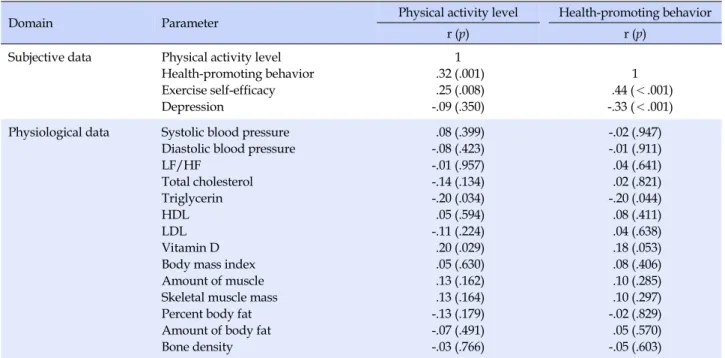
Pearson product-moment correlation coefficients are shown in Table 1. The physical activity level showed sig- nificant correlations with health-promoting behaviors (r=
.32, p=.001) and exercise self-efficacy (r=.25, p=.008). Health- promoting behaviors showed a significant negative corre- lation with depression (r=-.33, p<.001). Additionally, the physical activity level showed significant correlations with TG (r=-.20, p=.034), vitamin D (r=.20, p=.029).
The systolic and diastolic BP showed significant corre- lations with TG, LDL, and HDL. The systolic BP showed significant positive correlations with TG (r=.32, p=.001), LDL (r=.25, p=.007), and the diastolic BP showed signi- ficant positive correlations with TG (r=.27, p=.004), LDL (r=.24, p=.011). Also, HDL has significant negative corre- lation with systolic BP (r=-.33, p<.001), and diastolic BP (r=-.29, p=.002). Vitamin D levels showed significant neg- ative correlations with total cholesterol (r=-.19, p=.047) and HDL (r=-.20, p=.035)(Table 2).
DISCUSSION
This study was performed to ascertain the relationships among physical activity level, health-promoting behavior, and physiological variables and to explore the association between physiological variables. The study demonstrated a significant relationship between health-promoting be- havior and physical activity levels. Health-promoting be- haviors help alleviate physical and psychological stresses, and strengthen the positive aspects of life.22) This finding was consistent with previous study.8) Health-promoting behavior is one of the most important factors in caring for one’s health. This direct relationship between health-pro- moting behaviors and physical activity levels shows us that increased health-promoting behaviors would improve
Table 1. Correlations among Physical Activity Levels, Health-promoting Behaviors, Subjective and Physiological Data (N=115)
Domain Parameter Physical activity level Health-promoting behavior
r (p) r (p)
Subjective data Physical activity level Health-promoting behavior Exercise self-efficacy Depression
1 .32 (.001) .25 (.008) -.09 (.350)
1 .44 (<.001) -.33 (<.001) Physiological data Systolic blood pressure
Diastolic blood pressure LF/HF
Total cholesterol Triglycerin HDL LDL Vitamin D Body mass index Amount of muscle Skeletal muscle mass Percent body fat Amount of body fat Bone density
.08 (.399) -.08 (.423) -.01 (.957) -.14 (.134) -.20 (.034) .05 (.594) -.11 (.224) .20 (.029) .05 (.630) .13 (.162) .13 (.164) -.13 (.179) -.07 (.491) -.03 (.766)
-.02 (.947) -.01 (.911) .04 (.641) .02 (.821) -.20 (.044) .08 (.411) .04 (.638) .18 (.053) .08 (.406) .10 (.285) .10 (.297) -.02 (.829) .05 (.570) -.05 (.603) HDL=High density lipid; HF=High frequency; LDL=Low density lipid; LF=Low frequency.
Table 2. Correlations among Physiological Variables (N=115)
Variables SBP DBP T. Cho TG LDL HDL Vit. D Bone density
r (p) r (p) r (p) r (p) r (p) r (p) r (p) r (p)
SBP 1
DBP .71 (<.001) 1
T. Cho .12 (.211) .13 (.152) 1
TG .32 (.001) .27 (.004) .50 (<.001) 1
LDL .25 (.007) .24 (.011) .83 (<.001) .47 (<.001) 1
HDL -.33 (<.001) -.29 (.002) .30 (.001) -.24 (.009) -.13 (.166) 1
Vit. D .21 (.025) .16 (.098) -.19 (.047) -.12 (.195) -.11 (.236) -.20 (.035) 1
Bone density .18 (.055) .13 (.163) -.01 (.946) .07 (.439) .06 (.519) -.08 (.384) .09 (.329) 1 DBP=Diastolic blood pressure; HDL=High density lipid; LDL=Low density lipid; SBP=Systolic blood pressure; T. Cho=Total cholesterol;
TG=Triglycerin; Vit. D=Vitamin D.
university students’ attitudes to health care and their phy- sical activity. Therefore, healthcare programs are to be fo- cused on, encouraging health-promoting behaviors in or- der to increase physical activity levels.
Second, there were significant correlations between the physical activity level and exercise self-efficacy as well as between health-promoting behaviors and exercise self- efficacy. As in previous studies, physical activity has been positively related to self-efficacy,23) and self-efficacy is a vital factor affecting health-promoting behavior.24) Increas- ing self-efficacy is generally considered an important me-
diator of the effects of physical activity interventions.
Additionally, there was a significant negative correla- tion between health-promoting behaviors and depression.
Meanwhile, a relationship between depression and phys- ical activity level was not found. A longitudinal study to examine the relationships between physical activity and depression showed lower levels of physical activity asso- ciated with depression.25) Similarly, the physical activity level was significantly related to depressive symptoms and they argued the possibility of the role of physical ac- tivity in preventing depressive symptoms.12) These find-
ings are not consistent with this study’s result. Therefore, further research is needed to examine the relationship be- tween depression and physical activity.
Higher health-promoting behaviors showed lower lev- els of depression, which was consistent with other study findings.13,26) A negative correlation between the geriatric depression score and health-promoting behavior was found. The Geriatric Depression Scale score was negati- vely associated with health-promoting behaviors. Social participation, health responsibility, self-protection, an ac- tive lifestyle, and the total health promotion for seniors score all reached statistical significance. Previous studies have also shown that any level of physical activity, includ- ing low levels (e.g., walking<150 min/week) can prevent future depression. From a population health perspective, promoting physical activity may serve as a valuable men- tal health promotion strategy in reducing the risk of de- veloping depression.
Physical activity level showed significant correlations with TG and vitamin D among physiological variables.
High levels of physical activity showed reduced TG, in- creased vitamin D. Previous study performed to deter- mine the effect of an intensive exercise program reported that increased physical activity through the exercise pro- gram significantly decreased serum triglycerides.27) Also, the result indicated a significant positive relationship be- tween physical activity level and vitamin D. There is evi- dence that vitamin D status is associated with physical activity. A positive correlation between vitamin D and physical activity has been reported and, potentially, in- tensive physical activity might contribute to increase vita- min D levels.15) Another study also showed that vitamin D is related to high-impact physical activity.28) These find- ings are supported by our study results.
Moreover, BP showed a significant positive correlation with level of triglyceride and LDL, and negative correla- tion with the level of HDL. Hypertension, high TG, and low HDL are the main indicators of the metabolic syn- drome with the central circumference.29) In this study, HDL and vitamin D showed a negative correlation. How- ever, in many recent studies, a positive correlation be- tween HDL and vitamin D has been reported.29) A recent review included that there is implicit evidence for the association among higher vitamin D level and low risk of cardiovascular disease and type 2 diabetes, and low BP.30)
Some study limitations are as follows. First, study par- ticipants were restricted to only undergraduate and grad- uate students at one university; therefore, caution is need- ed regarding the generalization of the results to other population groups. Second, the data used in this study are
secondary data collected for intervention studies for un- dergraduate and graduate students. Since the data was not collected for the purpose of this study, there may be prob- lems such as missing important information. Therefore, further studies are needed, including other variables those affect health. In addition, Pearson's product-moment cor- relation coefficient was used to analyze the simple rela- tionship among variables in this study. Comprehensive follow-up studies using advanced statistics such as multi- ple regression, multivariable analysis considering gender and age should be conducted to analyze factors directly or indirectly affecting physical activity level, health-promot- ing behavior, and physiological variables. Further studies undertaken in diverse settings with larger sample will be needed to generalize the study findings. Here, we discuss the results compared with previous studies, which will contribute to the establishment of strategies to improve the physical activity and mental health of Korean uni- versity students.
CONCLUSION
University students represent one of the largest student groups in the Korean higher education system. Under- standing the relationships among their physical activity, health-promoting behavior, and physiological variables are important steps to help advance the application of physical activity intervention programs for the university student population. This study result provides us with some empirical suggestions for health educators in col- leges and universities who are interested in promoting physical and mental health. For example, the physical ac- tivity level was correlated with health-promoting behavior, and self-efficacy affected both physical activity and health- promoting behaviors positively. Meanwhile, healthpromot- ing behaviors seemed to reduce depression. In addition, physical activity can lead to a positive change in the serum lipid profile, especially outdoor activity increases the vita- min D level. Finally, health educators should recognize and address the relationships among those variables in the design and implementation of health-promoting pro- grams to provide Korean university students with the best opportunity to engage in greater physical activity.
REFERENCES
1. Trost SG, Blair SN, Khan KM. Physical inactivity remains the greatest public health problem of the 21st century: evidence, improved methods and solutions using the ‘7 investments that work'as a framework. Br J Sports Med. 2014 Feb 1;48(3):169-70.
https://doi.org/10.1136/bjsports-2013-093372
2. World Health Organization. Global strategy on diet, physical activity and health [Internet]. Geneva [Internet]. [Geneva]:
World Health Organization; 2017 May 23 [cited 2018 Mar 15].
Available from:
http://www.who.int/dietphysicalactivity/pa/en/
3. Lee IM, Shiroma EJ, Lobelo F, Puska P, Blair SN, Katzmarzyk PT, et al. Effect of physical inactivity on major non-communi- cable diseases worldwide: an analysis of burden of disease and life expectancy. Lancet. 2012 Jul 21;380(9838):219-29.
https://doi.org/10.1016/S0140-6736(12)61031-9
4. Chastin SF, Mandrichenko O, Helbostadt J, Skelton DA. Asso- ciations between objectively-measured sedentary behaviour and physical activity with bone mineral density in adults and older adults, the NHANES study. Bone. 2014 Jul;64:254-62.
https://doi.org/10.1016/j.bone.2014.04.009
5. Biswas A, Oh PI, Faulkner GE, Bajaj RR, Silver MA, Mitchell MS, et al. Sedentary time and its association with risk for dis- ease incidence, mortality, and hospitalization in adults: a sys- tematic review and meta-analysis. Ann Intern Med. 2015 Jan 20;162(2):123-32. https://doi.org/10.7326/M14-1651
6. Kyu HH, Bachman VF, Alexander LT, Mumford JE, Afshin A, Estep K, et al. Physical activity and risk of breast cancer, colon cancer, diabetes, ischemic heart disease, and ischemic stroke events: systematic review and dose-response meta-analysis for the Global Burden of Disease Study 2013. BMJ. 2016 Aug 6;354:i3857. https://doi.org/10.1136/bmj.i3857
7. Wei CN, Harada K, Ueda K, Fukumoto K, Minamoto K, Ueda A. Assessment of health-promoting lifestyle profile in Japanese university students. Environ Health Prev Med. 2012 May;17 (3):222-7. https://doi.org/10.1007/s12199-011-0244-8 8. Mohammadi M, Ramezankhani A, Mohammadi S, Zahed S,
Khabiri F, Khodakarim S, et al. The predictors of metabolic syndrome based on Walker health-promoting lifestyle in Iran 2016. Diabetes Metab Syndr. 2017 Dec;11 Suppl 2:S745-9.
https://doi.org/10.1016/j.dsx.2017.05.009
9. Hershner SD, Chervin RD. Causes and consequences of sleepi- ness among college students. Nat Sci Sleep. 2014 Jun 24;6:
73-84. https://doi.org/10.2147/NSS.S62907
10. Dinger MK, Brittain DR, Hutchinson SR. Associations between physical activity and health-related factors in a national sam- ple of college students. J Am Coll Health. 2014;62(1):67-74.
https://doi.org/10.1080/07448481.2013.849710
11. Kim GS, Lee CY, Kim IS, Lee TH, Cho E, Lee H, et al. Dyadic ef- fects of individual and friend on physical activity in college students. Public Health Nurs. 2015 Sep-Oct;32(5):430-9.
https://doi.org/10.1111/phn.12176
12. Liao Y, Shibata A, Ishii K, Oka K. Independent and combined associations of physical activity and sedentary behavior with depressive symptoms among Japanese adults. Int J Behav
Med. 2016 Aug;23(4):402-9.
https://doi.org/10.1007/s12529-015-9484-0
13. Mammen G, Faulkner G. Physical activity and the prevention of depression: a systematic review of prospective studies. Am J Prev Med. 2013 Nov;45(5):649-57.
https://doi.org/10.1016/j.amepre.2013.08.001
14. Muros JJ, Zabala M, Oliveras-Lopez MJ, Ocana-Lara FA, Lopez-Garcia de la Serrana H. Results of a 7-week school-based physical activity and nutrition pilot program on health-related parameters in primary school children in southern Spain.
Pediatr Exerc Sci. 2013 May;25(2):248-61.
https://doi.org/10.1123/pes.25.2.248
15. Scott D, Ebeling PR, Sanders KM, Aitken D, Winzenberg T, Jones G. Vitamin D and physical activity status: associations with five-year changes in body composition and muscle func- tion in community-dwelling older adults. J Clin Endocrinol Metab. 2015 Feb;100(2):670-8.
https://doi.org/10.1210/jc.2014-3519
16. Bang KS, Lee I, Kim S, Lim CS, Joh HK, Park BJ, et al. The ef- fects of a campus forest-walking program on undergraduate and graduate students' physical and psychological health. Int J Environ Res Public Health. 2017 Jul 5;14(7):728.
https://doi.org/10.3390/ijerph14070728
17. Seo HM, Hah YS. A study of factors influencing on health pro- moting lifestyle in the elderly: application of Pender's health promotion model. J Korean Acad Nurs. 2004 Dec;34(7):1288- 97. https://doi.org/10.4040/jkan.2004.34.7.1288
18. Marcus BH, Selby VC, Niaura RS, Rossi JS. Self-efficacy and the stages of exercise behavior change. Res Q Exerc Sport. 1992 Mar;63(1):60-6.
https://doi.org/10.1080/02701367.1992.10607557
19. Han E. Analysis of stages of change in exercise behavior in of- fice workers using transtheoretical model [master's thesis].
[Seoul]: Yonsei University; 2004. 68 p.
20. Craig CL, Marshall AL, Sjostrom M, Bauman AE, Booth ML, Ainsworth BE, et al. International physical activity question- naire: 12-country reliability and validity. Med Sci Sports Exerc.
2003 Aug;35(8):1381-95.
https://doi.org/10.1249/01.MSS.0000078924.61453.FB 21. Rhee MK, Lee YH, Park SH, Sohn CH, Chung YC, Hong SK, et
al. A standardization study of Beck Depression Inventory I- Korean version (K-BDI): reliability and factor analysis. The Korean J Psychopathol. 1995 Dec;4(1):77-95.
22. Lee MS, Kim KS, Cho MK, Ahn JW, Kim S. Study of stress, health promotion behavior, and quality of life of nursing stu- dents in clinical practice and factors associated with their qual- ity of life. J Muscle Jt Health. 2014 Aug;21(2):125-34.
https://doi.org/10.5953/JMJH.2014.21.2.125
23. Joseph RP, Royse KE, Benitez TJ, Pekmezi DW. Physical activ- ity and quality of life among university students: exploring
self-efficacy, self-esteem, and affect as potential mediators.
Qual Life Res. 2014 Mar;23(2):659-67.
https://doi.org/10.1007/s11136-013-0492-8
24. Lo SWS, Chair SY, Lee FK. Factors associated with health-pro- moting behavior of people with or at high risk of metabolic syndrome: based on the health belief model. Appl Nurs Res.
2015 May;28(2):197-201.
https://doi.org/10.1016/j.apnr.2014.11.001
25. Gudmundsson P, Lindwall M, Gustafson DR, Ostling S, Hall- strom T, Waern M, et al. Longitudinal associations between physical activity and depression scores in Swedish women fol- lowed 32 years. Acta Psychiatr Scand. 2015 Dec;132(6):451-8.
https://doi.org/10.1111/acps.12419
26. Chang CF, Lin MH, Wang J, Fan JY, Chou LN, Chen MY. The relationship between geriatric depression and health-promot- ing behaviors among community-dwelling seniors. J Nurs Res.
2013 Jun;21(2):75-82.
https://doi.org/10.1097/jnr.0b013e3182921fc9
27. Hamasaki H, Noda M, Moriyama S, Yoshikawa R, Katsuyama H, Sako A, et al. Daily physical activity assessed by a triaxial
accelerometer is beneficially associated with waist circumfe- rence, serum triglycerides, and insulin resistance in Japanese patients with prediabetes or untreated early type 2 diabetes. J Diabetes Res. 2015;2015:526201.
https://doi.org/10.1155/2015/526201
28. Herrmann D, Pohlabeln H, Gianfagna F, Konstabel K, Lissner L, Marild S, et al. Association between bone stiffness and nutri- tional biomarkers combined with weight-bearing exercise, physical activity, and sedentary time in preadolescent child- ren: a case-control study. Bone. 2015 Sep;78:142-9.
https://doi.org/10.1016/j.bone.2015.04.043
29. Ju SY, Jeong HS, Kim DH. Blood vitamin D status and metabolic syndrome in the general adult population: a dose-response meta- analysis. J Clin Endocrinol Metab. 2014 Mar;99(3):1053-63.
https://doi.org/10.1210/jc.2013-3577
30. Theodoratou E, Tzoulaki I, Zgaga L, Ioannidis JP. Vitamin D and multiple health outcomes: umbrella review of systematic reviews and meta-analyses of observational studies and rand- omised trials. BMJ. 2014 Apr;348:g2035.
https://doi.org/10.1136/bmj.g2035