연구노트
Ethnic Differences in Cigarette Smoking Behavior:
The Paso del Norte 2002 Behavioral Risk Factor Surveillance Survey
2)Gang Lee*
The goal of this study is to identify and compare predictors of smoking initiation, persistence and smoking status among Hispanics and Whites. The sample includes 1,410 Hispanic and non-Hispanic White adults living in El Paso, TX, USA and Doña Ana and Otero counties, NM, USA from the Paso del Norte 2002 BRFSS. Whites reported higher rates of cigarette smoking and became regular smokers earlier than Hispanics. Males were twice more likely to initiate cigarette smoking and progress to regular smoking than females among Hispanics, but this gender difference among Whites was not significant. Childhood exposure to drinkers or alcoholics was an important predictor of smoking initiation and becoming a regular smoker, but only among Hispanics. Few identified ethnic differences in predictors of smoking were found. The findings underscore the importance of Hispanic norms on smoking behaviors. Prevention efforts need to address the culture as one of the important components relevant to smoking.
key words: cigarette smoking ethnicity social status
Ⅰ. INTRODUCTION
While the prevalence of cigarette smoking has declined in the United States, this rate varies across racial/ethnic populations(CDC 2005; USDHHS 2004).
* Associate Professor, Department of Sociology & Anthropology, University of Texas at El Paso.
E-mail: [email protected]
Minority youths, especially Hispanics and African-Americans, currently have a lower prevalence of smoking than Whites, but the rates among minority adults are higher(USDHHS 1998; SAMHSA 2005). The age at the onset and development of regular smoking by ethnic minorities(Griesler & Kandel 1998; Griesler et al. 2002;
Hu et al. 1995; Kandel et al. 2004) are important variables to the understanding of ethnic differences. Development of cigarette smoking is a staged process from initiation to regular smoker(Flay 1993; Leventhal & Cleary 1980; McCarthy 1985). Early adolescence is the most important at-risk period, as most smokers initiate cigarette smoking during this developmental stage.
There are important ethnic differences in family norms against smoking, including parental cigarette and other substance use that predict smoking initiation and persistence(Catalano et al. 1992; Clark et al. 1999; O’Loughlin et al. 1998). Parental cigarette smoking is a strong predictor of a child’s smoking initiation, while parent substance use particularly predicts persistence of childhood smoking (Chassin et al.
1998; Griesler & Kandel 1998).
Social status also predicts individual’s smoking initiation and persistence.
Cigarette smoking behaviors and current smoking status are strongly influenced by and related to social context, particularly socio-economic status of income, education, and occupation(Barbeau et al. 2004; Flint & Novotny 1998; Winkleby et al. 1999). Unemployment status, especially for impoverished minorities, is correlated with higher level of smoking(Preston & Elo 1995; Schalick et al. 2004;
Weden et al. 2006).
This article examines the role of racial/ethnic differences among Whites and Hispanics in exposures to risk factors for smoking initiation and persistence, hypothesizing that childhood exposures to substance use and myriad socioeconomic status explain the differences in smoking behavior.
Ⅱ. METHODS
Data for this analysis were obtained from the 2002 Paso del Norte Behavioral Risk Factor Surveillance Survey(PdN BRFSS). Utilizing the Centers for Disease Control and Prevention(CDC 2003) procedures, the PdN 2002 BRFSS was designed to elicit information from a random sample of non-institutionalized adults living in El Paso, TX, USA and Doña Ana and Otero counties, NM, USA in 2002. This study was based on Hispanics(N = 880, 62%) and non-Hispanic Whites(N = 530, 38%). Females composed about 66 percent of the sample. Mean age was 45.9 years(SD = 17.0). The response rate was 36.8% for this survey.
The participants for the 2002 PdN BRFSS had different probabilities of selection, and the distribution of the demographic characteristics of the sample was significantly different than the distributions of the population of the Paso del Norte region reported in the 2000 US Census. The sampling weights that correct for unequal probabilities of sample selection were applied, and all analyses were conducted on the weighted sample using SUDAAN(a statistical software package for the analysis of correlated data developed by Research Triangle Institute International).
1. MEASURES
1) Dependent Variables
(1) Smoker
Respondents were askedthe following:
▪ "Have you smoked at least 100 cigarettes in your entire life?"
▪ "Do you now smoke cigarettes every day, some days, or not at all?"
Smokers were defined as those who reported having smoked more than 100 cigarettes during their lifetime(41%). Current smokers were defined the same way, with the addendum of currently smoking every day, or some days. Former smokers were also defined as those who reported smoking more than 100 cigarettes during their lifetime, but who currently did not smoke. Trichotomous variable of cigarette use(non-smokers, former smokers, and current smokers) was used to examine variations in socio-economic status on the progression of cigarette use as Former smokers that had ever used cigarettes, but had currently stopped using, and Current smokers that used cigarettes persistently.
(2) Age of onset and age of regular smoking
Respondents who reported having smoked more than 100 cigarettes during their lifetime(Smokers) were asked two categorical questions:
▪ "How old were you the first time you smoked a cigarette, even one or two puffs?"(Age of smoking onset)
▪ "How old were you when you first started smoking cigarettes regularly?"
(Age of regular smoking)
Mean ages for onset and regular smoking were 15.8 years and 18.5 years, respectively.
Time interval to regular smoking was measured by subtracting age of onset smoking from age of regular smoking. This measure was particularly important to investigate the relationship between a person’s reaction to the experimental use of cigarette(initiation) and the rate of progression to regular smoking.
2) Independent Variables
(1) Childhood exposure
There were two dichotomous questions asking about their childhood exposure to a substance user. To measure the exposure to alcoholic drinking, the respondents
were asked a qualifying question:
▪ "During your childhood, did you live with anyone who was a problem drinker or alcoholic?"(If the answer was 'no', the entry was coded as 0 and if the answer was 'yes', it was coded as 1).
To measure the exposure to illicit drug use, the respondents were asked
▪ "During your childhood, did you live with anyone who used street(or illicit) drugs?"
About 22% of respondents had lived with a problem drinker or alcoholic and 4% had lived with an illicit drug user.
(2) Social status
Four variables were noted under the realm of social status:
▪ Marital status was a dichotomous variable(married persons = 59%).
▪ Level of Education was coded as 1 = less than high school, 2 = high school graduate, 3 = some college, and 4 = college graduate.
▪ Income was coded as 1 = less than $10K to 8 = $75K or more.
▪ Employment was also a dichotomous variable(employed = 54%).
2. STRATEGY FOR ANALYSES
Analyses were estimated on Hispanics and non-Hispanic Whites to identify ethnic differences. A proportional hazard model(Yamaguchi 1991) was chosen for multivariate analysis with time-to-event data to assess the relationship between childhood exposures and the likelihood of smoking initiation along with the time interval to regular smoking. This model examines the relationship of the survival distribution to covariates, given that not all the subjects in the survey had lived through the period of risk for onset smoking. The proportional hazard model can be expressed as:
′
where is the observed failure time, is a p-dimensional vector of covariates,
is the corresponding vector of regression coefficients, and is the baseline hazard function(at ).
I assessed the effect of socio-economic status only on the measure of three levels of current cigarette smoking status, since smoking onset and becoming a regular smoker occurred before the construction of socio-economic status. To estimate the effects of socio-economic status for the person classified into trichotomous variables(non-smokers, former smokers and current smokers), a multi-nominal logit model was implemented. This model was used to assess the effects of independent variables on a polytomous categorical dependent variable. This statistical model can be expressed as:
where j = 0, 1, 2 refers to the categories of the dependent variable(non-smokers, former smokers, and current smokers), i =1...n indexes of individual respondents, and β is the vector of covariates.
Ⅲ. RESULTS
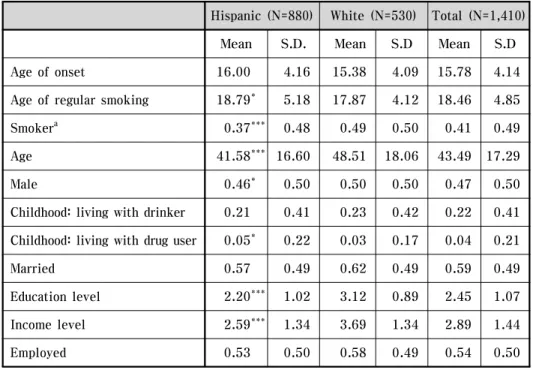
Age of onset cigarette smoking was slightly, but not significantly, higher among Hispanics(16 years old) than Whites(15.38 years old). Age of regular smoking was significantly higher among Hispanics(18.79 years old, p < 0.05) than Whites(17.87 years old) (Table 1). Hispanics were more likely to become regular smokers later in life when compared to Whites.
Table 1. Mean and Standard Deviation of Study Variables by Ethnicity (PdN BRFSS 2002)
Hispanic (N=880) White (N=530) Total (N=1,410) Mean S.D. Mean S.D Mean S.D
Age of onset 16.00 4.16 15.38 4.09 15.78 4.14
Age of regular smoking 18.79* 5.18 17.87 4.12 18.46 4.85
Smokera 0.37*** 0.48 0.49 0.50 0.41 0.49
Age 41.58*** 16.60 48.51 18.06 43.49 17.29
Male 0.46* 0.50 0.50 0.50 0.47 0.50
Childhood: living with drinker 0.21 0.41 0.23 0.42 0.22 0.41 Childhood: living with drug user 0.05* 0.22 0.03 0.17 0.04 0.21
Married 0.57 0.49 0.62 0.49 0.59 0.49
Education level 2.20*** 1.02 3.12 0.89 2.45 1.07
Income level 2.59*** 1.34 3.69 1.34 2.89 1.44
Employed 0.53 0.50 0.58 0.49 0.54 0.50
a smoking more than 100 cigarette in lifetime
Asterisk: t-test difference between Hispanic and White
* p < .05; ** p < .01; *** p < .001;
Whites(49%) were also more likely to be smokers than Hispanics(37%, p < 0.001).
In the sample, there were less Hispanic males than White males,and Hispanics(41.58 years old) were younger than Whites(48.51 years old, p < 0.001). Hispanics were slightly less likely to live with problem drinkers or alcoholics (21%, n.s.), but more likely to live with drug users(5%, p < .05) than Whites (23% and 3%, respectively).
Ethnic differences also appeared with regard to the effects of social status on smoking status. Whites reported higher in the education level(3.12 vs. 2.20, p < 0.001) and income(3.69 vs. 2.59, p < 0.001) than Hispanics. Employment rates were higher for Whites, but not statistically significant(58% for Whites and 53% for Hispanics, n.s.).
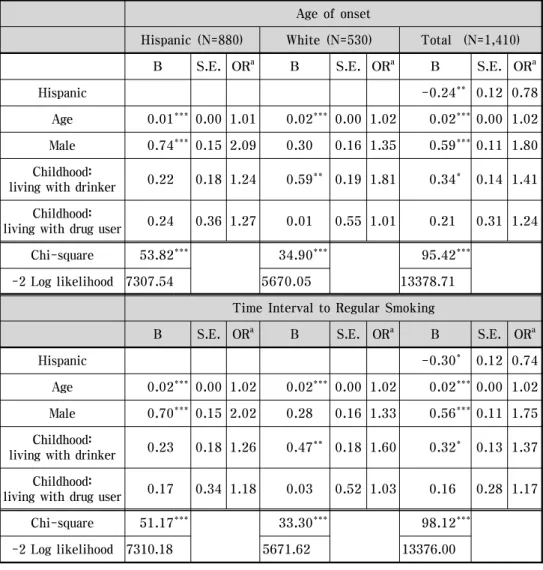
Table 2. Proportional Survival Analysis of Smokers' Initiation and Time Interval to Regular Smoking
Age of onset
Hispanic (N=880) White (N=530) Total (N=1,410)
B S.E. ORa B S.E. ORa B S.E. ORa
Hispanic -0.24** 0.12 0.78
Age 0.01*** 0.00 1.01 0.02*** 0.00 1.02 0.02***0.00 1.02 Male 0.74*** 0.15 2.09 0.30 0.16 1.35 0.59***0.11 1.80 Childhood:
living with drinker 0.22 0.18 1.24 0.59** 0.19 1.81 0.34* 0.14 1.41 Childhood:
living with drug user 0.24 0.36 1.27 0.01 0.55 1.01 0.21 0.31 1.24
Chi-square 53.82*** 34.90*** 95.42***
-2 Log likelihood 7307.54 5670.05 13378.71
Time Interval to Regular Smoking
B S.E. ORa B S.E. ORa B S.E. ORa
Hispanic -0.30* 0.12 0.74
Age 0.02*** 0.00 1.02 0.02*** 0.00 1.02 0.02***0.00 1.02 Male 0.70*** 0.15 2.02 0.28 0.16 1.33 0.56***0.11 1.75 Childhood:
living with drinker 0.23 0.18 1.26 0.47** 0.18 1.60 0.32* 0.13 1.37 Childhood:
living with drug user 0.17 0.34 1.18 0.03 0.52 1.03 0.16 0.28 1.17
Chi-square 51.17*** 33.30*** 98.12***
-2 Log likelihood 7310.18 5671.62 13376.00
a OR = Odds Ratio (indicates the impact of a one unit change in the independent variable on the ratio of the probability of the dependent variable)
* p <.05; ** p < .01; *** p < .001;
Ethnic differences were assessed in the relationships between age of the onset and time interval to regular smoking, and childhood exposures to substance use, and childhood experiences of living with a drinker and drug user in conjunction with the respondent’s age and gender(Table 2). Hispanics were less likely to initiate smoking
cigarettes than Whites(OR = .78, p < 0.01). For both Hispanics and Whites, age was significantly related to the initiation of cigarette smoking (OR = 1.01, p < .001 for Hispanics; OR = 1.02, p < .001 for Whites). The older the participants in the survey, the more likely they were to report the smoking onset regardless their ethnic background. Among Hispanics, males were more likely to start to smoke cigarettes than females(OR = 2.09, p < .001). Childhood exposure to alcohol increased the likelihood of onset smoking for Whites only(OR = 1.81, p < .001), but childhood exposure to drug users did not have a significant effect on age of the onset.
In the analysis of time interval to regular smoking, the patterns of the relationships were identical to age of the onset. The negative effect of Hispanics was significant(OR = .74, p < .05);that is, Hispanics were less likely to become regular smokers. The effects of age on time interval to regular smoking also persists for both Hispanics(OR = 1.02, p < .001) and Whites(OR = 1.02, p < .001). The likelihood of regular smoking remains high among Hispanic males (OR = 2.02, p < .001). For Whites, living with problem drinkers increased the odds of becoming regular smokers(OR = 1.60, p < .01).
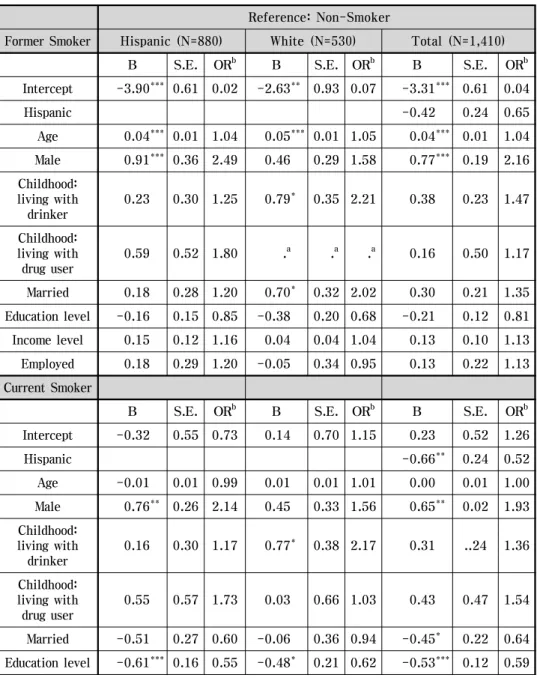
The multinomial logit model of cigarette smoking status with additional social status variables of marriage, education, income and employment is displayed in Table 3. Hispanics were more likely to be non-smokers than former smoker, but this difference among Hispanics was not significant(OR =.65, n.s.). However, Hispanics were less likely to be current smokers(OR =.52, p < .01). Age did predict higher rates of former smokers for Hispanics(OR = 1.04, p < .001) and Whites(OR =
1.05, p < .001), but did not predict the persistence of current smoking. Hispanic males were more likely to be former smokers(OR = 2.49, p < .001) and current smokers(OR = 2.14, p < .01) than Hispanic females. For Whites, childhood experiences of living with a drinker or alcoholic predicted higher rates of former smokers(OR = 2.21, p < .05) and current smokers(OR = 2.17, p < .05). Among Whites, being married was more positively related with being a former smoker (OR
= 2.02, p < .05) than never married, divorced, widowhood and separation, but not related with current smoking. A White married person was more likely to have
Reference: Non-Smoker
Former Smoker Hispanic (N=880) White (N=530) Total (N=1,410)
B S.E. ORb B S.E. ORb B S.E. ORb
Intercept -3.90*** 0.61 0.02 -2.63** 0.93 0.07 -3.31*** 0.61 0.04
Hispanic -0.42 0.24 0.65
Age 0.04*** 0.01 1.04 0.05*** 0.01 1.05 0.04*** 0.01 1.04 Male 0.91*** 0.36 2.49 0.46 0.29 1.58 0.77*** 0.19 2.16 Childhood:
living with drinker
0.23 0.30 1.25 0.79* 0.35 2.21 0.38 0.23 1.47
Childhood:
living with drug user
0.59 0.52 1.80 .a .a .a 0.16 0.50 1.17
Married 0.18 0.28 1.20 0.70* 0.32 2.02 0.30 0.21 1.35 Education level -0.16 0.15 0.85 -0.38 0.20 0.68 -0.21 0.12 0.81 Income level 0.15 0.12 1.16 0.04 0.04 1.04 0.13 0.10 1.13 Employed 0.18 0.29 1.20 -0.05 0.34 0.95 0.13 0.22 1.13 Current Smoker
B S.E. ORb B S.E. ORb B S.E. ORb
Intercept -0.32 0.55 0.73 0.14 0.70 1.15 0.23 0.52 1.26
Hispanic -0.66** 0.24 0.52
Age -0.01 0.01 0.99 0.01 0.01 1.01 0.00 0.01 1.00
Male 0.76** 0.26 2.14 0.45 0.33 1.56 0.65** 0.02 1.93 Childhood:
living with drinker
0.16 0.30 1.17 0.77* 0.38 2.17 0.31 ..24 1.36
Childhood:
living with drug user
0.55 0.57 1.73 0.03 0.66 1.03 0.43 0.47 1.54
Married -0.51 0.27 0.60 -0.06 0.36 0.94 -0.45* 0.22 0.64 Education level -0.61*** 0.16 0.55 -0.48* 0.21 0.62 -0.53*** 0.12 0.59 (to be continued) smoked in the past and to have ceased it in the present.
Table 3. Multinomial Regression of Non-Smoker, Former Smoker and Current Smoker by Ethnicity.
Income level 0.16 0.12 1.17 -0.32* 0.1 0.72 0.03 0.10 1.03 Employed 0.58* 0.29 1.79 0.87* 0.35 2.38 0.62** 0.24 1.86 Chi-square 132.73*** df=16 114.33*** df=16 226.50*** df=18
-2 Log
Likelihood 1217.51 817.06 2049.92
a not enough cases to calculate odds ratio.
b OR = Odds Ratio (indicates the impact of one unit change in the independent variable on the ratio of the probability of the dependent variable)
* p < .05; ** p < .01; *** p < .001;
The negative correlation of the education level on current smoking persisted among Hispanics (OR=.55, p<.001) and Whites (OR=.62, p<.05).
The income level was significantly and negatively related to increase likelihood of current smoking only for Whites(OR = .72, p < .05), while being employed was more strongly and positively related to current smoking status than being unemployed for both Hispanics(OR = 1.79, p < .05) and Whites(OR = 2.38, p < .05).
Ⅳ. DISCUSSION AND CONCLUSIONS
This article examined predictors of cigarette smoking behavior regarding initiation and regular smoking by Hispanic and non-Hispanic Whites in the Paso del Norte 2002 Behavioral Risk Factor Surveillance System(BRFSS) data.
Whites reported an earlier age of onset smoking than Hispanics, and Hispanics reported lower rates of smoking initiation than Whites. This finding is consistent with the literature that shows the rates of cigarette smoking were lower among Hispanics than Whites(USDHHS 1998, 2000; Griesler et al. 2002; Nelson 1995).
These ethnic differences slightly increased with progression to regular smoking behavior. Gender(being male) predicted smoking initiation and progression only among Hispanics. Males were twice more likely to initiate cigarette smoking, and progress to regular smoking than females among Hispanics, but not Whites; a difference that parallels previously reported findings(Dusenbury et al. 1992;
Felix-Ortiz & Newcomb 1995; Smith et al. 1991). This gender difference of cigarette smoking among Hispanics may reflect gender difference of the normative perception on smoking (Elder et al. 1988; Navarro 1996).
While Hispanics and Whites reported similar numbers of living with problem drinkers during their childhood, the effect of childhood exposure to alcohol was significant only for Whites. Even though Hispanic smokers were more likely to consume alcohol than non-smokers, this finding may suggest that Hispanic smokers have norms and attitudes related to cigarette smoking that differ from those of white smokers(Escobedo et al. 1996; Lee & Markides 1991). The results of the impacts of social status(married, education level, income level, and employment) on smoking status were inconsistent among different ethnic groups of Hispanics and Whites
In conclusion, the impact of different norms and expectations of Hispanic families on the smoking onset and persistence have important policy implications. Culturally sensitive and appropriate smoking prevention programs are needed for different ethnic groups. Prevention efforts need to address the cultural norms as one of the important components of relevance to smoking, in addition to the level of education, income, and employment status.
Reference
Barbeau, E. M., N. Krieger, and M. J. Soobader. 2004. “Working Class Matters: Socioeconomic Disadvantage, Race/Ethnicity, Gender, and Smoking in NHIS 2000.” American Journal of Public Health 94: 269-278.
Catalano, R. F., D. M. Morrison, and E. A. Wells. 1992. “Ethnic Differences in Family Factors Related to Early Drug Initiation.” Journal of Studies on Alcohol 53: 208-217.
Center for Disease Control and Prevention. 1998. “Tobacco Use Among Adolescent in the United States, 1997.” Morbidity and Mortality Weekly Report 47: 229-233.
Centers for Disease Control and Prevention. 2003. “Behavioral Risk Factor Surveillance System 2002 Year-To-Date.” Data Quality Report Handbook V.3.
Center for Disease Control and Prevention. 2005. “Annual Smoking-Attributable Mortality,
Years of Potential Life Lost and Economic Costs—United States, 1997-2001.”
Morbidity and Mortality Weekly Report 54: 625-628.
Chassin, L., C. Presson, M. Todd, J. S. Rose, and S. J. Sherman. 1998. “Maternal Socialization of Adolescent Smoking: The Intergenerational Transmission of Parenting and Smoking.” Developmental Psychology 34: 1189-1201.
Clark, P., A. Scarisbrick-Hauser, S. P. Gautam, and S. J. Wirk. 1999. “Anti-Tobacco Socialization in the Homes of African-American and White and Smoking and Nonsmoking Parents.” Journal of Adolescent Health 24: 329-339.
Dusenbury, L., J. F. Kerner, E. Baker, G. Botvin, S. James-Ortiz and A. Zauber. 1992.
“Predictors of Smoking Prevalence Among New York Latino Youth.” American Journal of Public Health 82: 55-58.
Elder, J. P., C. A. Molgaard, and L. Gresham. 1988. “Predictors of Chewing Tobacco and Cigarette Use in a Multiethnic Public School Population.” Adolescence 23: 689-702.
Escobedo, L. G., D. G. Kirch and R. F. Anda. 1996. “Depression and Smoking Initiation Among US Latinos.” Addiction 91: 113-119.
Felix-Ortiz, M. and M. D. Newcomb. 1995. “Cultural identity and drug use among Latino and Latina adolescents.” In Botvin, G. J., S. P. Schinke and M. A. Orlandi(eds).
Drug Abuse Prevention with Multiethnic Youth. Thousand Oaks, CA: Sage Publications, 147-165.
Flay, B. R. 1993. “Youth Tobacco Use: Risks, Patterns and Control.” In Orleans C. T., J.
Slade(eds). Nicotine Addiction: Principles and Management. New York: Oxford University Press, 365-84.
Flint, A. J. and T. E. Novotny. 1998. “Trends in Black/White Differences in Current Smoking Among 18 to 24 Year Olds in the United States, 1983-1993.” American Journal of Preventive Medicine 14,19-24.
Griesler, P. C., and D. B. Kandel. 1998. “Differences in the Correlates of Adolescent Cigarette Smoking.” Journal of Adolescent Health 23: 167-180.
Griesler, P. C., D. B. Kanel, and M. Davies. 2002. “Ethnic Differences in Predictors of Initiation and Persistence of Adolescent Cigarette Smoking in the National Longitudinal Survey of Youth.” Nicotine & Tobacco Research 4: 79-93.
Hu, F. B., B. R. Flay, D. Hedeker, O. Siddiqui and L. W. Day. 1995. “The Influences of Friends' and Parental Smoking on Adolescent Smoking Behavior: The Effects of Time and Prior Smoking.” Journal of Applied Social Psychology 25 2018-2047.
Kandel, D. B., G. Kiros, C. Schaffran, and M. Hu. 2004. “Racial/Ethnic Differences in Cigarette Smoking Initiation and Progression to Daily Smoking: A Multilevel
Analysis.” American Journal of Public Health 94: 128-135.
Lee, D. J. and K. S. Markides. 1991. “Health Behaviors, Risk Factors and Health Indicators Associated with Cigarette Use in Mexican Americans: Results from the Hispanic HANES.” American Journal of Public Health 81: 859-864.
Leventhal, H, and P. D. Cleary. 1980.“The Smoking Problem: a Review of the Research and Theory in Behavioral Risk Modification.” Psychological Bulletin 88: 370-405.
McCarthy, W. J. 1985. “The cognitive developmental model and other alternatives to the social skills deficit model of smoking onset.” In Bell C. S., R. Battjes(eds). Prevention Research: Deterring Drug Use Among Children and Adolescents. NIDA Research Monograph 63. Rockville (MD): US Department of Health and Human Services, Public Health Service, Alcohol, Drug Abuse, and Mental Health Administration, National Institute on Drug Abuse, 153-169.
Navarro, A. M. 1996. “Cigarette Smoking Among Aadult Latinos: the California Tobacco Baseline Survey.” Annals of Behavioral Medicine 18: 238-245.
Nelson, D. E., G.A. Giovino, D. R. Shopland, P. D. Mowery, S. L. Mills, and M. P.
Eriksen. 1995. “Trends in Cigarette Smoking Among US Adolescents, 1974-1991.”
American Journal of Public Health 85: 34-40.
O’Loughlin J., G. Paradis, L. Renaud, and L. S. Gomez. (1998). “One Year Predictors of Smoking Initiation and of Continued Smoking Among Elementary Schoolchildren in Multiethnic, Low-Income, Inner-City Neighborhoods.” Tobacco Control 7, 268- 275.
Preston, S. H. and I. T. Elo. 1995. “Are Educational Differentials in Adult Mortality Increasing in the United States?” Journal of Aging and Health 7: 476-496.
Schalick, L. M., W. C. Hadden, E. Pamuk, V. Navarro and G. Pappas. 2004. “The Widening Gap in Death Rates Among Income Groups in the United States from 1967 to 1986.” In Navarro, V and C.(eds). Political And Economic Determinants Of Population Health And Well-Being: Controversies And Developments. Amityville, NY: Baywood Publishing. 115-127.
Smith, K. W., S. A. McGraw and J. E. Carrillo. 1991. “Factors Affecting Cigarette Smoking and Intention to Smoke Among Puerto Rican-American High School Students.” Hispanic Journal of Behavioral Sciences 13, 401-411.
Substance Abuse and Mental Health Services Administration. 2005. Results from the 2004 National Household Survey on Drug Use and Health. Rockville, MD: U.S.
Department of Health and Human Services.
U.S. Department of Health and Human Services. 1998. Tobacco Use Among U.S.
Racial/Ethnic Minority Groups—African Americans, American Indians and Alaska Natives, Asian Americans and Pacific Islanders, and Hispanics: A Report of the Surgeon General. Atlanta: U.S. Department of Health and Human Services, Centers for Disease Control and Prevention.
U.S. Department of Health and Human Services. 2000. Reducing Tobacco Use: A Report of the Surgeon General. Atlanta, Georgia: U.S. Department of Health and Human Services, Centers for Disease Control and Prevention, National Center for Chronic Disease Prevention and Health Promotion.
U.S. Department of Health and Human Services. 2004. The Health Consequences Of Smoking: A Report Of The Surgeon General. Atlanta: U.S. Department of Health and Human Services, Centers for Disease Control and Prevention.
Weden, M. M., N. M. Astone, and D. Bishai. 2006. “Racial, Ethnic and Gender Differences in Smoking Cessation Associated with Employment and Joblessness Through Your Adulthood in the US.” Social Science & Medicine 62: 303-316.
Winkleby, M. A., C. Cubbin, and D. K. Ahn. 1999. “Pathways by which SES and ethnicity influence cardiovascular disease risk factors.” In Adler, N. E., Marmot, M., McEwen, B. S. and J. Stewart(eds.) Socioeconomic Status And Health In Industrial Nations:
Social, Psychological, And Biological Pathways. New York, NY: New York Academy of Sciences, 191-209.
Yamaguchi, K. 1991. Event History Analysis. Newbury Park: Sage Publications.
<접수 2010/4/9, 1차수정 2011/3/19, 2차수정 2011/5/31, 게재확정 2011/6/1>