Research Article
Short-term Supplementation with a Trace Mineral-fortified Microbial Culture May Increase Trace Minerals in Longissimus dorsi Muscle and Prevent
Incidence of Urolithiasis in Finishing Hanwoo Steers
Young Il Kim
1, Farhad Ahmadi
1, Sang Moo Lee
2, Youn Hee Lee
1, Do Young Choi
1and Wan Sup Kwak
1*
1
Division of Food Biosciences, College of Health and Medical Life Sciences Konkuk University, Chung-Ju, Chung-Buk 380-701, Republic of Korea,
2Department of Animal Science, Sangju Campus, Kyungpook University, Sangju, Kyungbuk,
42-711, Republic of Korea
ABSTRACT
This study evaluated the effects of TMC (trace mineral-fortified microbial culture) supplementation on growth performance, carcass characteristics, and meat quality parameters of Hanwoo steers during the last 4 months of finishing period. The TMC was a combination of 0.4% trace minerals, 20.0% Na-bentonite, and 79.6% feedstuffs, which was inoculated with a mixed microbial culture (Enterobacter ludwigii, Bacillus cereus, B. subtilis, Lactobacillus plantarum, and Saccharomyces cerevisiae). Twenty-four steers were blocked by initial BW (634 ± 16 kg) and randomly allocated to one of two treatments (control vs. 3.3% TMC). The effect of TMC supplementation on the growth performance was not significant. There was no incidence of urolithiasis in TMC- fed steers. However 3 out 12 steers (25%) fed the control diet were observed to have urinary calculi. The carcass yield and meat quality parameters were not affected by TMC supplementation, however marbling score was increased in TMC-fed steers (P = 0.08). There was no effect of TMC treatment on the chemical composition of longissimus dorsi muscle (LM). The TMC supplementation increased concentrations of manganese (P < 0.01), cobalt (P = 0.02), iron, and copper (P = 0.06) in LM. In conclusion, TMC treatment did not negatively affect growth performance and meat quality parameters, and positively affected the trace minerals profile of LM.
(Key words :Microbe, Trace mineral, Performance, Longissimus muscle, Hanwoo, Urinary calculi)
. INTRODUCTION
Literatures indicated that improvements in trace mineral status through supplementation would benefit beef cattle productivity through enhanced growth performance, carcass and meat quality parameters, or increased concentration of certain trace minerals in longissimus dorsi muscle (LM) (Greene et al., 1988; Underwood and Suttle, 1999; Spears and Kegley, 2002; Kim et al., 2007a; Kwak et al., 2015).
However, these beneficial responses to trace mineral supplementation are not consistent in the literatures.
Adding certain direct-fed microbes is associated with improvements of growth, mineral status, and meat quality (Cole et al., 1992; Yoon and Stern, 1995; Krehbiel et al., 2003; Aragon, 2013; Kwak et al., 2012b). For instance, Kwak et al. (2012a) reported that the dietary addition of
Na-bentonite and a mixed microbial culture (B. subtilis and
S. cerevisiae) increased concentrations of zinc, copper, andiron in LM of Hanwoo steers. Similarly, the combination of the certain trace minerals and a mixed culture of B. subtilis and S. cerevisiae improved the growth performance and meat yield and quality of Hanwoo steers (Kim et al., 2007a).
More recently, TMC supplementation for approximately 9 months did not affect growth performance, health, and the carcass characteristics, but increased carcass weight and concentrations of zinc, selenium, and sulfur in the LM of finishing Hanwoo steers (Kwak et al., 2015).
This study hypothesized that feeding with TMC for a shorter period, i.e. approximately four months, may positively affect the health, meat quality, and concentrations of some minerals in LM of Hanwoo steers.
* Corresponding author : Professor Kwak, Wan-Sup (Ph.D.), Division of Food Biosciences, College of Health and Medical Life Sciences Konkuk University, Chung-Ju, Chung-Buk 380-701, Republic of Korea. Tel: +82-43-8403521, Fax: +82-43- 8518675, E-mail: [email protected]
. MATERIALS AND METHODS 1. Preparation of TMC
The mixed microbial inocula used in TMC formulation were previously isolated and identified in our laboratory (Kim et al., 2007b; Kim et al., 2008; Kim and Kwak, 2012). Enterobacter ludwigii KU201-3, B. cereus KU206-3, and B. subtilis KU3, previously identified as highly cellulolytic bacteria, were cultured in plate count broth (5 g casein, 2.5 g yeast extract, and 1 g/L dextrose) at 36°C for 24 h. L. plantarum KU5, an efficient lactic-acid producing bacteria, was cultured in de Man, Rogosa and Sharpe (MRS) broth (0881, Difco Laboratories Inc., Detroit, MI, USA) at 36°C for 24 h. S. cerevisiae was cultured in yeast malt broth (0711, Difco Laboratories Inc., USA) at 30°C for 48 h. The mixed microbial culture (0.6% v/w) was inoculated into a mixture of 19.6% ground corn grain, 16.0% soybean meal, 24.4% defatted rice bran, 20.0% Na- bentonite, 12.2% spent mushroom substrate, 3.3% jujube (Zizyphus jujuba), 2.5% sugarcane molasses, 1.6% magnesium oxide, and 0.4% trace minerals (sodium selenite, zinc sulfate, copper sulfate, and cobalt sulfate). The resultant mixture (TMC) was allowed to ensile for 5 d at room temperature (25°C). According to the product specification (Bionit, Korea Sud Chemical Co., Korea), Na-bentonite (75~85% montmorillonite) had 58% SiO
2, 20% Al
2O
3, 6%
Fe
2O
3, 3.5% MgO, 2.5% CaO, 2% Na
2O, 1% K
2O, and 7%
others. The mineral profile of the bentonite was determined as: 1.41% Ca, 0.04% P, 0.10% Mg, 1.78% K, 0.66% Na, 1,631 ppm Fe, 7.9 ppm Zn, 5.0 ppm Cu, and 212 ppm Mn. The chemical composition profile of the basal diet and
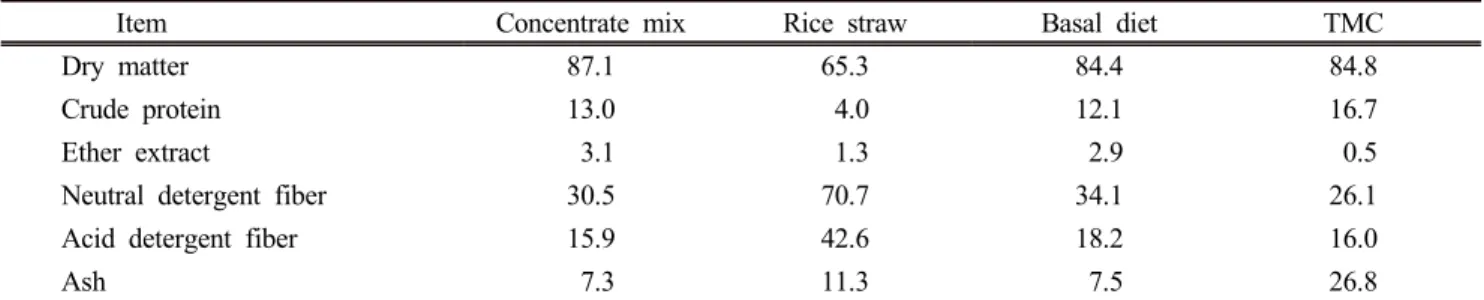
TMC is presented in Table 1. The trace mineral profile of TMC (g/kg DM TMC) was determined as: 1.15 Zn, 0.41 Cu, 0.004 Co, 4.23 Fe, and 0.23 Mn.
2. Animals and experimental designs
The animals were housed and cared for according to the guidelines approved by the Konkuk University Institutional Animal Care and Use Committee.
Twenty-four Hanwoo steers (mean age = 29.3 months; BW
= 634 ± 16 kg) were blocked by body weight (BW) and assigned at random to one of two treatments (6 steers per pen; 2 pens per treatment): control or 3.3% TMC, which was top-dressed at each feeding time and fed to the steers during the last 4 months of the finishing period. Selenium, zinc, copper, and cobalt content of TMC diets met approximately 1.5-fold the National Research Council’s requirements for beef cattle. Basal diets met or exceeded the predicted requirements for energy, protein, minerals, and vitamins of the National Research Council (2000), which indicated that control steers did not receive diets deficient in the trace minerals supplemented. All steers had free access to concentrate mix, and rice straw was restricted to 1.2 kg/d (as-fed basis). Diets were offered twice a day (07:00 and 18:00). The BW was measured monthly using a CAS BI-2RB digital weighing and counting scale. Dry matter intake (DMI) was measured daily on a pen basis and was estimated as the residual feed deducted from the amount of feed offered. Average daily gain (ADG) was calculated by period for each animal by subtracting the initial BW from the final BW and dividing by the number of days on the experiment and averaged by pen. Steers
Table 1. Chemical compositions of basal finishing diets and TMC
1)(%, DM basis)
Item Concentrate mix Rice straw Basal diet TMC
Dry matter 87.1 65.3 84.4 84.8
Crude protein 13.0 4.0 12.1 16.7
Ether extract 3.1 1.3 2.9 0.5
Neutral detergent fiber 30.5 70.7 34.1 26.1
Acid detergent fiber 15.9 42.6 18.2 16.0
Ash 7.3 11.3 7.5 26.8
1)TMC (trace minerals-fortified microbial culture) was composed of 0.6% (v/w) mixed microbial culture inoculated into a mixture of 19.6% ground corn grain, 16.0% soybean meal, 24.4% defatted rice bran, 20.0% Na-bentonite, 12.2% spent mushroom substrate, 3.3%
low quality jujube, 2.5% molasses, 1.6% magnesium oxide, and 0.4% trace minerals, followed by a 5-d fermentation.
were slaughtered at 734 ± 17 kg BW, after 124 days on their diets (33.4 months of age).
3. Analysis of diets and meat
Dietary samples were collected weekly, dried and then ground through a 1-mm screen in a mill (Cemotec, Tecator, Skanor, Sweden). Samples were then subjected to the analysis of chemical composition (DM, CP, EE, and crude ash) according to standard procedures described by the Association of Official Analytical Chemists (AOAC, 2003).
Neutral detergent fiber (NDF; with heat-stable amylase and sodium sulfite) and acid detergent fiber (ADF) content were determined according to the procedure of Van Soest et al.
(1991).
The part of LM between the 12
thand 13
thribs was removed. Each meat sample was minced 3 times, thoroughly mixed to form a homogenous material, and stored at 20ºC until further analysis. A sub-sample (approximately 150 g) was taken for determination of DM, CP, EE and ash concentration (AOAC, 2003). Mineral profile analysis of LM was performed using an inductively coupled argon plasma emission spectroscopy (ICP-OES 5300DV, Perkin Elmer, Billerica, MA, USA), as described by Braselton et al. (1997).
4. Carcass traits
Steers were withdrawn from their diets 24 h prior to being slaughtered. After slaughter and 24 h postmortem, the yield and quality grade of each carcass was measured using Korean Carcass Grading Standards, specified in the Korean Livestock Enforcement Regulation (Korean Ministry of Agriculture and Forest, 2007). Quality grades were classified as 1
++(highest quality), 1
+, 1, 2, and 3 (lowest quality).
Backfat thickness and the LM area were measured at the 13
thrib. Yield index was calculated as: 68.184 (0.625 × backfat thickness [mm]) + (0.130 × LM area [cm
2]) (0.024
× cold carcass weight [kg]) + 3.23. Yield grades were graded as: grade A = higher than 67.5; grade B = higher than 62.0 and lower than 67.5; and grade C = lower than 62.0.
Marbling was graded as: 1 = practically devoid, 9 = abundant; meat color: 1 = bright cherry red, 7 = extremely
dark red; fat color: 1 = white, 7 = dark yellow; texture: 1
= soft, 3 = firm; and maturity: 1 = immature, 9 = mature.
5. Statistical analysis
The experimental design was according to 2 pens per treatment, with 6 steers per pen, resulting in a total of 24 steers. One steer in control treatment died because of urinary calculi. Data were subjected to one-way analysis of variance by using the general linear model procedure (Statistix7, 2000). When a significant dietary treatment effect was detected, separation of least squares means was accomplished using Student’s t-test. For the purpose of discussion, a P-value less than 0.05 was considered as significant, a P-value 0.05 but less than 0.1 was considered a tendency, and a P-value 0.1 was considered non-significant.
. RESULTS AND DISCUSSION 1. DMI and Body weight gain
The TMC treatment slightly affected finishing DMI (concentrate mix intake), with 9.3 and 9.7 kg for control and TMC-fed steers, respectively.
The effect of TMC treatment on overall growth performance was not significant. This observation was expected because BW change is affected by DMI, which was similar between two diets. In addition, because the basal diet met the mineral requirement of the steers (NRC 2000), the animal mineral status was likely well within the adequate range to support the nutrient requirement of growth during the finishing period. In agreement, Kwak et al. (2015) reported that TMC supplementation (9 months) did not affect DMI and growth performance of finishing Hanwoo steers. Conversely, Kim et al. (2007a) found that feeding a fermented mineral feed (1%) to Hanwoo steers (from 18 to 25 months of age) increased ADG from 0.64 to 1.08 kg/d, as compared to control steers.
2. Urinary calculi occurrence
This study found that three of the 12 steers receiving the
control diets were identified to have urinary calculi (25%), however, none of the TMC-fed steers had urinary calculi (Table 2).
Obstructive urolithiasis is an important nutritional disease in ruminants, with steers being at the greatest risk (Oehme and Tillmann, 1965; Loreeti et al., 2003). Although the exact mechanism of calculogenesis is not completely understood, feeding high-grain and low-roughage rations, early-age castration, low water intake, excessive or unbalanced intake of minerals, and alkaline urine pH are known risk factors (Larson, 1996; Loretti et al., 2003;
Radostits et al., 2007; Ewoldt et al. 2008; Amarpal et al., 2013; Makhdoomi and Gazi, 2013).
The inadequate water intake is associated with negative body water balance, which results in supersaturation of urine, and thus increased likelihood of crystalloids formation in urine (Waltner-Toews and Meadows, 1980; Blood et al., 1983; Ewoldt et al., 2008; Amarpal et al., 2013). Adding mineral salts to the ration was recommended as a preventative measure to stimulate water intake and diuresis, and thus minimized the occurrence of urinary calculi formation (Loreeti et al., 2003; Ewoldt et al., 2008; Parrah et al., 2010). Adding mineral salts to the diets of steers was associated with increased water intake and ruminal dilution rate (Rogers et al., 1979). We postulated that the higher content of mineral salts in TMC diets possibly stimulated more water intake and diuresis, which could minimize formation of the urinary calculi.
One effective management technique for minimizing the formation of urinary calculi is reduction in urine pH, which prevents the precipitation of uroliths. We speculated that the sulfate form of the trace minerals in TMC diets increased the concentration of the organic sulfate, the highest
oxidation state of sulfur in animal tissues which contributed to the reduction in urine pH (Hunt, 1956; Van Reen et al., 1964), and subsequently promoted the dissolution of urinary stones.
3. Carcass traits and chemical and mineral composition of meat
The TMC supplementation had negligible effect on cold carcass weight. This observation was expected because there is a positive correlation between carcass weight and final BW, which was not affected by TMC supplementation (Table 2). This finding was not agreed with previous studies (Spears and Kegley, 2002; Spears, 2003) which reported that dietary supplementation of the trace minerals improved cattle performance and carcass weight. Feeding the similar basal finishing diet supplemented with TMC for about 9 months increased the cold carcass weight by an average of 24 kg (Kwak et al., 2015), which suggests that a longer period of TMC supplementation might have a positive effect on carcass weight.
The TMC-fed steers had an improved meat quality grade, and thus a greater proportion of their carcasses were graded 1. This was possibly due to the higher marbling score in TMC fed steers (P = 0.08). Conversely, Kwak et al. (2015) reported that TMC supplementation did affect carcass yield and meat quality traits. Ahola et al. (2005) also found that trace minerals supplementation (Zn, Cu, and Mn; both organic and inorganic form) did not affect carcass characteristics such as carcass weight, ribeye area, yield grade, as well as marbling score of beef cattle.
The effect of feeding TMC on the chemical composition and meat mineral profile of LM is presented in Table 4.
Table 2. Growth performance and obstructive urolithiasis outbreak of Hanwoo steers without or with TMC supplementation during the last 4 months of finishing period
Item Control (n = 11) TMC (n = 12) SE
P-valueInitial BW (29.3 mo. old), kg 634 634 16 0.99
Final BW (33.4 mo. old), kg 732 736 17 0.84
Total net gain, kg 98 102 9 0.78
Average daily gain, kg 0.79 0.82 0.08 0.78
Obstructive urolithiasis outbreak, head 3 0
TMC = trace mineral-fortified microbial culture.Table 3. Carcass characteristics and meat quality parameters of Hanwoo steers without or with TMC supplementation during the last 4 months of finishing period
Item Control (n = 11) TMC (n = 12) SE
P-valueCold carcass weight, kg 423 421 12.3 0.89
Yield traits
Backfat thickness, mm 13.3 14.5 2.42 0.64
Longissimus muscle area, cm2
86.1 87.3 3.41 0.73
Yield index 64.1 63.6 1.61 0.74
Yield grade
1)2.0 2.3 0.29 0.40
Quality traits
Marbling score
2)5.18 6.58 0.76 0.08
Meat color score
3)4.82 4.67 0.18 0.43
Fat color score
4)3.0 3.0 0.13 0.99
Texture score
5)1.18 1.0 0.11 0.13
Overall maturity
6)2.18 2.25 0.18 0.71
Quality grade
7)2.64 2.01 0.40 0.13
1
++, steer (%) 2 (18) 4 (33.3)
1
+, steer (%) 3 (27) 4 (33.3)
1, steer (%) 3 (27) 4 (33.3)
2, steer (%) 3 (27) 0 (0.0)
TMC = trace mineral-fortified microbial culture.
1) Converted into numeric values as: grade A = 3, B = 2, and C = 1. A (high yield; >67.5), B (yields <67.5 and >62.0), and C (low yield; <67.5).
2) 1 = practically devoid, 9 = abundant.
3) 1 = bright cheery red, 7 = extremely dark red.
4) 1 = creamy white, 7 = yellowish.
5) 1 = soft, 3 = firm.
6) 1 = immature, 9 = mature.
7) Converted into numeric values: grade 1++= 1, 1+= 2, 1 = 3, and 2 = 4. Quality grade 1++ is the highest or most desirable grade and grade 2 is the lowest degree of quality.
Table 4. Chemical and mineral composition of longissimus muscle of Hanwoo steers without or with TMC supplementation during the last 4 months of finishing period
Item Control (n = 11) TMC (n = 12) SE P-value
Chemical composition
Dry matter, % 38.4 39.9 1.71 0.43
Crude protein, % of DM 19.4 19.6 0.73 0.76
Ether extract, % of DM 42.4 46.6 3.80 0.32
Crude ash, % of DM 2.81 2.40 0.23 0.07
Mineral composition, mg/kg
Manganese 0.22 0.26 0.01 <0.01
Zinc 29.0 30.2 2.23 0.63
Iron 31.0 34.2 1.48 0.06
Copper 0.68 0.95 0.13 0.06
Cobalt 0.08 0.09 0.01 0.02
TMC = trace mineral-fortified microbial culture.
The TMC supplementation did not affect DM, CP, EE, and crude ash content of LM. The treatment resulted in higher concentrations of cobalt (P = 0.02) and manganese (P < 0.01), and tended to increase iron (P = 0.06) and copper (P = 0.06) concentrations in LM. In agreement, TMC supplementation to finishing Hanwoo steers increased the concentrations of zinc, selenium, and iron in LM (Kwak et al., 2015). More recently, 3.1% TMC supplementation in the basal diets of sheep led to higher zinc and copper absorption and concentration, without adverse effects on performance (Kwak et al., 2016).
Feeding a combination of Na-bentonite and microbial culture (B. subtilis and S. cerevisiae) increased concentrations of zinc, copper, iron, magnesium, sodium and potassium in LM of Hanwoo steers, but cold carcass weight and yield and quality traits were not affected by treatment (Kwak et al., 2012a). Likewise, Kwak et al. (2012b) reported that feeding a mixed microbial culture (B. subtilis and S.
cerevisiae) to Hanwoo steers did not affect carcass yield
and quality traits after slaughtering, but increased the concentrations of phosphorus, magnesium, iron, and zinc in the LM, compared to the control. Lee et al. (2010) also reported that supplementing dietary Na-bentonite to Hanwoo steers increased concentrations of phosphorus, magnesium, sodium, potassium, iron, copper, and zinc in the LM, compared to the control.
The TMC used in this study contained 20% Na-bentonite, which might have contributed to the increased concentration of the minerals in LM. Bentonite as known to have high swelling capacity might decrease the rate of digesta passage through the gastrointestinal tract, and thus increases absorption of minerals (Kwak et al., 2012a). Other studies also suggested an improved mineral balance by direct-fed yeast culture supplementation for ruminants (Cole et al., 1992; Yoon and Stern, 1995). However, because TMC was a combination of several minerals and mixed microbial culture, relating the observed responses to a particular mineral or microbial strain was not possible. Therefore, further study is required to verify what responses are due to which microbial culture or trace mineral, and to identify whether these minerals are stored in other tissues rather than the LM or if they are excreted into urine after supplementation.
In conclusion, TMC supplementation for 4 months had no effect on the growth performance and carcass traits of finishing Hanwoo steers, but had a positive impact on urinary calculi prevention, meat quality grade, and concentrations of some trace minerals in longissimus muscle.
. ACKNOLEDGEMENTS
This study was supported by the Boeun County Agricultural Technology Center in Chung-Buk province, Korea.
. REFERENCES
Ahola, J.K., Sharpe, L.R., Dorton, K.L., Burns, P.D., Stanton, T.L.
and Engle, T.E. 2005. Effects of lifetime copper, zinc, and manganese supplementation and source on performance, mineral status, immunity, and carcass characteristics of feedlot cattle. The Professional Animal Scientist 21:305-317.
Amarpal, K.P., Aithal, H.P., Pawde, A.M., Pratap, K. and Gugjoo, M.B. 2013. A retrospective study on the prevalence of obstructive urolithiasis in domestic animals during a period of 10 years. Advances in Animal and Veterinary Sciences 1:88-92.
AOAC. 2003. Official Methods of Analysis of the Association of Official Agricultural Chemists. 17th ed. 2nd revision. AOAC International, Gaithersburg, MD, USA.
Aragon, S. 2013. Influence of yeast cell wall supplementation during the finishing phase on feedlot steer performance, carcass characteristics and post-mortem tenderness. M.S. Thesis. Texas Tech University. http://hdl.handle.net/2346/50309.
Blood, D., Radostits, O., Henderson, J., Arundel, J. and Gay, C.
1983. Veterinary Medicine: A Text of the Disease of Cattle, Sheep, Pigs, Goats and Horses. Bailliere Tindall. London, UK.
Braselton, W.E., Stuart, K.J., Mullaney, T.P. and Herdt, T.H. 1997.
Biopsy mineral analysis by inductively coupled plasma-atomic emission spectroscopy with ultrasonic nebulization. Journal of Veterinary Diagnosis and Investigation 9:395-400.
Cole, N., Purdy, C. and Hutcheson, D. 1992. Influence of yeast culture on feeder calves and lambs. Journal of Animal Science 70:1682-1690.
Ewoldt, J.M., Jones, M.L. and Miesner, M.D. 2008. Surgery of obstructive urolithiasis in ruminants. Veterinary Clinics of North America: Food Animal Practice 24:455-465.
Greene, L., Lunt, D., Byers, F., Chirase, N., Richmond, C., Knutson, R. and Schelling, G. 1988. Performance and carcass quality of steers supplemented with zinc oxide or zinc methionine. Journal
of Animal Science 66:1818-1823.
Hunt, J.N. 1956. The influence of dietary sulphur on the urinary output of acid in man. Clinical Science 15:119-134.
Kim, S.H., Byun, S.H., Lee, S.M., Hwang, J.H., Jeon, B.T., Moon, S.H. and Sung, S.H. 2007a. Effects of supplementation period and levels of fermented mineral feed (Power-Mix®) on the growth and carcass characteristics of Hanwoo steer. Korean Journal for Food Science of Animal Resources 27:450-456.
Kim, Y., Jung, S., Seok, J., Yang, S., Huh, J. and Kwak, W.S.
2007b. Isolation and identification of high cellulolytic bacteria from spent mushroom substrate and determination of optimal medium conditions for the growth. Korean Journal of Microbiology and Biotechnology 35:255-260.
Kim, Y.I. and Kwak, W.S. 2012. Isolation and identification of lactic acid bacteria from spent mushroom substrate for silage making and determination of optimal medium conditions for growth.
Journal of Animal Science and Technology 54:435-442.
Kim, Y.I., Jeong, S.H., Seok, J.S., Yang, S.Y., Huh, J.W. and Kwak, W.S. 2008. Isolation and identification of hydrolytic enzyme- producing bacteria from spent mushroom substrate. Journal of Animal Science and Technology 50:713-720.
Korean Livestock Enforcement Regulation. 2007. Korean carcass grading standards. An attached list No. 4, Revised 2007. 6.19, KDAF, Korea.
Krehbiel, C., Rust, S., Zhang, G. and Gilliland, S. 2003. Bacterial direct-fed microbials in ruminant diets: Performance response and mode of action. Journal of Animal Science 81:E120-E132.
Kwak, W.S., Kim, Y.I., Lee, S.M., Lee, Y.H., and Choi, D.Y. 2015.
Effect of feeding a mixed microbial culture fortified with trace minerals on the performance and carcass characteristics of late-fattening Hanwoo steers: A field study. Asian-Australasian Journal of Animal Sciences 28:1592-1598.
Kwak, W.S., Lee, S.M. and Kim, Y.I. 2012a. Effects of dietary addition of bentonite and probiotics on meat characteristics and health of Hanwoo (Bos taurus coreanae) steers fed rice straw as a sole roughage source (a field study). Journal of the Korean Society of Grassland and Forage Science 32:387-396.
Kwak, W.S., Lee, S.M. and Kim, Y.I. 2012b. Effects of dietary addition of Bacillus and Saccharomyces culture on blood profiles, growth, and meat characteristics of Hanwoo (Bos taurus coreanae) steers. Research Opinions in Animal & Veterinary Sciences 2:194-199.
Kwak, W.S., Kim, Y.I., Choi, D.Y. and Lee, Y.H. 2016. Effects of feeding mixed microbial culture fortified with trace minerals on ruminal fermentation, nutrient digestibility, and nitrogen and trace mineral balance in sheep. Accepted Manuscript (Journal of
Animal Science and Technology).
Larson, B.L. 1996. Identifying, treating, and preventing bovine urolithiasis. Veterinary Medicine 91:366-377.
Lee, S.M., Kim, Y.I. and Kwak, W.S. 2010. Effects of dietary addition of bentonite on manure gas emission, health, production, and meat characteristics of Hanwoo (Bos Taurus coreanae) steers.
Asian-Australasian Journal of Animal Sciences 23:1594-1600.
Loreeti, P.A., Oliveria, L.O., Cruz, C.F. and Driemer, D. 2003.
Clinical and pathological study of an outbreak of obstructive urolithiasis in feedlot cattle in South Brazil. Pesquisa Veterinária Brasileira 23:223-236.
Makhdoomi, D. and Gazi, M.A. 2013. Obstructive urolithiasis in ruminants A review. Veterinary World 6:233-238.
National Research Council. 2000. Nutrient Requirements of Beef Cattle. Update 2000. National Academy Press, Washington, DC, USA.
Oehme, F.W. and Tillmann, H. 1965. Diagnosis and treatment of ruminant urolithiasis. Journal of the American Veterinary Medical Association 147:1331-9.
Parrah, J.D., Hussain, S.S., Moulvi, B.A., Singh, M. and Athar, H.
2010. Bovine uroliths analysis: A review of 30 cases. Israel Journal of Veterinary Medicine, 65:103-107.
Radostits, O.M., Gay, C.C. Hinchcliff, K.W. and Constable, P.D.
2007. Veterinary Medicine: A Textbook of the Diseases of Cattle, Horses, Sheep, Pigs and Goats (10th), Elsevier Publishing, New York, NY.
Rogers, J.A., Marks, B.C., Davis, C.L. and Clark, J.H. 1979.
Alteration of rumen fermentation in steers by increasing rumen fluid dilution rate with mineral salts. Journal of Dairy Science 62:1599-1605.
Spears, J. and Kegley, E. 2002. Effect of zinc source (zinc oxide vs zinc proteinate) and level on performance, carcass characteristics, and immune response of growing and finishing steers. Journal of Animal Science 80:2747-2752.
Spears, J.W. 2003. Trace mineral bioavailability in ruminants. The Journal of Nutrition 133:1506S-1509S.
Statistix7. 2000. User's Manual. Analytical Software, Tallahassee, FL, USA.
Underwood, E.J. and Suttle, N.F. 1999. Mineral Nutrition of Livestock. 3rd ed. CABI Publishing, New York.
Van Reen, R., Simmons, W.K. and Jenkins Jr., L. 1964. Urolithiasis in the rat. 4. Influence of amino acid supplements on the occurrence of citrate calculi. Journal of Nutrition 83:358-364.
Van Soest, P.J., Robertson, J.B. and Lewis, B.A. 1991. Methods of dietary fiber, neutral detergent fiber, nonstarch polysaccharides in relation to animal nutrition. Journal of Dairy Science 74:3583-
3597.
Waltner-Toews, D. and Meadows. D. 1980. Urolithiasis in a herd of beef cattle associated with oxalate ingestion. The Canadian Veterinary Journal 21:61-66.
Yoon, I. and Stern, M. 1995. Influence of direct-fed microbials on
ruminal microbial fermentation and performance of ruminants: A review. Asian-Australasian Journal of Animal Sciences 8:533-555.
(Received April 25, 2016 / Revised September 3, 2016 / Accepted September 9, 2016)