• 검색 결과가 없습니다.

Factors influencing the six therapeutic communication modes among occupational therapists<sup>†</sup>

N/A
N/A
Protected

Academic year: 2021

Share "Factors influencing the six therapeutic communication modes among occupational therapists<sup>†</sup>"

Copied!
13
0
0

로드 중.... (전체 텍스트 보기)

전체 글

(1)

Factors influencing the six therapeutic communication modes among occupational therapists

Eun-Jeong Ryu 1 · Sun Wook Lee 2

1 Dream Child Development Center, Daegu, Korea

2 Department of Occupational Therapy, Daegu University

Received 27 August 2020, revised 7 September 2020, accepted 7 September 2020

Abstract

This cross-sectional study describes the perceived use of six therapeutic communi- cation modes among occupational therapists in Korea per the intentional relationship model and explores the factors influencing mode use. We conducted a paper-and-pencil survey with a convenience sampling method and analyzed a total of 214 responses (response rate: 64.88%) using the Vocational Self-Efficacy Scale and the Clinical As- sessment of Modes-Therapist ([CAM-T] Korean). Therapists reported that they used five of the six therapeutic communication modes with similar frequency and that they used the advocating mode least frequently. A multiple regression model comprising the three subscales of vocational self-efficacy-practice setting, therapists’ perception of client satisfaction, and satisfaction level on therapeutic performance-predicted the CAM-T total score of F (7, 205)=16.34, p<.0005, and adjusted R

2

=.336. The strongest predictors across the six therapeutic modes were factors that pertained to perceptions of the therapeutic relationship. These findings suggest that efficacy-building efforts on individual confidence and collective efficacy, along with education for therapeutic relationships, are required to foster effective use of interpersonal skills.

Keywords: Intentional relationship model, occupational therapy, self-efficacy, therapeu- tic communication.

1. Introduction

Health care professionals such as occupational therapists face increasing responsibility due to recent legislation that requires them to take part in a concerted effort to increase mental health (Jung and Cha, 2009; Lee, 2020). The unique role of occupational therapists is to analyze the dynamics of life events and activities (i.e., occupation) and to facilitate factors that promote the optimal level of participation for multiple client populations, includ- ing a person with disabilities, an organization, and/or groups and populations (American

† This study was undertaken by Eun-Jeong Ryu in partial fulfillment of the requirements for the degree of Master’s in Rehabilitation Science at Daegu University.

1

Occupational Therapist, Dream Child Development Center, Daegu 41593, Korea

2
Corresponding author: Assistant Professor, Department of Occupational Therapy, Rehabilitation Sci-

ence, Daegu University, Gyeongsan 38453, Korea. E-mail: [email protected]

(2)

Occupational Therapy Association, 2014). Domestically, attempts to cultivate professional competency (Chang et al., 2015; Ku et al., 2015) and provide an impetus for highlighting therapeutic use of empathy and the use of self have been aggregated and indicated the needs for professional development efforts (Jung and Bae, 2017; Kim and Jung, 2016; Park and Chang, 2014). Indeed, health care providers such as occupational therapists continually pur- sue self-efficacy in order to fulfill their responsibilities (Hwang, 2012; Park and Kim, 2008).

With newly added components of practice setting, aptly serving the diverse needs of clients through therapeutic relationships (Peloquin, 2005), which has long been one of the core professional skills, is more necessary than ever.

The Intentional Relationship Model ([IRM] Taylor, 2020) is a conceptual practice model developed to guide occupational therapists’ theory-based facilitation of a client’s therapeutic transformation and to build a therapeutic alliance between the client and the therapist aim- ing at occupational engagement, which is the essence of the means and the ultimate goals of professional actions. IRM postulates interpersonal communication competencies in three areas: knowledge about the nature of the interpersonal skills inferred in the therapeutic situ- ation, interpersonal methods and modes, and interpersonal therapeutic reasoning capacities during emphatic break moments. Guided by this model, occupational therapists utilize six therapeutic communication modes, including the advocating, collaborating, empathizing, encouraging, instructing, and problem-solving modes. Because this model is unique, edu- cation and professional development are necessary for occupational therapists to develop professional competencies with these therapeutic modes. Over 95% of occupational thera- pists in Korea reported that this use of self is a critical component in everyday encounters for a better outcome with clients, making this construct an essential part of occupational therapy (Jung and Bae, 2017; Kim and Jung, 2016). In a survey study with 215 clients receiving occupational therapy, Choi (2015) found that the use of these IRM modes was associated with clients’ satisfaction and motivation for rehabilitation.

Perceived self-efficacy (Bandura, 1997) defined as, beliefs in one’s capabilities to organize and execute the courses of action required to produce given attainments, has been famously researched across disciplines as one of the most important factors influencing work perfor- mance. The construct is also embedded in the occupational therapy process which promotes client participation. Bandura (1997) proposed four sources of building self-efficacy: mastery experience, vicarious experience, verbal persuasion, and physiological and affective states.

In Bandura’s social cognitive theory, the occupational therapy process reflects these four elements for the client’s participation. In particular, IRM’s principles and skills resonate with and guide the vicarious experience (i.e., being a role model for clients), verbal persua- sion (i.e., use of therapeutic modes), and physiological and affective states (i.e., recognizing nonverbal cues from clients). Although the construct of therapeutic use of self has always stayed with the profession, the practical conceptual practice model, the IRM, was introduced in 2009. Internationally, researchers have developed psychometric properties of self-efficacy measures associated with IRM (Bonsaksen and Carstensen, 2018; Ritter et al., 2018; Yaz- dani et al., 2017). These studies stressed that therapeutic communication and interpersonal skills are at the core of professional efficacy in occupational therapy.

Although therapeutic communication requires self-efficacy (Nrgaard et al., 2012) and oc-

cupational therapists must bear emotional burdens in everyday encounters (Lee and Bang,

2015; Oh and Koo, 2018), the specific knowledge needed to support occupational therapy

job performance pertaining to therapeutic communication using IRM in Korea has not yet

(3)

been drawn on. Therefore, in this study we aimed to describe the current state of therapists self-perceived therapeutic communication modes and the extent to which therapists per- ceive vocational self-efficacy. To date, despite a plethora of evidence that found self-efficacy promotes work performance (Stajkovic and Luthans, 1998; Walumbwa et al., 2005), some argue that multifaceted factors other than self-efficacy may also play a role in determining work performance (Iroegbu, 2015; Judge et al., 2007). Because little is known about the adoption of IRM among therapists in Korea and a lastest study on IRM shed light on East- ern culture-specific researches, this study employed the vocational self-efficacy measure and took collective efficacy into consideration. Then, we examined the extent to which various factors impacted mode use. The research questions are as follows:

1. How do therapists perceive vocational self-efficacy, and to what extent do thera- pists perceive that they adopt and practice context-driven therapeutic communication modes?

2. What factors predict and what is the pattern of factors predicting mode use overall and for each of the six modes in practice?

By recognizing the theory-based six therapeutic communication skills and the factors impacting them, the IRM aspires to provide a targeted educational support to occupational therapists so that they can play a prominent role in bringing clients toward full participation in life.

2. Methods

2.1. Design

This study was a cross-sectional, paper-and-pencil survey. Participants went through an informed consent process prior to their participation in the survey, and the institutional review board at Daegu university approved the survey (1040621-2019-HR-02 9-02).

2.2. Participants and procedure

We recruited a convenience sample from the provincial areas because they have a con-

densed number of occupational therapists practicing in a variety of environments (e.g., gen-

eral hospitals, hospitals, clinics, and nursing hospitals). With a 95% confidence interval and a

5% margin of error, the required sample size was about 314 (Barlett et al., 2001). Health care

facilities where occupational therapists serve adult clients were contacted, and confidentiality

was assured with a sealed box. The survey questionnaire contains no personal information

corresponding to the Health Insurance Portability and Accountability Act codes. A total

of 266 responses (for a response rate of 64.88%) were returned. A total of 230 responses

were complete and had no missing data, of which 214 responses with an internal consistency

greater than .6 on all subscales of the two study instruments were used for analysis. A data

double-checking process for a random 10% of responses preceded the analysis.

(4)

2.3. Survey instrument

The survey comprised questions regarding demographic information and two independent measures (i.e. Vocational Self-Efficacy Scale and Clinical Assessment of Modes - Therapist).

The research team made a modification to the rating scale to avoid a tendency to endorse midpoint responses; feedback on readability and clarity was gathered from seven therapists holding master’s degrees; and the further revision was incorporated from a pilot test with 20 therapists as recommended in literature (Forsyth and Kviz, 2017). The description of the two measures are as follows.

2.3.1. Vocational self-efficacy scale (VSE)

We measured participants’ vocational self-efficacy using a modified version (Kang, 2013) of the original version (Kim, 2003). This measure comprises 19 items designated into four themes. The overall internal consistency for Cronbach’s alpha of the vocational self-efficacy scale used in this study was .773, and those for the four subscales are as follows: self- confidence (.608), self-regulatory efficacy (.610), task difficulty preference (.634), and pos- tulated collective efficacy (.845). For this study, the scale has been modified to the 4-point Likert scale (Not at all [1], Very little [2], Somewhat [3], To a great extent [4]).

2.3.2. Clinical assessment of modes - therapist (CAM-T)

CAM-T (Taylor et al., 2013) measures a therapist’s perception on the six therapeutic com- munication modes based on the IRM as a self-report. The measure has 30 items describing a therapist’s experience when interacting with a client. The original 5-point scale has been modified to a 4-point Likert scale (Never/very rarely [1], Rarely [2], Frequently [3], Very frequently [4]). The measure also asks two additional questions on therapeutic relationships:

Overall, how satisfied do you think your client was with the therapy services he/she received from you? and Overall, how satisfied were you with the way you carried out treatment with this particular client?

Fan and Taylor (2016) tested the construct validity of CAM-T; the Cronbach’s α statistics for the English version was as following: overall communication (.93), advocating (.89), collaborating (.75), empathizing (.62), encouraging (.81), instructing (.69), and problem- solving (.84) (Taylor and Popova, 2020). A forward translation with a pilot testing was performed for this study, and the overall Cronbach’s α measured for this study was .882.

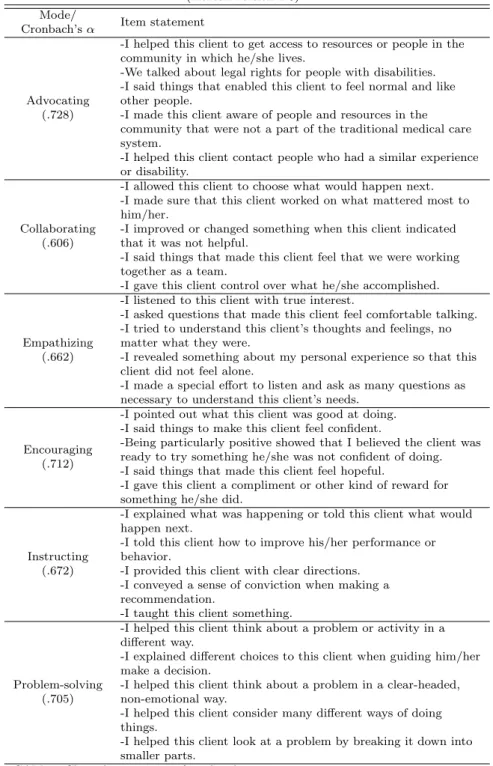
Table 2.1 shows the item statements for each mode and the internal consistency coefficient for each of the six modes.

2.4. Data analysis

All data were analyzed using the Statistical Program for the Social Sciences software

program, version 25.0 (SPSS, Inc., Chicago, IL). Descriptive statistics, independent t-test,

analysis of variance, chi-square test of independence and correlation analysis were used for

basic description of the data and group differences on measures. A total score of the six

mode uses to represent overall communication and the sum scores for each subscale were

generated to represent therapists’ perception of the extent of the use of each mode. Standard

multiple regression analysis was used to examine predictive factors for therapists’ perception

of the extent of the overall mode use and the use of each mode.

(5)

Table 2.1 Items of the CAM-T (version 1.0) and the internal consistency for six modes (Korean version 1.0)

Mode/

Item statement Cronbach’s α

Advocating

-I helped this client to get access to resources or people in the

(.728)

community in which he/she lives.

-We talked about legal rights for people with disabilities.

-I said things that enabled this client to feel normal and like other people.

-I made this client aware of people and resources in the community that were not a part of the traditional medical care system.

-I helped this client contact people who had a similar experience or disability.

Collaborating

-I allowed this client to choose what would happen next.

(.606)

-I made sure that this client worked on what mattered most to him/her.

-I improved or changed something when this client indicated that it was not helpful.

-I said things that made this client feel that we were working together as a team.

-I gave this client control over what he/she accomplished.

Empathizing

-I listened to this client with true interest.

(.662)

-I asked questions that made this client feel comfortable talking.

-I tried to understand this client’s thoughts and feelings, no matter what they were.

-I revealed something about my personal experience so that this client did not feel alone.

-I made a special effort to listen and ask as many questions as necessary to understand this client’s needs.

Encouraging

-I pointed out what this client was good at doing.

(.712)

-I said things to make this client feel confident.

-Being particularly positive showed that I believed the client was ready to try something he/she was not confident of doing.

-I said things that made this client feel hopeful.

-I gave this client a compliment or other kind of reward for something he/she did.

Instructing

-I explained what was happening or told this client what would

(.672)

happen next.

-I told this client how to improve his/her performance or behavior.

-I provided this client with clear directions.

-I conveyed a sense of conviction when making a recommendation.

-I taught this client something.

Problem-solving

-I helped this client think about a problem or activity in a

(.705)

different way.

-I explained different choices to this client when guiding him/her make a decision.

-I helped this client think about a problem in a clear-headed, non-emotional way.

-I helped this client consider many different ways of doing things.

-I helped this client look at a problem by breaking it down into smaller parts.

CAM-T: Clinical assessment of modes-therapist

(6)

3. Results

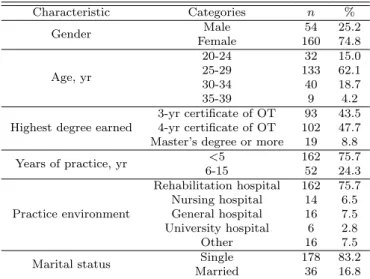
3.1. Participating therapists’ characteristics and perceived vocational self-efficacy Three-quarters of respondents were women, and their ages ranged from 23 to 29 (mean (M)=27.62, SD=3.15). Their years of practice ranged from 1 year to 15 years (M=4.02, SD=2.58); three-quarters of therapists were practicing less than 5 years. The most frequently reported practice setting was a rehabilitation hospital. Detailed information is indicated in Table 3.1.

Table 3.1 Characteristics of the participants (N=214)

Characteristic Categories n %

Gender Male 54 25.2

Female 160 74.8

Age, yr

20-24 32 15.0

25-29 133 62.1

30-34 40 18.7

35-39 9 4.2

Highest degree earned

3-yr certificate of OT 93 43.5 4-yr certificate of OT 102 47.7 Master’s degree or more 19 8.8

Years of practice, yr <5 162 75.7

6-15 52 24.3

Practice environment

Rehabilitation hospital 162 75.7 Nursing hospital 14 6.5 General hospital 16 7.5 University hospital 6 2.8

Other 16 7.5

Marital status Single 178 83.2

Married 36 16.8

yr= year

Table 3.2 shows the extent to which therapists reported on the four subscales of the VSE.

Overall, respondents indicated only moderate levels of overall self-efficacy (mean total score of VSE=51.74, SD=4.47). The therapists’ gender (t(212)=3.13, p=.002), practice setting (F(4, 209)=2.44, p=.048), and how they perceived the clients’ satisfaction about the service (F (3, 210)=2.93, p=.035) indicated differences on the total score of the VSE, and no dif- ference was observed by age, years of practice, highest degree earned, marital status, and therapists’ own perceived satisfaction about the service.

Table 3.2 Vocational self-efficacy perceived by occupational therapists (N=214)

Subscale M SD

Task difficulty preference 2.95 .24

Self-confidence 2.79 .31

Postulated collective efficacy 2.60 .45

Self-regulatory efficacy 2.49 .38

(7)

3.2. Practice context-based use of therapeutic modes (CAM-T)

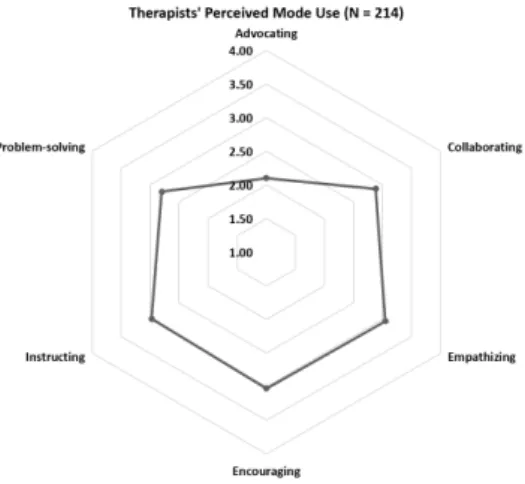
Figure 3.1 portrays the reported use of six IRM modes among occupational therapists measured by CAM-T. The overall mean communication score (i.e., total CAM-T score di- vided by the 30 items) was 2.81 (SD=.25). This cohort reported a roughly equivalent extent of mode use in descending order of empathizing (M= 3.05, SD=.33), encouraging (M=3.02, SD=.34), instructing (M=2.97, SD=.32), collaborating (M=2.89, SD=.30), and problem- solving mode (M=2.80, SD=.35). They reported noticeably less use of the advocating mode (M=2.10, SD=.46).

Figure 3.1 Therapists’ perceived mode use measured by the CAM-T

On average, therapists reported a lesser degree of perceived satisfaction level on her/his own performance regarding the therapy service (Rarely (n=54, 25.4%), Frequently (n=152, 71.4%), Very frequently (n=7, 3.3%)) than their perceived client satisfaction level (Never/

very rarely (n=1, .5%), Rarely (n= 29, 13.6%), Frequently (n=173, 80.8%), Very fre- quently (n=11, 5.1%)). Among the demographic variables, practice setting (F (4, 209)= 3.45, p=.009), therapists’ perceived client satisfaction (F (3, 210)=14.51, p=.000), and therapists’

perception on therapeutic performance (F (2, 210)=22.20, p=.000) statistically significantly altered the CAM-T total score. The Pearson’s product-moment correlation coefficient be- tween the CAM-T total score and the total score of VSE was .457 (p<.0005).

3.3. Factors predicting overall communication and the IRM six mode use

A multiple regression was run to explore which factors predict the CAM-T total score

(i.e., the extent to which therapists use IRM modes) and each of the 6 IRM modes. A

theory-driven consideration was applied for the four factors of the VSE while a data-driven

consideration was applied to demographic factors to identify factors in statistically significant

relationships. Six demographic factors (i.e., age, gender, years of practice, highest education

acquired, practice setting, marital status) and two factors associated with the perception on

the therapeutic relationships (i.e., therapists’ perception on client satisfaction and her/his

own therapeutic performance) were examined for the model-building process.

(8)

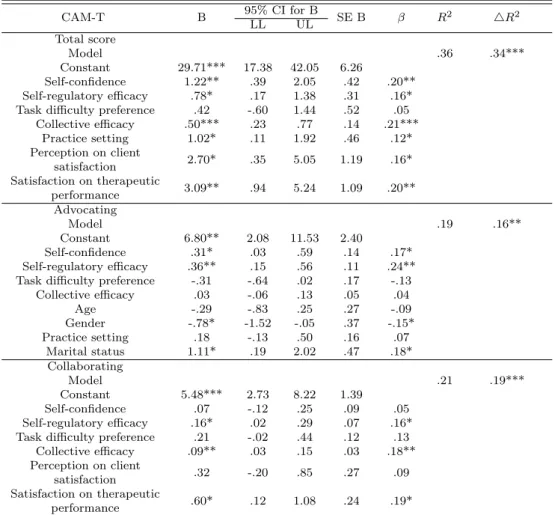
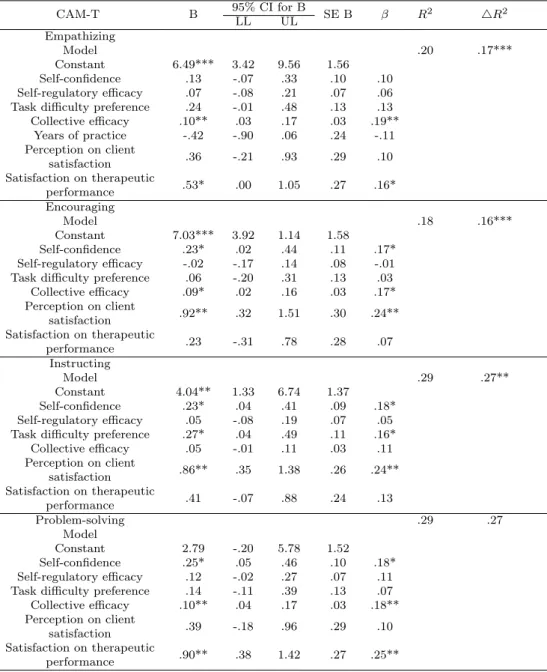
First, four subscales of the vocational self-efficacy, practice setting, therapists’ perception on client satisfaction, and satisfaction level on therapeutic performance were used for the prediction of the overall communication. The model, which was statistically significant, pre- dicted the CAM-T total score, F(7, 205)=16.34, p< .0005, adj. R 2 =.336. The three subscales of vocational self-efficacy (i.e., self-confidence, self-regulatory efficacy, and postulated collec- tive efficacy), practice setting, therapists’ perception on client satisfaction, and satisfaction level on therapeutic performance were all statistically significant factors in the prediction (p< .05). Factors predicting each of the six modes were examined individually; regression coefficients and standard errors can be found in Table 3.3.

Table 3.3 Summary of multiple regression for CAM-T total score and six modes

CAM-T B 95% CI for B

SE B β R

2

4R

2

LL UL

Total score

Model .36 .34***

Constant 29.71*** 17.38 42.05 6.26

Self-confidence 1.22** .39 2.05 .42 .20**

Self-regulatory efficacy .78* .17 1.38 .31 .16*

Task difficulty preference .42 -.60 1.44 .52 .05 Collective efficacy .50*** .23 .77 .14 .21***

Practice setting 1.02* .11 1.92 .46 .12*

Perception on client

2.70* .35 5.05 1.19 .16*

satisfaction Satisfaction on therapeutic

3.09** .94 5.24 1.09 .20**

performance Advocating

Model .19 .16**

Constant 6.80** 2.08 11.53 2.40

Self-confidence .31* .03 .59 .14 .17*

Self-regulatory efficacy .36** .15 .56 .11 .24**

Task difficulty preference -.31 -.64 .02 .17 -.13

Collective efficacy .03 -.06 .13 .05 .04

Age -.29 -.83 .25 .27 -.09

Gender -.78* -1.52 -.05 .37 -.15*

Practice setting .18 -.13 .50 .16 .07

Marital status 1.11* .19 2.02 .47 .18*

Collaborating

Model .21 .19***

Constant 5.48*** 2.73 8.22 1.39

Self-confidence .07 -.12 .25 .09 .05

Self-regulatory efficacy .16* .02 .29 .07 .16*

Task difficulty preference .21 -.02 .44 .12 .13

Collective efficacy .09** .03 .15 .03 .18**

Perception on client

.32 -.20 .85 .27 .09

satisfaction Satisfaction on therapeutic

.60* .12 1.08 .24 .19*

performance

Model: Enter method in SPSS Statistics, B: unstandardized regression coefficient,

CI: confidence interval, LL: lower limit, UL: upper limit, SE B: standard error of the coefficient, β: standardized coefficient, R

2

: coefficient of determination, 4R

2

: adjusted R

2

*p<.05. **p<.01. ***p<.001.

(9)

Table 3.4 Summary of multiple regression for CAM-T total score and six modes

CAM-T B 95% CI for B

SE B β R

2

4R

2

LL UL

Empathizing

Model .20 .17***

Constant 6.49*** 3.42 9.56 1.56

Self-confidence .13 -.07 .33 .10 .10

Self-regulatory efficacy .07 -.08 .21 .07 .06 Task difficulty preference .24 -.01 .48 .13 .13 Collective efficacy .10** .03 .17 .03 .19**

Years of practice -.42 -.90 .06 .24 -.11

Perception on client

.36 -.21 .93 .29 .10

satisfaction Satisfaction on therapeutic

.53* .00 1.05 .27 .16*

performance Encouraging

Model .18 .16***

Constant 7.03*** 3.92 1.14 1.58

Self-confidence .23* .02 .44 .11 .17*

Self-regulatory efficacy -.02 -.17 .14 .08 -.01 Task difficulty preference .06 -.20 .31 .13 .03

Collective efficacy .09* .02 .16 .03 .17*

Perception on client

.92** .32 1.51 .30 .24**

satisfaction Satisfaction on therapeutic

.23 -.31 .78 .28 .07

performance Instructing

Model .29 .27**

Constant 4.04** 1.33 6.74 1.37

Self-confidence .23* .04 .41 .09 .18*

Self-regulatory efficacy .05 -.08 .19 .07 .05 Task difficulty preference .27* .04 .49 .11 .16*

Collective efficacy .05 -.01 .11 .03 .11

Perception on client

.86** .35 1.38 .26 .24**

satisfaction Satisfaction on therapeutic

.41 -.07 .88 .24 .13

performance

Problem-solving .29 .27

Model

Constant 2.79 -.20 5.78 1.52

Self-confidence .25* .05 .46 .10 .18*

Self-regulatory efficacy .12 -.02 .27 .07 .11 Task difficulty preference .14 -.11 .39 .13 .07 Collective efficacy .10** .04 .17 .03 .18**

Perception on client

.39 -.18 .96 .29 .10

satisfaction Satisfaction on therapeutic

.90** .38 1.42 .27 .25**

performance

Model: Enter method in SPSS Statistics, B: unstandardized regression coefficient,

CI: confidence interval, LL: lower limit, UL: upper limit, SE B: standard error of the coefficient, β: standardized coefficient, R

2

: coefficient of determination, 4R

2

: adjusted R

2

*p<.05. **p<.01. ***p<.001.

(10)

4. Discussion

The cross-sectional study of occupational therapists includes data on perceived vocational self-efficacy and the use of six therapeutic communication modes in everyday therapeutic encounters. Importantly, the findings of this study are limited by the design of the survey, which measured perceived rather than objective information. Also, this study was based on a convenience sample of participants; the CAM-T was only forward translated, and the internal consistency of the subscales is acceptable but not yet excellent. As the CAM-T measures the perceived manifestations of a therapist’s mode use, it is noteworthy that results may or may not coincide with the actual use of modes. Nonetheless, this measure indicates the therapeutic modes that are most perceived to be enacted in the therapist’s context.

Therapists reported that they perceived that they used the six modes with approximately the same frequency, except for the advocating mode, which they used the least. The most reported modes were the empathizing and encouraging modes. Notably, this finding is con- gruent with a previous study of the IRM modes (Choi, 2015), in which clients perceived that occupational therapists employed empathizing and encouraging modes most frequently and the advocating mode the least. Although this finding is promising, indicating that ther- apists’ perceptions concur with their clients’ viewpoints, further studies via a probabilistic sampling method other than convenience sampling, along with concurrent reports from both therapists and clients, can help comprehensively portray the current state of intricate inter- personal dynamics in therapy situations.

The finding that the advocating mode was the least used agrees with previous studies in the United States, Norway, and Singapore (Bonsaksen, 2013; Carstensen and Bonsaksen, 2017; Wong et al., 2020). In this study, we found that factors influencing participants’ use of the advocating mode included being male and married, in addition to vocational self-efficacy- related factors such as self-confidence and self-regulatory efficacy. In a national survey study with 148 occupational therapy students in Norway (Bonsaksen, 2015), being male was a predictor of higher general self-efficacy and self-esteem. Hypothetically, this finding may imply a need for an educational and support system for the empowerment of single female therapists and students who experience less self-confidence and self-regulatory efficacy. To determine whether this hypothesis is valid, future studies are required that will examine additional confounding factors of therapists’ and clients’ demographic information.

The study also investigated which factors best predicted the use of overall communication skills and the prevalence of individual IRM modes. First, we examined the VSE measure and found that participants indicated that the area with the highest perceived vocational self-efficacy was task-difficulty preference, followed by self-confidence, collective efficacy, and self-regulatory efficacy. Evidence suggests that being a health-care provider such as an oc- cupational therapist has an important impact on emotional burnout (Hwang, 2012; Lee and Bang, 2015; Lee and Ma, 2018; Nam et al., 2020; Oh and Koo, 2018; Park and Kim, 2008).

Because perceptions of self-regulatory efficacy are influenced by negative affect associated with work performance (Bandura et al., 2003), and the importance of efficacy related to job performance and satisfaction can be seen in an interdisciplinary team context, the reported level of self-efficacy calls for a support system (Lee and Han, 2018; Seo et al., 2019).

We then found that a combination of the subscales of vocational self-efficacy influenced

the extent to which each mode was used. In a national survey study in the United States,

Taylor et al. (2011) found that mode use increased as therapists perceived more interpersonal

(11)

difficulties in practice. It can be argued that the frequency of mode use reflects a therapist’s vocational self-efficacy even as it reflects the challenging practice situation. Subsequently, one would infer that increasing overall vocational efficacy can equip therapists with the skills to deal with interpersonal adversity in therapeutic encounters. More specifically, we found that self-confidence and collective efficacy were the most important factors for predicting a wide range of mode use. This suggests that vocational self-efficacy-building efforts need to be pursued by targeting not only at the individual level, but also at the organizational level. It might be best to revisit Bandura’s (2006) note on the impact of perceived collective efficacy- i.e., the higher the perceived collective efficacy, the greater the motivational investment, staying power despite impediments, and performance accomplishment.

Among the predictive factors of overall and individual mode use, those pertaining to the therapeutic relationship had the largest impact, indicating that while general vocational self-efficacy can also be a predicting factor, more specific consideration needs to be given to specific interpersonal aspects, such as the therapist’s perception of client satisfaction along with self-reflection on performance, which Bandura also emphasized in measuring self- efficacy. This finding provides empirical evidence for the importance of recognizing not only the client and therapist individually but also the lived interpersonal relationship as theorized in IRM. Ultimately, different patterns of affecting factors can be foundations upon which to build a flexible use of modes. As Taylor (2020) noted, The key to intentional practice is not to strive to be someone else but to gain awareness of your own therapeutic qualities and to build on and refine those qualities (p. 359). Once again, the factors explored in this study are perceptions of confidence, thoughts about self-efficacy and organization, and viewpoints of relationships with clients. Researchers seek to clarify the positive clinical effects of mode use in association with the participation levels of clients and their satisfaction with the health- care service (Choi, 2015; Fan and Taylor, 2018). As they do so, support for recognizing and utilizing theory-based therapeutic skills is necessary if therapists are to guide therapeutic relationships in light of their extended responsibility in community mental health (Vax et al., 2012). Orchestrated endeavors to increase collective efficacy can be best facilitated by using IRM in an interdisciplinary team context (Nrgaard et al., 2012).

5. Conclusion

In this study, we explored how occupational therapists’ feelings of professional self-efficacy predicted the extent to which they perceived themselves to be adopting six theory-based ther- apeutic communication modes in their practices. Being confident, in control, and supported within the work-based social environment were experiences that influenced the utilization of therapeutic communication skills. However, positive thoughts such as expecting clients’

satisfaction and one’s own satisfaction about the therapy service were stronger predictors of mode use. Findings suggest that the development of therapeutic skills requires multifaceted levels of support, not only for the therapist (confidence and self-regulatory efficacy), but also for the organization (collective efficacy) and for the relationship itself (including the clients’

and therapists’ satisfaction). These findings emphasize the need to build the interpersonal

skills of therapists who have the significant responsibility of supporting clients’ self-efficacy

in life by providing verbal persuasion and vicarious experience as social role models.

(12)

References

American Occupational Therapy Association (2014). Occupational therapy practice framework: Domain and process (3rd ed.), American Journal of Occupational Therapy, 68, S1-S48.

Bandura, A. (1997). Efficacy: The exercise of control , Freeman, New York.

Bandura, A. (2006). Guide for constructing self-efficacy scales. In T. Urdan and F. Pajares (Eds.), Self- Efficacy Beliefs of Adolescents, Information Age Publishing, Connecticut.

Bandura, A., Caprara, G. V., Barbaranelli, C., Gerbino, M. and Pastorelli, C. (2003). Role of affective self-regulatory efficacy in diverse spheres of psychosocial functioning. Child Development , 74, 769-782.

Barlett, J. E., Kotrlik, J. W. and Higgins, C. C. (2001). Organizational research: Determining appropriate sample size in survey research. Information Technology, Learning, and Performance Journal , 19, 43-50.

Bonsaksen, T. (2013). Self-reported therapeutic style in occupational therapy students. British Journal of Occupational Therapy, 76, 496-502.

Bonsaksen, T. (2015). Predictors of general self-efficacy and self-esteem in occupational therapy students:

A cross-sectional study. Occupational Therapy in Mental Health, 31, 298-310.

Bonsaksen, T. and Carstensen, T. (2018). Psychometric properties of the Norwegian self-efficacy for thera- peutic mode use (N-SETMU). Scandinavian Journal of Occupational Therapy, 25, 475-480.

Carstensen, T. and Bonsaksen, T. (2017). Differences and similarities in therapeutic mode use between occupational therapists and occupational therapy students in Norway. Scandinavian Journal of Occu- pational Therapy, 24, 448-454.

Chang, K.-Y., Lee, H.-S., Jung, M.-Y., Jeon, B.-J., Park, S.-H., Woo, H.-S. and Shim, S.-H. (2015). De- velopment of the Korean occupational therapist essential competency. Journal of Korean Society of Occupational Therapy, 23, 1-16.

Choi, H. (2015). Occupational therapists’ interpersonal modes perceived by clients, clients satisfaction, and motivation for rehabilitation, Master’s Thesis, Daegu University.

Fan, C. W. and Taylor, R. R. (2016). Assessing therapeutic communication during rehabilitation: The clinical assessment of modes. American Journal of Occupational Therapy, 70, 7004280010p1.

Fan, C. W. and Taylor, R. R. (2018). Correlation between therapeutic use of self and clients’ participation in rehabilitation. American Journal of Occupational Therapy, 72, 7211500036p1.

Forsyth, K. and Kviz, F. J. (2017). Survey research. In R. R. Taylor (Ed.), Kielhofner’s research in occu- pational therapy: Methods of inquiry for enhancing practice, F. A. Davis, Philadelphia.

Hwang, S. H. (2012). A study on the relationships between occupational therapists’ burn-out, professional self-concept, and self-efficacy. Journal of the Korea Academia-Industrial Cooperation Society, 13, 1728- 1738.

Iroegbu, M. N. (2015). Self-efficacy and work performance: A theoretical framework of Albert Bandura’s model, review of findings, implications and directions for future research. Psychology and Behavioral Sciences, 4, 170-173.

Judge, T. A., Jackson, C. L., Shaw, J. C., Scott, B. A. and Rich, B. L. (2007). Self-efficacy and work-related performance: The integral role of individual differences. Journal of Applied Psychology, 92, 107-127.

Jung, N.-H. and Bae, W.-J. (2017). A survey on awareness and experience on therapeutic relationship and therapeutic use of self for the occupational therapists. The Korean Society for Occupational Therapy, 25, 75-85.

Jung, M.-Y. and Cha, Y.-J. (2009). An analysis on the status and supply-demand of occupational therapists in Korea. The Journal of Korean Society of Occupational Therapy, 17, 113-127.

Kang, D. S. (2013). Influence of job efficacy of employees at an old folks hospital on job satisfaction, Master’s Thesis, Daegu Haany University.

Kim, B.-M. (2003). A study for the vocational self-efficacy scale development , Master’s Thesis, Ewha Wom- ans University.

Kim, S. E., and Jung, M. (2016). Review of therapeutic use of self. The Korean Society of Assistive Technology, 8, 33-41.

Ku, I.-S., M-Y., Yoo, E.-Y., Park, J.-H., Lee, J.-S. and Lee, H.-S. (2015). Development of competency indicators for Korean occupational therapists (K-CIOT). Journal of Korean Society of Occupational Therapy, 23, 137-149.

Lee, S.-H. (2020). The mental health workforce in Korea: Current state and policy implications. Health and Social Welfare Forum, 4, 43-54.

Lee, S.-H. and Bang, Y.-S. (2015). The effect of emotional labor and burnout on the job attitude of occu- pational therapists. Journal of Korean Society of Occupational Therapy, 23, 95-108.

Lee, N. Y., and Han, J. Y. (2018). The effect of self-efficacy for group work and learning presence on transfer

(13)

of learning in TBL (Team-based learning) using flipped. Journal of the Korean Data & Information Science Society, 29, 951-960.

Lee, S. I. and Ma, S. R. (2018). A study on burnout, emotional labor, and self-efficacy of occupational therapists. Journal of Korea Entertainment Industry Association, 12, 279-288.

Nam, S.-Y., Lee, S. A., Kim, Y.-E. and Lee, K.-S. (2020). Association of interpersonal competence and emotional labor with job stress in occupational therapists. Journal of Korean Society of Occupational Therapy, 28, 13-25.

Nrgaard, B., Ammentorp, J., Ohm Kyvik, K. and Kofoed, P. E. (2012). Communication skills training increases self-efficacy of health care professionals. Journal of Continuing Education in the Health Pro- fessions, 32, 90-97.

Oh, S.-Y. and Koo, J.-W. (2018). Emotional labor factors affecting depressive mood in occupational ther- apists. Journal of Korean Society of Occupational Therapy, 26, 1-11.

Park, S.-H. and Chang, M.-Y. (2014). The correlation between self-esteem of occupational therapists and their empathy with others. The Journal of Korean Society of Occupational Therapy, 22, 15-26.

Park, E.-Y. and Kim, E.-J. (2008). Job stress and self-efficacy of occupational therapist. Journal of the Korea Contents Association, 8, 208-216.

Peloquin, S. (2005). Embracing our ethos, reclaiming our heart (Eleanor Clarke Slagle Lecture). American Journal of Occupational Therapy, 59, 611-625.

Ritter, V. C., Yazdani, F., Carstensen, T., Thrrisen, M. M. and Bonsaksen, T. (2018). Psychometric proper- ties of an instrument derived from the Intentional Relationship Model: The self-efficacy for recognizing clients’ interpersonal characteristics (N-SERIC). The Open Journal of Occupational Therapy, 6.

Seo, Y. A., Yoon, S. and Kim, Y. A. (2019). The effects of domestic nursing practical education using role-play: A systematic review and meta-analysis. Journal of the Korean Data & Information Science Society, 30, 309-321.

Stajkovic, A. D. and Luthans, F. (1998). Self-efficacy and work-related performance: A meta-analysis.

Psychological bulletin, 124, 240-261.

Taylor, R. R. (2020). The intentional relationship: Occupational therapy and use of self , Phildelphia.

Taylor, R. R., Lee, S. W. and Kielhofner, G. (2011). Practitioners’ use of interpersonal modes within the therapeutic relationship: Results from a nationwide study. Occupational Therapy Journal of Research:

Occupation, Participation and Health, 31, 6-14.

Taylor, R. R. and Popova, E. S. (2020). Validation of the clinical assessment of modes -Therapist version (CAM-T) in acute rehabilitation settings. American Journal of Occupational Therapy, 74, 7404345030p 1-7404345030p8.

Taylor, R. R., Wong, S., Fan, C. W., Kjellberg, A., Alfredsson-Agren, K., Andersson, E. and Zubel, B.

(2013). Clinical assessment of modes -Therapist self- Report version (CAM-T), University ofIllinois at Chicago.

Vax, S., Schreuer, N. and Sachs, D. (2012). Work-related self-efficacy of occupational therapists in mental health. Scandinavian Journal of Occupational Therapy, 19, 42-48.

Walumbwa, F. O., Lawler, J. J., Avolio, B. J., Wang, P. and Shi, K. (2005). Transformational leadership and work-related attitudes: The moderating effects of collective and self-efficacy across cultures. Journal of Leadership and Organizational Studies, 11, 2-16.

Wong, S. R., Fan, C. W. and Polatajko, H. (2020). Exploring culture and therapeutic communication:

Therapeutic mode use by occupational therapists in the united states and singapore. American Journal of Occupational Therapy, 74, 7403205120p1-7403205120p11.

Yazdani, F., Carstensen, T. and Bonsaksen, T. (2017). Therapeutic mode preferences and associated factors among Norwegian undergraduate occupational therapy students: A cross-sectional exploratory study.

Scandinavian Journal of Occupational Therapy, 24, 136-142.

수치

Table 2.1 Items of the CAM-T (version 1.0) and the internal consistency for six modes (Korean version 1.0) Mode/ Item statement Cronbach’s α Advocating
Table 3.1 Characteristics of the participants (N=214)
Figure 3.1 portrays the reported use of six IRM modes among occupational therapists measured by CAM-T
Table 3.3 Summary of multiple regression for CAM-T total score and six modes
+2

참조

관련 문서