22(1) : 64-69 (2016)
http://dx.doi.org/10.20307/nps.2016.22.1.64
64
Identification of Antioxidative Constituents from Polygonum aviculare using LC-MS Coupled with DPPH Assay
Hyeji Shin
1, Hayeon Chung
1, Byoungduck Park
2and Ki Yong Lee
1,*
1
College of Pharmacy, Korea University, Sejong 339-700, Korea
2
College of Pharmacy, Keimyung University, Daegu 704-701, Korea
Abstract − A method for simultaneously identifying antioxidative compounds was developed using time-based LC-MS coupled with DPPH assay regardless of the time consuming process. The methanolic extract of Polygonum aviculare (Polygonaceae) showed significant DPPH radical scavenging activity. Time-based DPPH assay for simultaneous identification of active compounds from the extracts of P. aviculare was used. Major peaks of ethyl acetate fraction of P. aviculare showed high DPPH radical scavenging activity. A simple phenolic compound (1) and six flavonoids (2-7) were isolated from the ethyl acetate fraction of P. aviculare by silica gel and sephadex LH-20 column chromatography. The structures of seven compounds were determined to be protocatechuic acid (1), catechin (2), myricitrin (3), epicatechin-3-O-gallate (4), avicularin (5), quercitrin (6), and juglanin (7) based on the analysis of the
1H-NMR,
13C-NMR and ESI-MS data. All compounds exhibited significant antioxidant activity on DPPH assay and active compounds were well correlated with predicted one.
Keywords − Polygonum aviculare, Flavonoids, LC-MS, DPPH assay
Introduction
Natural products which have used for thousands of years have showed different therapeutic effects with few side effects by pharmacological studies and clinical trials.
However, to screen and purify the bioactive compounds of nature products is not easy because natural products are complex mixtures containing up to hundreds or even thousands of various constituents.
1Recently, the introduc- tion of HPLC equipped with mass spectrometry has been applied to screen and identify unknown compounds in natural products. The LC-MS coupled with DPPH assay which is performed DPPH radical scavenging assay after separate extracts by LC-MS determine not only information of the compound but also antioxidant activity of the compound.
2,3Polygonum aviculare L. (common knotgrass, birdweed, and pigweed) belongs to the family Polygonaceae and is an annual plant which is widely distributed through Korea, China, Japan and so on. It can be found in field or roadside easily.
4Traditionally, the sprouts of P. aviculare has been used for food. Furthermore, it also has been used
important traditional medicine to treat rheumatitis, gout, diarrhea, dysentery, hemoptysis and bleeding.
5A previous study have been reported flavonoids (quercetin, kaempferol, myricetin, isorhamnetin, luteolin, avicularin, myricitrin, rutin, quercitrin and astragalin)
6and phenolic acids (gallic acid, protocatechuic acid and chlorogenic acid)
4from P.
aviculare. Its compounds provide many pharmacological effects, such as anti-atherosclerotic,
7anti-hypertensive, diuretic, anti-obese, astringent, insecticide,
8antioxidant,
4anti-tumor
9and anti-inflammatory.
10Therefore, the purpose of the study is to simultaneously identify antioxidative compounds from P. aviculare effi- ciently using time-based DPPH assay regardless of the time consuming process.
Experimental
General experimental procedure − NMR spectra were recorded on a Bruker SPECTROSPIN 300 MHz spectro- meter. Silica gel (70 - 230 mesh, Merck, Germany) and Sephadex LH-20 (25 - 100 μm, Amersham Biosciences, Sweden) were used for open column chromatography (CC). Thin-layer chromatography (TLC) was performed on a precoated silica gel 60 F
254(0.25 mm, Merck, Ger- many). Medium pressure liquid chromatography (MPLC) was performed on Biotage Isolera One system equipped
*Author for correspondence
Ki Yong Lee, College of Pharmacy, Korea University, 2511 Sejong- ro, Sejong, Korea
Tel: +82-44-860-1623; E-mail: [email protected]
with a HPFC pump, a variable dual-wavelength detector and a collector. Silica gel column for MPLC was SNAP Ultra 25 g. HPLC grade solvents (acetonitrile, water and methanol) were purchased from Fisher scientific Korea Ltd. Formic acid, DPPH (1,1-diphenyl-2-picrylhydrazyl) and curcumin were purchased from Sigma Aldrich Co.
Plant material − The herb of P. aviculare was purchased from Kyungdong Oriental Herbal Market, Seoul, Korea.
The voucher specimen (KUP-HD051) was deposited in the laboratory of pharmacognosy, College of Pharmacy, Korea University.
HPLC conditions − The chromatography analytical procedures were performed on an Agilent 1260 Series (Agilent, Santa Clara, CA, USA). LC system equipped with a binary pump, an online degasser, an auto plate- sampler, and a thermostatically controlled column com- partment. The columns were maintained at 30
oC. The separation was carried out on an Shiseido CapCell PAK C18 column (150 × 4.6 mm, 5 μm), preceded by a C18 guard column (4.00 × 3.00 mm; Phenomenex, USA). The binary gradient elution system consisted of 0.1% formic acid in water (solvent A) and 0.1% formic acid in acetonitrile (solvent B) and separation was achieved using the following gradient: 15% B at 0 - 5 min; 15 - 95% B at 5 - 30 min. The flow rate was 0.6 mL/min and the injection volume was 10.0 and 20.0 μL. In case of 20.0 μL, it is used for time-dependent DPPH assay.
Mass spectrometry conditions − Mass spectrometry was performed using an Agilent 6530 Q-TOF mass spectrometer (Agilent, Santa Clara, CA, USA) equipped with an electrospray ionization (ESI) interface, and was operated in negative ion mode with parameters set as follows: capillary voltage, 4000 V; fragmentor, 175 V;
skimmer, 65 V; OCT 1 RF Vpp, 750 V; pressure of nebulizer, 40 psi; drying gas temperature, 325
oC; sheath gas temperature, 350
oC. Nitrogen was used as sheath and drying gas at a flow rate of 10.0 and 12.0 L/min, res- pectively. Data were collected in centroid mode and the mass range was set at m/z 50 - 1000 using the extended dynamic range. The accurate-mass capability of the TOF analyzer allowed reliable confirmation of the identity of the detected metabolites, normally with mass errors below 5 ppm in routine analysis. An external calibration solution (Agilent calibration solution A) was continuously sprayed in the ESI source of the Q-TOF system, employing the ions with m/z 112.9855 (TFA anion) and 1033.9881 [HP- 0921 (TFA adduct)] to recalibrate the mass axis, ensuring mass accuracy and reproducibility throughout the chroma- tographic run. The Mass Hunter Workstation software LC/MS Data Acquisition for 6530 series Q-TOF (version
B.05.00) was used to control all the acquisition para- meters of the HPLC-Q-TOF-MS system and also to process the obtained data.
DPPH assay − For the measurement of DPPH radical scavenging activity, 190 μL of an ethanol solution of 15 μM DPPH was mixed with 10 μL of ethanol with or without the different concentrations of the tested samples such as extract, n-hexane fraction, EtOAc fraction, n- BuOH fraction, H
2O fraction and compounds were isolated from the EtOAc fraction in a 96-well plate. For time-based DPPH assay, each 30 seconds’ effluent of HPLC was manually collected during 30 minutes on each well of 96-well plate. And then samples of each well were applied to the DPPH assay. The plate was incubated in a dark room at room temperature for 30 min and the reduction of the DPPH free radical was measured by reading the absorbance at 517 nm. DPPH, a purple-colored, stable free radical is reduced to the yellow-colored diphenyl- picrylhydrazine when antioxidants are added. Curcumin was used as positive control. The inhibition ratio (percent) was calculated from the following equation: % inhibition
= [1 − (S − So) / (C − Co)] × 100, where S is the absor- bance of DPPH 190 μL + sample 10 μL; So is the absor- bance of ethanol 190 μL + sample 10 μL; C is the absor- bance of DPPH 190 μL + ethanol 10 μL; Co is the absor- bance of ethanol 190 μL + ethanol 10 μL.
Extraction and isolation − The herb of P. aviculare (1.0 kg) were accurately weighed and extracted with 80%
methanol (MeOH) for 90 min in an ultrasonic apparatus.
After evaporation of most of the solvent, the residue (107.23 g) was suspended in H
2O and then partitioned successively with n-hexane, ethyl acetate (EtOAc) and n- BuOH. The EtOAc fraction (7.99 g) was subjected to silica gel column chromatography using gradient elution with n-hexane 100% to MeOH:EtOAc (1:1), in order to divide the fraction into fifteen fractions (E1~E15).
Fraction E4 was re-chromatographed on sephadex LH-20 using isocratic elution with MeOH to give four fractions (E4-1~E4-4). Compound 2 (64.9 mg) was obtained from E4-4. Fraction E6 was separated over sephadex LH-20 using isocratic elution with MeOH to yield three fractions (E6-1~E6-3). Compound 4 (2.6 mg) obtained from E6-2.
Fraction E11 was subjected to sephadex LH-20 with
MeOH to afford five fractions (E11-1~E11-5). Compound
3 (27.1 mg) was obtained from E11-4. Fraction E7 was
recrystallized with n-hexane. According to the TLC profiles,
the crystal was re-chromatographed on sephadex LH-20
using isocratic elution with MeOH to afford nine fractions
(E7A-1~E7A-9). Compounds 7 (7.8 mg) and 5 (10.5 mg)
were obtained from E7A-3 and E7A-6, respectively.
Fraction E7 residue was applied to silica gel MPLC using gradient elution with chloroform:MeOH:H
2O (25:4:1) to chloroform:MeOH:H
2O (10:5:1) to yield eleven fractions (E7B-1~E7B-11). Fraction E7B-5 was purified by a RP- C18 semi-preparative HPLC (16% acetonitrile) to yield compound 1 (5.1 mg). Fraction E7B-9 was separated on sephadex LH-20 with MeOH to yield compound 6 (4.0 mg).
Protocatechuic acid (1) − ESI-MS m/z 153.0255 [M- H]
−(calcd. 153.0187 for C
7H
5O
4);
1H-NMR (300 MHz, CD
3OD) δ: 7.45 (1H, d, J = 2.1 Hz, H-2), 7.42 (1H, dd, J = 8.7, 2.1 Hz, H-6), 6.79 (1H, d, J = 8.7 Hz, H-5);
13C- NMR (75 MHz, CD
3OD) δ: 168.8 (-COO-), 150.1 (C-4), 144.6 (C-3), 122.4 (C-6), 121.7 (C-1), 116.3 (C-2), 114.3 (C-5).
Catechin (2) − ESI-MS m/z 289.0714 [M-H]
−(calcd.
289.0718 for C
15H
13O
6);
1H-NMR (300 MHz, CD
3OD) δ:
6.84 (1H, d, J = 1.8 Hz, H-2'), 6.75 (1H, d, J = 8.1 Hz, H- 5'), 6.73 (1H, dd, J = 7.8, 1.8 Hz, H-6'), 5.93 (1H, d, J = 2.1 Hz, H-8), 5.86 (1H, d, J = 2.1 Hz, H-6), 4.58 (1H, d, J = 7.5 Hz, H-2), 4.00 (1H, m, J = 7.8, 5.4 Hz, H-3), 2.88 (1H, dd, J = 16.2, 5.4 Hz, H-4a), 2.54 (1H, dd, J = 15.9, 8.1 Hz, H-4b);
13C-NMR (75 MHz, CD
3OD) δ:
156.5 (C-5), 156.4 (C-7), 155.5 (C-9), 144.8 (C-3'), 144.8 (C-4'), 130.8 (C-1'), 118.7 (C-6'), 114.7 (C-2'), 113.9 (C- 5'), 99.4 (C-10), 94.9 (C-6), 94.1 (C-8), 81.4 (C-2), 67.4 (C-3), 27.1 (C-4).
Myricitrin (3) − ESI-MS m/z 463.0882 [M-H]
−(calcd 463.0882 for C
21H
19O
12);
1H-NMR (300 MHz, CD
3OD) δ: 6.95 (2H, s, H-2', 6'), 6.36 (1H, s, H-6), 6.20 (1H, s, H- 8), 5.31 (1H, br s, H-1''), 4.22 (1H, s ,H-2''), 3.81 (1H, dd, J = 9.3, 3.0 Hz, H-3''), 3.55 (1H, dd, J = 9.3, 6.3 Hz, H- 5''), 0.98 (3H, d, J = 6.3 Hz, H-6'');
13C-NMR (75 MHz, CD
3OD) δ: 180.3 (C-4), 166.5 (C-7), 163.8 (C-5), 160.1 (C-2), 159.1 (C-9), 147.5 (C-5'), 147.5 (C-3'), 138.5 (C- 4'), 136.9 (C-3), 122.5 (C-1'), 110.2 (C-6'), 110.2 (C-2'), 106.5 (C-10), 104.2 (C-1''), 100.4 (C-6), 95.3 (C-8), 74.0 (C-4''), 72.7 (C-3''), 72.6 (C-5''), 72.5 (C-2''), 18.3 (C-6'').
Epicatechin-3-O-gallate (4) − ESI-MS m/z 441.0919 [M-H]
−(calcd. 441.0822 for C
22H
17O
10);
1H-NMR (300 MHz, CD
3OD) δ: 6.96 (2H, s, H-2'', 6''), 6.94 (1H, d, J = 1.5 Hz, H-2'), 6.84 (1H, dd, J = 8.1, 1.8 Hz, H-6'), 6.72 (1H, d, J = 8.1 Hz, H-5'), 5.97 (2H, m, H-6, 8), 5.54 (1H, m, H-3), 5.04 (1H, s, H-2), 3.05 (1H, dd, J = 17.4, 4.5 Hz, H-4b), 2.88 (1H, d, J = 17.7 Hz, H-4a);
13C-NMR (75 MHz, CD
3OD) δ: 166.1 (-COO-), 156.5 (C-7), 156.5 (C- 5), 155.9 (C-9), 144.9 (C-5'), 144.9 (C-3'), 144.5 (C-5''), 144.5 (C-3''), 138.4 (C-4''), 130.0 (C-1'), 120.0 (C-1''), 118.0 (C-6'), 114.6 (C-2'), 113.7 (C-5'), 108.8 (C-2''), 108.8 (C-6''), 97.9 (C-10), 95.1 (C-6), 94.4 (C-8), 77.2 (C- 2), 68.5 (C-3), 25.4 (C-4).
Avicularin (5) − ESI-MS m/z 433.0786 [M-H]
−(calcd.
433.0776 for C
20H
17O
11);
1H-NMR (300 MHz, CD
3OD) δ: 7.53 (1H, s, H-2'), 7.52 (1H, d, J = 8.4 Hz, H-6'), 6.90 (1H, d, J = 8.4 Hz, H-5'), 6.40 (1H, s, H-8), 6.21 (1H, s, H-6), 5.47 (1H, s, H-1''), 4.33 (1H, br d, J = 2.1 Hz, H-2''), 3.91 (1H, dd, J = 5.1, 2.7 Hz, H-3''), 3.87 (1H, br q, J = 4.8 Hz, H-4''), 3.50 (2H, m, H-5'');
13C-NMR (75 MHz, CD
3OD) δ: 178.6 (C-4), 164.7 (C-7), 161.7 (C-5), 157.9 (C-2), 157.2 (C-9), 148.5 (C-4'), 144.9 (C-3'), 133.5 (C-3), 121.7 (C-6'), 121.6 (C-1'), 115.4 (C-2'), 115.0 (C- 5'), 108.1 (C-1''), 104.2 (C-10), 98.5 (C-6), 93.4 (C-8), 86.6 (C-4''), 81.9 (C-2''), 77.3 (C-3''), 61.1 (C-5'').
Quercitrin (6) − ESI-MS m/z 447.1020 [M-H]
−(calcd.
447.0927 for C
21H
19O
11);
1H-NMR (300 MHz, CD
3OD) δ: 7.33 (1H, d, J = 1.8 Hz, H-2'), 7.29 (1H, d, J = 8.4 Hz, H-6'), 6.89 (1H, d, J = 8.1 Hz, H-5'), 6.36 (1H, d, J = 1.8 Hz, H-8), 6.19 (1H, d, J = 1.8 Hz, H-6), 5.34 (1H, br s, H- 1''), 4.22 (1H, s, H-2''), 3.73 (1H, d, J = 9.0 Hz, H-3''), 3.30-3.34 (2H, m, H-4'', 5''), 0.93 (3H, d, J = 6.0 Hz, H- 6'');
13C-NMR (75 MHz, CD
3OD) δ: 180.1 (C-4), 166.4 (C-7), 163.7 (C-5), 159.7 (C-9), 159.0 (C-2), 150.3 (C-4'), 146.9 (C-3'), 136.7 (C-3), 123.4 (C-6'), 123.3 (C-1'), 117.3 (C-5'), 116.8 (C-2'), 106.3 (C-10), 104.0 (C-1''), 100.2 (C- 6), 95.1 (C-8), 73.7 (C-4''), 72.6 (C-3''), 72.5 (C-2''), 72.3 (C-5''), 18.1 (C-6'').
Juglanin (7) − ESI-MS m/z 417.0847 [M-H]
−(calcd.
417.0827 for C
20H
17O
10);
1H-NMR (300 MHz, CD
3OD) δ: 7.97 (2H, d, J = 8.7 Hz, H-2', 6'), 6.92 (2H, d, J = 8.7 Hz, H-3', 5'), 6.43 (1H, d, J = 1.8 Hz, H-8), 6.23 (1H, d, J = 1.8 Hz, H-6), 5.51 (1H, s, H-1''), 4.34 (1H, d, J = 3.0 Hz, H-2''), 3.93 (1H, dd, J = 5.1, 3.0 Hz, H-3''), 3.82 (1H, dd, J = 9.0, 4.5 Hz, H-4''), 3.49 (2H, d, J = 4.5 Hz, H-5'');
13
C-NMR (75 MHz, CD
3OD) δ: 179.0 (C-4), 166.2 (C-7), 163.2 (C-5), 161.7 (C-4'), 159.0 (C-9), 158.0 (C-2), 135.0 (C-3), 132.1 (C-2'), 132.1 (C-6'), 122.9 (C-1'), 116.6 (C- 3'), 116.6 (C-5'), 109.7 (C-1''), 105.0 (C-10), 99.9 (C-6), 94.9 (C-8), 88.1 (C-4''), 83.5 (C-2''), 78.7 (C-3''), 62.6 (C-5'').
Result and Discussion
Recently, HPLC coupled with mass spectrometry has
been widely used to identify unknown compounds in
complex mixtures. The separation and activity determi-
nation provide information of an antioxidant activity of
individual compounds while mass spectrometry provides
information of the molecular type and the molecular
weight of the compound of interest. This hyphenated
technique gives rapid information of antioxidative consti-
tuents without the need for preparative isolation tech-
niques.
2,3From screening, 80% MeOH extracts of the
herb of P. aviculare showed significant free radical scavenging activity on the DPPH assay. Therefore, it is interesting to identify the antioxidative constituents in the plant without isolation. From the 80% MeOH extracts of
the herb of P. aviculare was partitioned with n-hexane-, EtOAc-, and n-BuOH fractions. The antioxidant activities of total extract and each fraction were assessed by DPPH assay at concentrations of 0.04, 0.2, 1.0, 5.0 and 10.0 μg/ml Table 1. DPPH radical scavenging activity of the extract and fractions from P. aviculare
0.04 μg/ml 0.2 μg/ml 1.0 μg/ml 5.0 μg/ml 10.0 μg/ml
total extract 10.0 ± 1.1 9.7 ± 1.7 29.8 ± 1.3 66.6 ± 2.1 89.0 ± 1.2
n-hexane fr. -0.8 ± 0.9 21.1 ± 1.8 56.2 ± 2.0 92.4 ± 2.3 94.8 ± 0.1
EtOAc fr. 38.1 ± 1.8 76.8 ± 0.5 93.8 ± 1.1 98 ± 0.16 96 ± 0.10
n-BuOH fr. 5.9 ± 0.3 39.7 ± 3.2 94.7 ± 0.2 95.1 ± 0.3 95 ± 0.4
water fr. 7.6 ± 2.5 1.2 ± 2.6 3.2 ± 4.3 9.1 ± 3.0 14.8 ± 1.2
Data represent the means ± S.D. from triplication.
Fig. 1. HPLC chromatogram (254 nm) and time-dependent DPPH assay results of EtOAc fraction from P. aviculare (A), expansion of the
HPLC chromatogram between 11 - 16 min (B), UV spectrum of each peaks (C).
(Table 1). The EtOAc fraction showed higher antioxidant effect than other fractions. A method, time-dependent DPPH assay was used for simultaneous identification of anti-oxidative compounds in EtOAc fraction. The HPLC chromatogram of EtOAc fraction had been obtained by gradient condition for 30 min (Fig. 1). Sample for time- dependent DPPH assay was collected as the same condition of used EtOAc fraction analysis every 30 seconds.
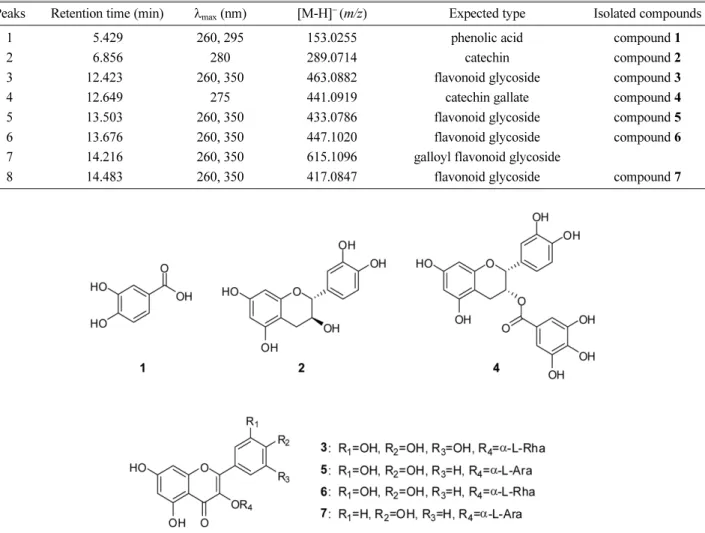
Information of constituents with antioxidant effect in EtOAc fraction was simultaneously confirmed (Table 2).
In Fig. 1, major peaks of EtOAc fraction of P. aviculare showed high DPPH radical scavenging activity. The types of active compounds were expected as phenolics and fla- vonoids. Prediction of antioxidative constituents from natural products was just took an hour or two.
For verification of this method, active compounds were isolated from the EtOAc fraction. Chromatographic purifi- cation of the EtOAc fraction was obtained six flavonoids (2 - 7) and a simple phenolic compound (1) (Fig. 2). The
structures of these compounds were identified as protocatechuic acid (1),
11catechin (2),
11,12myricitrin (3),
13epicatechin-3-O-gallate (4),
12,17avicularin (5),
15,16quercitrin (6)
18and juglanin (7)
14from
1H-NMR,
13C-NMR and ESI-MS data. Unfortunately, we could not isolate a peak 7 (Rt = 14.216 min) and assumed a galloyl flavonoid glyco- side. The compounds from EtOAc fraction were measured the DPPH radical scavenging activity at concentrations of 1, 5, 10, 50 and 100 μM. Curcumin which is well-known antioxidant compound was used as positive control.
Compounds 1 - 6 showed higher antioxidant effect than curcumin (IC
5027.80 μM) with IC
50values range from 10.22 to 19.91 μM, while compound 7 showed lower antioxidant activity (Table 2). These results were well correlated with predicted one and a previous report by Nugroho et al.
4The DPPH radical scavenging activity is dependent on the position of hydroxyl groups in the aromatic ring.
19All compounds except compound 7 that has hydroxyl groups of ortho position in the aromatic ring Table 2. LC-MS analysis of each peak in EtOAc fractions from P. aviculare
Peaks Retention time (min) λ
max(nm) [M-H]
−(m/z) Expected type Isolated compounds
1 5.429 260, 295 153.0255 phenolic acid compound 1
2 6.856 280 289.0714 catechin compound 2
3 12.423 260, 350 463.0882 flavonoid glycoside compound 3
4 12.649 275 441.0919 catechin gallate compound 4
5 13.503 260, 350 433.0786 flavonoid glycoside compound 5
6 13.676 260, 350 447.1020 flavonoid glycoside compound 6
7 14.216 260, 350 615.1096 galloyl flavonoid glycoside
8 14.483 260, 350 417.0847 flavonoid glycoside compound 7
Fig. 2. Structures of the compounds isolated from P. aviculare.
were exhibited strong antioxidant activity. The result describes that the position and number of hydroxyl groups bonded to B ring of flavonoids (compounds 2 - 6) are important factor for free-radical scavenging activity.
Thus, this study suggests that the time-based LC-MS coupled with DPPH assay can be predicted the active compounds easily without the time-consuming process structure identification.
Acknowledgements
This work was supported by the National Research Foundation of Korea Grant funded by the Korean Govern- ment (NRF-2014R1A1A1003605 and NRF-2014R1A4A 1007304).
References
(1) Qu, F. N.; Qi, L. W.; Wei, Y. J.; Wen, X. D.; Yi, L.; Luo, H. W.; Li, P. Biol. Pharm. Bull. 2008, 31, 501-506.
(2) Nuengchamnong N.; Krittasilp K.; Ingkaninan K. Food Chem. 2011, 127, 1287-1293.
(3) Nuengchamnong N.; Krittasilp K.; Ingkaninan K. Food Chem. 2009, 117, 750-756.
(4) Nugroho, A.; Kim, E. J.; Choi, J. S.; Park, H. J. J. Pharm. Biomed.
Anal. 2014, 89, 93-98.
(5) Robu, T.; Robu, B.; Robu, S. Environ. Eng. Manag. J. 2008, 7, 579- 588.
(6) Granica, S.; Piwowarski, J. P.; Pop³awska, M.; Jakubowska, M. J.
Pharm. Biomed. Anal. 2013, 72, 216-222.
(7) Park, S. H.; Sung, Y. Y.; Nho, K. J.; Kim, H. K. J. Ethnopharmacol.
2014, 151, 1109-1115.
(8) Sung, Y. Y.; Yoon, T.; Yang, W. K.; Kim, S. J.; Kim, D. S.; Kim, H.
K. Evid. Based Complement Alternat. Med. 2013, 2013, 626397.
(9) Hsu, C. Y. Biol. Res. 2006, 39, 281-288.
(10) Granica, S.; Czerwi ska, M. E.; Zy y ska-Granica, B.; Kiss, A.
K. Fitoterapia 2013, 91, 180-188.
(11) Nguyen, P. H.; Zhao, B. T.; Lee, J. H.; Kim, Y. H.; Min, B. S.;
Woo, M. H. Bull. Korean Chem. Soc. 2014, 35, 1763-1768.
(12) Seto, R.; Nakamura, H.; Nanjo, F; Hara, Y. Biosci. Biotech.
Biochem. 1997, 61, 1434-1439.
(13) Aderogba, M. A; Ndhlala, A. R; Rengasamy, K. R; Van Staden, J.
Molecules 2013, 18, 12633-12644.
(14) Kim, H. J.; Woo, E. R.; Park, H. K. J. Nat. Prod. 1994, 57, 581- 586.
(15) Kwon, D. J.; Bae, Y. S. Chem. Nat. Compd. 2013, 49, 131-132.
(16) Park, B. J.; Matsuta, T.; Kanazawa, T.; Park, C. H.; Chang, K. J.;
Onjo, M. Chem. Nat. Compd. 2012, 48, 477-479.
(17) Magiera, S.; Baranowska, I.; Lautenszleger, A. J. Pharm. Biomed.
Anal. 2015, 102, 468-475.
(18) de Beck P. O.; Duoux, M. G.; Cartier, G.; Mariotte, A. M.
Phytochemistry 1998, 47, 1171-1173.
(19) Sroka, Z.; Cisowski, W. Food Chem. Toxicol. 2003, 41, 753-758.
Received September 2, 2015 Revised September 25, 2015 Accepted September 29, 2015
ní z· ní
Table 3. DPPH radical scavenging activity of isolated compounds from P. aviculare
Compounds IC
50, μM
a1 19.91
2 15.19
3 10.22
4 13.31
5 10.33
6 13.98
7 89.91
Curcumin
b27.80
a
Inhibitory concentration, 50%
b