Tuberc Respir Dis 2012;73:249-257
CopyrightⒸ2012. The Korean Academy of Tuberculosis and Respiratory Diseases. All rights reserved.
Bronchiectasis
Changhwan Kim, M.D., Dong-Gyu Kim, M.D.
Department of Internal Medicine and Lung Research Institute, Hallym University College of Medicine, Chuncheon, Korea
The frequency of diagnosing bronchiectasis is increasing around the world. Cystic fibrosis is the most common inherited cause of bronchiectasis, but there is increasing recognition of significant numbers of patients with bronchiectasis from various causes. With increasing awareness of bronchiectasis, a significant number of research, concerning the causes and treatments, were published over the past few years. Investigation of the underlying cause of bronchiectasis is the most important key to effective management. The purpose of this report is to review the immunological abnormalities that cause bronchiectasis in those that the cystic fibrosis has been excluded, identify the available evidences of current management, and discuss several controversies in the treatment of this disorder.
Key Words: Bronchiectasis; Etiology; Immunologic Deficiency Syndromes; Therapeutics
Address for correspondence: Dong-Gyu Kim, M.D.
Division of Pulmonary, Allergy & Critical Care Medicine, Department of Internal Medicine, Hallym University Sacred Heart Hospital, Hallym University College of Medicine, 896, Pyeongchon-dong, Dongan-gu, Anyang 431-070, Korea Phone: 82-31-380-3719, Fax: 82-31-380-3973
E-mail: [email protected] Received: Jun. 23, 2012 Revised: Jun. 30, 2012 Accepted: Jul. 5, 2012
CCIt is identical to the Creative Commons Attribution Non-Commercial License (http://creativecommons.org/licenses/by-nc/3.0/).
Introduction
Bronchiectasis is defined as permanently dilated air- ways due to chronic bronchial inflammation caused by inappropriate clearance of various microorganisms and recurrent or chronic infection
1. It was once considered to be an orphan disease with fading relevance in the developed world in the late 20th century
2. Although the true prevalence is unknown for most regions, bron- chiectasis is now being diagnosed with increasing fre- quency in North America and around the globe. The rate of bronchiectasis-associated hospitalizations in- creased markedly, starting around age 50, with the high- est rate in the oldest age groups and particularly in old- er women in the United States
3. Currently just under
1,000 people die from bronchiectasis each year, and the mortality rate also is increasing at 3% per year in England and Wales
4. Clinical features of bronchiectasis include chronic production of sputum often mucopur- ulent or purulent in nature, persistent bacterial colo- nization and recurrent lower respiratory tract infections.
Symptoms include hemoptysis and breathlessness char- acterized by mild to moderate airflow obstruction, leth- argy and reduced health status
5.
Bronchiectasis is a pathological description of lung
damage, namely inflamed thick walled and dilated
bronchi. Such damage is the ultimate consequence of
inflammation and infection arising from various causes
either inherited or acquired. Cystic fibrosis is the most
common inherited cause of bronchiectasis in white pop-
ulations, but there is increasing recognition of significant
numbers of patients with bronchiectasis from a variety
of causes
6. Post-infectious damage is no longer the most
common cause of bronchiectasis in developed countries
following the introduction of antibiotic therapy and im-
munization programs. Irrespective of the underlying
cause, patients with bronchiectasis are often colonized
with bacterial species. This indicates failure of the usual
host defense to maintain sterility of the respiratory tract,
so the importance of identifying immunodeficiency has
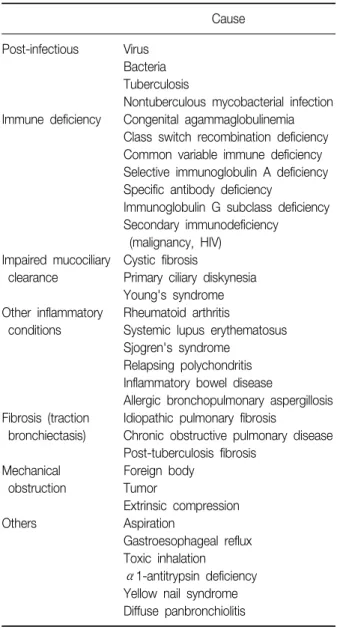
Table 1. Causes of bronchiectasis
Cause Post-infectious VirusBacteria Tuberculosis
Nontuberculous mycobacterial infection Immune deficiency Congenital agammaglobulinemia
Class switch recombination deficiency Common variable immune deficiency Selective immunoglobulin A deficiency Specific antibody deficiency
Immunoglobulin G subclass deficiency Secondary immunodeficiency
(malignancy, HIV) Impaired mucociliary Cystic fibrosis
clearance Primary ciliary diskynesia Young's syndrome Other inflammatory Rheumatoid arthritis
conditions Systemic lupus erythematosus Sjogren's syndrome
Relapsing polychondritis Inflammatory bowel disease
Allergic bronchopulmonary aspergillosis Fibrosis (traction Idiopathic pulmonary fibrosis
bronchiectasis) Chronic obstructive pulmonary disease Post-tuberculosis fibrosis
Mechanical Foreign body
obstruction Tumor
Extrinsic compression
Others Aspiration
Gastroesophageal reflux Toxic inhalation
α1-antitrypsin deficiency Yellow nail syndrome Diffuse panbronchiolitis HIV: human immunodeficiency virus.
been underlined
7.
In this review, we will focus on the immunological abnormalities that cause bronchiectasis in patients in whom cystic fibrosis has been excluded, and discuss several controversies in the current management of this disorder.
Treatable Causes of Bronchiectasis
The underlying conditions associated with bron- chiectasis are listed in Table 1. It is an important ques-
tion whether knowledge of the underlying medical cause leads to a change in management of patients with bronchiectasis. One study conducted in two pediatric respiratory clinics identified the etiology in 77% of cases with non-cystic fibrosis bronchiectasis. Furthermore, they found that immunodeficiency and intrinsic abnor- malities accounted for the majority of cases and that knowledge of a specific causal agent led to a mod- ification in management
8. This has been confirmed in the adult setting in a study performed at a tertiary hospi- tal in the United Kingdom
9. Among 165 patients con- firmed to have bronchiectasis on computed tomography scan, an underlying cause was identified in 74% of patients. Knowledge of the underlying cause directly af- fected management in 37% of patients. These studies suggest that investigation of the underlying causes of bronchiectasis leads to an alteration in therapy to target these specific conditions in many more cases than was previously thought, which can have significant prog- nostic implications. As the treatable causes of bron- chiectasis, primary immune deficiency, allergic broncho- pulmonary aspergillosis, nontuberculous mycobacterial infection, airway obstruction, inflammatory bowel dis- ease, rheumatoid arthritis and aspiration can be in- cluded
10.
Immune Deficiencies in Non-Cystic Bronchiectasis
A range of immunologic abnormalities are associated with non-cystic fibrosis bronchiectasis, and the preva- lence of each in bronchiectasis varies from study to study
11. Primary antibody deficiency is the most com- mon primary immunodeficiencies
12. It is characterized by a defect in the production of normal amounts of anti- gen-specific antibodies. These antibodies or immuno- globulins are essential for the adaptive immune re- sponse against various pathogens. A defect in antibody production causes recurrent and severe infections.
Primary antibody deficiency represents a heterogeneous
spectrum of conditions, including congenital agamma-
globulinemia, common variable immunodeficiency, class
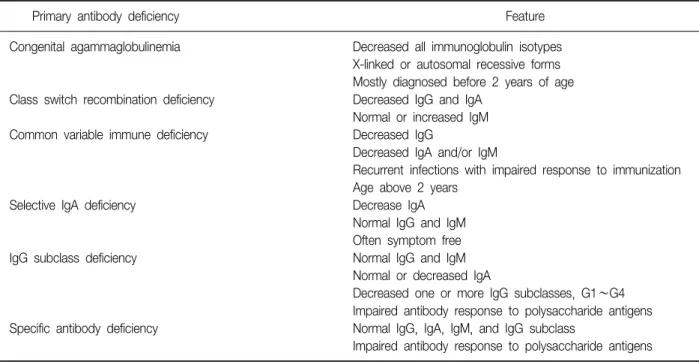
Table 2. Key features of primary antibody deficiencies
Primary antibody deficiency Feature
Congenital agammaglobulinemia Decreased all immunoglobulin isotypes X-linked or autosomal recessive forms Mostly diagnosed before 2 years of age Class switch recombination deficiency Decreased IgG and IgA
Normal or increased IgM
Common variable immune deficiency Decreased IgG
Decreased IgA and/or IgM
Recurrent infections with impaired response to immunization Age above 2 years
Selective IgA deficiency Decrease IgA
Normal IgG and IgM Often symptom free
IgG subclass deficiency Normal IgG and IgM
Normal or decreased IgA
Decreased one or more IgG subclasses, G1∼G4 Impaired antibody response to polysaccharide antigens Specific antibody deficiency Normal IgG, IgA, IgM, and IgG subclass
Impaired antibody response to polysaccharide antigens
switch recombination deficiency, selective immunoglob- ulin A deficiency, specific antibody deficiency, and im- munoglobulin G subclass deficiency
13. The key features of primary antibody deficiencies are summarized in Table 2.
Congenital agammaglobulinemia is a genetic defect which impairs antibody production of all immunoglob- ulin isotypes and response to vaccinations. X-linked agammaglobulinemia accounts for 85% of all cases of congenital agammaglobulinemia, and autosomal re- cessive forms account for the rest
12. Class switch re- combination deficiencies, formerly known as hyper-im- munoglobulin M syndromes, are very rare conditions characterized by decreased serum immunoglobulin G and A levels, but increased immunoglobulin M levels
14. Common variable immunodeficiency is an idiopathic antibody deficiency, defined by serum immunoglobulin G levels below 2 SD of normal controls in the presence of decreased immunoglobulin A and/or immunoglo- bulin M levels, recurrent infections, impaired response to immunization, exclusion of defined causes of hypo- gammaglobulinemia, and an age above 2 years
15. These 3 entities (congenital agammaglobulinemia, class switch recombination deficiency, and common variable im-
munodeficiency) have been commonly associated with development of bronchiectasis as a clinical complica- tion
12.
Selective immunoglobulin A deficiency is defined as
a decrease of serum immunoglobulin A levels below 2
SD of age-matched controls (or less than 0.07 g/L) but
normal serum immunoglobulin G and M levels
12,16. The
clinical course is asymptomatic in many patients, and
only a minority of patients develops recurrent lower res-
piratory tract infections and/or bronchiectasis
12.
Immunoglobulin G subclass deficiency is defined as
an abnormally low level of one or more immunoglob-
ulin G subclasses in patients with normal levels of total
immunoglobulin G and M. Immunoglobulin A level
may also be low. Some patients with subclass defi-
ciency exhibit impaired specific antibody production
16.
By the way, there is some controversy over whether de-
ficiencies of immunoglobulin G subclasses have a role
in the development of bronchiectasis. In a study esti-
mating immune function in adults with bronchectasis,
a number of subjects (14%) had low level of im-
munoglobulin G3, but the significance of this finding
was uncertain
17. Another small, single center, case-con-
trol study showed that almost half (48%) of the patients
Table 3. Uses of intravenous immunoglobulin in primary immune deficiencies
Benefit Immune deficiency
Definitely beneficial Primary immune defects with absent B cells
Primary immune defects with hypogammaglobulinemia and impaired specific antibody production Probably beneficial Primary immune defects with normogammaglobulinemia and impaired specific antibody production Unlikely to beneficial Selective immunoglobulin A deficiency
Isolated immunoglobulin G4 deficiency