Research Article Open Access
The Effects of Trunk Exercise on Mobility, Balance and Trunk Control of Stroke Patients
Seung-Heon An⋅Dae-Sung Park
1†Dept. of Physical Therapy, National Rehabilitation Hospital
1
Dept. of Physical Therapy, Konyang University
Received: September 16, 2016 / Revised: September 26, 2016 / Accepted: October 13, 2016
ⓒ 2017 J Korean Soc Phys Med
| Abstract |
1)PURPOSE: The initiation of the trunk muscles in stroke patients is delayed because the muscles involved in reach arm are activated earlier than the trunk muscles. The objective of this study was to examine the effects of mobility, balance, and trunk control ability through selective trunk exercise (STE) in patients with chronic stroke.
METHODS: A randomized pre-test and post-test control group design was initially used, with subjects randomly assigned to the STE group (n=15) and a control group (n=14).
All groups underwent physical therapy based on the neuro-developmental therapy (NDT) for 30 minutes a day, five times per week for four weeks. Additionally, the STE group did the trunk exercise for 30 minutes a day, three times per week for four weeks. The timed up and go test (TUG), Berg balance scale (BBS), and trunk impairment scale (TIS) were used for assessment.
RESULTS: The scores of the TUG, BBS, dynamic sitting balance subscale, and coordination subscale of TIS improved significantly in both groups but the improvement was more
†Corresponding Author : [email protected]
This is an Open Access article distributed under the terms of the Creative Commons Attribution Non-Commercial License (http://creativecommons.org/licenses/by-nc/3.0) which permits unrestricted non-commercial use, distribution, and reproduction in any medium, provided the original work is properly cited.
pronounced in the STE group (p<.05). This study showed a large effect on the scores of the TIS coordination subscale (d=.93) (p<.05), TIS dynamic balance subscale (d=.81) (p<.05), TUG (d=.75) (p<.05), and BBS (d=.73) (p<.05).
CONCLUSION: The combined STE and NDT program showed improvements in measures of mobility, balance, and trunk control in chronic stroke patients. These results suggest that STE should be considered to be included in the treatment program for patients with chronic stroke.
Key Words: Berg balance scale, Stroke, Timed up and go, Trunk exercise, Trunk impairment scale
Ⅰ. Introduction
Trunk control requires good sensomobility in order to maintain and recover the balance of body (Karatas et al., 2004; Ryerson et al., 2008). The trunk muscles are involved in selective movements to control the center of gravity as the base of support during standing, weight shifting, and maintaining static and dynamic postures (Verheyden et al., 2004). In general, the trunk muscles of a healthy person engage in controlling initial posture and are activated before the movement of the upper and lower limbs.
However, when it comes to stroke patients, it is known
that the initiation of the trunk muscles is delayed, because
the muscles involved in reach arm are activated earlier than the trunk muscles (Dickstein et al., 2000). Moreover, a comparison test using isokinetic dynamometer for the powers of trunk flexors, extensors, and both rotation muscles showed that stroke patients had statistically significant weaker trunk muscles than healthy people (Bohannon, 1992). In a proprioceptive position sense test of the trunk, stroke subjects showed an inability to re-position from the starting posture, compared to healthy people in the three planes: sagittal, frontal, and horizontal (Ryerson et al., 2008; Han and Shin, 2013).
By contrast to hemiplegia associated with the opposite side of brain lesions in post-stroke patients, trunk muscles have a multifaceted disorder (Bohannon, 1992; Dickstein et al., 1999; Fujiwara et al., 2001; Tsuji et al., 2003). In practice using the trunk impairment scale (TIS), amongst sub-acute stroke patients with trunk movement impairment are early predictors of the duration of hospital stay and performance of daily living activities (Duarte et al., 2002;
Verheyden et al., 2006). Also, trunk movement impairment associated with balance (51%), walking speed (27%) and functional mobility (44%) (Verheyden et al., 2006). The trunk movement impairment and muscle weakness in stroke patients can have a negative impact on the control of position and independent activities of daily living.
Therefore, recovering the ability of trunk control should be preceded by the training to restore other functions (Song and Kim, 2010; Jang and Kim, 2016).
The disorders of stroke patients, such as the weakness of trunk muscles, inappropriate motor-unit recruitment, the impairment of neurologic control and proprioceptive sense, excessively use abnormal compensatory strategies owing to disuse syndrome (Han and Shin, 2013). Exercise is focused on the restoration of upper and lower limbs, balance, and walking, rather than trunk exercise.
The previous study demonstrated that the effect of the trunk lateral flexion exercise in sitting among sub-acute
stroke patients (Verheyden et al., 2009) and the improvement in symmetric sitting posture among acute stroke patients through recognition training of trunk location (Mudie et al., 2002). The previous study (Karthikbabu et al., 2011b) about the effectiveness of trunk exercise using a plinth in chronic stroke patients, the results cannot be generalized as it did not have a control group. Therefore, this study aims to explore how additional trunk muscle training can be effective for mobility, balance, and trunk control of chronic stroke patients.
Ⅱ. Methods
The participants of the study were recruited from “M”
hospital. The criteria for subjects included patients with chronic stroke after six months of diagnosis, having a higher score than 24 in mini mental state examination-korean version (MMSE-K), being able to walk 10 meters independently, and scoring less than 21 on the trunk impairment scale (TIS). Therefore, patients with scores higher than 21 on the TIS were excluded from this study as it indicates that they can perform everyday activities independently (Verheyden et al., 2005).
This research was conducted between May 2014 and
November 2014. The twenty-eight patients with chronic
stroke participated for the study were observer-blinded,
randomized through the block randomization method, block
size of 2 x 2. The method of allocation was concealed
in sequentially numbered, sealed envelopes. An independent
observer who does not involved in interventions and the
outcome measures performed the randomization. Allocated
into two groups; 19 participants were in the selective trunk
exercise (STE) group and 19 in the control group. All
groups received conventional physical therapy based on
the neuro-development therapy 30 minutes per day, five
times per week for four weeks. It applied that stretching
exercise, strengthening of lower extremity muscle, progressive gait training, balance control, weight shifting, bearing.
The exercise programs of STE group were applied the protocols which suggested of the previous studies (Karthikbabu et al., 2011a; 2011b). The exercise program consisted of four supine exercises and seven sitting exercises. The four supine exercises were lifting the pelvis with crook-lying, unilateral pelvic bridge, upper trunk flexion rotation, and lower trunk flexion rotation. The seven sitting exercises were as follows: selective flexion extension of the lower trunk, upper trunk lateral flexion, lower trunk lateral flexion, upper trunk rotation, lower trunk rotation, forward reach, and lateral reach. The forward and lateral reach were performed at shoulder height.
The frequency of exercise was in accordance to the patients’ physical performance capabilities. The exercise intensity was controlled by the reduction of the base support, an increase in lever arm to intensify the exercise load, and the changes in maintaining time. In addition, when the patients were training, we supported them to minimize compensatory movements and to move the trunk of patient, diminishing observation and verbal advice. We conducted warm-up and cool down sessions for two minutes. There were 1-2 minute breaks during each exercise and 30 minutes per a day, three times per week for four weeks.
Subjects were required to stand up from a chair with arm rests, walk 3m, turn around, return to the chair, and sit down. The time taken to complete this task was measured in seconds with a stopwatch (Podsiadlo and Richardson, 1991). The test-retest reliability of TUG test in subjects with chronic stroke showed a high degree intra class correlation (ICC=.96) (Flansbjer et al., 2005).
The Berg balance scale (BBS) consists of 14 different tasks. The tasks test the subject’s ability to maintain positions or movements of increasing difficulty as well as the ability to change positions. Each item is scored on
a scale of 0 to 4, for a maximum of 56 points. A change in the score of 5 points has been shown to be clinically significant when used on a pre-test and post-test basis.
The test-retest reliability in subjects with chronic stroke showed a high degree (ICC=.95) (Mao et al., 2002).
The assessment for trunk impairment such as paresis was carried out on the TIS. The TIS consists of three subscales: static sitting balance, dynamic sitting balance and coordination, containing 3, 10, and 4 items. The TIS score ranges from a minimum of 0 to a maximum of 23, with a higher score indicating a better trunk performance.
The static subscale (a score of 7) investigates the ability of the subject to maintain a sitting position with the feet supported, while the legs are passively and actively crossed.
The dynamic subscale (a score of 10) contains items on lateral flexion of the trunk and unilateral lifting of the hip.
The coordination subscale (6 score) of the trunk contains selective rotation of the upper and lower part of the trunk.
Test-retest reliability was ICC=.94~.97 (Verheyden et al., 2005).
We compared general characteristics between the STE
group and the control group using the chi-square test. The
independent t-test was conducted to analysis the change of
different between the two groups. The paired t-test was used
to compare the difference between pre- and post-intervention
scores within the group. The level of significance was set
at p<.05. The analysis was performed using the SPSS version
18.0 (SPSS Inc., USA). The effect size was computed using
the formula d = d / s (d) where d is the mean difference
scores, and s (d) is the standard deviation of the difference
scores. Effect size index was then defined using Cohen’s
classification of effect size index (d), where small d=.20,
medium d=.50 and large d=.80. Hopkins (2000) suggests
that a sample size of at least 30 individuals should be
considered in reliability studies, in this case the sample size
was 31 using G*power software ver 3.1.9.2 (Kiel University,
Germany) on effect size .85, alpha=.05, power=.95.
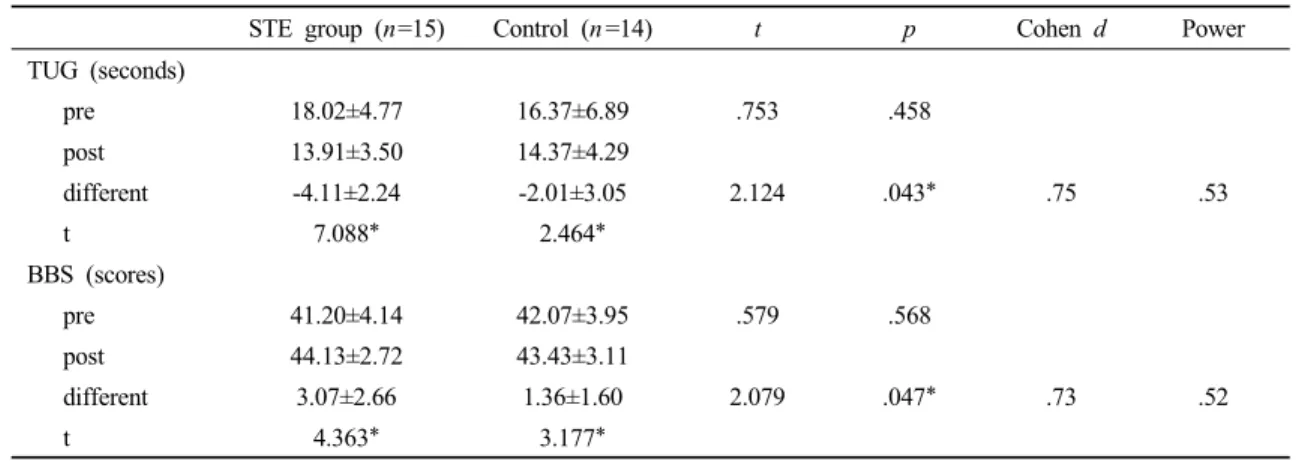
STE group (n=15) Control (n =14) t p Cohen d Power TUG (seconds)
pre 18.02±4.77 16.37±6.89 .753 .458
post 13.91±3.50 14.37±4.29
different -4.11±2.24 -2.01±3.05 2.124 .043* .75 .53
t 7.088* 2.464*
BBS (scores)
pre 41.20±4.14 42.07±3.95 .579 .568
post 44.13±2.72 43.43±3.11
different 3.07±2.66 1.36±1.60 2.079 .047* .73 .52
t 4.363* 3.177*
* p <.05,
STE group: selective trunk exercise group, TUG: timed up and go test, BBS: Berg balance scale
STE group (n =15) Control (n =14) X2/ t p
Age (years) 59.73±8.94 57.07±17.17 .529 .601
Gender (male/female)† 7/8 8/6 .318 .715
Hemiplegic side (left/right)† 8/7 9/5 .358 .710
Stroke lesion (ischemic/hemorrhage)† 9/6 8/6 .024 1.00
Duration (month) 9.07±3.47 8.93±2.30 .125 .901
†Pearson chi-square
STE group: selective trunk exercise group
Table 1. Demographic characteristics of participants (n=29)
Table 2. Comparison of timed up and go test, Berg balance scale in pre-post test (n =29)
Ⅲ. Results
Twenty-seven patients completed the study. One patient in control group was lost to follow up at three weeks.
The data collected in this study was from 15 participants in the intervention group and 14 from the control group.
Table 1 shows the participants demographic characteristics.
When comparing the mean pre-intervention and post- intervention differences using an independent sample t test, TUG of the experimental group significantly decreased more after intervention than the control group (p<.05). The BBS score significantly increased more in the experimental group than the control group (p<.05). The effect size Cohen d index for TUG (.75) (p<.05) and BBS (.73) (p<.05) were a large value (Table 2).
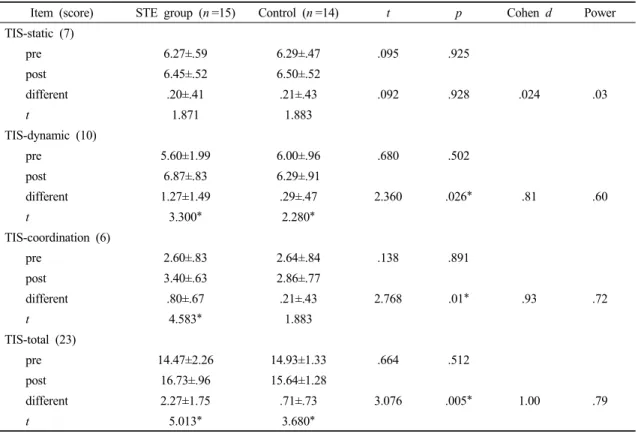
In the pre-post-tests within the groups, TIS-static did not have a significant difference, but TIS-total, TIS-dynamic and TIS-coordination increased 1.56 (p<.05), .98 (p<.05), and .59 (p<.05) more in each than the control group. The effect size Cohen d index for coordination (.93) (p<.05) and static (.81) (p<.05) were reached a power value of .80. The effect size index (Cohen d) for TIS-coordination (.98) (p<.05) and TIS-dynamic (.81) (p<.05) were large compared to TIS-static (.02) (p<.05) (table 3).
Ⅳ. Discussion
There is an impairment in the ability to control the trunk
for post-stroke patients due to excessive use and learning
Item (score) STE group (n =15) Control (n =14) t p Cohen d Power TIS-static (7)
pre 6.27±.59 6.29±.47 .095 .925
post 6.45±.52 6.50±.52
different .20±.41 .21±.43 .092 .928 .024 .03
t 1.871 1.883
TIS-dynamic (10)
pre 5.60±1.99 6.00±.96 .680 .502
post 6.87±.83 6.29±.91
different 1.27±1.49 .29±.47 2.360 .026* .81 .60
t 3.300* 2.280*
TIS-coordination (6)
pre 2.60±.83 2.64±.84 .138 .891
post 3.40±.63 2.86±.77
different .80±.67 .21±.43 2.768 .01* .93 .72
t 4.583* 1.883
TIS-total (23)
pre 14.47±2.26 14.93±1.33 .664 .512
post 16.73±.96 15.64±1.28
different 2.27±1.75 .71±.73 3.076 .005* 1.00 .79
t 5.013* 3.680*
* p <.05,
STE group: selective trunk exercise group, TIS; trunk impairment scale
Table 3. The compare of trunk impairment scale in pre-post test (n =29)