• 검색 결과가 없습니다.

The Effects of Stage-based Training and Core Exercises on Cobb's Angle and Trunk Length in Scoliosis Patients: A Case Study

N/A
N/A
Protected

Academic year: 2021

Share "The Effects of Stage-based Training and Core Exercises on Cobb's Angle and Trunk Length in Scoliosis Patients: A Case Study"

Copied!
6
0
0

로드 중.... (전체 텍스트 보기)

전체 글

(1)

J Korean Soc Phys Med, 2016; 11(1): 127-132 http://dx.doi.org/10.13066/kspm.2016.11.1.127

Online ISSN:

Print ISSN:

2287-7215 1975-311X

Research Article Open Access

코어 운동을 포함한 변화단계별 훈련이

척추측만증 환자의 Cobb각과 몸통 길이에 미치는 영향

김미선⋅이명희 1† ⋅김익환

라온제나 클리니컬 운동센터, 1 위덕대학교 물리치료학과

The Effects of Stage-based Training and Core Exercises on Cobb’s Angle and Trunk Length in Scoliosis Patients: A Case Study

Mi-Sun Kim, PT, PhD⋅Myoung-Hee Lee, PT, PhD 1† ⋅Ik-Hwan Kim, PT, MS Department of Physical Therapy, Raonjena clinical center

1 Department of Physical Therapy, Uiduk University

Received: February 01, 2016 / Revised: February 01, 2016 / Accepted: February 15, 2016

ⓒ 2015 J Korean Soc Phys Med

| Abstract |

1)

PURPOSE: The purpose of this study was to investigate the effects of stage-based training, including core exercises, on scoliosis patients.

METHODS: Two patients with scoliosis participated in the study. Both patients participated for eight months and were trained for an hour three times a week. The training program consisted of stretching and strengthening, as well as core exercises, and was divided into five stages. The Cobb angles and trunk lengths of the subjects were measured after one month, two months, and four months of training.

Measurements were also taken after the subjects completed training. All of the measurements were taken using Formetric 4D.

†Corresponding Author : [email protected]

This is an Open Access article distributed under the terms of the Creative Commons Attribution Non-Commercial License (http://creativecommons.org/licenses/by-nc/3.0) which permits unrestricted non-commercial use, distribution, and reproduction in any medium, provided the original work is properly cited.

RESULTS: The Cobb’s angle of subject A, which was 41°

before training, measured 30° following training. The Cobb’s angle of subject B also improved from 41° prior to training to 34° after training. Furthermore, the trunk lengths of both subjects improved. The trunk length of subject A increased from 438 ㎜ to 450 ㎜ and, and the trunk length of subject B increased from 433 ㎜ to 458 ㎜.

CONCLUSION: This study has shown that stage-based training and core training can be used as effective treatments for scoliosis patients.

Key Words: Scoliosis, Stage based training, Core exercise

Ⅰ. 서 론

척추측만증은 이마면에서 관찰했을 때 좌우의 불균

형이 나타나며 측방으로 만곡이 나타나고 가슴우리의

비틀림을 동반하는 척추의 변형으로 정의할 수 있다

(Asher 와 Burton, 2006). 이는 외관상 좌우 어깨 또는

(2)

골반 높이의 차이를 유발하고 이러한 잘못된 자세정렬 로 인해 통증도 발생될 수 있으며 가슴우리의 변형으로 호흡에 영향을 미칠 수도 있다. 또 심할 경우 장기의 압박으로 여러 가지 관련 기능의 저하를 초래한다 . 척 추측만증의 원인을 정확하게 정의 내리기는 어렵지만 척추 주변 근육의 불균형으로 인한 잘못된 자세가 지속 되는 것이 원인 중 하나라고 할 수 있으며 이는 청소년 기에 많이 나타난다(Kim, 1998).

현재 척추측만증의 치료로 수술적 방법과 보존적 방법이 있는데 보존적 방법 중 가장 보편적인 것은 보조 기를 착용하는 것이다. 보존적 치료는 Cobb각의 크기 에 따라 다른 방법을 적용하는데 일반적으로 중등도 각도 (20~40°)에서 보조기를 적용한다(Falk et al, 2015).

이 중 측만이 진행성이거나 상당히 증가될 가능성이 있는 경우 경성 보조기를 사용하기도 한다(Maruyama et al, 2011). 여러 선행 연구에서 보조기를 사용함으로 써 Cobb각이 줄어들거나 수술을 하지 않아도 되는 결과 를 보고하였지만 하루에 20시간 이상 보조기를 착용한 경우에만 효과가 있었던 연구도 있고 골밀도 감소 등의 부정적 결과를 보고한 연구도 있었다(Seifert et al, 2009;

Lam et al, 2011). 이 외에도 활동기에 있는 측만증 환자 들은 일상생활 시 불편함 등을 이유로 보조기의 장시간 착용을 꺼린다. 이렇듯 보조기의 착용은 장단점을 공유 하고 있어 이를 보완하기 위해 임상에서는 운동치료를 병행하고 있다.

이전 선행연구들에서 척추측만증 환자에 대한 유연 성 운동 , 근력강화운동 등 다양한 운동의 효과를 보고 하였고(Jung et al, 2009; Park, 2007; Park, 2012) 최근 연구에서는 척추측만증 환자에게 불안정 지지면에서 의 척추안정화 운동을 적용하여 자세와 균형의 향상을 보고하였으며(Lee 와 Lim, 2012), 슈로스 운동과 슬링을 이용한 운동의 긍정적 효과에 대한 연구도 있었다 (Lee 와 Kim, 2014). 이 중 코어 운동은 척추를 안정화시키는 콜셋 역할을 하는 근육을 훈련하는 운동방법으로 코어 의 중요성과 효과는 여러 연구에서 강조되고 있다(Choi et al, 2012; Lim et al, 2011; Seo et al, 2013).

하지만 코어운동에 관한 연구의 대상은 주로 요통환 자 , 노인 등으로 척추측만증 환자에게 적용된 코어운동

의 효과에 대한 연구는 아직 미비한 실정이며 이에 본 연구는 코어운동을 포함한 변화단계별 훈련이 척추측 만증 환자에게 어떠한 영향을 주는지 알아보기 위해 실시되었다.

Ⅱ. 연구 방법

1. 연구대상 및 연구기간

본 연구에 참여한 대상자는 각각 21세와 18세의 척추 측만증으로 진단받은 남성이며 이들은 모두 본 연구의 취지에 대한 자세한 설명을 듣고 연구목적과 실험 절차 에 대해 충분히 이해하여 자발적인 동의 후 연구에 참여 하였다. 연구는 2014년 2월부터 2015년 2월까지 시행되 었으며 대상자들은 이 기간 중 각각 8개월 동안 본 연구 에 참여하였다.

대상자 A는 21세 남성으로 키 175 ㎝, 몸무게 63

㎏ , 운동 전 Cobb각은 41° 였다. 대상자 B는 18세 남성으 로 키 172 ㎝, 몸무게 50 ㎏, 운동 전 Cobb각은 대상자 A와 동일하게 41° 였다.

2. 실험방법

각 대상자들은 운동 전 Formetric 4D (DIERS, International GmbH of Schlangenbad, Germany) 장비를 이용하여 자세를 측정하였다 . 운동을 시작한 후 3개월 간은 매월 1차, 2차, 3차 측정을 실시하였고, 4차는 3차 측정 후 2개월 뒤, 5차는 4차 측정 후 3개월 뒤에 측정을 실시하였다 . Formetric 4D는 척추의 자세 측정 시 방사 선 검사의 대안으로 사용할 수 있는 광학 측정장비로 래스터 선을 이용하여 등표면을 3차원으로 재구성하고 척추중심에서 가시돌기의 위치를 추정하여 위치를 찾 아내는 방식을 사용한다. Formetric 4D는 척추의 만곡 을 정확하게 분석할 수 있으며, 측정결과의 높은 재현 성과 객관적 데이터를 제공한다(Knott et al, 2010).

연구대상자는 상의를 탈의하고 하의는 골반 중간까

지 탈의하여 표시된 지점에서 벽을 향해 선 자세를 유지

하여 벽면에 표시된 지점을 응시한다. 대상자의 뒤쪽

2 m 떨어진 지점에 카메라를 설치하여 대상자의 자세를

(3)

ⱒ⊲Ԩ⎲თ⑂Ԩリ㉦㉚Ԩᦾ㍒࿦ূᧂԨ㏆ᔦ⑲Ԩ⦗⪒⬟ᛊ⚛Ԩ㍖⒎⑖ԨՋշժժࣿ৺Ԩា⺳Ԩଶ⑲⋎Ԩ᣶⭖ྒԨ⋿㊣ | 129

1 st stage

(~1 mon) 1. stretching

2 nd stage (1~2 mon)

1. warming up (head to toe) : maintain 10~20 sec*20 2. tongue stretching : maintain 6~10 sec*20

3. abdominal brathing : maintain 20 sec*30 4. trunk rotaion : side to side (4 times)*15 5. knee flexion to chest : 1 set (10 times)*3

3 rd stage (2~3 mon)

1. stretching

2. warming up : maintain 20 sec*30 3. tongue stretching : maintain 10 sec*30 3. abdominal breathing : maintain 25 sec*30 4. seated on swiss ball : 1 set (10 times)*3 5. squat with swiss ball : 1 set (3 times)*15 6. abdominal curl : 1 set(3 times) *15

4 th stage (3~5 mon)

1. seated medicine ball rotation :1 set (3 times)*20 2. hip stability : maintain 10 sec*15

3. cross extension (side to side)*15 4. squat with swiss ball :1 set (3 times)*20

5. oblique pully with side shuffle : 1 set (3 time)*15 6. bridging with one leg back : 1 set (3 times)*15

5 th stage (5~8 mon)

1. shoulder press 12 tiems*4 2. row 12 tiems*3

3. back extension 10 times*3 4. bench press 10 times*3

5. standing triceps extension 12 times*3 6. squat 10 times*4

7. seated leg curl 10 times*4 8. crunch 10 tiems*4 Table 1. Exercise program

측정하였고 척추만곡을 분석한 자료 중 Cobb각과 7번 목뼈의 가시돌기, 양쪽 뒤위엉덩뼈가시 사이의 중심을 연결한 몸통길이 (trunk length)를 본 연구의 자료로 활용 하였다.

3. 운동방법

각 대상자들은 초기 상담 후 운동을 실시하였으며, 치료 전 근육 이완을 목적으로 초음파를 적용하였다.

변화 단계별 운동은 총 5단계로 이루어졌고, 1단계는 스트레칭, 2단계는 코어기본 강화운동, 3단계는 스트레 칭과 코어기본강화 운동으로 구성하였다. 4단계는 코 어강화운동으로 구성하였으며 5단계는 근력강화운동 이 주로 실시되었다. 코어운동은 Kim (2010)의 연구에 서 제시한 운동법을 수정해서 구성하였으며 , 근육강화 운동은 Delavier와 Gundill (2011)이 제시한 프로그램을

수정하여 사용하였다. 치료는 주 3회, 회당 1시간 실시 하였고 자세한 운동방법은 Table 1과 같다.

Ⅲ. 연구 결과

1. Cobb각의 변화

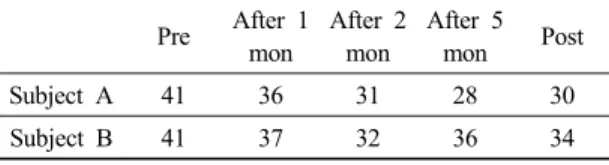
8개월 동안 대상자 A의 Cobb각은 41°에서 30°로 작

아졌으며 , 1차 평가 시는 41°로 측정되었으나 2차 평가

시 36°, 3차 31°, 4차 28°까지 줄어들었다가 5차 평가

시 30°로 측정되었다. 대상자 B 역시 1차 평가 시 41°로

측정되었으나 2차 평가 시 37°로 줄었고, 3차 평가 시

32°까지 줄었다가 4차, 5차 평가 시 36°, 34°로 나타났다

(Table 2).

(4)

(unit: °) Pre After 1

mon

After 2 mon

After 5 mon Post

Subject A 41 36 31 28 30

Subject B 41 37 32 36 34

Table 2. A change of Cobb’s angle

2. 몸통 길이의 변화

대상자 A의 몸통 길이는 1차 438 ㎜, 2차 466 ㎜, 3차 455 ㎜, 4차 457 ㎜, 그리고 5차는 450 ㎜로 8개월간 총 12 ㎜ 증가하였고, 대상자 B의 몸통 길이는 1차 측정 시 433 ㎜에서 2차는 440 ㎜, 3차 450 ㎜, 4차 451 ㎜, 마지막 5차 평가 시 458 ㎜로 나타나 25 ㎜ 증가하였다 (Table 3).

(unit: ㎜) Pre After 1

mon

After 2 mon

After 5 mon Post

Subject A 438 466 455 457 450

Subject B 433 440 450 451 458

Table 3. A change of trunk length

Ⅳ. 고 찰

척추측만증은 척추의 좌우 불균형으로 인해 측방으 로 만곡이 생긴 형태이며 이로 인한 자세불균형, 통증, 호흡 기능 문제가 발생될 수 있다. 또한 척추 주변의 근육에도 변화를 유발하는데, 척추측만증 환자의 척추 세움근 근섬유의 변화를 관찰한 선행 연구에 따르면 대상자의 오목한 쪽에서 type Ⅰ 근섬유의 양이 정상인 에 비해 줄어든 반면 type Ⅱ 근섬유는 오목한 쪽과 볼록한 쪽 모두 정상인에 비해 늘어난 것을 확인할 수 있었다(Mannion et al, 1998). 유사한 연구에서도 뭇갈래 근의 근섬유 형태가 척추측만증 환자의 오목한 쪽에서 변화한 것을 확인하였는데 이 역시 type Ⅰ에서 type

Ⅱ로 변화한 것이라고 하였다(Meier et al, 1997).

코어 운동은 기본적으로 배근육의 근력과 지구력을

향상시키고 허리의 폄근 기능을 향상시켜 신경 근육계 의 조절 및 협응력을 원활하게 하여 척추를 안정시키는 근육을 재교육하기 위한 목적으로 실시하는 것이다 (Lederman, 2010). 본 연구에서 대상자들에게 1단계 관 절 스트레칭 후 2단계와 3단계에서 기본적인 코어 운동 을 실시하고 이어 4단계에서 코어 강화운동으로 변화 하여 적용하였는데 이는 기본적인 코어운동을 통한 근 조절과 협응력을 향상시키고 깊은 근육을 활성화 시킨 후 약화되어 있는 주변 근육을 강화하기 위한 목적으로 실시한 것이다. Kim 등(2012)의 연구에서는 요추안정 화 운동의 형태에 따라 뭇갈래근의 심부 또는 표면 근섬 유의 활성화 결과가 달라진다고 하였다. 본 연구에서도 선행연구와 같이 2단계에서 혀의 운동이나 호흡을 이 용한 운동을 적용하여 변화된 심부 근섬유의 활성화에 영향을 주었고 더 진전된 단계에서 볼을 이용하거나 팔다리를 이용한 코어 강화 운동을 적용하여 표면 뭇갈 래근을 훈련함으로써 척추 주위의 근육들이 정상적인 기능을 할 수 있도록 영향을 주었다고 사료된다. 또 Lee와 Lim (2012)의 연구에서 불안정한 면에서의 척추 안정화 운동이 심부근 동시수축과 표면근 협응에 효과 가 있어 몸통의 비대칭성을 향상시키고 정적 균형 능력 도 향상시킨다고 밝혀 본 연구의 결과를 뒷받침해 주고 있다. 기능적 척추측만증이 있는 대학생을 대상으로 코어운동을 한 Park (2015)의 연구에서도 Cobb각의 호 전과 최대근력증가를 보여 코어운동의 효과를 입증하 였다.

본 연구에서는 두 명의 척추측만증 환자를 대상으로 스트레칭, 단계별 코어운동, 근력강화 운동을 단계적으 로 적용하여 그 효과를 확인하였으나 일반화를 위해 차후 더 많은 대상자에게 적용하여 효과를 확인할 필요 가 있다고 사료된다.

Ⅴ. 결 론

본 연구는 코어운동을 포함한 변화단계별 훈련이

척추측만증 환자에게 미치는 영향에 대해 알아보기 위

해 실시되었으며 Cobb각이 감소되고 몸통길이가 증가

(5)

ⱒ⊲Ԩ⎲თ⑂Ԩリ㉦㉚Ԩᦾ㍒࿦ূᧂԨ㏆ᔦ⑲Ԩ⦗⪒⬟ᛊ⚛Ԩ㍖⒎⑖ԨՋշժժࣿ৺Ԩា⺳Ԩଶ⑲⋎Ԩ᣶⭖ྒԨ⋿㊣ | 131

한 결과를 보여 척추측만증 환자에게 임상적으로 의미 있는 운동방법이라 할 수 있다.

References

Asher MA, Burton DC. Die Biomechanic Des Rumpfes.

Adolescent idiopathic scoliosis: natural history and long term treatment effects. Scoliosis. 2006;1:2.

Choi SH, Lim JH, Cho HY et al. The Effects of Trunk Stabilization Exercise Using Swiss Ball and Core Stabilization Exercise on Balance and Gait in Elderly Women. J Korean Soc Phys Med. 2012;7(1):49-58.

Delavier F, Gundill M. La méthode Delavier de musculation (2 nd ed). France, VIGOT, 2011.

Drerup B, Hierholzer E. Back shape measurement using video rastersterography and three-dimensional reconstruction of spinal shape. Clinical Biomechanics. 1994;9(1):

28-36.

Drerup B, Ellger B, Bentrup FM, et al. Functional rasterstereographic images. A new method for biomechanical analysis of skeletal geometry.

Orthopade. 2001;30(4):242-50.

Falk B, Rigby WA, Akseer N. Adolescent idiopathic scoliosis:

the possible harm of bracing and the likely benefit of exercise. Spine J. 2015;15(1):209-10.

Jung YD, Lee HO, Song MY. The Effect of Home Exercise Program on Pelvic Alignment and Lumbar Scoliosis of Chronic Low Back Pain. J Korean Soc Phys Med.

2009;4:133-40.

Kim EJ. A comparison of technique based on Scoliosis. Master’s Degree. Ewha Womens University, 1993.

Kim MS. A study on the standardization of core strengthening program for persons with stroke. Master’s Degree.

Yongin University, 2010.

Kim SJ, Ha SM, Park GN, et al. Effects of Three Lumbar Stabilization Exercises on the Thickness of Deep and Superficial Fibers of the Lumbar Multifidus. Phys

Ther Kor. 2012;19(2):20-8.

Knott P, Mardjetko S, Rollet M, et al. Evaluation of the reproducibility of the formetric 4D measurements for scoliosis. Scoliosis. 2010;5(1):O10.

Lam TP, Hung VW, Yeung HY, et al. Abnormal bone quality in adolescent idiopathic scoliosis: a case-control study on 635 subjects and 269 normal controls with bone densitometry and quantitative ultrasound.Spine.

2011;36(15):1211-7.

Lederman E. The myth of core stability. J Bodyw Mov Ther.

2010;14(1):84-98.

Lee JH, Kim SY. Comparative Effectiveness of Schroth Therapeutic Exercise Versus Sling Therapeutic Exercise in Flexibility, Balance, Spine Angle and Chest Expansion in Patient with Scoliosis. J Korean Soc Phys Med. 2014;9(1):11-23.

Lee WJ, Lim CH. Effect of Unstale Surface Lumbar Stabilization Exercise on Trunk Posture and Balance Ability in Patients With Scoliosis. J Korean Soc Phys Med.

2012;7:59-67.

Lim JS, Song JM, Kim JS. The Effect of Core Stabilization Exercise on Foot Pressure in Hemiplegic Patients.

J Korean Soc Phys Med. 2011;6 (2):109-18.

Mannion AF Meier, M, Grob D, et al. Paraspinal muscle fibre type alterations associated with scoliosis: an old problem revisited with new evidence. Eur Spine J.

1998;7(4):289-93.

Maruyama T, Grivas TB, Kaspiris A. Effectiveness and outcomes of brace treatment: a systematic review.

Physiother Theory Pract. 2011;27(1):26-42.

Meier MP, Klein MP, Krebs D, et al. Fiber transformations in multifidus muscle of young patients with idiopathic scoliosis. Spine. 1997;22(20):2357-64.

Park SK. The Effects of Spine-strengthening exercises on teenager’s fitness and improvement of standing posture asymmetry. Master’s Degree. Sungshin Women’s University. 2012.

Park WS. The effect of stretching, muscle strength exercise

(6)

program on idiopathic scoliosis of the youth. Master’s Degree. Nambu University. 2007.

Park YS. The Effect of Core Exercise Program for Male College Students with Functional Scoliosis. Doctor’s Degree.

Kyungsang University. 2015.

Seifert J, Selle A, Flieger C, Gunther KP. Compliance as

a prognostic factor in the treatment of idiopathic scoliosis. Orthopade. 2009;38(2):151-8.

Seo HJ, Kim JH, Shin HH, et al. Comparative Analysis of

Muscles Activation relate to Core Stability during

5 Therapeutic Exercise in Children with Spastic

Diplegia. J Korean Soc Phys Med. 2013;8(4):583-92.

수치

Table 2. A change of Cobb’s angle

참조

관련 문서

As a result of performing a compound exercise of spinning and Zumba for 8 weeks, the change in α-amylase showed a significant difference in the exercise group (p<.01), and

The purpose of this study was to investigate how the BOSU Ball exercise, which can develop core muscles in middle-aged women, affects body composition and

12 weeks of combined exercise (body strength exercise and aerobic exercise) was applied to measure health fitness (muscle strength, muscular endurance,

Third, for the change in balance ability according to core training and plyometric training, the core group showed a significant difference in travel area

Second, the perception of exercise immersion based on the general characteristics of the study subjects (gender, grade, guidance period, participation time,

The change in active oxygen was decreased after exercise in the exercise group than in the control group, and there was a statistically significant

The purpose of this study was to investigate how the 8-week aerobic exercise program affects the physical strength and stress of obese women in the

This study was conducted to investigate the effects of a 12-week swimming exercise program on body composition, blood lipids and inflammatory indicators in