• 검색 결과가 없습니다.

MOK, a Pharmacopuncture Medicine, Reduces Inflammatory Response through Inhibiting the Proinflammatory Cytokine Production in LPS-stimulated Mouse Peritoneal Macrophages

N/A
N/A
Protected

Academic year: 2021

Share "MOK, a Pharmacopuncture Medicine, Reduces Inflammatory Response through Inhibiting the Proinflammatory Cytokine Production in LPS-stimulated Mouse Peritoneal Macrophages"

Copied!
11
0
0

로드 중.... (전체 텍스트 보기)

전체 글

(1)

MOK, a Pharmacopuncture Medicine, Reduces Inflammatory Response through Inhibiting the Proinflammatory Cytokine Production in LPS-stimulated Mouse Peritoneal Macrophages

Ji Hye Hwang

1

, Min Sub Hwang

2

, Yong-ki Park

1,3,*

1

Korean Medicine R&D Center, Dongguk University

2

Dept. of Acupuncture & Moxibustion Medicine, College of Korean Medicine, Dongguk University

3

Department of Herbology, College of Korean Medicine, Dongguk University

[Abstract]

Objectives : Inthisstudy,weinvestigatedtheanti-inflammatoryandanti-oxidativeeffectsof MOK,apharmacopuncturemedicine,inlipopolysaccharide(LPS)-stimulatedmouseperitoneal macrophages.

Methods : PeritonealmacrophageswereisolatedfromICRmice.Primarymacrophageswere treatedwithMOKextract(1.25,2.5,5,10,and20mg/ml)for30minandthenstimulatedwith LPS(1μg/ml)fortheindicatedtimes.CytotoxicitywasmeasuredusingMTTandLDHassays.

Nitricoxide(NO)productioninculturesupernatantswasmeasuredusingtheGriessassay.

ThemRNAexpressionofiNOS,COX-2,proinflammatorycytokines(TNF-α,IL-1β,andIL-6) andantioxidantenzymes(HO-1andMnSOD)wasmeasuredbyRT-PCR.

Results : TreatmentwithMOKextract(2.5,5,and10mg/ml)significantlydecreasedLPS-induced NOproductioninperitonealmacrophagesthroughinhibitionofiNOSexpression.Theexpres- sion of COX-2, TNF-α, IL-1β, and IL-6 mRNA was also decreased in LPS-stimulated macrophagesupontreatmentwithMOKextract.MOKtreatmentalsoincreasedtheexpression ofHO-1andMnSODmRNAinmacrophages.

Conclusion : TheseresultsindicatethatMOKexertsanti-inflammatoryandantioxidanteffects byregulatingthetranscriptionlevelsofinflammatorymediatorsandantioxidantproteinsin activatedmacrophages.

※ ThisresearchwassupportedbytheKoreanHealthTechnologyR&DProjectthroughtheKorean HealthIndustryDevelopmentInstitute(KHIDI)fundedbytheMinistryofHealth&Welfare,Republic ofKorea(grantnumber:HI16C0622).

✱ Correspondingauthor:DepartmentofHerbology,CollegeofKoreanMedicine,DonggukUniversity, Dongdaero123,Gyeongju38066,RepublicofKorea

Tel:+82-54-770-2661 E-mail:[email protected] Key words :

Antiinflammation;

Antioxidation;

LPS;

MOK;

Peritoneal macrophages;

Pharmacopuncture

Received : 2017. 01. 11.

Revised : 2017. 02. 02.

Accepted : 2017. 02. 06.

On-line : 2017. 02. 20.

ThisisanOpen-AccessarticledistributedunderthetermsoftheCreativeCommonsAttributionNon-CommercialLicense(http://creativecommons.org/licenses/by- nc/3.0)whichpermitsunrestrictednon-commercialuse,distribution,andreproductioninanymedium,providedtheoriginalworkisproperlycited.

TheAcupuncture istheJournalofKoreanAcupuncture&MoxibustionMedicineSociety.(http://www.TheAcupuncture.org)

Copyright2017KAMMS.KoreanAcupuncture&MoxibustionMedicineSociety.Allrightsreserved.

(2)

Ⅰ. Introduction

Pharmacopuncture therapy is a new stimulating method for acupoints, and involves injection of herbal extract at acupoints. This method has been frequently used for the regulation of immune bal- ance in the clinical setting

1,2)

.

MOK is a medicinal extract with ten different herbs for pharmacopuncture therapy in Korean clinics, and is modified from OK extract, which is commonly used for pharmacopuncture treatment of patients with thyroid syndromes such as hy- pothyroidism and hyperthyroidism. MOK consists of OK which is known to have anti-inflammatory effects

1-3)

and Hominis Placenta, and MOK is also applied clinically in heart disease and Hwa- Byung

2-5)

.

Among the constituents of MOK, Moschus (Moschus berezovskii), Bovis Calculus (Bos taurus), Ursi Fel (Ursus arctos) and Hominis Placenta are the main components. Moschus is a representative orifice-opening medicine and recently, it has been widely used as a constituent of pharmacopuncture besides an internal medicine in clinical practice. It has also been reported to have hepatoprotective activity, memory improvement effect, and anti- cancer activity. Ursi Fel and Bovis Calculus are representative heat-clearing medicines. Ursi Fel has been reported to possess hepatoprotective and anti-inflammatory activities, and Bovis Calculus has been reported to improve cerebral blood flow, systemic blood pressure, and lipid metabolism

3,6,7)

. Hominis Placenta, a tonifying and replenishing medicine, has the capacity to tonify qi, blood, and essence, and is used for treatment in conditions re- quiring tissue regeneration, regulation of immune response, prevention of infection, promotion of hormone function and improvement of dysmenor- rhea, climacteric symptoms, peripheral facial paralysis, osteoporosis, arthritis, and so on

6,8)

.

However, although MOK is widely used in Korean clinics for the treatment of heart and thy- roid diseases, little scientific evidence is available

for its activity. In this study, we investigated the effects of MOK on inflammatory and oxidant re- sponses using activation of mouse peritoneal macrophages.

Ⅱ. Materials and Methods

1.Materials

1)Preparation of MOK extract

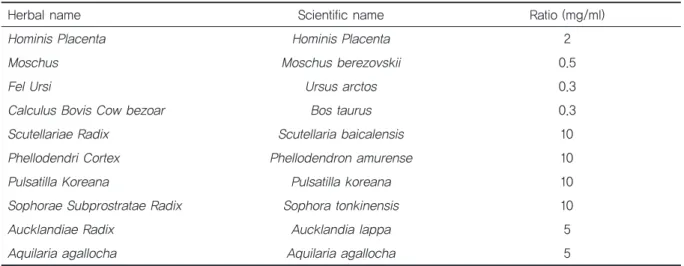
MOK extract was provided by the Korea Im- muno-Pharmacopuncture Association (Seoul, Korea) and was manufactured under a Good Man- ufacturing Practice (GMP) compliant facility (Korea Immuno-Pharmacopuncture Association, Seoul, Korea). The quality of all the raw materials in MOK was approved by the Korea Food & Drug Administration (KFDA). MOK was extracted with dried herbs (106.2 g) in distilled water (1 L) for 3 hours and then mixed with alcohol to 1:1, filtered through a two-layer mesh and then concentrated under vacuum pressure. After freeze-dried MOK was dissolved in water (53.1 mg/ml) (Table 1).

2)Reagents

Lipopolysaccharide (LPS, L2630), 3-[4,5-di- methylthiazol-2-yl]-2,5-diphenyltetraoliumbromide (MTT), sulfanilamide, and N-1-napthylethylenedi- amine dihydrochloride (NED) were purchased from Sigma-Aldrich (St Louis, MO, USA). RPMI1640, fetal bovine serum (FBS), penicillin, and strepto- mycin were purchased from GenDEPOT (Barker, TX, USA). TRIzol reagent was obtained from Bio- Rad Laboratories (Philadelphia, PA, USA). M-MLV reverse transcriptase, and lactate dehydrogenase (LDH) Cytotoxicity Assay Kit were obtained from Promega (Madison, WI, USA). Taq-based PCR en- zyme was purchased from Toyobo (Osaka, Japan).

Thioglycollate broth was purchased from Difco

Laboratories (Detroit, MI, USA).

(3)

3)Animals

Male ICR mice (5-weeks old, 17–21 g) were ob- tained from Orient Bio Inc. (Gyeonggi-do, Korea).

The animals were housed under controlled envi- ronmental conditions with an ambient temperature of 23±1℃, a relative humidity of 50±10%, a 12 h light/dark cycle, and free access to food and water.

2.Methods

1)Isolation and culture of peritoneal macrophages

Peritoneal exudates were obtained from male ICR mice by lavage after 4 days of intraperitoneal injection with 2 ml of 3% thioglycollate broth as re- portedpreviously

9)

. AfterwashingwithRPMI-1640 medium containing 2% FBS, 100 U/ml penicillin, and 100 μg/ml streptomycin, the peritoneal macrophages (1×10

6

cells/ml) were plated in culture dishes for 4 h at 37℃ in a 5% CO

2

incubator.

After discarding the unattached cells, primary macrophages were maintained in RPMI-1640 medium containing 10% FBS at 37℃ in a 5% CO

2

in- cubator.

2)MTT assay

To determine the toxic range of MOK extract in peritoneal macrophages, cell viability was meas- ured using an MTT-based colorimetric assay.

Briefly, peritoneal macrophages (5×10

4

cells/well) were seeded in 96-well plates and treated with MOKextractatdifferentconcentrationsfor24 hat 37℃ in a 5% CO

2

incubator. Upon culture termina- tion, 10 μl of MTT solution (5 mg/ml) was added to each well, and incubated for 4 h. The resulting crystals were dissolved in 100 μl DMSO, and ab- sorbance at 570 nm was measured using a mi- croplatereader(GENios, TEKANInstruments, Inc., Austria). Cell viability was calculated by the for- mula: (viable cells)% = (OD of MOK-treated sam- ple/OD of untreated sample) × 100

3)LDHassay

LDH is a well-known marker of cell membrane integrity and cell viability, and its accumulation is the result of plasma membrane breakdown and al- tered permeability at the stage of secondary necro- sis in the late stage of apoptosis

10)

. Therefore, we next measured the cytotoxic response to MOK ex- tract, by measuring the release of LDH leakage in cell culture medium according to the manufac- turer’sinstructions. Briefly, peritonealmacrophages (5×10

4

cells/well) were seeded in 96-well plates and treated with MOK extract at different concen- trations for 24 h at 37℃ in a 5% CO

2

incubator. Cy- toTox 96 Reagent (50 μl) was then added to each well, and the plate was covered with foil and incu- bated for 30 min at room temperature; 50 μl of Stop Solution was then added to each well, and op- tical density (OD) at 490 nm was measured using a microplate reader (GENios, TEKAN Instruments, Inc., Austria). Cytotoxitywascalculatedbythefor- mula: (Cytotoxity)% = (OD of MOK-treated sam- ple/OD of Control sample (Maximum LDH Release)

4)NO assay

TomeasuretheNOlevels, peritonealmacrophages (1×10

5

cells/ml) were treated with MOK extract at differentconcentrationsfor30 min, andthenstim- ulated with LPS (1 μg/ml) or without it for 24 h at 37℃ in a 5% CO

2

incubator. NO levels were meas- ured in culture supernatants by the Griess assay.

Therefore, the culture supernatants (100 μl) were added to a 96-well plate, followed by 1% sulfanil- amide (50 μl) and 0.1% NED (50 μl). The plate was then incubated for 15 min at room temperature in the dark, and the absorbance was measured at 540 nm in a microplate reader (GENios). A standard curve was generated in the same fashion using NaNO

2

.

5)Reverse Transcription (RT)-PCR

Peritoneal macrophages were treated with MOK extract at different concentrations for 30 min, and then stimulated with LPS or without for 5 h at 37℃

in a 5% CO

2

incubator. Total RNA was isolated

(4)

from each cell using TRIzol reagent, and cDNA synthesis from total RNA with a mixture including oligo-dT primer, 5x RT buffer (Promega Co., Madi- son, WI, USA), 0.5 mM dNTP, 3 mM MgCl

2

, RNase inhibitor, and Improm-II

TM

reverse transcriptase (2U) was carried out at 25℃ for 5 min and 42℃ for 60 min. The reaction was terminated at 70℃ for 10 min. PCR was carried out using specific primers for the target genes (Table 2), and PCR mixture [2 μl cDNA, 4 μM 5′ and 3′ primers, 10x buffer (10

mM Tris-HCl, pH 8.3), 50 mM KCl, 0.1 % Triton X- 100, 25 mM MgCl

2

, 250 μM dNTPs, and 1 U Taq polymerase under the following incubation condi- tions: 30 s denaturation at 94℃, 30 s annealing at 58-60℃, 1 min extension, and 10 min final exten- sion at the end of 30 cycles. Band intensity was quantified by automated densitometric analysis (ChemiDoc MP Imaging System (BioRad Laborato- ries, CA, USA).

Table 2. PrimersequencesforPCR

Name Sequence (5′→ 3′)

iNOS Forward CCCGAAGTTTCTGGCAGC

Reverse GGCTGTCAGAGCCTCGTGGCTT

COX-2 Forward GGAGAGACTATCAAGATAGTGATC

Reverse ATGTCAGTAGACTTTTACAGCTC

TNF-α Forward ATAGCTCCCAGAAAAGCAAGC

Reverse CACCCCGAAGTTCAGTAGACA

IL-1β Forward GCCTTGGGCCTCAAAGGAAAGAATC

Reverse GGAAGACACAGATTCCATGGTGAAG

IL-6 Forward TGGAGTCACAGAAGGAGTGGCTAAG

Reverse TCTGACCACAGTGAGGAATGTCCAC

MnSOD Forward GTGACTTTGGGTCTTTTGAG

Reverse GCTAACATTCTCCCAGTTGA

HO-1 Forward AAGATTGCCCAGAAAGCCCTGGAC

Reverse AACTGTCGCCACCAGAAAGCTGAG

GAPDH Forward GACATCATACTTGGCAGGTT

Reverse CTCGTGGAGTCTACTGGTGT

Table 1. ConstituentsofMOKextract

Herbal name Scientific name Ratio (mg/ml)

Hominis Placenta Hominis Placenta 2

Moschus Moschus berezovskii 0.5

Fel Ursi Ursus arctos 0.3

Calculus Bovis Cow bezoar Bos taurus 0.3

Scutellariae Radix Scutellaria baicalensis 10

Phellodendri Cortex Phellodendron amurense 10

Pulsatilla Koreana Pulsatilla koreana 10

Sophorae Subprostratae Radix Sophora tonkinensis 10

Aucklandiae Radix Aucklandia lappa 5

Aquilaria agallocha Aquilaria agallocha 5

(5)

6)StatisticalAnalysis

GraphPad Prism (GraphPad Software, Inc., San Diego) was used for statistical analysis. Data were expressed as mean ± SEM (standard error of mean) of three independent experiments and were analyzed for statistical significance using analysis of variance (ANOVA), followed by Tukey’s test for multiple comparisons. Null hypotheses of no dif- ference were rejected if p-values were less than 0.05.

Ⅲ. Results

1.Effects of MOK extract on cell viability and toxicity in peritoneal macrophages

To investigate the cytotoxic effects of MOK ex- tract in peritoneal macrophages, we measured cell viability using both the MTT and LDH assays.

MOK extract did not show any effect on cell viabil- ity (Fig. 1A) or cell toxicity (Fig. 1B) in a range of 1.25 to 20 mg/ml in peritoneal macrophages; how- ever, color interference was observed at 20 mg/ml.

Therefore, we used the MOK extract within 10 mg/ml for efficacy in the study.

2.Effects of MOK extract on NO production and iNOS mRNA expression in LPS-stimulated peritoneal macrophages

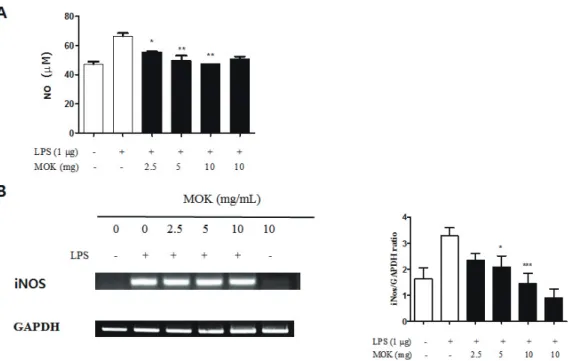
To investigate the inhibitory effects of MOK ex- tract on inflammatory responses in activated macrophages, we measured NO production and iNOS expression in LPS-stimulated peritoneal macrophages by the Griess assay and RT-PCR, re- spectively. As shown in Fig. 2A, NO production wasincreasedafterLPSstimulationofmacrophages, and treatment with MOK extract at 2.5, 5, and 10 mg/ml in LPS-simulated cells resulted in signifi- cantly reduced NO production in a concentration- dependent manner. In addition, MOK extract at 5 and 10 mg/ml significantly inhibited iNOS mRNA expressioninLPS-stimulatedmacrophages(Fig. 2B).

3.Effects of MOK extract on COX-2 mRNA expression in LPS-stimu- lated peritoneal macrophages

We investigated the inhibitory effects of MOK extract on the expression of the inflammatory me- diator, COX-2, in LPS-stimulated peritoneal macrophages by RT-PCR. As shown in Fig. 3, COX-2 mRNA expression was increased upon LPS

Fig. 1.EffectsofMOKextractoncellviabilityandcytotoxicityinperitonealmacrophages.Cellsweretreatedwith

MOKextractat1.25,2.5,5,10,and20mg/mlfor24h.CellviabilitywasmeasuredbytheMTTassay,and

cytotoxicitywasmeasuredbytheLDHreleaseassay.Dataaremean±SEMofthreeindependentexperiments

(6)

stimulation in peritoneal macrophages. Treatment with the MOK extract at 5 and 10 mg/ml signifi- cantly decreased the LPS-induced COX-2 expres- sion (Fig. 3).

4.Effects of MOK extract on mRNA expression of pro-inflammatory cytokines in peritoneal

macrophages

To better understand the inhibitory effect of MOK extract on the inflammatory responses in ac- tivated macrophages, mRNA expression of proin- flammatory cytokines was investigated in LPS-stimulated peritoneal macrophages by RT- PCR. Treatment with MOK extract at 5 and 10 mg/ml significantly inhibited the expression of IL- 1β, IL-6, and TNF-αmRNA in LPS-stimulated peritoneal macrophages (Fig. 4).

Fig. 2. Effect of MOK extract on NO production and iNOS mRNA expression in LPS-stimulated peritoneal macrophages.ThecellsweretreatedwithMOKextractat2.5,5and10mg/mlfor30min,andthenstimulatedwith orwithoutLPS(1μg/ml)for5h.(A)NOlevelsweremeasuredinculturemediumbytheGriessassay.The expressionofiNOSmRNAwasdeterminedbyRT-PCR.GAPDHwasusedasaninternalcontrol.iNOSdensitywas analyzedusingGAPDHastheinternalcontrol,andrepresentedasahistogramwithmean±SDofthree independentexperiments.*p < 0.05,**p < 0.01,and***p < 0.001vs.LPSalone

Fig. 3.EffectofMOKextractonCOX-2mRNAexpres- sioninLPS-stimulatedperitonealmacrophages.The cellsweretreatedwithMOKextractat2.5,5,and10 mg/mlfor30minandthenstimulatedwithLPS(1 μg/ml)orwithoutfor5h.(A)COX-2expressionwas analyzedbyRT-PCR.GAPDHwasusedasaninternal control.(B)COX-2densitywasanalyzedusingGAPDH asaninternalcontrol,andrepresentedasahistogram withamean±SDofthreeindependentexperiments.

*p < 0.05,**p < 0.01,and***p < 0.001vs.LPSalone

(7)

5.Effects of MOK extract on oxida- tive stress in LPS-stimulated peritoneal macrophages

To investigate the antioxidant effects of MOK extract in activated macrophages, we analyzed the

mRNA expression of antioxidant enzymes in peri- tonealmacrophagesbyRT-PCR. Theexpressionof HO-1 and MnSOD mRNA was significantly in- creased by treatment with the MOK extract at 10 mg/ml in peritoneal macrophages (Fig. 5).

Fig. 4. EffectofMOKextractontheexpressionofproinflammatorycytokinemRNAsinLPS-stimulatedperitoneal macrophages.ThecellsweretreatedwithMOKextractat2.5,5,and10mg/mlfor30min,andthenstimulatedwith orwithoutLPS(1μg/ml)for5h.(A)TheexpressionofTNF-α,IL-1β,andIL-6mRNAwasanalyzedbyRT-PCR.

GAPDHwasusedasaninternalcontrol.(B)ThedensityofeachcytokinewasanalyzedusingGAPDHasaninternal control,andrepresentedasahistogramwithmean±SDofthreeindependentexperiments.*p < 0.05,and

**p < 0.01vs.LPSalone

Fig. 5.EffectofMOKextractontheexpressionofHO-1andMnSODmRNAinperitonealmacrophages.Thecells

weretreatedwithMOKextractat10mg/mlfor30min,and(A)theexpressionofHO-1andMnSODmRNAwas

analyzedbyRT-PCR.(B)ThedensityofeachcytokinewasanalyzedusingGAPDHasaninternalcontrol,andrep-

resentedasahistogramwithmean±SDofthreeindependentexperiments.*p < 0.05vs.cellsalone

(8)

Ⅳ. Discussion

Pharmacopuncture is a new method of acupunc- ture treatment in Traditional Korean Medicine (TKM). This method is widely used in clinics because it does not involve the digestive system, and can therefore work faster, with more efficacy thanmedicinesadministeredorally

1,2)

. Inparticular, Immuno-Pharmacopuncture therapy was first de- veloped by Nam Sang-cheon and has been used with many extracts such as HN, I, OK, MOK, V, CO, CS, CA, CH, and S in clinical practice

2)

. Among these, MOK consists of ten components: Hominis Placenta, Moschus, Fel Ursi, Calculus Bovis, Scutellariae Radix, Phellodendri Cortex, Pulsatilla Koreana, Sophorae Subprostratae Radix, Saus- surea lappa, and Aquilaria agallocha. It is clinically used to treat for the meridian of fire in nature and symptoms related to heart disease such as fright palpitations, fearful throbbing, sleep disorders, angina pectoris, and thyroid diseases such as thy- roid hyperthyroidism, hypothyroidism, thyroid hy- pertrophy, and goiter

2,4)

.

Immuno-Pharmacopuncture therapy with MOK is frequently administered in clinics, but little re- search

4,5)

exists about its effects and the mechanism of action with its constituents. More- over, there is no scientific evidence for MOK in which Hominis Placenta is newly added since 2003.

To the best of our knowledge, this is the first effi- cacy study for evaluating the effect of MOK on the regulation of inflammatory responses in activated macrophages. This study will be helpful for the use of MOK in clinics.

MOK is a polyherbal extract for pharmacopunc- ture consisting of ten different constituents:

Moschus is a representative orifice-opening medi- cine, and is a detoxification agent for treating in- flammation, relieving swelling, and killing pain. It has been described as a highly valued ingredient in Chinese medicinal remedies

6,11)

. Bovis Calculus is a heat-clearing and an orifice-opening medicine.

Ursi Fel, Scutellariae Radix, Phellodendri Cortex,

Pulsatilla Koreana, and Sophorae Subprostratae Radix are heat-clearing medicines. Aucklandiae Radix and Aquilaria agallocha are qi-regulating medicines. Hominis Placenta is a tonifying and re- plenishing medicine. Ursi Fel was reported to pos- sess various properties such as antimicrobial, anti-inflammatory, anti-hepatotoxic, choleretic lithagogic, anti-liver fibrosis, anti-cancer, anti- pyretic and sedative, anticonvulsant and analgesic, hypotensive, anti-tussive and anti-asthmatic, and anti-stress and relaxing effects in modern pharmacological research

6,12)

. Bovis calculus has been reported to exhibit antispasmodic, fever-re- ducing, anti-inflammatory, antioxidant and gall- bladder-repairing effects

13)

. Hominis placenta is a rich source of various bioactive substances, includ- ingpeptides, nucleicacids, fattyacids, aminoacids, enzymes, minerals, and trace elements

14,15)

and is known to have various pharmacological effects such as anti-oxidation, anti-inflammation, and regeneration, especially acceleration of wound healing

12,16,17)

. However, a comparison of the biolog- ical activity of MOK with those of single medicines has not been reported. In this study, we found that MOK has an anti-inflammatory effect in activated macrophages via downregulation of the inflamma- tory mediator transcription, and antioxidant effects through an increase in antioxidant enzyme expression.

Biological experiments are most often performed

with immortalized cell lines because they are

readily available and can be expanded without lim-

itation. However, cell lines may differ from the in

vivo situation in important aspects

18)

. Therefore, in

our study, we investigated the effects of MOK on

the inflammatory response and oxidative stress in

primary macrophages isolated from the peritoneal

cavity of mice. Macrophages are major cells in the

innate immune system, which act as the first line

of defense against invading pathogens such as

bacteria, viruses, and fungi and respond to their

attack by releasing cellular signaling molecules

and anti-microbial agents

19,20)

. In the normal state,

inflammatory mediators such as NO/iNOS, COX-2,

(9)

andproinflammatorycytokinessuchasTNF-α, IL- 1β, and IL-6 generated from macrophages play an essential role in host survival and tissue repair

21)

. However, overproduction of these inflammatory mediators is closely related to the induction and progression of inflammatory diseases

22,23)

.

In response to proinflammatory stimulation with LPS, upregulation of iNOS occurs, releasing NO, a reactive free radical. High levels of NO produced by iNOS are cytotoxic to cells undergoing inflam- mation

24)

. COX-2 also plays an important role in inflammation mediated by activated macrophages through the production of prostaglandin (PG) E

2

which is a major indicator of inflammation as well as NO

25)

. In this study, we found that treatment with MOK extract in peritoneal macrophages ef- fectively inhibited LPS-induced overproduction of NO through downregulation of iNOS expression and inhibition of COX-2 expression. This indicates that MOK extract has an anti-inflammatory effect in activated macrophages through inhibition of in- flammatory mediator production.

Many biological molecules, including reactive oxygen species (ROS), NO, PGE2, and proinflam- matory cytokines such as TNF-α, IL-1β, and IL-6 areinvolvedinthedevelopmentofinflammation

23,26)

. Macrophages are important producers of proin- flammatory cytokines when they are exposed to stimuli such as LPS exposure

27)

. These proinflam- matory cytokines allow an increase in blood flow and capillary permeability, leading to infiltration of immune cells. TNF-αplays a central role in in- flammatory and destructive processes commonly found in several human autoimmune and chronic inflammatory diseases

28)

. IL-1β is also a major proinflammatory cytokine, and is important for the initiation and enhancement of inflammatory responses to the proliferation of some microorgan- isms

29)

. IL-6 is an endogenous mediator of LPS-in- duced fever

30)

. In the present study, MOK treatment significantly inhibited the expression of TNF-α, IL-1β, and IL-6 mRNA in LPS-stimulated peritoneal macrophages, suggesting that the MOK extract can decrease the production of these cy-

tokines as well as that of iNOS and COX-2.

Oxidative stress induced by the overproduction of ROS that damage cellular lipids, proteins, and DNA is thought to be implicated in a variety of dis- eases or conditions, including some cancers, car- diovascular disease, acute inflammatory problems, diabetes mellitus complications, chronic inflam- matory diseases such as rheumatoid arthritis and lupus erythematosus, photo-oxidative stress to the eye such as cataract, central nervous system disorders such as certain forms of familial amy- otrophic lateral sclerosis, neurodegenerative disor- ders such as Parkinson's disease and Alzheimer's dementia, and age-related disorders, perhaps even including factors underlying the aging process itself

31,32)

. The antioxidant system includes exogenous and endogenous components; the latter include antioxidant enzymes such as superoxide dismutases (CuZnSOD and MnSOD), glutathione peroxidase (GSPx), and heme oxygenase-1 (HO- 1)

33)

. TheantecedentupregulationofHO-1 isneces- sary and sufficient for subsequent induction of the MnSOD gene in astroglia. The mechanism mediat- ing MnSOD expression in astroglia overexpressing HO-1 is likely oxidative in nature

34)

.

In this study, MOK treatment induced the upreg- ulation of MnSOD and HO-1 mRNA in peritoneal macrophages. This indicates that MOK extract has antioxidant potential.

We expect that MOK extract has various effects on the modulation of immune responses and pro- tection of hepatic damage. In future studies, we will investigate other effects of MOK and on sig- naling pathways such as MAPKs and NF-kB that are regulated by inflammatory responses.

Ⅴ. Conclusions

In summary, we demonstrated that MOK, an

herbal mixture used in Immuno-Pharmacopunc-

ture, can suppress LPS-induced inflammatory re-

(10)

sponses in peritoneal macrophages through inhibi- tion of NO production, suppression of inflammatory mediators (iNOS, and COX-2), pro- inflammatory cytokines (TNF-α, IL-1β, and IL-6) mRNA expression, and an increase in antioxidant enzymes (HO-1 and MnSOD). These results suggest that MOK can be used as a safe anti-in- flammatory treatment in pharmacopuncture.

Ⅵ. References

1. Korean Acupuncture & Moxibution Soc. The Acupuncture and Moxibution Medicine. Paju:

Hanmi medical publishing co. 2016:204-8.

2. Jung C, Jung JH, Lee MS. Immune Pharma- copuncturology. Chungnam: Kyungrak medical publishing co. 2011: 127-33.

3. Kim HJ, Gwan R, Han JW et al. Analysis of physioactivities on OK yakchim. J Immuno- Pharmacopuncture. 2013;2(1):9-16.

4. Hwang JH. A case report of Hwa-byeong with MOK Herbal acupuncture therapy. J Immuno- Pharmacopuncture. 2013;2(1):43-55.

5. Kim HJ, Gwan R, Han JW, Jung C, Park KH.

Analysis of physioactivities on MOK yakchim.

J Immuno-Pharmacopuncture. 2013;2(1):17- 25.

6. The National College of Oriental Medicine Her- bology Classroom. Herbology. Seoul: Youn- grimsa. 2016:216-8, 221-3, 250-3, 257-8, 273-4 , 395-6, 560-2, 617-8.

7. Kim HJ, Gwan R, Han JW, Jung C. Anti-oxi- dant and anti-inflammatory effects of V yakchim. J Immuno-Pharmacopuncture. 2013;

2(1):1-8.

8. Hwang JH, Cho HS, Lee HJ et al. Effect of In- hibition Macrophage Migration Inhibitory Fac- tor Activation by Hominis Placenta Herbal Acupuncture on Rheumatic Arthritis. The Acupunct. 2008:25(3):41-51.

9. Smith SR, Denhardt G, Terminelli C. The anti-

inflammatory activities of cannabinoid receptor ligands in mouse peritonitis models. Eur J Pharmacol. 2001;432(1):107-19.

10. Gurunathan S, Park JH, Han JW, Kim JH.

Comparative assessment of the apoptotic po- tential of silver nanoparticles synthesized by Bacillus tequilensis and Calocybe indica in MDA-MB-231 human breast cancer cells: Tar- geting p53 for anticancer therapy. Int J Nanomed. 2015:10(1):4203–23.

11. Thevis M, Sch ä nzer W, Geyer H et al. Tradi- tional Chinese medicine and sports drug testing: identification of natural steroid ad- ministration in doping control urine samples resulting from musk (pod) extracts. Br J Sports Med. 2013;47(2):109–14.

12. Feng Y, Siu K, Wang N et al. Bear bile:

dilemma of traditional medicinal use and ani- mal protection. J Ethnobiol Ethnomed. 2009;

5(2):1-45.

13. Li X, Xu Y, Zhang C et al. Protective Effect of Calculus Bovis Sativus on Dextran Sulphate Sodium-Induced Ulcerative Colitis in Mice.

Evid Based Complement Alternat Med. 2015;

2015:469506.

14. Jang SY, Park JW, Bu Y, Kang JO, Kim J. Pro- tectiveeffectsofhominisplacentahydrolysates onradiationenteropathyinmice. NatProdRes.

2011;25(20):1988-92.

15. Park SY, Phark S, Lee M, Lim JY, Sul D. Anti- oxidative and anti-inflammatory activities of placental extracts in benzo[a]pyrene-exposed rats. Placenta. 2010;31(10):873-9.

16. De D, Datta Chakraborty P, Mitra J et al. Ubiq- uitin-like protein from human placental extractexhibitscollagenaseactivity. PLoSOne.

2013;8(3):e59585.

17. Park JY Lee JY, Jeong MS et al. Effect of Ho- minis Placenta on cutaneous wound healing in normal and diabetic mice. Nutr Res Pract.

2014;8(4):404-9.

18. PanC, KumarC, BohlS, KlingmuellerU, Mann

M. Comparative Proteomic Phenotyping of Cell

Lines and Primary Cells to Assess Preservation

(11)

of Cell Type-specific Functions. Mol Cell Pro- teomics. 2009;8(3):443-50.

19. Zhang L, Wang CC. Inflammatory response of macrophasges in infection. Hepatobiliary Pan- creat Dis Int. 2014;13(2):138–52.

20. Adib-Conquy M, Scott-Algara D, Cavaillon JM, Souza-Fonseca-Guimaraes F. TLR-medi- ated activation of NK cells and their role in bacterial/viral immune responses in mammals.

Immunol Cell Biol. 2014;92(3):256–62.

21. Korhonen R, Lahti A, Kankaanranta H, Moila- nen E. Nitric oxide production and signaling in inflammation. Curr Drug Targets Inflamm Al- lergy. 2005;4(4):471–9.

22. Satoh M, Minami Y, Takahashi Y, Nakamura M. Immune modulation: role of the inflamma- tory cytokine cascade in the failing human heart. Curr Heart Fail Rep. 2008;5(2):69–74.

23. Chang LY, Wan HC, Lai YL, Chou IC, Chen YT, Hung SL. Areca nut extracts increased the ex- pression of cyclooxygenase-2, prostaglandin E2 and interleukin-1a in human immune cells via oxidative stress. Arch Oral Biol. 2013;8(10):

1523–31.

24. Albina JE, Reichner JS. Nitric oxide in inflam- mation and immunity. Newhorizons (Baltimore, Md). 1995;3(1):46-64.

25. Rocca B, FitzGerald GA. Cyclooxygenases and prostaglandins: shaping up the immune re- sponse. Int Immunopharmacol. 2002;2(5):603- 30.

26. Dennis M, Sudlow C. Inflammatory markers and poor outcome after stroke: a prospective

cohort study and systematic review of inter- leukin-6. PLoS Medicine. 2009;6(9):e1000145.

27. Sweet MJ, Hume DA. Endotoxin signal trans- duction in macrophages. J Leukoc Biol. 1996;

60(1):8-26.

28. Andreakos ET, Foxwell BM, Brennan FM, Maini RN, Feldmann M. Cytokines and anti- cytokine biologicals in autoimmunity: present and future. Cytokine Growth Factor Rev.

2002;13(4-5):299-313.

29. El-Omar EM, Carrington M, Chow WH et al.

Interleukin-1 polymorphisms associated with increased risk of gastric cancer. Nature. 2000;

404(6776):398-402.

30. Stein B, Kung Sutherland MS. IL-6 as a drug discovery target. Drug Discovery Today. 1998;

3(5):12.

31. Davies KJ. Oxidative stress: the paradox of aerobic life. Biochem Soc Symp. 1995;61:1-31.

32. Sareen SG, Jack LS, James LG. The antioxidant nutrients, reactive species, and disease. In: Advanced nutrition and human metabolism 4th edited. California, USA: Thom- son Wadsworth. 2004:368-77.

33. Leopold JA, Loscalzo J. Oxidative mechanisms and atherothrombotic cardiovascular disease.

Drug Discov Today Ther Strateg. 2008;5(1):5- 13.

34. Frankel D, Mehindate K, Schipper HM. Role of

heme oxygenase-1 in the regulation of man-

ganese superoxide dismutase gene expression

in oxidatively-challenged astroglia. J Cell

Physiol. 2000;185(1):80-6.

수치

Table 2. PrimersequencesforPCR
Fig. 1.EffectsofMOKextractoncellviabilityandcytotoxicityinperitonealmacrophages.Cellsweretreatedwith MOKextractat1.25,2.5,5,10,and20mg/mlfor24h.CellviabilitywasmeasuredbytheMTTassay,and cytotoxicitywasmeasuredbythe
Fig.  2. Effect of MOK extract on NO production and iNOS mRNA expression in LPS-stimulated peritoneal macrophages.ThecellsweretreatedwithMOKextractat2.5,5and10mg/mlfor30min,andthenstimulatedwith orwithoutLPS(1μg/ml)fo
Fig. 4. EffectofMOKextractontheexpressionofproinflammatorycytokinemRNAsinLPS-stimulatedperitoneal macrophages.ThecellsweretreatedwithMOKextractat2.5,5,and10mg/mlfor30min,andthenstimulatedwith orwithoutLPS(1μg/ml)for5

참조

관련 문서

In the present study, 10 study stations were established, and seasonal changes for various ecological aspects of the community such as species composition, number of

tricuspidata on the production of proinflammatory cytokines in TNFα+IFNγ-stimulated HaCaT cells ...15 Fig.5: The cell viability of sub-fractions from 70% EtOH

 The use of cells and biological molecules or cellular and biomolecular processes to solve problems and make

Localized inking and offset printing Printing of Biological Molecules (II). Subtractive offset printing Printing of

In conclusion, the data acquired in this study demonstrate that pinosylvin can inhibit LPS-induced expression of pro-inflammatory mediators, and the

As a result, in spite of the much cost reductions accomplished in numerous areas following efforts among the cost elements, including fertilizer cost, for production,

Unlike caspase-8, caspase-10 does not play a role during differentiation into macrophages, but after differentiation, it regulates the process of inflammatory cell deaths

As shown in Figure 7 , Pim-1 downregulation suppressed TAK1 phosphorylation and the TAK1 inhibitor, (5Z)-7-Oxozeaenol decreased Pim-1 expression levels in the