Biomedical Science Letters 2018, 24(1): 9~14 https://doi.org/10.15616/BSL.2018.24.1.9 eISSN : 2288-7415
Assessment of Ki-67 for Predicting Effective Prognosis in Breast Cancer Subtypes
Sangjung Park
1,§, Sunyoung Park
2,§, Jungho Kim
2, Sungwoo Ahn
2, Kwang Hwa Park
3,†and Hyeyoung Lee
2,†1
Department of Biomedical Laboratory Science, College of Life and Health Sciences, Hoseo University, Asan 31499, Korea
2
Department of Biomedical Laboratory Science, College of Health Sciences, Yonsei University, Wonju 26493, Korea
3
Department of Pathology, College of Medicine, Yonsei University Wonju, Wonju 26426, Korea
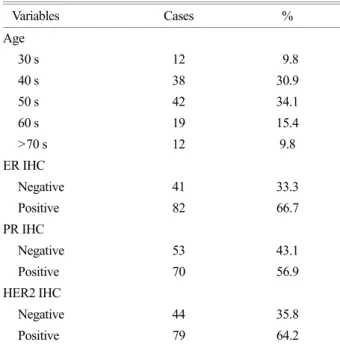
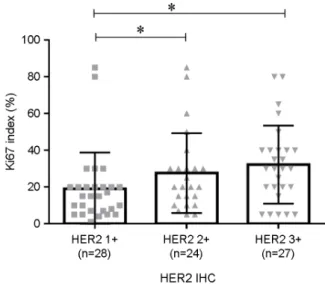
Ki-67 has been widely performed and become an important biomarker in worldwide clinics, but the standard cut off value of Ki-67 index in breast cancer is still controversy. The objective study was to understand the Ki-67 in breast cancer subtypes and to investigate relative risk of breast cancer subtypes according to Ki-67 cut off value in Korean breast cancer. Immunohistochemical staining (IHC) for estrogen receptor (ER), progesterone receptor (PR), human epidermal growth factor receptor 2 (HER2), and Ki-67 index was examined from 123 breast cancer patients. Ki-67 index was significantly overexpressed in PR, ER, and HER2 hormone negative groups. Ki-67 index in Triple negative and HER2 subtypes was shown significantly higher than that in Luminal A and Luminal B subtype. Then, we compared the relative risk of each subtype according to 14% and 20% Ki-67 cut off value, which were applied in most clinics. Especially, 20% Ki-67 cut off value in HER2 and Triple negative subtypes was shown 8.41 fold and 2.83 fold higher relative risk than this in Luminal A subtype. Moreover, Ki-67 index in HER2 2+ or 3+ status showed significantly overexpressed than this in HER2 1+ status. At the 20% Ki-67 cut off value, HER2 1+ or 2+ status and 3+ status showed significant difference.
Therefore, the 20% Ki-67 cut off value will be useful as a precise prognostic management and helpful for interpreting diverse outcomes of other subtypes in breast cancer patients.
Key Words: Ki-67, Breast cancer, Triple negative, HER2, Immunohistochemistry
INTRODUCTION
Breast cancer has the second most incidence rates in females (Siegel et al., 2016). Treatment of breast cancer is
determined by breast cancer subtypes according to main distinct hormone (estrogen and progesterone) receptors and human epidermal growth factor receptor 2 receptor (HER2) (O'Brien et al., 2010; Luporsi et al., 2012). It's classified as four subtypes; Luminal A subtype, which shows Estrogen
Original Article
*Received: November 29, 2017 / Revised: December 22, 2017 / Accepted: January 24, 2018
§Contributed equally to this work.
†Corresponding author: Kwang Hwa Park. Department of Pathology, College of Medicine, Yonsei University Wonju, 20 Ilsan-ro, Wonju-si, Gangwon-do 26426, Korea.
Tel: +82-33-741-1556, Fax: +82-33-731-6590, e-mail: [email protected]
†Corresponding author: Hyeyoung Lee. Department of Biomedical Laboratory Science, College of Health Sciences, Yonsei University, 1 Yonseidae-gil, Wonju, Gangwon 26426, Korea.
Tel: +82-33-760-2740, Fax: +82-33-760-2561, e-mail: [email protected]
○CThe Korean Society for Biomedical Laboratory Sciences. All rights reserved.
○CCThis is an Open Access article distributed under the terms of the Creative Commons Attribution Non-Commercial License (http://creativecommons.org/licenses/by-nc/3.0/) which permits unrestricted non-commercial use, distribution, and reproduction in any medium, provided the original work is properly cited.