http://dx.doi.org/10.5369/JSST.2018.27.5.345 pISSN 1225-5475/eISSN 2093-7563
Heterogeneous Porous WO 3 @SnO 2 Nanofibers as Gas Sensing Layers for Chemiresistive Sensory Devices
Peresi Majura Bulemo
1,2, Jiyoung Lee
1, and Il-Doo Kim
1,3,+Abstract
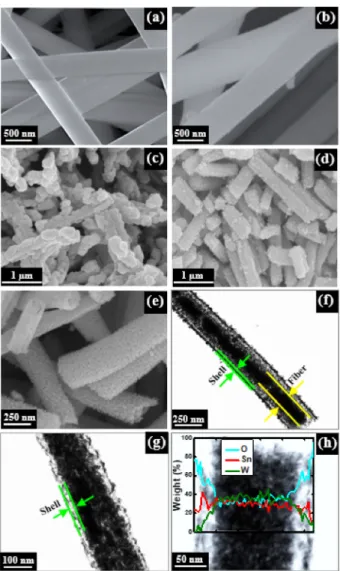
We employed an unprecedented technique to synthesize porous WO
3@SnO
2nanofibers exhibiting core-shell and fiber-in-tube con- figurations. Firstly, 2-methylimidazole was uniformly incorporated in as-spun nanofibers containing ammonium metatungstate hydrate and the sacrificial polymer (polyacrylonitrile). Secondly, the 2-methylimidazole on the surfaces of nanofibers was complexed with tin(II) chloride (SnCl
2) via simple impregnation of the as-spun nanofibers in ethanol containing tin(II) chloride dihydrate (SnCl
2·2H
2O). The presence of vacant p-orbitals in tin (Sn) and the nucleophilic nitrogen on the imidazole ring allowed for the reaction between SnCl
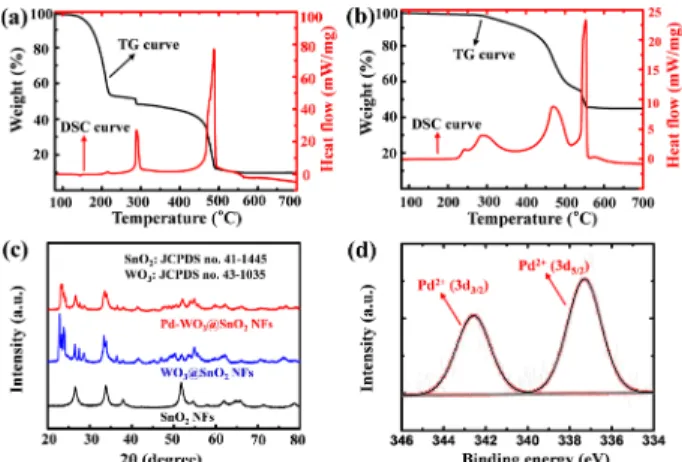
2and 2-methylimidazole, forming adducts on the surfaces of the as-spun nanofibers. The calcination of these nanofibers resulted in porous WO
3@SnO
2nanofibers with a higher surface area (55.3 m
2·g
−1) and a better response to 1-5 ppm of acetone than pristine SnO
2NFs synthesized using a similar method. An improved response to acetone was achieved upon functionalization of the WO
3@SnO
2nano- fibers with catalytic palladium nanoparticles. This work demonstrates the potential application of WO
3@SnO
2nanofibers as sensing lay- ers for chemiresistive sensory devices for the detection of acetone in exhaled breath.
Keywords: WO
3@SnO
2heteronanostructures, adducts, core-shell, fiber-in-tube, gas sensors, exhaled breath
1. INTRODUCTION
One-dimensional (1D) semiconducting metal oxide (SMO)- based heteronanostructures, especially those in core-shell configurations, exhibit versatility and applicability in gas sensing applications owing to their interfacial heterojunction barriers [1- 2]. More importantly, the combination of different SMOs with different work functions allows for the tunability of the gas- sensing properties [3]. Apart from the transduction of the molecular interaction of gases with individual material components, heterojunctions (such as n-n or p-n interfaces) in hybrids offer synergistic functionalities that amplify their sensing
capability. Typically, strain-induced defects originating from lattice mismatch are effective electron- and hole-trapping regions that cause the depletion of charge carriers in the vicinity of the interfaces. Of particular interest here are the electron kinetics at the interfaces of the contact materials. Lattice mismatch between the core-shell components creates a high density of states originating from surface strains (defects), which are dependent on core size and shell thickness [4]. Because of the trapped electrons, the electron barrier extends into the interface-forming elements.
In an effort to pursue the advantages of this interfacial phenomenon, several composite materials have been widely synthesized and used in gas sensing applications. In particular, few reports have been made on using SnO
2and WO
3heteronanostructures as sensing layers, and few have shown amplified responses to several gases, such as H
2S, NH
3, NO, and NO
2[5-9]. However, their performance toward low gas concentrations (< 5 ppm) has not been significantly investigated.
Nonetheless, a combination of SnO
2and WO
3is an ideal choice for the suppression of moisture poisoning in pristine SnO
2systems because WO
3does not show cross-sensitivity to moisture [10-12].
Moreover, the enhancement of porosity and surface area further improves the interaction of SnO
2-WO
3nanostructures with the target gases.
In this work, porous 1D WO
3@SnO
2fibrous nanostructures exhibiting core-shell and fiber-in-tube configurations were
1
Department of Materials Science and Engineering, Korea Advanced Institute of Science and Technology, 291 Daehak-ro, Yuseong-gu, Daejeon 34141, Republic of Korea
2
Department of Mechanical and Industrial Engineering, University of Dar es Salaam, P. O. Box 35131, Dar es Salaam, Tanzania
3
Advanced Nanosensor Research Center, KI Nanocentury, Korea Advanced Institute of Science and Technology, 291 Daehak-ro, Yuseong-gu, Daejeon 34141, Republic of Korea
+