RESEARCH ARTICLE
Received: August 11, 2020, Revised: August 30, 2020, Accepted: September 3, 2020 eISSN 2233-7679
†Correspondence to: Ji-Hyoung Han, https://orcid.org/0000-0003-1613-2879
Department of Dental Hygiene, Suwon Science College, 288 Seja-ro, Jeongnam-myeon, Hwaseong 18516, Korea Tel: +82-31-350-2418, Fax: +82-31-350-2075, E-mail: [email protected]
Copyright © The Korean Society of Dental Hygiene Science.
Influence of Job Embeddedness and Resilience on Turnover Intention in Dental Hygienists
Ji-Min Hwang
1and Ji-Hyoung Han
2,†1
Department of Dental Hygiene, Baekseok Culture University, Cheonan 31065,
2
Department of Dental Hygiene, Suwon Science College, Hwaseong 18516, Korea
Background: Maintaining a skilled workforce by minimizing the turnover of competent dental hygienists is very important for
securing dental competitiveness. Therefore, it is necessary to find a predictor of turnover and lower turnover intention. To understand dental hygienist turnover, it is necessary to study the resilience, a positive factor of personal characteristics and job embeddedness that induces residual tissue. The purpose of this study was to investigate the effect of dental hygienists’ job embeddedness and resilience on turnover intention.
Methods: A survey was conducted on licensed dental hygienists nationwide, from March 19 to July 19, 2020. T-test and one way
ANOVA analysis were performed to compare the job embeddedness, resilience, and turnover intention according to the general characteristics. Pearson’s correlation analysis was performed to identify the correlation between job embeddedness, resilience, and turnover intention. Multiple regression analysis was performed to determine the effect on the turnover intention.
Results: Job embeddedness was the highest with link and resilience scoring 3.57 and 4.16, respectively. The turnover intention
scored 3.53. Among the general characteristics, age, marriage, total dental clinic career, education degree, and position showed statistically significant differences in job embeddedness, resilience, and turnover intention. Suitability, link, and sacrifice of job embeddedness were shown to affect the degree of turnover intention, with an explanatory power of 26.2%.
Conclusion: In order to reduce the dental hygienists’ turnover intention, job embeddedness and resilience should be increased.
Thus, measures should be undertaken for professional and systematic program development and human resources management.
Key Words: Dental hygienists, Job embeddedness, Resilience, Turnover
Introduction
A key element of hospital organization is human resources; securing and maintaining this is important for hospital growth and development
1-3). Dental hygienists are professional human resources that play a pivotal role in the promotion of oral health in the public and influence the determination of productivity and quality of dental services.
Around 45.9% (88,000) of dental hygienist license holders are active, and more than 5,000 are licensed annually, but they are having difficulty in manpower supply and demand due to turnover
4). Turnovers happen in 45.8% of
dental hygienists, which is almost half of the total
5).
Maintaining a skilled workforce by minimizing the
turnover of competent dental hygienists is very important
for securing dental competitiveness
6). Therefore, it is
necessary to find a predictor of turnover and lower
turnover intention. Job embeddedness and resilience are
being discussed as new variables for turnover
7,8). Job
embeddedness refers to the degree to which an organiza-
tional member is rooted in the organization in relation to
the job
9). Job embeddedness expresses a high degree of
relevance to be buried deeply in something, or in simpler
terms, this is why an organization’s members choose to
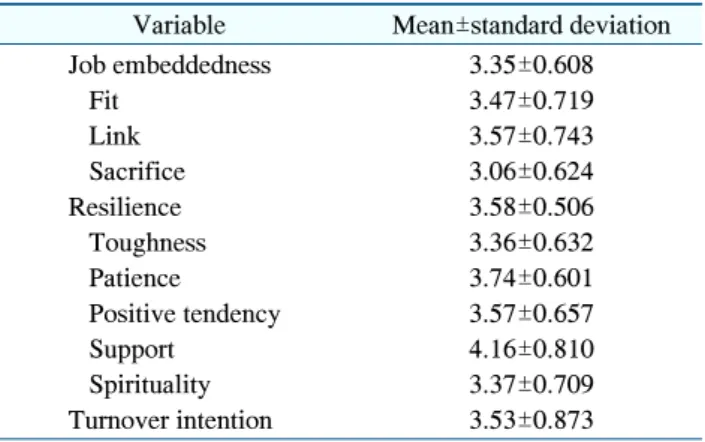
Table 1. Job Embeddedness, Resilience, Turnover Intention
Variable Mean±standard deviation
Job embeddedness 3.35±0.608
Fit 3.47±0.719
Link 3.57±0.743
Sacrifice 3.06±0.624
Resilience 3.58±0.506
Toughness 3.36±0.632
Patience 3.74±0.601
Positive tendency 3.57±0.657
Support 4.16±0.810
Spirituality 3.37±0.709
Turnover intention 3.53±0.873
remain
7). Resilience is a concept that includes the ability of an individual to overcome stress or adversity, adapt positively, and grow as an individual
10). Dental hygienists reportedly experience high stress, namely due to inter- personal conflict, physical environment, organizational system, job demand, and lack of reward
11). In organ- izational culture, resilience is needed to mature human capital, control individual feelings, and overcome stress.
These two factors lower the turnover intention of dental hygienists.
Due to the shortage of health care workers, other studies on turnover have been ongoing
2,3,6-8). However, studies involving job embeddedness and resilience in dental hygienists are insufficient. To understand dental hygienist turnover, it is necessary to study resilience, a positive factor of personal characteristics, and job embeddedness, which is an individual’s reason for remaining in their job.
This study aims to provide basic data for efficient manpower management by understanding the effects of job placement and the resilience of dental hygienists on their turnover intentions.
Materials and Methods
1. Subjects and methods
This study was conducted by randomly sampling and surveying licensed dental hygienists across the country.
The survey was conducted from March 19 to July 19, 2020. The purpose of the research were explained to the research subjects, and confidential information were investigated after receiving written consent from the subjects, to comply with research ethics. The sample size was obtained from the G Power 3.1 program, and 221 people were calculated for correlation and regression analysis based on an effect size of 0.15, significance level of 0.05, and statistical power of 0.8.
2. Variables used in analysis
A total of 9 questions were used to investigate the following general characteristics: age, sex, marriage, religion, total dental clinic career, current dental clinic carrier, educational degree, position, and monthly salary.
Job embeddedness was based on the definition set by
Mitchell et al.
9), and its sub-domains consisted of 18 questions composed of 8 questions for fit, 4 questions for link, and 6 questions for sacrifice. Fit is the suitability of the subject to being a dentist. Link refers to the interaction between departments or colleagues. Lastly, sacrifice means the patient’s sacrifice for the dental clinic. The answers to the questions were measured on a five-point scale ranging from five points for “very much so” to one point for “not at all.” The reliability of the research tool was Cronbach’s =0.912. The questions for resilience was developed by Connor and Davidson
12)and translated into Korean by Baek
13). The sub-domains consisted of a total of 25 questions: 9 for toughness, 8 for patience, 4 for positive tendency, 2 for support, and 2 for spirituality. The answers to the questions were measured on a five-point scale ranging from five points for “very much so” to one point for “not at all.” The reliability of the research tool was Cronbach’s =0.910. The turnover intention consisted of five questions by Moon and Han
2)modified and supplemented by the tools developed by Mobley
14). A Likert five-point scale was used, and Cronbach’s value was 0.847.
3. Data analysis
General characteristics were analyzed for frequency,
and job embeddedness, resilience, and turnover intention
were analyzed for technical statistics. The t-test and
one-way ANOVA analysis were performed to compare
job embeddedness, resilience, and turnover intention
according to general characteristics. Levene statistics were
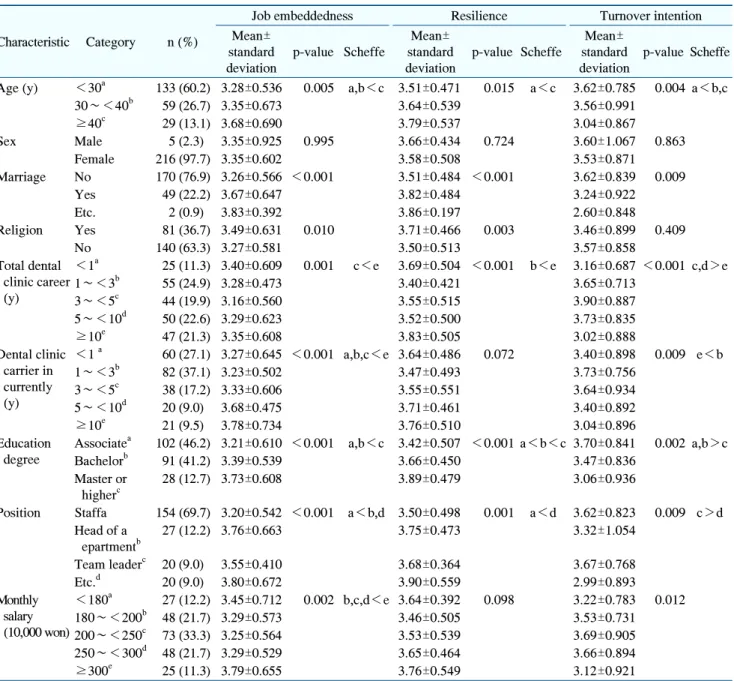
Table 2. Differences in Job Embeddedness, Resilience and Turnover Intention according to General Characteristics
Characteristic Category n (%)
Job embeddedness Resilience Turnover intention
Mean±
standard deviation
p-value Scheffe
Mean±
standard deviation
p-value Scheffe
Mean±
standard deviation
p-value Scheffe
Age (y) <30
a133 (60.2) 3.28±0.536 0.005 a,b<c 3.51±0.471 0.015 a<c 3.62±0.785 0.004 a<b,c
30∼<40
b59 (26.7) 3.35±0.673 3.64±0.539 3.56±0.991
≥40
c29 (13.1) 3.68±0.690 3.79±0.537 3.04±0.867
Sex Male 5 (2.3) 3.35±0.925 0.995 3.66±0.434 0.724 3.60±1.067 0.863
Female 216 (97.7) 3.35±0.602 3.58±0.508 3.53±0.871
Marriage No 170 (76.9) 3.26±0.566 <0.001 3.51±0.484 <0.001 3.62±0.839 0.009
Yes 49 (22.2) 3.67±0.647 3.82±0.484 3.24±0.922
Etc. 2 (0.9) 3.83±0.392 3.86±0.197 2.60±0.848
Religion Yes 81 (36.7) 3.49±0.631 0.010 3.71±0.466 0.003 3.46±0.899 0.409
No 140 (63.3) 3.27±0.581 3.50±0.513 3.57±0.858
Total dental clinic career (y)
<1
a25 (11.3) 3.40±0.609 0.001 c<e 3.69±0.504 <0.001 b<e 3.16±0.687 <0.001 c,d>e
1∼<3
b55 (24.9) 3.28±0.473 3.40±0.421 3.65±0.713
3∼<5
c44 (19.9) 3.16±0.560 3.55±0.515 3.90±0.887
5∼<10
d50 (22.6) 3.29±0.623 3.52±0.500 3.73±0.835
≥10
e47 (21.3) 3.35±0.608 3.83±0.505 3.02±0.888
Dental clinic carrier in currently (y)
<1
a60 (27.1) 3.27±0.645 <0.001 a,b,c<e 3.64±0.486 0.072 3.40±0.898 0.009 e<b
1∼<3
b82 (37.1) 3.23±0.502 3.47±0.493 3.73±0.756
3∼<5
c38 (17.2) 3.33±0.606 3.55±0.551 3.64±0.934
5∼<10
d20 (9.0) 3.68±0.475 3.71±0.461 3.40±0.892
≥10
e21 (9.5) 3.78±0.734 3.76±0.510 3.04±0.896
Education degree
Associate
a102 (46.2) 3.21±0.610 <0.001 a,b<c 3.42±0.507 <0.001 a<b<c 3.70±0.841 0.002 a,b>c
Bachelor
b91 (41.2) 3.39±0.539 3.66±0.450 3.47±0.836
Master or higher
c28 (12.7) 3.73±0.608 3.89±0.479 3.06±0.936
Position Staffa 154 (69.7) 3.20±0.542 <0.001 a<b,d 3.50±0.498 0.001 a<d 3.62±0.823 0.009 c>d Head of a
epartment
b27 (12.2) 3.76±0.663 3.75±0.473 3.32±1.054
Team leader
c20 (9.0) 3.55±0.410 3.68±0.364 3.67±0.768
Etc.
d20 (9.0) 3.80±0.672 3.90±0.559 2.99±0.893
Monthly salary (10,000 won)
<180
a27 (12.2) 3.45±0.712 0.002 b,c,d<e 3.64±0.392 0.098 3.22±0.783 0.012
180∼<200
b48 (21.7) 3.29±0.573 3.46±0.505 3.53±0.731
200∼<250
c73 (33.3) 3.25±0.564 3.53±0.539 3.69±0.905
250∼<300
d48 (21.7) 3.29±0.529 3.65±0.464 3.66±0.894
≥300
e25 (11.3) 3.79±0.655 3.76±0.549 3.12±0.921
Data was analysed by t-test and one-way ANOVA statistics.
used to test for equal variances, and differences between groups were analyzed through the Scheffe follow-up test.
Pearson’s correlation analysis was performed to identify the correlation between job embeddedness, resilience, and turnover intention. Multiple regression analysis was performed to determine the effect on turnover intention, and the significance level of all analyses was set to 0.05.
The data were analyzed using the software for statistical analysis, PASW statistics ver. 18.0 (IBM Corp., Armonk,
NY, USA).
Results
1. Job embeddedness, resilience, and turnover intention
Job embeddedness was the highest in link with a score
of 3.57, and sacrifice was the lowest at 3.06. Resilience
had scores of 4.16 in support, 3.74 in patience, and 3.57 in
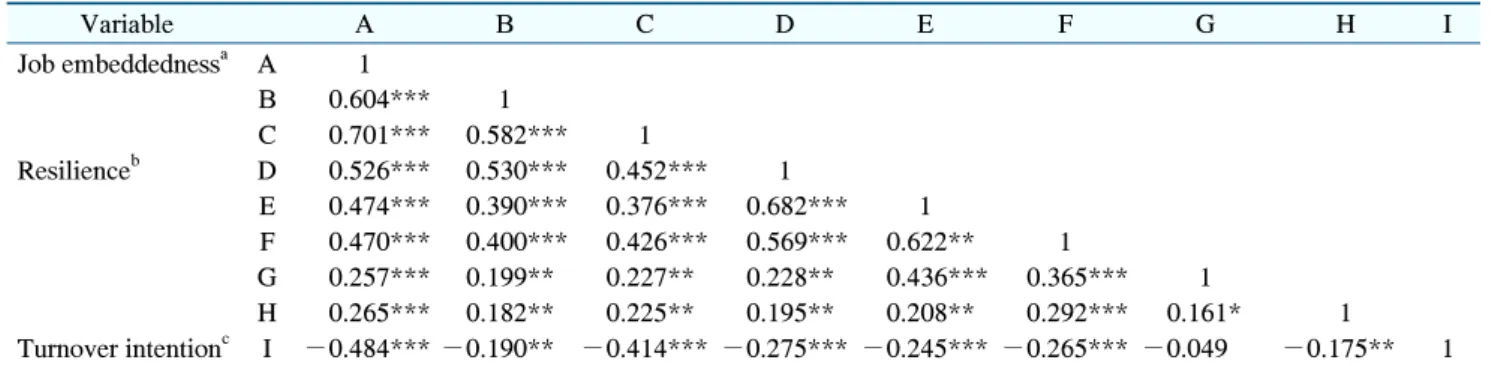
Table 3. Correlation between Sub-Domains of Job Embeddedness and Resilience and Turnover Intention
Variable A B C D E F G H I
Job embeddedness
aA 1
B 0.604*** 1
C 0.701*** 0.582*** 1
Resilience
bD 0.526*** 0.530*** 0.452*** 1
E 0.474*** 0.390*** 0.376*** 0.682*** 1
F 0.470*** 0.400*** 0.426*** 0.569*** 0.622** 1
G 0.257*** 0.199** 0.227** 0.228** 0.436*** 0.365*** 1
H 0.265*** 0.182** 0.225** 0.195** 0.208** 0.292*** 0.161* 1
Turnover intention
cI −0.484*** −0.190** −0.414*** −0.275*** −0.245*** −0.265*** −0.049 −0.175** 1
*p<0.05, **p<0.01, ***p<0.001.
a
A: fit, B: link, C: sacrifice.
b
D: toughness, E: patience, F: positive tendency, G: support, H: spirituality.
c
I: turnover intention.
Data was analysed by Pearson correlation statistics.
positive tendency, with toughness scoring the lowest at 3.36. The turnover intention had a score of 3.53 (Table 1).
2. Differences in job embeddedness, resilience, and turnover intention according to general characteristics Among the general characteristics, there were statistically significant differences in job embeddedness, resilience, and turnover intention according to age, marriage, total dental clinic career, educational degree, and position. The higher the age and level of education, the higher the job embeddedness (p=0.005, p<0.001) and resilience (p=0.015, p<0.001) and the lower the degree of turnover intention (p=0.004, p=0.002). These variables also differed depending on marriage status; unmarried people showed lower job embeddedness (p<0.001), lower resilience (p<0.001), and a higher degree of turnover intention (p=0.009, Table 2).
3. Correlation between the sub-domains of job embeddedness, resilience, and turnover intention
Sacrifice and fit (0.701), patience and toughness (0.682), link and fit (0.604), and sacrifice and link (0.582) showed high positive correlations between each other.
However, there was a negative correlation between turnover intentions and the sub-domains of job embeddedness and resilience. Among them, turnover intention and fit
(−0.484) showed the lowest negative correlation.
Sacrifice (−0.414) and toughness (−0.275) showed a low negative correlation (p<0.05, Table 3).
4. Factors affecting turnover intentions
As a result of analyzing multicollinearity between independent variables prior to regression analysis, the tolerance limit was 0.450 to 0.586, which was 0.1 or more.
The variance inflation factors was 1.708 to 2.223, which did not exceed 10, indicating that there was no problem in multicollinearity between independent variables.
It was found that the fit, link, and sacrifice of job embeddedness were factors affecting turnover intention.
The explanatory power was 26.2% and the Durbin–
Watson index was 1.993, which was close to 2, indicating that there was no autocorrelation of the error term. The regression model was found to be statistically significant (F=26.973, p<0.001, Table 4).
Discussion
This study attempted to investigate the effect of job embeddedness and resilience on turnover intention in dental hygienists. The main implications according to the research results are as follows.
First, we examined the job embeddedness, resilience,
and turnover intention of dental hygienists. Job embeddedness
scored 3.35. Regarding the sub-domains, link scored the
Table 4. Factors Affecting Turnover Intentions