Chemotherapy
Infect Chemother 2016;48(4):317-323
ISSN 2093-2340 (Print) · ISSN 2092-6448 (Online)
Received: July 17, 2016 Accepted: October 19, 2016 Published online: November 21, 2016 Corresponding Author : Jun-Ho Yang, MD
Department of Thoracic and Cardiovascular Surgery, Gyeongsang National University Hospital, 79 Gangnam-ro, Jinju 52727, Korea
Tel: +82-55-750-8124, Fax: +82-55-214-3260 E-mail: [email protected]
This is an Open Access article distributed under the terms of the Creative Commons Attribution Non-Commercial License (http://creativecommons.org/licenses/by-nc/3.0) which permits unrestricted non-commercial use, distribution, and repro- duction in any medium, provided the original work is properly cited.
Copyrights © 2016 by The Korean Society of Infectious Diseases | Korean Society for Chemotherapy
www.icjournal.org
Association between Body Mass Index and
Sputum Culture Conversion among South Korean Patients with Multidrug Resistant Tuberculosis in a Tuberculosis Referral Hospital
Hyun-Oh Park
1, Sung-Hwan Kim
1, Seong-Ho Moon
1, Joung-Hun Byun
1, Jong-Woo Kim
1, Chung-Eun Lee
2, Jong-Duk Kim
2, In-Seok Jang
2, and Jun-Ho Yang
21Department of Thoracic and Cardiovascular Surgery, College of Medicine and Institute of Health Sciences, Gyeongsang National Univer- sity Changwon Hospital, Changwon; 2Department of Thoracic and Cardiovascular Surgery, College of Medicine and Institute of Health Sciences, Gyeongsang National University Hospital, Jinju, Korea
Background: Multidrug-resistant tuberculosis (MDR-TB) is an important global health problem. Furthermore, the time to identify a positive sputum culture is an important risk factor for the spread of tuberculosis, and several factors can predict a prolonged time to culture conversion. Moreover, the relationship between poor nutritional status and infectious disease is clearly estab- lished. Therefore, the present study aimed to investigate the association between body mass index (BMI) and sputum culture conversion within 3 months among patients with MDR-TB.
Materials and Methods: We retrospectively evaluated 218 patients with MDR-TB who were treated at a large tuberculosis refer- ral hospital in South Korea between January 2005 and December 2010. The outcome of interest was defined as sputum culture conversion within 3 months, and we analyzed the association between BMI and this outcome.
Results: Among the 218 patients, 53 patients (24.3%) had a low BMI (<18.5 kg/m2). In the multivariate Cox proportional-haz- ards regression analysis, failure to achieve sputum culture conversion within 3 months was independently associated with hav- ing a low BMI (hazard ratio [HR]: 1.741, 95% confidence interval [CI]: 1.006–3.013; P = 0.047) and a positive sputum smear at the initiation of therapy (HR: 8.440, 95% CI: 1.146–62.138, P = 0.036).
Conclusion: Low BMI (<18.5 kg/m2) was an independent risk factor for failure to achieve sputum culture conversion within 3 months among patients with MDR-TB.
Key Words: Tuberculosis; Multidrug-resistant; Nutritional status; Risk factors; Sputum
Introduction
There were an estimated 9.7 million cases of tuberculosis (TB) in 2014 [1], and multi-drug resistant tuberculosis (MDR- TB) is a major global health problem, despite global control efforts. Furthermore, the increasing incidence of MDR-TB can create challenges regarding TB control in many countries. In this context, MDR-TB is defined as resistance to at least rifam- picin and isoniazid, which are the two most effective first-line anti-TB drugs. In 2014, there were an estimated 300,000 MDR- TB cases (range: 220,000-370,000), and approximately 54% of these cases occurred in India, China, and the Russian Federa- tion [2].Moreover, in 2014, 53% of the MDR-TB cases were among new cases and 47% of the MDR-TB cases were previ- ously treated TB cases [2].
TB is the important infectious disease in South Korea, and nation-wide reporting identified 787 patients with MDR-TB in 2015, which represented an 8.1% decrease from the previous year [3]. However, among the Organization for Economic Co-operation and Development countries, South Korea still maintains the highest ranking in terms of the incidence, prev- alence, and mortality of MDR-TB [1]. Although most patients with drug-susceptible TB can be cured using a 6-month course of treatment, most MDR-TB cases are treated for ≥20 months using the daily administration of drugs that are more toxic, more expensive, and less effective, compared to the drugs that are used to treat drug-susceptible TB [4, 5]. Further- more, treatment is only successful in approximately one-half of patients with MDR-TB, which is related to the high rates of loss to follow-up (28%) and death (15%) [5].
Positive sputum culture results from patients with pulmo- nary TB are the most important factor in controlling the spread of MDR-TB, as these patients expel droplets that can carry infectious bacilli through coughing or sneezing [6].
There are also several factors that can predict a prolonged time to culture conversion: cavitary lesions on radiographic images, uncontrolled diabetes mellitus, old age, and the total number of administered anti-TB drugs [7].Furthermore, the relationship between poor nutritional status and infectious disease is clearly established [8], some reports have demon- strated that malnutrition could be a risk factor for TB mortali- ty [9], and other reports have suggested that malnutrition is related to treatment failure [10]. Therefore, the present study aimed to evaluate the association between body mass index (BMI; as a measure of nutritional status) and sputum culture conversion within 3 months among a population of South Ko- rean patients with MDR-TB.
Materials and Methods
1. Study population and ethical considerations This retrospective study’s design was approved by the ethics committee of the National Masan Tuberculosis Hospital (Ko- rean National Institute of Health). We identified all patients who were treated for MDR-TB between January 2005 and De- cember 2010 at a tertiary TB referral hospital in South Korea (the National Masan Hospital). Suspected cases of MDR-TB are generally identified by various units at the National Masan Tuberculosis Hospital or other healthcare facilities, and are referred to the MDR-TB clinic at the National Masan Tubercu- losis Hospital. The patients’ medical records were reviewed to collect data regarding their demographic characteristics, TB treatment history, chest radiographs, comorbidities, drug sus- ceptibility testing (DST) results, and clinical outcomes. Pa- tients were excluded from the present study if their records did not contain information regarding their height and weight.
All patients had been followed-up every month until they completed their treatment regimen.
2. Sputum cultures and DST
The diagnosis of MDR-TB was established using sputum cul- tures and DST results. Sputum specimens were processed using sodium hydroxide and N-acetyl-L-cysteine to screen for ac- id-fast bacilli, based on the Ziehl-Neelsen method. All cultures were performed using the MB/BacT liquid culture system (bioMérieux, Durham, NC, USA) and Ogawa agar slants (egg- based medium). DST was performed using Lowenstein-Jensen agar slants and the following drugs: isoniazid (0.2 mg/mL), ri- fampicin (40 mg/mL), ethambutol (2.0 mg/mL), streptomycin (10 mg/mL), kanamycin (40 mg/mL), ofloxacin (2.0 mg/mL), ethionamide (40 mg/mL), cycloserine (30 mg/mL), and pa- ra-aminosalicylic acid (1 mg/mL). Drug resistance for all drugs was defined as growth of >1% (vs. the control) in Lowen- stein-Jensen media [11]. Sputum culture conversion was defined as two consecutive negative sputum cultures at least 30 days apart. We defined time to conversion as the time from the initia- tion of therapy to the first of the two negative sputum cultures.
3. Treatment
The Korean guidelines for TB treatment were used to treat patients based on their DST results and treatment history.
Treatment for each patient was only started or modified after discussion between a group of TB specialists. The typical treatment regimen consisted of at least four targeted oral drugs and one injectable drug. Where possible, the four oral
drugs were administered for the full term of treatment and the injectable drug was administered for 8 months. The injectable drug was administered 6 times per week for the first 2 months, and then 3 times per week thereafter. Renal function, hepatic function, smears, and cultures were assessed monthly until the end of treatment. Some patients were followed-up after their discharge from the hospital, and the typical duration of treatment was 12–36 months, based on the culture results, changes in the chest radiographs, and history of TB treatment.
4. Definition
Pre-treatment BMI was measured for each patient, and was calculated as body mass divided by height squared (kg/m2).
The BMI value attempts to quantify an individual’s tissue mass, and individuals are categorized as underwent, normal weight, overweight, or obese, based on their BMI value. The commonly accepted BMI ranges are <18.5 kg/m2 for under- weight and 18.5–25 kg/m2 for normal weight. The patients in the present study were categorized as having a low BMI (<18.5 kg/m2) or assigned to the control group (BMI of ≥18.5 kg/m2).
The outcome of interest was defined as sputum culture con- version within 3 months, and we analyzed the association be- tween BMI and this outcome.
5. Data analysis
Descriptive analyses were performed using Pearson’s chi- square test (for categorical variables) and the t-test (for con-
tinuous variables). The characteristics of the low BMI and control groups were compared, and differences with a P-value of <0.05 were considered statistically significant. Cox propor- tional-hazards regression analysis was used to investigate the association between BMI or other factors and sputum culture conversion within 3 months. All analyses were performed us- ing SPSS software (version 18.0, IBM Corp., Armonk, NY, USA), and missing data were not replaced or imputed.
Results
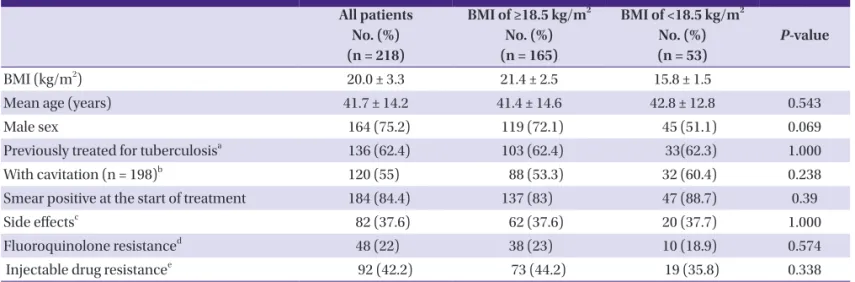
Between January 2005 and December 2010, 218 patients were treated for MDR-TB at our hospital. A total of 164 pa- tients (75.2%) were men, and the overall mean patient age was 41.7 ± 14.2 years (men: 41.2 ± 13.2 years, women: 43.4 ± 16.7 years). Ninety-two patients (42.2%) were resistant to one or more injectable drugs, and 48 patients (22.0%) were resistant to one or more fluoroquinolone. Lung cavitation was con- firmed on the chest radiographs for 120 patients (55.0%), and 136 patients (62.4%) had been treated for TB. Positive sputum cultures at the start of treatment were observed for 84.4% of the patients. The mean time to culture conversion was 3 months, and approximately 70% of the patients achieved spu- tum culture conversion within 3 months The mean overall BMI was 20.0 ± 3.3 kg/m2, and 53 patients (24.3%) had a BMI of <18.5 kg/m2 (Table 1). The patients received different em-
Table 1. Patient characteristics according to body mass index
All patients No. (%) (n = 218)
BMI of ≥18.5 kg/m2 No. (%) (n = 165)
BMI of <18.5 kg/m2 No. (%) (n = 53)
P-value
BMI (kg/m2) 20.0 ± 3.3 21.4 ± 2.5 15.8 ± 1.5
Mean age (years) 41.7 ± 14.2 41.4 ± 14.6 42.8 ± 12.8 0.543
Male sex 164 (75.2) 119 (72.1) 45 (51.1) 0.069
Previously treated for tuberculosisa 136 (62.4) 103 (62.4) 33(62.3) 1.000
With cavitation (n = 198)b 120 (55) 88 (53.3) 32 (60.4) 0.238
Smear positive at the start of treatment 184 (84.4) 137 (83) 47 (88.7) 0.39
Side effectsc 82 (37.6) 62 (37.6) 20 (37.7) 1.000
Fluoroquinolone resistanced 48 (22) 38 (23) 10 (18.9) 0.574
Injectable drug resistancee 92 (42.2) 73 (44.2) 19 (35.8) 0.338
Data are reported as mean ± standard deviation or number (%). Differences were evaluated using the independent samples t-test or Pearson’s chi-square test, as appro- priate.
aPatients who denied receiving any anti-tuberculosis treatment or having a >30–day history of anti-tuberculosis treatment.
bChest radiography or computed tomography was performed for all 198 patients.
cSide effects: drug eruption, nausea, vomiting, abdominal discomfort, peripheral neuropathy, nephrotoxicity, hepatic toxicity, ototoxicity, and hypothyroidism.
dIncluded levofloxacin, moxifloxacin, or ofloxacin
eIncluded kanamycin, streptomycin, or amikacin.
BMI, body mass index.
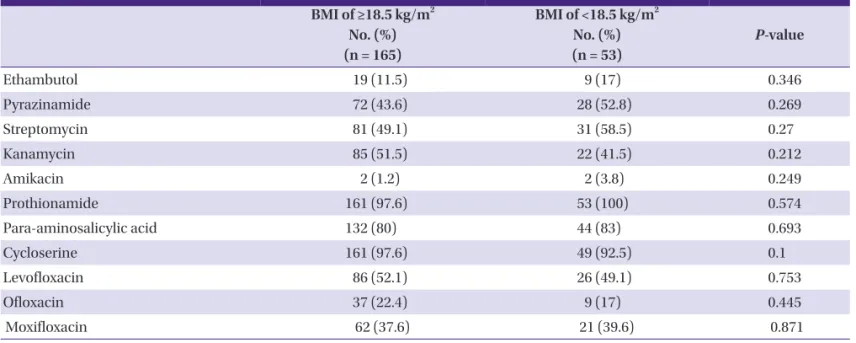
pirical initial treatments, and the most commonly used drugs were prothionamide, cycloserine, para-aminosalicylic acid, levofloxacin, pyrazinamide, moxifloxacin, ofloxacin, and eth- ambutol; streptomycin or kanamycin were commonly used as injectable drugs (Table 2). We did not detect any significant differences in the drugs that were used for the low BMI and control groups.
The univariate Cox proportional-hazard regression analyses revealed that failure to achieve sputum culture conversion within 3 months was significantly associated with a positive sputum smear at the initiation of treatment (hazard ratio [HR]:
11.276, 95% confidence interval [CI]: 1.564–81.298; P = 0.016)
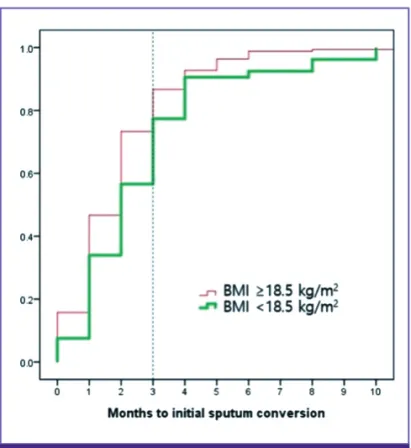
and a BMI of <18.5 kg/m2 (HR: 1.974, 95% CI: 1.191–3.272; P = 0.008). Age, sex, cavitation, side effects during treatment, re- sistance to fluoroquinolone, and resistance to injectable drugs were not significantly associated with failure to achieve spu- tum culture conversion. The multivariate Cox proportion- al-hazard regression analysis confirmed that failure to achieve sputum culture conversion was independently associated with a BMI of <18.5 kg/m2 (HR: 1.741, 95% CI: 1.006–3.013; p = 0.047) and a positive sputum smear at the initiation of treat- ment (HR: 8.440, 95% CI: 1.146–62.138; P = 0.036) (Table 3, Fig. 1). A total of 200 patients (91.7%) achieved sputum culture conversion during their treatment. Among the 53 patients Table 2. Anti-tuberculosis drugs used for 218 patients with multidrug-resistant tuberculosis
BMI of ≥18.5 kg/m2 No. (%) (n = 165)
BMI of <18.5 kg/m2 No. (%) (n = 53)
P-value
Ethambutol 19 (11.5) 9 (17) 0.346
Pyrazinamide 72 (43.6) 28 (52.8) 0.269
Streptomycin 81 (49.1) 31 (58.5) 0.27
Kanamycin 85 (51.5) 22 (41.5) 0.212
Amikacin 2 (1.2) 2 (3.8) 0.249
Prothionamide 161 (97.6) 53 (100) 0.574
Para-aminosalicylic acid 132 (80) 44 (83) 0.693
Cycloserine 161 (97.6) 49 (92.5) 0.1
Levofloxacin 86 (52.1) 26 (49.1) 0.753
Ofloxacin 37 (22.4) 9 (17) 0.445
Moxifloxacin 62 (37.6) 21 (39.6) 0.871
BMI, body mass index.
Table 3. Cox proportional hazards regression analysis of risk factors for sputum culture conversion within 3 months among 218 patients with multidrug- resistant tuberculosis
Risk factors Total Conversiona
n (%)
Univariate Multivariate
HR (95% CI) P-valueb HR (95% CI) P-valueb
BMI of <18.5 kg/m2 53 30 (56.6) 1.974 (1.191–3.272) 0.008 1.741 (1.006–3.013) 0.047
Age of ≥40 years 110 74 (67.3) 1.286 (0.795–2.081) 0.305 1.304 (0.767–2.218) 0.327
Male sex 164 110 (67.1) 1.548 (0.843–2.842) 0.158 1.724 (0.878–3.385) 0.113
Cavitation 120 88 (66.7) 1.269 (0.737–2.183) 0.5 0.85 (0.481–1.503) 0.577
Smear positivec 184 118 (64.1) 11.276 (1.564–81.298) 0.016 8.44 (1.146–62.138) 0.036
Side effects 82 57 (69.5) 0.899 (0.547–1.478) 0.675 1.115 (0.642–1.935) 0.7
FQ resistance 48 30 (62.5) 1.523 (0.885–2.621) 0.129 1.64 (0.890–3.021) 0.113
ID resistance 92 60 (65.2) 1.190 (0.736–1.924) 0.477 1.029 (0.612–1.731) 0.914
aWithin 3 months after the initiation of therapy.
bBoldface indicates a significant difference compared to the baseline characteristics.
cThe sputum smear was positive at the initiation of therapy.
HR, hazard ratio; CI, confidence interval; BMI, body mass index; FQ, fluoroquinolone; ID, injectable drug.
with a BMI of <18.5 kg/m2, 47 patients (88.7%) achieved spu- tum culture conversion (Table 4).
Discussion
It is important to control MDR-TB, and positive sputum cul- ture results from patients with pulmonary TB can be used to help control the spread of MDR-TB. In this context, transmis- sion occurs when a person inhales droplets that contain My- cobacterium tuberculosis, which subsequently enters the al-
veoli of the lungs. Thus, prolonged periods of infectiousness may increase the likelihood of spreading MDR-TB [6].Howev- er,few studies have evaluated predictors of initial sputum con- version among patients with MDR-TB. In Latvia, the signifi- cant predictors of initial sputum culture conversion were previous treatment for MDR-TB using second-line drugs, a high initial sputum colony count (≥3+), bilateral cavitation, and a higher number of resistant drugs at the initial treatment [12].In the present study, we found that a low BMI (<18.5 kg/
m2) and a positive sputum smear at the initiation of treatment were independently associated with failed sputum culture conversion within 3 months. However, our overall sputum conversion rate (91.7%) was higher than the rates from previ- ous studies [13, 14], which indicates that the underlying man- agement protocol functioned reasonably well. Nevertheless, patients with a positive smear culture at the initiation of treat- ment exhibited a high risk of failed sputum culture conversion (HR: 8.440, 95% CI: 1.146–62.138; P = 0.036), which may be re- lated to these patients having a high initial high bacillary bur- den. For example, Holtz et al. have reported that a high initial sputum colony count (≥3+) was significantly associated with delayed sputum conversion (odd ratio: 10.8, 95% CI: 1.3–91.1) [12].
Malnutrition has well-established effects on immune func- tion [15], and the accompanying decrease in immunity may increase susceptibility to many infectious diseases [16, 17].
For example, Scrimshaw et al. have suggested that malnutri- tion reduced the concentrations of immunoglobulins, inter- leukin-2 receptors, and T-cell subsets (helper, suppressor-cy- totoxic, and natural killer cells) among patients with TB [18].
The most useful measure of malnutrition in adults is BMI, and low BMI (<18.5 kg/m2) is associated with increased TB-related morbidity and mortality [19, 20]. Furthermore, several study have demonstrated that low BMI is a risk factor of mortality among patients with TB who are co-infected with HIV [10], and underweight status (BMI of <18.5 kg/m2) was significantly associated with severe clinical symptoms and a higher pro- portional of positive sputum cultures. Moreover, in South Afri- ca, underweight status was a significant predictor of more ad- vanced TB disease (odds ratio: 14.2, 95% CI: 4.4–46.2) [1]. Our findings regarding the risk of being underweight are also simi- lar to the findings of Kurbatova et al., who reported that un- derweight patients had a low sputum conversion rate (HR:
0.82, 95% CI: 0.72–0.93; P = 0.002), compared to patients with MDR-TB who had a BMI of ≥18.5 kg/m2 [20].
The present study has several limitations. First, we only eval- uated patients from a single TB referral hospital, which may Figure 1. Time to initial sputum culture conversion according to body
mass index. The time to conversion among patients with a body mass in- dex of <18.5 kg/m2 was significantly longer, compared to the group with a normal body mass index.
BMI, body mass index.
Table 4. The sputum culture conversion results BMI of ≥18.5 kg/m2
No. (%)
BMI of <18.5 kg/m2 No. (%)
Achieved SCC 153 (92.7) 47 (88.7)
Defaulted before achieving SCC
2 (1.2) 0 (0)
Failed SCC 9 (5.5) 4 (7.5)
Died before achieving SCC
1 (0.6) 2 (3.8)
Total 165 53
BMI, body mass index; SCC, sputum culture conversion.
have introduced selection bias and limits the extrapolation of our findings to the entire population of South Korean patients with MDR-TB. Second, our study only evaluated a relatively small sample of MDR-TB cases, and larger studies are needed to validate our findings regarding the predictors of outcomes in cases of MDR-TB. Third, we were unable to perform long- term follow-up, which limits any conclusions regarding the long-term trends for this disease.
In the present study, underweight status and a positive ini- tial sputum smear were associated with failing to achieve spu- tum culture conversion within 3 months among a single-cen- ter population of patients with MDR-TB. Our findings suggest that underweight status and a positive initial sputum smear might be risk factors for community transmission from pa- tients with MDR-TB.
Acknowledgements
We acknowledge the outstanding contributions of the tech- nicians and nursing staff at the National Masan Tuberculosis Hospital.
Conflicts of Interest
No conflicts of interest.
ORCID
Hyun-Oh Park http://orcid.org/0000-0003-1302-6456 Jun-Ho Yang http://orcid.org/0000-0002-7508-5307
References
1. World Health Organization (WHO). Global tuberculosis report 2015. Available at: http://aidsdatahub.org/glob- al-tuberculosis-report-2015-who-2015. Accessed 2 May 2016.
2. World Health Organization (WHO). Global tuberculosis report 2014. Available at: http://reliefweb.int/report/
world/global-tuberculosis-report-2014. Accessed 2 May 2016.
3. Park WS, Kang HY, Kim SJ, Cha JO, Son HJ, Park O. Noti- fied tuberculosis status in Korea, 2015. Public Health Weekly Report of the KCDC 2015;9:342-5.
4. Kwon YS, Kim YH, Suh GY, Chung MP, Kim H, Kwon OJ, Choi YS, Kim K, Kim J, Shim YM, Koh WJ. Treatment out- comes for HIV-uninfected patients with multidrug-resis-
tant and extensively drug-resistant tuberculosis. Clin In- fect Dis 2008;47:496-502.
5. World Health Organization (WHO). Companion hand book to the WHO guidelines for the programmatic man- agement of drug-resistant tuberculosis. Available at:
http://www.who.int/tb/publications/pmdt_companion- handbook/en. Accessed 4 May 2016.
6. Jensen PA, Lambert LA, Iademarco MF, Ridzon R; CDC.
Guidelines for preventing the transmission of Mycobacte- rium tuberculosis in health-care setting, 2005. MMWR Recomm Rep 2005;54:1-141.
7. Long R, Bochar K, Chomyc S, Talbot J, Barrie J, Kunimoto D, Tilley P. Relative versus absolute noncontagiousness of respiratory tuberculosis on treatment. Infec Control Hosp Epidemiol 2003;24:831-8.
8. Scrimshaw NS. Historical concepts of interactions, syner- gism, and antagonism between nutrition and infection. J Nutr 2003;133:316S-21S.
9. Zachariah R, Spielmann MP, Harries AD, Salanioni FM.
Moderate to severe malnutrition associated with early death in patients with tuberculosis is a risk factor. Trans R Soc Trop Med Hyg 2002;96:291-4.
10. Podewils LJ, Holtz T, Riekstina V, Skripconoka V, Zarovska E, Kirvelaite G, Kreigere E, Leimane V. Impact of malnutri- tion on clinical presentation, clinical course, and mortality in MDR-TB patients. Epidemiol Infect 2011;139:113-20.
11. Canetti G, Fox W, Khomenko A, Mahler HT, Menon NK, Mitchison DA, Rist N, Smelev NA. Advances in techniques of testing mycobacterial drug sensitivity, and the used of sensitivity tests in tuberculosis control programmes. Bull World Health Organ 1969;41:21-43.
12. Holtz TH, Sternberg M, Kammerer S, Laserson KF, Rieksti- na V, Zarovska E, Skripconoka V, Wells CD, Leimane V.
Time to sputum culture conversion in multidrug-resistant tuberculosis: predictors and relationship to treatment out- come. Ann Intern Med 2006;144:650-9.
13. Hafkin J, Modongo C, Newcomb C, Lowenthal E, MacGre- gor RR, Steenhoff AP, Freidman H, Bisson GP. Impact of the human immunodeficiency virus on early multi- drug-resistant tuberculosis treatment outcomes in Bo- tswana. Int J Tuberc Lung Dis 2013;17:348-53.
14. Qazi F, Khan U, Khowaja S, Javaid M, Ahmed A, Salahud- din N, Hussain H, Becerra MC, Golub JE, Khan AJ. Predic- tors of delayed culture conversion in patients treated for multidrug-resistant tuberculosis in Pakistan. Int J Tuberc Lung Dis 2011;15:1556-9.
15. Hickson M. Malnutrition and ageing. Postgrad Med J
2006;82:2-8.
16. Harris T, Cook EF, Garrision R, Higgins M, Kannel W, Goldman L. Body mass index and mortality among non- smoking older persons. The Framingham heart study.
JAMA 1988;259:1520-4.
17. Lee YM, Kim SM, Park SJ, Lee SO, Choi SH, Kim YS, Woo JH, Kim SH. Factors associated with a strong response to the T-SPOT.TB in patients with extrapulmonary tuberculo- sis. Infect Chemother 2014;46:248-52.
18. Scrimshaw NS, SanGiovanni JP. Synergism of nutrition, in- fection, and immunity: an overview. Am J Clin Nutr 1997;66:464S-77S.
19. Mupere E, Malone L, Zalwango S, Chiunda A, Okwera A,
Parraga I, Stein CM, Tisch DJ, Muqerwa R, Boom WH, Mayanja H, Whalen CC. Lean tissue mass wasting is asso- ciated with increased risk of mortality among women with pulmonary tuberculosis in urban Uganda. Ann Epidemiol 2013;22:466-73.
20. Kurbatova EV, Gammino VM, Bayona J, Becerra MC, Danilovitz M, Falzon D, Gelmanova I, Keshavjee S, Lei- mane V, Mitnick CD, Quelapio MI, Riekstina V, Taylor A, Viklepp P, Ziqnol M, Ceqielski JP. Predictors of sputum culture conversion among patients treate d for multi-drug-resistant tuberculosis. Int J Tuberc Lung Dis 2012;16:1335-43.