Article
CTNNB1 Mutation in Aldosterone Producing Adenoma
Jian-Jhong Wang1,2, Kang-Yung Peng2,3, Vin-Cent Wu2,3, Fen-Yu Tseng2,4, Kwan-Dun Wu2,3
1Division of Nephrology, Department of Internal Medicine, Chi Mei Medical Center, Liouying, Tainan City; 2TAIPAI (Taiwan Primary Aldosteronism investigator); Divisions of 3Nephrology, 4Endocrinology and Metabolism, Department of Internal Medicine, National Taiwan University Hospital, Taipei, Taiwan
Discoveries of somatic mutations permit the recognition of subtypes of aldosterone-producing adenomas (APAs) with distinct clini- cal presentations and pathological features. Catenin β1 (CTNNB1) mutation in APAs has been recently described and discussed in the literature. However, significant knowledge gaps still remain regarding the prevalence, clinical characteristics, pathophysiology, and outcomes in APA patients harboring CTNNB1 mutations. Aberrant activation of the Wnt/β-catenin signaling pathway will fur- ther modulate tumorigenesis. We also discuss the recent knowledge of CTNNB1 mutation in adrenal adenomas.
Keywords: CBTNN1; KCNJ5; Primary aldosteronism; Aldosterone producing adenomas; Taiwan Primary Aldosteronism Investi- gator
INTRODUCTION
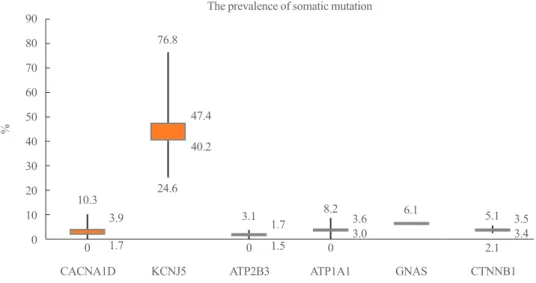
Primary aldosteronism is the most common cause of secondary hypertension with a prevalence of 5% to 10% in hypertensive patients and 20% in patients with treatment-resistant hyperten- sion [1-4]. In aldosterone-producing adenoma (APA), the ma- jority of somatic mutations were potassium voltage-gated chan- nel subfamily J member 5 (KCNJ5) mutations (ranging from 52.9% to 76.8% in Asia) [5-7]. Recently, the prevalence of a novel catenin β1 (CTNNB1) mutation in APAs was 3.7% to 5.1% [5,8]. We integrate the studies of APAs and show the prevalence of reported somatic mutation in APAs (Fig. 1) [6- 22]. CTNNB1 mutations were associated with stabilized β-catenin and increased AXIN2 (axis inhibition protein 2) ex- pression, suggesting the activation of Wnt signaling [23]. In APA, CTNNB1 mutations occurred mutually exclusively from KCNJ5, ATPase Na+/K+ transporting subunit α1 (ATP1A1), ATPase plasma membrane Ca2+ transporting 3 (ATP2B3), and
calcium voltage-gated channel subunit α1 D (CACNA1D) mu- tated tumors, implying that aberrant Wnt activation plays a piv- otal role in APA formation [24]. Accordingly, tumors with CTN- NB1 mutations were associated with relatively large adenomas and predominantly expressed in females [8].
PATHOGENIC MECHANISM OF CTNNB1 MUTATION IN THE ADRENAL GLAND
The Wnt signaling pathway, through β-catenin signaling, is im- portant for the normal development and maintenance of the ad- renal cortex, and more specifically, the zona glomerulosa (ZG) within the cortex [25,26]. Somatic mutations of CTNNB1 have been found in 27% of adrenocortical adenomas and 31% of ad- renocortical carcinomas [27]. Exon 3 of the CTNNB1 gene (en- coding β-catenin) contains specific serine and threonine resi- dues, where phosphorylation marks β-catenin for degradation [28]. Mutations or deletions of exon 3, leading to the aberrant
Received: 30 June 2017, Revised: 6 July 2017, Accepted: 17 July 2017 Corresponding author: Vin-Cent Wu
Department of Internal Medicine, National Taiwan University Hospital, 7 Chung-Shan South Rd, Zhong-Zheng Dist, Taipei 100, Taiwan
Tel: +886-2-23123456 (63098), Fax: +886-2-23952333 E-mail: [email protected]
Copyright © 2017 Korean Endocrine Society
This is an Open Access article distributed under the terms of the Creative Com- mons Attribution Non-Commercial License (http://creativecommons.org/
licenses/by-nc/4.0/) which permits unrestricted non-commercial use, distribu- tion, and reproduction in any medium, provided the original work is properly cited.
pISSN 2093-596X · eISSN 2093-5978
activation of Wnt signaling, subsequently inhibits the phosphor- ylation of β-catenin [29]. Due to alterations in exon 3 of the CTNNB1 gene, mice with activating Wnt signaling develop hy- peraldosteronism and adrenocortical tumors [24]. Mutations in CTNNB1 also cause increased and abnormal Wnt activation in human adrenocortical tumors [27,30], and augment the Wnt signaling pathway, leading to tumor formation [31]. In one re- cent series, cases of APAs harboring activating mutations of β-catenin were described in three women (two during pregnan- cy and one postmenopausal), who had a heterozygous somatic mutation (C→G, p.Ser33Cys in case 1, C→T, p.Ser45Phe in case 2, and G→A, p.Gly34Arg in case 3) in exon 3 of CTNNB1.
All three mutations are predicted to affect a GSK-3β (glycogen synthase kinase 3β) phosphorylation consensus motif and could thus impair β-catenin degradation and up-regulate Wnt activity, resulting in elevated levels of active β-catenin [32].
CTNNB1 AND THE TWO HIT THEORY DEPICT TUMOR FORMATON IN ALDOSTERONISM
In the peritumoral tissue of APA, important remodeling of the adrenal cortex has also been observed with reduced vasculariza- tion, ZG hyperplasia, and increased nodulation that were not correlated with cytochrome P450 family 11 subfamily B mem- ber 2 (CYP11B2) expression [33]. A recent study showed that somatic mutations in the KCNJ5, ATP1A1, or CACNA1D genes
are not limited to APAs, but are also found in the more frequent multinodular adrenals [34]. However, in a multinodular gland, the mutation was found in only one nodule, showing that muta- tion and nodule formation are independent processes [35].
These data demonstrate that the processes of nodule formation and aldosterone hypersecretion can be dissociated in pathologi- cal adrenals, suggesting a two-hit model for APA formation.
The primary hit, consisting of somatic mutation of one of the known genes in about 60% of cases and of other unknown ge- netic mutation in the remaining patients, can cause aldosterone hypersecretion. The secondary hit would lead to alterations in the normal balance between adrenocortical cell proliferation and apoptosis, triggering nodule formation (Fig. 2) [36,37]. Of note, activation of the Wnt/β-catenin pathway further modulates the two hits required for both adrenal nodule formation and in- creased aldosterone secretion [23,38]. APAs harboring CTNNB1 mutation could display CYP11B1 or CYP11B2 heterogeneous expression [8], or in both CYP11B2-positive and CYP11B2- negative regions [39]. It is also consistent with our result that the Wnt/β-catenin pathway activates downstream cyclin D1 transcription, which is a gene involved in cell growth [40] in ad- enomas with CTNNB1 mutations compared with wild-type APA adenomas. All of these findings, together with the reported higher prevalence of CTNNB1 mutations among other adrenal adenomas [41] and adrenal cancers [23], suggest that CTNNB1 mutations may be more related to tumor cell growth (tumori- genesis), rather than to actual aldosterone production.
Fig. 1. The prevalence of the most known mutation of aldosterone producing adenoma. This box plot displays the full range of variation (from maximum, mean, medium to minimum, accordingly) in each index somatic mutation. CACNA1D, calcium voltage-gated channel subunit α1 D; KCNJ5, potassium voltage-gated channel subfamily J member 5; ATP2B3, ATPase plasma membrane Ca2+ transporting 3;
ATP1A1, ATPase Na+/K+ transporting subunit α1; GNAS, guanine nucleotide binding protein, α stimulating; CTNNB1, catenin β1.
90 80 70 60 50 40 30 20 10 0
%
The prevalence of somatic mutation
CACNA1D KCNJ5 ATP2B3 ATP1A1 GNAS CTNNB1
0 0 0 2.1
10.3
3.1 8.2 5.1
3.9 1.7 3.6 3.5
1.7 1.5 3.0 3.4
6.1 24.6
76.8
47.4 40.2
CYP11B1, CYP11B2, LHCGR, AND GNRHR EXPRESSION IN APAs HARBORING CTNNB1 MUTATIONS
Two subgroups of APAs were observed: one with diffuse CY- P11B2 expression with concomitantly low CYP11B1 expression, and one with low CYP11B2 and high CYP11B1 expressions [8].
APAs harboring CTNNB1 mutations have shown variable ex- pression of CYP11B1 and CYP11B2 [5,8,32]. Of note, APAs harboring CTNNB1 mutations could express luteinizing hor- mone/choriogonadotropin receptor (LHCGR) and gonadotropin releasing hormone receptor (GNRHR), encoding gonadal recep- tors, at levels that were more than 100 times higher than the lev- els in other APAs in one report [32]. Constitutive activation of the Wnt signaling pathway in ZG-like adenomatous cells could lead to de-differentiation toward the common adrenal-gonadal precursor cell type, and to the aberrant expression of gonadal re-
ceptors LHCGR and/or GNRHR [5]. However, GNRHR could present diffuse cytoplasmic, membranous, and nuclear expres- sion in adenomas, and was especially enhanced in adenomas harboring CTNNB1 mutations from female patients. GNRHR was attenuated in KCNJ5 mutated adenomas. LHCGR was dif- fusely expressed in adrenal tissues and was prominent in adeno- mas harboring CTNNB1 mutations [5]. Compared with KCNJ5 mutated APAs, no difference in CYP11B1 expression levels were observed, but significantly higher CYP11B2 expression was observed in CTNNB1 mutated tumors in a single report [8].
CLINICAL CHARACTERISTICS OF PATIENTS WITH TUMORS HARBORING CTNNB1 MUTATIONS
CTNNB1 mutated APAs were more often observed in female patients (60% to 75%) [5,8] and older patients, with a shorter Fig. 2. A two-hit model for the pathogenesis of aldosterone-producing adenoma (APA). (A, B) Primary hit: Somatic mutations in CAC- NA1D, KCNJ5, ATP2B3, ATP1A1, and possibly other genetic alterations produce cell depolarization, increased cytoplasmic calcium level and increased CYP11B2 expression, causing aldosterone hypersecretion. Secondary hit: Aberrant activation of signaling pathways (such as Wnt/β-catenin, Shh, PKA, etc.) causes imbalances between cell proliferation and death in the adrenal, leading to adenoma formation. (A) Adapted from Lalli et al., with permission from Elsevier [36]. (B) Adapted from Seidel et al. [37]. CACNA1D, calcium voltage-gated chan- nel subunit α1 D; KCNJ5, potassium voltage-gated channel subfamily J member 5; ATP2B3, ATPase plasma membrane Ca2+ transporting 3;
ATP1A1, ATPase Na+/K+ transporting subunit α1; APCC, aldosterone-producing cell clusters; HSD3b, hydroxy-δ-5-steroid dehydrogenase, 3β- and steroid δ-isomerase cluster; CTNNB1, catenin β1; DACH1, dachshund family transcription factor 1; Shh, sonic hedgehog; PKA, protein kinase A; Ang II, angiotensin II; AT1, Ang II type 1; CAMK, Ca2+/calmodulin-dependent protein kinase; CYP11B2, cytochrome P450 family 11 subfamily B member 2.
B A
duration of hypertension [5]. There were no significant differ- ences in preoperative aldosterone levels, tumor size at surgery, and the ratio of parental hypertension in patients with tumors harboring CTNNB1 mutations compared to those with tumors harboring KCNJ5 mutations [5,8]. However, CTNNB1 muta- tions led to higher serum potassium and creatinine levels com- pared to KCNJ5 mutations in one study [5].
Patients with tumors harboring CTNNB1 mutation have a small but increased risk of malignant transformation [27]. Ex- periments using β-catenin mutated mice which develop benign tumors can transition to malignancy, indicating the requirement of additional epigenetic changes [24,42]. This is consistent with the multistep progression model seen in patients with familial adenomatous polyposis [43]. However, most APAs rarely in- crease in size and the transition to aldosterone-producing carci- nomas is extremely rare [44]. Adrenal carcinomas harboring CTNNB1 mutation are also extremely rare.
CLINICAL OUTCOMES AFTER
ADRENALECTOMY IN APA PATIENTS HARBORING CTNNB1 MUTATIONS
According to our study, CTNNB1 mutation carriers had a higher possibility (87.5%) of residual hypertension than other APA pa- tients after adrenalectomy [5]. Compared with KCNJ5 mutation carriers (12.5% vs. 79.3%, P<0.001), CTNNB1 mutation carri- ers had a much lower chance of recovery from hypertension, even after 1-year follow-up. One of the possible explanations of the higher postadrenalectomy residual hypertension among pa- tients harboring CTNNB1 mutations could be that age-related essential hypertension plays an important role in the hyperten- sion observed in these patients.
CTNNB1 MUTATION OCCUR IN CUSHING’S SYNDROME AND CORTISOL PRODUCING ADENOMAS
CTNNB1 mutations and activation of the Wnt/β-catenin path- way are also found in other benign and malignant adrenocorti- cal neoplasms that do not produce aldosterone, including corti- sol producing adenomas (CPA) [45-47]. As previously stated, activated Wnt/β-catenin signaling contributes to adrenal tumori- genesis [48]. CTNNB1 mutation has been described in a 4-month-old Thai infant with Cushing’s syndrome secondary to bilateral adrenal tumors with hepatic metastasis [49]. Following molecular investigations, a deletion mutation of β-catenin in-
volving codons 44 to 45 was detected in the right adrenal tumor and peripheral blood of this patient, which indicates systemic mutation. Immunohistochemistry showed nuclear accumulation of β-catenin on the right adrenal tumor together with the meta- static nodule in the liver and the left adrenal tumor harbored wild-type β-catenin.
For CPAs, mutations in the catalytic subunit of protein kinase A (PKA) were identified and shown to occur mutually exclu- sively to CTNNB1 mutations [50,51]. The PKA pathway has paramount importance in the regulation of adrenocortical growth and hormone secretion. Activating mutations in PKA led to constitutively activated cyclic adenosine monophosphate (cAMP) signaling, causing increased cortisol production and tumor formation. Expression analysis revealed the increased expression of genes involved in the biosynthesis and metabo- lism of steroids in tumors with protein kinase cAMP-activated catalytic subunit α (PRKACA) mutation [50]. Somatic gain-of- function mutations in the PRKACA have been found in corti- sol-producing adrenocortical adenomas [50-53], but the pres- ence of genetic alterations in genes involved in the PKA path- way in APA is currently unknown. ARMC5 (armadillo repeat containing 5) is a gene found to be mutated in macronodular adrenal hyperplasia and has a connection with the PKA path- way [54].
CONCLUSIONS
CTNNB1 mutations in a subset of APAs are predominant with aberrant β-catenin accumulation. Tumors harboring these muta- tions have a variable histological and CYP11B2/B1 expression pattern, and show different clinical characteristics, such as fe- male gender dominance and a higher risk of postadrenalectomy residual hypertension. CTNNB1 mutations in APAs could relate to tumorigenesis rather than aldosterone production by activat- ing Wnt/β-catenin signaling.
CONFLICTS OF INTEREST
No potential conflict of interest relevant to this article was re- ported.
ACKNOWLEDGMENTS
This research was supported by Chi Mei Medical Center, Li- ouying (grant number, CLFHR10609), and Ministry of Science and Technology (MOST) of the Republic of China (Taiwan)
(grant number, MOST 106-2321-B-182-002). We also express our sincere gratitude to all staff of the Taiwan Clinical Trial Consortium, TCTC.
ORCID
Vin-Cent Wu https://orcid.org/0000-0001-7935-0991
REFERENCES
1. Mulatero P, Stowasser M, Loh KC, Fardella CE, Gordon RD, Mosso L, et al. Increased diagnosis of primary aldoste- ronism, including surgically correctable forms, in centers from five continents. J Clin Endocrinol Metab 2004;89:
1045-50.
2. Fogari R, Preti P, Zoppi A, Rinaldi A, Fogari E, Mugellini A.
Prevalence of primary aldosteronism among unselected hy- pertensive patients: a prospective study based on the use of an aldosterone/renin ratio above 25 as a screening test. Hy- pertens Res 2007;30:111-7.
3. Rossi GP, Bernini G, Caliumi C, Desideri G, Fabris B, Ferri C, et al. A prospective study of the prevalence of primary al- dosteronism in 1,125 hypertensive patients. J Am Coll Car- diol 2006;48:2293-300.
4. Hannemann A, Bidlingmaier M, Friedrich N, Manolopoulou J, Spyroglou A, Volzke H, et al. Screening for primary aldo- steronism in hypertensive subjects: results from two German epidemiological studies. Eur J Endocrinol 2012;167:7-15.
5. Wu VC, Wang SM, Chueh SJ, Yang SY, Huang KH, Lin YH, et al. The prevalence of CTNNB1 mutations in primary aldosteronism and consequences for clinical outcomes. Sci Rep 2017;7:39121.
6. Wu VC, Huang KH, Peng KY, Tsai YC, Wu CH, Wang SM, et al. Prevalence and clinical correlates of somatic mutation in aldosterone producing adenoma-Taiwanese population.
Sci Rep 2015;5:11396.
7. Zheng FF, Zhu LM, Nie AF, Li XY, Lin JR, Zhang K, et al.
Clinical characteristics of somatic mutations in Chinese pa- tients with aldosterone-producing adenoma. Hypertension 2015;65:622-8.
8. Akerstrom T, Maharjan R, Sven Willenberg H, Cupisti K, Ip J, Moser A, et al. Activating mutations in CTNNB1 in aldo- sterone producing adenomas. Sci Rep 2016;6:19546.
9. Xekouki P, Hatch MM, Lin L, Rodrigo de A, Azevedo M, de la Luz Sierra M, et al. KCNJ5 mutations in the National Institutes of Health cohort of patients with primary hyperal-
dosteronism: an infrequent genetic cause of Conn’s syn- drome. Endocr Relat Cancer 2012;19:255-60.
10. Taguchi R, Yamada M, Nakajima Y, Satoh T, Hashimoto K, Shibusawa N, et al. Expression and mutations of KCNJ5 mRNA in Japanese patients with aldosterone-producing ad- enomas. J Clin Endocrinol Metab 2012;97:1311-9.
11. Kitamoto T, Suematsu S, Matsuzawa Y, Saito J, Omura M, Nishikawa T. Comparison of cardiovascular complications in patients with and without KCNJ5 gene mutations harbor- ing aldosterone-producing adenomas. J Atheroscler Thromb 2015;22:191-200.
12. Boulkroun S, Beuschlein F, Rossi GP, Golib-Dzib JF, Fisch- er E, Amar L, et al. Prevalence, clinical, and molecular cor- relates of KCNJ5 mutations in primary aldosteronism. Hy- pertension 2012;59:592-8.
13. Azizan EA, Murthy M, Stowasser M, Gordon R, Kowalski B, Xu S, et al. Somatic mutations affecting the selectivity fil- ter of KCNJ5 are frequent in 2 large unselected collections of adrenal aldosteronomas. Hypertension 2012;59:587-91.
14. Kuppusamy M, Caroccia B, Stindl J, Bandulik S, Lenzini L, Gioco F, et al. A novel KCNJ5-insT149 somatic mutation close to, but outside, the selectivity filter causes resistant hy- pertension by loss of selectivity for potassium. J Clin Endo- crinol Metab 2014;99:E1765-73.
15. Scholl UI, Healy JM, Thiel A, Fonseca AL, Brown TC, Kun- stman JW, et al. Novel somatic mutations in primary hyper- aldosteronism are related to the clinical, radiological and pathological phenotype. Clin Endocrinol (Oxf) 2015;83:779- 89.
16. Scholl UI, Goh G, Stolting G, de Oliveira RC, Choi M, Overton JD, et al. Somatic and germline CACNA1D calci- um channel mutations in aldosterone-producing adenomas and primary aldosteronism. Nat Genet 2013;45:1050-4.
17. Nakajima Y, Okamura T, Horiguchi K, Gohko T, Miyamoto T, Satoh T, et al. GNAS mutations in adrenal aldosterone- producing adenomas. Endocr J 2016;63:199-204.
18. Beuschlein F, Boulkroun S, Osswald A, Wieland T, Nielsen HN, Lichtenauer UD, et al. Somatic mutations in ATP1A1 and ATP2B3 lead to aldosterone-producing adenomas and secondary hypertension. Nat Genet 2013;45:440-4.
19. Williams TA, Monticone S, Schack VR, Stindl J, Burrello J, Buffolo F, et al. Somatic ATP1A1, ATP2B3, and KCNJ5 mutations in aldosterone-producing adenomas. Hyperten- sion 2014;63:188-95.
20. Akerstrom T, Crona J, Delgado Verdugo A, Starker LF, Cu- pisti K, Willenberg HS, et al. Comprehensive re-sequencing
of adrenal aldosterone producing lesions reveal three somat- ic mutations near the KCNJ5 potassium channel selectivity filter. PLoS One 2012;7:e41926.
21. Fernandes-Rosa FL, Williams TA, Riester A, Steichen O, Beuschlein F, Boulkroun S, et al. Genetic spectrum and clinical correlates of somatic mutations in aldosterone-pro- ducing adenoma. Hypertension 2014;64:354-61.
22. Hong AR, Kim JH, Song YS, Lee KE, Seo SH, Seong MW, et al. Genetics of aldosterone-producing adenoma in Korean patients. PLoS One 2016;11:e0147590.
23. Boulkroun S, Samson-Couterie B, Golib-Dzib JF, Amar L, Plouin PF, Sibony M, et al. Aldosterone-producing adenoma formation in the adrenal cortex involves expression of stem/
progenitor cell markers. Endocrinology 2011;152:4753-63.
24. Berthon A, Sahut-Barnola I, Lambert-Langlais S, de Jouss- ineau C, Damon-Soubeyrand C, Louiset E, et al. Constitutive beta-catenin activation induces adrenal hyperplasia and pro- motes adrenal cancer development. Hum Mol Genet 2010;
19:1561-76.
25. Heikkila M, Peltoketo H, Leppaluoto J, Ilves M, Vuolteena- ho O, Vainio S. Wnt-4 deficiency alters mouse adrenal cor- tex function, reducing aldosterone production. Endocrinolo- gy 2002;143:4358-65.
26. Kim AC, Reuter AL, Zubair M, Else T, Serecky K, Bingham NC, et al. Targeted disruption of beta-catenin in Sf1-ex- pressing cells impairs development and maintenance of the adrenal cortex. Development 2008;135:2593-602.
27. Tissier F, Cavard C, Groussin L, Perlemoine K, Fumey G, Hagnere AM, et al. Mutations of beta-catenin in adrenocor- tical tumors: activation of the Wnt signaling pathway is a frequent event in both benign and malignant adrenocortical tumors. Cancer Res 2005;65:7622-7.
28. Liu C, Li Y, Semenov M, Han C, Baeg GH, Tan Y, et al.
Control of beta-catenin phosphorylation/degradation by a dual-kinase mechanism. Cell 2002;108:837-47.
29. Bjorklund P, Lindberg D, Akerstrom G, Westin G. Stabiliz- ing mutation of CTNNB1/beta-catenin and protein accumu- lation analyzed in a large series of parathyroid tumors of Swedish patients. Mol Cancer 2008;7:53.
30. Durand J, Lampron A, Mazzuco TL, Chapman A, Bourdeau I. Characterization of differential gene expression in adreno- cortical tumors harboring beta-catenin (CTNNB1) muta- tions. J Clin Endocrinol Metab 2011;96:E1206-11.
31. Morin PJ, Sparks AB, Korinek V, Barker N, Clevers H, Vo- gelstein B, et al. Activation of beta-catenin-Tcf signaling in colon cancer by mutations in beta-catenin or APC. Science
1997;275:1787-90.
32. Teo AE, Garg S, Shaikh LH, Zhou J, Karet Frankl FE, Gur- nell M, et al. Pregnancy, primary aldosteronism, and adrenal CTNNB1 mutations. N Engl J Med 2015;373:1429-36.
33. Boulkroun S, Samson-Couterie B, Dzib JF, Lefebvre H, Louiset E, Amar L, et al. Adrenal cortex remodeling and functional zona glomerulosa hyperplasia in primary aldoste- ronism. Hypertension 2010;56:885-92.
34. Fernandes-Rosa FL, Giscos-Douriez I, Amar L, Gomez- Sanchez CE, Meatchi T, Boulkroun S, et al. Different so- matic mutations in multinodular adrenals with aldosterone- producing adenoma. Hypertension 2015;66:1014-22.
35. Dekkers T, ter Meer M, Lenders JW, Hermus AR, Schultze Kool L, Langenhuijsen JF, et al. Adrenal nodularity and so- matic mutations in primary aldosteronism: one node is the culprit? J Clin Endocrinol Metab 2014;99:E1341-51.
36. Lalli E, Barhanin J, Zennaro MC, Warth R. Local control of aldosterone production and primary aldosteronism. Trends Endocrinol Metab 2016;27:123-31.
37. Seidel E, Scholl UI. Intracellular molecular differences in aldosterone: compared to cortisol-secreting adrenal cortical adenomas. Front Endocrinol (Lausanne) 2016;7:75.
38. El Wakil A, Lalli E. The Wnt/beta-catenin pathway in adre- nocortical development and cancer. Mol Cell Endocrinol 2011;332:32-7.
39. Nanba K, Chen AX, Omata K, Vinco M, Giordano TJ, Else T, et al. Molecular heterogeneity in aldosterone-producing adenomas. J Clin Endocrinol Metab 2016;101:999-1007.
40. Safe S, Kasiappan R. Natural products as mechanism-based anticancer agents: sp transcription factors as targets. Phyto- ther Res 2016;30:1723-32.
41. Tadjine M, Lampron A, Ouadi L, Bourdeau I. Frequent mu- tations of beta-catenin gene in sporadic secreting adrenocor- tical adenomas. Clin Endocrinol (Oxf) 2008;68:264-70.
42. Heaton JH, Wood MA, Kim AC, Lima LO, Barlaskar FM, Almeida MQ, et al. Progression to adrenocortical tumori- genesis in mice and humans through insulin-like growth factor 2 and β-catenin. Am J Pathol 2012;181:1017-33.
43. Phelps RA, Chidester S, Dehghanizadeh S, Phelps J, Sando- val IT, Rai K, et al. A two-step model for colon adenoma initiation and progression caused by APC loss. Cell 2009;
137:623-34.
44. Funder JW, Carey RM, Mantero F, Murad MH, Reincke M, Shibata H, et al. The management of primary aldosteronism:
case detection, diagnosis, and treatment: an Endocrine Soci- ety Clinical Practice guideline. J Clin Endocrinol Metab
2016;101:1889-916.
45. Bonnet S, Gaujoux S, Launay P, Baudry C, Chokri I, Ragaz- zon B, et al. Wnt/β-catenin pathway activation in adrenocor- tical adenomas is frequently due to somatic CTNNB1-acti- vating mutations, which are associated with larger and non- secreting tumors: a study in cortisol-secreting and -nonse- creting tumors. J Clin Endocrinol Metab 2011;96:E419-26.
46. Gaujoux S, Grabar S, Fassnacht M, Ragazzon B, Launay P, Libe R, et al. β-Catenin activation is associated with specific clinical and pathologic characteristics and a poor outcome in adrenocortical carcinoma. Clin Cancer Res 2011;17:328-36.
47. Thiel A, Reis AC, Haase M, Goh G, Schott M, Willenberg HS, et al. PRKACA mutations in cortisol-producing adeno- mas and adrenal hyperplasia: a single-center study of 60 cases. Eur J Endocrinol 2015;172:677-85.
48. Berthon A, Drelon C, Ragazzon B, Boulkroun S, Tissier F, Amar L, et al. WNT/β-catenin signalling is activated in al- dosterone-producing adenomas and controls aldosterone production. Hum Mol Genet 2014;23:889-905.
49. Pusantisampan T, Sangkhathat S, Kayasut K, Kanngurn S, Jaruratanasirikul S, Chotsampancharoen T, et al. Cushing’s syndrome in an infant secondary to malignant adrenocorti-
cal tumors with somatic mutation of beta-catenin. Pediatr Dev Pathol 2010;13:238-42.
50. Cao Y, He M, Gao Z, Peng Y, Li Y, Li L, et al. Activating hotspot L205R mutation in PRKACA and adrenal Cushing’s syndrome. Science 2014;344:913-7.
51. Beuschlein F, Fassnacht M, Assie G, Calebiro D, Stratakis CA, Osswald A, et al. Constitutive activation of PKA cata- lytic subunit in adrenal Cushing’s syndrome. N Engl J Med 2014;370:1019-28.
52. Goh G, Scholl UI, Healy JM, Choi M, Prasad ML, Nelson- Williams C, et al. Recurrent activating mutation in PRKACA in cortisol-producing adrenal tumors. Nat Genet 2014;46:
613-7.
53. Sato Y, Maekawa S, Ishii R, Sanada M, Morikawa T, Shirai- shi Y, et al. Recurrent somatic mutations underlie corticotro- pin-independent Cushing’s syndrome. Science 2014;344:
917-20.
54. Assie G, Libe R, Espiard S, Rizk-Rabin M, Guimier A, Lus- cap W, et al. ARMC5 mutations in macronodular adrenal hyperplasia with Cushing’s syndrome. N Engl J Med 2013;
369:2105-14.