Return to Play of Elite Overhead Athletes with Superior Labral Anterior Posterior Tears only after Rehabilitation
Jin Young Park, Kyung Ho Hong , Jae Hyung Lee, Kyung Soo Oh1, Seok Won Chung1, Seung Hyub Jeon2, Myung Joo Cha3
Neon Orhopaedic Surgery, 1Department of Orthopedic Surgery, Konkuk University School of Medicine, 2Now Orthopedic Surgery, 3Gem Fitness Center, Seoul, Korea
Background: Although there have been multiple reports on surgical outcomes of superior labral anterior to posterior (SLAP) lesions in overhead athletes, only a few reports exist in the literature about the results of nonoperative treatment in elite (collegiate or professional) overhead athletes. To determine the clinical outcomes of nonoperative treatment of SLAP lesions in elite overhead athletes.
Methods: Between January 2006 and December 2011, 69 patients were selected. Initial arthroscopic SLAP repair was performed in 19 patients and of the 50 patients who underwent nonsurgical treatment, such as range of motion gain and periscapular muscle strengthen- ing, 14 patients were converted to surgical treatment; 5 patients were lost to follow-up. Medical records of 31 elite overhead athletes who underwent nonsurgical treatment were retrospectively reviewed. Four clinical outcome measures were used: visual analogue scale (VAS) for pain, VAS for satisfaction, American Shoulder and Elbow Surgeons (ASES) score, and subjective feeling of recovery.
Results: The average follow-up period was 35.9 months (range, 24–62 months). The VAS for pain decreased from 6.5 to 2.2 (p<0.01) and VAS for satisfaction was 7.6. The ASES score increased from 54.1 to 85.9 (p<0.01). The overall average value of subjective feeling of recovery was 72%. Twenty-three out of 31 elite athletes (74.2%) returned to play after rehabilitation; these 23 athletes performed at the same or higher levels after rehabilitation.
Conclusions: Nonsurgical treatment in elite overhead athletes with SLAP lesion should be considered as a treatment option.
(Clin Shoulder Elbow 2017;20(2):77-83)
Key Words: Superior labral anterior to posterior; Rehabilitation; Elite overhead athletes; Shoulder Clinics in Shoulder and Elbow Vol. 20, No. 2, June, 2017
https://doi.org/10.5397/cise.2017.20.2.77
Received September 2, 2016. Revised May 7, 2017. Accepted May 15, 2017.
Correspondence to: Kyung Ho Hong
Neon Otrhopaedic Surgery, 8 Seolleung-ro 131-gil, Gangnam-gu, Seoul 06059, Korea Tel: +82-2-540-3200, Fax: +82-2-540-3200, E-mail: [email protected] IRB approval (No. KUH1060073).
Financial support: None. Conflict of interests: None.
Introduction
Shoulder injuries in overhead athletes are becoming more prevalent in the field of orthopaedic surgery as participation in throwing sports at an early age continues to grow at a rapid rate.1) Superior labral anterior to posterior (SLAP) lesions by Sny- der et al.2) are a common cause of pain and disability, particu- larly in the shoulders of overhead athletes.3-5)
In SLAP lesions, it has previously been reported that when nonsurgical treatment is unsuccessful in relieving symptoms, surgical repair may be necessary to successfully return these patients back to their sports activities, particularly overhead
athletes.6,7) Recently, various surgical treatments for SLAP lesions have been reported, ranging from debridement of the lesions (for types I and III)8) to surgical repair (for types II and IV lesion).5,9,10) Moreover, the surgical treatments of these various types of SLAP lesions differ from each other in terms of the fixation methods and operative devices, such as staples, metallic and absorbable suture anchors or tacks.5,11,12)
To date, there have been multiple reports documenting successful outcomes using surgical treatment for SLAP le- sions.4,5,9,10,13-15) Although literature review revealed that SLAP repair provides biomechanical stability and achieves excellent clinical results, the outcomes in the ability of these overhead ath-
letes to be able to return to pre-injury level of play remains con- troversial.12,16-18) Some authors reported substantially high rates of return to sports, while others found that arthroscopic SLAP repair does not provide consistent return to overhead sports.4,10,14,18,19)
Most previous studies did not keep a consistent definition of overhead athletes; they enrolled a mixed patient population (athletes/nonathletes or elite/recreational) that can cause dif- ficulty in understanding the postoperative course of elite over- head athletes undergoing SLAP surgical treatment. Until recently, there have only been a few studies that reported the results of nonsurgical treatment of SLAP lesions in elite (collegiate/high school or professional) overhead athletes. Therefore, there are limited information available regarding the treatment methods (surgical /nonsurgical) of SLAP lesions in elite overhead athletes.
The purpose of this study is to determine the clinical outcomes of nonoperative treatment (rehabilitation) of SLAP lesions in elite overhead athletes.
Methods
Patient Selection
After obtaining approval from our institutional review board, a study population was recruited through a retrospective review
of the Konkuk University Hospital-Orhopaedic Surgery database system. Subjects were included in the study if they were elite (collegiate/high school or professional) overhead athletes, had clinical diagnosis of SLAP lesion based on a positive O’Brien test, underwent a compression rotation test performed by one senior author (JY Park), and had documentation of SLAP lesion on mag- netic resonance imaging or magnetic resonance arthrography or computed tomography arthrography by one specialized muscu- loskeletal radiologist with 10 years of experience in our institu- tion.
Patients with previous surgery, glenohumeral instability, par- tial or complete rotator cuff tears, acromioclavicular arthritis, Bankart lesions, glenohumeral arthritis, or impingement were excluded. Moreover, patients were excluded from the study if the clinical follow-up period after rehabilitation was less than 24 months, and if they underwent surgical treatment (arthroscopic SLAP repair).
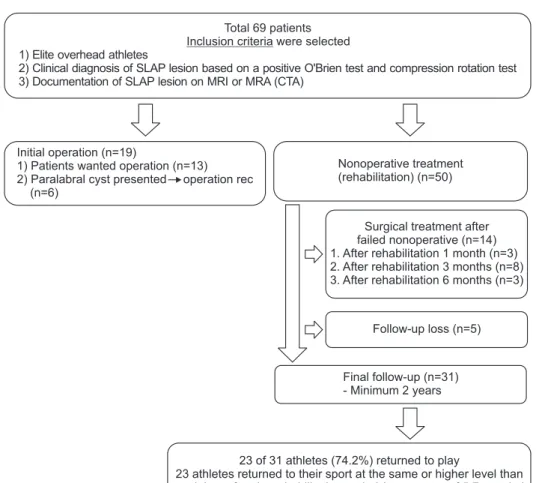
All patients (69 patient), who were treated for SLAP tears at our institution between January 2006 and December 2011, met the inclusion criteria. Nineteen patients (19 of 69 patients) un- derwent initial arthroscopic SLAP repairs; 13 of these patients (13 of 19 patients) (patients or team officials) had strongly desired and 6 of these patients (6 of 19 patients) were recommended to
Nonoperative treatment (rehabilitation) (n=50)
23 of 31 athletes (74.2%) returned to play
23 athletes returned to their sport at the same or higher level than pre-injury after the rehabilitation period (an average of 5.7 months)
Surgical treatment after failed nonoperative (n=14) 1. After rehabilitation 1 month (n=3) 2. After rehabilitation 3 months (n=8) 3. After rehabilitation 6 months (n=3)
Follow-up loss (n=5)
Final follow-up (n=31) - Minimum 2 years Initial operation (n=19)
2) Paralabral cyst presented operation rec (n=6)
1) Patients wanted operation (n=13)
Total 69 patients Inclusion criteria were selected 1) Elite overhead athletes
2) Clinical diagnosis of SLAP lesion based on a positive O'Brien test and compression rotation test 3) Documentation of SLAP lesion on MRI or MRA (CTA)
Fig. 1. Flow diagram showing disposition of patients in the study.
rec: recommend.
undergo surgery for concomitant paralabral cyst extension to the spinoglenoid notch. The other 50 patients underwent nonsurgi- cal treatment; of which, 14 patients (14 of 50 patients, 28.0%) underwent surgical treatment after nonsurgical treatment failure.
Of these 14 patients, 3 patients (3 of 14 patients) underwent ar- throscopic SLAP repair after rehabilitation for one month due to worsened should pain, 8 patients (8 of 14 patients) underwent repair after three months, and the remaining 3 patients (3 of 14 patients) underwent repair after six months; 5 patients were lost to follow-up within 2 years.
Finally, the medical records of 31 elite overhead athletes (31 of 50 elite overhead athletes, 62.0%), who underwent nonsurgical treatment (rehabilitation) were retrospectively reviewed (Fig. 1).
If patients did not visit the outpatient clinic for routine regular check-up, we contacted them by telephone to complete the outcome measurement questionnaires.
Clinical Assessments
Four clinical outcome measures were used in this study: the visual analogue scales (VASs) for pain, VAS for satisfaction, Amer- ican Shoulder and Elbow Surgeons (ASES) score, and subjective feeling of recovery. The VAS score is a horizontal line, 10 cm in length, anchored by word descriptors, ‘no pain’ or ‘not satisfied’
on the left side (score 0) and ‘very severe pain’ or ‘very satisfied’
on the right (score 10). The ASES score involves a score sum- mation on a 100-point system (50 points for daily function, 50 points for pain). To evaluate the subjective feeling of recovery, patients were asked to describe the degree of recovery of shoul- der function when performing athletic activities as compared with the pre-injury state.14,20) For evaluation of return to play, each athlete was asked, in a yes or no question, whether he or she resumed athletics as an elite athlete.
Post-treatment performance was estimated by asking whether the athlete (1) returned to the original team or moved to another team (promotion, release, or relegation) and (2) whether the athlete had any achievements, such as winning awards.20) Nonsurgical Program (Rehabilitation)
Nonsurgical treatment (rehabilitation), including rest from provocative activities, consisted of nonsteroidal anti-inflamma- tory drugs and physical therapy protocol focused on endurance and strength training of the rotator cuff and scapular stabilizer muscles, as well as posterior shoulder stretching/mobilization of capsular and cuff tightness. Exercises to improve the strength and endurance are not initiated until the resolution of pain. Rest from provocative activities has been known to decrease inflammation and associated symptoms so that stretching and strengthening can begin sooner.11) The goals of rehabilitation include restora- tion of muscle strength, endurance, and normal glenohumeral/
scapulothoracic motion. Moreover, proprioception, stability, and neuromuscular control must be emphasized. Nonsteroidal anti-
inflammatory drugs, massage therapy, and passive- or active- assisted range of motion exercises can be incorporated.7,21)
Strengthening exercises includes a core strengthening pro- gram, periscapular muscular strengthening exercises, and a rota- tor cuff strengthening program. Posterior shoulder stretching/
mobilization includes the ‘‘sleeper stretch’’ and cross-body ad- duction stretches.
The ‘‘sleeper stretch’’ is performed with the patient lying on his or her side, flexing both the elbow and shoulder to 90°, while the shoulder is passively internally rotated.22) It is thought that stretching to attain full, symmetrical internal rotation may al- leviate pain and symptoms associated with SLAP lesions.
Statistical Analysis
Paired t-test was used to compare the pre- and post-treat- ment outcome scores.
The results were compared between the two groups with Mann-Whitney test for continuous data and chi-square test for categorical data. Statistical analysis was performed using SPSS software ver 16.0 (SPSS Inc., Chicago, IL, USA). All tests were analyzed with a 95% confidence level. The level of significance was set at p<0.05.
Results
Demographics
All patients were males, with a mean age of 20.3 ± 4.43 years (range, 15–34 years) at presentation. The mean follow- up was 35.9 ± 12.3 months (range, 24–62 months). All patients were elite overhead athletes, at various levels: collegiate or high school (n=18) and professional (n=13). The majority (28 of 31 patients) were baseball players, and the remaining 3 consisted of 1 basketball player, 1 volleyball player, and 1 badminton player.
While 11 patients (11 of 31 patients) had insidious onset of symptoms, 20 patients recounted a traumatic event or a specific moment of when the symptoms started.
Clinical Outcomes and Return to Play
The rehabilitation in specialized rehabilitation center brought substantial improvement in overall pain and function. The VAS for pain improved from 6.5 ± 1.4 pre-treatment to 2.2 ± 1.7 post-treatment (p<0.01), and the VAS for satisfaction was 7.6
± 1.5. The ASES score went from 54.1 ± 14.3 pre-treatment to 85.9 ± 10.1 post-treatment (p<0.01).
The overall mean value of subjective feeling of recovery was approximately 72% ± 17%.
Twenty-three of 31 athletes (74.2%) returned to play after nonsurgical treatment (rehabilitation). Twenty-three athletes re- turned to their sports at the same or higher level than pre-injury after the rehabilitation period (an average of 5.7 ± 1.3 months;
range, 3–7 months).
When players who returned to play were compared with those who failed to return, statistical differences were found in VAS for pain, VAS for satisfaction, ASES score, and recovery (%) (Table 1). Although other overhead sports groups were too small, when the sports were classified into 2 categories, baseball and other overhead sports, statistical differences were not detected in any of the outcome measurements (Table 2).
Although there was a trend toward higher clinical outcomes and return rate in the other overhead athletes compared with the baseball players, a comparison of clinical outcomes and re- turn rate did not reach statistical significance.
When the sports grade were classified into 2 categories, ama- teur (collegiate or high school) and professional, statistical differ- ences were not detected in any of the outcome measurements (Table 3). Although there was a trend toward higher clinical out- comes and return rate in the amateur athletes compared with the professional athletes, they did not reach statistical significance.
In the baseball players (n=28), amateur (collegiate or high school) players demonstrated a higher success rate of return- to-play (12/16, 75.0%) compared with the professional players
(8/12, 66.7%); however, this did not reach statistical significance (p=0.598).
Post-treatment performances are listed in Table 4.
Discussion
SLAP lesions are a common cause of pain and disability in overhead athletes. The precise mechanism of SLAP lesions is Table 1. Comparison between Players Who Returned to Play and Those Who Failed to Return
Variable Age (yr) VAS for pain ASES score VAS for
satisfaction Recovery (%) Pre-treatment Post-treatment Pre-treatment Post-treatment
Returned (n=23) 20.1 ± 3.2 6.3 ± 1.5 1.4 ± 0.8 55.4 ± 15.1 90.2 ± 6.5 8.1 ± 1.1 80.4 ± 13.5
Failed (n=8) 20.8 ± 2.8 7.1 ± 0.9 4.2 ± 2.1 50.4 ± 12.5 73.4 ± 8.9 5.9 ± 1.1 50.6 ± 8.6
p-value NS NS <0.01 NS <0.01 <0.01 <0.01
Values are presented as mean ± standard deviation.
VAS: visual analogue scale, ASES: American Shoulder and Elbow Surgeons, NS: not significant.
Table 2. Comparison between Baseball Players and Other Overhead Athletes
Variable Age (yr) VAS for pain ASES score VAS for
satisfaction Recovery
(%) Return
to play Pre-treatment Post-treatment Pre-treatment Post-treatment
Baseball (n=28) 20.4 ± 4.6 7.2 ± 1.9 2.3 ± 1.8 51.4 ± 13.1 84.9 ± 10.3 7.5 ± 1.4 72.2 ± 14.9 20 (71.4) Other (n=3) 19.3 ± 4.1 6.6 ± 1.1 1.2 ± 0.4 56.4 ± 11.5 94.3 ± 6.9 8.0 ± 1.7 78.3 ± 24.6 3 (100)
p-value NS NS NS NS NS NS NS NS
Values are presented as mean ± standard deviation or number (%).
VAS: visual analog scale, ASES: American Shoulder and Elbow Surgeons, NS: not significant.
Table 3. Comparison between Amateur (Collegiate or High School) and Professional Overhead Athletes
Variable Age (yr) VAS for pain ASES score VAS for
satisfaction Recovery
(%) Return
to play Pre-treatment Post-treatment Pre-treatment Post-treatment
Amateur (n=18) 19.1 ± 3.7 6.3 ± 1.5 1.7 ± 1.4 53.2 ± 16.0 87.0 ± 10.5 7.6 ± 1.4 74.4 ± 17.4 14 (77.8) Professional (n=13) 20.7 ± 4.3 6.7 ± 1.2 2.6 ± 2.0 55.3 ± 12.5 84.3 ± 10.1 7.3 ± 1.6 70.4 ± 19.4 9 (69.2)
p-value NS NS NS NS NS NS NS NS
Values are presented as mean ± standard deviation or number (%).
VAS: visual analog scale, ASES: American Shoulder and Elbow Surgeons, NS: not significant.
Table 4. Posttreatment Performances of the Athletes Who Returned to Play Variable Baseball players
(n=28) Other overhead athletes (n=3)
Returning to the original position 14 1
Promotion or achievements 6* 2†
Release or relegation 8 0
Values are presented number only.
*Six amateur (collegiate or high school) baseball players turned professional.
†One colligate basketballl player turned professional, the other one high school badminton player was chosen to become national team two years after the rehabilitation.
still not completely understood; it has been hypothesized that repetitive overhead throwing may cause undue stress on the structure.23) Recently, it has been suggested that forces during the late cocking and acceleration phases of throwing may create a
‘‘peel-back’’ phenomenon, leading to SLAP lesions.24,25) Thus far, there have been numerous studies examining the pathogenesis, clinical presentation, and management of these SLAP lesions.
Advances in diagnostic imaging and arthroscopic surgical tech- niques have improved our ability to identify and successfully treat SLAP lesions.3,7,11)
Multiple reports have documented successful outcomes using surgical treatment of SLAP lesions.4,5,9,10,13-15) Although literature review revealed that SLAP repair provides biomechanical stabil- ity with excellent clinical results, there was still controversy re- garding the outcomes of overhead athletes being able to return to their pre-injury level of play.12,16-18)
While some authors reported substantially high rates of re- turn to sports, others found that arthroscopic SLAP repair does not provide consistent return to overhead sports.4,10,14,18,19) Ac- cording to previous series, the rate of return-to-play at a level similar to or higher than the pre-injury level was between 74%
to 92%.5,18,19,26) Other studies, however, have shown lower rates (22%–38%) of return to play at a similar level in overhead athletes.10,27) Kim et al.10) reported good-to-excellent results in 89% of overhead athletes; however, only 22% of these patients returned to their pre-injury level. Cohen et al.27) also observed that despite high ASES scores, normal physical examination, and minimal pain, only 40% was able to return to their pre-injury level. Similarly, Brockmeier et al.5) reported a mean ASES score of 92.6 in an athletic population in which only 74% returned to their pre-injury level. Recently, Sayde et al.28) performed a systematic review of 14 studies regarding the repair of type II SLAP tears in athletes. They found that for all athletes, 73% were able to return to their previous level of play, whereas only 63%
of overhead athletes returned to their previous level of play. It appears overhead athletes have a more difficult time recovering from this lesion compared with other athletes. Repair of type II SLAP tears leads to a return to previous level of play in most pa- tients. Overhead athletes appear to have a lower rate of return to pre-injury level.
There have been a few previous studies assessing the results of nonsurgical treatment in SLAP lesions. No studies have re- ported the results of nonsurgical treatment for SLAP lesions since 2009. In 2010, Edwards et al.6) showed that 10 out of 15 over- head-throwing athletes (66.7%) in a mixed patient population (recreational/competitive level) treated with a nonoperative regi- men for a SLAP lesion were able to return to play at the same or better level than before the injury.
Our results indicated that nonsurgical treatment (rehabilita- tion) for SLAP lesions in elite overhead athletes brought substan- tial improvements in clinical outcomes that are comparable with
other studies using current operative treatments.
With these favorable clinical outcomes, 23 out of 31 athletes (74.2%) returned to play after rehabilitation. These 23 athletes returned to their sport at the same or higher level.
Our recently study20) retrospectively reviewed 24 elite over- head athletes who underwent arthroscopic type 2 SLAP repairs.
Despite favorable clinical and radiological results, only 12 pa- tients (50.0%) returned to play after the operation. Although this trend did not reach statistical significance (p=0.097), we also noted a trend toward a lower return rate in baseball players (38%) compared with other overhead athletes (75%), in accor- dance with other previous studies. Ide et al.19) published a report that the return rate was 63% for baseball players versus 86%
for other overhead athletes. Brockmeier et al.5) noted a similar finding: A higher return rate for other overhead athletes (76%) compared with baseball players (64%). Our result also noted a trend toward a lower return rate in baseball players (71%) com- pared with other overhead athletes (100%), but this trend did not reach statistical significance (p=0.290).
One interesting finding was that the clinical outcomes (VAS for pain and satisfaction, ASES score) in this study lower than the successful outcomes in other studies using current operative treatments. However, the return rate in this study seemed to be just as good as the results of other studies. The issue of discor- dance between clinical outcomes and return rate has been iden- tified as a major concern in treating elite overhead athletes with SLAP lesions.5,10,27) In accordance with previous studies, our find- ings show a high return rate of 74% and lower clinical outcomes (ASES scores 85.9) than our previous study (ASES scores 87.1).20)
Thus, successful clinical outcomes do not always guarantee corresponding recovery of shoulder function in overhead ath- letes. We propose some hypotheses regarding such finding. Elite overhead athletes after operative treatment tend to consider their lesions more seriously than after nonoperative treatment and think their postoperative recovery was prolonged or unsat- isfactory. Elite overhead athletes after nonsurgical treatment tend to get harder rehabilitation and less fear of return to the game than athletes after operative treatment.
Another advantage of rehabilitation is to be possible to return to their previous level of play more quickly than surgical treat- ment. Our findings show a shorter period for return to play (an average of 5.7 ± 1.3 months; range, 3–7 months) than other studies using the current operative treatments.14,20) After opera- tive treatment, athletes with high demand of overhead throwing activities are likely to require a longer duration of rehabilitation for full recovery.
The present study provides important information. Rehabili- tation for SLAP lesions has resulted in substantial improvements in clinical outcomes and favorable return rate. The present study also provides guidance on which treatment method, whether surgical or nonsurgical, is best suited for elite athletes with SLAP
lesion. If elite overhead athletes had clinical diagnosis of SLAP lesion and documentation of SLAP lesion on radiologic evalua- tion, and identify there are other concomitant pathology. If there are other concomitant pathologies, especially SLAP lesions with concomitant paralabral cyst extension to the spinoglenoid notch, which has the potential to cause compressive neuropathy, we recommend surgery; if not, we recommend rehabilitation. Our results indicated that in patients where there is significant pain or functional level does not approach favorable clinical outcomes after an initial three-month course of nonsurgical treatment (rehabilitation), surgical fixation should be considered. In 14 pa- tients, surgical treatment was performed after nonsurgical treat- ment failure; and of these 14 patients, 11 patients underwent surgical treatment after three months of rehabilitation. Thus, we note that if symptoms do not improve within three months of rehabilitation, SLAP lesions are likely very severe.
We recognize several limitations of this study. First, this study was retrospective in data collection with a small (n=31) sample size, making it difficult to interpret the outcomes precisely. Due to the restricted study population, we evaluated only elite over- head athletes aged 35 years or younger; hence, generalizability to the entire, general population may be weak. Thus, the result may not allow for statistical valid conclusions, and the return rate and clinical outcome cannot be generalized. Second, although using useful clinical examination tests and imaging studies, the diagnosis and characterization of SLAP lesions is best performed arthroscopically examination.2,13,26,29-32) In this study, we did not perform arthroscopic examination; we only performed nonop- erative treatment (rehabilitation). Therefore, the characteristics of SLAP lesions was not verified. Third, the design of the study was prone to selection bias. It is possible that only patients who had a successful result or stable SLAP lesions returned for follow- up. Fourth, rehabilitation was performed at multiple institutions (specialized rehabilitation center or rehabilitation centers in the team), and as such, we could not evaluate the number of physi- cal therapy sessions and grade of physical therapy sessions per patient. Thus, rehabilitation was not standardized, and multiple physical therapists were likely used. To reduce this problem, all patients received standard physical therapy prescriptions from the same institution. Nonetheless, the same therapy throughout various institutions is not possible; hence, a consistent, standard- ized protocol of rehabilitation is necessary in a future study.
While considering the aforementioned limitations, this study still supports that the initial nonsurgical treatment (rehabilitation) of SLAP lesion in elite overhead athletes without other concomi- tant pathology is still good treatment modality.
When nonsurgical treatment fails to relieve symptoms after at least three months, surgical treatment may be necessary to successfully return the elite overhead athlete back to their game.
Nonsurgical treatment focuses on the management of associ- ated pathology and specific examination findings. The goals of
rehabilitation include improving posterior capsular flexibility as well as strengthening the rotator cuff and scapular stabilizer muscles.5,7,11,33)
However, limited data and mid-term follow-up remain to be the weaknesses of the current preliminary study, warranting more research in this field. Large multicenter prospective trials will be necessary to clarify this problem for orthopedists to best guide treatment for elite overhead athletes with SLAP lesions.
Overall, we found that the return to pre-injury level of com- petition for elite overhead athletes after rehabilitation is 74%
despite relative lower ASES scores and satisfaction than other results.5,10,20,27,28)
Conclusion
We concluded that the rehabilitation may be an effective treatment for isolated SLAP lesion in elite overhead athletes with favorable clinical and functional outcomes. We showed the return rate between patients who underwent rehabilitation and those who underwent surgical treatment was comparable, with a shorter period of recovery necessary in those undergoing reha- bilitation.
Thus, nonsurgical treatment (rehabilitation) for three months should be first attempted in elite overhead athletes with SLAP le- sions without other concomitant pathologies. Surgical treatment should be attempted only in those with concomitatnt paralabral cyst extension to the spinoglenoid notch and those with nonsur- gical treatment failure.
Therefore, rehabilitation, especially for elite overhead athletes with the diagnosis of isolated SLAP lesion, should be considered as a first-line treatment option.
References
1. Ramappa AJ, Hawkins RJ, Suri M. Shoulder disorders in the overhead athlete. Instr Course Lect. 2007;56:35-43.
2. Snyder SJ, Karzel RP, Del Pizzo W, Ferkel RD, Friedman MJ.
SLAP lesions of the shoulder. Arthroscopy. 1990;6(4):274-9.
3. Abrams GD, Safran MR. Diagnosis and management of supe- rior labrum anterior posterior lesions in overhead athletes. Br J Sports Med. 2010;44(5):311-8.
4. Neri BR, ElAttrache NS, Owsley KC, Mohr K, Yocum LA. Out- come of type II superior labral anterior posterior repairs in elite overhead athletes: effect of concomitant partial-thickness rota- tor cuff tears. Am J Sports Med. 2011;39(1):114-20.
5. Brockmeier SF, Voos JE, Williams RJ 3rd, et al. Outcomes after arthroscopic repair of type-II SLAP lesions. J Bone Joint Surg Am. 2009;91(7):1595-603.
6. Edwards SL, Lee JA, Bell JE, et al. Nonoperative treatment of superior labrum anterior posterior tears: improvements in pain, function, and quality of life. Am J Sports Med. 2010;38(7):
1456-61.
7. Keener JD, Brophy RH. Superior labral tears of the shoulder:
pathogenesis, evaluation, and treatment. J Am Acad Orthop Surg. 2009;17(10):627-37.
8. Altchek DW, Warren RF, Wickiewicz TL, Ortiz G. Arthroscopic labral debridement. A three-year follow-up study. Am J Sports Med. 1992;20(6):702-6.
9. Field LD, Savoie FH 3rd. Arthroscopic suture repair of superior labral detachment lesions of the shoulder. Am J Sports Med.
1993;21(6):783-90; discussion 790.
10. Kim SH, Ha KI, Kim SH, Choi HJ. Results of arthroscopic treatment of superior labral lesions. J Bone Joint Surg Am.
2002;84(6):981-5.
11. Knesek M, Skendzel JG, Dines JS, Altchek DW, Allen AA, Bedi A. Diagnosis and management of superior labral ante- rior posterior tears in throwing athletes. Am J Sports Med.
2013;41(2):444-60.
12. Gorantla K, Gill C, Wright RW. The outcome of type II SLAP repair: a systematic review. Arthroscopy. 2010;26(4):537-45.
13. Burkhart SS, Morgan CD, Kibler WB. Shoulder injuries in overhead athletes. The “dead arm” revisited. Clin Sports Med.
2000;19(1):125-58.
14. Neuman BJ, Boisvert CB, Reiter B, Lawson K, Ciccotti MG, Co- hen SB. Results of arthroscopic repair of type II superior labral anterior posterior lesions in overhead athletes: assessment of return to preinjury playing level and satisfaction. Am J Sports Med. 2011;39(9):1883-8.
15. Cho HL, Lee CK, Hwang TH, Suh KT, Park JW. Arthroscopic repair of combined Bankart and SLAP lesions: operative tech- niques and clinical results. Clin Orthop Surg. 2010;2(1):39-46.
16. Panossian VR, Mihata T, Tibone JE, Fitzpatrick MJ, McGarry MH, Lee TQ. Biomechanical analysis of isolated type II SLAP lesions and repair. J Shoulder Elbow Surg. 2005;14(5):529-34.
17. Patzer T, Habermeyer P, Hurschler C, et al. The influence of superior labrum anterior to posterior (SLAP) repair on restoring baseline glenohumeral translation and increased biceps load- ing after simulated SLAP tear and the effectiveness of SLAP repair after long head of biceps tenotomy. J Shoulder Elbow Surg. 2012;21(11):1580-7.
18. Yung PS, Fong DT, Kong MF, et al. Arthroscopic repair of iso- lated type II superior labrum anterior-posterior lesion. Knee Surg Sports Traumatol Arthrosc. 2008;16(12):1151-7.
19. Ide J, Maeda S, Takagi K. Sports activity after arthroscopic su- perior labral repair using suture anchors in overhead-throwing athletes. Am J Sports Med. 2005;33(4):507-14.
20. Park JY, Chung SW, Jeon SH, Lee JG, Oh KS. Clinical and radiological outcomes of type 2 superior labral anterior pos-
terior repairs in elite overhead athletes. Am J Sports Med.
2013;41(6):1372-9.
21. Manske R, Prohaska D. Superior labrum anterior to posterior (SLAP) rehabilitation in the overhead athlete. Phys Ther Sport.
2010;11(4):110-21.
22. Burkhart SS, Morgan CD, Kibler WB. The disabled throwing shoulder: spectrum of pathology Part III: the SICK scapula, scapular dyskinesis, the kinetic chain, and rehabilitation. Ar- throscopy. 2003;19(6):641-61.
23. Grossman MG, Tibone JE, McGarry MH, Schneider DJ, Vene- ziani S, Lee TQ. A cadaveric model of the throwing shoulder:
a possible etiology of superior labrum anterior-to-posterior le- sions. J Bone Joint Surg Am. 2005;87(4):824-31.
24. Burkhart SS, Morgan CD. The peel-back mechanism: its role in producing and extending posterior type II SLAP le- sions and its effect on SLAP repair rehabilitation. Arthroscopy.
1998;14(6):637-40.
25. Shepard MF, Dugas JR, Zeng N, Andrews JR. Differences in the ultimate strength of the biceps anchor and the generation of type II superior labral anterior posterior lesions in a cadaveric model. Am J Sports Med. 2004;32(5):1197-201.
26. Morgan CD, Burkhart SS, Palmeri M, Gillespie M. Type II SLAP lesions: three subtypes and their relationships to superior insta- bility and rotator cuff tears. Arthroscopy. 1998;14(6):553-65.
27. Cohen DB, Coleman S, Drakos MC, et al. Outcomes of isolat- ed type II SLAP lesions treated with arthroscopic fixation using a bioabsorbable tack. Arthroscopy. 2006;22(2):136-42.
28. Sayde WM, Cohen SB, Ciccotti MG, Dodson CC. Return to play after Type II superior labral anterior-posterior lesion re- pairs in athletes: a systematic review. Clin Orthop Relat Res.
2012;470(6):1595-600.
29. Burkhart SS, Morgan CD, Kibler WB. The disabled throwing shoulder: spectrum of pathology Part I: pathoanatomy and biomechanics. Arthroscopy. 2003;19(4):404-20.
30. Tuite MJ, Cirillo RL, De Smet AA, Orwin JF. Superior labrum anterior-posterior (SLAP) tears: evaluation of three MR signs on T2-weighted images. Radiology. 2000;215(3):841-5.
31. Kim TK, Queale WS, Cosgarea AJ, McFarland EG. Clinical fea- tures of the different types of SLAP lesions: an analysis of one hundred and thirty-nine cases. J Bone Joint Surg Am. 2003;85- A(1):66-71.
32. Lintner DM. Superior labrum anterior to posterior tears in throwing athletes. Instr Course Lect. 2013;62:491-500.
33. Andrews JR, Carson WG Jr, McLeod WD. Glenoid labrum tears related to the long head of the biceps. Am J Sports Med.
1985;13(5):337-41.