Streptococcus pneumoniae Type Determination by Multiplex Polymerase Chain Reaction
The purpose of this study was to develop pneumococcal typing by multiplex PCR and compare it with conventional serotyping by quellung reaction. Pneumococcal strains used in this study included 77 isolates from clinical specimens collected from children at Seoul National University Children’s Hospital from 2006 to 2010. These strains were selected as they represented 26 different serotypes previously determined by quellung reaction.
Molecular type was determined by 8 sequential multiplex PCR assays. Bacterial DNA extracted from cultured colonies was used as a template for PCR, and primers used in this study were based on cps operon sequences. Types 6A, 6B, 6C, and 6D were assigned based on the presence of wciNβ and/or wciP genes in 2 simplex PCRs and sequencing. All 77 isolates were successfully typed by multiplex PCR assays. Determined types were as follows:
1, 3, 4, 5, 6A, 6B, 6C, 6D, 7C, 7F, 9V, 10A, 11A, 12F, 13, 14, 15A, 15B/15C, 19A, 19F, 20, 22F, 23A, 23F, 34, 35B, and 37. The results according to the PCR assays were in complete concordance with those determined by conventional quellung reaction. The multiplex PCR assay is highly reliable and potentially reduces reliance upon conventional serotyping.
Key Words: Streptococcus pneumoniae; Serotyping; Polymerase Chain Reaction/
methods; Korea Ki Wook Yun1,2, Eun Young Cho1,2,
Ki Bae Hong1, Eun Hwa Choi1,2 and Hoan Jong Lee1,2
1Department of Pediatrics, Seoul National University Children’s Hospital, Seoul; 2Department of Pediatrics, Seoul National University College of Medicine, Seoul, Korea
Received: 14 March 2011 Accepted: 25 May 2011 Address for Correspondence:
Eun Hwa Choi, MD
Department of Pediatrics, Seoul National University Children’s Hospital, 101 Daehak-ro, Jongno-gu, Seoul 110-769, Korea Tel: +82.2-2072-3624, Fax: +82.2-766-7283 E-mail: [email protected]
This study was supported by a grant (no. 0420100740) from the Seoul National University Research Fund.
DOI: 10.3346/jkms.2011.26.8.971 • J Korean Med Sci 2011; 26: 971-978
INTRODUCTION
Streptococcus pneumoniae is the leading cause of invasive and noninvasive diseases in the pediatric population and places a high burden on the health care system worldwide, including in Korea (1). Although only a limited number among the 92 sero- types account for pneumococcal diseases, the serotype distribu- tion can vary by patient age, geographic region, and time of sur- veillance (2). Currently, the licensure of the 7-valent pneumo- coccal conjugate vaccine (PCV7) heralds a new era in the con- trol of pneumococcal diseases. Since the introduction of PCV7 in the United States, a decrease in the incidence of invasive pneu- mococcal disease (IPD) caused by vaccine serotypes has been observed in pediatric and nonpediatric age groups (3). Also in Korea, PCV7 brought out substantial reduction in carriage of vaccine serotypes and transmission of those in the community (4). On the other hand, extensive antibiotic use has resulted in increased pressure and promotion of several antibiotic-nonsus- ceptible non-PCV7 serotypes, mainly 19A (5). Thus, the com- bined pressure by antibiotic use and some replacement in na- sopharyngeal carriage by PCV7 has resulted in increased car- riage of and disease from some strains such as serotype 19A, 6C and a few others. Like this, the possibility of replacement of the vaccine types by nonvaccine types exists. Therefore, continuous
monitoring on serotype changes of nasopharyngeal carriage and isolates from IPD is very important in making decisions on the national immunization strategy. A convenient and accurate method for serotype determination is needed for evaluation of vaccine efficacy and changes in pneumococcal epidemiology.
These have led to renewed interest in developing accurate and efficient systems for pneumococcal serotyping.
Currently, serotype distribution is monitored by culture of the organism followed by serological determination of the capsular type by the standard capsular test (6). The high cost of antisera, subjectivity in interpretation, and technical expertise require- ments are serious drawbacks of the system. The development of PCR-based serotyping systems has the potential to overcome some of the difficulties associated with serologic testing. Recent- ly, the Centers for Disease Control and Prevention (CDC), Unit- ed States, established a multiplex PCR protocol for the identifi- cation of pneumococcal serotypes that can be applied to clini- cal or research use (7). Furthermore, the recently recognized serotype 6D can only be detected by the molecular method (8).
This molecular typing method can be used for establishment of clonal epidemiology of pneumococci (9).
We aimed to compare pneumococcal typing using multiplex PCR with the conventional quellung capsular reaction, and to detect new serotypes, 6C and 6D, by PCR and sequencing.
MATERIALS AND METHODS Pneumococcal isolates
Hospital-wide surveillance has continued to monitor pneumo- coccal diseases as a part of routine clinical care at Seoul National University Children’s Hospital (SNUCH) since 1991. Each pneu- mococcal isolate was identified using standard microbiological tests, including colony morphology, hemolysis pattern, and op- tochin susceptibility. These isolates were all stored at -80°C un- til use.
Pneumococcal strains for this study included 77 isolates from the stock obtained during the period from 2006 to 2010. These strains were selected to represent 26 different serotypes that were relatively common in Korea, as recent epidemiologic studies had suggested (2, 10).
Serotyping by quellung reaction
Serotype was determined by the quellung reaction using anti- serum (Statens Serum Institute, Copenhagen, Denmark). Brief-
ly, the stored clinical isolates were recovered by plating on 5%
sheep blood agar plates (tryptic soy agar base supplemented with 5% sheep blood), and incubating in 5% CO2 at 37°C over- night. A 1.5 μL aliquot of a suspension of the isolate in Mueller- Hinton broth and 1.5 μL antisera were mixed under a glass cov- erslip and examined for capsular swelling using a phase contrast microscope at × 1,000 magnification.
Typing by multiplex PCR assay
All pneumococcal isolates used in the PCR assays were delinked with the results of serotyping by quellung reaction, and the re- searcher who performed the PCR was also blinded to these re- sults. Extraction and purification of DNA from pneumococcal colonies were performed as described in the QIAamp Kit (QIA- GEN GmbH, Hilden, Germany). Briefly, a sweep of cultures were sampled and resuspended in 100 μL distilled water in 1.7 mL microfuge tubes. These were heated at 100°C for 5 min. Af- ter 500 μL nucleic lysis solution was added to each tube, the sam- ples were incubated at 65°C for 15 min. Next, 200 μL of protein
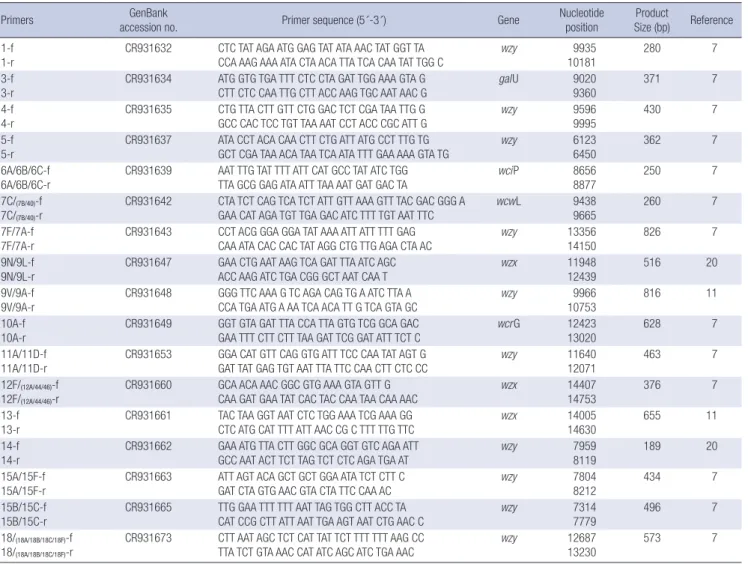
Table 1. Oligonucleotide primers used for pneumococcal typing by multiplex PCR
Primers GenBank
accession no. Primer sequence (5´-3´) Gene Nucleotide
position Product
Size (bp) Reference 1-f
1-r CR931632 CTC TAT AGA ATG GAG TAT ATA AAC TAT GGT TA
CCA AAG AAA ATA CTA ACA TTA TCA CAA TAT TGG C wzy 9935
10181 280 7
3-f
3-r CR931634 ATG GTG TGA TTT CTC CTA GAT TGG AAA GTA G
CTT CTC CAA TTG CTT ACC AAG TGC AAT AAC G galU 9020
9360 371 7
4-f 4-r
CR931635 CTG TTA CTT GTT CTG GAC TCT CGA TAA TTG G GCC CAC TCC TGT TAA AAT CCT ACC CGC ATT G
wzy 9596
9995
430 7
5-f
5-r CR931637 ATA CCT ACA CAA CTT CTG ATT ATG CCT TTG TG
GCT CGA TAA ACA TAA TCA ATA TTT GAA AAA GTA TG wzy 6123
6450 362 7
6A/6B/6C-f
6A/6B/6C-r CR931639 AAT TTG TAT TTT ATT CAT GCC TAT ATC TGG
TTA GCG GAG ATA ATT TAA AAT GAT GAC TA wciP 8656
8877 250 7
7C/(7B/40)-f 7C/(7B/40)-r
CR931642 CTA TCT CAG TCA TCT ATT GTT AAA GTT TAC GAC GGG A GAA CAT AGA TGT TGA GAC ATC TTT TGT AAT TTC
wcwL 9438
9665
260 7
7F/7A-f
7F/7A-r CR931643 CCT ACG GGA GGA TAT AAA ATT ATT TTT GAG
CAA ATA CAC CAC TAT AGG CTG TTG AGA CTA AC wzy 13356
14150 826 7
9N/9L-f
9N/9L-r CR931647 GAA CTG AAT AAG TCA GAT TTA ATC AGC
ACC AAG ATC TGA CGG GCT AAT CAA T wzx 11948
12439 516 20
9V/9A-f 9V/9A-r
CR931648 GGG TTC AAA G TC AGA CAG TG A ATC TTA A CCA TGA ATG A AA TCA ACA TT G TCA GTA GC
wzy 9966
10753
816 11
10A-f
10A-r CR931649 GGT GTA GAT TTA CCA TTA GTG TCG GCA GAC
GAA TTT CTT CTT TAA GAT TCG GAT ATT TCT C wcrG 12423
13020 628 7
11A/11D-f 11A/11D-r
CR931653 GGA CAT GTT CAG GTG ATT TCC CAA TAT AGT G GAT TAT GAG TGT AAT TTA TTC CAA CTT CTC CC
wzy 11640
12071
463 7
12F/(12A/44/46)-f 12F/(12A/44/46)-r
CR931660 GCA ACA AAC GGC GTG AAA GTA GTT G CAA GAT GAA TAT CAC TAC CAA TAA CAA AAC
wzx 14407
14753
376 7
13-f
13-r CR931661 TAC TAA GGT AAT CTC TGG AAA TCG AAA GG
CTC ATG CAT TTT ATT AAC CG C TTT TTG TTC wzx 14005
14630 655 11
14-f 14-r
CR931662 GAA ATG TTA CTT GGC GCA GGT GTC AGA ATT GCC AAT ACT TCT TAG TCT CTC AGA TGA AT
wzy 7959
8119
189 20
15A/15F-f
15A/15F-r CR931663 ATT AGT ACA GCT GCT GGA ATA TCT CTT C
GAT CTA GTG AAC GTA CTA TTC CAA AC wzy 7804
8212 434 7
15B/15C-f
15B/15C-r CR931665 TTG GAA TTT TTT AAT TAG TGG CTT ACC TA
CAT CCG CTT ATT AAT TGA AGT AAT CTG AAC C wzy 7314
7779 496 7
18/(18A/18B/18C/18F)-f 18/(18A/18B/18C/18F)-r
CR931673 CTT AAT AGC TCT CAT TAT TCT TTT TTT AAG CC TTA TCT GTA AAC CAT ATC AGC ATC TGA AAC
wzy 12687
13230
573 7
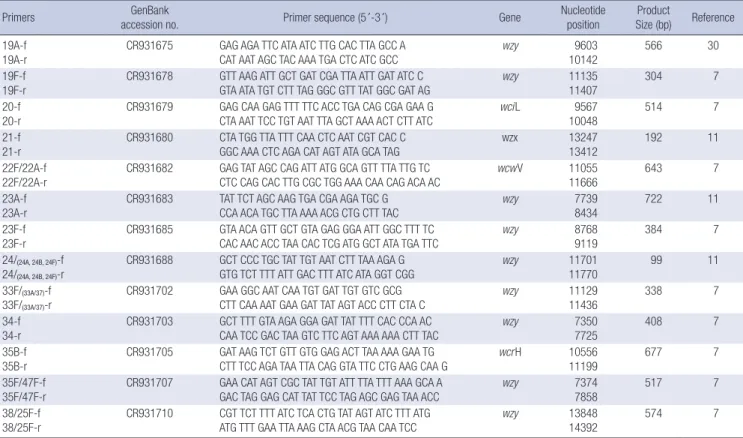
(continued to the next page)
precipitation solution was added to each 600 μL sample, and then the samples were cooled on ice and centrifuged for 3 min at 13,200 rpm to pellet the cell debris. An aliquot of each supernatant con- taining extracted DNA was used as a template for PCR.
Thirty primer pairs were designed to target serotypes 1, 3, 4, 5, 6A/6B/6C, 7C, 7F, 9N, 9V, 10A, 11A, 12F, 13, 14, 15A, 15B/15C, 18C, 19A, 19F, 20, 21, 22F, 23A, 23F, 24F, 34, 35B, 35F, 37, and 38.
The sequences for the type-specific primers were published by the CDC (USA) (11) and the primers were designed on the ba- sis of cps loci containing the serotype-specific genes that serve as the basis for differentiation of pneumococci by PCR-based approaches (Table 1) (12). Eight multiplex reactions were se- quentially performed as shown in Table 2. These primers were grouped together based on the frequency of serotype distribu- tions among invasive pneumococci recovered in Korea (10), such
that common serotypes were included in reactions 1 through 3.
The PCRs were performed in 25 μL volumes, with each reac- tion mixture containing the following: 2.5 μL of × 10 Tris-HCl buf- fer (100 mM, pH 8.3, Mg2+ free), 2.0 μL of 2.5 mM dNTPs, 2.0 μL of MgCl2, 0.25 μL of 5.0 U/μL Taq DNA polymerase (Takara Bio Inc., Japan), primers with pre-determined concentrations (Data not shown), and distilled water to a final volume of 20 μL. Final- ly, 5 μL of the DNA extract from the clinical specimens was add- ed to each reaction mixture. Thermal cycling was performed in a PTC-200 Peltier Thermal Cycler DNA engine (MJ Research, Watertown, MA, USA) under the following conditions: 95°C for 15 min followed by 35 amplification cycles of 94°C for 30 sec, 63°C for 90 sec, and 72°C for 60 sec. Each PCR included distilled water as a negative control and DNA extracted from pneumo- coccal isolates from which serotypes were previously determined
Table 1. (continued from the previous page) Oligonucleotide primers used for pneumococcal typing by multiplex PCR
Primers GenBank
accession no. Primer sequence (5´-3´) Gene Nucleotide
position
Product
Size (bp) Reference 19A-f
19A-r CR931675 GAG AGA TTC ATA ATC TTG CAC TTA GCC A
CAT AAT AGC TAC AAA TGA CTC ATC GCC wzy 9603
10142 566 30
19F-f 19F-r
CR931678 GTT AAG ATT GCT GAT CGA TTA ATT GAT ATC C GTA ATA TGT CTT TAG GGC GTT TAT GGC GAT AG
wzy 11135
11407
304 7
20-f
20-r CR931679 GAG CAA GAG TTT TTC ACC TGA CAG CGA GAA G
CTA AAT TCC TGT AAT TTA GCT AAA ACT CTT ATC wciL 9567
10048 514 7
21-f 21-r
CR931680 CTA TGG TTA TTT CAA CTC AAT CGT CAC C GGC AAA CTC AGA CAT AGT ATA GCA TAG
wzx 13247
13412
192 11
22F/22A-f 22F/22A-r
CR931682 GAG TAT AGC CAG ATT ATG GCA GTT TTA TTG TC CTC CAG CAC TTG CGC TGG AAA CAA CAG ACA AC
wcwV 11055
11666
643 7
23A-f
23A-r CR931683 TAT TCT AGC AAG TGA CGA AGA TGC G
CCA ACA TGC TTA AAA ACG CTG CTT TAC wzy 7739
8434 722 11
23F-f 23F-r
CR931685 GTA ACA GTT GCT GTA GAG GGA ATT GGC TTT TC CAC AAC ACC TAA CAC TCG ATG GCT ATA TGA TTC
wzy 8768
9119
384 7
24/(24A, 24B, 24F)-f
24/(24A, 24B, 24F)-r CR931688 GCT CCC TGC TAT TGT AAT CTT TAA AGA G
GTG TCT TTT ATT GAC TTT ATC ATA GGT CGG wzy 11701
11770 99 11
33F/(33A/37)-f
33F/(33A/37)-r CR931702 GAA GGC AAT CAA TGT GAT TGT GTC GCG
CTT CAA AAT GAA GAT TAT AGT ACC CTT CTA C wzy 11129
11436 338 7
34-f 34-r
CR931703 GCT TTT GTA AGA GGA GAT TAT TTT CAC CCA AC CAA TCC GAC TAA GTC TTC AGT AAA AAA CTT TAC
wzy 7350
7725
408 7
35B-f
35B-r CR931705 GAT AAG TCT GTT GTG GAG ACT TAA AAA GAA TG
CTT TCC AGA TAA TTA CAG GTA TTC CTG AAG CAA G wcrH 10556
11199 677 7
35F/47F-f
35F/47F-r CR931707 GAA CAT AGT CGC TAT TGT ATT TTA TTT AAA GCA A
GAC TAG GAG CAT TAT TCC TAG AGC GAG TAA ACC wzy 7374
7858 517 7
38/25F-f 38/25F-r
CR931710 CGT TCT TTT ATC TCA CTG TAT AGT ATC TTT ATG ATG TTT GAA TTA AAG CTA ACG TAA CAA TCC
wzy 13848
14392
574 7
This table was modified from reference 11.
Table 2. Pneumococcal serotypes that are included in 8 multiplex PCRs PCR reaction Total number of
included serotypes Serotypes
Reaction 1 8 14 6A/6B /6C/6D 23F 19A 9V
Reaction 2 5 19F 3 15B/15C 18C
Reaction 3 4 1 5 9N 7F
Reaction 4 3 4 20 22F
Reaction 5 5 7C 12F 11A 10A 23A
Reaction 6 5 21 37 15A 35F 13
Reaction 7 2 38 35B
Reaction 8 2 24F 34
by the quellung reaction as a positive control.
Type determination of serogroup 6
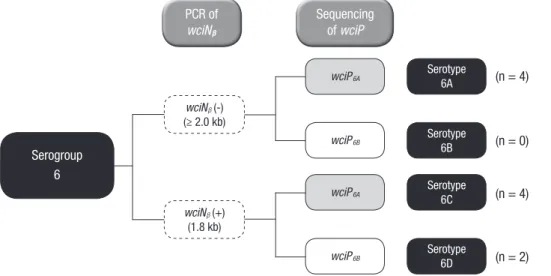
To assign types to 6 serogroups, we screened 10 strains that were positive by PCR with 6A/6B/6C primer for the presence of either wciNβ or wciP genes using 2 simplex PCRs and subsequent se- quencing analysis. First, the wciN gene was amplified with the forward primer (5106) 5´-TAC CAT GCA GGG TGG AAT GT-3´
and the reverse primer (3101) 5´-CCA TCC TTC GAG TAT TGC- 3´, resulting in product sizes of 1.8 kb for types 6C or 6D for the wciNβ gene. Following this reaction, presence of an G or A at po- sition 584, a characteristic of 6A and 6B wciP (wciP6A and wciP6B) respectively, was confirmed by sequencing analysis of the wciP gene using the forward primer 5´-AAT TTG TAT TTT ATT CAT GCC TAT ATC TGG-3´ and the reverse primer 5´-TTA GCG GAG ATA ATT TAA AAT GAT GAC TA-3´ (11). Strains that carry wciP6A
genes are assigned as type 6A or 6C and those that carry wciP6B
are assigned as type 6B or 6D (Fig. 1).
RESULTS
Optimization of multiplex PCR
Among a total of 54 serotypes that could be determined by 8 se- quential multiplex PCRs with 30 primers, 34 serotypes (except serotypes 7A/7B, 9A/9L, 11D, 12A, 15F, 18A/18B/18F, 22A, 24A/
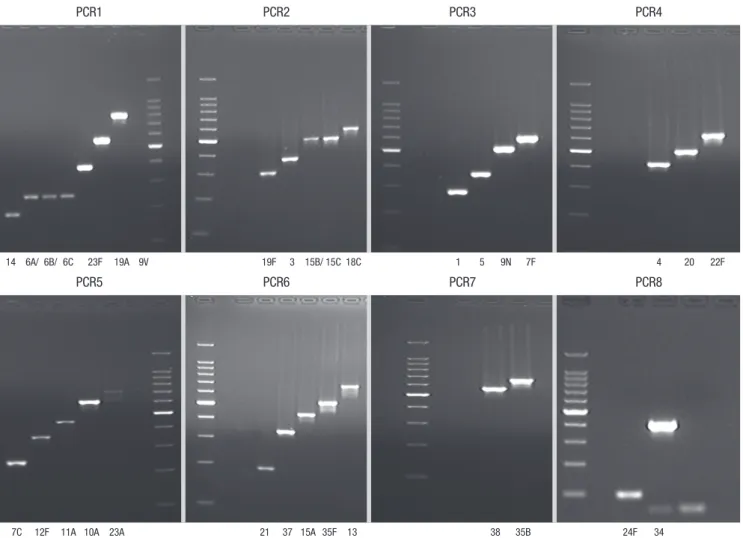
24B, 25F, 33A/33F, 40, 44, 46, 47F) were available from the ar- chived pneumococcal isolates for which serotypes were deter- mined previously by the quellung reaction. A multiplex PCR system was optimized for these strains such that we were able to produce all the PCR products of each serotype-specific size (Fig. 2).
Types identified by multiplex PCR
Seventy-seven pneumococcal isolates were tested and all sam- ples were successfully amplified by PCR. The types identified by
the PCR assays were as follows: 1 (n = 1), 3 (n = 3), 4 (n = 1), 5 (n = 1), 6A/6B/6C/6D (n = 10), 7C (n = 1), 7F (n = 2), 9V (n = 4), 10A (n = 3), 11A (n = 4), 12F (n = 1), 13 (n = 3), 14 (n = 4), 15A/15B (n
= 8), 15C (n = 4), 19A (n = 5), 19F (n = 3), 20 (n = 1), 22F (n = 3), 23A (n = 4), 23F (n = 4), 34 (n = 2), 35B (n = 4), and 37 (n = 1). Of the 77 total isolates, 28 were detected in reaction 1 (including serotypes 6A/6B/6C/6D, 9V, 14, 19A, 23F), 14 in reaction 2 (in- cluding serotypes 3, 15B/15C, 19F), and 4 in reaction 3 (includ- ing serotypes 1, 5, 7F). Therefore, 60% of all serotypes were de- termined within these 3 reactions.
Identification of 6C and 6D
Multiplex PCR reaction 1 identified 10 strains within serogroup 6.
From them, 4 isolates of 6A or 6B and 6 isolates of 6C or 6D were delineated by the first simplex PCR using primers for the wciNβ
gene. Sequencing of the wciP gene showed wciP6A gene sequenc- es for 4 strains within 6A or 6B subgroup, indicating these were all serotype 6A. Among the 6 strains within 6C or 6D subgroup, sequencing analysis revealed wciP6A gene in 4 strains (serotype 6C) and wciP6B gene in 2 strains (serotype 6D) (Fig. 1).
Comparison with the conventional quellung reaction Serotypes determined by multiplex PCR were in complete con- cordance, with one exception, with those previously determined by conventional serotyping methods. One isolate was typed as 19A by PCR but previously assigned 19F by quellung reaction.
When the conventional serotyping and PCR were repeated, the serotype was confirmed to be 19A.
DISCUSSION
This study aimed to develop a method for molecular serotyping of pneumococcus by multiplex PCR assays. We were able to iden- tify 24 serotypes correctly out of 77 pneumococcal isolates for which serotypes were previously determined by the quellung Serogroup
6
Serotype
6A (n = 4)
(n = 0)
(n = 4)
(n = 2) PCR of
wciNϐ
Sequencing of wciP
Serotype 6B
Serotype 6C
Serotype 6D wciNϐ(-)
(≥ 2.0 kb)
wciNϐ(+) (1.8 kb)
wciP6A
wciP6A
wciP6B
wciP6B
Fig. 1. Type determination of serogroup 6 based on the presence of wciNβ and the se- quencing results of the wciP genes.
reaction. In addition, the PCR assay identified one strain that was erroneously serotyped by the classic method. The findings in this study suggest that the performance of the multiplex PCR assay is excellent and it can be successfully used for pneumo- coccal serotyping.
Capsular serotype-specific polysaccharides are a major viru- lence factor in disease development following infection and pneumococcal impact on human health is various according to the capsular type (9). The PCVs provide significant serotype-spe- cific protection against invasive disease; however, rates of IPD were still substantial. Serotype replacement is already eroding the efficacy of PCV7 in high-risk populations (13). The recent li- censure of 13-valent pneumococcal conjugate vaccine (PCV13), which includes PCV7 serotypes plus serotypes 1, 3, 5, 6A, 7F, and 19A may reduce IPD caused by these 6 added serotypes. How- ever, non-PCV13 serotypes may likely be associated with sero- type replacement in the future (14). Therefore, continuous accu- rate monitoring for serotype in individual region is important.
Identification of pneumococcal serotypes is currently per- formed using large panels of expensive antisera in the quellung reaction, the traditional ‘gold standard’. Cross-reactions between
serotypes and discrepancies between methods can occur, and some strains are non-serotypable (6). A rapid pneumococcal serotyping assay has been developed recently, (the ‘multibead assay’) based on the capacity of pneumococcal lysates to inhibit the ability of 24 different anti-capsule antibodies to bind to latex beads coated with 34 different polyssacharides (15). This assay is well suited for use in primary screening because of its high throughput and reproducible results, but access to serological reagents is quite limited. Also, serotype coverage is currently lim- ited to only 24 serotypes of 92 (16).
Molecular typing has the potential to improve discrimination and provide additional information. Although several molecu- lar typing methods had been developed early in the 2000s, all required further evaluation and improvement (17, 18). Produc- tion of the capsule is largely controlled by capsular polysaccha- ride synthesis genes located at the cps locus, in which the first four genes are conserved in almost all serotypes, while the cen- tral parts of the loci contain the serotype-specific genes that serve as the basis for differentiation of pneumococci by PCR-based approaches (17). The cps gene clusters for at least 16 pneumo- coccal serotypes have been sequenced and serotype-specific PCR1
14 6A/ 6B/ 6C 23F 19A 9V 19F 3 15B/15C18C 1 5 9N 7F 4 20 22F
PCR3
PCR2 PCR4
PCR5
7C 12F 11A 10A 23A 21 37 15A 35F 13 38 35B 24F 34
PCR7
PCR6 PCR8
Fig. 2. Representative multiplex reactions. The serotypes determined by 8 different multiplex formulations are shown below the lanes, respectively.
genes were identified earlier (19). The sequences of the cps loci from all of the 92 known pneumococcal serotypes have been completed recently (http://www.sanger.ac.uk/Projects/ S_pneu- moniae/CPS/), providing an opportunity to develop a simple sequence-based scheme for identifying the most commonly oc- curring serotypes. In 2006, the CDC (USA) recommended typ- ing by PCR and developed a protocol for the same (7). On the basis of this protocol, two other groups developed modified PCR protocols to cover their own prevalent serotypes (20, 21). These studies determined that this method required minimal training and no prior experience with PCR for efficient and accurate se- rotype surveillance, and was far less time-consuming than clas- sical quellung reaction-based serotyping.
Recent interest in pneumococcus has been focused on newly discovered pneumococcal serotypes, 6C and 6D (22, 23), and 6D prevalence has been higher than 6C since 1996 in Korea (8).
In a recent study, factor 6d antiserum was validated for accurate serotyping of 6C and is now commercially available (24), but an- tiserum for the detection of 6D has not yet been developed. The detection of 6D is only possible by molecular methods using cap- sular DNA (25).
The PCR system used in this study is also well adapted for typ- ing most prevalent serotypes of pneumococcus, including 6C and 6D, and required less work and skill for accurate typing. Ad- ditionally, we did not find evidence suggesting that the genetic variability between different strains of the same serotype could affect its serotype determination using a PCR-based approach, as suggested previously (26). There was only one case in which the results of the multiplex PCR scheme and original convention- al serotyping were discrepant. In this instance, the PCR-based result proved to be accurate. We were able to reaffirm that sub- jectivity in interpretation of the quellung reaction can result in incorrect serotyping.
Major advantages of this molecular approach include the po- tential to type small numbers of isolates at moderate expense, prompt identification of predominant serotypes for case inves- tigations, and a reduction in the number of isolates requiring transport to reference laboratories for serotyping. Since the first 3 reactions in this sequential multiplex scheme are designed to cover the predominant serotypes in Korea (2), they would theo- retically detect -85% of all isolates obtained through the SNUCH surveillance (1991 to 2005) program. In reality, we were only able to determine types in 60% of the isolates within these 3 reactions.
However, if test strains for the PCR assay were selected in exact proportion to our serotype epidemiology, the percentages should be greatly increased. In addition, this scheme allowed us to ob- tain results for all of the isolates within the PCV13 as well as the PCV7, except serotype 4 (included in reaction 4). The adaptabil- ity of this method to grouping alternative combinations of sero- type-specific primer sets according to seroprevalence in individ- ual countries could save cost and time.
A major limitation of pneumococcal serotype epidemiology is that most cases, including empyema and meningitis, remain culture-negative due to the widespread use of antibiotics prior to presenting at the hospital. Recently, several studies have re- vealed increased identification of pneumococcus and subse- quent typing by multiplex PCR assay in IPDs. Application of mo- lecular diagnosis improved detection rate of pneumococcus from 24% by culture to 71% by PCR and it also provided the op- portunity to know the serotype distribution in pneumococcal empyema (27). Benefit of molecular typing method was shown in pneumococcal meningitis as well (28). Overall, molecular typing method can add further detail to the clinical profile and epidemiology of pneumococcal disease.
Additionally, the measurement of pneumococcal carriage in the nasopharyngeal reservoir is subject to potential confound- ers that include low-density and multiple-strain colonization.
Detection of simultaneous carriage with more than one sero- type using standard culture methods is severely limited (29), yet detection of all pneumococcal serotypes present in respiratory specimens is critical for the study of the epidemiology of pneu- mococcal colonization. If multiplex PCR typing could be done directly on clinical samples, more co-colonization may be de- tected.
Nevertheless, this PCR approach still has several problems.
First, the amount of genetic variability that exists among differ- ent isolates expressing the same serotype is unknown. Also there is the potential to assign types to strains with defective cps oper- ons, although such isolates are rarely recovered from invasive infections. Another weakness of the current PCR approach is the inability to determine all types due to the absence of some type specific-PCR primers. Furthermore, we are currently un- able to resolve certain types from rarely occurring serotypes with- in the same serogroup because some primers are designed to detect multiple serotypes. Therefore, additional testing using the quellung reaction or sequencing is required for precise typ- ing. However, because the sequences of the cps loci from all of the known 92 pneumococcal serotypes have been recently com- pleted, we have an opportunity to overcome most of these prob- lems.
We have attempted to develop a schematic approach to sero- typing the isolates obtained through our surveillance program using 30 primer pairs divided among 8 multiplex PCRs as a mod- ification of the protocol provided by the CDC (USA). Each mul- tiplex reaction was designed to sequentially include the most frequently occurring serotypes, with 8 reactions progressively covering all the isolates identified in our center since 1991. For typing of serogroup 6, an additional 2-step simplex PCR and se- quencing were included.
In conclusion, a multiplex PCR approach was successfully adapted to target the most prevalent serotypes in 3 reactions, and can be used as an alternative to costly conventional sero-
typing in Korea, allowing for meaningful serotype surveillance by laboratories equipped only with basic PCR capability. Over- all, we have found this PCR approach to be highly reliable, with the potential to greatly reduce reliance upon conventional sero- typing. These molecular typing methods will be essential for ep- idemiological studies that are needed to monitor serotype dis- tribution and detect serotype switching, if any, among S. pneu- moniae isolates before and after the introduction and widespread use of conjugate vaccines.
REFERENCES
1. Lee JH, Cho HK, Kim KH, Kim CH, Kim DS, Kim KN, Cha SH, Oh SH, Hur JK, Kang JH, Kim JH, Kim YK, Hong YJ, Chung EH, Park SE, Choi YY, Kim JS, Kim HM, Choi EH, Lee HJ. Etiology of invasive bacterial in- fections in immunocompetent children in Korea (1996-2005): a retrospec- tive multicenter study. J Korean Med Sci 2011; 26: 174-83.
2. Kim SH, Song EK, Lee JH, Kim NH, Lee JA, Choi EH, Lee HJ. Changes of serotype distribution of Streptococcus pneumoniae isolated from children in Korea over a 15 year-period (1991-2005). Korean J Pediatr Infect Dis 2006; 13: 89-98.
3. Whitney CG, Farley MM, Hadler J, Harrison LH, Bennett NM, Lynfield R, Reingold A, Cieslak PR, Pilishvili T, Jackson D, Facklam RR, Jorgensen JH, Schuchat A. Decline in invasive pneumococcal disease after the in- troduction of protein-polysaccharide conjugate vaccine. N Engl J Med 2003; 348: 1737-46.
4. Kim KH, Hong JY, Lee H, Kwak GY, Nam CH, Lee SY, Oh E, Yu J, Nahm MH, Kang JH. Nasopharyngeal pneumococcal carriage of children at- tending day care centers in Korea: comparison between children immu- nized with 7-valent pneumococcal conjugate vaccine and non-immu- nized. J Korean Med Sci 2011; 26: 184-90.
5. Choi EH, Kim SH, Eun BW, Kim SJ, Kim NH, Lee JA, Lee HJ. Streptococ- cus pneumoniae serotype 19A in children, South Korea. Emerg Infect Dis 2008; 14: 275-81.
6. Sørensen UB. Typing of pneumococci by using 12 pooled antisera. J Clin Microbiol 1993; 31: 2097-100.
7. Pai R, Gertz RE, Beall B. Sequential multiplex PCR approach for deter- mining capsular serotypes of Streptococcus pneumoniae isolates. J Clin Microbiol 2006; 44: 124-31.
8. Choi EH, Lee HJ, Cho EY, Oh CE, Eun BW, Lee J, Kim MJ. Prevalence and genetic structures of Streptococcus pneumoniae serotype 6D, South Korea. Emerg Infect Dis 2010; 16: 1751-3.
9. Sandgren A, Sjostrom K, Olsson-Liljequist B, Christensson B, Samuels- son A, Kronvall G, Henriques Normark B. Effect of clonal and serotype- specific properties on the invasive capacity of Streptococcus pneumoni- ae. J Infect Dis 2004; 189: 785-96.
10. Song EK, Lee JH, Kim NH, Lee J, Kim DH, Park KW, Choi EH, Lee HJ.
Epidemiology and clinical reatures of invasive pneumococcal infections in children. Korean J Pediatr Infect Dis 2005; 12: 140-8.
11. CDC. Oligonucleotide primers used for deducing 40 pneumococcal cap- sular serotypes. Available at http://www.cdc.gov/ncidod/biotech/files/
pcr-oligonucleotide-primers-March2010.pdf [accessed on March 2010].
12. Kong F, Gilbert GL. Using cpsA-cpsB sequence polymorphisms and sero- type-/group-specific PCR to predict 51 Streptococcus pneumoniae cap-
sular serotypes. J Med Microbiol 2003; 52: 1047-58.
13. Singleton RJ, Hennessy TW, Bulkow LR, Hammitt LL, Zulz T, Hurlburt DA, Butler JC, Rudolph K, Parkinson A. Invasive pneumococcal disease caused by nonvaccine serotypes among alaska native children with high levels of 7-valent pneumococcal conjugate vaccine coverage. JAMA 2007;
297: 1784-92.
14. Pandya GA, McEllistrem MC, Venepally P, Holmes MH, Jarrahi B, Sanka R, Liu J, Karamycheva SA, Bai Y, Fleischmann RD, Peterson SN. Moni- toring the long-term molecular epidemiology of the pneumococcus and detection of potential ‘vaccine escape’ strains. PLoS One 2011; 6: e15950.
15. Yu J, Carvalho Mda G, Beall B, Nahm MH. A rapid pneumococcal sero- typing system based on monoclonal antibodies and PCR. J Med Micro- biol 2008; 57: 171-8.
16. Cho KY, Lee JA, Cho SE, Kim NH, Lee JA, Hong KS, Lee HJ, Kim KH. A study of serotyping of Streptococcus pneumoniae by multibead assay.
Korean J Pediatr 2007; 50: 151-6.
17. Lawrence ER, Arias CA, Duke B, Beste D, Broughton K, Efstratiou A, George RC, Hall LM. Evaluation of serotype prediction by cpsA-cpsB gene polymorphism in Streptococcus pneumoniae. J Clin Microbiol 2000; 38:
1319-23.
18. Lawrence ER, Griffiths DB, Martin SA, George RC, Hall LM. Evaluation of semiautomated multiplex PCR assay for determination of Streptococcus pneumoniae serotypes and serogroups. J Clin Microbiol 2003; 41: 601-7.
19. Jiang SM, Wang L, Reeves PR. Molecular characterization of Streptococ- cus pneumoniae type 4, 6B, 8, and 18C capsular polysaccharide gene clus- ters. Infect Immun 2001; 69: 1244-55.
20. Dias CA, Teixeira LM, Carvalho Mda G, Beall B. Sequential multiplex PCR for determining capsular serotypes of pneumococci recovered from Brazilian children. J Med Microbiol 2007; 56: 1185-8.
21. Morais L, Carvalho Mda G, Roca A, Flannery B, Mandomando I, Soria- no-Gabarró M, Sigauque B, Alonso P, Beall B. Sequential multiplex PCR for identifying pneumococcal capsular serotypes from South-Saharan African clinical isolates. J Med Microbiol 2007; 56: 1181-4.
22. Park IH, Pritchard DG, Cartee R, Brandao A, Brandileone MC, Nahm MH. Discovery of a new capsular serotype (6C) within serogroup 6 of Streptococcus pneumoniae. J Clin Microbiol 2007; 45: 1225-33.
23. Jin P, Kong F, Xiao M, Oftadeh S, Zhou F, Liu C, Russell F, Gilbert GL. First report of putative Streptococcus pneumoniae serotype 6D among naso- pharyngeal isolates from Fijian children. J Infect Dis 2009; 200: 1375-80.
24. Jacobs MR, Dagan R, Bajaksouzian S, Windau AR, Porat N. Validation of factor 6d antiserum for serotyping Streptococcus pneumoniae serotype 6C. J Clin Microbiol 2010; 48: 1456-7.
25. Bratcher PE, Kim KH, Kang JH, Hong JY, Nahm MH. Identification of natural pneumococcal isolates expressing serotype 6D by genetic, biochem- ical and serological characterization. Microbiology 2010; 156: 555-60.
26. Yu J, Lin J, Benjamin WH Jr, Waites KB, Lee CH, Nahm MH. Rapid mul- tiplex assay for serotyping pneumococci with monoclonal and polyclonal antibodies. J Clin Microbiol 2005; 43: 156-62.
27. Blaschke AJ, Heyrend C, Byington CL, Obando I, Vazquez-Barba I, Doby EH, Korgenski EK, Sheng X, Poritz MA, Daly JA, Mason EO, Pavia AT, Ampofo K. Molecular analysis improves pathogen identification and epidemiologic study of pediatric parapneumonic empyema. Pediatr In- fect Dis J 2011; 30: 289-94.
28. Saha SK, Darmstadt GL, Baqui AH, Hossain B, Islam M, Foster D, Al- Emran H, Naheed A, Arifeen SE, Luby SP, Santosham M, Crook D. Iden-
tification of serotype in culture negative pneumococcal meningitis using sequential multiplex PCR: implication for surveillance and vaccine de- sign. PLoS One 2008; 3: e3576.
29. Huebner RE, Dagan R, Porath N, Wasas AD, Klugman KP. Lack of utility of serotyping multiple colonies for detection of simultaneous nasopha- ryngeal carriage of different pneumococcal serotypes. Pediatr Infect Dis J
2000; 19: 1017-20.
30. Pimenta FC, Gertz RE Jr, Roundtree A, Yu J, Nahm MH, McDonald RR, Carvalho Mda G, Beall BW. Rarely occurring 19A-like cps locus from a serotype 19F pneumococcal isolate indicates continued need of serology- based quality control for PCR-based serotype determinations. J Clin Mi- crobiol 2009; 47: 2353-4.
AUTHOR SUMMARY
Streptococcus pneumoniae Type Determination by Multiplex Polymerase Chain Reaction
Ki Wook Yun, Eun Young Cho, Ki Bae Hong, Eun Hwa Choiand Hoan Jong Lee
In this study we develop pneumococcal typing by multiplex PCR and compare it with conventional serotyping by Quellung reaction. All isolates were successfully typed by multiplex PCR assays adapted to target the most prevalent serotypes in 3 reactions.
In addition, type 6 was easily identified based on the presence of wciNβ and/or wciP genes in 2 simplex PCRs and sequencing. The multiplex PCR assay was highly reliable, with the potential to greatly reduce reliance upon conventional serotyping.