INTRODUCTION
Pregnancy rarely occurs in women with Cushing’s syn- drome(CS), because both excessive cortisol and androgen levels suppress gonadotropin secretion and impair ovarian and endometrial functions. CS usually presents with hyper- tension and diabetes, so it may give rise to increase mater- nal and fetal morbidity, including high rates of miscarriage or premature delivery. Here we report a case of CS in preg- nancy secondary to an adrenal cortical adenoma, which was diagnosed after delivery and treated with laparoscopic adre- nalectomy.
CASE REPORT
A 30-yr-old pregnant woman gravida two para one at 30 weeks of gestation was referred and admitted in March 31 2001, because of the difficulty of controlling hypertension and cushingoid features. She had been diagnosed the gesta- tional diabetes at 27 weeks’ gestation by the 100-gram oral glucose tolerance test, and had been controlled through the diet control. She experienced preeclampsia in her previous pregnancy and was delivered by cesarean operation.
Physical examination revealed with some features of CS, including moon face, truncal obesity, muscular atrophy, purple striae on the abdomen, hyperpigmentation over pres- sure areas and acne. Her blood pressure in hospital ranged
from 150/100 to 190/120 mmHg. She was administered with intravenous hydralazine, but her blood pressure was not controlled.
Her blood sugar level after admission was 106 mg/dL due to diet control. Urinary dipstick test revealed significant pro- teinuria (+++). Except for mild increased serum GOT/GPT (57/100 U/L), other laboratory abnormalities were not found.
Fetal ultrasonography revealed a single viable fetus with normal morphology and parameters. Diastolic pressure of umbilical artery was nearly absent and RI was checked at 0.97. The fetal heart rate monitoring disclosed a loss of vari- ability. Because of severe preeclampsia and compromised fetal status, emergency cesarean operation was performed. A 1,220-gram female baby with Apgar scores of 6 at 1 min and 8 at 5 min was delivered. The neonatal course was compli- cated by a moderate respiratory distress syndrome requiring artificial surfactant. The baby was discharged 3 months later in a good condition.
A provisional diagnosis of CS in pregnancy with gestational diabetes was made after delivery because of some clinical features of CS above described, and plasma cortisol, 24-hr urinary free cortisol and plasma ACTH, the plasma cortisol response to low- and high-dose dexamethasone suppression tests was measured. Her morning and evening plasma corti- sol levels were 26.3 g/dL (normal: 5-25 g/dL) and 34.6 g/dL (normal: half of the morning level), respectively. 24 hr urinary free cortisol were 409.5 nmol/day (normal: 55- 248 nmol/day), and were not suppressed with low-dose or
Department of Obstetrics & Gynecology, College of Medicine, Dong-A University and Institute of Medical Science, Busan, Korea
Myoung Seok Han, M.D.
Department of Obstetrics and Gynecology, College of Medicine, Dong-A University and Institute of Medical Science, Dongdaeshin-dong 3Ga, Seo-gu, Busan 602-715, Korea
Tel : +82.51-240-5098, Fax : +82.51-244-9553 E-mail : [email protected]
444 J Korean Med Sci 2003; 18: 444-6
ISSN 1011-8934
Copyright The Korean Academy of Medical Sciences
Cushing’s syndrome in pregnant women is rare and difficult to be diagnosed because of the syndrome's association with oligomenorrhea or amenorrhea and the changes in cortisol metabolism during normal pregnancy. Cushing syndrome in pregnancy is usually confused with complicated pregnancy, such as preeclamp- sia or gestational diabetes, and its rarity leads to a low degree of clinical suspi- cion, often delaying diagnosis. We experienced a case of Cushing’s syndrome in pregnancy, which had been considered as the severe preeclampsia and ges- tational diabetes due to uncontrolled hypertension and hyperglycemia. The preg- nancy was terminated with an emergency cesarean operation at 30 weeks of gestation because of severe preeclampsia. In consequence of the evaluation about the Cushing’s syndrome after delivery, the adrenal cortical adenoma of right adrenal gland was diagnosed and laparoscopic adrenalectomy was per- formed.
Key Words : Cushing’s Syndrome; Pregnancy; Adenoma, Adrenal Cortical
Received : 18 March 2002 Accepted : 8 July 2002
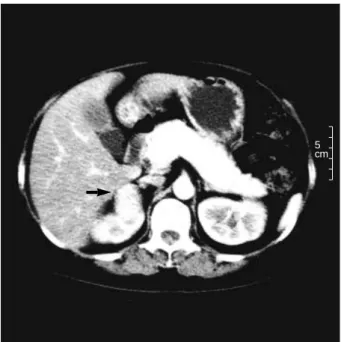
high-dose dexamethasone loading. ACTH level was 2-14 pg/mL (normal: 10-60 pg/mL). Abdominal CT detected a 3-cm sized right adrenal mass (Fig. 1). The final diagnosis was CS in pregnancy secondary to an adrenal tumor. The patient underwent a laparoscopic right adrenalectomy. Patho- logic examination showed a benign adrenocortical adenoma.
Maintenance steroid replacement was continued postop- eratively until now because of impaired adrenal function.
DISCUSSION
The occurrence of pregnancy in the face of untreated CS is rare because of the high incidence of ovulatory disturbances experienced by patients with the disorder. In 1953, Hunt and McConahey (1) first reported several cases of pregnancy associated with untreated Cushing syndrome. Since then Buescher et al. (2) reviewed a total of 58 patients with 65 pregnancies associated with CS in the world literature and found that 50% of these cases were caused by adrenal ade- noma, in contrast to 15.7% in nonpregnant women. In 1998, Murakami et al. (3) showed similar results that the benign adrenocortical adenoma was found in about half of pregnan- cy with CS, but the most common cause of CS in nonpreg- nant women was pituitary-dependent adrenal hyperplasia.
This difference may be related to the mechanism of ovula- tion suppression. In other words, the patient with pituitary- dependent CS could due mainly to a disturbed gonadotropic axis, such as cosecretion of prolactin, but the patients with an adrenal adenoma are more likely to be purely cortisol- producing, allowing women to retain more often their ovu- latory function (2-4).
CS is a disease associated with high mortality rates, esti- mated at 50% at 5 yr when the disease is untreated. CS in pregnancy follows a hazardous course with an increased inci- dence of abortion, premature labor, hypertension, gestation- al diabetes, cardiac failure and even pulmonary edema (2, 3, 5). It is therefore not surprising that the maternal morbidity in CS is excessive.
Hypertension and glucose intolerance are common mater- nal complications. Their incidences are reported as high as 58.8% and 25.0%, respectively (3). In this case, blood pres- sure was also very high and was not controlled by intravenous hydralazine administration. Although the maternal glucose level in this patient was not so high at the time of admis- sion, postpartum blood glucose level ranged from 110 mg/
dL to 240 mg/dL. This may be owing to the patient’s strict diet control during antepartum period.
Fetal complications are also severe. Preterm deliveries, be- tween 22 and 36 gestational weeks, were associated with half of pregnancies. Intrauterine growth retardation (IUGR) oc- curred in 13.2% and perinatal deaths were 8.8% of the preg- nancies (3). Fetal weight in this case was 1,220-gram, so IUGR was not marked, considering that the gesational age was 30 weeks.
If the etiology of CS is adrenal adenoma, the therapeutic alternatives are unilateral adrenalectomy during pregnancy or medical treatment with operation performed after delivery (6, 7). The ideal timing for an adrenalectomy is not known, but most obstetricians and surgeons consider the second trimester to be suitable as the pregnancy is relatively more stable during this period (8). This patient was treated with laparoscopic adrenalectomy after delivery because the diag- nosis was made after cesarean operation. Successful medical treatment of hypercortisolism secondary to an adrenal ade- noma during pregnancy with metyrapone or ketoconazole has also been reported (9). However, metyrapone crosses the placenta and may affect fetal adrenal steroid synthesis, and ketoconazole is teratogenic and embryotoxic in animals (10).
This treatment could be an alternative for poor surgical can- didates or be used to stabilize patients prior to operation.
We believe that CS complicating pregnancy is a high-risk obstetric condition. Definitive treatment during pregnancy may not alter the perinatal outcome except for a reduction in the prematurity rates. During the third trimester, early delivery of the fetus, with delay of definite therapy until after delivery, may be the most prudent course. Vaginal delivery is preferable to cesarean operation because of the problems with poor tissue healing and wound breakdown. Therapy must be indivisualized between a definitive surgical approach versus alleviation of hypercortisolism using chemotherapy.
There is no logical phase for supportive therapy alone because maternal and perinatal outcomes are unacceptably poor in the face of untreated Cushing syndrome.
Conclusively, CS in pregnancy requires a high index of suspicion because of its rarity, therefore CS is worthy of being
Cushing’s Syndrome and Pregnancy 445
Fig. 1.Abdominal CT showing a right adrenal mass (arrow).
5 cm
considered when a pregnant woman develops high blood pressure and/or hyperglycemia. Otherwise, both mother and fetus may have poor outcomes, since the diagnosis is delayed and treatment is not instituted in a timely manner.
REFERENCES
1. Hunt AB, McConahey WM. Pregnancy associated with diseases of the adrenal glands. Am J Obstet Gynecol 1953; 66: 970-87.
2. Buescher MA, McClamrock HD, Adashi EY. Cushing syndrome in pregnancy. Obstet Gynecol 1992; 79: 130-7.
3. Murakami S, Saitoh M, Kubo T, Kawakami Y, Yamashita K. A case of mid-trimester intrauterine fetal death with Cushing’s syndrome. J Obstet Gynaecol Res 1998; 24: 153-6.
4. Chico A, Manzanares JM, Halperin I, Martinez de Osaba MJ, Ade- lantado J, Webb SM. Cushing’s disease and pregnancy: report of
six cases. Eur J Obstet Gynecol Reprod Biol 1996; 64: 143-6.
5. Guihaume B, Sanson ML, Billaud L, Bertagna X, Laudat MH, Luton JP. Cushings syndrome and pregnancy: aetiologies and prognosis in twenty-two patients. Eur J Med 1992; 1: 83-9.
6. Pickard J, Jochen AL, Sadur CN, Hofeldt FD. Cushing’s syndrome in pregnancy. Obstet Gynecol Surv 1990; 45: 87-93.
7. Macgibbon AL, Brieger GM. Cushing syndrome in pregnancy sec- ondary to an adrenal cortical adenoma. Aust N Z J Obstet Gynaecol 1995; 35: 217-9.
8. Bevan JS, Gough MH, Gillmer MD, Burke CW. Cushing’s syn- drome in pregnancy: the timing of definitive treatment. Clin Endo- crinol 1987; 27: 225-33.
9. Amado JA, Pesquera C, Gonzalez EM, Otero M, Freijanes J, Alvarez A. Successful treatment with ketoconazole of Cushing s syndrome in pregnancy. Postgrad Med J 1990; 66: 221-3.
10. Aron DC, Schnall AM, Sheeler LR. Cushing’s syndrome and preg- nancy. Am J Obstet Gynecol 1990; 162: 244-52.
446 H.G. Kim, K.H. Lee, G.H. Je, et al.