A Study on the Korea Database Industry Promotion Act
Legislation
ABSTRACT
The Database Industry Promotion Act was proposed at the National Assembly plenary session on July 26, 2012 and since then it has been in the process of enactment in consultation with all the governmental departments concerned. The recent trend of economic globalization and smart device innovation suggests a new opportunity and challenges for all industries. The database industry is also facing a new phase in an era of smart innovation. Korea is in a moment of opportunity to take an innovative approach to promoting the database industry. Korea should set up a national policy to promote the database industry for citizens, government, and research
institu-ⓒ Seoung-Hun Bae, Jung-Sun Lim, Jae-Jin Lee,
Accepted date: September 23, 2013 Received date: May 14, 2013
✻Corresponding Author: Minsoo Shin Professor
Business School
Hanyang University, Korea E-mail: [email protected]
All JISTaP content is Open Access, meaning it is accessible online to everyone, without fee and authors’ permission. All JISTaP con-tent is published and distributed under the terms of the Creative Commons Attribution License (http://creativecommons.org /licenses/by/3.0/). Under this license, authors reserve the copy-right for their content; however, they permit anyone to unre-strictedly use, distribute, and reproduce the content in any medi-um as far as the original authors and source are cited. For any reuse, redistribution, or reproduction of a work, users must clari-fy the license terms under which the work was produced. Open Access
Journal of Information Science Theory and Practice http://dx.doi.org/10.1633/JISTaP.2013.1.3.5
Seoung-Hun Bae
Korea Institute of Science and Technology Information, Korea E-mail: [email protected]
Jung-Sun Lim
Korea Institute of Science and Technology Information, Korea E-mail: [email protected]
Jae-Jin Lee
Korea Database Agency Dept. of Strategy & Planning, Korea E-mail: [email protected]
Cheon-Woong Park
Korea Database Agency Dept. of Strategy & Planning, Korea E-mail: [email protected]
Kwang-Min Shin
Korea Institute of Science and Technology Information, Korea E-mail: [email protected]
Sang-Kyu Kang
Korea Institute of Science and Technology Information, Korea E-mail: [email protected]
Jin-Sun Yoon
Korea Institute of Science and Technology Information, Korea E-mail: [email protected]
Minsoo Shin
✻Business School
Hanyang University, Korea E-mail: [email protected]
1. INTRODUCTION
As information technology (IT) develops, informa-tion systems become complex and diverse. The effects of information systems on society and individual life become extended. A database, a core infrastructure component of information technology, is an aggrega-tion collecting and accumulating related sets of data to make them available to be searched and used in vari-ous ways, and in order to develop our society into an information-based society with a focus on knowledge-based service (Park & Lee, 2009).
In a knowledge information society, a database is not merely a simple assembly of data organized by conceptual structures of data, but an infrastructure functioning as a framework that stores and circulates data structurally and systematically (Bae et al., 2012).
The database industry provides services by analyzing and processing the accumulated data in a field that makes it possible for the effective creation and use of information and knowledge throughout society. Thus, the database industry has both direct and indirect effects on industry in general, let alone on hardware (H/W) and software (S/W) (Lee, 2003). The database industry is developing as a high added value industry integrating with various services as well.
Recently, data constructions by corporations and data accumulations by social network service (SNS) are increasing geometrically. In the big data era in which large amounts of data are produced, the impor-tance of databases using big data and creating new value is gradually increasing.
However, the Korean database industry requires leg-islation and regulation to promote the industry, as it has problems such as a lack of competitiveness from small and medium-sized companies, a poor quality
management system, and an unbalanced demand/sup-ply of specialized manpower. It also lacks a promotion system to foster an independent industry (Bae et al., 2012). In Korea, laws relevant to databases are focused on the database construction itself, and they only pro-vide legal ground for the subjects of production from the point of view of the database supplier, while in for-eign countries, legal systems have been fostering the whole industry, supporting not only database con-struction but also the users of the database. To make the database industry a core infrastructural component of the knowledge information society and a high add-ed value industry in Korea, there should be a special arrangement.
In this paper, we explain why and how the establish-ment of the Database Industry Promotion Act was car-ried out. In addition, we analyze the effects of the Da-tabase Industry Promotion Act and shed a light on the social background of the database act, and the legal characteristics and significance of the act. We analyze the current issues that can be resolved through estab-lishment of the database act in the future, by explain-ing the structure and contents of the act as well.
2. DEFINITION AND CURRENT STATUS OF
DATABASE INDUSTRY
2.1 Definition of Database Industry
A database means an ‘aggregation of data,’ and is a system that systemically accumulates serial data and provides the data to be used in the right place in a time-ly manner (Law Firm Suho, 2009). As a tool to accu-mulate and manage geometrically increasing digital data, databases are in the same vein as informationiza-tion, along with developing information technology. tions, as well as enterprises. Above all, the Database Industry Promotion Act could play a great role in promoting the social infrastructure to enhance the capacity of small and medium-sized enterprises. This article discusses the background of the development of the Database Industry Promotion Act and its legislative processes in order to clarify its legal characteristics, including the meaning of the act. In addition, this article explains individual items related to the overall structure of the Database Industry Promotion Act. Finally, this article reviews the economic effects of the database industry for now and the future.
That is, in modern society, the database has a core role in all fields in which informationization is being devel-oped (Park & Lee, 2009). Therefore, the definition of a database differs slightly depending on various perspec-tives. The International Standard Organization (ISO/ IEC) defines a database as an assembly of data orga-nized by a conceptual structure that describes charac-teristics of the data and the relations between entities related to each data to support more than one applied area (ISO/IEC 2382-17, 1999), emphasizing the tech-nical aspects, while the World Intellectual Property Organization (WIPO) defines it as a compilation of data or other material in every form by selection or arrangement of contents that compose intellectual cre-ation, emphasizing the aspect of a written work (WIPO -ESCWA, 2003). The Linux Foundation defines a database as a group of formal data composed so that a computer can easily search data (The Linux Infor-mation Project, 2006). In the definition of database in current law, whether or not effective search and use are available is a standard metric in deciding the value of a database. In copyright law (revised in 2011), a database is defined as a “compilation that systematically arrang-es or composarrang-es material that separately approacharrang-es to the material or that can search the material,” different from a written work (Bae et al., 2012). Like the above, the stream of informationization is recently changing from focusing on database construction to uses of da-tabases, and the definition of a database is evolving fol-lowing the change of the times. While accumulating and storing a large amount of data was an important performance of a database in the past, recently, how effectively data can be searched and used has become a parameter in deciding the value of a database, let alone the total amount of data.
The database industry is a field that provides ser-vice by searching and using established databases, and according to the Database Industry Promotion Act which will be addressed, the database industry is defined as an “industry that provide service related to production of databases to create economic value”
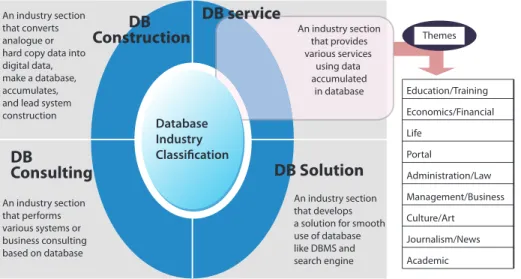
(Law Firm Suho, 2009), and the Korea Database Agen-cy defines the industry as an “industry that constructs and systemizes a database with digitalized data, contin-uously operates and manages the database, and makes the accumulated database a more valuable product and provides the service by analyzing and processing in order to lead a business” (Bae et al., 2012). In other words, the database industry consists of four sectors, including database construction which converts the analogue data into digital data, makes a database, and constructs a system; DBMS, a database service that provides information on various subject areas using the stored data; a database solution that develops and maintains solutions for using databases, such as search engines; and database consulting that performs system or business consulting based on databases. Among these elements, database service is closely related with database solutions. However, there is a difference be-tween database service and database solutions. For example, firms delivering database service may pro-vide weather information services using weather data-bases or legal information service using legal datadata-bases. Firms delivering database solutions are such as Oracle and SAP. According to Korea Standard Industrial Cla-ssifications (KSIC), database services includes portals, Internet infomediary businesses, news supply busi-nesses, and online information supply businesses. Database solutions includes application software de-velopment and supply businesses, computer program-ming service businesses, computer system integration and consulting businesses, and information processing businesses.
As above, the database industry is an integrated in-dustry group that supports related businesses focused on databases, and is closely related to the contents industry (or of the service providing the contents, in-cluding combinations of both) and the software indus-try.1Recently in academic legal circles, databases are regarded as an independent industry, while databases dealt with in these industries have limited subjects and do not enclose the databases themselves, and as such
1
Software Industry Promotion Act, Article 2 (Definition): The “Software industry” is an industry related to the development, making, production, and distribution of software and related services, and the construction and operation of information systems by the “E-Government act,” Article 2, No. 13
the industry is regarded as an integrated one that also functions as infrastructure in all industries.
2.2 Current Status and Trend of Database In-dustry
2.2.1 Current status of Korea database industry
The Korean database industry was valued at 11 tril-lion won in 2012, having grown by 6.09% year on year, and it is expected to grow by a 8.2% annual average since 2010, and is projected to exceed 14 trillion won in 2017 (Korea Database Agency, 2012). This growth rate is over 2.5 times the rate of Korea GDP growth in 2012, showing that the database industry has a higher growth rate than other industries. When the industry is segmented, the database construction market value
was 4 trillion, 512 billion won, growing by 6.4% since 2011, and the database service market was 4 trillion, 484.7 billion won, growing by 3.8% year on year, ac-counting for 40.7% of the database industry market. Database solution market value was 1 trillion, 746.7 billion won, growing by 10.6% since 2011, 36.8% of this being in security solutions. While the database consulting market is the smallest area in the database industry, it grew into a 263 billion won market, record-ing a high growth rate of 7.9% (Korea Database Agen-cy, 2006).
Based on 2011, the number of companies in the da-tabase industry in Korea is estimated to be about 5,300 (Park et al., 2011), and the annual revenue of most of them are less than 10 billion won. In the database con-struction area, about 85% of companies make annual
Fig. 1 Classification of database industry. Reprinted from Policy plan for promotion of database industry, 2012
Table 1. Annual size variation of Korean database industry market (Unit: 100 million KRW)
Item 2010 2011 2012 36,610 42,242 12,983 2,253 42,374 43,218 15,800 2,437 45,120 44,847 17,467 2,630 Total 94,088 103,829 110,064
Note: From 2012 Database industry market analysis result report, 2012
DB construction DB service DB solution DB consulting
revenues of less than 10 billion won, and more than 35% of companies’ revenue was less than 2 billion won.
In the database service area, more than 90% of the companies have annual revenues of less than 10 billion won, and the annual revenues of 55% of companies were less than 1 billion won. However, as database consulting and solution companies did not disclose their sales amounts accurately, numbers were difficult to estimate (Korea Database Agency, 2011). On the other hand, recently Korean database companies are actively entering the overseas market, most of them database solution and consulting companies, and exports in 2011 were found to reach 479 billion won (Ministry of Culture, Sports and Tourism, 2011).
The total manpower working in the database indus-try in 2012 was 230,000 people, an increase of by 5% from 2011. The number of people who directly deal with databases was found to be 61,230 (Korea Database Agency, 2012). According to the Korea Database Agen-cy, average revenue per person related to databases was 179.64 million won, about 6.5 times GDP in 2011 (23,749
dollars), showing that the database industry is a high efficiency industry with high productivity (Korea Database Agency, 2011).
2.2.2 Current status of overseas database industry
Overseas database service market value was 506 bil-lion dollars in 2012, growing by 3.3% year on year (Fooladi et al., 2013). In the service market, new infor-mation accounted for 82.9 billion dollars, being the largest sector, followed by web search at 64.9 billion dollars, and education and training at 64.4 billion dol-lars. Especially, HR information showed the highest growth rate of 19.1% year on year, with web search showing 17.3% growth rate year on year. However, news information declined by -6%, and yellow page directory information declined by -4%. Table 2 shows market size by database service worldwide.
The biggest company in the database service market is Google, with revenues of 46 billion dollars in 2012, followed by Thomas Reuters with 13.1 billion dollars. Especially, Google is settling down as the major com-pany in the search syndication market, with over 20%
Table 2. Worldwide database service market by area (Unit: Billions of Dollars,* %)
Item Market Growth rate
25.1 4.6 46.3 35.8 55.8 64.4 6.1 18.2 41.0 82.9 31.4 64.9 4.0 26.5 506.0 3.5 6.0 1.2 1.3 6.0 4.9 19.1 4.0 6.0 -6.0 5.4 17.3 -3.8 -4.0 3.3 Note: From Information industry market size & share rankings: Preliminary 2012 results. Outsell. 2013
* Annual average exchange rate of 2012: 1,113.47 KRW/dollar
B2B Trade Publishing Company Information Consumer Books Consumer Magazines Credit & Financial Information Education & Training HR Information Legal, Tax & Regulatory Market & IT Research News Providers & Publishers
Scientific, Technical & Medical Information Web Search
Licensed Content Aggregation & Syndication Service Yellow Pages & Directories
of annual growth. Among Korean companies, NHN grew by 101.6% year on year, with revenues of 2.5 bil-lion dollars. As China continues to emerge as a new stronghold in the database service market, Baidu.com was ranked seventeenth, with revenues of 3.5 billion dollars.
The worldwide market size of DBMS, the represen-tative database solution, was about 24 billion dollars in 2011, growing by 5.4% year on year (Korea Database Agency, 2012). The data integration market grew from 3 billion dollars in 2010 to 3.5 billion dollars in 2011, expanding by 13.9%. The data integration market con-sists of data quality management and master data management. The BI (Business Intelligence) solution market was found to have increased by 9.8% from 10.5 billion dollars in 2010 to 11.5 billion dollars in 2011. When the BI solution market is segmented, the BI Platform market was 6.7 billion, the CPM market was 2.2 billion, and the analytics market was 1.7 billion dol-lars. Especially, the ratio of the analytic market was found to have been extended in the BI solution market (Korea Database Agency, 2012).
2.3 Problems of Database Industry
Several problems are being exposed in fostering a Korea database industry. Poor related legal systems, a lack of manpower, poor quality management, and dis-torted service eco-systems are major problems.
To foster and promote the database industry, basic elements like organization, manpower, and budgeting should be supported, but a systematic environment for fostering the database industry is lagging far behind. Especially, from the aspect of law, databases have simi-lar regulations in some legislation, but they are not solid enough to support business initiation. And thus there is no legal system which integrates the industry. In most laws, only the construction of the database is regulated, and the construction is stipulated to be the discretion of the state or the head of an organization. As there is no restrictive regulation regarding failure of construction, numerous difficulties impede the devel-opment of a systematically fostered database industry. Therefore, an independent law that generally specifies the database industry is required.
Second, even though the database industry needs a large quantity of specialized manpower from database
planning and management for operation, insufficient policies for fostering database specialists is also a major cause that impedes the growth of industry (Bae et al., 2012). In this situation, on database industry sites, man-power is fostered by themselves. However, this is accom-panied by high costs and time spent, and employing new employees is difficult. According to a survey, a total average of 60,880 thousand won per person is the cost for an IT company to employ a new employee and train the employee (Ministry of Security and Public Administration, 2012). Therefore, a mid and long term strategy to foster special manpower needs to be estab-lished, and cooperation between industry and educa-tion should be systematically regulated to maintain a consistent cooperative relationship.
Third, acknowledgement of the need for database quality management is gradually spreading, but quality management systems are still insufficient (Bae et al., 2012). It was found that a social cost accounting of 46 trillion, 900 billion won is incurred as an annual aver-age economic loss (Bae et al., 2012). In addition, the number of data errors occurring due to insufficient quality management is estimated to be over 65 million cases in public agencies, and 43 billion cases in private corporations (Korea Database Agency, 2010), with a high average database error rate of 4.38% (Korea Data-base Agency, 2012).
Fourth, the service eco-system is distorted. The aver-age revenues of 55% of database service companies were less than 300 million won, and the types of data-bases served number about 2,000, tied up for the last 5 years (Law Firm Suho, 2009). More than half out of 51 service providers provide databases for free via portals, and 93% are not getting properly paid (Korea Data-base Agency, 2012). This demonstrates not only the need for a legal regulation to solve this problem, but also an independent organization that mediates, settles, and assesses these problems for win-win partnerships.
3. ECONOMIC EFFECT OF DATABASE
INDU-STRY
3.1 Economic Effects of Database Industry Industry analysis was used to measure the economic effect of the database industry. Industry analysis
in-volves a comprehensive statistical table that records all transactions related to the production and disposal of goods and service occurring in an economy during a certain period (usually one year) in a certain principle and form, and it is widely used as basic data for the establishment of various economic policies and for economic and industrial analysis. Mutual linkage of the database industry and other industries can be fig-ured out using this industry analysis, and the econom-ic effect of demand for the database industry on the whole industry can be evaluated (Park et al., 2011).
Industry analysis presumes that the input coefficient is always consistent and the supply of raw material is always flexible, and the input coefficient mediates the final demands and is exogenously determined, like with consumption, investment, and export and gross output. From the perspective of the whole national economy, the production activity of each industry is made ultimately to fulfill final demand.
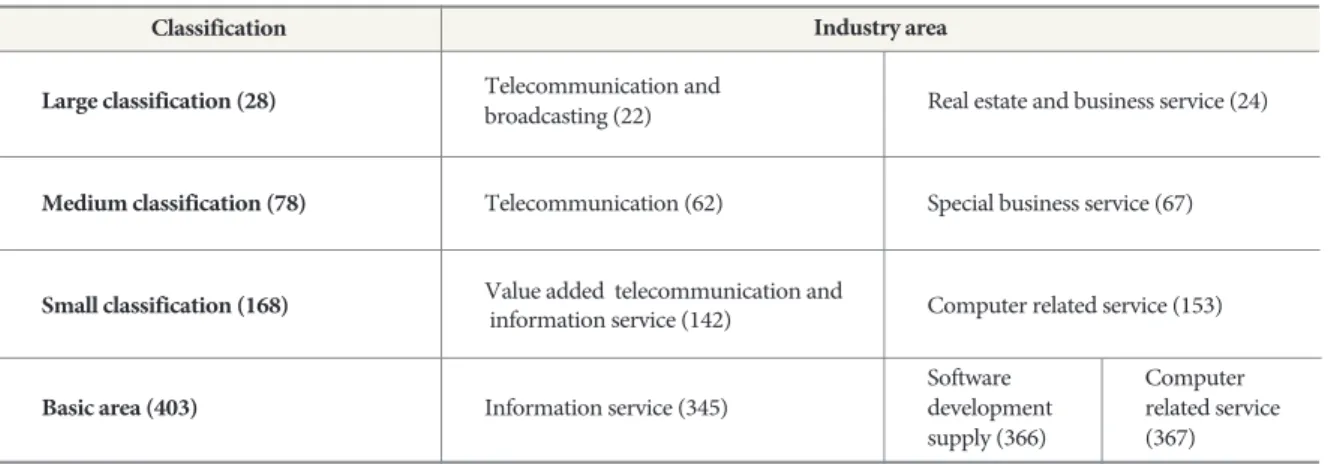
To make an industry analysis, the industry closely related to the database industry on the input-output table was identified to estimate the industry related to databases. Classification of the database industry based on Korean standard industry classification was com-pared with basic areas on the input-output table and adjusted for this study.
3.1.1 Production inducement effect
If there are many areas in an industry, using an input coefficient to measure the production induce-ment effect that is infinitely continued is difficult, thus
the production inducement coefficient can be deduct-ed using an inverse matrix.
𝑎11𝑿1+𝑎 12 𝑿2+ ∙ ∙ ∙ ∙ ∙ ∙ ∙ ∙+𝑎 1𝑛𝑿𝑛+𝑌1−𝑀1=𝑿1 ∙ ∙ ∙ 𝑎𝑖1𝑿1+𝑎𝑖2 𝑿2+ ∙ ∙ ∙ ∙ ∙ ∙ ∙ ∙+𝑎 𝑖𝑛𝑿𝑛+𝑌𝑖−𝑀𝑖=𝑿𝑖 ∙ ∙ ∙ 𝑎𝑛1𝑿1+𝑎𝑛2 𝑿2+∙ ∙ ∙ ∙ ∙ ∙ ∙ ∙+𝑎 𝑛𝑛𝑿𝑛+𝑌𝑛−𝑀𝑛=𝑿𝑛
𝑎𝑖𝑗is input coefficient, 𝑿𝑖 is output in i area, 𝑌𝑖is
final demand in i area, and 𝑀𝑖is income in i area.
𝑿=[𝐼−(𝐼−𝑚⌃)𝐴]-1
[(𝐼−𝑚⌃)𝑌✽+𝐸]
X is gross output vector, A is input coefficient mat-rix, Y is final demand, E is export, and m is import coefficient. Here, the [𝐼−(𝐼−𝑚⌃)𝐴]-1
matrix is the pro-duction inducement coefficient. The propro-duction in-ducement coefficient means the direct and indirect production effect induced in each industry area to ful-fill one increased unit of final demand.
The production inducement coefficient of the data-base industry data-based on the above is estimated to be 1.838, which means that a production of 31 trillion, 790.9 billion won is required to fulfill the financial demands of 17 trillion, 291.9 billion won (Park et al., 2011).
3.1.2 Added value inducement effect
A production inducement coefficient table was used to deduct the interaction formula showing interac-tion between final demand and added value. When
Table 3. Database industry classification on input-output table
Industry area
Large classification (28) Telecommunication and
broadcasting (22) Real estate and business service (24)
Medium classification (78) Telecommunication (62) Special business service (67)
Small classification (168) Value added telecommunication and
information service (142) Computer related service (153)
Basic area (403) Information service (345)
Software development supply (366) Computer related service (367) Classification
added value vector is (𝑉 ) and diagonal matrix of add-ed value coefficient is (𝑉⌃v), relation of 𝑉=Âv𝑿is
estab-lished. Therefore, when the production inducement interaction formula substitutes in this formula, the for-mula of 𝑉=Âv[𝐼−(𝐼−𝑚⌃)𝐴]-1𝑌𝑑
is obtained and in this for-mula, Âv[𝐼−(𝐼−𝑚⌃)𝐴]-1
is the added value inducement coefficient matrix. The added value inducement coeffi-cient is the sum of added value directly and indirectly in-duced in a whole national economy when one unit of final demand for domestic production occurs in an
industry area (Korea National Bank, 2011). The added value inducement coefficient of the database industry is 0.872, which means that 15 trillion, 284.6 billion won of added value is induced when the final demand of 17 trillion 292.9 billion won is fulfilled (Park et al., 2011).
3.1.3 Employment effect
To deduct the labor inducement coefficient, the demand equation between final demand and gross output, used to calculate the production inducement coefficient explained above, was multiplied by the diagonal matrix of labor coefficient (𝑙⌃=𝐿/𝑋) to estab-lish 𝐿=𝑙⌃[𝐼−(𝐼−𝑚⌃)𝐴]-1𝑌𝑑
. Here, 𝑙⌃[𝐼−(𝐼−𝑚⌃)𝐴]-1
is the employment inducement coefficient. As for the labor inducement effect by final demand item, the labor inducement coefficient matrix was multiplied by the final demand vector of consumption, investment, and export to measure labor inducement count 𝐿w=𝑙𝑙
⌃
w[𝐼−(𝐼−𝑚⌃)𝐴] -1𝑌𝑑
by final demand item.
The employment inducement demand can be ana-lyzed by the two aspects of employee and employer.2
The employment inducement coefficient means labor directly and indirectly induced in the production process, including not only labor directly needed in one unit of product in a certain industry (labor coeffi-cient), but also the labor indirectly induced during the production process (Korea National Bank, 2011). The employment inducement coefficient of the database industry is 13.177 persons per 1 billion won, with an estimated total employment inducement of 337,475 persons (Park et al., 2011).
3.2 Economic Effect of Establishment of Data-base Industry Promotion Act
To measure the economic effect of the establishment of the Database Industry Promotion Act, a survey was given to 82 corporations that are located in Korea and prominent in the database business.
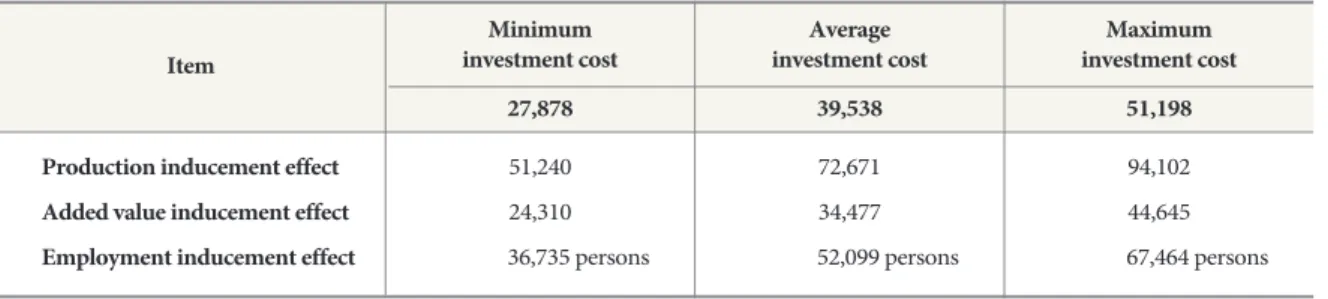
From the survey, the average investment by corpo-rations related to databases to the database industry was estimated at 1.9 billion won and, after legislation, this was expected to increase by 38.5% to 2.68 billion won. Therefore, each private corporation is expected to make an additional annual investment of an average 750 million won in the database industry through the establishment of the Database Industry Promotion Act. Accordingly, from a minimum of 2 trillion, 787.8 billion won to a maximum of 5 trillion, 119.8 billion won of economic effect is projected (Park et al., 2011). Production inducement effect is estimated from a minimum of 5 trillion, 123.9 billion won to a maxi-mum of 9 trillion 410.1 billion won. The added value inducement effect is estimated to be from a minimum of 2 trillion, 430.9 billion won to a maximum of 4
tril-2
Including employee, small business owner, and unpaid family employee
Table 4. Economic effect of database industry
Item Production inducement effect Added value inducement effect Employment inducement effect Whole industry average
Database industry
1.940 1.838
0.722 0.872
18.354persons/1 billion won 13.177persons/1 billion won
Whole industry average Database industry
lion, 464.4 billion won (Bae et al., 2012). The employ-ment induceemploy-ment effect is additionally estimated from a minimum of 36,735 persons to a maximum of 67,464 persons of employment expected, showing an average of 52,099 persons in job creation effect (Bae et al., 2012).
3.3 Database Use Effect
When economic effect by database use is indirectly estimated through database use effect in the public sec-tor, in Europe, the economic effect on EU (European Union) member countries by use of public informa-tion in the private sector is estimated to be 61 trillion won (40 billion EUR) a year, and when direct and indi-rect economic effect is considered together, it is ex-pect-ed to be 211 trillion won (140 billion EUR) a year (Graham, 2011). In Korea, systematic policies are be-ing established for the introduction and use of infor-mation and data in the public sector, and the econom-ic value following the use of publeconom-ic information is esti-mated to be about 1 billion won (Korea Database Agency, 2006).
4. DATABASE INDUSTRY PROMOTION ACT
4.1 Current Status of Laws Related to Data-base Industry
4.1.1 Korean status
Current Korean law regulates database construction, but there is almost no legal base regulating industry fostering or support. Copyright law and national space information law directly defines database components as including information structure, information sys-tems, information telecommunication bases, and link-ed subjects. Table 6 shows the current status of domes-tic laws that includes databases.
Domestic laws related to database use are focused on the database construction itself, and they merely pro-vide legal ground for the subjects of production from the point of view of database suppliers. Database con-struction is regarded as a right or discretion from the point of view of the database supplier, and databases are regulated as a subject of construction only in public
Table 6. Classification of domestic legislation related to databases
Note: From Study on improvement of legal system for DB industry advancement, 2009
Related law
Copyright law Article 2, No. 19
National space information law Article 2 No. 2 Weather law Article 2 No. 14
Law of protection and use of location information, Article 2, No. 8 Basic act of state informationization, Article 3, No. 15
Basic act of logistics policy, Article 30, clause 1
Item
Table 5. Economic effect following establishment of Database Industry Promotion Act (Unit: 100 Million KRW)
Item Minimum investment cost Average investment cost Maximum investment cost 27,878 39,538 51,198 51,240 24,310 36,735 persons 72,671 34,477 52,099 persons 94,102 44,645 67,464 persons
Production inducement effect Added value inducement effect Employment inducement effect
Direct definition regulated
Information system
Information telecommunication base Construction and linked subjects
sectors such as government, or in facilitating a con-struction program of a constructor like a government. As there are no restrictions governing fulfilling the responsibilities of database construction, they are just declarative regulations. Moreover, there is no adminis-trative or legal ground at the provincial/state level for quality management, distribution support, industry fostering, or other restrictions. Regarding database dis-tribution applicable to the private sector, protection regulation of databases is just specified by copyright law, enabling settlement by damage compensation based on precedents or protection of databases without creativity or according to an act of unfair competition prevention. Therefore, a review of unbalanced database regulation is needed again from the aspects of produc-tion, management, use, and industry, and establish-ment of database legislation is needed so that activities can be conducted organically in various areas.
4.1.2 Current status in foreign countries
When we studied systems related to databases in foreign countries, their legal systems were fostering their whole industry, supporting not only database con-struction but also users of the database.
Japan is fostering and promoting their whole indus-try, supporting not only suppliers’ production man-agement but also distribution manman-agement from the point of view of users (Kim, 2011).
Considering the social effect of information sharing and disclosure, the USA mandates database construc-tion not only in the public sector but also in the private sector for specific issues, and regulations to enforce con-tinuous database quality management have been es-tablished. At a federal level, information quality man-agement of all federal government departments was systemized through establishment of the Information Quality Act (Law Firm Suho, 2009).
The EU is trying to maximize the value of database use through legal protection of databases and open data policy in the public sector, and in 2003 a directive on
reuse of public information was established to stipulate the use of public information by the private sector, and in 2011, the reuse of public information and data was mandated through a data open policy (Graham, 2011).
As mentioned above, domestic database-related laws are focused on database construction itself, and there is almost no regulation on database industry fostering and use. And there is almost no law on data quality manage-ment and support for industry promotion or elemanage-ments to enhance usability of constructed databases. On the other hand, in major countries, databases are recognized as an important form of media that realizes fulfillment of publically beneficial obligations like the distribution and use of information, not as an asset, and related reg-ulations are being modified (Law Firm Suho, 2009). 4.2 History of Legislation Related to Database Industry
Regulation on databases first appeared in 1994, in a partially amended copyright law, and databases have become the subject of legal protection since then. How-ever, at that time, copyright law regulated a compila-tion work as a creative compilacompila-tion of materials or arrangements,3so databases were not applicable to this regulation and were not protected. Therefore, the need for an independent legal system for database protec-tion was addressed and in 1996, a law of database pro-tection and promotion was proposed for the first time in the National Assembly, but the legislation failed due to conflicts on legal provisions between departments (Kim, 2011).
During the time that claims were being continually made by creators that database protections under copyright law were insufficient, the “Mirae informa-tion incident”4occurred and the need for database maker protection strongly emerged. Motivated by this incident, an ‘Act of Database Protection and Use’ was proposed in 1999, with the opinion that a law embrac-ing the protection of investment in database makembrac-ing is required; however, it was discarded when the National
3
A collection of theses, figures, shapes, and other materials, or something systematically composed for searching using an information processing device.
4
A real estate association illegally copied the database of Mirae Information, a database provider serving real estate information to real estate brokers in the Ilsan area in the Kyeonggi-do region. Mirae Information gave up their whole business due to this incident.
Assembly term expired. After the legislation failed in 1999, the responsible department at that time, the Mi-nistry of Information and Telecommunication, pre-announced legislation (Ministry of Information and Telecommunication Notification No. 2001-5), but in the process of opinion adjustment with the Ministry of Culture and Tourism, a settlement was made to revise copyright law, nevertheless failing to make final legisla-tion (Bae et al., 2012).
In 2011, as revenues of the database industry exceed-ed 10 trillion won, the industry emergexceed-ed as one with a high market contribution and employment effect. How-ever, government agencies and the National Assembly remain in discussion over the opinion that an inde-pendent law is needed to systematically foster and sup-port the database industry. In industry and the acade-mic sector also, the necessity to prepare a legal system related to databases has been addressed. Therefore, on June 1, 2011 the Database Industry Promotion Act was proposed and subsequently introduced in the National Assembly on December 23, but it was discarded as the term of the National Assembly had expired.
Even though the database act was discarded due to the last National Assembly’s term expiration, as
con-sensus on the need for a database related law spreads in the National Assembly, government, corporations, and the academic sector, the act was proposed again on July 26, 2012. However, the department responsible for the database industry was integrated into the Ministry of Science, ICT, and Future Planning, and it will be supplemented with the act of database industry promotion and proposed again in May 2013.
When the flow of steps from the law of database protection and promotion proposed in 1996 to the present proposed Database Industry Promotion Act is studied, the direction of the legal system can be seen to be changing from a focus on protection and facilitation of database use to the fostering of industry that facili-tates the use of databases.
4.3 Main Subjects of Database Industry Pro-motion Act
The Database Industry Promotion Act planned for proposal again in May 2013 consists of 4 chapters, 23 articles, and supplementary provisions, including chapter 1, general rules; chapter 2, database industry base construction; chapter 3, database industry foster-ing; and chapter 4, penalties.
Fig. 2 Scope of Database Industry Promotion Act. Reprinted from Improvement plan of legal system for DB industry fostering,
4.3.1 Production
The production area consists of standards imple-mentation and quality management. Article 8 and 15 apply to standards setting, and articles 9, 10, and 11 apply to quality management.
Article 8 (standardization) contains activity support for industrial standardization required in making and using databases, quality improvement, and securement of compatibility, and article 15 (actual conditions sur-vey) contains an actual conditions survey for more effective performance of the database industry.
Article 9 (quality improvement) contains database quality improvement plans like database quality stan-dard and examination plans, and article 10 (quality certification) contains quality certification for database quality securement and distribution facilitation. Especi-ally, article 11 (security management) contains subjects related to database security management to respond to data security accidents.
4.3.2 Distribution
The distribution area consists of making and using, distribution support, and international cooperation and support for overseas market expansion.
Article 7 (support to database making) regulates the preparation of support plans for database makers and businesses, and article 21 (activation of convergence database) regulates the preparation of base regulation for convergence of the database industry and other industries.
Article 16 (database distribution support) stipulates a support plan to activate database distribution, and article 18 (establishment and recommendation of compensation calculation standards) regulates inter-national cooperation for support of overseas market expansion of database industry overseas market ex-pansion support projects.
4.3.3 Human resources
In the human resource area, article 13 (fostering spe-cialized manpower) stipulates support for spespe-cialized manpower fostering by developing and improving actual job ability through job standards preparation, cooperation between industry, and education and sup-port for related education, as demand for database spe-cialist manpower increases.
4.3.4 Finance
The Finance area consists of technical development and funding.
Article 12 (facilitation of technical development) contains continuous support for research and develop-ment by governdevelop-ment to secure database related tech-nology and management, procurement techtech-nology transfer, and information exchange facilitation of relat-ed technology information, and article 19 (commer-cialization support) regulates contribution to technolo-gy development activation by stipulating economic support by government for commercialization of core technology.
Article 5 (funding) stipulates that the government should make efforts to prepare funding required to foster the database industry.
4.3.5 Fostering
The fostering area consists of planning, execution and restrictions, support for various subjects, demand and use of management, supply, and management cre-ation.
Article 3 (establishment of basic plan) regulates set-ting up basic plans for database industry promotion, and article 4 regulates establishment and execution of the executive plan according to basic plans related to the database industry.
Article 22 (protection of material data) stipulates preparation of protective plans for material data used in databases, and article 24 (prohibited act) regulates protection of database makers by listing prohibited acts in order to protect the value of the database.
Article 25 (penalty) regulates protection of material data and punishments to deter database system false attacks, and article 22 (establishment of Korea Data-base Promotion Agency) provides a ground of estab-lishment for specialized authority to foster the data-base industry.
Article 17 (securing fair trade order) regulates pre-paration of an automatic support environment to con-struct and distribute databases, and article 20 (registra-tion of database business) regulates database business registration in order to manage business results of database corporations and manpower history.
5. CONCLUSION
Today, we can see and feel that the world economy is rapidly changing. Databases are not just simple in-formation constructed in your computer like in the past, but are an important information source that can be used anytime and anywhere by processing the data-base into useful information. Datadata-bases are changing our way of life and culture (Lee, 2007).
In 2012, revenues of the database industry exceeded 11 trillion won, and the importance of the industry is increasing as a core industry, showing a high yearly growth rate exceeding 6.0%.
However, the Korean database industry has prob-lems including low competitiveness of small and medi-um size companies, poor quality management sys-tems, and a lack of specialized manpower. First, ac-cording to the 2012 Korea database industry market analysis result report provided by the Korea database agency, Korean database service providers with annual sales around a mere 170 million won occupy 56% in terms of the number of database service providers yet occupy only 4.2% of the Korean database market. A vicious circle is perpetuated in the unfair trade envi-ronment where conglomerates are monopolizing the market. Database service providers with annual sales over five billion won take 11.1% in terms of the num-ber of database service providers and occupy over 80% of the Korean database market. In addition, small and medium-sized database service providers are not de-manding fair compensation when providing database services for large portals. While they are experiencing difficulties in finding a new market, such large portals are launching very similar database services. Thus, the survival of small and medium-sized database service providers is being threatened.
Data loss recovery costs have reached 46 trillion, 900 billion won, and according to the 2012 Korea database industry market analysis result report by the Korea database agency, the accumulated database error rate in private and public organizations’ databases from 2004 to 2011 reaches 4.38%, causing economic loss in general society. Here, the database error rate is an esti-mate of errors introduced during data entry and clean-ing. The estimate of this rate can be obtained by count-ing the number of errors which occur, for example, when entering numbers where characters should be
entered, and dividing it by the total number amount of verified data. While 28,800 persons of medium and high quality database manpower are needed by 2014, only 2,300 persons of medium and high quality man-power graduating from college will be available, a shortfall of 26,400. Therefore, a legal ground for re-solving general problems of the database industry like above, to create a sound database eco-system, and to construct a virtuous circle, should be prepared through the Database Industry Promotion Act.
As large amounts of data is produced, distributed, and shared by the expansion of smartphones and SNS, corporations recognize data as a core asset, and the importance of databases is ever increasing through the technical support of transfers, storage, protection, con-vergence and copies of data and the acceleration of knowledge distribution. Therefore, a legal basis should be established so that databases with increasing impor-tance can be protected and used under a database act.
In 2011, the size of the database industry was esti-mated to be 10 trillion, 400 billion won, and a produc-tion inducement of 31 trillion, 800 billion won and an added value inducement of 15 trillion, 300 billion won were estimated, with a huge effect on the Korean econ-omy. When the law is enacted, investment in database corporations will expand and a 4 billion person em-ployment inducement effect is expected. As above, the Database Industry Promotion Act will increase the future value of the database industry and support the active vitality of the Korean economy by expanding the role of the database industry.
REFERENCES
Bae, S., Lee, J., & Park, C. (2012). Policy plan for data-base industry promotion. Seoul: Eul-Dong Kim (National Assembly member).
Fooladi, P., May, N., and Lewis, K. (2013). Information industry market size and share rankings report: Preliminary 2012 results. CA: Outsell.
ISO/IEC 2382-17 (1999). Information technology vo-cabulary, part 17: Databases, 2ndedition.
Kim E. (2011). Improvement of legal system for DB industry fostering. Seoul: Eul-Dong Kim, National Assembly member.
pro-motion act establishment. Seoul: Eul-Dong Kim, National Assembly member.
Korea Database Agency (2006). Study on economic evaluation and effect analysis of commercial use of public information. Seoul: Korea Database Agency. Korea Database Agency (2010). Economic effect
analy-sis of data quality management. Seoul: Korea Data-base Agency.
Korea Database Agency (2011). Survey of demand and supply of database manpower in Korea. Seoul: Ko-rea Database Agency.
Korea Database Agency (2012). 2012 Database white paper. Seoul: Korea Database Agency
Korea Database Agency (2012). 2012 Korea database industry market analysis result report. Seoul: Korea Database Agency.
Korea Database Agency (2012). Survey report of DB distribution activation. Seoul: Korea Database Agen-cy.
Korea National Bank (2011). 2009 industry input-out-put table. Seoul: Korea National Bank
Law Firm Suho (2009). Study on improvement plan for DB industry advancement. Seoul: Korea Database Agency.
Lee, J. (2007). Consideration of direction and structure of legislation of local informationization. Korea Local Informationization Journal, 10(2), 1-30. Lee, K. (2003). Problems and direction of amendment
of software industry promotion act. Study on Ad-ministrative Law, 9, 121-141.
Ministry of Culture, Sports and Tourism (2011). 2010 contents industry statistics. Seoul: Ministry of Cul-ture, Sports and Tourism
Ministry of Security and Public Administration (2012). 2012 National Informatization White Paper. Seoul: Ministry of Security and Public Administration Park, C. & Lee, K. (2009). Study on influencing
ele-ment for enhancing web service satisfaction of aca-demic information. Digital Policy Journal, 7(4), 91-100.
Park, S., Kim, H., Lee, J., Park, C. & Rye, J. (2011). Database industry economic effect analysis report according to database industry promotion act (pro-posal). Seoul: Korea Database Agency.
The Linux Information Project (2006). Retrieved from http://www.linfo.org/database.html
Vickery, G. (2011). Review of recent studies on psi
re-use and related market developments. Paris: Euro-pean Public Sector Information Platform.
WIPO-ESCWA (2003). Protection of Databases, WIPO-ESCWA Arab Regional Conference on Intellectual Property and Electronic Commerce (pp. 1-10). Beirut: Center for Information Technology and Intellectual Property (CITIP).