• 검색 결과가 없습니다.

Outcomes of Open Surgical Repair of Descending Thoracic Aortic Disease

N/A
N/A
Protected

Academic year: 2021

Share "Outcomes of Open Surgical Repair of Descending Thoracic Aortic Disease"

Copied!
7
0
0

로드 중.... (전체 텍스트 보기)

전체 글

(1)

http://dx.doi.org/10.5090/kjtcs.2014.47.3.255 ISSN: 2233-601X (Print) ISSN: 2093-6516 (Online)

Department of Thoracic and Cardiovascular Surgery, Asan Medical Center, University of Ulsan College of Medicine Received: August 14, 2013, Revised: October 14, 2013, Accepted: October 25, 2013, Published online: June 5, 2014

Corresponding author: Joon Bum Kim, Department of Thoracic and Cardiovascular Surgery, Asan Medical Center, University of Ulsan College of Medicine, 88 Olympic-ro 43-gil, Songpa-gu, Seoul 138-736, Korea

(Tel) 82-2-3010-5416 (Fax) 82-2-3010-6966 (E-mail) [email protected]

C

The Korean Society for Thoracic and Cardiovascular Surgery. 2014. All right reserved.

CC

This is an open access article distributed under the terms of the Creative Commons Attribution Non-Commercial License (http://creative- commons.org/licenses/by-nc/3.0) which permits unrestricted non-commercial use, distribution, and reproduction in any medium, provided the original work is properly cited.

Outcomes of Open Surgical Repair of Descending Thoracic Aortic Disease

Won-Young Lee, M.D., Jae Suk Yoo, M.D., Joon Bum Kim, M.D., Ph.D., Sung-Ho Jung, M.D., Ph.D., Suk Jung Choo, M.D., Ph.D., Cheol Hyun Chung, M.D., Ph.D., Jae Won Lee, M.D., Ph.D.

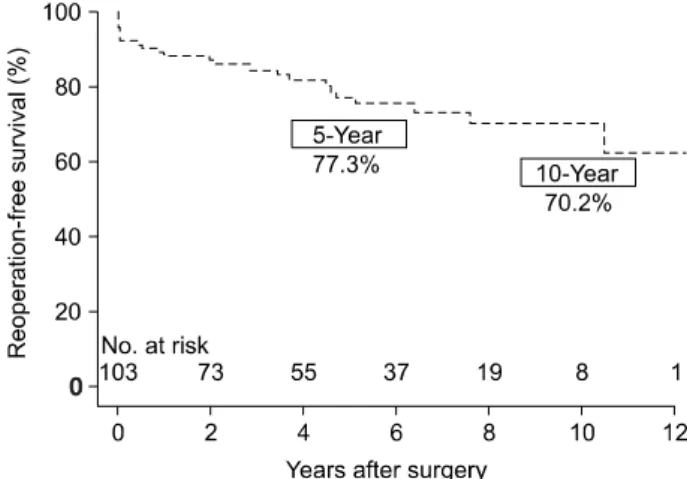
Background: To determine the predictors of clinical outcomes following surgical descending thoracic aortic (DTA) repair. Methods: We identified 103 patients (23 females; mean age, 64.1±12.3 years) who underwent DTA replace- ment from 1999 to 2011 using either deep hypothermic circulatory arrest (44%) or partial cardiopulmonary bypass (CPB, 56%). Results: The early mortality rate was 4.9% (n=5). Early major complications occurred in 21 patients (20.3%), which included newly required hemodialysis (9.7%), low cardiac output syndrome (6.8%), pneumonia (7.8%), stroke (6.8%), and multi-organ failure (3.9%). None experienced paraplegia. During a median follow-up of 56.3 months (inter-quartile range, 23.1 to 85.1 months), there were 17 late deaths and one aortic reoperation.

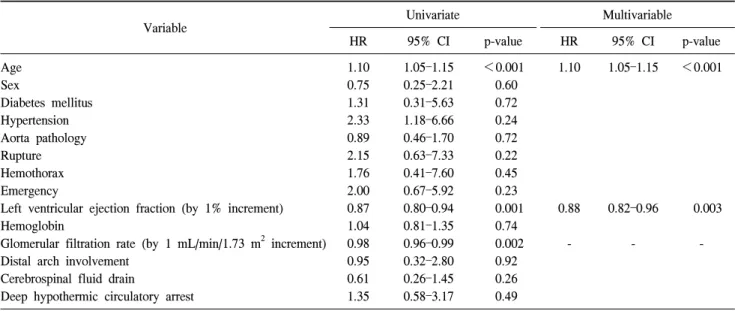
Overall survival at 5 and 10 years was 80.9%±4.3% and 71.7%±5.9%, respectively. Reoperation-free survival at 5 and 10 years was 77.3%±4.8% and 70.2%±5.8%. Multivariable analysis revealed that age (hazard ratio [HR], 1.10;

95% confidence interval [CI], 1.05 to 1.15; p<0.001) and left ventricle (LV) function (HR, 0.88; 95% CI, 0.82 to 0.96; p<0.003) were significant and independent predictors of long-term mortality. CPB strategy, however, was not significantly related to mortality (p=0.49). Conclusion: Surgical DTA repair was practicable in terms of acceptable perioperative mortality/morbidity as well as favorable long-term survival. Age and LV function were risk factors for long-term mortality, irrespective of the CPB strategy.

Key words: 1. Aorta

2. Descending thoracic aorta 3. Cardiopulmonary bypass

INTRODUCTION

Open surgical repair remains a gold standard therapeutic option in the management of descending thoracic aorta (DTA) aneurysm. Because of the progress in cardiopulmonary bypass (CPB) strategies, spinal cord protective adjuncts, as well as improvements in postoperative care, outcomes of open repair of DTA have improved [1-3]. Despite these improvements, morbidity and mortality rates in DTA replacement still re-

main high [2-4], with the recent data showing operative mor-

tality rate of 4.7%, lower extremity paralysis rate of 3.4%,

and stroke rate of 2.7% even in the high-volume aortic cen-

ters [5]. These figures might be challenging in low-volume

aortic centers. In this context, concerns regarding the chal-

lenging risks of open surgical repair of DTA have led to the

global atmosphere favoring thoracic endovascular aortic repair

(TEVAR) more frequently even without hard evidence in

support of the long-term benefits of TEVAR [6].

(2)

Reviewing the literature published in Korea, only a few studies have analyzed clinical outcomes of open surgical re- pair of DTA, of which the largest-scale study is one that evaluated 22 patients decades ago [7]. We therefore sought to evaluate the outcomes following open surgical repair of DTA in a reasonably sized cohort in the current era and to de- termine independent predictors of long-term outcomes.

METHODS 1) Patients and operative techniques

Out of 212 patients who underwent DTA repair between June 1999 and August 2011 at Asan Medical Center, we identified 103 patients (mean age, 53.8±13.1 years; 23 wom- en) who underwent aortic surgery only for thoracic aortic segments. One hundred and nine patients who underwent aortic surgery combined with thoracoabdominal aorta repair and arch replacement were excluded in this study.

The operative procedure was conducted as follows: Patients were intubated with a double lumen endotracheal tube.

Cerebrospinal fluid (CSF) drainage was in 56 patients (54%) who were supposed to receive lower thoracic aorta replace- ment. Left posterolateral thoracotomy was performed for all patients, and the level of entrance (4–6th intercostal spaces) was determined on the basis of the aortic segment replaced.

The left femoral artery was the preferred site for arterial can- nulation in the absence of atherosclerotic changes in the distal arteries. The left femoral vein was the most common site for venous cannulation. In general, arterial and venous cannula- tion was established with a wire-directed approach. Three mg/kg of heparin was given for systemic heparinization.

Deep hypothermic circulatory arrest (DHCA) was used in 44 patients (42.7%), and partial CBP was used in 58 patients (56.3%). The decision between DHCA versus partial CPB strategies depended on anatomic factors including involve- ment of the distal arch or feasibility of aortic cross-clamping, but was finally left to the attending surgeon’s discretion. The patients who underwent DHCA (n=44, 45%) were cooled to the core body temperature of 18

o

C, and when circulatory ar- rest was initiated, the aorta was opened. Proximal aortic anas- tomosis was made with a branched vascular graft in an open fashion, and then, an additional arterial cannula was inserted

through the side branch of the aortic graft so that both the upper and the lower body could be perfused. For partial CPB strategies, proximal DTA clamping or distal arch clamping (between left common carotid and left subcalvian artery [LSCA]) with separate LSCA clamping was performed under mild hypothermia (>30

o

C). Distal anastomosis was per- formed in an open fashion if distal clamping was not feasible in both DHCA and partial CPB techniques. After CPB wean- ing, protamine was administered to return the activated clot- ting times to baseline.

2) Data collection and statistical analysis

Data were collected from chart reviews, and the analysis was retrospective. Early mortality was defined as death within 30 days of surgery. Stroke was defined as any new clinically and radiographically evident brain injury including focal and global deficits. Paraplegia was defined as a deficit of the lower extremities including weakness or complete loss of mo- tor function [8]. For study purposes, renal failure was defined as the new requirement for hemodialysis, and low cardiac output syndrome (LCOS) was defined as heart failure requir- ing mechanical ventricular support such as intra-aortic balloon pulsation or veno-arterial extracorporeal membrane oxyge- nation.

Categorical variables were presented as frequencies and percentages, and continuous variables were expressed as mean±standard deviation or medians with inter-quartile ranges. For multivariable analyses, Cox proportional hazards models were used to determine the risk factors of death.

Variables listed in Table 1 were evaluated in the models, and those with a p-value of 0.20 or less in the univariable analy- ses were candidates for the multivariable Cox models.

Multivariable analyses involved a backward elimination tech- nique, and only variables with a p-value of less than 0.10 were used in the final model. Final models were validated in 1,000 bootstrap samples. All statistical analyses were per- formed with PASW SPSS ver. 18.0 (SPSS Inc., Chicago, IL, USA).

RESULTS

Baseline characteristics and intraoperative profiles of the

(3)

Table 1. Baseline characteristics and intraoperative profiles of patients

Variable Total (n=103)

Deep hypothermic circulatory arrest

(n=45)

Partial CPB (n=58) p-value

Age (yr) Female gender Diabetes mellitus Hypertension Aorta pathology Acute dissection Chronic dissection

Aneurysm without dissection Emergency or urgent surgery Rupture or impending rupture Malperfusion

Shock Hemothorax

Involvement of distal arch

Left ventricular ejection fraction (%) Blood hemoglobin level (g/dL)

Glomerular filtration rate (mL/min/1.73 m

2

) Cerebrospinal fluid drainage

Concomitant coronary artery bypass grafting Perfusion times (min)

CPB time

Total circulatory arrest time

53.8±13.1 23 (22.3) 6 (5.8) 52 (50.4)

10 (9.7) 36 (34.9) 57 (55.3) 11

a)

(10.7)

8 1 1 5 86 (83.5) 61.8±5.3 13.3±1.7 84.5±33.9

56 (54.4) 5 (4.9)

153.8±83.5

54.2±12.6 11 (24.4) 0 22 (48.9)

3 (6.7) 21 (46.7) 21 (46.7) 5 (11.1) 4 (8.9) 0 0 2 (4.4) 42 (93.3) 61.5±5.0 13.3±1.7 82.5±26.7

30 (66.7) 1 (2.2)

196.4±59.7 23.3±13.5

53.6±13.6 12 (20.7) 6 (100.0) 30 (51.7)

7 (12.1) 15 (25.9) 36 (62.1) 6 (10.3) 4 (6.9) 1 (100.0) 1 (100.0) 3 (5.2) 44 (75.9) 62.0±5.5 13.2±1.8 86.0±38.8

26 (44.8) 4 (6.9)

116.9±84.0 -

0.81 0.81 0.034 0.84 0.092

0.90 0.73

>0.99

>0.99 0.87 0.030 0.61 0.86 0.61 0.030 0.38

<0.001 - Values are presented as mean±standard deviation or number (%).

CPB, cardiopulmonary bypass.

a)
Some patients had more than one indication for emergency or urgent surgery.

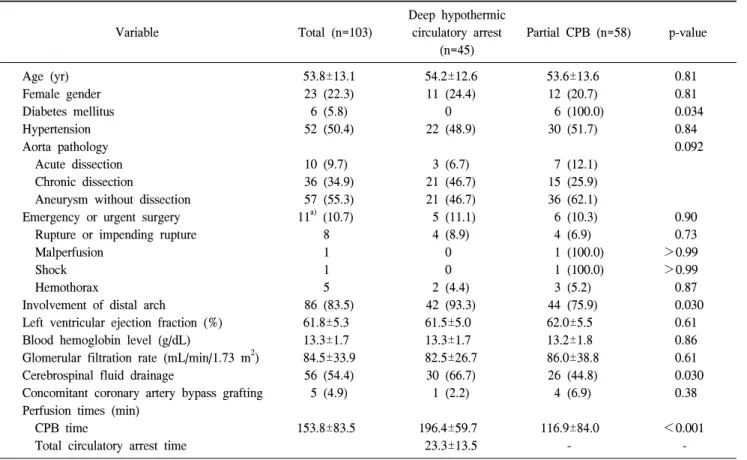
patients are shown in Table 1. Eleven patients (10.7%) under- went emergency or urgent surgeries as indicated in Table 1.

CPB time was longer in the DHCA group (196.4±59.7 mi- nutes versus 116.9±84.0 minutes, p<0.001), and mean circu- latory arrest time was 23.3±13.5 minutes in the DHCA group.

Early operative outcomes are summarized in Table 2. Early mortality occurred in five patients (4.9%). The causes of ear- ly deaths were LCOS in all patients, among which four pa- tients showed multi-organ failure. Regarding the early mortal- ity cases, one patient had low left ventricle (LV) ejection fraction (35%) preoperatively, in whom partial CPB strategy was applied. The other four patients underwent DHCA strategies. Early major complications occurred in 21 patients (20.3%) including 7 patients (6.8%) of re-exploration for postoperative bleeding. Ten patients (9.7%) required new dial- ysis for acute renal failure and 7 patients (6.8%) developed

stroke, but no cases of paraplegia were reported. Between the DHCA group and the partial CPB group, the DHCA group had a higher rate of LCOS (13.3% versus 1.7%, p=0.041) and the duration of mechanical ventilation was longer than in the partial CPB group.

During the median follow-up duration of 56.3 months (inter-quartile range, 23.1 to 85.1 months), there were 17 (16.5%) late mortalities including 11 cardiovascular-related deaths. Non-cardiovascular causes of death were malignancy in one, respiratory failure in four, and alcoholic liver disease in one patient. The overall survival rates at 5 and 10 years were 80.9%±4.3% and 71.7%±5.9%, respectively (Fig. 1).

The 5- and 10-year reoperation-free survival rates were

77.3%±4.8% and 70.2%±5.8%, respectively (Fig. 2). There

was one aortic reoperation case during follow-up, in whom

asymptomatic pseudoaneurysm at the anastomoses site was

seen at regular follow-up computed tomography performed 3

(4)

Table 2. Early operative outcomes

Variable Total (n=103)

Deep hypothermic circulatory arrest

(n=45)

Partial cardiopulmonary

bypass (n=58)

p-value

Early mortality

No. of patients with major complications Re-exploration due to surgical bleeding Requirement for dialysis

Requirement for hemodynamic mechanical support Permanent neurologic injury

Stroke Paraplegia Multi-organ failure Surgical wound revision Pneumonia

Ventilator support duration (hr) Ventilator support>12 hr Ventilator support>24 hr Intensive care unit stay (day)

5 (4.9) 21 (20.3)

7 (6.8) 10 (9.7) 7 (6.8) 7 (6.8) 7 (6.8)

0 4 (3.9) 4 (3.9) 8 (7.8) 25 (13–55)

79 (77.7) 52 (50.5) 5 (3–7)

4 (8.9) 14 (31.1) 5 (11.1) 6 (13.3) 6 (13.3) 5 (11.1) 5 (11.1)

0 3 (6.7) 1 (2.2) 5 (11.1)

41 (91.1) 34 (75.6) 6 (4–9)

1 (1.7) 7 (12.1)

2 (3.4) 4 (6.9) 1 (1.7) 2 (3.4) 2 (3.4)

0 1 (1.7) 3 (5.2) 3 (5.2)

38 (65.5) 18 (31.0) 4 (3–5)

0.17 0.026

0.24 0.33 0.041

0.24 0.24 - 0.32 0.63 0.29

0.004

<0.001 0.28 Values are presented as number (%) or median (inter-quartile range).

Fig. 1. A Kaplan-Meier plot for overall survival. Fig. 2. A Kaplan-Meier plot for aortic reoperation-free survival.

months after surgery. Reoperative aortic replacement was per- formed without leaving significant morbidity.

The patient variables associated with mortality in the uni- variate analysis were age (p<0.001), LV ejection fraction (p=0.001), and glomerular filtration rate (p=0.002). Multivari- able analyses revealed that age (hazard ratio [HR], 1.10; 95%

confidence interval [CI], 1.05 to 1.15; p<0.001) and LV function (HR, 0.88; 95% CI, 0.82 to 0.96; p<0.003) were significantly associated with mortality (Table 3). Ruptured aorta and urgent/emergency cases, however, were not sig-

nificantly associated with an increased risk of mortality in this study. Furthermore, different CPB strategies (p=0.49) and distal arch involvement (p=0.92) did not significantly affect mortality.

DISCUSSION

Open surgical repair remains a gold standard approach in

the management of DTA lesions requiring invasive inter-

vention [9]. Progress in pre-operative management and CPB

(5)

Table 3. Risk factor analysis for long-term mortality

Variable Univariate Multivariable

HR 95% CI p-value HR 95% CI p-value

Age Sex

Diabetes mellitus Hypertension Aorta pathology Rupture Hemothorax Emergency

Left ventricular ejection fraction (by 1% increment) Hemoglobin

Glomerular filtration rate (by 1 mL/min/1.73 m

2

increment) Distal arch involvement

Cerebrospinal fluid drain

Deep hypothermic circulatory arrest

1.10 0.75 1.31 2.33 0.89 2.15 1.76 2.00 0.87 1.04 0.98 0.95 0.61 1.35

1.05–1.15 0.25–2.21 0.31–5.63 1.18–6.66 0.46–1.70 0.63–7.33 0.41–7.60 0.67–5.92 0.80–0.94 0.81–1.35 0.96–0.99 0.32–2.80 0.26–1.45 0.58–3.17

<0.001 0.60 0.72 0.24 0.72 0.22 0.45 0.23 0.001

0.74 0.002

0.92 0.26 0.49

1.10

0.88

-

1.05–1.15

0.82–0.96

-

<0.001

0.003

-

HR, hazard ratio; CI, confidence interval.

strategies as well as adjunctive maneuvers to protect the kid- neys, visceral organs, and central nervous system has sig- nificantly improved surgical outcomes [3,4,8,10,11]. However, open surgical repair of DTA is still regarded as a surgical challenge having a reported early mortality rate of 4.8% to 22.4% [8,12]. In addition, in the era of endovascular alter- natives, patients who undergo open repair of DTA generally have highly complex aortic pathology where TEVAR ap- proaches are regarded inappropriate, and these circumstances make it more challenging for practicing surgeons to undertake open surgery for DTA, particularly for surgeons in low-vol- ume aortic centers [3,8].

In the past decades, a number of researches have been con- ducted to improve the preservation of end-organ functions from ischemic damages. Several perfusion techniques were developed such as DHCA and partial CPB including femo- ral-femoral bypass and left heart bypass [4,9]. Adjunctive strategies such as intercostal reimplantation, CSF drainage, motor/somatosensory-evoked potential monitoring, and rapid renal cooling have also been developed. Despite these im- provements in surgical techniques and adjuncts for end-organ protection, the optimal CPB strategy between DHCA and par- tial CPB still remains controversial [9]. Recent studies re- viewed that DHCA for open repair of DTA has several ad- vantages over non-DHCA [9,11,13-15]. First, a bloodless field

without clamping the aorta can be obtained. In particular, since clamping of the aorta is not safe if the aortic disease involves the distal aortic arch, DHCA may offer a safe envi- ronment for surgery in this situation. Patel et al. [11] demon- strated that half of the patients suffered from postoperative stroke when cross-clamping was conducted for the atheroma- tous aortic arch, but the stroke rate decreased to 11% when DHCA was used without aortic clamping. Secondly, hypo- thermia has a protective effect on the spinal cord and visceral organs by decreasing the oxygen demand [13]. In support of this hypothesis, Rokkas et al. [14] reported that the spinal cord is protected by DHCA not only by decreased metabo- lism but also by the inhibition of the release of excitatory amino acids in the extracellular neuronal space [14]. In DHCA strategies, however, prolonged CPB time may require more transfusion, and hypothermia induces impairment of co- agulation cascade [15].

Partial CPB strategies have certain advantages such as re- quirement for shorter CPB time than DHCA, which con- sequently reduce the risks of coagulopathy and lethal intra- pulmonary hemorrhage that may hamper postoperative recov- ery [15]. Moreover, several recent studies reported excellent spinal cord protection using a mild-hypothermic distal perfu- sion technique in combination with CSF drainage [4,16].

Acher [16] suggested that the quality of spinal cord pro-

(6)

tection relies mainly on perfusion, metabolism, and oxygen delivery to the spinal cord during mild hypothermia rather than the CPB strategies themselves. Spinal cord perfusion can be further augmented by CSF drainage and maintaining the mean arterial pressure above 80 mmHg. Along with the opti- mization of the hemoglobin level, oxygen saturation and car- diac index are regarded important to prevent postoperative de- layed paraplegia.

In support of these previous reports, the present study also showed that the CPB strategy was not significantly related to early mortality, multi-organ failure, neurologic injury, and ARF. Although the rate of immediate postoperative LCOS re- quiring mechanical support was higher in the DHCA group (Table 2), the CPB strategy did not affect long-term survival even in a univariate analysis (Table 3). The independent pre- dictors were age (HR, 1.10; 95% CI, 1.05 to 1.15; p<0.001) and LV ejection fraction (HR, 0.88; 95% CI, 0.82 to 0.96; p

<0.003), which are not factors adjustable by surgery.

Because of the retrospective nature of this study, we could not determine why LV venting was not routinely used.

However, considering the higher rates of LCOS (p=0.041) in the DHCA group, we recently changed our strategy to asser- tively insert an LV vent (via LV apex) when conducting DHCA.

Despite the improvements in the operative outcomes of open surgical repair of DTA, it still regarded too aggressive, particularly in the current era of TEVAR. Early mortality rates following TEVAR are reported to be up to 7.4% [17]

and 4-year mortality after TEVAR for ruptured thoracic aneurysm has been estimated to be 25.4% [18]. For elective cases, TEVAR was associated with lower risks of early death and complications compared with open repair of DTA [6,18,19]. However, there are only a few studies that have compared long-term outcomes between TEVAR and open re- pair in DTA. Of note, Makaroun et al. [19] reported that TEVAR showed a comparable 5-year survival rate (68% ver- sus 67%, p-value=0.433) with that of open surgery.

Nevertheless, the risk of vascular complications following TEVAR is reported to be substantial, and the 5-year re-inter- vention rate was reported to be 3.6% to 17% [19,20]. In this regard, overall clinical outcomes including intervention-related complications should be compared between TEVAR and open

surgery in further large-scale studies in order to determine optimal candidates for each treatment option.

1) Limitation

This study is limited by a retrospective analysis that in- cludes an inherent bias. Non-randomized design may have af- fected the results because of unmeasured confounders, proce- dure bias, or detection bias, even with the use of rigorous statistical adjustment. Further, this study represents the experi- ence of a single large tertiary referral center and might not be generalized to other centers.

2) Conclusions

The outcomes of open surgical repair of DTA were fea- sible in terms of excellent perioperative mortality/morbidity as well as favorable long-term outcomes. Age and LV function were independent predictors of long-term mortality, whereas the surgical strategies did not significantly affect the clinical outcomes.

CONFLICT OF INTEREST

No potential conflict of interest relevant to this article was reported.

REFERENCES

1. Hiratzka LF, Bakris GL, Beckman JA, et al. 2010 ACCF/

AHA/AATS/ACR/ASA/SCA/SCAI/SIR/STS/SVM guidelines for the diagnosis and management of patients with Thoracic Aortic Disease: a report of the American College of Cardio- logy Foundation/American Heart Association Task Force on Practice Guidelines, American Association for Thoracic Surgery, American College of Radiology, American Stroke Association, Society of Cardiovascular Anesthesiologists, Society for Cardiovascular Angiography and Interventions, Society of Interventional Radiology, Society of Thoracic Surgeons, and Society for Vascular Medicine. Circulation 2010;121:e266-369.

2. Patel HJ, Williams DM, Upchurch GR Jr, et al. A compar- ison of open and endovascular descending thoracic aortic repair in patients older than 75 years of age. Ann Thorac Surg 2008;85:1597-603.

3. Svensson LG, Crawford ES, Hess KR, Coselli JS, Safi HJ.

Variables predictive of outcome in 832 patients undergoing

(7)

repairs of the descending thoracic aorta. Chest 1993;104:

1248-53.

4. Estrera AL, Miller CC 3rd, Chen EP, et al. Descending thoracic aortic aneurysm repair: 12-year experience using distal aortic perfusion and cerebrospinal fluid drainage. Ann Thorac Surg 2005;80:1290-6.

5. Svensson LG, Kouchoukos NT, Miller DC, et al. Expert consensus document on the treatment of descending thoracic aortic disease using endovascular stent-grafts. Ann Thorac Surg 2008;85(1 Suppl):S1-41.

6. Chaikof EL, Mutrie C, Kasirajan K, et al. Endovascular re- pair for diverse pathologies of the thoracic aorta: an initial decade of experience. J Am Coll Surg 2009;208:802-16.

7. Lee HS, Lee SH, Yoon YC, Kuh BI, Kim CH. Surgical treatment of the descending thoracic aorta: an analysis of 22 cases. Korean J Thorac Cardiovasc Surg 1999;32:532-5.

8. Bozinovski J, Coselli JS. Outcomes and survival in surgical treatment of descending thoracic aorta with acute dissection.

Ann Thorac Surg 2008;85:965-70.

9. Weiss AJ, Lin HM, Bischoff MS, et al. A propensity score-matched comparison of deep versus mild hypothermia during thoracoabdominal aortic surgery. J Thorac Cardio- vasc Surg 2012;143:186-93.

10. Coselli JS, LeMaire SA, Koksoy C, Schmittling ZC, Curling PE. Cerebrospinal fluid drainage reduces paraplegia after thoracoabdominal aortic aneurysm repair: results of a randomized clinical trial. J Vasc Surg 2002;35:631-9.

11. Patel HJ, Shillingford MS, Mihalik S, Proctor MC, Deeb GM. Resection of the descending thoracic aorta: outcomes after use of hypothermic circulatory arrest. Ann Thorac Surg 2006;82:90-5.

12. Coselli JS, Plestis KA, La Francesca S, Cohen S. Results of

contemporary surgical treatment of descending thoracic aort- ic aneurysms: experience in 198 patients. Ann Vasc Surg 1996;10:131-7.

13. Kouchoukos NT, Masetti P, Rokkas CK, Murphy SF, Blackstone EH. Safety and efficacy of hypothermic car- diopulmonary bypass and circulatory arrest for operations on the descending thoracic and thoracoabdominal aorta.

Ann Thorac Surg 2001;72:699-707.

14. Rokkas CK, Sundaresan S, Shuman TA, et al. Profound sys- temic hypothermia protects the spinal cord in a primate model of spinal cord ischemia. J Thorac Cardiovasc Surg 1993;106:1024-35.

15. Kestin AS, Valeri CR, Khuri SF, et al. The platelet function defect of cardiopulmonary bypass. Blood 1993;82:107-17.

16. Acher C. It is not just assisted circulation, hypothermic ar- rest, or clamp and sew. J Thorac Cardiovasc Surg 2010;140 (6 Suppl):S136-41.

17. Shah AA, Craig DM, Andersen ND, et al. Risk factors for 1-year mortality after thoracic endovascular aortic repair. J Thorac Cardiovasc Surg 2013;145:1242-7.

18. Coselli JS, Gopaldas RR. Ruptured thoracic aneurysms: to stent or not to stent? Circulation 2010;121:2705-7.

19. Makaroun MS, Dillavou ED, Wheatley GH, Cambria RP;

Gore TAG Investigators. Five-year results of endovascular treatment with the Gore TAG device compared with open re- pair of thoracic aortic aneurysms. J Vasc Surg 2008;47:

912-8.

20. Lee CJ, Rodriguez HE, Kibbe MR, Malaisrie SC, Eskandari

MK. Secondary interventions after elective thoracic endovas-

cular aortic repair for degenerative aneurysms. J Vasc Surg

2013;57:1269-74.

수치

Table 1. Baseline characteristics and intraoperative profiles of patients Variable Total  (n=103) Deep  hypothermic circulatory  arrest  (n=45) Partial  CPB  (n=58) p-value Age  (yr) Female  gender Diabetes  mellitus Hypertension Aorta  pathology     Acute
Fig. 1. A Kaplan-Meier plot for overall survival. Fig. 2. A Kaplan-Meier plot for aortic reoperation-free survival.
Table 3. Risk factor analysis for long-term mortality

참조

관련 문서