www.labmedonline.org 79 eISSN 2093-6338
고빈도항원에 대한 항체의 경우 빈도상 드물게 검출됨에도 불구하 고, 적합혈을 공급할 수 있는 현실적인 방법이 없어 여전히 용혈성 수혈부작용을 일으킬 가능성이 높다. 따라서 안전한 수혈을 위한 적절한 조치가 필요한 것으로 판단된다.
Diego 혈액형계는 21개의 항원으로 구성되어 있으며, 그 중 Dib 는 고빈도항원이다[1]. 1976년 처음으로 발견된 항-Dib는 매우 드물 게 발견되지만, 지연성용혈성수혈반응 및 신생아용혈성질환을 일 으킬 수 있는 항체 중 하나로 알려져 있다[2, 3]. 국내에서는 항-Dib 에 의한 신생아용혈성질환은 4예가 보고되었고 모든 증례에서 심 각한 용혈성 반응을 보였으며, 면역글로불린 투여, 교환수혈, 광선 요법 등의 치료가 필요한 고빌리루빈혈증을 보였다[3-7]. 최근 저자 들은 항-Dib가 검출되고, 동시에 혈액형 항원 검사에서 Di(a+b-)로 확인된 2례를 경험하여 이를 보고할 뿐만 아니라, 향후 국내에서 의 희귀혈액형 헌혈자 등록 프로그램 구축 및 혈액공급의 필요성 에 대해 제안하고자 한다.
첫 번째 환자는 78세 여자로 타병원에서 왼정강 구획증후군(com- partment syndrome)으로 근막절개술을 시행 받았으며 내원 3일전 부터 O형 RhD 양성 농축적혈구 5단위를 수혈 받고 이후 발생한 혈청 creatinine의 증가로 내원하였다. 환자는 이전 병원에서 수혈 을 세 차례 받는 동안 혈색소가 9.2 g/dL에서 8 g/dL, 7.8 g/dL 그리 최근 국내 수혈의학에서 ‘면역 적합성(immune compatibility)’에
대한 관심의 증대 및 의료기관의 적극적인 type and screen 검사 도입으로 인하여 예기항체 및 주요 비예기항체에 의한 용혈성수혈 부작용에 대한 예방적 조치가 적절하게 이루어지고 있다. 그러나
Di(a+b-) 표현형을 가진 환자에서 발견된 항-Di b 2예:
국내 희귀혈액형 헌혈자 등록 사업의 필요성 제안
Two Clinical Cases of Anti-Di
bwith Di(a+b-) Phenotypes: Practical Need for Rare Blood Donor Registry Program in Korea
이민영1,2·박태성2*·오승환3·김신영4*·김현옥4
Min Young Lee, M.D.1,2, Tae Sung Park, M.D.2*, Seung Hwan Oh, M.D.3, Sinyoung Kim, M.D.4*, Hyun-Ok Kim, M.D.4
경희대학교 대학원 진단검사의학과1, 경희대학교 의과대학 진단검사의학과2, 인제대학교 의과대학 진단검사의학과3, 연세대학교 의과대학
진단검사의학과4
Department of Laboratory Medicine1, Graduate School, Kyung Hee University, Seoul; Department of Laboratory Medicine2, School of Medicine, Kyung Hee University, Seoul; Department of Laboratory Medicine3, Inje University College of Medicine, Busan; Department of Laboratory Medicine4, Yonsei University College of Medicine, Seoul, Korea
단신
Lab Med Online
Vol. 7, No. 2: 79-82, April 2017
https://doi.org/10.3343/lmo.2017.7.2.79 수혈의학
Corresponding author: Tae Sung Park
Department of Laboratory Medicine, School of Medicine, Kyung Hee University, 23 Kyung Hee dae-ro, Dongdaemun-gu, Seoul 02447, Korea Tel: +82-2-958-8673, Fax: +82-2-958-8609, E-mail: [email protected] Co-corresponding author: Sinyoung Kim
Department of Laboratory Medicine, Yonsei University College of Medicine, 50-1 Yonsei-ro, Seodaemun-gu, Seoul 03722, Korea
Tel: +82-2-2228-2452, Fax: +82-2- 313-0956, E-mail: [email protected]
* These authors contributed equally to this article as the co-corresponding authors.
Received: June 21, 2016
Revision received: October 11, 2016 Accepted: October 19, 2016
This article is available from http://www.labmedonline.org 2017, Laboratory Medicine Online
This is an Open Access article distributed under the terms of the Creative Commons Attribution Non-Commercial License (http://creativecommons.org/licenses/by-nc/4.0/) which permits unrestricted non-commercial use, distribution, and reproduction in any medium, provided the original work is properly cited.
Here, we report two cases of identified anti-Dib antibodies with rare Di(a+b-) blood types from two different hospitals in Korea. Dib mismatched transfusion could cause a hemolytic transfusion reaction. However, it is extremely difficult to find compatible blood for patients with such a rare blood type. In this regard, we concluded that national level rare donor registry program, wherein rare blood types are indexed, needs to be estab- lished. Moreover, laboratory medicine specialists at each hospital should encourage donor registration and family testing through education for helping patients with rare blood types. These efforts will help establish a system that guarantees safe blood transfusion for patients.
Key Words: Rare blood donor registry program, Anti-Dib, Transfusion
이민영 외: Anti-Dib and Rare Blood Donor Registry Program
https://doi.org/10.3343/lmo.2017.7.2.79 80 www.labmedonline.org
고 7.3 g/dL로 낮아지는 추세를 보이고 있었다(Fig. 1). 환자의 혈액 형은 O형 RhD 양성이었으며 항체선별검사에서 양성 결과를 보였 다. 항체동정검사(Resolve Panel A: Ortho-clinical Diagnostics, Rar- itan, NJ, USA)에서 11개의 모든 패널에서 4+의 반응성을 보였으나, 자가혈구에서는 응집이 관찰되지 않았다. 직접항글로불린검사에 서는 음성을 나타냈다. 원내에서 보유한 O형 RhD 양성 농축적혈 구를 가지고 환자의 혈청과 교차시험을 시행하였으나 적합한 혈액 을 하나도 찾을 수 없었다. 고빈도항원에 대한 항체가 추정되어 표 준검사실(Central Laboratory of the Swiss Red Cross in Bern, Swit- zerland)에 의뢰하였고, 검사 결과 항-Dib가 존재하고 항원형은 Di (a+b-)인 것으로 확인되었다. DI gene (SLC4A1)에 대한 직접염기서 열분석을 통해 Diego 유전자형 검사를 시행한 결과 DI*A/A 동형 접합체로 표현형검사 결과에 부합하였다(Fig. 2).
두 번째 환자는 73세 여자로 위팔뼈 골절로 내원하였다. 수술 전 검사로 실시한 혈액형 검사에서 A형 RhD 양성의 결과를 보였다.
항체선별검사에서 양성 소견을 보여 실시된 항체동정검사(ID-Di- aPanel, ID-DiaPanel P; Bio-Rad, Cressier, Morat, Switzerland)에서 모든 적혈구에 양성 소견을 보였으며, 자가혈구에서는 응집이 관 찰되지 않았다. 혈액은행에서 적합한 농축적혈구를 찾기 위하여 A 형 RhD 양성 농축적혈구를 환자의 혈청과 교차시험을 실시하였으 나 적합한 적혈구제제를 발견할 수 없었다. 고빈도항원에 대한 항 체가 검출된 것으로 판단되어, 표준검사실(Central Laboratory of the Swiss Red Cross in Bern)에 검사를 의뢰하였다. 그 결과 항-Dib 및 항-C가 검출되었다. PCR을 통한 Diego 유전자형검사에서는 DI*B 대립유전자가 존재하지 않는 것으로 밝혀져 항-Dib가 동종항
체임을 확인하였다.
Diego 혈액형의 표현형 중 Di(a-b+)가 90% 이상으로 대부분을 차지하는 것으로 알려져 있고 Di(a+b-)는 백인과 아프리카계 미국 인의 0.01% 미만에서 보이며, 일본인의 0.2%로 보고되고 있다[9].
우리나라는 최근 국내의 1개 대학병원에 내원한 헌혈자 및 환자를 대상으로 한 혈액형 관련 특정항원음성 빈도 조사에서 Di(a+b-)인 비율은 1.2%로 확인되었다[10]. 한국인 헌혈자 419명을 대상으로 한 다른 연구에서도 Di(a+b-) 항원형이 RhD 양성 헌혈자의 0.3%, RhD 음성 헌혈자의 1.8%의 빈도를 보였다[11].
항-Dib 항체 양성인 환자에 적합한 농축적혈구를 확보하는 것은 희귀헌혈자 등록프로그램이 운영되지 않는 국내에서는 매우 어렵 다. 국내에 수혈이 필요한 상황에서 항-Dib를 가진 것이 확인되었 던 환자의 경우 적합혈을 구할 수 없어 수술을 연기하고 환자의 혈 액을 예치하여 자가 수혈을 진행하였다[12] (Table 1). 또한 신생아 용혈성질환이 예견되는 태아를 위하여 원내에서 갖고 있던 600개 의 농축적혈구와 항-Dib 항체 양성인 산모의 혈청과 교차 시험을 실시한 결과 적합한 혈액은 1개뿐이었고 더 많은 적합혈을 얻기 위 하여 대한적십자사 중앙혈액검사센터에 요청하여 시행한 600단위 농축적혈구와의 교차시험에서도 1개의 적합 혈액만을 찾을 수 있 었다는 보고도 있다[4]. 따라서, 현재의 시스템 하에서는 항-Dib를 갖고 있는 환자에서 적합혈을 찾는 데에는 많은 시간과 노력이 소 요될 것으로 예상된다.
본 증례들은 추가적인 수혈을 필요로 하는 경우는 아니었다. 이
Table 1. Reported cases of adult patients having anti-Dib in Korea
Case Age/Sex Blood group Diego phenotype Unexpected antibody
identification Diagnosis
1 [14] 57/F N/A Di(a+b−) anti-Dib Liver cancer
2 [present case] 78/F O+ Di(a+b−) anti-Dib Compartment syndrome
3 [present case] 73/F A+ Di(a+b−) anti-Dib, anti-C Humerus fracture
Fig. 1. Hemoglobin value of the patient in Case 1.
10 9 8 7 6
3 days before 2 days before 1 day before Admission 2 units
RBCs
2 units RBCs
1 unit RBCs
Hb
Fig. 2. Sequence analysis of SLC4A1. Arrow indicates homozygous sub- stitution of proline (CCG) with leucine (CTG) at position 854 of exon 19.
이민영 외: Anti-Dib and Rare Blood Donor Registry Program
https://doi.org/10.3343/lmo.2017.7.2.79 www.labmedonline.org 81
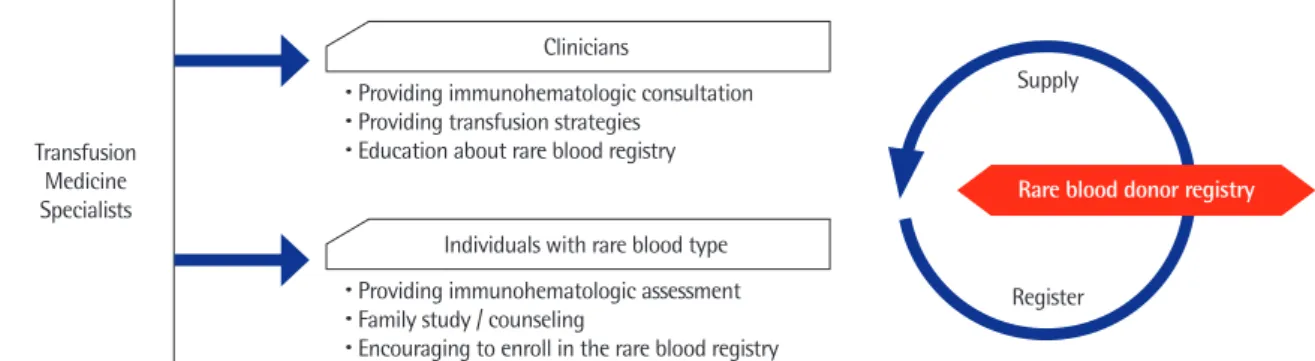
러한 환자들이 수혈이 예상되는 수술을 계획하고 있다면 혈액 예 치를 통해 자가 수혈을 시행하는 등의 방법을 통해 수혈을 진행할 수 있겠지만, 응급 수혈이 필요한 경우 혈액 수급이 현실적으로 매 우 어려운 상황에 직면하게 된다. 미국에서는 1959년에 처음으로 희귀혈액형 항체를 가진 환자들을 위해 이에 맞는 혈액의 수급이 필요하다는 의식을 갖고 American Rare Donor Program을 설립하 여 미국 적십자와 American Association of Blood Banks와 함께 운영하며 헌혈자에 대한 데이터베이스를 구축하고 희귀혈액형의 수급에 대한 자료를 갖고 있다. 유럽에서도 비슷한 기구를 갖고 있 으며 아시아에서는 유일하게 일본에서 희귀혈액형 헌혈자에 대한 등록 프로그램을 갖고 있었다[13, 14]. 우리나라에서는 2000년대 초부터 이에 대한 사업을 준비하여 현재 Korean Rare Donor Pro- gram과 Korean Rare Blood Program을 구축하여 시범적으로 운영 하고 있으나 아직 실제적인 희귀 혈액 수급까지는 영향력이 미치지 않고 있어 적합혈을 공급받지 못할 상황에 대한 적절한 가이드라 인의 필요나 희귀 혈액 장기 냉동 보관 시스템 구축에 대한 지적이 있어 왔다[12, 15]. 성공적인 희귀혈액형 등록 사업을 위해서는 모 든 헌혈자의 혈액에 대한 집단선별검사를 시행하는 방법이 있으나 현재는 그보다 우선적으로 희귀혈액형을 갖고 있는 것으로 밝혀 진 환자에 대하여 교육과 홍보를 통해 헌혈을 장려하거나 가족, 특 별히 형제 자매에 대한 검사를 통하여 더 많은 희귀혈액형을 가진 사람을 찾아내기 위한 교육을 하는 것이 선행되어야 할 것이다. 첫 번째 증례에서 환자의 가족에 대한 검사(family study)를 요청하였 으나 당시 수혈이 더 이상 필요하지 않았기 때문에, 환자뿐만 아니 라 담당 의사조차도 이에 대한 필요성을 인식하지 못하였다. 시스 템 구축을 위해 선행된 조사 연구에서도 강조하고 있는 것 중 하나 가 헌혈자의 적극적인 참여와 지속적인 관심을 유도하기 위해서는 전문교육을 받은 담당자에 의해 업무가 진행되어야 한다는 것이다 [16]. 이는 희귀헌혈자 등록 사업이 희귀혈액형을 가진 환자들의 수 혈에 현실적인 도움을 주기 위해서는 각 병원 내에도 희귀혈액형 에 대하여 환자나 임상의사에게 전문적으로 상담과 교육을 해주
는 진단검사의학과 전문의와 같은 수혈의학 전문가가 필요하다는 것을 말해준다(Fig. 3).
요 약
저자들은 국내 두 개의 병원에서 희귀혈액형인 Di(a+b-)에 대한 항-Dib를 검출한 2예를 보고하였다. 항-Dib는 용혈성수혈부작용을 일으키는 임상적으로 유의한 항체로 알려져 있지만 이러한 희귀혈 액형을 가진 환자에게 공급할 적합혈을 찾는 것은 쉽지 않은 실정 이다. 그러므로 국가적으로 희귀혈액형 헌혈자 등록 사업에 박차 를 가해야 할 것이며 각 병원에서는 진단검사의학과 전문의들이 희귀혈액형에 대한 교육을 통하여 헌혈자 등록과 가족 검사를 장 려하여야 할 것이다. 이러한 노력을 통하여 희귀혈액형을 가진 환 자들도 안전한 수혈을 보장받을 수 있는 시스템이 구축될 것으로 사료된다.
REFERENCES
1. International Society of Blood Transfusion. Names for DI Blood Group Alleles. http://isbtweb.org/fileadmin/user_upload/files-2015/red%20 cells/blood%20group%20allele%20terminology/allele%20tables/010%
20DI%20Alleles%20v2.0%20110914.pdf (v2.0 119014).
2. Thompson PR, Childers DM, Hatcher DE. Anti-Dib-first and second ex- amples. Vox Sang 1967;13:314-8.
3. Mochizuki K, Ohto H, Hirai S, Ujiie N, Amanuma F, Kikuta A, et al.
Hemolytic disease of the newborn due to anti�Dib: a case study and review of the literature. Transfusion 2006;46:454-60.
4. Choi JW, Kim MJ, Kim MH, Park JR, Kim HO. A case of mild hemolytic disease of the fetus and newborn - The first case of anti-Dib identified on prescreening test during pregnancy. Korean J Blood Trans 2010;21:
165-70.
Fig. 3. Proposed protocol after identifying rare blood type in a patient.
Transfusion Medicine Specialists
Clinicians
Individuals with rare blood type
· Providing immunohematologic consultation
· Providing transfusion strategies
· Education about rare blood registry
· Providing immunohematologic assessment
· Family study / counseling
· Encouraging to enroll in the rare blood registry
Supply
Register
Rare blood donor registry
이민영 외: Anti-Dib and Rare Blood Donor Registry Program
https://doi.org/10.3343/lmo.2017.7.2.79 82 www.labmedonline.org
5. Kim HC, Kang MJ, Chae JH, Shim WS, Nahm CH, Hah KS. A case of hemolytic disease of the newborn due to Anti-Dib antibody. Korean J Blood Transfus 1994;5:151-8.
6. Oh EJ, Jekarl DW, Jang HS, Park HI, Park YJ, Choi HA, et al. Severe he- molytic disease of the newborn due to anti-Dib treated with photother- apy and intravenous immunoglobulin. Ann Clin Lab Sci 2008;38:80-2.
7. Park MH, Son J, Go JW, Kim JY, Ahn DH, Kim DA. A case of hemolytic disease of the newborm due to anti-Dib Antibody. J Korean Soc Neo- natol 1999;6:268-71.
8. Petz LD, Swisher SN, Kleinman SN, Spencer RP, Strauss RG. Clinical practice of transfusion medicine. 3rd ed. New York: Churchill Living- stone Inc, 1996:128.
9. Tsuneyama H. Diego blood system and the antibodies. Nihon Rinsho 2005;63:692.
10. Kwon JR, Lee MN, Jang CH, Kim YK, Choi YS. Establishment of Ko- rean Rare Blood Program in Koreans. Public Health Weekly Report 2013;6:846-50.
11. Hong YJ, Chung Y, Hwang SM, Park JS, Kwon JR, Choi YS, et al. Geno- typing of 22 blood group antigen polymorphisms and establishing a national recipient registry in the Korean population. Ann Hematol 2016;
95:985-91.
12. Park JH, Cho D, Ryang DW. Transfusion support of patients with anti- bodies against high-frequency RBC antigens. Korean J Blood Transfus 2014;25:69-71.
13. Mallory D, Malamut D, Sandler SG. A decade of rare donor services in the United States. Vox Sang 1992;63:186-91.
14. Kaur R and Jain A. Rare blood donor program in the country: Right time to start. Asian J Transfus Sci 2012;6:1.
15. Cho EH, Chun S, Seo JY, Kang ES, Cho D, Kim DW. A system for cryo- preservation of rare red blood cell units; right time to start. Korean J Blood Transf 2015;26:323-5.
16. Lee MK, Choi BC, Oh DJ, Jeong OJ, Kim MJ. A study to establish rare blood type donor registration system. Korean J Blood Transfus 2005;
16:38-44.