• 검색 결과가 없습니다.

Journal of Korean Biological Nursing Science

N/A
N/A
Protected

Academic year: 2021

Share "Journal of Korean Biological Nursing Science"

Copied!
10
0
0

로드 중.... (전체 텍스트 보기)

전체 글

(1)

INTRODUCTION

Most malignancies are aging-related, which puts the increasing geri- atric population more susceptible to cancer diagnosis. Gastrointestinal (GI) cancer including gastric, colorectal, pancreatic, biliary and hepato- cellular carcinomas has been reported as one of the most prevalent ma- lignancies with high mortality rate among this segment of population [1]. Advanced medical technology has allowed increased indications for GI cancer-directed surgeries and cancer survivorship for the geriatric patients. However, age-related complications have made it difficult to

provide postoperative nursing care. Postoperative delirium (POD) is one of the most common postsurgical complications that may be reversible and transient but can lead into adverse outcomes if not properly man- aged in a timely manner [2,3]. A missed management may lead into se- vere cognitive impairment and delayed independence, which may cause prolonged hospital stay, increased healthcare costs and possibly de- creased quality of life [4]. Limited strategies for its early detection, pre- vention and management threaten quintessential postoperative nursing care delivery [5].

Several studies have reported concerns related to GI cancer among

Literature Review of Postoperative Delirium in Geriatric Patients After Elective Gastrointestinal Cancer Surgery

Park, Da-In ·Choi-Kwon, Smi

College of Nursing · The Research Institute of Nursing Science, Seoul National University, Seoul, Korea

Purpose: Increasing number of older adults are receiving cancer surgeries especially for gastrointestinal cancers, which brings forth at- tention to age-related postoperative complication prevention. Postoperative delirium (POD) is a common complication that rises after surgical procedures involving general anesthesia, largely in the elderly population. Due to its sudden onset and fluctuating symptoms, POD often goes underdiagnosed and undertreated even though it may lead to various adverse outcomes. POD in GI cancer surgical el- derly patients is poorly understood in terms of prevalence, pathophysiology, assessment, treatment and nursing management. We aimed to identify available literature and investigate study results to broaden our understanding of geriatric GI cancer POD. Methods:

The search process involved six databases to identify relevant studies abided by inclusion criteria. Results: Eleven studies were selected for this review. Geriatric POD is closely related to frailty and surgical complications. Frailty increases vulnerability to surgical stress and causes cerebral changes that affect stress-regulating neurotransmitter proportions, brain blood flow, vascular density, neuron cell life and intracellular signal transductions. These conditions of frailty result in increased risks of surgical complications such as blood loss, car- diovascular events and inflammation, which all may lead to the POD. Mini Metal State Examination (MMSE), Confusion Assessment Method (CAM) and Delirium Rating Scale-revised-98 (DRS-R-98) are recommended for POD assessment to identify high-risk patients.

Conclusion: The POD prevalence ranged from 8.2% to 51.0%. The multifactorial causative mechanism suggests nurses to identify high- risk elderly GI-cancer surgical patients by reviewing patient-specific factors and surgery-specific factors.

Key Words: Delirium; Gastrointestinal cancer; Elderly; Review 국문주요어:  섬망, 위장암, 노인, 리뷰

Corresponding author: Choi-Kwon Smi

College of Nursing, The Research Institute of Nursing Science, Seoul National University, 103 Daehak-ro, Jongno-gu, Seoul 03080, Korea Tel: +82-2-740-8801 Fax: +82-2-765-4103 E-mail: [email protected]

Received: July 13, 2018 Revised: July 26, 2018 Accepted: July 31, 2018

This is an Open Access article distributed under the terms of the Creative Commons Attribution Non-Commercial License (http://creativecommons.org/licenses/by-nc/4.0) which permits unrestricted non-commercial use, distribution, and reproduction in any medium, provided the original work is properly cited.

www.bionursingjournal.or.kr

https://doi.org/10.7586/jkbns.2018.20.3.177

Journal of Korean Biological Nursing Science 2018;20(3):177-186

(2)

geriatrics and epidemiologic trends of aging population. Recent Korean national data reported that the average medical expenses among elderly population has doubled from year 2009 to 2016, which is in accordance with increased number of patients who have undergone surgical cancer procedures [6,7]. Also, newly diagnosed cancer population rose from 1.35 million in 2015 to 1.44 million in 2016, indicating 6.3% annual in- crease rate with 51.9% of the patients being elderly patients [6]. The surgi- cal cancer procedures that showed the greatest increased rate during the past 5 years in Korea were elective GI cancer surgeries [7].

Most of the reported geriatric GI malignancy surgeries are elective in- stead of emergency procedures [1,8]. GI elective surgeries are scheduled for the purpose of malignant tumor removal and resection of nearby sites, whereas emergency surgeries are usually associated with ischemia, obstruction, hemorrhage, perforation and inflammation which may or may not be associated with cancer. About 60% of surgical procedures are reported to have performed on patients older than 65 [8]. As advanced age is not a contraindication for GI malignancy surgery, the surgical rate is likely to increase. Although increased number of elderly have benefit- ted from receiving cancer-targeted surgical treatments, this population is more susceptible to postoperative complications compared to younger patients. They are more likely to be in poorer baseline health status asso- ciated with declined physiology, multiple comorbidities, polypharmacy and geriatric syndromes. Considering increased surgical cases among this population, preventative nursing measures for postsurgical age-re- lated complications are crucial.

Although researchers have identified POD as an independent factor that causes considerable complications, its complex nature and sudden onset make it challenging to achieve early detection and prompt treat- ment [9]. Bedside nurses are most likely to notice early signs of POD with proper assessments. However, as exemplified by one study, as much as 69% of incidents were unrecognized by nurses, which raises great concerns for missed and inappropriate nursing care [10]. Most of the past studies have mainly focused on identifying POD among cardiotho- racic and orthopedic patients exclusively in intensive care unit (ICU) settings. Now that increased number of geriatric patients are being indi- cated for elective GI cancer surgeries and spending critically ill postop- erative period in ward settings, current knowledge on POD that identify predisposing factors to predict the occurrence should be evaluated. A clear understanding of POD pathways, signs and symptoms will guide nurses to achieve preventative measures and timely treatment. In view of

this, the aim of this integrative review was to examine prevalence, patho- physiology, assessment, treatment and nursing management of POD in geriatric elective GI cancer surgical patients in ward settings.

METHODS

This integrative review was conducted to offer a systematic synthesis of available literature regarding ward-based POD in geriatric elective GI cancer surgical patients following the guidelines of PRISMA statement.

Two researchers (DP and SCK) and an experienced librarian indepen- dently extracted data before duplicate removal, and the study qualities were evaluated by each researcher. Initially, each researcher indepen- dently screened 10% of a random sample of citations to ensure adequate inter-rater agreement. Disagreements between researchers were resolved by a joint review of the articles to reach consensus; otherwise, a third re- viewer was available to make a final decision.

1. Search strategy

The integrative review question was developed using PICO (Popula- tion/problem, Intervention/exposure, Comparison, Outcome) model. A two-phase approach was performed to expedite the literature search procedure with an effort to remain rigorous but to prevent bias. After data extraction process was performed, reference lists of identified arti- cles were reviewed and relevant studies not revealed in the first phase were identified. This snowball technique was primarily performed by one of the authors (DP). Searches were performed using the Embase, MEDLINE, CINAHL, Cochrane Library, and Web of Science databases for articles published in English or Korean. As for the methodology, both quantitative and qualitative studies were searched for inclusion.

Additional studies revealed from reference list check were identified us- ing Google Scholar. The electronic search strategy had combination of the following components: 1) postoperative delirium; 2) confusion; 3) delirium; 4) cognitive dysfunction; 5) postoperative cognitive; 6) postop- erative cognitive dysfunction; 7) elective abdominal surgery; 8) abdomi- nal surgery; 9) surgery; 10) operation; 11) intervention; 12) nursing inter- vention; 13) nursing. The date of the final search was January 12, 2018.

2. Eligibility criteria

Studies were eligible if they included geriatric patient population (≥65

years) who have undergone elective GI cancer surgical procedures and

(3)

reported prognostic factors associated with POD. Any assessment meth- ods to capture and diagnose POD were eligible, and all definitions of each prognostic factor were included. Studies were excluded if they fo- cused on non-geriatric patients such as pediatric or working-age popula- tion, studied non-GI surgeries or non-cancer surgeries, or if the study setting was not ward-based. Studies in languages other than English or Korean were excluded as well. After scanning the title and abstract, studies that did not present data outcomes related to the prevention of POD or adverse events were discarded.

3. Quality appraisal

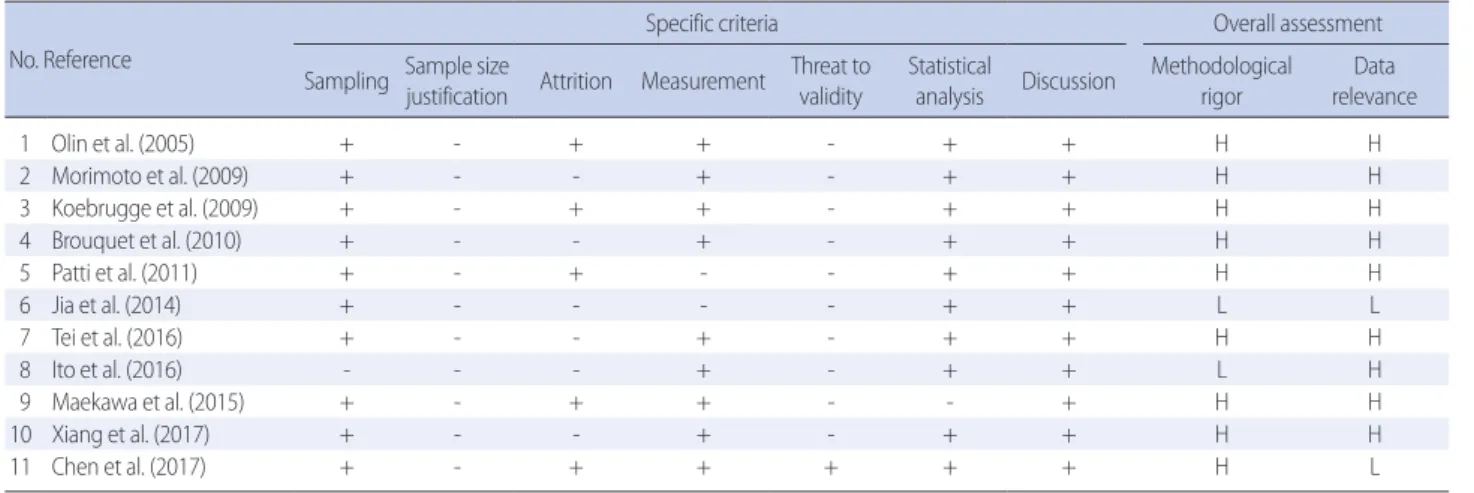
Although there is no gold standard for evaluating, calculating and in- terpreting methodological quality in integrative reviews, it is recom- mended to critically appraise the literature using quality scores to inform data analysis on methodological rigor and data relevance [11]. We as- sessed included studies based on the contribution of data, and rated for overall methodological rigor and data relevance according to Whitte- more and Knafl’s model [11]. Reviewed studies were rated as “high” or

“low” according to the followings: “high”=less than 3 unmet criteria;

“low”= 4 or more unmet criteria (Table 1).

RESULTS

The search process is shown in Figure 1. The majority of the studies (n=298, 60.3%) were discarded during the abstract review phase due to inclusion of non-cancer-related surgery patients or non-GI cancer sur- gery patients: orthopedic, vascular, cardiovascular, and pulmonary.

Some of the excluded studies combined GI and non-GI cancer surgical patients but did not make clear distinction. In 97 (18.5%) articles, patient population was limited to those receiving care in ICU or post-anesthesia

Table 1. Quality Appraisal of Included Studies No. Reference

Specific criteria Overall assessment

Sampling Sample size

justification Attrition Measurement Threat to validity

Statistical

analysis Discussion Methodological rigor

Data relevance

1 Olin et al. (2005) + - + + - + + H H

2 Morimoto et al. (2009) + - - + - + + H H

3 Koebrugge et al. (2009) + - + + - + + H H

4 Brouquet et al. (2010) + - - + - + + H H

5 Patti et al. (2011) + - + - - + + H H

6 Jia et al. (2014) + - - - - + + L L

7 Tei et al. (2016) + - - + - + + H H

8 Ito et al. (2016) - - - + - + + L H

9 Maekawa et al. (2015) + - + + - - + H H

10 Xiang et al. (2017) + - - + - + + H H

11 Chen et al. (2017) + - + + + + + H L

Criterion not met (-); Criterion met (+); H= (high) less than 3 unmet criteria; L= (low) 4 or more unmet criteria.

Figure 1. Flow diagram of the search and review process according to the PRISMA guideline.

Records identified through database searching (n= 4,679)

Records after duplicates removed (n= 5,120)

Records included for abstract review (n= 560)

Records for full-text review (n= 66)

Records included in this study (n= 11) Records excluded by title review with inclusion and exclusion criteria (n= 4,560)

Records excluded of abstract review (n= 494) - I nclude orthopedic, vascular, cardiovascular,

pulmonary surgery patients (n= 298) - Not ward setting (n= 97)

- Not limited to geriatric population (n= 57) - P atients with mental disorders, alcohol

addiction or alcohol withdrawal syndrome preoperatively (n= 20)

- Case reports/secondary research (n= 9) - Not published in English or Korean (n= 7) - Unable to obtain data/Not found (n= 6)

Records excluded after full-text review (n= 55) - N o distinction made to elective abdominal

surgery patients only (n= 31) - Not relevant outcome (n= 13) - Not ward setting (n= 9) - Ongoing study (n= 2)

Additional records identified through other sources (n= 886)

Iden tifica tion Scr eening Elig ibilit y Included

(4)

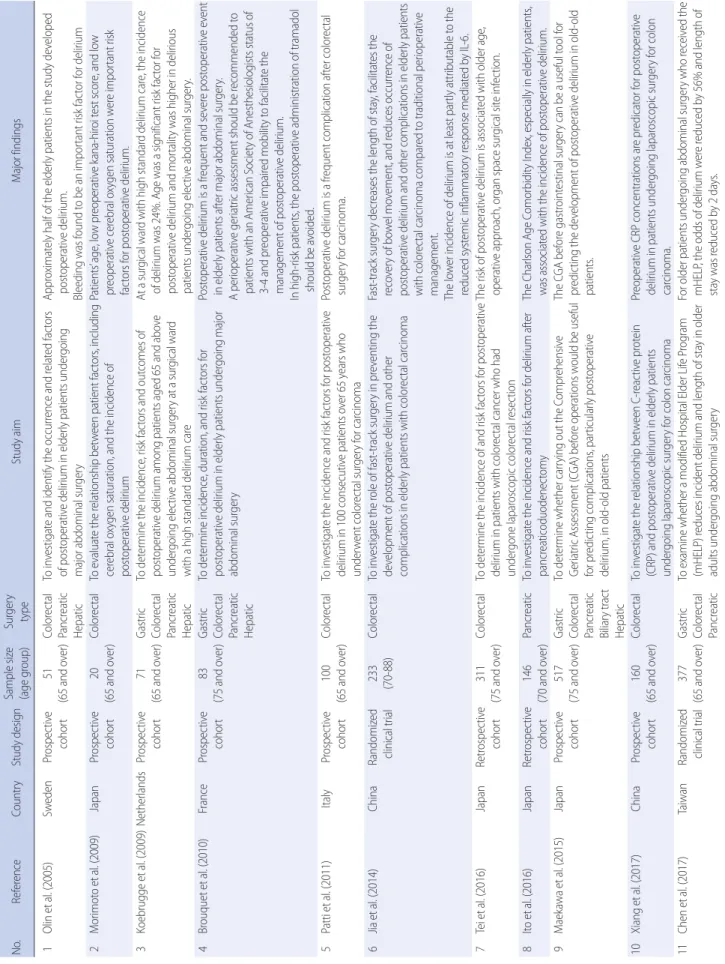
Table 2. Summar y of Included Studies No. Ref er enc e Coun try Study desig n Sample siz e (age g roup) Sur ger y type Study aim M ajor findings 1 Olin et al . (2005) Sw eden Pr ospec tiv e c ohor t 51 (65 and o ver) Color ec tal Pancr ea tic Hepa tic T o in vestiga te and iden tify the oc cur renc e and r ela ted fac tors of post oper ativ e delir ium in elder ly pa tien ts under going major abdominal sur ger y A ppr oxima tely half of the elder ly pa tien ts in the study de veloped post oper ativ e delir ium. B leeding w as f ound t o be an impor tan t r isk fac tor f or delir ium 2 M or imot o et al . (2009) Japan Pr ospec tiv e c ohor t 20 (65 and o ver) Color ec tal T o e valua te the r ela tionship bet w een pa tien t fac tors , including cer ebr al o xy gen sa tur ation, and the incidenc e of post oper ativ e delir ium

P a tien ts ’ age , lo w pr eoper ativ e k ana-hir oi t est sc or e, and lo w pr eoper ativ e c er ebr al o xy gen sa tur ation w er e impor tan t r isk fac tors f or post oper ativ e delir ium. 3 Koebrugge et al . (2009) Nether lands Pr ospec tiv e c ohor t 71 (65 and o ver) Gastr ic Color ec tal Pancr ea tic Hepa tic

T o det er mine the incidenc e, r isk fac tors and out comes of post oper ativ e delir ium among pa tien ts aged 65 and abo ve under going elec tiv e abdominal sur ger y a t a sur gical w ar d with a high standar d delir ium car e

A t a sur gical w ar d with high standar d delir ium car e, the incidenc e of delir ium w as 24%. A ge w as a sig nifican t r isk fac tor f or post oper ativ e delir ium and mor talit y w as higher in delir ious pa tien ts under going elec tiv e abdominal sur ger y. 4 Br ouquet et al . (2010) Fra nce Pr ospec tiv e c ohor t 83 (75 and o ver) Gastr ic Color ec tal Pancr ea tic Hepa tic

T o det er mine incidenc e, dur ation, and r isk fac tors f or post oper ativ e delir ium in elder ly pa tien ts under going major abdominal sur ger y

P ost oper ativ e delir ium is a fr equen t and se ver e post oper ativ e e ven t in elder ly pa tien ts af ter major abdominal sur ger y. A per ioper ativ e ger ia tric assessmen t should be r ec ommended t o pa tien ts with an Amer ican S ociet y of Anesthesiolog ists sta tus of 3-4 and pr eoper ativ e impair ed mobilit y t o facilita te the managemen t of post oper ativ e delir ium. In high-r isk pa tien ts , the post oper ativ e administr ation of tr amadol should be a voided . 5 Pa tti et al . (2011) Italy Pr ospec tiv e c ohor t 100 (65 and o ver) Color ec tal T o in vestiga te the incidenc e and r isk fac tors f or post oper ativ e delir ium in 100 c onsecutiv e pa tien ts o ver 65 y ears who under w en t c olor ec tal sur ger y f or car cinoma P ost oper ativ e delir ium is a fr equen t c omplica tion af ter c olor ec tal sur ger y f or car cinoma. 6 Jia et al . (2014) China Randomiz ed clinical tr ial 233 (70-88) Color ec tal T o in vestiga te the r ole of fast -tr ack sur ger y in pr ev en ting the de velopmen t of post oper ativ e delir ium and other complica tions in elder ly pa tien ts with c olor ec tal car cinoma

F ast -tr ack sur ger y decr eases the length of sta y, facilita tes the rec ov er y of bo w el mo vemen t, and r educ es oc cur renc e of post oper ativ e delir ium and other c omplica tions in elder ly pa tien ts with c olor ec tal car cinoma c ompar ed t o tr aditional per ioper ativ e managemen t. T he lo w er incidenc e of delir ium is a t least par tly a ttr ibutable t o the reduc ed syst emic inflamma tor y r esponse media ted b y IL -6. 7 Tei et al . (2016) Japan Retr ospec tiv e c ohor t 311 (75 and o ver) Color ec tal T o det er mine the incidenc e of and r isk fac tors f or post oper ativ e delir ium in pa tien ts with c olor ec tal canc er who had under gone lapar osc opic c olor ec tal r esec tion

T he r isk of post oper ativ e delir ium is associa ted with older age , oper ativ e appr oach, or gan spac e sur gical sit e inf ec tion. 8 Ito et al . (2016) Japan Retr ospec tiv e c ohor t 146 (70 and o ver) Pancr ea tic T o in vestiga te the incidenc e and r isk fac tors f or delir ium af ter pancr ea tic oduodenec tom y T he C har lson A ge C omor bidit y I ndex, especially in elder ly pa tien ts , w as associa ted with the incidenc e of post oper ativ e delir ium. 9 M aek aw a et al . (2015) Japan Pr ospec tiv e c ohor t 517 (75 and o ver) Gastr ic Color ec tal Pancr ea tic Biliar y tr ac t Hepa tic

T o det er mine whether car rying out the C ompr ehensiv e Ger ia tric A ssessmen t ( CGA ) bef or e oper ations w ould be useful for pr edic ting c omplica tions , par ticular ly post oper ativ e delir ium, in old- old pa tien ts

T he C GA bef or e gastr oin testinal sur ger y can be a useful t ool f or pr edic ting the de velopmen t of post oper ativ e delir ium in old- old pa tien ts . 10 Xiang et al . (2017) China Pr ospec tiv e c ohor t 160 (65 and o ver) Color ec tal T o in vestiga te the r ela tionship bet w een C-r eac tiv e pr ot ein (CRP) and post oper ativ e delir ium in elder ly pa tien ts under going lapar osc opic sur ger y f or c olon car cinoma P r eoper ativ e CRP c onc en tra tions ar e pr edica tor f or post oper ativ e delir ium in pa tien ts under going lapar osc opic sur ger y f or c olon car cinoma. 11 Chen et al . (2017) Taiw an Randomiz ed clinical tr ial 377 (65 and o ver) Gastr ic Color ec tal Pancr ea tic

T o examine whether a modified Hospital E lder Lif e P rog ram (mHELP) r educ es inciden t delir ium and length of sta y in older adults under going abdominal sur ger y

F or older pa tien ts under going abdominal sur ger y who r ec eiv ed the mHELP , the odds of delir ium w er e r educ ed b y 56% and length of sta y w as r educ ed b y 2 da ys .

(5)

care unit. Also, studies that focused on pediatric patients or included age groups other than the geriatric population (n=57, 11.5%), and patients diagnosed with mental disorders, alcohol addiction or alcohol with- drawal syndrome preoperatively (n=20, 4.0%) were excluded. Full-text review revealed further study exclusion. Studies that did not make a clear distinction exclusively to elective abdominal surgery patients (n=31, 56.4%) were excluded. Also, studies that did not focus on report- ing predictive factors or characteristics of POD patients (n=13, 23.6%), were not conducted in ward (n=9, 16.4%), or were ongoing studies with no conclusive data (n=2, 3.6%) were excluded. Finally, 11 studies that satisfied all inclusion criteria were included in this integrative review [12- 22]. These studies were all quantitative studies, and qualitative studies that met inclusion criteria were not found. Most of the 11 studies exam- ined prevalence and predisposing factors of POD. On the other hand, two focused on the role of surgical method and nursing method in POD prevention. The sample size varied among the studies, with some enroll- ing as few as 20 and some included as many as 517. As for the study de- sign, 7 (63.6%) employed a prospective research design, 2 (18.2%) used retrospective research design, and 2 (18.2%) incorporated randomized clinical trial design. Some studies included homogeneous surgery types (n= 6, 54.5%), whereas some included heterogeneous surgery (n=5, 45.5%). Summary of included studies is shown in Table 2.

1. Definition

The operational definition describing delirium is applied to POD when the clinical manifestations of delirium appear after surgical opera- tion. Delirium refers to acutely altered and fluctuating mental status with signs of altered level of consciousness and inability to maintain at- tention [12-22]. This condition cannot be explained by any other neuro- cognitive disorder and has a sudden onset. Studies have described three motor subtypes of delirium where each shows different symptoms: hy- peractive, hypoactive and mixed [15,17-19,23]. For hyperactive delirium, patients usually present restlessness, irritability, agitation, hallucinations, delusions, and are very often combative [18,19]. Patients experiencing hyperactive POD are more likely to be noncompliant with treatment regimen and are at risk for harming themselves and other healthcare personnel from their aggressive behaviors. Contrary, hypoactive POD presents with decreased responses, alertness, motor movements, lethar- gy, abnormal thought process, and patients tend to be slow in respond- ing to stimulation and questions [14,21]. Patients presenting both hyper-

active and hypoactive POD symptoms are categorized as mixed motor subtype [12,13]. These varying symptoms are usually recognized by nurses, and we recommend perioperative nurses caring for GI cancer- directed geriatric patients to carefully assess for these signs.

2. Prevalence

POD prevalence rate varied among studies ranging from 8.2% to 51.0%. Several factors may possibly contribute to this disparity. Different inclusion criteria such as cancer type, surgical sites, age range, preopera- tive cognition, medical status, drugs used for premedication and anes- thesia peri/postoperatively may have caused the wide range of preva- lence rate. Nevertheless, this review has shown that as much as half of the geriatric patients receiving GI cancer-directed surgeries develop POD in ward settings. Compared to past reports on cardiothoracic and orthopedic patients that showed incidence rate to be approximately 8-35% following operations involving general anesthesia, the prevalence may increase when it comes to GI cancer-directed surgeries suggesting a need for further investigations [24].

3. Pathophysiology

From reviewing included studies, several prognostic factors of POD were identified as shown in Table 3. We categorized these factors into patient-specific and surgery-specific factors. Patient-specific factors refer to the characteristics that can be identified prior to surgical procedures including older age [14,16,18,20,21], low baseline cerebral saturation [18], cognitive impairment [12,16-18,21], declined motor function [12,17,21], decreased preoperative serum calcium or albumin levels [12,20] and presence of comorbidities [14,21]. Surgery-specific risk factors that put patient body at more stressed state include the followings: invasive pre- operative preparation (e.g. mechanical enema, nasogastric tube inser- tion) [13,15], blood transfusions [12,19], greater blood loss [19], crystal- loid infusions [19,20], cardiovascular events [20,22], longer operation hours [19], longer hours spent to recover from general anesthesia [18], in- flammatory response mediated by proinflammatory cytokines [15], de- layed feeding [15], and postoperative analgesic administration [12,15].

The majority of the literature has supported the notion that advanced

age is an independent risk factor of POD. Aging process puts geriatric pa-

tients more susceptible to decreased homeostatic regulation capacity,

which becomes more prominent when the patient undergoes major sur-

gical procedures that require general anesthesia. Ample data has indicat-

(6)

ed aging to be associated with cerebral changes such as stress-regulating neurotransmitter proportion changes, reduced brain blood flow, de- creased vascular density, neuron cell death, and disrupted intracellular signal transduction systems [25,26]. The aging process accumulates oxi- dative damage to cells and tissues and reduces antioxidant mechanism, which causes cerebral damage and may trigger delirium. Age-related brain changes make elderly patients inevitable of having higher risks of POD. Similar to most of our included study results, a recent observation- al, longitudinal study conducted on hospitalized, medically ill patients has revealed that delirium risk increases from 3% for ≤65 years to 14%

for 65 to 74 and 36% for those ≥75 years of age [16,27]. POD in older pa- tients usually is preceded with prodromal phase where patients present restlessness, anxiety, irritability and sleep disturbances which develop gradually [27]. As it is evident that POD is common in this population,

we recommend nurses to assess for prodromal phase preceding the sud- den onset of POD.

Geriatric patients are most often characterized with frailty which in- creases vulnerability to surgical stress. Frailty is described with common phenotypes of hemodynamic instability, functional impairment, cogni- tive dysfunction, general weakness and malnutrition [9]. It may be that these phenotypes interchangeably play role in multidimensional cause of POD as they are closely related to the associated factors identified in our review. Hemodynamic instability is linked to the low baseline cere- bral saturation. Although not evidently described in the included stud- ies, low baseline cerebral saturation may have triggered hypoactive POD development post-surgery. Hypoperfusion has been indicated to in- crease cerebral hypoxia during and after surgical procedures, which re- duces acetyl coenzyme A, glutamate and acetylcholine synthesis in the Table 3. Results of Included Studies

No. Reference

Preoperative cognitive function definition

Delirium definition

POD prevalence

Prognostic factors & patient outcomes

n %

1 Olin et al. (2005) MMSE CAM; EMR 26 51.0 N eed for intraoperative, postoperative blood transfusion; intraoperative tachycardia; greater intraoperative blood loss; intraoperative crystalloid infusion;

postoperative 24h crystalloid infusion; longer operations; longer hospital stay;

lower MMSE scores on day 4 after surgery 2 Morimoto et al. (2009) HDS;

Kana-hiroi-test

DSM-IV; DRS 5 25.0 O lder age; lower preoperative kana-hiroi-test score; lower baseline rSO2; longer recovery time after anesthesia

3 Koebrugge et al. (2009) CST DSM-IV;DOS 17 23.9 O lder than ≥ 75 years; lower CST scores; ASA score; longer hospital stay; more complications; higher mortality;

4 Brouquet et al. (2010) MMSE CAM 15 18.1 A SA score 3-4; preoperative hospital stay > 2days; ADL score > 0; TGUG test > 20 seconds; MMSE < 26; preoperative calcium serum calcium level < 2.2mmol/L;

intraoperative blood transfusion; tramadol administration for postoperative analgesia

5 Patti et al. (2011) MMSE CAM; DRS 18 18.0 O lder age; preoperative lower blood albumin levels; intraoperative higher incidence of hypotension; intraoperative elevated infusion volume > 5L;

intraoperative excessive blood loss; higher mortality; higher complication rates;

longer hospitalization stay

6 Jia et al. (2014) Cranial MRI scan DRS-R-98 19 8.2 T raditional therapy instead of fast-track surgery; invasive preoperative preparation;

opioid drug administration; delayed feeding; enhanced IL-6 level

7 Tei et al. (2016) NR CAM 44 14.1 O lder age; ASA score; performance status; PNI; operative approach; organ/space SSI; cardiac or pulmonary disease

8 Ito et al. (2016) NR DSM-IV 29 19.9 O lder age; medical history of hypertension; CACI score; complication of sepsis;

longer hospital stay

9 Maekawa et al. (2015) MMSE CAM 124 24.0 Barthel Index; vitality index; MMSE; calculated IADL and GDS

10 Xiang et al. (2017) MMSE CAM 39 24.4 O lder age; MCCI; preoperative MMSE score; preoperative or postoperative CRP concentrations; postoperative cardiovascular events

11 Chen et al. (2017) MMSE CAM 40 10.6 Traditional perioperative care instead of implementing mHELP

POD= Postoperative delirium; MMSE= Mini mental state examination; HDS= Hasegawa dementia score; CST= Cognitive screening test; MRI= Magnetic resonance

imaging; NR = Not reported; CAM = Confusion assessment method; EMR = Electronic medical records; DSM-IV = Diagnostic and statistical manual of mental

disorders-IV; DRS= Delirium rating scale; DOS= Delirium observation scale; DRS-R -98= Delirium rating scale-revised-98; ASA= Anesthesiologists physical status

classification system; ADL= Activities of daily living; TGUG= Timed get up and go test; PNI= Prognostic nutrition index; Oran/space SSI= Organ space surgical site

infection; CACI = Charlson age comorbidity index; IADL = Instrumental activities of daily living; GDS = Geriatric depression score; MCCI = Modified charlson

comorbidity index; CRP= C-reactive protein; mHELP= modified hospital elder life program.

(7)

citric acid cycle [28]. This reduction results decreased cholinergic and glutaminergic brain activity, which then may lead to hypoactive POD.

The dopamine-to-norepinephrine conversion process in the brain is ox- ygen dependent, which allows to assume that hypoxic state will lead to great accumulation of dopamine [25,29]. Dopamine is associated with calcium channels, and increased dopamine results in an intracellular calcium influx, which consequently lead to brain mitochondrial oxida- tive phosphorylation [22,25,26]. This process causes clinical manifesta- tions of hyperactive POD including agitations, aggressive behaviors, de- lusions and hallucinations. Many have shown that intraoperative oxygen saturation to be positively correlated with postoperative cognitive and motor functions, which is in accordance with our review results [12,21,26]. It may be that the degeneration of brain neurons and the mi- lieu of neurotransmitters cause POD [5]. In our review, preoperative se- rum calcium or albumin decline was indicative of POD. These factors may be translated as malnutrition in elderly population, which increases POD risk from reduction in glucose supply and amino acid deficiencies that are critical for adequate metabolism [26,30]. As the patient-specific factors that may influence elderly patients receiving GI-cancer surgeries are closely related to frailty phenotypes, nurses should assess for these characteristics preoperatively to identify high-risk patients.

Surgery-specific factors identified in the included studies are associat- ed with GI-cancer surgery complications such as blood loss, cardiovas- cular events and inflammation. GI-cancer surgeries usually involve lon- ger operation hours compared to minor surgeries, which puts patients at a greater risk for bleeding, sepsis, and complications associated with in- traoperative medication use [18,20]. The correlation between blood loss amount and POD is thought to be due to the hypoxia in the cerebral cells, which triggers decreased brain oxidative metabolism leading to abnormal neurotransmissions, cerebral dysfunction and behavioral changes [12,19,22]. Intraoperative blood loss most likely leads to blood transfusions. A number of studies conducted on cardiothoracic surger- ies have demonstrated that blood transfusions during surgery increase odds of POD [12,19]. Nevertheless, factors that may influence patient’s cardiovascular system and circulation increase the odds of altered neu- rocognitive function after surgical procedures. Cerebral autoregulation and cerebral arterial pressure play an important role in maintaining brain perfusion and function [28]. As some of our included studies have indicated, geriatric patients receiving GI-cancer surgeries tend to have coexisting conditions (e.g. hypertension, diabetes mellitus) and are on

multiple medications, which were suggested to be predisposing factors of POD [14,16,21]. It has been suggested that these comorbidities in el- derly population, combined with decreased arterial elasticity, affect the cerebral autoregulation and cerebral arterial pressure, which becomes more prominent during operations involving anesthesia [28]. Geriatric patients who had large variance in intraoperative blood pressure fluctua- tions were more likely to develop delirium after surgery [28]. The inva- sive surgical operations trigger peripheral inflammatory process, which induces inflammatory mediator release that may elicit episodes of deliri- um. In accordance with previous studies that reported several inflam- matory cytokines and mediators to be responsible for POD, enhanced proinflammatory cytokines including interleukin-6 and septic condi- tions were found to be more prominent in delirium patients [15,21].

4. Assessment

Preventative measures for POD may be the optimal choice in reducing the incidence rate. Thorough pre/postoperative assessments are essential for early detection and diagnosis. Impaired cognition prior to surgical procedures indicates high-risk POD patients, and, therefore, most of the included studies conducted preoperative cognitive function tests. The purpose of such assessments was to exclude patients with severe cognitive impairment, to test the ability of cognitive assessment tool to predict POD, and to detect cognitive alterations after surgery. The most widely used to quantify cognitive function was the Mini Mental State Examina- tion (MMSE), a 30-point questionnaire (ranging from 0 to 30, with 24 and above indicating “normal cognition,” 19-23 meaning “mild impair- ment,” 10-18 meaning “moderate impairment” and 9 and below meaning

“severe impairment” [12,13,17,19,20,22]. Other assessment tools such as Hasegawa Dementia Score (HDS) and Kana-hiroi-test [18], Cognitive Screening Test (CST) [16], and cranial magnetic resonance imaging scan (MRI) [15] were used for the same purposes. Among these various assess- ment tools, we recommend the use of MMSE which is fairly easy to apply and has proven validity and reliability [12,13,22].

As for postoperative assessment, either single or a combination of

two separate delirium-related tools was incorporated after the patients

have recovered from the general anesthesia. Most widely used tool was

Confusion Assessment Method (CAM) (63.6%) where trained nurses

assessed for 4 classic POD-related characteristics: (1) acute and fluctu-

ating changes in mental status; (2) inattention; (3) disorganized and

incoherent thinking; and (4) altered levels of consciousness [12,13,17,

(8)

19-22]. The diagnosis of POD was made in all 7 studies if the patient showed presence of features (1) and (2) and either (3) or (4). This tool is an easy-to-use and straight-forward method, which has shown reli- ability and validity in POD assessment [19-21]. Diagnostic and Statis- tical Manual of Mental Disorders 4th edition (DSM-IV) criteria was used in 3 studies, which defined delirium if the patient presented with any one of 4 symptoms that showed signs of cognitive disturbances [14,16,18]. Patients who scored 12 or more points on the Delirium Rat- ing Scale (DRS) were categorized in to delirium group in 2 studies [18,20]. Also, Delirium Rating Scale-Revised-98 (DRS-R-98), a revised version of DRS, was used to evaluate the cognitive domain of delirium for attention, orientation, short-term and long-term memory, and vi- suospatial ability where to total score of 18 or more defined delirium [15]. Similar to DRS and DRS-R-98, 13-item Delirium Observation Scale (DOS) was used for potential risk for POD development [16]. In 8 studies that indicated screening frequencies, patients were evaluated once, twice or 3 times a day for POD or possible cognitive shifts. For convenient use in clinical settings by nurses, we recommend the use of CAM and DRS-R-98. These two scales are the most suitable for nurs- ing use to optimize holistic nursing care.

5. Patient outcomes

Although not all studies have investigated complications that arose from POD, the results of those that have identified patient outcomes were in accordance with previous study outcomes that have assessed cardiothoracic or orthopedic patients in ICU. Patients, who have devel- oped POD tend to have significantly longer hospital stay, had more post- operative complications, were more likely to be transferred to ICU, had higher mortality rate, took longer mean time to be able to tolerate solid diet and longer mean time to pass flatus, had higher rate of being dis- charged to long-term care facilities, and were more likely to develop re- current POD [12-14,16,19,20,22]. Longer hospital stay was closely related to postoperative complications such as postoperative incision infection, pulmonary infection, cardiovascular events and septic complications [12,14,22]. In one study that investigated postoperative course depending on presence of POD, the mortality rate of POD patients was 14% which was most closely related to septic complications [12].

6. Treatment and nursing management

In the respect that POD is a multifactorial phenomenon, an integrated

nursing approach is needed in providing geriatric patient care. POD treatment requires a multicomponent strategy, but clinicians largely rely on pharmacologic management only. Depending on the motor subtype of POD, pharmacological treatments involving sedatives such as halo- peridol and benzodiazepines are considered. However, these pharmaco- logical treatments are limited to acute physiologic symptom management and may pose side effects including oversedation and prolonged deliri- um. Therefore, we suggest that the aims of geriatric GI-cancer surgical patients should focus on optimizing preventative measures by assessing and identifying high-risk patients. Prior to implementing any treatment strategies, assessment for an underlying cause should be performed. It has been indicated that environmental and supportive nursing interven- tions such as proactive geriatric consultation, orienting communication method, oral and nutritional assistance, early mobilization, music thera- py and lighting adjustments were found to have positive effects on pre- venting POD [13]. One of the included studies has shown that nursing management protocol that contains elements mentioned above to be ef- fective in POD prevention [13]. In addition to proper screening for risk factors, we suggest POD educational nursing protocols that promote hy- dration, safety management, manage stress and family interactions that may help in maintaining adaptive cognitive functioning.

CONCLUSION

The cancer landscape has been changing dramatically with aging

population worldwide [1]. This epidemiologic trend has brought forth a

distinctive health concerns that are closely related to age. Now that ad-

vanced age is no longer a contraindication for GI cancer surgeries, the

number of geriatric patients receiving postoperative nursing care has in-

creased which emphasizes nurses to focus on identifying, assessing and

managing age-related postoperative complications. Our review may be

limited by including a relatively small number of studies that are pub-

lished in languages in English or Korean only. There were also limitations

in the included studies themselves such as mean age differences, surgical

procedures and methodologies. Despite the limitations, we provide a

compelling evidence that the POD poses challenges in identifying and

providing treatment in timely manner. Also, we show that nursing as-

sessment and management skills are critical in enhancing geriatric GI-

cancer surgical patient outcomes. Prompt nursing assessment and recog-

nition of POD will not only contribute to improved early diagnosis and

(9)

treatment, but also improve quality of perioperative care socially and fi- nancially. Nurses may easily identify high-risk patients using MMSE and assess for POD using CAM and DRS-R-98. Further investigations spe- cific to general ward settings and homogenous GI cancer-directed sur- geries may further deepen our knowledge on POD. Studies investigating POD according to the three motor subtypes will also open pathways to enhancing POD management. We suggest future researchers to establish adequately powered, large scale studies and to develop POD nursing al- gorithm specific to geriatric patients to optimize nursing care.

CONFLICT OF INTEREST The authors declare no conflict of interest.

REFERENCES

1. Tan HJ, Saliba D, Kwan L, Moore AA, Litwin MS. Burden of geriatric events among older adults undergoing major cancer surgery. Journal of Clinical On- cology. 2016;34(11):1231-1238. http://doi.org/10.1200/JCO.2015.63.4592 2. Marcantonio ER, Juarez G, Goldman L, Mangione CM, Ludwig LE, Lind L, et

al. The relationship of postoperative delirium with psychoactive medications.

The Journal of American Medical Association. 1994;272(19):1518-1522.

https://doi.org/10.1001/jama.1994.03520190064036

3. Robinson TN, Raeburn CD, Tran ZV, Angles EM, Brenner LA, Moss M. Post- operative delirium in the elderly: Risk factors and outcomes. Annals of Surgery.

2009;249(1):173-178. https://doi.org/10.1097/sla.0b013e31818e4776 4. Chen Y, Ding S, Tao X, Feng X, Lu S, Shen Y, et al. The quality of life of patients

developed delirium after coronary artery bypass grafting is determined by cog- nitive function after discharge: A cross-sectional study. International Journal of Nursing Practice. 2017;23(5):e12563. https://doi.org/10.1111/ijn.12563 5. Kubota K, Suzuki A, Ohde S, Yamada U, Hosaka T, Okuno F, et al. Age is the

most significantly associated risk factor with the development of delirium in patients hospitalized for more than five days in surgical wards: Retrospective cohort study. Annals of Surgery. 2017; 267(5): 874-877. https://doi.org/10.1097/

sla.0000000000002347

6. Seong SC, Kim S. 2016 National health insurance statistical yearbook. National Health Insurance Service; 2017.

7. Seong SC. 2015 Major operation statistics yearbook. National Health Insurance Service; 2016.

8. Ganai S, Lee KF, Merrill A, Lee MH, Bellantonio S, Brennan M, et al. Adverse outcomes of geriatric patients undergoing abdominal surgery who are at high risk for delirium. The Archives of Surgery. 2007;142(11):1072-1078. https://doi.

org/10.1001/archsurg.142.11.1072

9. Florou C, Theofilopoulos D, Tziaferi S, Chania M. Post-operative delirium in elderly people diagnostic and management issues of post-operative delirium in elderly people. Advances in Experimental Medicine and Biology. 2017;987:301- 312. https://doi.org/10.1007/978-3-319-57379-3_27

10. Jeong E, Chang SO. Exploring nurses’ recognition of delirium in the elderly by

using Q-methodology. Japan Journal of Nursing Science. 2017. https://doi.

org/10.1111/jjns.12199

11. Whittemore R, Knafl K. The integrative review: Updated methodology. Journal of Advanced Nursing. 2005;52(5):546-553. https://doi.org/10.1111/j.1365- 2648.2005.03621.x

12. Brouquet A, Cudennec T, Benoist S, Moulias S, Beauchet A, Penna C, et al. Im- paired mobility, ASA status and administration of tramadol are risk factors for postoperative delirium in patients aged 75 years or more after major abdominal surgery. Annals of Surgery. 2010;251(4):759-765. https://doi.org/10.1097/

sla.0b013e3181c1cfc9

13. Chen CC, Li HC, Liang JT, Lai IR, Purnomo JDT, Yang YT, et al. Effect of a modified hospital elder life program on delirium and length of hospital stay in patients undergoing abdominal surgery: A cluster randomized clinical trial.

The Journal of American Medical Association of Surgery. 2017;152(9):827-834.

https://doi.org/10.1001/jamasurg.2017.1083

14. Ito Y, Abe Y, Handa K, Shibutani S, Egawa T, Nagashima A, et al. Postoperative delirium in patients after pancreaticoduodenectomy. Digestive Surgery.

2017;34(1):78-85. https://doi.org/10.1159/000446928

15. Jia Y, Jin G, Guo S, Gu B, Jin Z, Gao X, et al. Fast-track surgery decreases the in- cidence of postoperative delirium and other complications in elderly patients with colorectal carcinoma. Langenbeck’s Archives of Surgery. 2014;399(1):77- 84. https://doi.org/10.1007/s00423-013-1151-9

16. Koebrugge B, Koek HL, van Wensen RJ, Dautzenberg PL, Bosscha K. Delirium after abdominal surgery at a surgical ward with a high standard of delirium care:

Incidence, risk factors and outcomes. Digestive Surgery. 2009;26(1):63-68.

https://doi.org/10.1159/000194947

17. Maekawa Y, Sugimoto K, Yamasaki M, Takeya Y, Yamamoto K, Ohishi M, et al.

Comprehensive geriatric assessment is a useful predictive tool for postoperative delirium after gastrointestinal surgery in old-old adults. Geriatriatrics &

Gerontoly International. 2016;16(9):1036-1042. https://doi.org/10.1111/

ggi.12587

18. Morimoto Y, Yoshimura M, Utada K, Setoyama K, Matsumoto M, Sakabe T.

Prediction of postoperative delirium after abdominal surgery in the elderly.

Journal of Anesthesia. 2009;23(1):51-56. https://doi.org/10.1007/s00540-008- 0688-1

19. Olin K, Eriksdotter-Jonhagen M, Jansson A, Herrington MK, Kristiansson M, Permert J. Postoperative delirium in elderly patients after major abdominal surgery.

The British Journal of Surgery. 2005;92(12):1559-1564. https://doi.org/10.1002/

bjs.5053

20. Patti R, Saitta M, Cusumano G, Termine G, Di Vita G. Risk factors for postoper- ative delirium after colorectal surgery for carcinoma. European Journal of On- cology Nursing. 2011;15(5):519-523. https://doi.org/10.1016/j.ejon.2011.01.004 21. Tei M, Wakasugi M, Kishi K, Tanemura M, Akamatsu H. Incidence and risk factors of postoperative delirium in elderly patients who underwent laparo- scopic surgery for colorectal cancer. International Journal of Colorectal Disease.

2016;31(1):67-73. https://doi.org/10.1007/s00384-015-2335-2

22. Xiang D, Xing H, Tai H, Xie G. Preoperative c-reactive protein as a risk factor for postoperative delirium in elderly patients undergoing laparoscopic surgery for colon carcinoma. Biomed Research International. 2017;2017:5635640.

https://doi.org/10.1155/2017/5635640

23. Robinson TN, Eiseman B. Postoperative delirium in the elderly: Diagnosis and management. Clincal Interventions in Aging. 2008;3(2):351-355. https://doi.

org/10.2147/cia.s2759

(10)

24. Miyagawa Y, Yokoyama Y, Fukuzawa S, Fukata S, Ando M, Kawamura T, et al.

Risk factors for postoperative delirium in abdominal surgery: A proposal of a postoperative delirium risk score in abdominal surgery. Digestive Surgery.

2017;34(2):95-102. https://doi.org/10.1159/000449044

25. Juraska JM, Lowry NC. Neuroanatomical changes associated with cognitive ag- ing. Current Topics in Behavioral Neurosciences. 2012;10:137-162. https://doi.

org/10.1007/7854_2011_137

26. Vyas S, Rodrigues AJ, Silva JM, Tronche F, Almeida OF, Sousa N, et al. Chronic stress and glucocorticoids: From neuronal plasticity to neurodegeneration.

Neural Plasticity. 2016;2016:6391686. https://doi.org/10.1155/2016/6391686 27. Pendlebury ST, Lovett NG, Smith SC, Dutta N, Bendon C, Lloyd-Lavery A, et

al. Observational, longitudinal study of delirium in consecutive unselected acute medical admissions: Age-specific rates and associated factors, mortality

and re-admission. The British Medical Journal Open. 2015;5(11):e007808.

https://doi.org/10.1136/bmjopen-2015-007808

28. Hirsch J, DePalma G, Tsai TT, Sands LP, Leung JM. Impact of intraoperative hypotension and blood pressure fluctuations on early postoperative delirium after non-cardiac surgery. British Journal of Anaesthesia. 2015;115(3):418-426.

https://doi.org/10.1093/bja/aeu458

29. Bilotta F, Lauretta MP, Borozdina A, Mizikov VM, Rosa G. Postoperative deliri- um: Risk factors, diagnosis and perioperative care. Minerva Anestesiologica.

2013;79(9):1066-1076.

30. Kratz T, Heinrich M, Schlauss E, Diefenbacher A. Preventing postoperative de- lirium. Deutsches Arzteblatt International. 2015;112(17):289-296. https://doi.

org/10.3238/arztebl.2015.0289

수치

Figure 1. Flow diagram of the search and review process according to  the PRISMA guideline
Table 2. Summary of Included Studies          No.ReferenceCountryStudy designSample size  (age group)Surgery typeStudy aimMajor findings 1Olin et al

참조

관련 문서

Key Words: Aged; Sarcopenic Obesity; protein; Fatigue; Polypharmacy 국문주요어: 노인, 근감소성 비만, 단백질, 피로, 다약제 복용.. Corresponding author:

Purpose: This study compared the effect of music and noise blocking on the vital signs, postoperative pain, analgesic use, length of stay in the Post Anesthesia Care Unit

Key Words: Fluid therapy education program; Urinary tract infections; Dehydration; Aged stroke patients 국문주요어: 수분섭취교육 프로그램, 요로감염,

Key Words: Arthroplasty, Replacement, Knee; Analgesia, Patient-Controlled; Patient education; Knowledge; Aged 국문주요어: 슬관절 전치술, 통증자가조절기,

Methods: This research’s design is quasi-experimental design and non-equiva- lent control group pretest-posttest experimental design conducted on 60 surgical

Key Words: Laughter therapy; Middle aged women; Laughter index; Cortisol; Immunoglobulin 국문주요어: 웃음치료, 중년기 여성, 웃음지수, 코티졸,

Purpose: The purpose of this study was to identify the characteristics and nursing activities of severe trauma patients regarding dam- aged body parts in Busan

(2003)Kidney TransplantMedication AdherenceClinical Outcomes Behaviors for Preventing Infection, Cancer and Cardiovascular DiseaseKidney Function Diet Management Exercise