계질환이나 과도한 알코올 섭취에 대한 임상적 검사지표(surrogate marker)로 널리 사용되고 있다. 그러나 최근 연구에 따르면 혈중 GGT 농도가 알코올 섭취나 간담도계의 질환 등과 관계없이 심혈 관계 질환의 위험요소, 대사증후군의 구성요소, 당뇨병의 발병위 험, 뇌졸중, 심장관련 치사율(cardiac mortality) 및 비치명적 심근 경색증(nonfatal myocardial infarction) 등과 뚜렷한 용량-반응관 계를 나타내며[1-7], 또한 퇴행성 인조질환(degenerative and man- made diseases)의 발생 위험을 예측할 수 있다고 보고하고 있다[8].
인체에서는 고혈압, 죽상경화증, 고지혈증, 당뇨병, 허혈-재관류, 암, 류마티스관절염, Behcet 질환, 신경손상성질환 등 만성퇴행성 질환의 발병기전 및 진행에 산화스트레스(oxidative stress)와 염증 반응이 중요한 역할을 하는 것으로 알려져 있다[9-15]. 이러한 산화 스트레스를 조절하는 체내의 중요한 대표적 항산화 작용물질 중
성인에서 참고구간 내의 혈중 Gamma-glutamyltransferase 농도에 따른 대사증후군 및 제2형 당뇨병 발병률과의 관련성
Relationship between Serum Gamma-glutamyltransferase Levels within Reference Intervals and the Prevalence of Metabolic Syndrome and Diabetes Mellitus in Adults
최문석1·배태원1·이재현1,2·조용곤1,2,3·이혜수1,2,3·최삼임1,2·김달식1,2
Moon Suk Choi, M.D.1, Tae Won Bae, M.D.1, Jae Hyeon Lee, M.D.1,2, Yong Gon Cho, M.D.1,2,3, Hye Soo Lee, M.D.1,2,3, Sam Im Choi, M.D.1,2, Dal Sik Kim, M.D.1,2
전북대학교 의학전문대학원 진단검사의학교실1, 전북대학교 임상의학연구소-전북대학교병원 의생명연구원2, 전북대학교병원 병원체자원은행3
Department of Laboratory Medicine1, Chonbuk National University Medical School; Research Institute of Clinical Medicine of Chonbuk National University-Biomedical Research Institute of Chonbuk National University Hospital2; Chonbuk National University Hospital Culture Collection for Pathogens3, Jeonju, Korea
http://dx.doi.org/10.3343/lmo.2013.3.1.15
Corresponding author: Dal Sik Kim, M.D.
Department of Laboratory Medicine, Chonbuk National University Hospital, 20 Geonji-ro, Deokjin-gu, Jeonju 561-712, Korea
Tel: +82-63-250-1793, FAX: +82-63-250-1200, E-mail: [email protected]
Received: August 21, 2012
Revision received: September 10, 2012 Accepted: September 10, 2012
This article is available from http://www.labmedonline.org 2013, Laboratory Medicine Online
This is an Open Access article distributed under the terms of the Creative Commons Attribution Non-Commercial License (http://creativecommons.org/licenses/by-nc/3.0/) which permits unrestricted non-commercial use, distribution, and reproduction in any medium, provided the original work is properly cited.
Background: This study was conducted to establish reference intervals (RIs) for serum gamma-glutamyltransferase (GGT), and to evaluate the association between serum GGT levels within RIs and the prevalence of metabolic syndrome (MetS) and type 2 diabetes mellitus (DM) in men and women.
Methods: A total of 363 healthy adults (137 men and 226 women) were enrolled for establishing the RIs of serum GGT. A cross-sectional study was conducted with 919 individuals (519 men and 400 women) to evaluate the associations between gender-specific serum GGT RI quartiles and prevalence of MetS and DM.
Results: The RIs for serum GGT levels (central 95th percentile ranges) were 9.0-70.6 IU/L and 4.0-31.3 IU/L in men and women, respectively. In men, the odds ratios (ORs) and 95% confidence intervals (CIs) for the prevalence of MetS in 4 serum GGT quartiles (lowest to highest) were 1.0 (reference), 3.6 (0.7-18.0), 8.8 (2.0-39.1), and 17.4 (4.0-75.3), respectively, while the ORs (95% CIs) for the prevalence of DM were 1.0 (reference), 1.0 (0.3-3.0), 1.7 (0.6-4.6), and 2.6 (1.0-6.6), respectively. In women, the corresponding ORs (95% CIs) were 1.0 (reference), 3.3 (0.6-16.6), 5.8 (1.2-27.3), and 18.8 (4.3-82.2) for MetS, respectively, and 1.0 (reference), 1.6 (0.3-9.7), 1.6 (0.3-9.9), and 8.0 (1.7-36.7) for DM, respectively. These significant relationships persisted after adjusting for age, alcohol intake, body mass index, and smoking.
Conclusions: Serum GGT levels, even within RIs, were proportionally associated with prevalence of metabolic syndrome and DM in both men and women. Serum GGT level may be an independent predictor for chronic degenerative diseases.
Key Word: Gamma-glutamyltransferase, Metabolic syndrome, Type 2 diabetes mellitus, Reference interval
서 론
혈중 gamma-glutamyltransferase (GGT)의 농도는 주로 간담도
하나가 세포 내 glutathione (GSH)인데, GGT 효소는 세포 외막에 존재하여 세포 내의 GSH 대사에 중요한 역할을 한다[16]. 따라서 혈중 GGT 농도가 인체 내 산화스트레스의 정도를 반영할 수 있는 지표 및 만성퇴행성질환의 발병위험에 대한 예측인자로서의 가능 성이 제시되고 있다[17]. 특히 혈중 GGT 농도가 정상인의 참고구간 내에서도 그 농도가 높을수록 만성퇴행성질환에 대한 유병률과 뚜렷한 용량-반응관계를 나타내며, 참고구간 내에서도 혈중 GGT 농도가 낮은 비만군에서는 제2형 당뇨병과 비만과의 관련성이 매 우 낮다는 보고는 흥미롭다[4, 18-20].
최근 연구에서는 혈중 GGT 농도가 인체 내의 다양한 환경오염 물질에 대한 노출의 간접적 지표로도 제시되고 있다. 일반 인구집 단에서도 혈중 잔류성 유기오염물질(persistent organic pollutants, POPs)의 농도가 높을수록 참고구간 내의 혈중 GGT 농도가 높으 며, 당뇨병의 유병률과도 강한 용량-반응관계를 보여준다[21, 22].
국내 한 연구에 의하면 일개 철강회사의 직원을 대상으로 실시한 건강검진(annual physical examination)의 분석결과 혈중 GGT의 평균농도가 매년 뚜렷하게 증가하는 경향을 보였으며, 이는 체질 량 지수(body mass index, BMI), 알코올 섭취, 흡연, 운동 및 혈중 콜레스테롤 농도 등으로 보정한 후에도 같은 경향을 나타냈다[22].
우리나라의 질병 양상은 이미 범 유행 감축시대(The age of re- ducing pandemic)에서 퇴행성인조질환 시대(The age of degener- ative and manmade diseases)로의 빠른 역학적 변천(epidemio- logic transition)을 보여주고 있다[23]. 현대인의 감소된 신체활동의 생활양식, 서구화된 식생활 습관, 다양한 환경오염물질에의 노출 증가 그리고 뚜렷한 퇴행성 인조질환의 증가양상 등을 고려할 때 인체 내 산화스트레스의 증가도 예측되어 혈중 GGT 농도가 이를 반영하는지에 대한 더 많은 연구가 다양한 집단 및 질환에서 요구 되며, 검사실에서도 혈중 GGT 농도에 대한 참고구간의 재설정 및 분석 등의 연구가 필요하다고 생각된다.
본 연구에서는 건강검진을 받기 위해 일개 대학교병원의 건강증 진센터를 방문한 건강한 성인남녀를 대상으로 혈중 GGT 농도의 참고구간을 설정하고, 일정기간 건강증진센터에 방문한 검진자를 대상으로 참고구간 내의 혈중 GGT 농도에 따른 대사증후군 및 당 뇨병의 유병률과의 연관성을 분석하고자 하였다.
대상 및 방법
1. 연구 대상
2011년 3월부터 10월까지 전북대학교병원 건강증진센터를 방문 하여 연구에 참여하기로 동의하고 설문지를 작성한 1,084명(남자 634명, 여자 450명)을 대상으로 하였다. 혈중 GGT 농도의 참고구 간의 설정은 CLSI guideline C28-A3에 따랐으며[24], 연구에 동의
한 전체 대상자 중 다음의 경우는 배제하였다: 1) 현재 고혈압 및 당뇨병 등의 치료 중인 질병이 있거나 약물을 복용하고 있는 경우, 2) 검진 시 수축기 혈압이 140 mmHg 이상이거나 이완기 혈압이 90 mmHg 이상인 경우, 3) 검진 시 공복혈당이 126 mg/dL 이상인 경우, 4) 검진 시 낮은 혈색소 농도를 갖는 경우(남자; <12 g/dL, 여 자; <11 g/dL), 5) 검진 시 혈소판수가 130,000/μL 이하인 경우, 6) 현재 흡연자인 경우, 7) 주 2회 이상 음주하는 경우, 8) 검진 시 HB- sAg 또는 anti-HCV Ab 양성, 9) 과거 주요 장기의 수술을 받은 병력 이 있는 경우, 10) 검진 시 혈액 또는 임상화학검사에서 이상소견 을 보인 경우. 이에 따라 혈중 GGT 농도의 참고구간을 설정하기 위한 대상자는 363명(남자 137명, 여자 226명)였다.
2. 연구 방법
대상자의 일반적 특성, 질병 및 과거력, 가족력, 음주, 흡연, 수술 및 알레르기 유무 등은 구조화된 설문지를 통해 조사하였다. 음주 는 월 1회 초과의 경우 음주자, 그 이하는 비음주자로 분류하였다.
흡연은 비흡연, 현재흡연 및 과거흡연으로 분류하였으며 과거흡연 과 현재흡연의 경우 구체적인 흡연기간과 흡연량을 조사하였다. 신 장과 체중은 속옷과 검진복을 입은 상태에서 Inbody 3.0 (Bio- space Co., Ltd., Seoul, Korea)을 이용하여 측정하였고, 비만도의 측정을 위해 신장(m)의 제곱으로 체중(kg)을 나눠서 체질량지수 를 계산하였다. 혈압은 10분 이상 편안하게 앉은 자세로 안정을 취 한 후 자동혈압측정계로 측정하였으며, 현재 고혈압의 진단을 받 아 치료받고 있거나, 검진 시 혈압이 140/90 mmHg 이상인 경우를 고혈압으로 정의하였다. 제2형 당뇨병의 정의는 검진 시 공복혈당 치가 126 mg/dL 이상 또는 당뇨병의 진단을 받고 현재 치료 중인 사람으로 하였다. 대사증후군의 정의는 NCEP ATP III (National Cholesterol Education Program Adult Treatment Panel III)의 기준 중 허리둘레 대신 체질량지수로 대체하여 체질량지수(≥25 kg/
m2), 혈중 중성지방(≥150 mg/dL), HDL-cholesterol (HDL-C) (남자
≤40 mg/dL, 여자≤50 mg/dL), 혈압(≥130/85 mmHg) 및 공복혈 당(≥110 mg/dL)의 5개 항목 중 3개 이상일 경우로 하였다[25, 26].
8시간 이상의 공복상태 유지 후 혈액 채취를 시행하였으며, com- plete blood count (CBC) 혈액검사(Sysmex XE-2100; TOA Medical Electronics Co., Kobe, Japan), 임상화학 및 면역혈청검사(ADVIA 2400 Chemistry system, ADVIA Centaur XP immunoassay system;
Siemens Healthcare Diagnostics, Inc., Tarrytown, NY, USA)를 시행 하였다.
3. 통계학적 분석
혈중 GGT농도의 참고구간의 설정은 남자군과 여자군으로 층화 하여 시행하였으며, 혈청 GGT의 측정값에서 1/3 법칙[24]에 따라
이상치(outlier)를 제거한 후 Shapiro-Wilk test로 정규분포를 검정 하였다. 혈중 GGT 농도는 정규분포를 나타내지 않아 2.5 percen- tile에서 97.5 percentile까지의 중앙 95백분위수(central 95th per- centile)로 참고구간을 설정하였다. 또한 새로 설정한 혈중 GGT 농 도의 참고구간 내에 해당되는 최종 분석 대상자는 919명(남자 519 명, 여자 400명)였으며, 남녀 두 군 사이의 비교는 독립 표본 t-검정 을 시행하였고, 남자군과 여자군의 혈중 GGT 농도를 4분위수 (quartile)로 나누어 ANOVA 분석을 시행하였다. 혈중 GGT 농도의 사분위 절단 수치는 남자군의 경우 19, 27 및 42 IU/L였으며, 여자 군의 경우는 9, 13 및 18 IU/L였다. 대사증후군 및 당뇨병의 대응 위 험도(odds ratio)는 혈중 GGT 농도가 제일 낮은 첫 번째 사분위군 을 참고집단(reference group)으로 하여 다변량 로지스틱 회귀분 석(multiple logistic regression analysis)을 시행하였고, 각각 연령, 체질량지수, 흡연 및 음주량으로 보정하였다. 모든 통계분석은 SPSS version 18.0 software package (SPSS Inc., Chicago, IL, USA) 를 이용하였으며, P<0.05인 경우를 통계적으로 유의하다고 판단 하였다.
결 과
1. 혈중 GGT 농도의 참고구간 설정
참고구간 설정은 참여한 전체 대상자 중 제외기준에 위배되지 않는 남자 137명과 여자 226명이었다. 평균 연령은 남자 43.5±9.5 세와 여자 43.3±10.8세로 유의한 차이가 없었으며(P=0.823), 수 축기혈압, 이완기혈압, 신장, 몸무게, BMI 그리고 혈청 LDL-choles- terol (LDL-C), 중성지방, 공복혈당, AST, ALT, 요산 및 GGT의 농도 는 모두 남자에서 유의하게 높았다(P<0.05). 혈중 총콜레스테롤 의 농도는 남녀 사이에 유의한 차이가 없었으며(P=0.659), HDL-C 의 농도는 여자에서 유의하게 높았다(P<0.001). 혈중 GGT의 평 균농도(평균±2SD)는 남자 28.3±16.0 IU/L와 여자 13.2±6.0 IU/
L로 통계적으로 유의한 차이를 보였으며(P<0.001), 남녀 모두에서 정규분포를 하지 않았으므로 비모수적 방법(중앙 95백분위수)으 로 설정한 참고구간은 남자 9.0-70.6 IU/L와 여자 4.0-31.3 IU/L였다 (Table 1).
2. 설정된 참고구간 내의 GGT 농도를 갖는 전체 대상군의 임상적 특징
참여한 전체 대상자 중 설정된 혈중 GGT의 참고구간내 농도를 갖는 대상은 총 919명(남자 519명, 여자 400명)였으며, 남자군과 여 자군의 평균 나이는 각각 47±10.7세 및 47.1±12.2세로 유의한 차 이가 없었다(P=0.940). 수축기혈압, 이완기혈압, 신장, 몸무게, 체 질량지수 그리고 혈청 LDL-C, 중성지방, 공복혈당, AST, ALT, 요산
및 GGT의 농도는 모두 남자에서 유의하게 높았다(P<0.05). 혈중 HDL-C 농도는 여자에서 유의하게 높았으며(P<0.001), 총콜레스 테롤 농도는 두 군 간에 통계적 차이가 없었다(P=0.258). 대사증 후군의 유병률은 남녀 각각 9.2%와 10.5%를 나타냈으며, 제2형 당 뇨병의 유병률은 각각 7.5%와 5%를 보였다(Table 2).
3. 참고구간 내의 혈청 GGT 농도의 사분위수에 따른 남녀 대상군의 임상적 특징
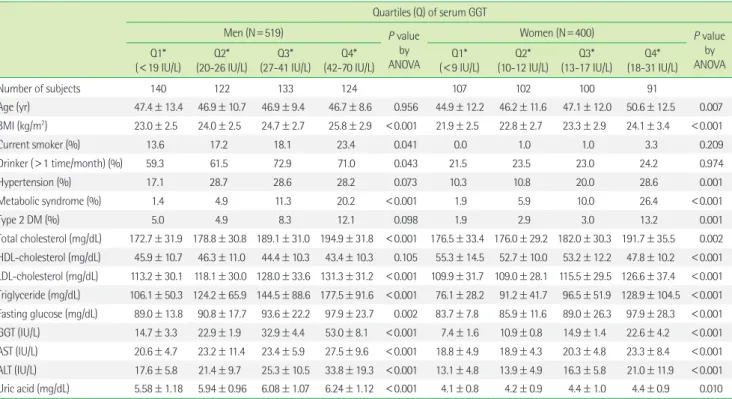
여자군에서는 연령의 증가에 따라 혈중 GGT 농도의 증가가 관 찰되었으나(P=0.007), 남자군에서는 유의한 차이를 보이지 않았 다(P=0.956). 혈중 GGT 농도가 증가함에 따라 혈중 총콜레스테 롤, LDL-C, 중성지방, 공복혈당, AST, ALT 및 요산의 농도 그리고 체질량지수와 대사증후군의 유병률은 남녀군 모두에서 유의하게 증가하였다(P<0.05). 흡연과 음주의 경우는 남자군에서 혈중 GGT의 증가와 관련성을 보였으며, HDL-C 농도 그리고 제2형 당뇨 병과 고혈압의 유병률은 여자군에서 혈중 GGT 농도의 사분위수 증가에 따라 유의한 관련성을 나타냈다(Table 3).
4. 참고구간 내의 혈중 GGT 농도에 따른 대사증후군 및 제2형 당뇨병 유병률
혈중 GGT 농도의 사분위수에 따라 GGT 농도가 가장 낮은 군 (Q1, GGT<19 IU/L)의 대사증후군 및 제2형 당뇨병 유병률을 1로 했을 때 그에 대한 대응 위험도를 Table 4와 5에 정리하였다. 남녀 Table 1. Clinical and biochemical characteristics of the subjects select- ed for establishing the reference intervals for serum GGT levels
Characteristics Men* Women* P value by t-test
Number of subjects 137 226
Age (yr) 43.5±9.5 43.3±10.8 0.823
Systolic BP (mmHg) 120.0±8.0 110.6±10.8 <0.001 Diastolic BP (mmHg) 76.0±7.7 70.8±8.8 <0.001
Height (cm) 170.3±5.7 158.9±5.5 <0.001
Weight (kg) 70.1±10.1 57.1±6.9 <0.001
BMI (kg/m2) 24.1±3.0 22.6±2.6 <0.001
Total cholesterol (mg/dL) 183.4±31.5 181.9±31.4 0.659 HDL-cholesterol (mg/dL) 46.9±10.7 54.1±12.5 <0.001 LDL-cholesterol (mg/dL) 123.0±30.9 114.8±31.2 0.015 Triglyceride (mg/dL) 120.8±67.4 88.7±47.0 <0.001 Fasting glucose (mg/dL) 87.5±9.4 84.6±8.4 0.002
GGT (IU/L) 28.3±16.0 13.2±6.0 <0.001
AST (IU/L) 22.8±6.1 19.0±4.9 <0.001
ALT (IU/L) 24.0±11.7 14.6±6.2 <0.001
Uric acid (mg/dL) 6.0±1.0 4.2±0.8 <0.001 GGT (central 95th percentile, IU/L) 9.0-70.6 4.0-31.3
*Data are expressed as mean±S.D.
Abbreviations: GGT, gamma-glutamyltransferase; BP, blood pressure; BMI, body mass index; HDL, high-density lipoprotein; LDL, low-density lipoprotein; AST, as- partate aminotransferase; ALT, alanine aminotransferase.
군 모두에서 혈중 GGT 농도가 증가함에 따라 대사증후군과 제2 형 당뇨병의 유병률은 뚜렷하게 증가하는 양상을 나타냈다. 나이, BMI, 음주 및 흡연유무를 보정한 후 사분위수군 Q2, Q3 및 Q4에 서의 대사증후군에 대한 대응 위험도(95% CI)가 남자군에서 3.3 (0.6-17.4), 7.6 (1.6-17.4) 및 12.6 (2.8-57.3), 그리고 여자군에서 2.2 (0.4-11.4), 3.1 (0.6-15.2) 및 8.5 (1.9-39.1)로 모두 뚜렷한 용량-반응 관계를 나타냈다(P for trend<0.05). 제2형 당뇨병에 대해서도 남 자군에서 1.2 (0.4-3.6), 2.2 (0.8-6.0) 및 3.5 (1.3-9.3), 그리고 여자군 에서 1.6 (0.2-10.0), 2.4 (0.2-9.3) 및 6.1 (1.3-29.8)로 모두 유의한 결 과를 나타냈다(P for trend<0.05).
고 찰
보통 인체에서 유래된 가검물에서 측청 또는 관측치는 진단 및 치료의 결정을 위해 또는 생리학적 상태를 평가하기 위해 참고구 간과 비교하게 된다. 그러므로 신뢰성 있는 참고구간을 확립하는 것은 검사실과 시약의 제조사에서는 매우 중요한 업무이다. Clini- cal and Laboratory Standards Institute (CLSI)에서는 참고구간의 설정을 위한 참고개체(reference individual)의 선택을 위해 직접 표본추출 기법(direct sampling techniques)을 이용할 것을 강력히
Table 3. Clinical and biochemical characteristics of male and female subgroups according to the quartiles of sex-specific serum GGT reference in- tervals
Quartiles (Q) of serum GGT
Men (N=519) P value
by ANOVA
Women (N=400) P value
by ANOVA Q1*
(<19 IU/L) Q2*
(20-26 IU/L) Q3*
(27-41 IU/L) Q4*
(42-70 IU/L) Q1*
(<9 IU/L) Q2*
(10-12 IU/L) Q3*
(13-17 IU/L) Q4*
(18-31 IU/L)
Number of subjects 140 122 133 124 107 102 100 91
Age (yr) 47.4±13.4 46.9±10.7 46.9±9.4 46.7±8.6 0.956 44.9±12.2 46.2±11.6 47.1±12.0 50.6±12.5 0.007 BMI (kg/m2) 23.0±2.5 24.0±2.5 24.7±2.7 25.8±2.9 <0.001 21.9±2.5 22.8±2.7 23.3±2.9 24.1±3.4 <0.001
Current smoker (%) 13.6 17.2 18.1 23.4 0.041 0.0 1.0 1.0 3.3 0.209
Drinker (>1 time/month) (%) 59.3 61.5 72.9 71.0 0.043 21.5 23.5 23.0 24.2 0.974
Hypertension (%) 17.1 28.7 28.6 28.2 0.073 10.3 10.8 20.0 28.6 0.001
Metabolic syndrome (%) 1.4 4.9 11.3 20.2 <0.001 1.9 5.9 10.0 26.4 <0.001
Type 2 DM (%) 5.0 4.9 8.3 12.1 0.098 1.9 2.9 3.0 13.2 0.001
Total cholesterol (mg/dL) 172.7±31.9 178.8±30.8 189.1±31.0 194.9±31.8 <0.001 176.5±33.4 176.0±29.2 182.0±30.3 191.7±35.5 0.002 HDL-cholesterol (mg/dL) 45.9±10.7 46.3±11.0 44.4±10.3 43.4±10.3 0.105 55.3±14.5 52.7±10.0 53.2±12.2 47.8±10.2 <0.001 LDL-cholesterol (mg/dL) 113.2±30.1 118.1±30.0 128.0±33.6 131.3±31.2 <0.001 109.9±31.7 109.0±28.1 115.5±29.5 126.6±37.4 <0.001 Triglyceride (mg/dL) 106.1±50.3 124.2±65.9 144.5±88.6 177.5±91.6 <0.001 76.1±28.2 91.2±41.7 96.5±51.9 128.9±104.5 <0.001 Fasting glucose (mg/dL) 89.0±13.8 90.8±17.7 93.6±22.2 97.9±23.7 0.002 83.7±7.8 85.9±11.6 89.0±26.3 97.9±28.3 <0.001 GGT (IU/L) 14.7±3.3 22.9±1.9 32.9±4.4 53.0±8.1 <0.001 7.4±1.6 10.9±0.8 14.9±1.4 22.6±4.2 <0.001 AST (IU/L) 20.6±4.7 23.2±11.4 23.4±5.9 27.5±9.6 <0.001 18.8±4.9 18.9±4.3 20.3±4.8 23.3±8.4 <0.001 ALT (IU/L) 17.6±5.8 21.4±9.7 25.3±10.5 33.8±19.3 <0.001 13.1±4.8 13.9±4.9 16.3±5.8 21.0±11.9 <0.001 Uric acid (mg/dL) 5.58±1.18 5.94±0.96 6.08±1.07 6.24±1.12 <0.001 4.1±0.8 4.2±0.9 4.4±1.0 4.4±0.9 0.010
*Data are expressed as mean±S.D, unless otherwise stated.
Abbreviations: GGT, gamma-glutamyltransferase; BP, blood pressure; BMI, body mass index; HDL, high-density lipoprotein; LDL, low-density lipoprotein; AST, aspartate ami- notransferase; ALT, alanine aminotransferase; DM, diabetes mellitus.
Table 2. Clinical and biochemical characteristics of all subjects with serum GGT levels within the reference intervals
Characteristics Men* Women* P value by t-test
Number of subjects 519 400
Age (yr) 47±10.7 47.1±12.2 0.940
Systolic BP (mmHg) 124.5±13.9 116.3±15.5 <0.001 Diastolic BP (mmHg) 77.8±9.6 73.1±10.3 <0.001 Height (cm) 170.3±5.7 158.2±5.8 <0.001 Weight (kg) 70.6±9.7 57.5±7.9 <0.001 BMI (kg/m2) 24.3±2.8 23.0±3.0 <0.001 Total cholesterol (mg/dL) 183.6±32.5 181.2±32.6 0.258 HDL-cholesterol (mg/dL) 45.0±10.6 52.4±12.2 <0.001 LDL-cholesterol (mg/dL) 122.5±32.0 114.9±32.3 <0.001 Triglyceride (mg/dL) 137.2±79.9 97.1±64.4 <0.001 Fasting glucose (mg/dL) 92.7±19.7 88.8±20.7 0.004
GGT (IU/L) 30.5±15.1 13.6±6.0 <0.001
AST (IU/L) 23.6±8.6 20.2±6.0 <0.001
ALT (IU/L) 24.4±13.5 15.9±7.8 <0.001
Uric acid (mg/dL) 6.0±1.1 4.3±0.9 <0.001
Metabolic syndrome (%) 9.2 10.5 0.527
Type 2 DM (%) 7.5 5. 0.114
*Data are expressed as mean±S.D, unless otherwise stated.
Abbreviations: GGT, gamma-glutamyltransferase; BP, blood pressure; BMI, body mass index; HDL, high-density lipoprotein; LDL, low-density lipoprotein; AST, as- partate aminotransferase; ALT, alanine aminotransferase; DM, diabetes mellitus.
주장하고 있다[24]. 그러나 이러한 직접 산정방법은 현실적으로 대 상이 되는 참고 모집단(reference population)을 구하는 것이 어렵 고 경제적 비용이 발생하므로 대다수의 검사실은 최소한의 검증 과정을 거친 참고구간을 사용하게 된다. 본 연구에서는 혈중 GGT 농도가 인체내 산화스트레스와 밀접한 연관성을 보이는 것으로 보고되고 있어서 참고개체의 선택을 위한 배제조건을 엄격하게 적 용하였다. 비모수 방법(중앙 95백분위수)에 의한 혈중 GGT 농도 의 참고구간은 남자 9.0-70.6 IU/L와 여자 4.0-31.3 IU/L로 비교할
수 있는 다른 국내연구는 찾기가 어려웠다. 다만 본 연구에서 참고 모집단의 남자의 평균 나이 및 혈중 GGT 농도는 각각 43.5세 및 28.3 IU/L 그리고 여자는 43.3세 및 13.2 IU/L로, 단순하게 비교하 기는 어렵지만 1977년 Kim 등의 연구에서 보여준 결과보다는 높 았다[27]. 본 연구가 한 기관의 건강검진센터에 일정기간 동안 방문 한 사람을 대상으로 한 단면연구였기 때문에 혈중 GGT 농도의 변 화에 대한 장기적 추이를 관찰할 수는 없었지만, 다양한 연구에서 보여주듯 혈중 GGT 농도가 인체 내 산화스트레스의 정도를 반영 Table 4. Odds ratios and 95% confidence intervals for the prevalence of metabolic syndrome according to quartiles of sex-specific serum GGT RIs in men and women
Quartiles (Q) of serum GGT
P trend
Q1 Q2 Q3 Q4
Men (<19 IU/L) (20-26 IU/L) (27-41 IU/L) (42-70 IU/L)
Number of subjects (N=519) 140 122 133 124
GGT (IU/L) (mean±SD) 14.7±3.3 22.9±1.9 32.9±4.4 53.0±8.1
Odds ratio (95% CI)
Model 1* 1 3.6 (0.7-18.0) 8.8 (2.0-39.1) 17.4 (4.0-75.3) <0.001
Model 2* 1 3.9 (0.8-20.1) 10 (2.2-45.6) 20.6 (4.7-90.9) <0.001
Model 3* 1 3.3 (0.6-17.4) 7.6 (1.6-35.3) 12.6 (2.8-57.3) <0.001
Women (<9 IU/L) (10-12 IU/L) (13-17 IU/L) (18-31 IU/L)
Number of subjects (N=400) 107 102 100 91
GGT (IU/L) (mean±SD) 7.41±1.6 10.9±0.8 14.9±1.3 22.6±4.2
Odds ratio (95% CI)
Model 1* 1 3.3 (0.6-16.6) 5.8 (1.2-27.3) 18.8 (4.3-82.2) <0.001
Model 2* 1 3.2 (0.6-16.3) 5.5 (1.2-26.0) 15.8 (3.6-69.8) <0.001
Model 3* 1 2.2 (0.4-11.4) 3.1 (0.6-15.2) 8.5 (1.9-39.1) 0.001
*Model 1, crude odds ratio; Model 2, model 1 plus adjustment for age; Model 3, model 2 plus adjustment for body mass index, alcohol intake, and smoking.
Abbreviations: CI, confidence intervals; GGT, gamma-glutamyltransferase.
Table 5. Odds ratios and 95% confidence intervals for the prevalence of diabetes mellitus according to quartiles of sex-specific serum GGT refer- ence intervals in men and women
Quartiles (Q) of serum GGT
P trend
Q1 Q2 Q3 Q4
Men (<19 IU/L) (20-26 IU/L) (27-41 IU/L) (42-70 IU/L)
Number of subjects (N=519) 140 122 133 124
GGT (IU/L) (mean±SD) 14.7±3.3 22.9±1.9 32.9±4.4 53.0±8.1
Odds ratio (95% CI)
Model 1* 1 1.0 (0.3-3.0) 1.7 (0.6-4.6) 2.6 (1.0-6.6) 0.099
Model 2* 1 1.2 (0.4-3.6) 2.2 (0.8-6.0) 3.5 (1.3-9.3) 0.033
Model 3* 1 1.2 (0.4-3.6) 2.2 (0.8-6.0) 3.5 (1.3-9.3) 0.033
Women (<9 IU/L) (10-12 IU/L) (13-17 IU/L) (18-31 IU/L)
Number of subjects (N=400) 107 102 100 91
GGT (IU/L) (mean±SD) 7.41±1.6 10.9±0.8 14.9±1.3 22.6±4.2
Odds ratio (95% CI)
Model 1* 1 1.6 (0.3-9.7) 1.6 (0.3-9.9) 8.0 (1.7-36.7) 0.001
Model 2* 1 1.6 (0.2-10.0) 1.4 (0.2-9.3) 6.1 (1.3-29.8) 0.012
Model 3* 1 1.6 (0.2-10.0) 1.4 (0.2-9.3) 6.1 (1.3-29.8) 0.012
*Model 1, crude odds ratio; Model 2, model 1 plus adjustment for age; Model 3, model 2 plus adjustment for body mass index, alcohol intake, and smoking.
Abbreviations: CI, confidence intervals; GGT, gamma-glutamyltransferase.
한다면 일반 인구집단에서도 혈중 GGT 농도의 참고구간의 장기 적 추이변화에 대한 지속적인 관찰연구가 필요하리라 사료된다.
1996년부터 2003년까지 국내 한 철강회사의 남자직원을 대상으 로 한 건강검진의 분석 결과에서 혈중 GGT 농도가 1996년의 10.5 IU/L에서 2003년 29.2 IU/L로 180%의 증가를 보였으며 이는 7년 동안 매년 지속적으로 증가하는 뚜렷한 장기추세(secular trend) 를 나타냈다. 본 연구에서는 참고구간내의 혈중 GGT 농도를 갖는 전체 남자 대상자 519명의 평균 혈중 GGT 농도가 30.5 IU/L로 이 등의 연구에서 보여준 2003년의 혈중 GGT 농도와 비슷했다. 이 등 의 연구에서 나타난 혈중 GGT 농도의 증가 경향은 환경적 위험 (environmental hazard)의 요소에 비교적 노출되기 쉬운 현장근무 자에서 뿐만 아니라 사무직 근로자에서도 나타났다. 기존의 보고 에서와 같이 혈중 GGT 농도가 만성퇴행성질환의 발병 등과 매우 밀접한 연관성을 보인다면 본 연구에서 일반 인구집단의 건강검진 대상자의 혈중 GGT 농도는 공중보건학적 의미에서 시사하는 바 가 크다 하겠다[28].
퇴행성인조질환 시대로의 빠른 역학적 변천을 보여주고 있는 우 리나라의 질병 양상은 산화스트레스가 그 발병 기전에서 중요한 역할을 하는 것으로 알려져 있고 최근 혈중 GGT 농도는 산화스트 레스에 대한 역학적 표지자로써 그 관심이 집중되고 있다[29, 30].
본 연구에서는 정상 참고구간 내에서 혈중 GGT 농도가 증가할수 록 대사증후군과 제2형 당뇨병의 발병률이 남녀 모두에서 뚜렷한 용량-반응 관계를 나타냈다. 혈중 GGT 농도가 가장 낮은 사분위 수군(Q1, 남자 9-19 IU/L, 여자 4-9 IU/L)을 참고군으로 했을 때 제 일 큰 사분위수군(Q4)의 대사증후군 및 제2형 당뇨병에 대한 대 응 위험도가 나이, BMI, 음주 및 흡연유무를 보정한 후 남자에서 는 각각 12.6과 3.5였고, 여자에서는 8.5와 6.1로 남녀 모두에서 강 한 관련성을 보였다. 이러한 결과는 국내의 다른 단면조사연구에 서와 일치된 소견이었으며, 대사증후군과 제2형 당뇨병에 대한 대 응 위험도가 본 연구에서 더 컸는데 이는 다른 연구에서 대상인구 수가 보다 많았던 점이 영향을 미친 것으로 사료된다[31-33].
본 연구를 비롯한 여러 연구에서와 같이 정상 참고구간 내의 혈 중 GGT 농도와 대사증후군 및 제2형 당뇨병의 연관성은 그 기전 을 아직 명확하게 설명할 수 없으나 제기되는 가설로는 첫째, 비알 코올성 지방간과 관련한 인슐린 저항성의 지표로 정상 참고구간 내의 높은 혈중 GGT 농도는 비만 및 내장지방 침착의 결과라는 것 이다[34-36]. 본 연구에서는 내장지방과 지방간의 유무 및 정도에 대한 연구는 이루어지지 않았으나, 남녀 두 군 모두에서 BMI가 증 가함에 따라 혈중 GGT 농도가 유의하게 증가하는 소견을 보임은 이 같은 가설에 부합된다. 또 다른 가설로는 산화스트레스는 당뇨 병 등의 발생기전에 중요한 역할을 하며 혈중 GGT의 농도가 인체 내 산화스트레스의 지표라는 것이다[22]. 세포 내 GSH은 free radi-
cal에 대한 세포 내 방어인자로 세포 내에 높은 농도로 유지되고 있는데, 과도한 산화스트레스에 대해 요구되는 세포 내 GSH 농도 를 증가시키기 위한 대사과정에서 혈중 GGT가 증가하는 것이다 [16, 17, 37]. 최근에는 혈중 GGT 농도가 여러 가지 다양한 환경오염 물질에의 노출에 대한 지표로서 다양한 질환을 예측할 수 있다는 주장이 제시되고 있다. Lee 등의 연구에 의하면 혈중 POPs의 농도 가 높을수록 혈중 GGT의 농도, 비만 및 당뇨병과 높은 관련성이 있음을 보여주고 있다[38, 39].
본 연구의 제한점은 건강증진센터를 방문한 건강 검진자를 대 상으로 한 단면조사연구로 인과관계를 명확하게 규정하거나 설명 하기가 어렵다는 것이다. 특히 건강 검진자에서 구조화된 설문지 로 혈중 GGT 농도에 영향을 줄 수 있는 상세한 약물사용의 병력, 식이습관, 환경적 요소 등에 대한 조사가 쉽지 않으며, 모든 변수 들의 측정이 한번에 이뤄졌기 때문에 대사증후군 및 제2형 당뇨병 의 유병률이 과대평가 될 가능성을 배제할 수 없다.
결론적으로 본 연구에서는 일반 인구집단의 건강 검진대상자에 서 혈중 GGT 농도가 참고구간 내에서도 높을수록 대사증후군 및 제2형 당뇨병과 뚜렷한 용량-반응관계의 연관성을 나타냈다. 따라 서 혈중 GGT 검사는 기존의 간담도계질환이나 과도한 알코올 섭 취에 대한 임상적 검사지표로서뿐만 아니라 많은 만성퇴행성질환 에서의 임상적 유용성이 적지 않을 것으로 판단된다. 또한 최근 혈 중 GGT 농도가 산화스트레스 및 역학적 검사지표로서의 유용성 이 제기되고 있으며, 산화스트레스의 유발요인이 증가되고 있는 현 대사회의 공중보건학적 측면에서 생각할 때 검사실에서는 혈중 GGT 농도에 대한 참고구간의 설정, 분석 및 장기적 추이관찰 등에 대해 더욱 심도 있는 연구와 논의가 필요할 것으로 사료된다.
요 약
배경: 본 연구에서는 건강한 성인에서 혈중 GGT 농도의 참고구간 을 설정하고, 참고구간 내의 혈중 GGT 농도에 따른 대사증후군 및 제2형 당뇨병 발병률과의 연관성을 분석하고자 하였다.
방법: 혈중 GGT 농도의 참고구간의 설정을 위해 총 363명(남자 137명, 여자 226명)의 건강한 성인을 대상으로 하였다. 2011년 3월 부터 10월까지 한 대학병원의 건강증진센터를 방문하여 본 연구 에 동의하고 건강검진을 실시한 총 919명(남자 519명, 여자 400명) 을 대상으로 단면조사연구를 시행하였다. 남자와 여자의 혈중 GGT 농도의 참고구간을 4군으로 나누어 대사증후군과 제2형 당 뇨병의 발병률의 관련성을 분석하였다.
결과: 중앙 95백분위수에 의한 혈중 GGT 농도의 참고구간은 남자 에서 9.0-70.6 IU/L 그리고 여자에서 4.0-31.3 IU/L였다. 참고구간 내 의 혈중 GGT 농도의 사분위수군에 따른 대사증후군 유병률의 대
응 위험도(95% CI)는 남자와 여자에서 각각 1.0, 3.6 (0.7-18.0), 8.8 (2.0-39.1), 17.4 (4.0-75.3)와 1.0, 3.3 (0.6-16.6), 5.8 (1.2-27.3), 18.8 (4.3-82.2)였고, 제2형 당뇨병에 대해서는 각각 1.0, 1.0 (0.3-3.0), 1.7 (0.6-4.6), 2.6 (1.0-6.6)과 1.0, 1.6 (0.3-9.7), 1.6 (0.3-9.9), 8.0 (1.7-36.7) 였다. 이러한 연관성은 나이, 알코올 섭취, BMI 및 흡연유무로 보정 한 후에도 유지되었다.
결론: 혈중 GGT 농도는 참고구간내의 농도라 할지라도 대사증후 군 및 제2형 당뇨병의 발병률과 용량-반응관계의 연관성을 나타냈 다. 따라서 혈중 GGT 농도는 만성퇴행성질환에 대해 하나의 독립 적 예측인자가 될 수 있을 것이다.
참고문헌
1. Nakanishi N, Suzuki K, Tatara K. Serum gamma-glutamyltransferase and risk of metabolic syndrome and type 2 diabetes in middle-aged Japanese men. Diabetes Care 2004;27:1427-32.
2. Rantala AO, Lilja M, Kauma H, Savolainen MJ, Reunanen A, Kesäniemi YA. Gamma-glutamyl transpeptidase and the metabolic syndrome. J Intern Med 2000;248:230-8.
3. Teschke R, Brand A, Strohmeyer G. Induction of hepatic microsomal gamma-glutamyltransferase activity following chronic alcohol con- sumption. Biochem Biophys Res Commun 1977;75:718-24.
4. Lee DH, Ha MH, Kim JH, Christiani DC, Gross MD, Steffes M, et al.
Gamma-glutamyltransferase and diabetes--a 4 year follow-up study.
Diabetologia 2003;46:359-64.
5. Perry IJ, Wannamethee SG, Shaper AG. Prospective study of serum gamma-glutamyltransferase and risk of NIDDM. Diabetes Care 1998;
21:732-7.
6. Miura K, Nakagawa H, Nakamura H, Tabata M, Nagase H, Yoshida M, et al. Serum gamma-glutamyl transferase level in predicting hyperten- sion among male drinkers. J Hum Hypertens 1994;8:445-9.
7. Jousilahti P, Rastenyte D, Tuomilehto J. Serum gamma-glutamyl trans- ferase, self-reported alcohol drinking, and the risk of stroke. Stroke 2000;31:1851-5.
8. Brenner H, Rothenbacher D, Arndt V, Schuberth S, Fraisse E, Fliedner TM. Distribution, determinants, and prognostic value of gamma-gluta- myltransferase for all-cause mortality in a cohort of construction work- ers from southern Germany. Prev Med 1997;26:305-10.
9. Higashi Y, Sasaki S, Nakagawa K, Matsuura H, Oshima T, Chayama K.
Endothelial function and oxidative stress in renovascular hyperten- sion. N Engl J Med 2002;346:1954-62.
10. Witztum JL and Berliner JA. Oxidized phospholipids and isoprostanes
in atherosclerosis. Curr Opin Lipidol 1998;9:441-8.
11. Chisolm GM and Steinberg D. The oxidative modification hypothesis of atherogenesis: an overview. Free Radic Biol Med 2000;28:1815-26.
12. Walter MF, Jacob RF, Jeffers B, Ghadanfar MM, Preston GM, Buch J, et al. Serum levels of thiobarbituric acid reactive substances predict car- diovascular events in patients with stable coronary artery disease: a longitudinal analysis of the PREVENT study. J Am Coll Cardiol 2004;
44:1996-2002.
13. Taysi S, Polat F, Gul M, Sari RA, Bakan E. Lipid peroxidation, some ex- tracellular antioxidants, and antioxidant enzymes in serum of patients with rheumatoid arthritis. Rheumatol Int 2002;21:200-4.
14. Niwa Y, Miyake S, Sakane T, Shingu M, Yokoyama M. Auto-oxidative damage in Behcet’s disease--endothelial cell damage following the el- evated oxygen radicals generated by stimulated neutrophils. Clin Exp Immunol 1982;49:247-55.
15. Zhang J, Perry G, Smith MA, Robertson D, Olson SJ, Graham DG, et al.
Parkinson’s disease is associated with oxidative damage to cytoplas- mic DNA and RNA in substantia nigra neurons. Am J Pathol 1999;154:
1423-9.
16. Carlisle ML, King MR, Karp DR. Gamma-glutamyl transpeptidase ac- tivity alters the T cell response to oxidative stress and Fas-induced apoptosis. Int Immunol 2003;15:17-27.
17. Lee DH, Blomhoff R, Jacobs DR Jr. Is serum gamma glutamyltransfer- ase a marker of oxidative stress? Free Radic Res 2004;38:535-9.
18. Lee DH, Jacobs DR Jr, Gross M, Kiefe CI, Roseman J, Lewis CE, et al.
Gamma-glutamyltransferase is a predictor of incident diabetes and hy- pertension: the Coronary Artery Risk Development in Young Adults (CARDIA) Study. Clin Chem 2003;49:1358-66.
19. Lee DH, Silventoinen K, Jacobs DR Jr, Jousilahti P, Tuomileto J. Gamma- Glutamyltransferase, obesity, and the risk of type 2 diabetes: observa- tional cohort study among 20,158 middle-aged men and women. J Clin Endocrinol Metab 2004;89:5410-4.
20. Lim JS, Lee DH, Park JY, Jin SH, Jacobs DR Jr. A strong interaction be- tween serum gamma-glutamyltransferase and obesity on the risk of prevalent type 2 diabetes: results from the Third National Health and Nutrition Examination Survey. Clin Chem 2007;53:1092-8.
21. Lee DH and Jacobs DR Jr. Association between serum concentrations of persistent organic pollutants and gamma glutamyltransferase: re- sults from the National Health and Examination Survey 1999-2002.
Clin Chem 2006;52:1825-7.
22. Lee DH, Lee IK, Song K, Steffes M, Toscano W, Baker BA, et al. A strong dose-response relation between serum concentrations of per-
sistent organic pollutants and diabetes: results from the National Health and Examination Survey 1999-2002. Diabetes Care 2006;29:
1638-44.
23. Suh I. Cardiovascular mortality in Korea: a country experiencing epi- demiologic transition. Acta Cardiol 2001;56:75-81.
24. Clinical and Laboratory Standards Institute. Defining, Establishing, and Verifying Reference Intervals in the Clinical Laboratory; Approved Guideline. Third Edition. Clinical and Laboratory Standards Institute;
2008.
25. Executive Summary of The Third Report of The National Cholesterol Education Program (NCEP) Expert Panel on Detection, Evaluation, And Treatment of High Blood Cholesterol In Adults (Adult Treatment Panel III). JAMA 2001;285:2486-97.
26. World Health Organization. The Asia-Pacific perspective: Redefining obesity and its treatment. In: IOTF; 2000.
27. Kim SH. Normal serum r-glutamyl transpeptidase activity of normal Koreans. J Korean Surg Soc 1977;1977:33-41.
28. Lee DH, Ha MH, Kam S, Chun B, Lee J, Song K, et al. A strong secular trend in serum gamma-glutamyltransferase from 1996 to 2003 among South Korean men. Am J Epidemiol 2006;163:57-65.
29. Ross JS, Stagliano NE, Donovan MJ, Breitbart RE, Ginsburg GS. Ath- erosclerosis and cancer: common molecular pathways of disease de- velopment and progression. Ann N Y Acad Sci 2001;947:271-92; dis- cussion 92-3.
30. Droge W. Free radicals in the physiological control of cell function.
Physiol Rev 2002;82:47-95.
31. Kim DJ, Noh JH, Cho NH, Lee BW, Choi YH, Jung JH, et al. Serum gamma-glutamyltransferase within its normal concentration range is related to the presence of diabetes and cardiovascular risk factors. Dia-
bet Med 2005;22:1134-40.
32. Kang YH, Min HK, Son SM, Kim IJ, Kim YK. The association of serum gamma glutamyltransferase with components of the metabolic syn- drome in the Korean adults. Diabetes Res Clin Pract 2007;77:306-13.
33. Lee MY, Weon CS, Ko CH, Lee BJ, Lee Y, Kim MJ, et al. Relations be- tween serum gamma-glutamyltransferase and prevalence of diabetes mellitus. The Korean Journal of Medicine 2004;67:498-506.
34. Marchesini G, Brizi M, Bianchi G, Tomassetti S, Bugianesi E, Lenzi M, et al. Nonalcoholic fatty liver disease: a feature of the metabolic syn- drome. Diabetes 2001;50:1844-50.
35. Yokoyama H, Hirose H, Moriya S, Saito I. Significant correlation be- tween insulin resistance and serum gamma-glutamyl transpeptidase (gamma-GTP) activity in non-drinkers. Alcohol Clin Exp Res 2002;26:
91S-4S.
36. Ortega E, Koska J, Salbe AD, Tataranni PA, Bunt JC. Serum gamma- glutamyl transpeptidase is a determinant of insulin resistance inde- pendently of adiposity in Pima Indian children. J Clin Endocrinol Metab 2006;91:1419-22.
37. Ceriello A and Motz E. Is oxidative stress the pathogenic mechanism underlying insulin resistance, diabetes, and cardiovascular disease?
The common soil hypothesis revisited. Arterioscler Thromb Vasc Biol 2004;24:816-23.
38. Lee DH, Steffes MW, Jacobs DR Jr. Can persistent organic pollutants explain the association between serum gamma-glutamyltransferase and type 2 diabetes? Diabetologia 2008;51:402-7.
39. Lee DH and Jacobs DR Jr. Is serum gamma-glutamyltransferase a marker of exposure to various environmental pollutants? Free Radic Res 2009;43:533-7.