Potential Yeast from Indonesian Wild Forest Honey Showing Ability to Produce Lipase for Lipid
Transesterification
Prayolga Toban Palilu, Rina Sri Kasiamdari, and Miftahul Ilmi*
Faculty of Biology, Universitas Gadjah Mada, Jl. Teknika Selatan, Sekip Utara, Yogyakarta 55281, Indonesia
Received: July 18, 2019 / Revised: September 13, 2019 / Accepted: September 16, 2019
Introduction
Lipase (triacylglycerol acyl hydrolases, E.C 3.1.1.3) catalyses the hydrolysis of triglycerides in a medium with high water availability. However, under low water conditions, the enzyme tends to catalyse the esterifica- tion reaction.
The ability of lipase to carry out various types of reac- tions makes it widely useful in various industrial appli- cation such as additives in detergents, the elaboration of dietetic foods for use in the food industry and synthesis chemical processes [1, 2]. Lipase also can be used as a
catalyst in biodiesel production as well as modifications of fats by transesterification reactions [3].
Biodiesel can be produced by esterification and esteri- fication to produce esters. Esterification is catalysed using acids, whereas transesterification catalysed by acids, bases, or enzymes [4]. Transesterification is a reaction of a triglyceride with alcohols in the presence of a catalyst to produce esters with glycerol as the by-prod- uct. Bases are the most used catalyst because it is cheaper than the other catalyst and gives high reaction rates [5]. However, base catalysts are known to lead to saponification of FFAs, generating emulsions which are difficult to break and lead to serious issues in down- stream processing [4]. Enzymes can also be used to con- vert plant oils into biodiesel and give a higher product purity, require less energy input and enable the use of a Biodiesel is produced through the transesterification process in the presence of alcohol and a catalyst that catalyzes the conversion of triglycerides to esters and glycerol compounds. A more optimal product conver- sion can be achieved using enzymes, such as lipase. Lipase is reported to be produced in osmophilic yeasts due to the low water content in their natural habitats. Wild forest honey is one of the osmophilic natural habitats in Indonesia. However, lipase-producing yeast has not been reported in the Indonesian honey. In this study, we screened the lipase-producing yeasts isolated from wild forest honey collected from Central Sulawesi. The production profile and activity of lipase were determined at different pH values and tem- peratures. One promising yeast was isolated from the honey, which was identified as Zygosaccharomyces mellis SG 1.2 based on ITS sequence. The maximum lipase production (24.56 ± 1.30 U/mg biomass) was achieved by culturing the strain in a medium containing 2% olive oil as a carbon source at pH 7 and 30℃ for 40 h. The optimum pH and temperature for lipase activity were 6 and 55℃, respectively. The enzyme main- tained 80% of its activity upon incubation at 25℃ for 4 h. However, the enzyme activity decreased by more than 50% upon incubation at 35 and 40℃ for 2 h. This is the first study to report the lipase producing capa- bility of Z. mellis. Further studies are needed to optimize the enzyme production.
Keywords: Osmophilic yeast, production profile, screening, Sulawesi, Zygosaccharomyces mellis
*Corresponding author Tel: +62 81 392709667 E-mail: [email protected]
© 2019, The Korean Society for Microbiology and Biotechnology
wider range of feedstocks [3, 4].
Lipases occur widely in microbes [6, 7] and considered as the easiest handle than the other producers. Microbes from the osmophilic environment, such as honey, poten- tially to produce lipase with high transesterification reaction rate considering the low water availability in habitat [8]. Most of the lipase research focuses on the production of extracellular lipases through a wide vari- ety of microorganisms [9, 10].
Indonesia is one of the world’s wild forest honey pro- ducers due to its high diversity of native flowers and bees [11]. The honey is a potential habitat for various microorganisms, especially lipase-producing yeasts. The previous study was able to isolate 26 yeast isolates from wild forest honey of Central Sulawesi [12]. However, the ability of isolated yeasts to produce lipase is unknown.
In this study, we screened lipase producing ability form the forest honey yeasts using qualitative and quan- titative approaches. We also determined the enzyme production profiles of the potential isolate. Further, activities of the produced lipase on different pH and tem- peratures were measured.
Materials and Methods
Microorganism and culture condition
Twenty-six yeast isolates from wild forest honey of Central Sulawesi were provided by Laboratory of Micro- biology, University of Gadjah Mada (UGM), Yogyakarta.
Pure isolates were kept in potato dextrose agar medium (PDA).
Screening of lipase production
Primary screening. The screening was done using phe- nol red with 0.04% olive oil as carbon source and 0.1%
Tween 80 as an inducer. Yeast that grows and forms the yellow zone around the colonies is considered as lipolytic [13]. Lipolytic index (IL) is expressed as a comparison between the diameter of the clear zone formed with the diameter of the colony [14].
Secondary screening. The screening was carried out by growing isolates with IL > 2 in the seed culture first to induce lipase production. Seed culture media also known as YPMG media contain 3% (w/v) yeast extract, 5% (w/v) peptone, 3% (w/v) malt extract and 10% (w/v)
glucose placed in 250 ml of Erlenmeyer flasks. The medium was incubated at room temperature and 200 rpm shaking for 3 days. The cell density was tested with a spectrophotometer with a wavelength of 600 nm.
Cultures with the absorbance of 0.8 were inoculated on liquid production media.
The composition of the production medium to grow yeast and produce lipase was modified from a previous study [15]. The medium containing 3% (w/v) peptone, 0.05% (w/v) MgSO4, 0.05% (w/v) KCl, 0.2% (w/v) K2HPO4, 1% (v/v) olive oil, and 1% (w/v) glucose was placed in 250 ml Erlenmeyer flasks. The flasks were inoculated with 10% (v/v) seed culture and incubated at room temperature with 100 rpm shaking. Culture har- vested every 12 h for 3 days to determine the best time production of each isolate. All experiments were done in triplicate.
Lipase production and activity measurement
The yeast biomass was harvested from 10 ml medium by centrifugation (4000 rpm for 20 min) and dried in an oven at 60℃ for 5 days. The weight of the biomass was measured in milligrams. The content of extracellular lipase was estimated according to the lipase activity in the supernatant.
Lipase activity of the supernatant was determined by incubating 100 µl filtrate with 1 ml isooctane containing 0.25 M oleic acid and 0.25 M ethanol for 20 min at 30℃.
The amount of oleic acid at 0 min and after 20 min was determined using the cupric-acetate pyridine colorimet- ric assay [16]. One unit of activity (U) is defined as the amount of oleic acid (µmol/ml) converted to product per min. Yeast lipase productivity (U/mgbiomass) is the ratio of lipase activity (U/ml) and cell biomass (mg/ml).
Molecular identification
Molecular identification was carried out on 1 isolate with the highest productivity. DNA isolation was carried out with the Zymo Research Kit, USA. The qualitative DNA testing was carried out by electrophoresis and quantitative DNA testing with nanodrop. The quantita- tive test of DNA is the measurement of DNA concentra- tion with the sample concentration needed is 10−250 (ng/µl).
DNA was amplified by PCR using ITS 1F 3'-TCC GTA GGT GAA CCT G-5 GCG and ITS 4R 3'-TCC
TCC TAT TAT GC-5 TCC GC-5’ as primers. The tem- perature program on PCR process are pre-denaturation 95℃ for 3 min, denaturation 95℃ for 30 s, annealing 63.5℃ for 1 min, extension 72℃ for 1 min 40 s, and final extension at 72℃ for 1 min 40 s.
PCR products in the form of amplicons are sequenced to find out the number and sequence. The amplicon was sent to PT. Genetika Science, Jakarta. The sequences obtained are edited with GeneStudio TM Version 2.2.0.0.
The analysis of gene sequence alignment obtained was done by the Basic Local Alignment Search Tool (BLAST) program on the NCBI gene bank to determine the per- centage of similar base pairs with references found in GenBank. The similarity value calculated by Phydit 3.1.
Profiles of enzyme production
The profile of enzyme production was determined from 1 isolate with the highest productivity grown in seed cul- ture and production media as described previously. The growth time was determined based on the best produc- tivity time in the secondary screening results. Profile production for the best carbon sources determined by producing lipase using olive oil 2%, glucose 2%, and 1%
olive oil + 1% glucose. Other medium components were like the one used in secondary screening. The culture incubated with 200 rpm shaking at room temperature Optimal production pH determined by growing isolates on medium containing optimal carbon sources with a variation of pH (4, 5, 6, 7, 8, 9) at 200 rpm in room tem- perature. Optimal temperature determined by growing isolates on optimal carbon source which adjusted to opti- mal pH at 200 rpm in a variation of temperature (25, 30, 35, 40℃). All experiments were done in triplicate.
Productivity tests were also carried out by growing iso- lates in seed culture and production media as described previously. The medium was incubated for 3 days and harvested every 12 h. Isolate is grown on production media with optimal sources of carbon, pH and tempera- ture. All experiments were done in triplicate.
Characterization of enzyme
Crude extract partial purification. A partially purified enzyme was obtained by precipitation using 50% ammo- nium sulphate [15]. Solid ammonium sulphate was added to crude extract suspension and allowed to stand
overnight. The precipitate was obtained by centrifuga- tion (14,000 g, 20 min at 4℃). The precipitates were resuspended in a minimal amount of distilled H2O and dialyzed against distilled water using a successive large volume of H2O. The total protein after dialysis was determined using Bradford method [17].
Enzyme activity in different pH and temperatures. The effect of pH was determined by measuring lipase activity at different pH ranging from 4 to 10. The pH of the reac- tion mixture was set using different buffers (citrate buffer for pH 3−5, phosphate buffer for pH 5−7 and borate buffer for pH 7−9). The effect of temperature on lipase activity was determined by measuring lipase activity at different temperatures ranging from 25 to 45℃. Lipase activity was determined using previously described methods. Lipase specific activity (U/mg) is the ratio of lipase activity (U/ml) and total protein in enzyme solution (mg/ml).
Stability of enzyme in different temperatures. The crude enzyme was incubated at various temperatures (25, 30, 35 and 40℃) for 8 h. The enzyme activity was determined every 2 h in phosphate buffer pH 6 using previously described methods. Lipase specific activity is the ratio of lipase activity (U/ml) and total protein in enzyme solution (mg/ml).
Statistical analysis
Quantitative data analysis was carried out with the SPSS program using One Way Anova. DNA sequencing from sequencing was analysed using the MEGA 6 program with the Maximum Likelihood method (ML) phylogenetic analysis, Kimura 2-parameter evolution model and 1000x bootstraps replication.
Result
Yeast screening
Primary screening. Primary screening of lipolytic yeast isolates was carried out on 26 yeast isolated from wild forest honey. Isolates have been purified on PDA media.
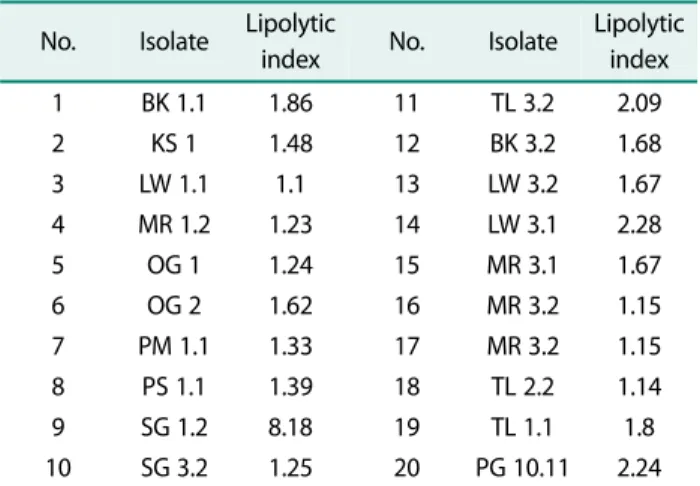
Based on the results, 23 yeast isolates were positive showing lipolytic activity with a clear zone around the colonies. In Table 1, there are 4 isolates with lipolytic index (IL) > 2, such as SG 1.2, TL 3.2, LW 3.1 and PG
10.11 with IL 8.18, 2.09, 2.28 and 2.24, respectively.
Secondary screening. Four isolates from primary screening with IL > 2 (SG 1.2., TL 3.2., LW 3.1. and PG 10.11.) were tested quantitatively to compare the productivity of each isolate on medium containing 1%
glucose and 1% olive oil. Biomass and enzyme activity of each isolate were observed for 3 days and productivity was determined. All experiments were done in triplicate.
The result can be seen in Fig. 1.
The result describes that SG 1.2 and LW 3.1 produce lipase maximum after 48 h incubation, while TL 3.2 and PG 10.11 after 24 h (Fig. 1). SG 1.2 was considered has the highest productivity compared to other isolates, hence it used in the next steps of the study.
Molecular identification
Identification of SG 1.2 was done by ITS 1F and ITS
4R as primers. The temperature program on PCR process are pre-denaturation 95℃ for 3 min, denatur- ation 95℃ for 30 s, annealing 63.5℃ for 1 min, extension 72℃ for 1 min 40 s, and final extension at 72℃ for 1 min 40 s. The phylogenetic tree was constructed using the MEGA 6 program with the Maximum Likelihood method (ML) phylogenetic analysis, Kimura 2-parameter evolution model and 1000x bootstraps replication.
Amplification in the ITS region using ITS 1 and ITS 4 primers resulted in a length of 856 bp. Blast analysis shows that SG 1.2 has the closest identity with Zygosaccharomyces siamiensis and Zygosaccharomyces mellis. The results of the phylogenetic tree reconstruc- tion using the closest species sequence in the BLAST results (Fig. 2) show that SG 1.2 has the closest genetic relationship with Z. mellis LN849131.1. Based on the similarity (Table 2), SG 1.2 has 99.50% similarity with Z. mellis AB302839.1 and 99.37% with Z. mellis LN849131. Based on these findings, it is concluded that SG 1.2 and Z. mellis AB302839.1 and LN849131.1. are the same species with > 99% similarity [18].
Profile of enzyme production
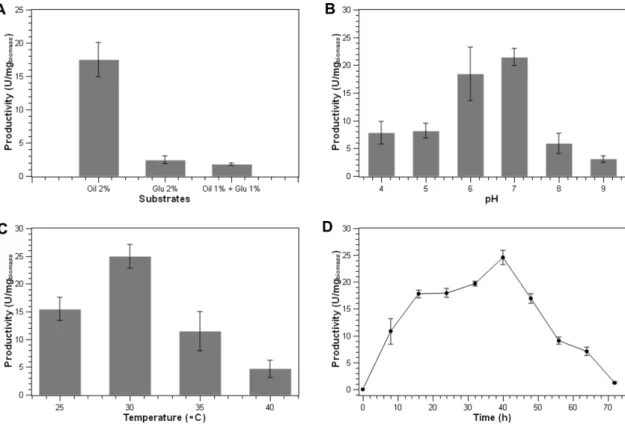
Effect of carbon for enzyme production. Profile produc- tion for the best carbon sources determined by producing lipase using olive oil 2%, glucose 2%, and 1% olive oil + 1% glucose for 48 h. The culture incubated with 200 rpm shaking at room temperature. All experiments were done in triplicate. The result can be seen in Fig. 3A.
Fig. 3A shows 2% olive oil gives a significantly high (p > 0.05) result (17.46 ± 2.59 U/mg biomass) when compared with the other carbon source. Based on this finding, lipase is best produced in medium contains olive Table 1. Lipolytic index of yeast isolates from primary screen-
ing.
No. Isolate Lipolytic
index No. Isolate Lipolytic index
1 BK 1.1 1.86 11 TL 3.2 2.09
2 KS 1 1.48 12 BK 3.2 1.68
3 LW 1.1 1.1 13 LW 3.2 1.67
4 MR 1.2 1.23 14 LW 3.1 2.28
5 OG 1 1.24 15 MR 3.1 1.67
6 OG 2 1.62 16 MR 3.2 1.15
7 PM 1.1 1.33 17 MR 3.2 1.15
8 PS 1.1 1.39 18 TL 2.2 1.14
9 SG 1.2 8.18 19 TL 1.1 1.8
10 SG 3.2 1.25 20 PG 10.11 2.24
Fig. 1. Secondary screening of 4 isolates with IL > 2 (SG 1.2., TL 3.2., LW 3.1. and PG 10.11.) on production medium contain 1% glucose and 1% olive oil as carbon source. Medium was incubated at room temperature for 72 h and harvested every 12 h.
oil as a sole carbon source.
Effect of pH for enzyme production. Optimal produc- tion pH determined by growing isolates on medium con- taining 2% olive oil with a variation of pH (4, 5, 6, 7, 8, 9). The culture incubated with 200 rpm shaking at room temperature. All experiments were done in triplicate.
The result can be seen in Fig. 3B.
Lipase production shows peak at pH 7 (21.45 ± 1.57 U/mg biomass) (Fig. 3B). Production at pH 6 also shows high productivity (18.45 ± 4.82 U/mg biomass). However, it significantly different (p > 0.05) with pH 7. The production in other pH (4, 5, 6, 7, 8, 9) give much lower results.
Effect of temperatures for enzyme production. Optimal temperature determined by growing isolates on 2% olive oil which adjusted to pH 7 in a variation of temperature (25, 30, 35, 40℃). The culture incubated with 200 rpm
shaking at room temperature. All experiments were done in triplicate. The result can be seen in Fig. 3C.
Lipase production shows peak at 30℃ (24.99 ± 2.12 U/
mg biomass) (Fig. 3C). Production at 25℃ also shows high productivity (15.46 ± 2.05 U/mg biomass). However, it significantly different (p > 0.05) with 30℃. The pro- duction in 35 and 40℃ give much lower results, 11.43 ± 3.52and 4.67 ± 1.51 U/mg biomass, respectively.
Production profile in optimum condition. Production profile in the optimum condition determined by growing isolates on medium containing 2% olive oil which adjusted to pH 7. The medium was incubated for 3 days at 30℃ 200 rpm and harvested every 12 h. All experi- ments were done in triplicate. The result can be seen in Fig. 3D.
Fig. 3D shows the highest productivity was obtained at 40 h incubation (24.56 ± 1.30 U/mg biomass) signifi- cantly different (p > 0.05) with others. The productivity of SG 1.2. decreased after 40 h incubation and decreased significantly until 72 h incubation (1.23 ± 0.16 U/mg bio- mass).
Characteristic enzyme
Crude extract partial purification. Partial Purification enzyme was obtained by precipitation using 50% ammo- nium sulphate. The precipitate was obtained by centrif- ugation (14,000 g, 20 min at 4℃). The precipitates were Fig. 2. Phylogenetic tree reconstruction using the MEGA 6 program with the Maximum Likelihood method and 1000x boot- straps replication.
Table 2. The similarity between SG 1.2 and its closest species according to the BLAST result.
Strains Similarity (%) Strains Similarity (%)
KC881075.1 98.22 MH592577.1 98.42
AB302839.1 99.50 AB565768.1 97.83
LN849131.1 99.37 AB565769.1 98.38
KC881076.1 97.99 AM279696.1 88.08
MH592576.1 97.41 LN849132.1 82.44
resuspended in a minimal amount of distilled H2O and dialyzed against distilled water using a successive large volume of H2O. All experiments were done in triplicate.
The result can be seen in Table 3.
Pre-purification was carried out by a 50% concentra- tion of ammonium sulphate precipitation. The protein bound to the ammonium sulphate aggregate was sepa- rated by the dialysis for 19 h. Only 10% of the protein left in the crude extract after the dialysis (Table 3).
Effect of pH for enzyme activity. The effect of pH was determined by measuring lipase activity at different pH ranging from 4 to 10. The pH of the reaction mixture was set using different buffers (citrate buffer for pH 3−5, phosphate buffer for pH 5−7 and borate buffer for pH 7−
9. Lipase specific activity is the ratio of lipase activity (U/
ml) and total protein in enzyme solution (mg/ml). All experiments were done in triplicate. The result can be seen in Fig. 4A.
The optimum lipase activity at pH 6 (43.39 ± 0.29 U/
mg protein). Lipase activity at pH 7 also show a high activity (33.71 ± 2.46 and 34.78 ± 2.83 U/mg protein).
However, it significantly different (p > 0.05) with pH 6.
The production in other pH (3, 4, 5, 8, 9) give much lower results.
Effect of temperatures for enzyme activity. The effect of temperatures was determined by measuring lipase activity at different temperatures (25, 30, 35 and 40℃).
The pH of the reaction was 6 using phosphate buffer.
Lipase specific activity is the ratio of lipase activity (U/
ml) and total protein in enzyme solution (mg/ml). All experiments were done in triplicate. The result can be seen in Fig. 4B.
Fig. 4B shows that lipase activity increases at a tem- perature of 25−35℃ and decreases at a temperature of 40℃. The highest enzyme-specific activity was in the Fig. 3. Effect of environmental condition on lipase production condition by SG 1.2. (A) Effect of carbon source; (B) Effect of pH;
(C) Effect of temperature; (D) Production profile in optimum conditions. Glu: glucose; Oil: olive oil.
Table 3. Partial purification profile.
Methods Relative activity (U/ml)
Total protein (mg/ml)
Specific activity (U/mg) Crude extract 17.92 ± 3.22 5.88 ± 1.31 3.05 ± 0.54 Partial purified
enzyme 18.13 ± 1.85 0.526 ± 0.13 34.47 ± 4.72
reaction of 35℃ (43.45 ± 2.27 U/mg protein). Lipase activity at 30℃ also shows a high activity (43.45 ± 2.27 U/mg protein). However, it significantly different (p > 0.05) with 35℃. The activity at 25, 35 and 40℃ give much lower results (29.37 ± 1.76; 34.99 ± 2.57and 25.20± 1.42 U/mg protein, respectively).
Enzyme stability. The enzyme was incubated at vari-
ous temperatures (25, 30, 35 and 40℃) for 8 h. The reac- tion mixtures were done every 2 h at pH 6 using phosphate buffer 30℃. Lipase specific activity is the ratio of lipase activity (U/ml) and total protein in enzyme solution (mg/ml). All experiments were done in tripli- cate. The result can be seen in Fig. 4C.
Incubation at 25℃ for 6 h maintains 79.91% of enzyme activity, while incubation treatments 35 and 40℃ at 2 h make the enzyme lose more than 50% activity (Fig. 4C).
The incubation at 30℃ removes 25% of enzyme activity.
The incubation at 30℃ for 2 h had the same residual activity as incubation at 25℃ for 6 h with 75% residual activity.
Discussion
Based on the findings above, SG 1.2 was identified as Z. mellis with 99.50% similarity with Z. mellis AB302839.1 and 99.37% with Z. mellis LN849131.1. Z.
siamiensis KC 881075.1 is in a clade with Z. mellis AB302839.1 because both isolate sequences have a 100%
identity with 95% query cover. Based on research by Saksinchai et al. [19], Z. siamiensis can be differentiated from Z. mellis based on sequence analysis of combined ITS-26S rDNA D1/D2. Egli and Henick-Kling [20]
revealed that Z. siamiensis indicated might have hetero- geneous ITS copies so that it had the possibility of being detected as the same species as other species in the Zygosaccharomyces genus. The physical characteristics that distinguish Z. siamiensis and Z. mellis are the abil- ity of Z. siamiensis to assimilate galactose and erythritol and grow at 37℃ as well as in the presence of 16% NaCl and 5% glucose [20].
Zygosacgharomyces mellis is known as an extreme osmophilic yeast and acts as a spoiling agent of high sugar foods and honey. Physiological characteristics that make the yeast particularly problematic include their ability to ferment sugar, osmotolerance, resistance to preservatives, formation of heat-resistant ascospores and fructophily [21−23]. Recent research by Liu et al.
[24] confirmed that Z. mellis tolerated sugar, ethanol, and acid at ranges of 500−700 g/l, 10−12% (v/v), and pH 2.5−4.5, respectively.
No one has reported that the genus Zygosaccharomyces is able to produce lipase. Yeast producing lipases from the Saccharomycetaceae family is dominated by Fig. 4. Effect of environmental factors on the activity of
lipase from SG 1.2. (A) Effect of pH, (B) Effect of temperatures, (C) Enzyme stability in different temperatures.
Candida rugosa. The specific activity of lipase from Saccharomyces cerevisiae is reported at 30 U/ mg after partial purification [25]. Lipase from Candida viswanathii has an activity of 13.9 U/mg, while Candida rugosa produced lipase with a relative activity of 12.15 U/ml, 5.9 U/ml, 7 U/ml [ 26−29].
Zygosacgharomyces mellis SG 1.2 optimally produce lipase with 2% olive oil as sole carbon source. Azeredo et al. [30] reported lipase production will increase with olive oil as a carbon source. Olive oil plays as an inducer for lipase production can induce lipase in high yield obtained by the high content of unsaturated free fatty [31]. According to the literature, the major factor in medium optimization to improve lipase productivity is the type of carbon source since lipases are inducible enzymes [32−35] and generally produced in the presence of lipid such as oil or triacylglycerol as inductor [32]. The synthesis of inducible enzymes probably inhibited at the level of transcription by the addition of glucose [36].
Lotti et al. [36] reported expression lipase profile of Candida rugosa may be changed by different inducers and mediate by lip genes.
Abiotic factors, such as pH and temperature are already well known giving significant influence in enzyme production. Maximum lipase production in this study was obtained in pH 7 at 30℃. It confirms the report by Gupta et al. [13] that lipase from microbes commonly effective in neutral condition. Korbekandi et al. [37] reported that Candida rugosa optimally produce lipase at pH 7. The rapid change in pH may alter the lipase production and may affect the nutrient absorption and growth of microbes [13]. The optimum temperature for lipase production corresponds with the growth tem- perature for lipase [13]. The optimum temperature for lipase enzyme production by following the temperature of the origin of the isolate [12]. Adham and Ahmed [15]
also report A. niger optimally produces lipase at 30℃.
Zygosacgharomyces mellis SG 1.2 productivity at 72 h incubation resembled a sigmoid curve. Olive oil as a sole carbon source used optimally at 40 h incubation and pro- duces optimal amounts of lipase. These findings confirm the reported by del Rio et al. [38] that C. rugosa consume olive oil as a sole carbon source in two stages. First stage related to the glycerol depletion with a little amount of lipase activity, and a second one, associated with the
consumption of the fatty acids and produce a higher amount in 40 h incubation. The declining productivity after 40 h of incubation indicates no more activity because the carbon source has been exhausted [26].
Activity increased from pH 4−6 and showed a decrease in pH 7. This indicates that the lipase activity produced by Z. mellis SG 1.2 had optimum activity at acidic pH.
The optimum enzyme characteristics at pH 6 are thought to contain negatively charged amino acid resi- dues and have a balance between amino acid residues and substrate in acidic conditions. Palmer [39] states that the pH profile of an enzyme is determined based on the amino acid residue possessed by an enzyme. This determines the balance between the degree of ionization of the amino acids possessed by the enzyme and the catalysis reaction substrate. Toida et al. [40], Pera et al.
[1], and Falony et al. [41] state that active lipase-producing microbes at pH 5.5, 6.5 and 6. Saxena et al. [42] reported that lipases produced by microbes showed stability at pH 6−7.5 with stability tolerance at pH 4 to 8.
The optimum enzyme characteristics at 35℃ did not differ much from the optimum temperature of enzyme production at 30℃. Saxena et al. [42] reported that almost all lipase-producing microbes have optimum activity at a temperature of 30−50℃. In his research, Saxena et al. [42] also reported that C. gigenta reaches maximum activity at a temperature of 30−35℃. enzyme activity decreases at 40−45℃ because the enzyme under- goes denaturation. Denaturation at high temperatures caused unfolded enzyme tertiary structures [43, 44].
Incubation at 25℃ for 6 h maintains 80% of enzyme activity, while 35 and 40℃ at 2 h make the enzyme lose more than 50% of its activity. 25℃ is the most optimal storage temperature because, at temperatures of 25℃, enzymes experience inactivation [42]. 30℃ is the optimum temperature produced, but exposure at 30℃ at 2 h incu- bation is considered too hot and can damage hydrogen bonds forming tertiary structures and cause enzymes to decrease activity [43, 45].
Acknowledgments
This study was partly supported by the Final Project Recognition program of Universitas Gadjah Mada (nr. 3002/UN1/DITLIT/DIT-LIT/LT/
2019).
Conflict of Interest
The authors have no financial conflicts of interest to declare.
References
1. Pera LM, Romero CM, Baigori MD, Castro GR. 2006. Catalytic properties of lipase extracts from Aspergillus niger. Food Technol.
Biotechnol. 44: 247-252.
2. Sharma R, Chisti Y, Banerjee CU. 2001. Production, purification, characterization, and applications of lipases. Biotechnol. Adv. 19:
627-662.
3. Christopher LP, Kumar H, Zambare VP. 2014. Enzymatic biodiesel:
Challenges and opportunities. Appl. Energy 119: 497-520.
4. Guldhe A, Singh B, Mutanda T, Permaul K, Bux F. 2015. Advances in synthesis of biodiesel via enzyme catalysis: Novel and sustain- able approaches. Renew. Sustain. Energy Rev. 41: 1447-1464.
5. Atadashi IM, Aroua MK, Aziz ARA, Sulaiman NMN. 2013. The effects of catalysts in biodiesel production: A review. J. Ind. Eng.
Chem. 19: 14-26.
6. Gutarra ML, Godoy MG, Maugeri F, Rodrigues MI, Freire DM.
2009. Production of an acidic and thermostable lipase of the mesophilic fungus Penicillium simplicissimum by solid-state fermentation. Bioresour. Technol. 100: 5249-5254.
7. Veerapagu M, Narayanan DRAS, Ponmurugan K, Jeya KR. 2013.
Screening selection identification production and optimization of bacterial lipase from oil spilled soil. Asian J. Pharm. Clin. Res. 6:
62-67.
8. Elwan SH, el-Hoseiny MM, Ammar MS, Mostafa SA. 1983. Lipase production by Bacillus circulans under mesophilic and osmo- philic conditions: Factor affecting lipase production. G. Batteriol.
Virol. Immunol. 76: 187-99.
9. Fjerbaek L, Christensen KV, Norddahl B. 2009. A review of current state of biodiesel production using enzymatic transesterification.
Biotechnol Bioeng. 102: 1298-1315.
10. Leung DYC, Wu X, Leung MKH. 2010. A review on biodiesel pro- duction using catalyzed transesterification. Appl. Energy 87:
1083-1095.
11. Kuntadi, K. 2008. Perkembangan koloni Apis mellifera L. yang diberi tiga formula kedelai sebagai pakan buatan pengganti ser- buksari. J. Penelitian Hutan dan Konservasi Alam 5: 367-379.
12. Prihartini M, Ilmi M. 2018. Karakterisasi dan klasifikasi numerik khamir dari madu hutan Sulawesi Tengah. J. Mikologi Indonesia 2: 112-128.
13. Gupta R, Gupta N, Rathi P. 2008. Bacterial lipases: An overview of production, purification and biochemical properties. Appl. Microbiol.
Biotechnol. 64: 763-781.
14. Zusfahair, Setyaningtyas T, Fatoni A. 2010. Isolasi, pemurnian dan karakterisasi lipase bakteri hasil skrining dari tanah tempat pem- buangan akhir (TPA) gunung Tugel Banyumas. J. Natur Indonesia 12: 124-129.
15. Adham NZ, Ahmed EM. 2009. Extracellular lipase of Aspergillus
niger NRRL3; production, partial purification and properties. Ind.
J. Microbiol. 49: 77-83.
16. Kwon DY, Rhee JS. 1986. A simple and rapid colorimetric method for determination of free fatty acids for lipase assay. J. Am. Oil Chem. Soc. 63: 89-92.
17. Bradford MM. 1976. A rapid and sensitive method for the quanti- tation of microorganisms quantities of protein in utilizing the principle of protein‐dye binding. Anal. Biochem 72: 248‐254.
18. Gaskell GJ, Carter DA, Britton WJ, Tovey ER, Benyon FHL, Lovborg, Y. 1997. Analysis of the internal transcribed spacer regions of ribosomal DNA in common airborne allergenic fungi. Electro- phoresis 18: 1567-1569.
19. Saksinchai S, Suzuki M, Chantawannakul P, Ohkuma M, Lumyong S. 2012. A novel ascosporogenous yeast species, Zygosaccharomyces siamensis, and the sugar tolerant yeasts associated with raw honey collected in Thailand. Fungal Divers. 52: 123-139.
20. Egli CM, Henick-Kling T. 2001. Identification of Brettanomyces/
Dekkera species based on polymorphism in the rRNA internal transcribed spacer region. Am. J. Enol. Vitic. 52: 241-247.
21. James SA, Stratford M. 2003. Spoilage yeasts with emphasis on the genus Zygosaccharomyces, pp. 171-191. In Boekhout T, Robert V (eds), Yeasts in food: Beneficial and detrimental aspects. Behrs Verlag, Hamburg.
22. Steels H, Bond CJ, Collins MD, Roberts IN, Stratford M, James SA.
1999. Zygosaccharomyces lentus sp. nov., a new member of the yeast genus Zygosaccharomyces Barker. Int. J. Syst. Bacteriol. 49:
319-327.
23. Steels H, James SA, Bond CJ, Roberts IN, Stratford M. 2002.
Zygosaccharomyces kombuchaensis: the physiology of a new species related to the spoilage yeasts Zygosaccharomyces lentus and Zygosaccharomyces bailii. FEMS Yeast Res. 2: 113-121.
24. Liu G, Tao C, Zhu B, Bhai W, Zhang L, Wang Z, et al. 2016. Identifi- cation of Zygosaccharomyces mellis strains in stored honey and their stress tolerance. Food Sci. Biotechnol. 25: 1645-1650.
25. Kumar KD, Usha KY, Swamy SV, Sailaja SV. 2014. Characterization of partially purified lipase from Saccharomyces cerevisiae. Int. J.
Pharm. Pharm. Sci. 6: 514-517.
26. Dalmau E, Montesinos J, Lotti M, Casas C. 2000. ffect of different carbon sources on lipase production by Candida rugosa. Enzyme Microb. Technol. 26: 657-663.
27. de Morais WG, Kamimura ES, Ribeiro EJ, Pessela BC, Cardoso VL, de Resende MM. 2016. Optimization of the production and char- acterization of lipase from Candida rugosa and Geotrichum can- didum in soybean molasses by submerged fermentation. Protein Exp. Purif. 123: 26-34.
28. de Almeida AF, Tauk-Tornisielo SM, Carmona EC. 2013. Acid lipase from Candida viswanathii: Production, biochemical properties, and potential application. Biomed. Res. Int. 2013: 435818.
29. Valero F, del Río JL, Poch M, Solà C. 1991. Fermentation behaviour of lipase production by Candida rugosa growing on different mixtures of glucose and olive oil. J. Ferment. Bioeng. 72: 399-401.
30. Azeredo LAI, Gomes PM, Sant’ana JR, Castilho LR, Freire DMG.
2007. Production and regulation of lipase activity from Pennicl-
lium restrictum in submerged and solid state fermentations. Curr.
Microbiol. 54: 361-365.
31. Gunstone FD, Hamilton RJ, Padley FB, Ilyas-Qureshi, M. 1965.
Glyceride studies: V. The distribution of unsaturated acyl groups in vegetable triglycerides. J. Am. Oil Chem. Soc. 42: 965-970.
32. Li CY, Cheng CY, Chen TL. 2004. Fed-batch production of lipase by Acinetobacter radioresistens using Tween 80 as carbon source.
Biochem. Eng. J. 19: 25-31.
33. Lima VMG, Krieger N, Sarquis MIM, Mitchell DA, Ramos LP, Fontana JD. 2003. Effect of nitrogen and carbon sources on lipase production by Penicillium aurantiogriseum. Food Technol.
Biotechnol. 41: 105-110.
34. Treichel H, de Oliveira D, Mazutti MA, di Luccio M, Oliveira JV.
2010. A review on microbial lipases production. Food Bioproc.
Tech. 3: 182-196.
35. Wang D, Xu Y, Shan T. 2008. Effects of oils and oil-related sub- strates on the synthetic activity of membrane-bound lipase from Rhizopus chinensis and optimization of the lipase fermentation media. Biochem. Eng. J. 41: 30-37.
36. Lotti M, Monticelli S, Montesinos JL, Brocca S, Valero F, Lafuente J.
1998. Physiological control on the expression and secretion of Candida rugosa lipase. Chem. Phys. Lipids 93: 143-148.
37. Korbekandi H, Abedi D, Pourhossein M, Motovali-Bashi M, Hejazi
M, Narimousaei M, Kabiri M. 2008. Optimisation of Candida rugosa lipase esterase activity. Biotechnology 7: 112-117.
38. del Rio JL, Serra P, Valero F, Pooh M, Sola C. 1990. Reaction scheme of lipase production by Candida rugosa growing on olive oil. Biotechnol. Lett. 12: 835-838.
39. Palmer T. 1991. Understanding enzyme, pp. 192-193. 3rd Ed. Ellis Horwood, New York.
40. Toida J, Akirawa Y, Kondou K, Fuusawa M, Sekiguchi J. 1998. Puri- fication and characterization of triacylglycerol lipase from Aspergillus oryzae. Biosci. Biotechnol. Biochem. 62: 759-763.
41. Falony G, Armas JC, Mendoza JCD, Hernández JLM. 2006. Produc- tion of extracellular lipase from Aspergillus niger by solid-state fermentation. Food Technol. Biotechnol. 44: 235-240.
42. Saxena RK, Ghosh PK, Gupta R, Davidson WS, Bradoo S, Gulati R.
1999. Microbial lipases: Potential biocatalysts for the future industry. Curr. Sci. 77: 101-115.
43. Daniel RM, Dines M, Petach HH. 1996. The Denaturation and deg- radation of stable enzymes at high temperatures. Biochem. J.
317: 1-11.
44. Matthew CR. 1993. Pathways of protein folding. Annu. Rev. Biochem.
62: 653-683.
45. Ward OP, Qin WM, Dhanjoon J, Ye J, Singh A. 2006. Physiology and biotechnology of Aspergillus. Adv. Appl. Microbiol. 58: 1-75.